Nuclear power proponents still scoffing at public safety concerns
An Otsu District Court injunction has suspended operations of two reactors at Kansai Electric Power Co.’s Takahama nuclear power plant in Fukui Prefecture, one of which was online.
Again, the significance of that development should be taken to heart. Proponents of nuclear power, in particular, should squarely face up to the public anxiety that lies in the backdrop of the court decision. But instead they are boiling with disgruntlement.
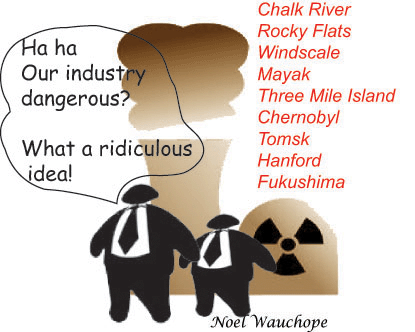 “Why is a single district court judge allowed to trip up the government’s energy policy?” Kazuo Sumi, a vice chairman of the Kansai Economic Federation, said resentfully.
“We could demand damages (from the residents who requested the injunction) if we were to win the case at a higher court,” Kansai Electric President Makoto Yagi said, although he prefaced his remark with a proviso that he is arguing only in general terms.
The government is maintaining a wait-and-see attitude.
The decision called into question the appropriateness of the Nuclear Regulation Authority’s new regulation standards and government-approved plans for evacuations in case of an emergency.
But NRA Chairman Shunichi Tanaka argued, “Our standards are nearing the world’s top level.”
And the government has no plans to review its emergency evacuation plans. It has only reiterated that it will “proceed with restarts of nuclear reactors in paying respect to NRA decisions.”
The Otsu decision is the third court order issued against the operation of nuclear reactors since the meltdowns five years ago at Tokyo Electric Power Co.’s Fukushima No. 1 nuclear power plant.
There has, in fact, been no fixed trend in court decisions. Another court rejected residents’ request last year for an injunction against reactor restarts at Kyushu Electric Power Co.’s Sendai nuclear plant in Kagoshima Prefecture.
But courts appear to be playing a more active role now than before the Fukushima disaster.
The nuclear proponents’ reactions reveal an underlying thinking: “The use of nuclear power is indispensable for Japan, which does not abound in energy resources. The government set up the NRA following the Fukushima disaster to increase expert control. Regional utilities have also taken safety enhancement measures. Courts are therefore asked not to meddle.”
But they should have a deeper understanding that this argument is no longer convincing to the public and court judges.
Some critics say the latest decision deviated from the 1992 Supreme Court ruling saying that decisions on the safety of nuclear plants should be made by administrative organs on the basis of expert opinions. But that argument is also off the mark.
The ruling, given in a case over Shikoku Electric Power Co.’s Ikata nuclear plant, certainly presented that point of view. But it also stated that the objective of safety regulations based on the Law on the Regulation of Nuclear Source Material, Nuclear Fuel Material and Reactors is to “make sure that no serious disaster will happen by any chance.”
A safety net, left in the hands of experts, collapsed all too easily during the Fukushima disaster, turning the phrase “by any chance” into reality.
Courts, which are the guardians of law, should rather be commended for trying to find out independently, to the extent that they can, if there is enough preparedness when a nuclear reactor will be restarted.
The latest alarm bell sounded by the judiciary sector provides an opportunity to ask once again why all the safety measures taken after the Fukushima nuclear disaster are still struggling to win the trust of the public.
The Fukushima disaster changed the awareness of the public. The judiciary sector was also affected.
It is high time for a change among nuclear proponents.
Radiation in seafood. Is that why California bans commercial crab fishing?

 California bans commercial crab fishing due to excessive radiation in seafood, March 27, 2016 by: David Gutierrez, staff writer NaturalNews In November of last year, California state officials placed an indefinite hold on the commercial crab season, in order to protect public health. The reason given by the state was dangerously high levels of algal toxins in the bodies of the crabs.
But according to New York radio station 95.1 FM (SuperStation 95), insiders from the California Fish and Game Commission have revealed that the real reason for the ban was dangerously high levels of radioactivity resulting from the 2011 Fukushima nuclear disaster.
Radioactive crab are so dangerous to eat that state officials felt the need to protect the public, Superstation 95 reports. But officials were unwilling to publicly admit the true reason for the ban, which contradicts official claims that the Fukushima disaster poses no threat to the U.S. West coast………..
“If people started connecting the dots proving radiation in seafood was making them sick, it would utterly destroy California’s seafood industry in days,” SuperStation 95 quotes the sources as saying………
The crab are not the first West Coast seafood to be reported radioactive. A recent study found that 100 percent of Pacific bluefin tuna tested off the coast of California contained radioactive materials from the Fukushima disaster.
Among the radioactive isotopes already detected off the U.S. west coast is strontium-90, which mimics calcium in the human body and therefore accumulates in the bones. There it can cause cancers of the bone and blood.
Sources for this article include:
SFChronicle.com http://www.naturalnews.com/053440_California_crab_season_radioactive_ocean.html#ixzz44MERWbgz.
Fukushima: Where mountains and forests cannot be decontaminated

In the background, workers in Iitate village go about their daily routine of removing the layer of irradiated topsoil, which are then placed in stacks of black bags
FUKUSHIMA, JAPAN – Up to 20,000 workers have been toiling to decontaminate towns and villages to clear the way for evacuated residents to return following the Fukushima nuclear plant disaster.
In head-to-toe protective gear, their primary task is removing by shovel and machinery topsoil contaminated with radioactive caesium, which leaked from the crippled power station when a tsunami swamped it five years ago.
The soil is put into plastic flexible container bags and transported by truck to isolated temporary storage sites, where they are surrounded with bags of clean soil to “seal” off emitted radiation. The interim facilities will receive some 22 million cubic m of soil from 43 cities, towns and villages across Fukushima prefecture. It will be put there for 30 years.
Soil under trees, in roadside ditches and places such as drain spouts get particular attention. This is where the radioactive pollutants tend to concentrate after being washed off roofs and pavements by rain and snow.

Once considered among the most beautiful villages in Japan, the farmlands of Iitate are now dotted with black bags – called ‘flexible container bags’ – holding contaminated soil.
The cleanup process also includes brushing and wiping rust or stains from roofs, removing sediment, washing roadside ditches and removing leaves from under trees.
But there remains a sizeable area where decontamination was suspended due to high radiation levels, including Futaba district, where the power plant is located.
The disaster also contaminated vast amounts of paddy straw and grass with radioactive material. This has led to plans for facilities for “designated waste”, which from Fukushima alone accounts for around 140,000 tonnes. It is now temporarily stored on farmland and at waste incineration plants.
The radiation reality will last for years to come.
“While it is possible to decontaminate residential areas, the same cannot be done with mountains and forests. You can’t remove all the trees. But radioactive matter has contaminated trunks and leaves, and when rain falls, these particles return to the ground,” said Ms Emiko Fujioka, secretary-general of non-profit group Fukushima Beacon.
Climate action must be fast tracked
 https://www.project-syndicate.org/commentary/focus-on-reducing-short-lived-climate-pollutants-by-achim-steiner-and-christiana-figueres-2016-03 ACHIM STEINERAchim Steiner is United Nations Under-Secretary-General and Executive Director of the UN Environment Programme (UNEP). CHRISTIANA FIGUERES Christiana Figueres is Executive Secretary of the United Nations Framework Convention on Climate Change (UNFCCC). BONN –
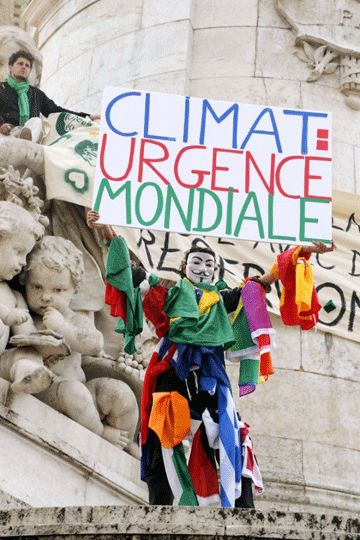
Last December in Paris, world leaders came together to agree on a set of goals and pathways for decarbonizing the global economy and increasing our capacity to adapt to climate change. It was a landmark achievement, but it was just the beginning. Every country – with the support of cities, the private sector, and citizens – must now move swiftly to fulfill its promises and bring climate change under control.
The need for urgent, concerted action cannot be emphasized enough. Any delay will cause negative consequences to continue to accumulate. This will not only cause tremendous suffering, especially to the world’s most vulnerable people; it will reverberate for decades to come, making the key goal of keeping the increase in global temperature below 2º Celsius (relative to pre-industrial levels) increasingly costly.
South Africa and the madnessof its nuclear build programme
 The madness of the nuclear build programme http://www.rdm.co.za/politics/2016/03/29/the-madness-of-the-nuclear-build-programme
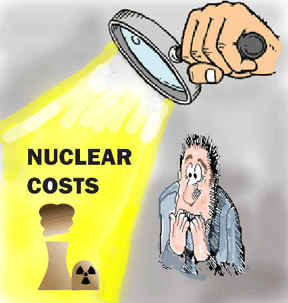
Nuclear vendors are loathe to submit to a competitive tendering process based on a long-term, fixed-priced contract ANTON EBERHARD 29 MARCH 2016 IT IS time for the gloves to come off. The onus is on those who support the procurement of nuclear power stations to demonstrate that this initiative is not corrupt and will not be ruinous for the economy.
We face a possible credit rating downgrade to junk, which will make us all poorer: it will cost a lot more to service our debt, there will be less money for social programmes, the rand will fall even further, and inflation will rise.
Yet some still promote a huge nuclear programme that is not needed, that is more expensive and risky than alternative energy sources, that is hard to finance, and that will create contingent liabilities for the Treasury when we can least afford them.
SA does not need to procure large chunks of new power now. Electricity demand is not growing: it’s falling, and is lower than it was a decade ago. Depressed economic activity is partly the reason, but it’s not the most important one.
Electricity and economic growth data no longer track each other. The size of SA’s economy has continued to increase, albeit slowly, but electricity consumption has headed in the opposite direction. Countries such as Australia have seen a similar decoupling of energy and economic growth.
Could electricity demand in SA rebound if economic growth revives? Do we need to cater for depressed electricity demand as a result of Eskom supply constraints? Possibly. But we also need to recognise that there are profound changes to the energy-intensity of our economy, as smelters and mines close. The structure of our economy is changing. A fourfold increase in electricity prices in the past decade has accelerated energy-efficiency investments and energy conservation.
Official electricity demand forecasts and plans are obsolete. If demand for electricity were to reignite, it would fire off a lower base, and the rate of growth would be lower. When we project demand forward to 2030 or beyond, it’s obvious that we need a lot less power than was forecast in the Integrated Resource Plan of 2010 (the basis for the 9600MW nuclear commitment).
But we also need to replace old coal power plants, and compensate for the decline in the performance of Eskom’s existing power stations. I’ve taken all these arguments into account, and calculate that we need about 17GW of new electricity generating capacity by 2030. Some may calculate a slightly different number, but the required capacity will be close to this.
We have already ordered more power than we need by 2030. The new Eskom Medupi and Kusile coal power stations will add 9.6GW; its Ingula pumped storage scheme, 1.3GW. Two peaking power stations — Desisa and Avon, ordered by the Department of Energy — will add 1GW.
Contracted industrial co-generation and the department’s coal independent power producers (IPPs) will each add 1GW, with plans for more. In addition, 92 projects, totalling 6,347MW, have been contracted in the first four rounds of the department’s renewable energy IPP programme. Granted, this is intermittent power and will need to be complemented by gas power plants that the department plans to procure this year. More than 3GW are in the pipeline.
In the meantime, SA has negotiated 2.5GW of hydro power from the Inga 3 development in the Democratic Republic of Congo, and is considering further hydro imports from the region.
Together, these power procurements exceed what we need in the next 15 years.
Our cheapest sources of power are now wind and solar energy. The Department of Energy has awarded long-term, fixed-price contracts for wind energy as low as 57c/kWh, far below Eskom’s average cost of supply. Renewable energy combined with gas power can offer reliable base load supply at less than R1/kWh. Imported hydro and coal IPPs will also beat this.
I challenge any nuclear power vendor to sign a long-term power contract at less than R1/kWh. Whenever I ask them what nuclear power will cost in the country, they say “it depends”, and “it will need to be negotiated”.
This is the point: nuclear vendors are loathe to submit to a competitive tendering process based on a long-term, fixed-priced contract in which they take the risks of construction time and cost overruns. But all the other energy technology providers are prepared to do so. This has been the basis of the success of the IPP programme that has delivered such spectacular investment outcomes and price certainty for consumers. So why would we opt for a nuclear procurement programme that aims only to select a strategic partner, with subsequent price negotiations that have uncertain outcomes?
Nuclear power plants are also hard to finance. A couple of years ago in Davos, President Jacob Zuma was asked how 9,600MW of nuclear power would be financed. His answer, remarkably, was: “I’ll speak to my finance minister.”
He would have had that conversation by now and it will be clear that there is no fiscal space to finance a programme that will cost more than a half-a-trillion rand, when we raise just more than a trillion rand annually in taxes to fund all SA’s needs. Debt financing is now the fastest-growing component of the national budget and interest payments are more than twice the spend on higher education.
Our traditional mechanisms for funding power investments are also constrained. Eskom’s balance sheet is stressed, and it is struggling to raise sufficient debt on private capital markets to complete Medupi and Kusile. It has no possibility of raising finance for even one nuclear power station.
The private sector will not finance a nuclear plant in SA. The only possibility is funding from nuclear vendor countries. France will struggle: its nuclear company, Areva, is technically bankrupt and its latest UK nuclear contract — at £92.50/MWh (R2/kWh) — would be unaffordable for us.
Russia will not be able to finance all of its nuclear ambitions. China is a possibility, but financing will need to be backed by a long-term contract with an agreed electricity tariff, and the government will have to provide a sovereign guarantee and insurance cover, which will add contingent liabilities to the Treasury that will hasten a credit rating downgrade.
Eskom’s management recently expressed interest in further investments in large coal and nuclear projects. Its big coal, big nuclear, and big networks strategy is Neanderthal. Why would SA want to go down this route? It’s irrational. SA’s economic situation is precarious. The government now needs to act in concert and remove uncertainty about this nuclear folly. We don’t need it, it is too expensive, and we cannot afford it.
• Eberhard is a professor at the University of Cape Town’s Graduate School of Business
Solar power – on its way to taking over the world energy scene
 Is solar set to take over the world? https://www.weforum.org/agenda/2016/03/is-solar-set-to-take-over-the-world Keith Breene, Senior Writer It’s the largest power plant of its kind. Built in the Moroccan desert, the $765 million Noor-Ouarzazate complex is set to power over a million homes.
Even a few years ago, a project of this scale in the North African desert would almost certainly have been an oil or gas power station. But the Noor-Ouarzazate complex runs on the power of the sun.
It is a sign of how far solar power has come that such large infrastructure projects are now being built. That the scheme was partly funded through a loan from theWord Bank also shows how solar is becoming mainstream.
What’s behind the growth in solar?
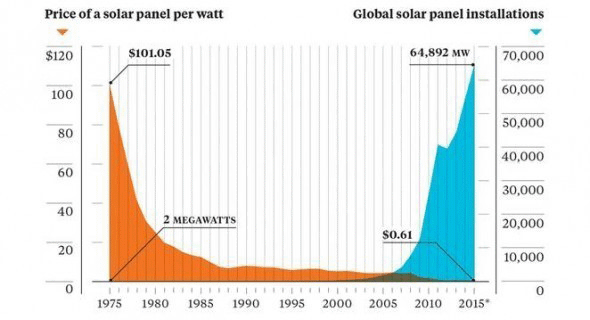
Of course, concern over the use of fossil fuels and global warming is a large part of solar’s current success. But the reason it is doing quite so well, quite so quickly really comes down to price.
The cost of power generated by solar has plummeted to the point where, in many parts of the world, it is now close to coal or gas generated electricity.
Source: Earth Policy Institute/Bloomberg
The more solar grows, the cheaper it becomes to manufacture solar panels, and the virtuous cycle continues.
But it’s not just that solar is becoming cheaper – it’s also that fossil fuel generation is becoming more expensive. That’s because once a solar or wind project is built, the marginal cost of the electricity it produces is almost nothing, whereas coal and gas plants require more fuel for every new watt produced. Power companies will choose the free power whenever they can, which means less is required from the fossil fuel power stations and the marginal cost of their power rises.
It’s a self-reinforcing cycle. As more renewables are installed, coal and natural gas plants are used less. As coal and gas are used less, the cost of using them to generate electricity goes up. As the cost of coal and gas power rises, more renewables will be installed.
BNEF reports that in every major region of the world, the lifetime cost of new coal and gas projects rose considerably in the second half of 2015, while the cost of renewables continued to fall.
How can we solve the problem of storing solar energy?
One of the problems with solar power is, of course, that it’s only there during the daytime. This has been used as an argument for keeping fossil fuel generation for the “base load” generation needed 24 hours a day.
But even this is changing. The Noor-Ouarzazate complex is not a photovoltaic power plant. Instead it uses concentrated solar power (CSP), which holds vast potential due to its ability to provide reliable power even when the sun is not shining.
Hundreds of mirrors focus the sun’s energy to heat a fluid that is used to produce steam that drives turbines to generate electricity. The fluid can also be used to heat molten salts stored in large storage tanks on site. The salt stays hot enough to generate steam even after the sun has gone down.
It is such a promising technology that the International Energy Agency estimatesthat up to 11% of the world’s electricity generation in 2050 could come from CSP.
What about batteries?
Another major change is rapidly improving battery technology. Alreadyhouseholds can buy battery packs for their solar panels, and the cost of these is expected to reduce significantly over the next few years.
Entrepreneur Elon Musk reckons that the entire world’s electricity demands could be met with around 2 billion large batteries.
What if it’s not very sunny?
It is easy to see why Morocco might look to solar to meet its energy needs. The same goes for many other hot and sunny parts of the world. But is solar really workable elsewhere?
For the answer to that, take a look at Germany. Hardly famous for its year-round sun, the northern European nation has nevertheless led the world in solar generation.
Germany has the capacity to generate over a third of its electricity from solar and in the summer of 2014 even managed to briefly generate over half of its power this way. Germany shows us that solar is not just a technology for the sun-drenched parts of the world.
Solar isn’t the only answer to the world’s energy needs, but it has much to offer. As the cost falls and the energy market is further disrupted, solar energy is set to play a huge part in meeting our global energy needs.
Nuclear power plants: all ready to be used by enemies, as weapons of war
Nuclear Power Plants: Pre-Deployed WMDs, CounterPunch 28 Mar 16, by KARL GROSSMAN Pre-deployed weapons of mass destruction.
That’s what nuclear power plants are. And that’s another very big reason—demonstrated again in recent days with the disclosure that two of the Brussels terrorists were planning attacks on Belgian nuclear plants—why they must be eliminated.
Nuclear power plants are sitting ducks for terrorists. With most positioned along bays and rivers because of their need for massive amounts of coolant water, they provide a clear shot. They are fully exposed for aerial strikes.
The consequences of such an attack could far outweigh the impacts of 9/11 and, according to the U.S. 9/11 Commission, also originally considered in that attack was the use of hijacked planes to attack “unidentified nuclear power plants.” The Indian Point nuclear plants 26 miles north of New York City were believed to be candidates…….

a main mission of the IAEA, ever since it was established by the UN in 1957 has been to promote nuclear power. It has dramatically minimized the consequences of the catastrophic accidents at Chernobyl and Fukushima and routinely understated all problems with atomic technology.
The “Nuclear Security Summit,” with the IAEA playing a central role, is part of a series of gatherings following a speech made by President Barack Obama in Prague in 2009 in which he said “I am announcing a new international effort to secure all vulnerable nuclear material around the world.”……..
Like the IAEA—formed as a result of a speech by U.S. President Dwight Eisenhower promoting “Atoms for Peace” at the UN—officials involved with nuclear power in the U.S. government and the nation’s nuclear industry have long pushed atomic energy and downplayed problems about nuclear power and terrorism.
As the Union of Concerned Scientists (UCS) says in its “Nuclear Security” statement, “The adequacy of a security system depends on what we think we are protecting against. If we have underestimated the threat, we may overestimate our readiness to meet it. The NRC [U.S. Nuclear Regulatory Commission] has sometimes used unrealistically modest assumptions about potential attackers. The design basis threat (DBT) is the official definition of the security threats power plant management is required to protect against….After 9/11, UCS criticized the DBT for nuclear plants on these grounds, among others.”
UCS says the NRC “ignored the possibility of air-and water-based attacks…it did not address the possibility of large attacking groups using multiple entry points, or of an attack involving multiple insiders…it concentrated on threats to the reactor core, failing to address the vulnerability of spent fuel storage facilities.” Since 2011, says the UCS, the NRC “finally revised its rules to address the threat of aircraft attack for new reactor designs—but at the same time has rejected proposed design changes to protect against water- and land-based attacks.”
There is “also concern about the testing standard used,” notes UCS. “In July 2012, the NRC adopted the new process. However, as a result of industry pressure, the standards were watered down..”
Further, says UCS, testing is “currently required only for operating reactors, leaving questions about the adequacy of protection against attacks on reactors that have shut down, but still contain radioactive materials that could harm the public if damaged.”
 A pioneer in addressing how nuclear power plants are pre-deployed weapons of mass destruction has been Dr. Bennett Ramberg. As he wrote in his 1980 landmark book, Nuclear Power Plants as Weapons for the Enemy: An Unrecognized Military Peril, despite the “multiplication of nuclear power plants, little public consideration has been given to their vulnerability in time of war.”
As he writes in a piece in the current Foreign Affairs, “Nuclear Power to the People: The Middle East’s New Gold Rush,” spotlighting the push now by many nations in the Middle East to build nuclear power plants, “Whatever the energy promise of the peaceful atom, evidently lost in the boom are the security risks inherent in setting up reactors in the Middle East—and not just the commonly voiced fear that reactors are harbingers of weapons. The real risk is the possibility that the plants themselves will become targets or hostages of nihilist Middle East militants, which could result in Chernobyl and Fukushima-like meltdowns.”
“Given the mayhem that Islamic State (also called ISIS) and kindred groups have sown in the region and their end-of-days philosophy, the plausibility of an attempted attack on an operating nuclear power plant cannot be denied,” writes Ramberg.
In fact, the plausibility of an attempted attack cannot be denied in the Middle East—or anywhere in world…..http://www.counterpunch.org/2016/03/28/nuclear-power-plants-pre-deployed-wmds/
Donald Trump’s terrifyingly dangerous policies on nuclear weapons proliferation
 Trump’s nuclear views are terrifying , USA Today, Mira Rapp-Hooper March 29, 2016
He’d ditch ‘predictable’ U.S. policies that have kept nuclear arms races in check for decades. The contours of Donald Trump’s foreign policy are becoming disturbingly clear. Newspapers have labeled his thinking on international affairs “isolationist” and “unabashedly non-interventionist,” yet those terms fail to capture the more alarming elements of his philosophy. Trump apparently is prepared to abandon the United States’ most important alliances, even at the risk of those countries acquiring nuclear weapons. In other words, he is prepared to end the decades-long U.S. policy of extended deterrence — protecting close partners against nuclear attack and thereby limiting the spread of nuclear weapons. Moreover, the presidential candidate gives little indication that he understands the implications of these radical policies for global security and stability.
One theme running through Trump’s foreign policy is his disdain for U.S. alliances and allies. In recent news media interviews, he has called U.S. treaties “one-sided,” labeled NATO “obsolete” and repeatedly called on South Korea and Japan to contribute more to U.S. basing costs overseas. Trump appeared surprised in a New York Times interview to learn that allies do pay a substantial portion of U.S. overseas basing costs, with none more supportive than Japan. Yet he also seemed unmoved by this information, insisting that allies should pay no less than a full 100% of U.S. overseas costs. A refusal to do so would force a President Trump to begin withdrawing troops, he told The Times. When told this might cause South Korea and Japan to acquire their own nuclear weapons, Trump demonstrated a flippant comfort, stating that the U.S. “may very well be better off.”
It hardly bears noting that abandoning U.S. treaty commitments and acquiescing to nuclear proliferation are completely at odds with decades of U.S. foreign policy……..
To understand why Trump’s views on extended deterrence are terrifying, one must examine his other positions on nuclear policy and strategy. In a December GOP debate, the candidate appeared to be unfamiliar with the nuclear triad, made up of the intercontinental ballistic missile, submarine-launched ballistic missiles, and bombers that can deliver nuclear weapons to their targets. Just days ago, he refused to rule out the use of a nuclear weapons against the Islamic State terrorist group. ……….
Perhaps most unsettling, Trump repeatedly insists that the United States must be more “unpredictable” in its national security policy — a chilling assertion, particularly when uttered in such close proximity to such irresponsible nuclear policies. Trump’s naiveté about the world’s most dangerous weapons leads one to infer that he might not have considered the fact that a nuclear Japan and South Korea could lead to dangerous arms racing with China and North Korea, proliferation by other states in East Asia and regional instability that invites major crises……..
this prospective commander in chief’s views are not just irresponsible: They are cataclysmically dangerous.
Mira Rapp-Hooper is a senior fellow with the Asia-Pacific Security Program at theCenter for a New American Security. Her Ph.D. dissertation, “Absolute Alliances,” was on the role of extended deterrence in international politics. http://www.usatoday.com/story/opinion/2016/03/29/donald-trump-nuclear-weapons-treaties-nato-terrifying-column/82341964/
China’s move towards renewable energy power on the grid: new high voltage transmission lines

 China pushes for mandatory integration of renewable power, Reuters, 28 Mar 16, BEIJING China has ordered power transmission companies to provide grid connectivity for all renewable power generation sources and end a bottleneck that has left a large amount of clean power idle, the country’s energy regulator said on Monday.
The grid companies have been ordered to plug in all renewable power sources that comply with their technical standards, the National Energy Administration (NEA) said.
China’s power is primarily delivered by the State Grid Corp of China [STGRD.UL] and the China Southern Power Grid Co [CNPOW.UL], with the latter responsible for delivering electricity in five southern provinces and regions.
China has become the world’s biggest wind and solar power user, but a large amount of renewable power has not been able to reach the grid because transmission capabilities are lagging generating capacity by around three to five years.
The State Grid is banking on building new ultra-high voltage (UHV) long-distance transmission lines to fill the gap. “The construction of UHV lines are to help with cross-regional power delivery,” said Wang Yanfang, a State Grid spokeswoman, referring to the need to deliver power from remoter regions to energy-hungry eastern China…….http://www.reuters.com/article/us-china-power-renewables-idUSKCN0WU0RF
All about the terrorists’ plan to attack Belgium’s nuclear power station
 Reuters: Bombers “switched target from nuke plant at last minute” — Report: Terror cell plotted to blow up nuclear plant… Threat of “most devastating terror attack in history” — Murder of nuclear worker increasing fear of more attacks — Police worry other cells “poised to unleash further terror” (VIDEOS) http://enenews.com/reuters-terrorists-switched-target-nuke-plant-last-minute-tv-bombers-planned-nuclear-power-plant-attack-murder-nuclear-security-guard-increases-fear-attacks-cbs-chilling-development-sparked-w?utm_source=feedburner&utm_medium=email&utm_campaign=Feed%3A+ENENews+%28Energy+News%29
The Independent, Mar 25, 2016 (emphasis added): Brussels bombings: Terror group ‘were planning to attack nuclear power station’, surveillance suggests — The Brussels bombers were allegedly planning to attack a nuclear power plant and had recorded 10 hours of surveillance footage of Belgium’s nuclear power chief, it has been reported… It is believed they may have been spying on the director as part of a possible kidnap plan to make him help them get into a plant, Belgian newspaper La Derniere Heure reports.
The Australian, Mar 26, 2016: Brussels: jihadists ‘planned attack’ on nuclear plant — Suicide bombers who blew themselves up in Brussels were reportedly originally considering an attack on a Belgian nuclear site, but arrests last week may have forced them to switch to targets in the nation’s capital… Police fear that at least two people directly linked to the Brussels bombings are at large and that other cells of terrorists are poised to unleash further terror.
Reuters, Mar 25, 2016: Attackers switched target from nuke plant at last minute, says paper
Reuters, Mar 24, 2016: Suicide bombers who blew themselves up in Brussels were originally considering an attack on a nuclear site in Belgium, but arrests started last week may have forced them to switch to targets… “Even if one couldn’t prevent these (Brussels) attacks, one can say that their magnitude could have been much bigger if the terrorists had been able to implement their original plan and not opted for easier targets,” said the police source.
Time, Mar 25, 2016: ISIS Attackers May Have Targeted Nuclear Power Station… A Belgiannuclear power plant may have been the target of an aborted plot by the ISIS cell that carried out this week’s terrorist attacks in Brussels… [There are] fears that an “insider” might offer access to terrorists… ISIS actually had a follower inside the Doel plant…
FOX 5 NY, Mar 24 2016: Report: Brussels bombers planned nuclear power plant attack… The newspaper Derniere Heure report that the ISIS cell was spying on the head of the Belgian nuclear program to possibly kidnap him to force their way into an atomic facility…
New Zealand Herald, Mar 26, 2016: 11 nuclear power plant workers have had their site access revoked amid fears of “insider help”…
CBS News, Mar 24, 2016: Brussels suspects linked to nuclear facility plot… It also emerged Thursday that the brothers were part of a plan uncovered earlier this year to try and target a Belgian nuclear facility… In light of that ISIS surveillance earlier this year, CBS News senior national security analyst Juan Zarate called the evacuation order for Belgium’s Tihange nuclear power plant, immediately following the Tuesday bombings, a “chilling development.”
CBS News, Mar 25, 2016: The terror attacks in Brussels are raising new questions about the security of nuclear plants… “If terrorists were able to successfully attack a nuclear facility, there could be a serious loss of life,” said Dr. Page Stoutland of the Nuclear Threat Initiative.
CBS News, Mar 25, 2016: Brussels attacks raise safety concerns of nuclear plants — The terror attacks in Brussels are raising new questions about the security of nuclear plants. An American official says two of the suspected terrorists may have been targeting a facility in Belgium. This revelation has sparked worldwide concern.
Sky News, Mar 25, 2016: [Investigators] conclude the terrorists “could have put national security in danger like never before”, according to Belgian media…
Sputnik, Mar 25, 2016: Brussels Terror Cell Was Plotting to Blow Up a Nuclear Plant… [with] sights set on a high-casualty strike against a nuclear power plant in Flanders, Belgium. When Belgian police apprehended Salah Abdeslam on Friday, March 18, theyprevented what could have been the single most devastating terror attack in history…
Sputnik, Mar 24, 2016: It is clear that Belgium’s secuity services were aware of plans to attack… Immediately after… security was tightened at Belgium’s nuclear power plants.
Telegraph, Mar 27, 2016: A security guard who worked at a Belgian nuclear medical research facility was murdered two days after the Brussels bombings… deepening fears that Islamist terror cells are plotting attacks against nuclear installations… He was found dead in his bathroom by his three children… A source from [his employer] told The Telegraph: “He was killed at gunpoint at his home [and] can’t rule out” [it] was to do with the terrorist attacks…
Big expansion of wind power for China
 China Plans 22% Boost for Wind Power Capacity After Record 2015 http://www.bloomberg.com/news/articles/2016-03-21/china-plans-22-boost-for-wind-power-capacity-after-record-2015 Mar 21 16
-
Government plan to develop 30.83 gigawatts of wind power
-
New developments restricted in places where turbines are idle
The nation plans to develop 30.83 gigawatts of wind power this year, the National Energy Administration said in a statement on its website on Monday. It added 33 gigawatts in 2015, triple France’s entire capacity of the clean resource, according to data from NEA.
Developers rushed to deliver projects last year before tariffs paid for clean energy were reduced, and the support levels on offer this year are generous enough to keep drawing in investment.
The central province of Henan will have the most wind power projects approved this year, with the eastern province of Shandong following, according to NEA.
Wind installations in China have almost doubled since 2012 to 139 gigawatts, according to data compiled by Bloomberg. The rapid growth of wind power has left the grid struggling to connect all the plants, forcing wind turbines to sit idle.
China is clamping down on the ability of local authorities to plan new wind projects in some of the windiest provinces because the pace of building to date has outstripped the grid’s ability to absorb new power flows. Those places include the northern provinces of Inner Mongolia, Jilin, Heilongjiang, Gansu, Ningxia and Xinjiang.
Obama’s role in nuclear security summit – but who will take over from him?
 Obama’s Last Chance to Bolster Nuclear Security, VOA March 29th, 2016 By Barbara SlavinTerrorist attacks in Belgium and Pakistan lend a greater sense of urgency to President Barack Obama’s final nuclear security summit, set to open on Thursday in Washington.
Leaders of more than 50 nations will discuss further steps to reduce and safeguard stockpiles of nuclear materials that would pose an even more serious threat to civilians than suicidal fanatics armed with guns and conventional explosives.
The concern is less about terrorists obtaining an actual nuclear weapon than stealing components for a so-called dirty bomb that could contaminate urban centers. Another frightening possibility is that terrorists could infiltrate and sabotage a nuclear power plant in an attempt to cause a catastrophic meltdown.
Belgian authorities found troubling evidence that the Islamic State network responsible for last week’s attacks on Brussels airport and the metro had been conducting surveillance of the home of a senior official at a local nuclear power plant. Two employees at another nuclear facility went to Syria as foreign fighters in 2012. One died in Syria, but the other returned to Belgium and was released from jail last year.
Long before the Syrian conflict and the advent of ISIS, the Obama administration made nonproliferation and nuclear security major priorities.
Since Obama started holding nuclear summits in 2010, 14 countries plus Taiwan have given up highly enriched uranium (HEU) once used in civilian reactors. An additional 2,697 kilograms of nuclear material has been moved or blended down to less potent forms and radiation detection equipment has been installed at 250 airports, seaports and land border crossings, according to Robert Manning of the Atlantic Council.
But there are still about 1,800 tons of nuclear material in military and civilian sites around the world, enough for thousands of weapons. The stockpile includes 61 tons of HEU at 100 civilian nuclear facilities in 25 countries. That’s enough for nearly 2,000 bombs.
China, whose president Xi Jinping will be attending the summit, has made a significant contribution to nuclear security by agreeing to take back HEU it provided as fuel for research reactors in several countries including Syria and Ghana. These reactors, developed in the 1950s and 60s, typically produce medical isotopes for use in treating cancer and other diseases, and were provided to many developing nations without much thought about their potential proliferation risk……..
A key question is how to institutionalize nonproliferation after Obama leaves office. There are real concerns about American nuclear policy under Obama’s successor, particularly if the winner of the November elections is the current frontrunner for the Republican presidential nomination, Donald Trump.
The bombastic real estate mogul, who revealed in an early debate that he did not know what the nuclear triad is (it is the three means of delivering a nuclear weapon from land, sea or air) envisions a drastic retrenchment of U.S. foreign policy commitments that could spur more countries to develop nuclear weapons.
Reversing more than 70 years of U.S. strategic thinking, Trump told The New York Times recently that the United States might be “better off” if Japan developed nuclear arms to deter a nuclear North Korea and if Tokyo did not have to continue to rely on the U.S. nuclear umbrella against both North Korea and China……..http://blogs.voanews.com/us-opinion/2016/03/29/obamas-last-chance-to-bolster-nuclear-security/
Solar towers- a more effective system for lower light conditions
New solar towers, cubes offer 20X more power, researchers say Solar towers are ideal for lower light conditions, Computerworld, By Lucas Mearian Mar 23, 2016 5 Researchers at MIT have discovered a method of optimizing solar energy collection by arranging photovoltaic (PV) panels on a tower or in a cube shape.
The new forms of solar energy collection offer anywhere from double to 20 times as much output compared with today’s common flat-panels using the same area.
The technology would be most advantageous in northern climates — further away from the equator — where the less intensive solar exposure can be optimized.
MIT’s research, the findings for which are based on both computer modeling and outdoor testing of real modules, were published in the journal Energy and Environmental Science…….http://www.computerworld.com/article/3047660/sustainable-it/new-solar-towers-cubes-offer-20x-more-power-researchers-say.html
Nuclear Summit: Belgium’s terrorism hightens need for nuclear security
 Belgium Highlights the Nuclear Terrorism Threat and Security Measures to Stop it, Huffington Post, Matthew Bunn, Professor, Harvard University; Co-Principal Investigator, Project on Managing the Atom , 28 Mar 16,
As world leaders gather for the fourth nuclear security summit this week, in the aftermath of the horrifying terrorist attacks in Brussels, it seems likely that Belgian Prime Minister Charles Michel will have more to say than anyone else — both about real nuclear terrorist dangers and about real steps taken to improve nuclear security.
Since the 2014 summit, Belgium has suffered a number of suspicious and alarming activities at its nuclear sites and against some of its nuclear technicians. In Aug. 2014, for example, someone with inside access at the Doel-4 nuclear reactordrained the lubricant for the reactor turbine, causing it to overheat and resulting in an estimated $100-$200 million in damage. The perpetrator and the motive remain unknown.
In Nov. 2015, Belgian police discovered that the terror cell that carried out the Paris attacks used a secret video camera to monitor an official at nuclear research sites with a wide range of nuclear and radiological materials, including enough highly enriched uranium for several nuclear bombs.
In response to what seemed to be a growing terrorist threat to the country’s nuclear infrastructure, the authorities beefed up protection against insider threats, toughened access control, deployed armed troops to protect reactors and, following the airport and subway attacks, removed all non-essential personnel from nuclear sites in order to reduce the number of potential insiders.
With a variety of different takes on these events swirling in recent news stories (seehere and here), it’s worth clarifying what we know and what is still unknown about the scale of this threat and how best Belgium — and the rest of Europe — can protect itself. (A just-released Harvard study also has details up through February.)
What was the video monitoring of a nuclear official about? Continue reading
EDF senior engineers call for delay in UK Hinkley nuclear power development
 Dissenting EDF engineers urge delay to Hinkley nuclear project Complexity makes completion date unrealistic, argues report, but French group sticks to timetable Ft.com : By Michael Stothard in Paris, 29 Mar 16,
Senior engineers at French utility EDF have called for at least a two year delay at the controversial Hinkley Point nuclear project in the UK and recommended a redesign of the reactor technology.
An internal white paper written by dissenting EDF engineers, which has been seen by the Financial Times, argues that Hinkley Point is so complex and untested that the company should announce a later completion date than the target of 2025.
The paper, circulated among top executives, said that the “realistic service date was 2027” due to the size of the project, continuing design modifications to the European Pressurised Reactor system and the “very low” competency of French supplier Areva in making some of the large components……..
The unsigned white paper was written after Mr Piquemal’s resignation by a group of senior engineers and other dissidents, according to people with knowledge of the document. The company plans to make the final investment decision on the project at a board meeting on May 11……..
The paper also addresses wider fears that the Hinkley project will in any case not be completed by 2025 and might suffer years of construction delays.
One person on the EDF board who had read the white paper said: “Few believe that we can build this [Hinkley Point] by 2025 any more.”…….
Three people close to the company said that CGN, EDF’s Chinese partner for Hinkley, also feared possible delays, attempting to insert a clause so it would take on a lower financial risk if there were a large problem.
In the case of a £5bn cost overrun, despite EDF having a 66.5 per cent stake in the project, EDF would be liable for 80 per cent of the additional costs, according to a document sent by the EDF finance department to the board’s audit committee in January…….https://next.ft.com/content/2ef61abe-f5b1-11e5-96db-fc683b5e52db
1 This Month
Chernobyl: The Lost Tapes – A good documentary on Chernobyl on SBS available On Demand for the next 3 weeks– https://www.sbs.com.au/ondemand/tv-program/chernobyl-the-lost-tapes/2352741955560

of the week–London Campaign for Nuclear Disarmament

Tell the Ukrainian Government to Drop Prosecution of Peace Activist Yurii Sheliazhenko
To see nuclear-related stories in greater depth and intensity – go to https://nuclearinformation.wordpress.com
-
Archives
- April 2026 (114)
- March 2026 (251)
- February 2026 (268)
- January 2026 (308)
- December 2025 (358)
- November 2025 (359)
- October 2025 (376)
- September 2025 (257)
- August 2025 (319)
- July 2025 (230)
- June 2025 (348)
- May 2025 (261)
-
Categories
- 1
- 1 NUCLEAR ISSUES
- business and costs
- climate change
- culture and arts
- ENERGY
- environment
- health
- history
- indigenous issues
- Legal
- marketing of nuclear
- media
- opposition to nuclear
- PERSONAL STORIES
- politics
- politics international
- Religion and ethics
- safety
- secrets,lies and civil liberties
- spinbuster
- technology
- Uranium
- wastes
- weapons and war
- Women
- 2 WORLD
- ACTION
- AFRICA
- Atrocities
- AUSTRALIA
- Christina's notes
- Christina's themes
- culture and arts
- Events
- Fuk 2022
- Fuk 2023
- Fukushima 2017
- Fukushima 2018
- fukushima 2019
- Fukushima 2020
- Fukushima 2021
- general
- global warming
- Humour (God we need it)
- Nuclear
- RARE EARTHS
- Reference
- resources – print
- Resources -audiovicual
- Weekly Newsletter
- World
- World Nuclear
- YouTube
-
RSS
Entries RSS
Comments RSS
 nuclear-news