South Carolina does not want to be the world’s nuclear waste dump
 “We strongly object to foreign-origin plutonium coming into South Carolina
over the next seven years we will continue to see dangerous shipments of nuclear waste routed through Charleston harbor
More Nuclear Dumping In South Carolina, FITSNEWS, 22 Mar 16 “……This week, nuclear shipments to the Palmetto State are back in the news – specifically the latest round of foreign plutonium slated to arrive in South Carolina from Japan.
That’s right: South Carolina is no longer the nation’s dumping ground … we are taking toxic waste from all over the world.
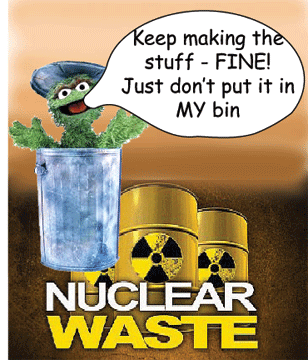 Foreign waste has been shipped to SRS for years – but the latest scheduled arrival in Charleston Harbor this month has finally sparked some criticism from nuclear watchdogs. “We strongly object to foreign-origin plutonium coming into South Carolina when DOE’s program to manage surplus weapons plutonium is in shambles,” said Tom Clements, director of Savannah River Site Watch. “As DOE’s plutonium fuel project has totally failed, it’s time for DOE to live up to its commitment to remove plutonium from South Carolina and not bring in more with no viable disposition path out of the state.”…..
The Japanese shipment – an estimated 331 kilograms of highly fissionable material – is reportedly being transported by British warships to Charleston harbor later this month. Its arrival and subsequent transfer to SRS is a matter of intense speculation and secrecy.
Why are we taking Japan’s plutonium? So terrorists don’t steal it, according to the feds …
In fact we reached out to the S.C. State Ports Authority (SCSPA) seeking information about the shipment, but the agency’s leadership told us it had “no idea” about the details.
S.C. governor Nikki Haley has merely stated that she wants the twelve metric tons of plutonium on-site at SRS to be processed prior to new waste arriving. She’s threatened lawsuits to that effect, too……….
over the next seven years we will continue to see dangerous shipments of nuclear waste routed through Charleston harbor en route to SRS with absolutely nothing resembling a long-term disposal agreement in place.
DOE recently indicated its intention to send six metric tons of stored plutonium from SRS to a facility in New Mexico, but this transfer is nothing but further confirmation of the abandonment of the MOX program – which was subsidizing an estimated 2,100 South Carolina jobs………..http://www.fitsnews.com/2016/03/22/more-nuclear-dumping-in-sc/
South Australia’s Nuclear Royal Commission grossly exaggerates benefits of nuclear waste dump
 Economic benefits of nuclear dump exaggerated: report, INDAILY, 22 Mar 16
The multi-billion dollar benefits of establishing a local nuclear waste dump were grossly exaggerated in last month’s royal commission tentative findings, according to a response by the Australia Institute released today……..
The report argues the primary beneficiaries of a nuclear storage industry would not be South Australian taxpayers, but “companies involved in the international nuclear industry, [which] are anxious to reduce financing and other costs, as nuclear power is already uncompetitive with most other generation technologies”.
The Australia Institute is scathing about the methodology of consultancy firm by Jacobs MCM, which provided the data underpinning Scarce’s conclusions.
“Jacobs assume that some 37 countries could send waste to Australia [but] many of these countries are yet to develop nuclear programs, have their own storage options, or have contractual obligations to other countries,” the report argues, adding that the much-cited potential economic benefits to SA “such as over $5 billion per year in revenue… should be closely questioned and have not received adequate scrutiny from the Royal Commission so far”.
“There is no data on the prices that the South Australian proposals might attract [and] estimating the price that environmental externalities might attract in such a market is notoriously difficult,” it says.
Denniss told InDaily: “When it comes to economic modeling it’s always the same: garbage in – garbage out.”
“If the assumptions are wrong, then the conclusions are wrong, and the Jacobs report has a very optimistic assumption for the price that other countries will be willing to pay for storage of nuclear waste,” he said.
“They’re very optimistic about the number of countries that will want to pay for this service and they’re very optimistic about the future of the nuclear industry as a whole, where many people think renewable energy will get cheaper and cheaper and displace the existing nuclear energy industry.
“If any of those assumptions are optimistic, the business base for the dump is exaggerated.”
Deniss argues that “if any other industry said ‘start building us $145 billion worth of infrastructure, it will take 120 years to finish, we’ll start paying you in 10 years, trust us’, they’d be laughed out of town”.
“This proposal is about SA taxpayers picking up the tab to help nuclear companies out of the economic hole they’re in,” he said.
He argues the business case is also predicated on “cheap, above-ground storage… for nearly a century before it’s all ultimately, expensively put underground”.
“But if this project goes belly-up halfway through, SA will be left with all the waste and none of the future revenues,” he said……….
“We’re always vocal opponents of people who use exaggerated economic claims to sell projects that would otherwise be unpopular,” Denniss said today of the institute’s anti-nuclear stance.
“Not many South Australians have a long-term desire to have a nuclear waste dump, but some of them believe if the state can make a lot of money out of it, maybe it’s worth doing… the problem is reports like the Jacobs report exaggerate the likely benefits to SA, while minimising debate about the very real economic and environmental and human risks of having a high-level nuclear waste dump.”
Conservation Council SA chief Craig Wilkins – a former adviser to Parnell who has also held a briefing for Key’s Ashford sub-branch – again seized on the Australia Institute’s research today, saying it “confirms what many South Australians suspect – the dump proposal being pushed by the Royal Commission seems way too good to be true”.
“The big question is: if it such as good deal, then why aren’t other countries rushing to do it?” he said.
“Something just doesn’t add up.”…….
UniSA economist and InDaily columnist Richard Blandy – who has also written against the economic imperative for a waste dump – joined Denniss at a media conference at the Grosvenor Hotel this morning. By chance, over the road in parliament, the Government was introducing legislative changes to allow unfettered debate about the establishment of a nuclear storage facility. http://indaily.com.au/news/2016/03/22/economic-benefits-of-nuclear-dump-exaggerated-report/
Once again, access to South Africa’s nuclear documents is denied
 Access to nuclear documents denied once again http://www.bdlive.co.za/business/energy/2016/03/22/access-to-nuclear-documents-denied-once-again BY LINDA ENSOR, 22 MARCH 2016 ENERGY Minister Tina Joemat-Pettersson has turned down an appeal by the Open Democracy Advice Centre (Odac) against her department’s refusal to grant access to sensitive documents relating to government’s nuclear procurement plans.

The centre — acting on behalf of Business Day — used the Promotion of Access to Information Act (Paia) last year to request access to three reports relating to the estimated cost of building 9,600MW nuclear plants. The reports on nuclear-procurement models, the cost of nuclear plants and financing models were compiled for the department by three international consultancies — KPMG, Ingerop and Deloitte.
Former Business Day editor Songezo Zibi, speaking last year after the application was lodged, said the newspaper had “reason to believe that the cost studies the department does not want the public to see until it is too late in the process, show that 9,600MW of nuclear will be unaffordable”.
The affordability of the nuclear plans has become even more concerning given the financial straits government finds itself in. But the Treasury has insisted that it will approve only what is affordable.
The energy department rejected the original Paia request, saying the documents were classified as secret and would not be made available to the public. Its view was confirmed by the minister in a letter sent last week to Odac’s head of advocacy and special projects, Alison Tilley. Ms Joematt-Pettersson said “there is no evidence before me to suggest that the public interest in the disclosure of the record sought outweighs the harm contemplated by the release of the reports”.
She said the records sought included “information (which includes financial information) to be used in the procurement process and if released, in all likelihood, would be detrimental to the procurement process, most especially the competitive bidding process that is soon to be under way.
“Disclosure thereof would have the effect of materially jeopardising the economic interests or financial welfare of the republic.”
Similar reasons were given by the department to maintain the secrecy of the intergovernmental agreements on nuclear co-operation that were found to contain no proprietary or commercial information when they were tabled in Parliament last June.
When the department rejected Odac’s request, Right 2 Know Campaign spokesman Murray Hunter said the affordability study for SA’s strategic arms procurement in 1999 had been classified until last year. “When this was unclassified, it was clear that there had been enormous financial risks. Governments often overclassify documents to shield themselves from accountability and end up making the wrong decisions. The fact that these documents are being withheld, makes it impossible for SA to have the conversation about nuclear energy.”
Odac has three months within which to lodge an appeal against the minister’s decision.
NEW NUCLEAR AIR-LAUNCHED CRUISE MISSILE A REDUNDANT CAPABILITY
 CRUISE CONTROL: WHY THE U.S. SHOULD NOT BUY A NEW NUCLEAR AIR-LAUNCHED CRUISE MISSILE KINGSTON REIF MARCH 21, 2016 The Obama administration’s fantastical plan to modernize the Cold War-era nuclear triad of land-based missiles, submarine-launched missiles, and long-range bombers is prompting an increasingly loud and much-needed debate in Washington and beyond about whether the effort is necessary and sustainable.
One of the most controversial pieces of this “all of the above” sustainment approach, which is projected to exceed $350 billion over the next decade, is the Air Force’s proposal to build a new fleet of roughly 1,000 nuclear-capable air-launched cruise missiles (ALCMs).
The Defense Department and supporters of replacing the nuclear ALCM in Congress and the think tank communityargue that building a new missile is necessary to maintain an effective U.S. nuclear deterrent because the current missile is losing its ability to penetrate increasingly sophisticated air and missile defenses. These proponents alsoclaim that retaining an ALCM option for the bomber leg of the triad provides the president with unique options to control escalation and respond proportionally to a limited nuclear attack. In other words, the new missiles would augment the ability of the U.S. military to fight a nuclear war.
In the halls of the Pentagon, where planners have spent decades justifying nuclear force levels that would make a hoarder seem frugal by comparison, these arguments have taken on an almost religious quality. Yet strip away the magical thinking that permeates so much of U.S. nuclear strategy and the case for a new ALCM is weak: it is redundant, recklessly expensive, and potentially destabilizing………
A redundant capability
While supporters of the LRSO cite anticipated improvements in the air defenses of potential adversaries as a reason to develop the new nuclear cruise missile, it is doubtful that any target the missile could hit could not also be destroyed by other U.S. nuclear weapons or conventional cruise missiles……..
U.S. nuclear capabilities would remain highly credible and flexible even without a nuclear ALCM. The arsenal includes other weapons that can produce more “limited” effects, most notably the B61 gravity bomb. More importantly, the notion the use of nuclear weapons can be fine-tuned to carefully control escalation to a full-scale nuclear exchange is very dangerous thinking. It is highly unlikely that an adversary on the receiving end of a U.S. nuclear strike would (or could) distinguish between a large warhead and a small warhead. The fog of war is thick. The fog of nuclear war would be even thicker.
Large or small, nuclear weapons are extremely blunt instruments, both in terms of their destructive power and the taboo associated with the fact they have not been used in 70 years. As Michael Krepon has elegantly put it, the case for the LRSO “demands a fealty to nuclear warfighting concepts that most Americans will be hard-pressed to understand. The nuclear deterrence business is most persuasive to taxpayers in the abstract; particulars require the suspension of disbelief.”
Other arguments in favor of the LRSO are also unconvincing. ……..
Furthermore, as highlighted by William Perry, President Bill Clinton’s defense secretary, and Andrew Weber, President Barack Obama’s assistant secretary of defense for nuclear, “cruise missiles are a uniquely destabilizing type of weapon” due to the fact that “they can be launched without warning and come in both nuclear and conventional variants.”
The possible risk of miscalculation and unintended escalation posed by the LRSO requires far more scrutiny than the blithe assertions from the administration that the missile will be stabilizing.
Indefensible Costs
The case for the LRSO is further undermined when one considers the high budgetary costs and significant opportunity costs. The United States is planning to rebuild all three legs of the nuclear triad and their associated warheads at a cost and on a schedule that many military leaders say is unsustainable…….
The bloated U.S. nuclear arsenal of approximately 4,700 weapons is largely irrelevant to the most pressing national security challenges the United States faces. Retaining an unnecessarily large arsenal and enhancing U.S. nuclear warfighting capabilities will not help Washington address the challenges posed by great powers such as Russia and China. If anything, doing so will exacerbate relations with these countries.
The choice is clear: chart a more realistic path for the nuclear arsenal that doesn’t severely constrain the force-sizing options of future presidents and reduces the risk of doing serious damage to conventional capabilities and other national security programs. As an early step in this course correction, the Pentagon should cancel its new cruise missile program and prioritize continued investments in the other legs of the nuclear triad and more relevant and usable non-nuclear capabilities, including longer-range conventional cruise missiles.
Doing so would be far more beneficial to U.S. security than spending billions to buy a redundant new nuclear missile unneeded for either deterrence or assurance.
Kingston Reif is the Director for Disarmament and Threat Reduction Policy at the Arms Control Association. You can follow him on Twitter at @KingstonAReif. http://warontherocks.com/2016/03/cruise-control-why-the-u-s-should-not-buy-a-new-nuclear-air-launched-cruise-missile/
LARGE-SCALE SOLAR POWER STORAGE CAN BECOME A REALITY
CAN LARGE-SCALE SOLAR POWER STORAGE BECOME A REALITY?, Stanford Engineering, An unexpected finding by a team of engineers could lead to a revolutionary change in how we produce, store and consume energy. By Glen Martin, 16 Feb 16, “……..Now a team led by William Chueh, an assistant professor of materials science and engineering, and Nicholas Melosh, an associate professor in the same department, has made a discovery that could make large-scale solar power storage a reality.
The breakthrough is based on the fact that ordinary metal oxides, such as rust, can be fashioned into solar cells capable of splitting water into hydrogen and oxygen.
So far it has been impractical to use water-splitting as a way to store the sun’s energy. One reason is cost-efficiency. Silicon-based solar cells, such as those used in rooftop solar arrays, are good at converting visible and ultraviolet light into electricity. But silicon cells waste the infrared light, which bears heat, beating down on them.”Standard cells utilize a relatively small portion of the spectrum, and the rest is lost as heat,” Chueh said.Until the recent Stanford experiments, it was believed that metal oxides also became less efficient as they became hotter. And since they were less efficient than silicon to start with, that made them less interesting as a water-splitting technology.The Stanford experiments change that misconception…………Discovering that heating up metal oxides produces more energy means that relatively simple engineering could be applied to heat these solar cells to enhance their efficiency.”You don’t have to add energy from an outside source,” said graduate student and team member Andrey Poletayev. “You can do it for free by concentrating solar radiation, either through a magnifying lens or parabolic mirrors.”Chueh believes that this discovery will refocus attention on developing metal oxides as cost-effective alternatives to silicon solar cells. Quite apart from their potential use in a day-to-night energy storage scenario, he envisions that pure hydrogen gas produced by water-splitting could be used to power vehicles or other machines directly and without pollution.”We can store these gases, we can transport them through pipelines, and when we burn them we don’t release any extra carbon,” said Chueh. “It’s a carbon-neutral energy cycle.”This research was supported by Stanford’s Global Climate and Energy Project and by the National Science Foundation. https://engineering.stanford.edu/news/can-large-scale-solar-power-storage-become-reality
The Atomic Church of the Last Gasp
Plutonium Pie in the Sky: the Dangerous Delusion of New Nukes CounterPunch by JAMES HEDDLE MARCH 22, 2016 “….. The Atomic Church of the Last Gasp New Nuclearists avoid coming to terms with the risks and failures of the existing world fleet of aging, ill-designed reactors. Some even advocate re-licensing embrittled reactors from the 1960s to extend their operation decades beyond their 40-year design life.)
NeoNuclearists believe – without operational proof-of-concept – in a pie-in-the-sky, perpetually not-yet-but-soon-to-be-born generation of ‘new, small modular nuclear reactors (SMRs).’ They will consume and eliminate existing nuclear waste and be so ‘inherently safe’ you can bury them in your back yard. Any day now……..
 The blind faith with which latter-day nuclear advocates approach the issues of human, ecological and economic risk associated with nuclear technologies, reminds one of the Melanesian millenarian movement called ‘cargo cults,’ in which indigenous tribes, following charismatic figures, built wooden aircraft replicas on mountain tops in the vain hopes – despite repeated failures – to lure down the western cargo planes loaded with commodities they saw flying overhead as portrayed in the 1962 film Mondo Cane.
Or, if the definition of ‘insanity’ is: ‘persisting in behavior which consistently fails,’ neo-nuclearism is clearly a form of collective insanity – atomic psychosis……….
Recovering from Nuclear Delusion The facts of the failure of the nuclear dream are there, for any who are not blinded by ideology or self-interest to see: in addition to its history of totalitarianism, incompetence and global disasters, nuclear energy deployment is plagued by public opposition, investor disinterest, consistently mounting cost and schedule over-runs and dependence on contiminating dwindling water supplies. Energy consultant Amory Lovins sees nuclear energy “dying a slow death from an overdose of market forces.” Futurist Jeremy Rifkin agrees, “From a business perspective, its dead.” Expert witness and nuclear engineer Arnie Gundersen puts it succinctly, “nuclear energy is just too expensive and too slow to have an impact on climate change.”
The 20th century ‘nuclear dream’ of global full-spectrum dominance and energy too cheap to meter has become a 21st century nightmare. It is time to wake up. As retired top U.S. energy administrator S. David Freeman puts it, “We have to kill nuclear power before it kills us.”
NeoNuclearists are entitled to their own opinions…but not to their own facts.http://www.counterpunch.org/2016/03/22/plutonium-pie-in-the-sky-the-dangerous-delusion-of-new-nukes/
Highest in 666 million years – today’s carbon emissions
 Carbon emissions rate ‘highest in 66 million years’ ABC News, 22 Mar 16 ABC Science The rate of carbon emissions is higher than at any time in fossil records stretching back 66 million years to the end of the age of the dinosaurs, according to a new study that sounds an alarm about risks to nature from anthropogenic warming.
Key points
- During Palaeocene-Eocene Thermal Maximum 55.8 million years ago temperatures rose 5 degrees C
- Scientists analysed marine fossils to determine rate of carbon emissions at this time
- Rate of carbon emissions was 10 times slower than current emissions
The Palaeocene-Eocene Thermal Maximum (PETM) event — which drove temperatures up by an estimated 5 degrees Celsius and damaged marine life by making the oceans acidic — is often seen as a parallel to the risks from the current build-up of carbon in the atmosphere from burning fossil fuels.
On present trajectories, greenhouse gas emissions will heat up Earth 3 to 4 degrees Celsius by 2100.
“Of all the changes we have seen in 66 million years, this event is the one that most looks like anthropogenic, or man-made, warming,” said study co-author Professor Andy Ridgwell, a paleo-climatologist at the University of Bristol.
Aside from the huge impact that killed the dinosaurs, what we are seeing now is the fastest rate of climate change in 66 million years.
Professor Andy Ridgwell
The parallels are striking: massive carbon emissions, followed by rapid global warming and major loss of species.
Fifty-six million years ago, those extinctions took place mainly in the ocean. Today the so-called “sixth great extinction” is underway both in the sea and on land………http://www.abc.net.au/news/2016-03-22/carbon-emissions-‘highest-in-66-million-years’/7266032
Scotland’s floating wind farm will ‘store’ power
 World’s first floating wind farm to ‘store’ power http://www.cnbc.com/2016/03/21/world-first-floating-wind-farm-to-store-power.html Anmar Frangoul Monday, 21 Mar 2016 Statoil is to install a lithium battery based storage system at the world’s first floating wind farm off the coast of Scotland.
The new system, called Batwind, is to be developed in co-operation with universities and suppliers from Scotland after a deal was signed last week between Statoil, the Scottish Government, the Offshore Renewable Energy (ORE) Catapult and Scottish Enterprise, according to a statement released on Monday.
“By developing innovative battery storage solutions, we can improve the value of wind energy for both Statoil and customers,” Stephen Bull, Statoil’s senior vice president for offshore wind, said. The system is to be installed at the end of 2018, Statoil said, and will have the battery capacity of “more than 2 million iPhones.”
Because renewable sources of energy, such as the sun and wind, do not promise a constant stream of power, storage is seen as vital in the transition to a low-carbon, renewable future. A recent report from the Carbon Trust found that energy storage has the potential to save £2.4 billion ($3.46 billion) a year by 2030.
The storage system from Statoil will be piloted at Hywind Scotland, an offshore “wind park” with five floating turbines. The park is currently being built, with electricity production set to commence at the end of 2017. Statoil say that the wind farm will be able to power roughly 20,000 homes.
“This will help maximize the renewable generation of the Hywind offshore wind farm, whilst informing the case for energy storage and demonstrating the technology’s ability to support renewables in Scotland and internationally,” Fergus Ewing, Scotland’s energy minister, said.
Problems of decommissioning nuclear reactors
Commentary on report: The Nationwide Failures of Decommissioning Regulation: Decommissioning Trust Funds or Slush Funds?
Fairewinds Energy Education DOWNLOAD THE REPORT
MiningAwareness, 24 Mar 16 After so many years rats can set up and spread contamination. However, where will they be decommissioned to? While the rats are a problem, letting the reactors sit up does actually allow some of it to become less radioactive. Some period of letting it sit up also allows time for a real solution, if there is any outside of a 24/7 monitored bunker.
A few years would allow construction of such a facility. Certainly Vermont is happy to send its large nuclear parts to sit outside and be buried at the Clive facility in Utah or West Texas.
Who wouldn’t be happy to get shot of this lethal waste? Eventually it’s going to come back up from its burial ground and land on the eastern states too. To be fair I haven’t read this document. However, I think that Vermont’s “waste pact” is with west Texas, WCS (Waste Control Specialists).
Although Vermont may not be suitable for radioactive waste due to rain, west Texas is unsuitable due to heat and alternating rain and dry spells, in conjunction with burial in concrete lined clay. Plus it’s hard to see the fairness in this, except there is a good chance that the rain out following the inevitable explosion at WCS will be over Vermont. Burial of waste is unacceptable everywhere. And, that’s what they do at WCS and Clive.
It’s easy to see people in the eastern US think that what happens out west has nothing to do with them, but weapons testing proved otherwise. Interestingly, if German nuclear waste is buried in South Carolina, rather than further west, Germany may be more impacted by the inevitable explosion than the US. Certainly Europe may be. But, like Europe’s unwanted people, the movement of the waste will be gradually westward.
Years more delay for EDF’s Flamanville nuclear power station
EDF’s French nuclear plant faces years of further delay, Ft.com 20 Mar 16 Kiran Stacey and Tom Burgis EDF’s new nuclear power station in France faces years of further delays if tests confirm that the steel used in its reactor is flawed, the country’s atomic watchdog has warned.
It is one of the clearest signals to date of the scale of the setback faced by the French utility. The flagship plant at Flamanville in Normandy has already been subject to years of delays and cost overruns, which have made it difficult for EDF to fund the identically designed £18bn reactor at Hinkley Point in the UK — a key element in Britain’s energy strategy.
Initially, Flamanville was expected to cost €3.3bn and start operations in 2012 — it is now planned to start in 2018 at a cost of €10.5bn.
But Julien Collet, the deputy director of France’s Nuclear Safety Authority, has said that it could be delayed further by several years, depending on the results of tests started last year and due to end this summer on the steel being used in the reactor core.

If the steel fails the tests, regulators could order EDF to rip out and replace the top and bottom of the reactor vessel. Mr Collet told the Financial Times: “It takes a lot of time to build new components like this — we’re talking years.”……
The concerns over the steel used in the Flamanville plant are only the latest in a string of misfortunes at that project and another in Finland, both of which use Areva’s European Pressurised Reactor, or EPR, model.
These delays have caused difficulties for EDF’s contentious new project at Hinkley Point in Somerset, which was originally planned for 2017 but is now set to be built by 2025…….
EDF was thrown a lifeline last week, however, when Emmanuel Macron, the French economy minister said his government would recapitalise the company if necessary.
But executives will come under scrutiny on Wednesday when they are grilled in Westminster about Hinkley Point by MPs on the cross-party energy select committee. http://www.ft.com/intl/cms/s/0/73d62552-ec65-11e5-bb79-2303682345c8.html#axzz43g9nsyxB
USA’s failure of f Decommissioning Regulation: are these trust funds really slush funds?

 The Nationwide Failures of Decommissioning Regulation: Decommissioning Trust Funds or Slush Funds? http://www.fairewinds.org/nuclear-energy-education//03tj9289ut746v9sb3cbkrhfzqgtdzFairewinds Energy Education has submitted a new decommissioning report entitled: The Nationwide Failures of Decommissioning Regulation: Decommissioning Trust Funds or Slush Funds? to the Nuclear Regulatory Commission (NRC). Research was funded by a Lintilhac Foundation Grant. First submitted a year ago, the report evaluates utility owner Entergy’s plan to use the NRC sanctioned SAFSTOR process to decommission Vermont Yankee.
Developed by the NRC, SAFSTOR is a subsidy that benefits nuclear power plant owners like Entergy by providing them with a 60-year window to decommission nuclear plants. With an increasing number of aging atomic power plants shutting down in the United States, Fairewinds’ report is an ongoing case study of the decommissioning process at Vermont Yankee where nuclear energy corporations have been allowed by the NRC to raid decommissioning funds procured by ratepayers like you and me. From unregulated withdrawals of funds, a 60-year timeline with no basis in science, to zero responsibility in regards to emergency planning, it’s clear that NRC regulations are benefitting corporations and not the public.
The Nationwide Failures of Decommisioning Regulation: Decommisioning Trust Funds or Slush Funds?, Comments Submitted to the Nuclear Regulatory Commission
March 17, 2016, Fairewinds Energy Education
AREVA’s huge loss on Finland nuclear project
 Areva Posts 2.04 Billion-Euro Loss on Finnish Project http://www.bloomberg.com/news/articles/2016-02-25/areva-delays-results-by-24-hours-after-securing-bridge-loan, 25 Feb 16 Francois De Beaupuy
The company, 87 percent owned by the French government, had a net loss of 2.04 billion euros in 2015 after a loss of 4.83 billion euros a year earlier, the company based near Paris said Friday in a statement. It took a 905 million-euro charge related to the Finnish power station project due to extra operating costs and the “probable impact” of further discussions with the customer to settle the disputes over the project and bring it to completion.
Areva said it expects negative net cash flow from operations in 2016 in the range of 1.5 billion to 2 billion euros, due partly to expenses to be incurred on large projects and an unfavorable change in working capital requirements.
As a result, Areva’s credit rating was downgraded in December by Standard & Poor’s to B+, four steps below investment grade. Shares of the company have dropped 32 percent this year, extending a drop of 40 percent in 2015. The company delayed its earnings report by one day in order to finalize a bridge loan.
EDF has said it will buy a majority stake in Areva’s reactor unit provided it’s not exposed to the Finnish atomic plant project.
Radioactivity in the Ocean: Diluted, But Far from Harmless
Still, the world has never quite seen an event like the one unfolding now off the coast of eastern Japan, in which thousands of tons of radioactively contaminated water from the damaged Fukushima Daiichi nuclear power plant are pouring directly into the ocean. And though the vastness of the ocean has the capacity to dilute nuclear contamination, signs of spreading radioactive material are being found off Japan, including the discovery of elevated concentrations of radioactive cesium and iodine in small fish several dozen miles south of Fukushima, and high levels of radioactivity in seawater 25 miles offshore.
“Given that the Fukushima nuclear power plant is on the ocean, and with leaks and runoff directly to the ocean, the impacts on the ocean will exceed those of Chernobyl, which was hundreds of miles from any sea,” said Ken Buesseler, senior scientist in marine chemistry at the Woods Hole Oceanographic Institution in Massachusetts. “My biggest concern is the lack of information. We still don’t know the whole range of radioactive compounds that have been released into the ocean, nor do we know their distribution. We have a few data points from the Japanese — all close to the coast — but to understand the full impact, including for fisheries, we need broader surveys and scientific study of the area.”
Buessler and other experts say this much is clear: Both short-lived radioactive elements, such as iodine-131, and longer-lived elements — such as cesium-137, with a half-life of 30 years — can be absorbed by phytoplankton, zooplankton, kelp, and other marine life and then be transmitted up the food chain, to fish, marine mammals, and humans. Other radioactive elements — including plutonium, which has been detected outside the Fukushima plant — also pose a threat to marine life. A key question is how concentrated will the radioactive contamination be. Japanese officials hope that a temporary fishing ban off the northeastern Japanese coast will be enough to avert any danger to human health until the flow of radioactive water into the sea can be stopped…….
Studies from previous releases of nuclear material in the Irish, Kara and Barents Seas, as well as in the Pacific Ocean, show that such radioactive material does travel with ocean currents, is deposited in marine sediment, and does climb the marine food web. In the Irish Sea — where the British Nuclear Fuels plant at Sellafield in the northwestern United Kingdom released radioactive material over many decades, beginning in the 1950s — studies have found radioactive cesium and plutonium concentrating significantly in seals and porpoises that ate contaminated fish. Other studies have shown that radioactive material from Sellafield and from the nuclear reprocessing plant at Cap de la Hague in France have been transported to the North Atlantic and Arctic Oceans. A study published in 2003 found that a substantial part of the world’s radioactive contamination is in the marine environment.
How the radioactive materials released from the Fukushima plants will behave in the ocean will depend on their chemical properties and reactivity, explained Ted Poston, a ecotoxicologist with the Pacific Northwest National Laboratory, a U.S. government facility in Richland, Washington. If the radionuclides are in soluble form, they will behave differently than if they are absorbed into particles, said Poston. Soluble iodine, for example, will disperse rather rapidly. But if a radionuclide reacts with other molecules or gets deposited on existing particulates — bits of minerals, for example — they can be suspended in the water or, if larger, may drop to the sea floor.
“If particulates in the water column are very small they will move with the current,” he explained. “If bigger or denser, they can settle in sediment.”…….http://e360.yale.edu/feature/radioactivity_in_the_ocean_diluted_but_far_from_harmless/2391/
Nuclear fallout is far more toxic to the living environment than previously thought’
Nuclear Radiation Is Far More Toxic to the Living Environment Than Previously Thought. CodeShutdown March 20, 2016 ‘for reasons only partly understood, nuclear fallout is far more toxic to the living environment than previously thought’ That’s it in a nutshell
The fallout doesn’t seem to disperse to a level of non toxicity, as is commonly believed. Biological response seems to linger even after an element has decayed to very low levels, for reasons science has not adequately examined. It is known that animals can re-concentrate radioactive and non radioactive elements thousands and even millions of times, but science does not apply this knowledge adequately to risk factors. – See more at: http://nukeprofessional.blogspot.com.au/2016/03/nuclear-radiation-is-far-more-toxic-to.html#sthash.INzr7inG.dpuf
Russia funding and building new nuclear power station in Finland

 Russian nuclear corporation to start construction of Hanhikivi NPP in Finland in 2017 http://tass.ru/en/economy/864293 NOVO-OGAREVO, March 22. /TASS/. Construction of the Hanhikivi 1 nuclear power plant in Finland to be implemented by the Russian nuclear corporation Rosatom will start in 2017. Such information is contained in materials for the working visit of Finland’s President Sauli Niinisto to Moscow.
The power plant is expected to start generating electric power in 2024.
In December 2013, Rusatom Overseas [Rosatom’s subsidiary – TASS] and Finnish Fennovoima signed the contract for construction of Hanhikivi-1 nuclear power plant. Along with the construction contract, a ten-year fuel contract was signed with Russia’s company TVEL.
Russia’s revenues from the Hanhikivi-1 nuclear power plant project will amount to €17.5 bln , head of Rosatom Sergey Kiriyenko said earlier. Of this amount only taxes to the federal budget will exceed €3 bln, he added.
According to Finnish media, the project’s cost will reach €6-7 bln, of which €1.6 bln will be invested by Fennovoima and the rest by Rosatom. The commissioning of the new nuclear power plant is scheduled for 2024.
Rusatom Overseas is to supply 1,200Mt reactor for Hakhikivi-1.
1 This Month

petition to oppose the rapid increase of space-military industry threatening Jeju Island and the region.
[Petition by April 19th (KST)] Stop the joint military-Hanwha Systems-Jeju Provincial Government Sea Launch!

Chernobyl: The Lost Tapes – A good documentary on Chernobyl on SBS available On Demand for the next 3 weeks– https://www.sbs.com.au/ondemand/tv-program/chernobyl-the-lost-tapes/2352741955560

of the week–London Campaign for Nuclear Disarmament

Tell the Ukrainian Government to Drop Prosecution of Peace Activist Yurii Sheliazhenko
To see nuclear-related stories in greater depth and intensity – go to https://nuclearinformation.wordpress.com
-
Archives
- April 2026 (194)
- March 2026 (251)
- February 2026 (268)
- January 2026 (308)
- December 2025 (358)
- November 2025 (359)
- October 2025 (376)
- September 2025 (257)
- August 2025 (319)
- July 2025 (230)
- June 2025 (348)
- May 2025 (261)
-
Categories
- 1
- 1 NUCLEAR ISSUES
- business and costs
- climate change
- culture and arts
- ENERGY
- environment
- health
- history
- indigenous issues
- Legal
- marketing of nuclear
- media
- opposition to nuclear
- PERSONAL STORIES
- politics
- politics international
- Religion and ethics
- safety
- secrets,lies and civil liberties
- spinbuster
- technology
- Uranium
- wastes
- weapons and war
- Women
- 2 WORLD
- ACTION
- AFRICA
- Atrocities
- AUSTRALIA
- Christina's notes
- Christina's themes
- culture and arts
- Events
- Fuk 2022
- Fuk 2023
- Fukushima 2017
- Fukushima 2018
- fukushima 2019
- Fukushima 2020
- Fukushima 2021
- general
- global warming
- Humour (God we need it)
- Nuclear
- RARE EARTHS
- Reference
- resources – print
- Resources -audiovicual
- Weekly Newsletter
- World
- World Nuclear
- YouTube
-
RSS
Entries RSS
Comments RSS
 nuclear-news