Treasonous Nuclear Security Hoax: US to Bury Foreign Plutonium at WIPP Site in New Mexico (Formally Approved ); Import of More Foreign Waste May Be Negotiated Today-Tomorrow Under Pretense of Nuclear Security; Obama Terrorizing America with Foreign Nuclear Waste

Obama’s “Nuclear Security Summits” have been a deadly hoax for America. It is wonderful for those many countries who literally get shot of their nuclear waste by sending it to be buried in America. And for those, such as Russia, who have benefitted from US taxpayer largesse in the upgrade of over 200 Russian nuclear sites. As of this week, it is official that foreign plutonium is to be buried in New Mexico at the WIPP site, which is still closed after a radiological accident due to exploding plutonium waste. http://www.wipp.energy.gov/Special/WIPP%20Update%203_17_16.pdf The import of more foreign waste may be negotiated today and tomorrow under pretense of nuclear security. The real security risk is the transport of dangerous radioactive waste from facilities in safe countries (e.g. vaults in a Swiss Nuclear Research Center) to be dumped and buried on America’s shores. In short, treasonous Obama is terrorizing America with foreign nuclear…
View original post 2,581 more words
NGO Joint Statement Against Secretive Plutonium Shipment in Tokai-mura
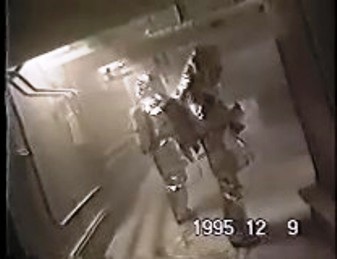
Monju Sodium leak fire via Wikileaks https://wikileaks.org/wiki/The_Monju_nuclear_reactor_leak
Press Release from Greenpeace.org:
“2016/03/18 NGO Joint Statement Against Secret Plutonium Shipment in Tokai-mura
プレスリリース – 2016-03-18
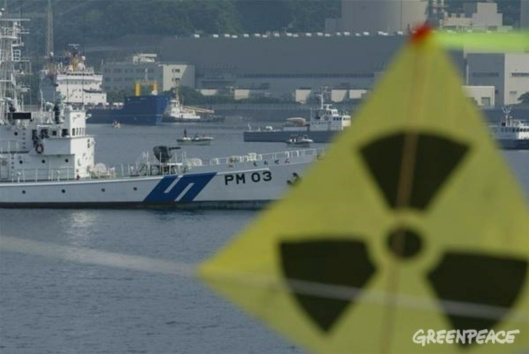
Tokyo, March 18 2016 – A shipment of weapons-grade plutonium scheduled to depart the port of Tokai, Ibaraki prefecture this coming weekend highlights the failure, but also the proliferation risks, of the current Japanese nuclear policy, a coalition of five non-governmental organizations warned today. A cargo of 331kg of plutonium will be loaded on to the Pacific Egret, an armed British nuclear transport ship, prior to departure under armed escort to the United States. It will be the largest shipment of separated plutonium since 1.8 tons of plutonium was delivered to Japan by controversial Akatsuki-maru in 1992. The two month voyage to the Joint Base Charleston-Weapons Station will then see the plutonium dumped at the Department of Energy Savannah River Site (SRS) in South Carolina.(1)…
View original post 1,208 more words
Indian Point Nuclear Power Station: Missing Bolts and Bars in Pressure Vessel Internals (Baffle-Former Bolts); Could Cause Fuel Failure; Block Cooling
According to the US NRC, during planned inspection of Indian Point Nuclear Power Station “Entergy identified baffle/former bolts with either visual anomalies or ultrasonic indications. All vessel internal examinations have been successfully completed with no anomalies other than the baffle/former bolts.” http://www.nrc.gov/reading-rm/doc-collections/event-status/event/2016/20160330en.html
Entergy offered more details in a Press Release: “Engineers identified missing bolts, and bars meant to hold them in place, and other degradation requiring replacement of the bolts. Each bolt, about two inches long and made of stainless steel, holds plate inserts together inside the reactor.” http://www.prnewswire.com/news-releases/hundreds-of-inspections-completed-on-indian-point-unit-2-replacement-of-reactor-liner-bolts-planned-300242845.html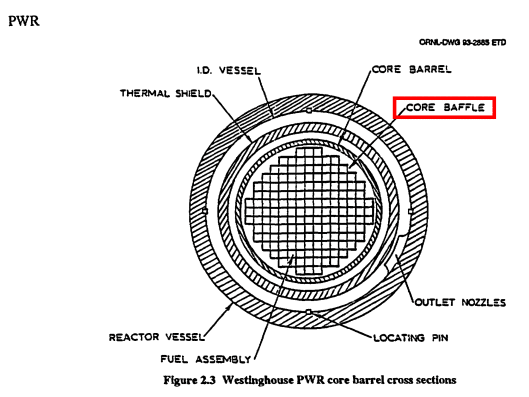
There are many bolts because there are many plates. Although there were “only” 11% damaged, the damage maybe concentrated because loss of one bolt could increase stresses in the surrounding areas. Thus, one suspects that there may have been plate failure or almost failure. [1] Apparently, even without total failure it can cause serious damage to the…
View original post 3,356 more words
March 31 Energy News

Opinion:
¶ This chart shows the United States’ mind-blowing clean energy potential • The United States uses about 3.7 million GWh of electricity each year. The next time someone tries to make the argument that 100 percent renewable energy is out of reach for the U.S., show them this image: [Grist]
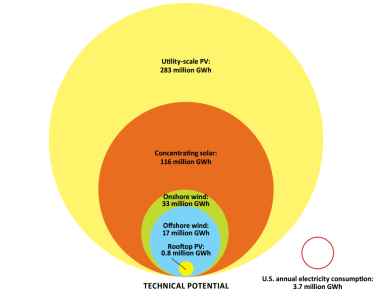 From the Environment America Research & Policy Center
¶ Wake up call for oil companies: electric vehicles will deflate oil demand • Major oil companies greatly underestimate the impact electric vehicles will have on their market. Trends currently underway in the auto industry are likely to have a substantial impact on oil demand. [CleanTechnica]
¶ Clear Skies From Wind Power • Over 17 million Americans have asthma. Every year it is responsible for more than 10 million doctor visits and 1.8 million trips to the emergency room. Health professionals tell us one of the biggest…
View original post 667 more words
March 30 Energy News
Science and Technology:
¶ The National Snow and Ice Data Center reported that the spread of Arctic sea ice set a new record low for the second straight year, stopping last week at 5.607 million square miles. That’s 5,000 square miles less than last year’s record low and 431,000 square miles less than the average. [CNN]
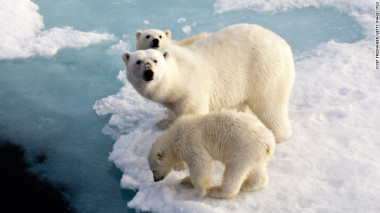 The consequences of climate change go
far beyond warming temperatures.
¶ MIT researchers demonstrated a calcium-metal-based liquid battery intended for grid-scale storage and a long cycle life. Calcium was blended with magnesium to make it usable. Use of earth-abundant materials and a scalable kind of construction are among the battery’s advantages. [CleanTechnica]
World:
¶ There are renewed calls to re-examine Alberta’s deregulated power market after the announced closure of a coal-fired electrical generator. Maxim Power Corp announced the temporary shut down of the 44-year-old plant, saying it is losing money…
View original post 521 more words
Spanish Nuclear Reactor Cooling System Defects: Hold Your Breath Until Aug. 2017 or Longer – May Be Too Late
There is such a thing as too late. The world stands at the precipice of too late. Spain would have until mid August 2017 to address failings in the cooling system of Almaraz nuclear power station, with the loophole of “reasonably practical” and claims that it is safe, anyway. While this appears prompt compared to the US NRC, which has given US nuclear power stations from 2012 to 2019 to repair serious electrical defects, it may not be prompt enough. Notice that the question, below, was raised by someone in neighboring Portugal. There can be very serious transboundary impacts. Belarus was, and remains, more badly hit than the Ukraine by the Chernobyl nuclear accident. Authoritarian States may be required in these countries to keep a lid on knowledge of health impacts and the concomitant dissent:
“Belarus, Ukraine and Russia were the most highly contaminated countries. About 5 million people…
View original post 747 more words
Ice wall at Fukushima plant switched on, but will it work?
by MARI YAMAGUCHI Mar. 31, 2016
TOKYO (AP) — The operator of Japan’s destroyed Fukushima nuclear plant switched on a giant refrigeration system on Thursday to create an unprecedented underground ice wall around its damaged reactors. Radioactive water has been flowing from the reactors, and other methods have failed to fully control it. The decontamination and decommissioning of the plant, damaged by a massive earthquake and tsunami in 2011, hinge of the success of the wall.
Q. WHAT IS AN ICE WALL?
A. Engineers installed 1,550 underground refrigeration pipes designed to create a 1.5-kilometer (0.9-mile) barrier of frozen soil around four damaged reactor buildings and their turbines to control groundwater flowing into the area and prevent radioactive water from seeping out. The pipes are 30 meters (100 feet) deep, the equivalent of a 10-story building. Engineers say coolant in the pipes will freeze the surrounding soil to minus 30 degrees Celsius (minus 22 Fahrenheit), creating the wall over several months.
Q. WHY IS AN ICE WALL NEEDED?
A. The cores of three of the damaged reactors melted during the accident and must be cooled constantly with water to keep them from overheating again. The cooling water becomes radioactive and leaks out through damaged areas into the building basements, where it mixes with groundwater, increasing the volume of contaminated water. Nearly 800,000 tons of radioactive water have been pumped out, treated and stored in 1,000 tanks that now occupy virtually every corner of the Fukushima plant, interfering with its decontamination and decommissioning and adding to the risk of further leaks of water into the nearby ocean.
Q. ARE THERE RISKS?
A. Construction officials say the coolant is environmentally safe. There were doubts that the huge refrigeration system could effectively freeze the soil while groundwater continues to flow in the area. The operator, Tokyo Electric Power Co., says results from a test of part of the wall last summer were mixed but suggest the system has sufficient capability. Experts are also concerned that an ice wall cannot be adjusted quickly in an emergency situation, such as a sudden increase in the flow of contaminated water, because it takes several weeks to freeze or melt. Electrical costs for running the refrigeration system could be steep. TEPCO says the wall, once formed, can remain frozen for up to two months in the event of a power failure.
Q. WHO MADE THE ICE WALL?
A. The 35 billion yen ($312 million) project was funded by the government and built by Kajima Corp., which has used similar technology in smaller projects such as subway construction. The wall was delayed by technical uncertainties and was finished last month, a year behind schedule.
Tepco starts freezing soil around Fukushima plant reactors
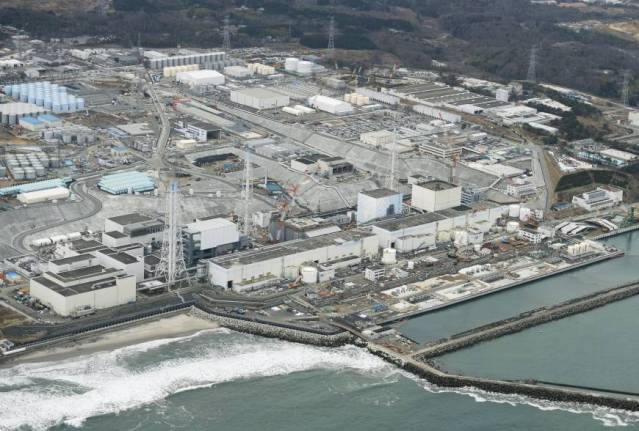
Tokyo Electric Power Co. said Thursday it has started freezing soil around damaged nuclear reactor buildings at the disaster-hit Fukushima plant, aiming to reduce the flow of groundwater into the highly contaminated facilities.
The Nuclear Regulation Authority on Wednesday gave Tepco permission to create a coolant-filled ice wall and start freezing soil on the east sea-facing side of the plant followed by 95 percent of the west side facing the mountains.
The work is expected to take more than three months to complete.
The plant was crippled by a massive earthquake and tsunami in March 2011.
In June 2014, Tepco installing equipment needed to establish the ice wall around the No. 1 to No. 4 reactors.
The work was completed in February, with the government funding some ¥35 billion ($309 million) of the project.
The utility plans to seek permission to extend the wall to cover the entire west side as well as the south and north sides of the plant after collecting data.
The 1.5-kilometer-long and 30-meter-deep wall is designed to stem a massive flow of groundwater from entering the basements of the reactor buildings and mixing with leaked toxic water.
The complete freezing is expected to take eight months if all goes smoothly.
Chief Cabinet Secretary Yoshihide Suga said the government “hopes the ice wall will stem the flow of groundwater into the facilities at an early date.”
Tepco and the government initially aimed to complete freezing the entire wall by the end of fiscal 2015, but the schedule was delayed due to prolonged discussions on safety measures.
The wall is expected to reduce the amount of groundwater flowing into the facilities every day to about 50 tons from more than 100 tons currently.
Still, the effectiveness of the ice wall, which would be the world’s largest ground freezing project, remains unclear.
The NRA warned earlier that if the groundwater level within the wall is reduced excessively by stemming the flow from outside, highly contaminated water within the buildings could seep out.
Tepco said it will stop the freezing work or inject water into wells around the reactor buildings if the groundwater level inside the wall is likely to become too low.
Increased Strontium in Sardines since Fukushima Accident?

Dogs fed sardines show high Strontium levels
by Dr. Peter Dobias, DVM
Why you might want to cut out small fish from your dog’s diet
I have had two dog patients with severely elevated levels of the element strontium. The interesting part is that these two dogs were fed a high amount of sardines and I highly suspect that strontium is coming from this source.
Strontium acts in the body the same way as calcium and deposits in bones. Sardines and other small fish are eaten whole with the bones and that is why they are more likely a source of this toxic element.
The reason why I am concerned is that the radioactive isotope strontium 90 is a toxic carcinogen and it has been released in Japan’s Fukushima disaster.
Here is an example of the results:

As a veterinarian, I source from almost three decades of experience, but still I like to see the proof. Hair testing for minerals and toxic elements has been really helpful because it is highly accurate and shows what is happening in different groups of dogs.
In the course of many years of testing, I have learned that dogs who eat fish-based foods have elevated mercury levels and sardines appear to be the cause of increased strontium. Since the Fukushima nuclear accident strontium is continuously being released into the oceans and not much is being done to inform the general public.
Sadly, I have noticed that dogs who have epilepsy have higher than average levels of strontium and mercury, which made me recommend against feeding fish and sardines to dogs, despite their nutritional benefits. Fish is not what it used to be.
http://peterdobias.com/blogs/blog/11014105-dogs-fed-sardines-show-high-strontium-levels
Fukushima Daiichi is not Tepco’s first accident
Fukushima is not Tepco’s first big accident. Fukushima was not their first Prom. They had practice only 4 years earlier. And guess what? Even back then Tepco misrepresented the amount that leaked into the ocean.
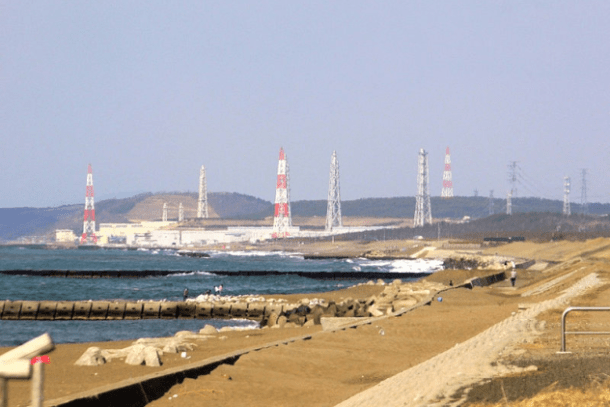
Chuetsu Earthquake
The Kashiwazaki-Kariwa Nuclear Power Plant (KKNPP) in Japan’s Niigata Prefecture can generate more power than any other power plant in the world—when it’s running. Since it became fully operational in 1997, one scandal after another has repeatedly forced it to shut down some or all of its seven reactors. Examples include concealing evidence of stress cracks and covering up the fact that the plant was built near fault lines.
That last bit came to light after the Chuetsu earthquake occurred on July 16, 2007. The magnitude 6.8 quake’s epicenter was only 24 kilometers (15 mi) offshore from the plant. The shaking was greater than the plant was designed to withstand; it was built before Japan updated their earthquake standards in 2006.
The ominous dry run for the later Fukushima Daiichi disaster damaged KKNPP and its reactors. The Tokyo Electric Power Company acknowledged that 1,200 liters of slightly radioactive water leaked into the sea and that dozens of barrels of low-level nuclear waste broke open during the quake. An exhaust pipe leaking radioactive iodine was also reported.
A report issued on July 19 by the Nuclear Information and Resource Service (NIRS) claimed the release of radioactive material to be much worse. According to NIRS, the water that leaked into the sea came from the irradiated fuel pool of one of the reactors. Another reactor had been releasing radioactive steam since the earthquake. The Associated Press also reported large amounts of damage to the plant’s infrastructure, with cracks and leaks seemingly everywhere. Liquefaction (formerly solid ground turning to mud) had occurred under parts of KKNPP.
1 This Month


18 March Webinar @ 1 PM EST: An Assessment of SMR Projects: The Case of Canada
register for the zoom:
https://us02web.zoom.us/webinar/register/WN_o8BIIOUvQ2ONJR1nta65DQ#/registration


of the week – STOP SMALL MODULAR REACTORS IN CANADA
To see nuclear-related stories in greater depth and intensity – go to https://nuclearinformation.wordpress.com
-
Archives
- March 2026 (138)
- February 2026 (268)
- January 2026 (308)
- December 2025 (358)
- November 2025 (359)
- October 2025 (376)
- September 2025 (258)
- August 2025 (319)
- July 2025 (230)
- June 2025 (348)
- May 2025 (261)
- April 2025 (305)
-
Categories
- 1
- 1 NUCLEAR ISSUES
- business and costs
- climate change
- culture and arts
- ENERGY
- environment
- health
- history
- indigenous issues
- Legal
- marketing of nuclear
- media
- opposition to nuclear
- PERSONAL STORIES
- politics
- politics international
- Religion and ethics
- safety
- secrets,lies and civil liberties
- spinbuster
- technology
- Uranium
- wastes
- weapons and war
- Women
- 2 WORLD
- ACTION
- AFRICA
- Atrocities
- AUSTRALIA
- Christina's notes
- Christina's themes
- culture and arts
- Events
- Fuk 2022
- Fuk 2023
- Fukushima 2017
- Fukushima 2018
- fukushima 2019
- Fukushima 2020
- Fukushima 2021
- general
- global warming
- Humour (God we need it)
- Nuclear
- RARE EARTHS
- Reference
- resources – print
- Resources -audiovicual
- Weekly Newsletter
- World
- World Nuclear
- YouTube
-
RSS
Entries RSS
Comments RSS
 nuclear-news