Fresh doubts on new nuclear: reports http://utilityweek.co.uk/news/fresh-doubts-on-new-nuclear-reports/1211252#.VrEUe9J97Gi 31/01/2016
The ongoing uncertainty over EDF’s Hinkley Point has cast doubt over the UK’s second planned new nuclear plant, Horizon’s Wylfa Newydd project, according to a report in the Sunday Telegraph. The newspaper reported this weekend that Hitachi chairman and chief executive Hiroaki Nakanishi expressed his concerns to the foreign secretary Philip Hammond when Hammond visited Japan earlier this month.
Nakanishi told the Telegraph: “The DECC worries about the stability of the scheduled construction of the [Hinkley Point] nuclear power plant, so some of the conditions – the credit requirements – those kind of things may affect us.
“In order to set up the financial conditions [to build Hinkley], Chinese capital was introduced, but what the real result will be – we have a very serious concern about that.”
Horizon expects to present full and final proposals later this year and is currently hoping to start generating power within the first half of the 2020s. It plans to generate more than 2,700 MW at the site using two Advanced Boiling Water Reactors supplied by Hitachi, which bought Horizon Nuclear Power in 2012.
Meanwhile, the Sunday Times reported that a get-out clause in the government’s contract with EDF, allowing the Treasury to back out of financial support if the French energy giant’s troubled Flamanville nuclear plant is not up and running by 2020, could put further pressure on the project. EDF is believed to have delayed a final investment decision on Hinkley until next month at the earliest, amid growing concerns over the financing of the proposed nuclear plant.
February 3, 2016
Posted by Christina Macpherson |
general |
Leave a comment
 GreenWorld
 We continue to hear the same old arguments over and over again–in comments in these pages, in blogs and newspaper op-eds, in press releases and out of the mouths of those utility execs trying to hold on to the 20th century model of electricity generation and distribution, and, most depressingly, in the U.S. Senate which passed by a resounding 87-4 vote legislation to encourage new nuclear power development.
The arguments go like this: Germany’s Energiewende energy transition is failing; renewables are fine, but they can’t provide baseload power and thus can’t reliably power a modern industrial society; renewables are still too expensive without subsidies; we need an all-of-the-above energy strategy to combat climate change; new generation reactors will be safer, cheaper and also effectively deal with radioactive waste, and so on.
Well, that last one is a whopper and has been promised since nuclear power first emerged–call us when one…
View original post 1,409 more words
February 2, 2016
Posted by Christina Macpherson |
Uncategorized |
Leave a comment
 geoharvey
World:
¶ Collaborating with Ecotricity, the Royal Society For Protection Of Birds installed a new wind turbine at RSPB Headquarters at the Lodge. A 100-meter wind turbine will deliver 1.85 million kWh per annum. The Director of Conservation says research shows the turbine is not in an area where birds will be endangered. [CleanTechnica]
 It’s windpower for the Royal Society For the Protection of Birds
¶ It was a good year for renewable energy in China, global research and consulting firm GlobalData said. China helped push global renewable installed capacity to an estimated 913.48 GW in 2015, leading the way in annual capacity additions for solar, biopower, small hydropower, and onshore wind. [CleanTechnica]
¶ Collapsing oil prices, Japan’s return to nuclear power, and market uncertainty in China are among the short-term challenges for liquefied natural gas. But longer-term competition from renewable energy in Europe and Asia…
View original post 724 more words
February 2, 2016
Posted by Christina Macpherson |
Uncategorized |
Leave a comment
 Radiation Free Lakeland
Twenty years ago the Lake District National Park declared that a famous stand of beech trees in the Rusland valley were “dead diseased and dying” not to mention “ugly” and that in the interests of public safety the trees should be clearfelled. Video from 1997
Many people disagreed and thought the line of 200 year old trees a thing of beauty.
Scientists and tree experts also lent their weight to the long campaign in spite of the local great and good from Cumbria Wildlife Trust to Friends of the Lake District backing up the plan to clearfell.
The Lake District National park’s vision of what is safe and beautiful did not extend to the Rusland beeches 20 years ago. Beauty is of course in the eye of the beholder.
An example of beauty being in the eye of the beholder is news that the former head of the LDNPA is lending his…
View original post 528 more words
February 2, 2016
Posted by Christina Macpherson |
Uncategorized |
Leave a comment
 daryanenergyblog
 Figure 1: EDF HQ, where trouble is brewing!
The government’s policy regarding nuclear energy is at risk of unravelling. The final okay for Hinkley C has now been delayed by EDF energy. Despite the masses of money thrown at them by the government, EDF are hesitant because it represents a massive financial risk. Many of the company’s leading creditors, workers and shareholders have urged them to pull out of the deal, pointing to the similar train wreck in Finland. That project is now nine years late and at least three times over its original budget.
Hinkley C has already been delayed multiple times (a 2025 startup is now seen as optimistic, 2030 is more likely) and already the budget has ballooned to £24.5 billion. Indeed, the recent delay is largely because EDF simply doesn’t have the cash reserves to finance the project and is having to scramble…
View original post 1,071 more words
February 2, 2016
Posted by Christina Macpherson |
Uncategorized |
Leave a comment
geoharvey
Opinion:
¶ 3 homes that will give you green energy envy • Renewable energy reduces your environmental impact and dependency on conventional energy technology, while increasing self-sufficiency. Some architects created impressively stunning designs that are energy efficient. Here are three of our favorites. [Memeburn]
 Ecocapsule. Image Credit: Nice Architects
¶ Green electricity without batteries • A paper in the journal Research Policy suggests solar PV modules will continue to drop in cost at a roughly 10% rate. A paper in Nature indicates that extensive renewable electricity provision is possible without the need for storing large amounts of energy in batteries. [News24]
Science and Technology:
¶ Microsoft is planning to dive underwater in the future with its prototype data centre that it tested hundreds of feet below the surface of the ocean off California. Under Project Natick, data centres will live under the sea in order to…
View original post 650 more words
February 2, 2016
Posted by Christina Macpherson |
Uncategorized |
Leave a comment
Article posted by Shaun McGee
posted to www.europeannewsweekly.wordpress.com
Given the fact that Racheal Maddow who in a recent report mentioned that the Authorities in Flint Michigan, who let people know that the drinking water of the city was full of chemicals and Lead Pb in October 2015 (because of local activism and pressure), had actually warned the government staff in Flint of this and even delivered clean water sources to the offices a whole year before the public statement. (recent levels peaked at 4000 parts per million and the actionable limit is 15 parts per million)
“does not meet treatment requirements” for state employees to drink, even as the Snyder administration was assuring Flint residents about the integrity of their water.

MOX fueled reactor 3 Explosion sends Iodine 131 to USA and Europe
I want to draw attention to a similar situation in the USA after the Fukushima nuclear disaster when high levels of Iodine 131 and other radionuclides were wafting their way to Europe. In Europe CRIIRAD had issued a warning on possible health effects in France and advised that children and Pregnant women should refrain from drinking milk and eating leafy vegetables. CRIIRAD also stated that the USA had ten times the level of radiation than France. The European Media did not run with the story nor did the US media, thus putting young children and Pregnant women at risk of increaing the amounts of iodine 131 they might have ingested or inhaled.
There are similar issues with the BP Gulf Oil disaster also covered by Charles Williams Digges, Maureen Dauphinee, Scott Porter and Trisha Springstead
DID YOUR CHILD DRINK MILK IN 2011??
Case n°F-2014-20439 doc N° C05780602 date 01/29/2016 This is an email from Edelman Martin to Mills Cheryl, D
Below is a document sent internaly by authorities in the USA to friends warning them of the problem and offering some practical steps to minimise the health risks;
“Radiation leak from the Fukushima reactor____(redacted)___Stay indoors if at all possible.”“The stuff travels far, very far”
“There is nothing, no events, no parties, sports, movies, etc that are worth getting exposure to radiation.”
“Wear a mask, and a hat if possible. Take a shower immediately after you return home and wash your clothes. Radioactive steam was released yesterday and continues today. It will likely be in the area now.”
“I won’t be going outdoors for awhile.”
Case n°F-2014-20439 doc N° C05780602 date 01/29/2016 This is an email from Edelman Martin to Mills Cheryl, D
the source for these documents can be found here;
https://foia.state.gov/Search/Results.aspx
H/t https://www.facebook.com/RadChick-Radiation-Research-Mitigation-260610960640885/?fref=photo
h/t D`un Renard for confirmation
h/t Rob Soltsik for link to FOIA website
Note;
Cheryl D. Mills (born 1965[4][5]) is an American lawyer, administrator, and corporate executive. She first came into public prominence while serving as deputy White House Counsel for President Bill Clinton, whom she defended during his 1999 impeachment trial. She has worked for New York University as Senior Vice President,[6] served as Senior Adviser and Counsel for Hillary Rodham Clinton‘s 2008 presidential campaign,[7] and is considered a member of “Hillaryland“.[7] She served as Counselor and Chief of Staff to Secretary of State Hillary Clinton.[8]
https://en.wikipedia.org/wiki/Cheryl_Mills
February 2, 2016
Posted by arclight2011part2 |
Uncategorized |
3 Comments
Article by Shaun McGee and Jimmy Hagan
This is an Interview with 82 yr young, Margaretta D`Arcy the well known Irish peace activist. On asking her about the 1916 Independence proclamation she said;

You want me to talk about 1916 and since then It`s been downhill all the way
Source: Margaretta Darcy – Guantanomo Granny strikes again! Ireland will be free!
February 2, 2016
Posted by arclight2011part2 |
Uncategorized |
Leave a comment

 New threat to Hinkley nuclear plant cash,Sunday Times, Danny Fortson 31 January 2016 BRITAIN could withdraw financial support for the controversial £18bn nuclear power station at Hinkley Point, Somerset, if a similar plant being built by France’s EDF is not running by 2020, The Sunday Times can reveal.
The condition, attached to a Treasury loan guarantee, raises fresh questions about the future of Britain’s first new atomic power plant in a generation.
Last week EDF, which is 84% owned by the French state, postponed a board meeting in Paris to approve Hinkley Point, amid concerns about the heavily indebted company’s ability to fund the project. The plant will be financed by EDF and its Chinese partner CGN, with the backing of a 35-year contract to sell power to households at above-market rates.
The arrangement hinges on a Treasury agreement to guarantee up to 17 billion pounds in loans…. (registered readers only) http://www.thesundaytimes.co.uk/sto/business/energy_and_environment/article1662807.ece?CMP=OTH-gnws-standard-2016_01_30
February 1, 2016
Posted by Christina Macpherson |
politics, UK |
Leave a comment

 Marshalls nuclear case set for ICJ hearing http://www.radionz.co.nz/international/pacific-news/295377/marshalls-nuclear-case-set-for-icj-hearing 1 Feb 16, The Marshall Islands’ legal battle against the world’s nuclear powers has inched forward after an international court announced dates for hearings involving India, Pakistan and Britain.
The UN’s highest court, the International Court of Justice, set dates between 7 March and 16 March for separate hearings for the three cases.
The Marshall Islands, where the United States tested 67 nuclear weapons between 1946 and 1958, launched action in 2014 against nine nuclear states.
It has accused them of flagrant violation of international law for failing to pursue the negotiations required by the 1968 Nuclear Non-Proliferation Treaty.
In the cases against India and Pakistan, the court at The Hague will examine whether it is competent to hear the lawsuits.
The hearing involving Britain will look at preliminary objections raised by Britain.
The Marshall Islands’ case against the US hit a stumbling block last year when it was thrown out by the Federal District Court in San Francisco.
An appeal is underway. The Marshall Islands also filed suits against Russia, France, China, Israel and North Korea.
February 1, 2016
Posted by Christina Macpherson |
Legal, OCEANIA |
Leave a comment
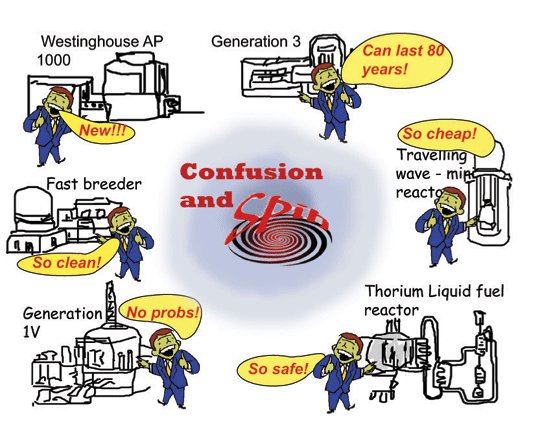
Nuclear renaissance? Failing industry is running flat out to stand still Jim Green, 30 Jan 2016, The Ecologist, “………Rhetoric about ‘super safe’ Generation IV reactors will likely continue unabated. That said, critical reports released by the US and French governments last year may signal a slow shift away from Generation IV reactor rhetoric.
The report by the French Institute for Radiological Protection and Nuclear Safety (IRSN) – a government authority under the Ministries of Defense, the Environment, Industry, Research, and Health – states: “There is still much R&D to be done to develop the Generation IV nuclear reactors, as well as for the fuel cycle and the associated waste management which depends on the system chosen.”
IRSN is also sceptical about safety claims: “At the present stage of development, IRSN does not notice evidence that leads to conclude that the systems under review are likely to offer a significantly improved level of safety compared with Generation III reactors … “
The US Government Accountability Office released a report in July 2015 on the status of small modular reactors (SMRs) and other ‘advanced’ reactor concepts in the US. The report concluded:
“While light water SMRs and advanced reactors may provide some benefits, their development and deployment face a number of challenges … Depending on how they are resolved, these technical challenges may result in higher-cost reactors than anticipated, making them less competitive with large LWRs [light water reactors] or power plants using other fuels … Both light water SMRs and advanced reactors face additional challenges related to the time, cost, and uncertainty associated with developing, certifying or licensing, and deploying new reactor technology, with advanced reactor designs generally facing greater challenges than light water SMR designs. It is a multi-decade process, with costs up to $1 billion to $2 billion, to design and certify or license the reactor design, and there is an additional construction cost of several billion dollars more per power plant.”
 Even SMR boosters are struggling to put a positive spin on the situation. Launching a Nuclear Energy Insider report on SMRs, lead author Kerr Jeferies said: “From the outside it will seem that SMR development has hit a brick wall, but to lump the sector’s difficulties together with the death of the so-called nuclear renaissance would be missing the point.”
According to a US think tank, 48 companies in north America, backed by more than US$1.6 billion (€1.5b) in private capital, are developing plans for advanced nuclear reactors. But even if all that capital was invested in a single R&D project, it would not suffice to commercialise a new reactor type.
The UK government also sees a big future for SMRs and has even promised to spend £250 million on “nuclear innovation and Small Modular Reactors”. But it will face two big problems. First, the money won’t go far. And second, nuclear power is already being outcompeted by wind and solar, which are getting cheaper all the time.
Dan Yurman notes in his review of nuclear developments in 2015: “Efforts by start-up type firms to build advanced reactors will continue to generate a lot of media hype, but questions are abundant as to whether this activity will result in prototypes.
“For venture capital firms that have invested in advanced designs, cashing out may mean licensing a design to an established reactor vendor rather than building a first-of-a-kind unit.”
Dr Jim Green is the national nuclear campaigner with Friends of the Earth Australia and editor of the Nuclear Monitor newsletter, where this article was originally published. Nuclear Monitor is published 20 times a year. It has been publishing deeply researched, often strongly critical articles on all aspects of the nuclear cycle since 1978. A must-read for all those who work on this issue! disaster……. www.theecologist.org/News/news_analysis/2987010/nuclear_renaissance_failing_industry_is_running_flat_out_to_stand_still.html
February 1, 2016
Posted by Christina Macpherson |
2 WORLD, Reference, technology |
1 Comment
 Hinkley Point nuclear fiasco spooks Hitachi boss, Telegraph, 31 Jan 16
Hitachi boss raises concerns about funding of its own Wylfa Newydd project with foreign secretary during visit to Japan The head of Hitachi has warned that the debacle surrounding the construction of Hinkley Point nuclear plant throws up “very serious concerns” about its own investment in the UK.
Hiroaki Nakanishi, chairman and chief executive of the Japanese industrial giant, said the setbacks experienced by Hinkley’s developer EDF raised questions about how future plants including its Wylfa Newydd project are funded.
Hitachi’s subsidiary Horizon is planning to build a nuclear plant on Anglesey that is expected to start generating power by the mid-2020s.
In an interview with The Telegraph, Mr Nakanishi revealed that he had expressed concerns about the expected costs of the project with Philip Hammond during the Foreign Secretary’s visit to Japan this month.
Horizon is in talks with the Government to ensure the Wylfa deal presents value for money for both sides.
Mr Nakanishi said Hitachi had set out “very fair conditions for the making of our investment”, but could only commit to a deal it believed was viable.
“Hinkley Point [raises questions] about what are the real solutions for setting up financial support,” he said.
“Nuclear power construction requires huge money … we need to arrange a financial plan for which the kind of money needed can be introduced.
“Some part is government endorsement, some is more preferable investment conditions from the part of the finance industry.” Mr Nakanishi said the challenges faced by Hinkley Point could also affect Horizon. “The DECC worries about the stability of the scheduled construction of the [Hinkley Point] nuclear power plant, so some of the conditions – the credit requirements – those kind of things may affect us.
“In order to set up the financial conditions [to build Hinkley], Chinese capital was introduced, but what the real result will be – we have a very serious concern about that.”
Asked if the firm might step back if it believed a viable deal was not on the table, Mr Nakanishi replied: “Yes”.
Horizon is in negotiations with the Department of Energy and Climate Change (DECC) on issues such as the strike price, or the amount the Government will guarantee per unit of electricity produced, which will be key to attracting additional finance…….. http://www.telegraph.co.uk/finance/newsbysector/energy/12128405/Hinkley-Point-nuclear-fiasco-spooks-Hitachi-boss.html
February 1, 2016
Posted by Christina Macpherson |
business and costs, UK |
Leave a comment








 nuclear-news