Germany’s costly nuclear waste dump correction
Environment state secretary Jochen Flasbarth, who described the situation in Asse II as “disastrous”, told journalists in Berlin that the current plan was to store the Asse waste, once retrieved, with the high-level radioactive waste for which the government is still searching a site…….
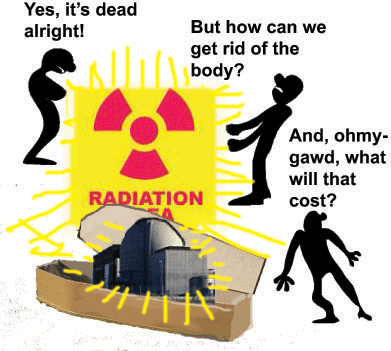
The Asse case shows how difficult it can be to undo a decision related to nuclear waste storage. It will take longer to retrieve the waste than it did to dump it

 Why Germany is digging up its nuclear waste, By PETER TEFFER , EU Observer, WOLFENBUETTEL, GERMANY, TODAY, 2 Feb 16 “….. in hindsight, the Asse II salt mine should never have been used in the 1960s and 1970s as a site to dump nuclear waste, said Ingo Bautz of the Federal Office for Radiation Protection………To anti-nuclear activists, Asse is a prime example of government not listening to citizens’ concerns. “Incidents were predicted,” said Wolfgang Ehmke, activist in the Gorleben region.
But the waste had to be stored somewhere, so the voices that warned against selecting Asse II were ignored.
“The potential risks for the future were accepted,” Bautz said, during a recent press visit to the mine organised by Clean Energy Wire, a non-profit group supported by the Mercator and European Climate foundations.
Road signs, deep underground
Until 1978, low and intermediate-level radioactive waste was stored in Asse II, the only such site in Germany.
Ten years later, the operator of the mine discovered leaks of radioactive brine. But it was not until 2008, when media reported about it, that the leaks became public knowledge.
The German government took control of the mine and tasked the Federal Office for Radiation Protection with its decommissioning.
The office concluded that the risk of groundwater contamination was too big, and the only truly safe option was to retrieve all the waste from the mine and store it elsewhere. In all, 126,000 containers filled with contaminated clothes, paper and equipment were stored in Asse, the office said.
“This task is very difficult,” said Bautz, who joined journalists to travel into the mine, 658m below the surface.
The lift plunged to the bottom at 36km/h. Inside the mine, the temperature was about 30C even though it was freezing above ground.
The mine is so large that workers have to use cars to get around. In one tunnel an LED road sign typically found in residential areas tells drivers to watch their speed……..
Since the mine is over a century old, it needs to be protected against a collapse or flooding. It will also need another lift to use for retrieving the waste.
And because of safety regulations regarding evacuation, only 120 people can be down in the mine at the same time. Workers are monitored for any exposure to radiation……..
In 2011, the EU adopted a rule obliging each country that has produced nuclear waste to have policies on how to manage their waste. Last August, all member states were due to report about their national programmes for the first time.
Germany told the commission it planned to put “all types of radioactive waste in deep geological disposal facilities with the aim to guarantee isolation from the biosphere in the long term, thus ensuring the safety of man and the environment without any need for maintenance”.
Environment state secretary Jochen Flasbarth, who described the situation in Asse II as “disastrous”, told journalists in Berlin that the current plan was to store the Asse waste, once retrieved, with the high-level radioactive waste for which the government is still searching a site…….
The Asse case shows how difficult it can be to undo a decision related to nuclear waste storage. It will take longer to retrieve the waste than it did to dump it…….
This is second part in a two-part series about Germany’s nuclear waste. Part one was about how Gorleben refused to be the country’s permanent waste repository. https://euobserver.com/beyond-brussels/132085
How Gorleben refused to be Germany’s nuclear dump
By PETER TEFFER GORLEBEN, GERMANY, 1. FEB (subscribers only) https://euobserver.com/beyond-brussels/132065
Electricite De France : 6 union board members will oppose Hinkley Point nuclear project
 EDF’s union board members to oppose Hinkley Point – sources, Yahoo 7 News, Reuters February 3, 2016 By Geert De Clercq PARIS – The six union members on EDF’s 18-seat board would vote against the French utility’s plans for two nuclear reactors in the UK, but other board members do not want to postpone the project, sources familiar with the situation said.
The unions want EDF to put off the 18 billion pound project to build two Areva-designed European Pressurised Reactors (EPR) at Hinkley Point in southwest England until it has strengthened its balance sheet and started up at least one of the four EPRs it has under construction elsewhere.
A united front of EDF’s unions opposing a major investment decision would be unprecedented, but the lack of support from other board members removes a major element of uncertainty for the plan.
“If the Hinkley Point project was put to the board today, the six union representatives would all vote against it,” one of the sources told Reuters on Tuesday.
EDF first announced Hinkley Point in 2013 and said in Oct. 2015 that Chinese utility CGN would take a 33.5 percent stake in the project, but it has not yet taken a final investment decision as it struggles to find financing.
On Monday, EDF’s dominant CGT union, which has three board members, called on the firm to postpone the project, saying EDF should prioritise upgrading its ageing nuclear fleet in France, start up the long-delayed EPR it is building in Flamanville, and design a new-model EPR reactor…….
A united front of EDF’s unions opposing a major investment decision would be unprecedented, but the lack of support from other board members removes a major element of uncertainty for the plan.
“If the Hinkley Point project was put to the board today, the six union representatives would all vote against it,” one of the sources told Reuters on Tuesday.
EDF first announced Hinkley Point in 2013 and said in Oct. 2015 that Chinese utility CGN would take a 33.5 percent stake in the project, but it has not yet taken a final investment decision as it struggles to find financing.
On Monday, EDF’s dominant CGT union, which has three board members, called on the firm to postpone the project, saying EDF should prioritise upgrading its ageing nuclear fleet in France, start up the long-delayed EPR it is building in Flamanville, and design a new-model EPR reactor……https://au.news.yahoo.com/world/a/30718719/edfs-union-board-members-could-vote-against-hinkley-point-sources/
Increasingly, it’s the “back end” of nuclear power that will be astronomically costly
 EU paints challenging picture of Europe’s nuclear future, Energy Post. February 2, 2016 by Sonja van Renssen “…..Paying for the aftermathIt is the back-end of the fuel cycle – waste management and decommissioning – that is going to claim a rising share of investments in the years ahead. More than 50 of the EU’s 131 reactors are likely to be shut down by 2025, the Commission says. Member States are moving “from research to action” on geological disposal. The first facilities are expected to be up and running in Finland, Sweden and France between 2020 and 2030 (Finland is in the lead with a due date of 2023). Almost all other Member States are at the “preliminary studies” stage. Public acceptance remains a challenge. So does deciding who is finally liable for the waste.
The projected costs of long-term geological storage depositories run from less than half a billion in Slovenia and Croatia to over €20 billion in France, the Commission says. It all adds up to €68 billion, or nearly half of the total estimated waste management costs of €142 billion out to 2050. For these, the average result of €3.23 per MWh is more than double what was estimated in recent studies, the Commission notes. Over a third of the total costs are for France.
 The other half of the end-of-life equation, decommissioning, is largely unknown terrain. When a nuclear site is decommissioned, it is released from regulatory oversight. Given “the ageing status of the European reactors, the capability of the industry and regulators to develop safe and cost effective decommissioning programs will determine to a great extent the future of nuclear commercial power in Europe”. This includes greater transparency in cost estimates, it adds. The Commission comes up with a total cost of €126 billion for decommissioning out to 2050. Some will argue that real costs are likely to be far higher.
Estimates of decommissioning costs per unit also vary “significantly” between Member States, from €0.20 billion in Finland to €1.33 billion in Lithuania. Germany and the UK are at the high end (€1.06 billion and €0.85 billion, respectively) while France is at the low end (€0.32 billion). The estimates depend on technology, the size and location of the reactor, and dismantling strategy, the Commission says.
Experience is scarce: although 89 reactors had been permanently closed in Europe as of October 2015, only three had been fully decommissioned. All three were in Germany. Worldwide, only 13 more have been decommissioned; all of them in the US. The Commission suggests a “European Centre of Excellence” to exchange best practice might help. http://www.energypost.eu/exclusive-eu-paints-challenging-picture-europes-nuclear-future/
EU paints challenging picture of Europe’s nuclear future, Energy Post. February 2, 2016 by Sonja van Renssen Not the full picture
In theory, the money for waste management and decommissioning is being accumulated throughout reactors’ lifetimes, primarily through a fixed contribution based on electricity sales. In most Member States, regulators define the method for securing funds (some, such as Germany however, rely on commercial law to require companies to build up reserves in their balance sheets).
Of the €268 billion needed in the EU by 2050, there is already €150 billion in the bank. In other words, as of 2014, European nuclear operators had dedicated assets that would cover 56% of the total estimated nuclear end-of-life costs, for reactors that were 64% of the way through their lives. A “possible explanation” for the difference is that some Member States are anticipating lifetime extensions.
The Commission concludes that “as a reliable low carbon technology and a major contributor to security of supply”, nuclear energy “is expected to remain an important component of the EU’s energy mix”. Maintaining EU technological leadership, including through the nuclear fusion project ITER, is “essential”. But this does not make nuclear energy competitive or affordable, nor does it ensure it can play a useful role in an EU power system dominated by renewables, where flexibility is central.
There are a few other things the draft PINC does not (yet) do. It does not advise on the involvement of foreign firms in supposedly strategic energy projects (e.g. China in Hinkley Point C). It does not draw lessons from recent upheavals in the nuclear industry (e.g. Areva’s bankruptcy). It does not tackle liability, although a former PINC suggested setting up a harmonised system of liability and financial mechanisms in case of an accident. And finally, it does not discuss harmonising strategies for decommissioning funds – also suggested in the former PINC – beyond proposing a European Centre of Excellence. http://www.energypost.eu/exclusive-eu-paints-challenging-picture-europes-nuclear-future/
Behind the Russia – South Africa nuclear love affair
World Nuclear Association strategist Steve Kidd said that it was highly unlikely that Russia would succeed in carrying out even half of the projects in which it claims to be closely involved.
While a world nuclear report by two independent international energy consultants concludes that, “the lack of realism and overblown market expectations drive nuclear companies and traditional utilities into ruin”.
This may explain why rating agencies consider nuclear investment risky and the abandoning of nuclear projects explicitly ‘credit positive’.
Over and above that, the project as it stands threatens our country’s sovereignty, since our energy supply will be solely in the hands of Russia, which Allister Sparks describes as a country with “one of the world’s nastiest dictatorships”
 Zuma, the Guptas and the Russians — the inside story RAND DAILY MAIL LILY GOSAM 02 FEBRUARY 2016 “………From Russia with love of all things nuclear Russia is Zuma’s “preferred partner” for the 9 600 MW nuclear build, according to energy experts, analysts and journalists. He has had numerous personal negotiations (some undisclosed) between 2009 and 2014 with his Russian counterparts — Vladimir Putin and Dmitry Medvedev[13] — and within that time two agreements were signed (and both concealed from public scrutiny[14] [15] [16]).
Should the nuclear programme go ahead as Zuma and his benefactors have planned, Rosatom — Russia’s state-owned nuclear company — will build the nuclear power plants.
Rosatom consists of 360 companies, with 34 reactors in operation, and 29 under construction, including nine in Russia [M&G][17]. It is a nuclear mass production machine designed and dependent on worldwide nuclear energy expansion and domination[18].
Over the past five years, Rosatom has quietly cornered the market in nuclear energy, systematically seeking out agreements and contracts with roughly 30 nations interested in the installation of nuclear power plants. According to Global Risk Insights, Russian-built nuclear power plants in foreign countries become more akin to embassies — or even military bases — than simple bilateral infrastructure projects. The long-term or permanent presence that accompanies the exportation of Russian nuclear power will afford president Vladimir Putin a notable influence in countries crucial to regional geopolitics[19] [20]. Continue reading
Renewabl eenergy is winning the world – University expert
 World is embracing clean energy, says expert http://www.sciencedaily.com/releases/2016/02/160201123053.htm Source: University of Exeter
- Summary:
- An expert argues that investment in renewable electricity now outstrips that in fossil fuels, and that increasing numbers of policies to improve the efficiency of energy use and to make energy systems more flexible are pointing to a global momentum in the adoption of sustainable energy systems.
- Renewable, energy efficient and flexible electricity sources are being adopted by policy makers and investors across the globe and this is sign of optimism in the battle against climate change, a University of Exeter energy policy expert is suggesting.
In a journal article published in Nature Energy, Professor Catherine Mitchell from the University’s Energy Policy Group argues that investment in renewable electricity now outstrips that in fossil fuels, and that increasing numbers of policies to improve the efficiency of energy use and to make energy systems more flexible are pointing to a global momentum in the adoption of sustainable energy systems.
“While the world is still dependent on fossil fuels, because energy systems have long lives, it has got to the point where more than half of global electricity system investment is in renewables rather than fossil fuels investment. It is a sign that globally we have moved our public policy discourse and investor preferences from the old ‘dirty’ energy system to a clean one,” she said.
The adoption of renewable electricity by a few countries like Denmark and Germany in the 1990s, has led to improved understanding of energy system operation and a fall in prices which has had a knock on effect. A few countries, like the UK, remain dominated by conventional energy systems but most are supporting the move to sustainable energy systems.
“They are just trying to act as good global neighbours and have realised that meeting their climate change reduction commitments is no longer as expensive as they thought, and it helps, rather than makes worse, the security of their energy systems, ” added Professor Mitchell, who us based at the University’s Penryn Campus in Cornwall.
While the changing discourse is welcome, Professor Mitchell stresses that the challenge of climate change has not yet been met and that policy statements need to be backed up with firm action
-
“The recent United Nations meeting on climate change in Paris and its agreements has led to strong support for individual country’s sustainable energy policies. However, these statements need to be backed up with appropriate governance — policies, institutions, incentives and energy system rules — to make sure they are implemented and are successful.”
Momentum is increasing towards a flexible electricity system based on renewables by Catherine Mitchell is published in Nature Energy.
Story Source:
The above post is reprinted from materials provided by University of Exeter.Note: Materials may be edited for content and length. Journal Reference:
- Catherine Mitchell. Momentum is increasing towards a flexible electricity system based on renewables. Nature Energy, 2016; 1 (2): 15030 DOI: 10.1038/nenergy.2015.30
25 toxic years of use of depleted uranium weapons
 “The most toxic war in history” – 25 years later, International Coalition to Ban Uranium Weapons, Quarter of a century on from the first widespread use of depleted uranium munitions, have lessons been learned about the need to protect civilians, military personnel and the environment from conflict pollution and the toxic remnants of war? 1 February 2016 – Doug Weir
This month marks the 25th anniversary of the start of Operation Desert Storm, the combat phase of the Gulf War. Precipitated by Iraq’s invasion and annexation of Kuwait in August 1990, the conflict was the first to see the widespread use of depleted uranium (DU) ammunition. US and UK forces subsequently acknowledged firing a combined 286,000kg of DU – the vast majority of which was fired by US Abrams and M60 tanks, and A10 and Harrier aircraft.
The decision to deploy the radioactive and chemically toxic weapons, which had been under development since the 1950s as a response to Cold War concerns over defeating Soviet armoured divisions, would prove highly contentious in the following years. Once the media and military’s enthusiasm for what was promoted as a new paradigm in high-tech low-casualty warfare began to subside, veterans, journalists and civil society organisations in the US and UK increasingly began to challenge the general conduct of the war, and the use of DU in particular.
“The most toxic war in history”
As increasing numbers of veterans began to report post-deployment health problems in the years that followed, attention began to focus on the overall toxicity of the conflict. From oil fires and pesticides, to the use and disposal of chemical weapons, the Gulf War was increasingly viewed as “the most toxic in history”. Whether it was – conflict pollution had been developing in concert with the mechanisation of warfare and industrialisation throughout the 20th Century, or whether this just represented a growing awareness of the linkages between chemicals and health is a matter of debate. Nevertheless, questions were asked about whether possible exposures to a suite of chemicals could be responsible for the ailments reported by veterans. These ranged from birth defects to chronic fatigue, and led to the emergence of the catch all term Gulf War Syndrome (GWS)…..
In the case of DU, it also became clear that scientifically unjustified assumptions had been made about the health risks it posed. Continue reading
Strange progress of Class Action lawsuit against Brookhaven National Lab
 “The Brookhaven scientific culture still doesn’t understand the interrelationship between humans and the natural world and the lethal consequences their work in nuclear technology imposes on the population and environment of the world. They still don’t understand that nuclear power is a polluting, deadly technology”
The book “Welcome to Shirley: A Memoir from an Atomic Town” by Kelly McMasters links widespread cancer in neighboring Shirley to radioactive releases from BNL.
Class action lawsuit against Brookhaven National Lab moving ahead, Enformable, Karl Grossman 2 Feb 16 A class action lawsuit—begun 20 years ago—that charges Brookhaven National Laboratory (BNL) with contaminating neighborhoods adjacent to it will be moving ahead again in New York State Supreme Court this month.
Court action is scheduled for the last week in February. Since it was first brought in 1996, the lawsuit has gone back and forth between the State Supreme Court and the Appellate Division several times, as BNL has fought it.
In July the Appellate Division—the judicial panel over the Supreme Court in New York State —ruled the case can move towards trial. It declared that “the causes of action of the proposed intervenors are all based upon common theories of liability.” In other words, it stated that the plaintiffs could sue for damages.
But, outrageously, the radioactive contamination caused by BNL—documented in the 2008 book “Welcome to Shirley: A Memoir from an Atomic Town” and focused upon by the award-winning 2012 documentary “The Atomic States of America”—can no longer be part of the case. Continue reading
USA’s $30 billion new cruise nuclear missile makes no sense financially or strategically
 A Nuclear Weapon the U.S. Doesn’t Need, Bloomberg View FEB 1, 2016 By Editorial Board
The administration’s proposal to spend up to $30 billion to create a new nuclear cruise missile meant to be carried by the aging B-52 bomber makes no sense
. . Cruise missiles, which are smaller than land-based intercontinental ballistic missiles and fly farther than tactical bombs dropped by planes, are the wild card of the nuclear arsenal: Unlike ICBMs, they are very hard to spot by radar or satellite, and, even if detected, they’re indistinguishable from conventionally armed cruise missiles.
This is a problem because a successful deterrence strategy requires that both sides in a potential nuclear conflict have a pretty good idea of what the other would do. Three years ago, the U.K. decided not to develop a submarine-based nuclear-tipped cruise missile because it carries too great a risk of “miscalculation and unintended escalation.”…….
Today, with Russia a much-diminished nuclear threat and China little interested in challenging U.S. nuclear superiority, the need to overwhelm either nation’s air defenses is less of a priority. Meanwhile, lesser potential adversaries such as Iran and North Korea have limited capability to protect their airspace. And technological advances have made the nuclear submarine fleet vastly more capable of penetrating enemy anti-missile defenses.
So why the push for the new cruise weapon? In part, it’s the natural inclination of the military to trade up……
plans to upgrade the nuclear cruise missile would not make the U.S., or the world, any safer.
To contact the senior editor responsible for Bloomberg View’s editorials: David Shipley atdavidshipley@bloomberg.net. http://www.bloombergview.com/articles/2016-02-01/a-nuclear-weapon-the-u-s-doesn-t-need
South Africa’s Zuma and the get rich plan about uranium

 Zuma, the Guptas and the Russians — the inside story RAND DAILY MAIL LILY GOSAM 02 FEBRUARY 2016 “……..Below exposes the reasons why Zuma is so hell bent on forcing the Russian 9 600 MW programme through, irrespective of: the evidence against it (from independent and government sources); the laws that stand in his way; the people that advise against it; and the grave concerns of his own party.
Radioactive plant-feed Continue reading
Another new plan to try to inspect Fukushma nuclear reactor 1
New Plan To Inspect Fukushima Unit 1 Unveiled, Simply Info January 31st, 2016
IRID has published a new plan to complete phase 2 of the robot containment inspection of unit 1 at Fukushima Daiichi. The initial plan involved dropping the shape changing robot down to the basement level of the containment structure. Due to brackish water and small debris in the water they have opted to not attempt to drop the shape changing robot or another swimming robot down into the lower level……..http://www.fukuleaks.org/web/?p=15279
Kyushu Electric Power Co. scraps plan for emergency facility at Sendai nuclear station

 Scrapped emergency plan puts Kyushu Electric’s safety commitment in doubt, Asahi Shimbun, February 01, 2016 Kyushu Electric Power Co. and the Nuclear Regulation Authority are at odds over the utility’s decision to scrap its plan to build an emergency facility at its Sendai nuclear power plant in Kagoshima Prefecture.
In December, Kyushu Electric requested the NRA’s permission to withdraw the plan, which the company had announced before two reactors at the nuclear plant were restarted in August and October 2015. The nuclear safety watchdog has called on the company to review its request.
This “important base-isolated building” is supposed to serve as a key disaster response center if a serious accident occurs at the nuclear plant. Why is the company trying to withdraw the plan to build such a facility after the two reactors resumed operations?
It is hardly surprising that local citizen groups have criticized the move as a breach of the legal principle of fairness and equality.
Kyushu Electric is causing itself to lose the trust of the public. The NRA’s response to the utility’s decision is reasonable.
The company’s Sendai nuclear plant was the first to meet the NRA’s stricter safety regulations drawn up after the Fukushima nuclear disaster in 2011. Consequently, the plant has been operating since August last year.
During the nuclear crisis at the Fukushima No. 1 nuclear plant, a seismically isolated building proved capable of serving as an on-site response center and played an important role in the aftermath of the accident.
Unlike ordinary earthquake-resistant buildings, which are designed to withstand violent shaking, base-isolated buildings are designed to reduce their movements during earthquakes.
When it applied for the NRA’s safety screening to restart the Sendai reactors, Kyushu Electric said it would construct by the end of March this year a three-story base-isolated building housing an emergency response center with a floor space of about 620 square meters.
The company said it would use an alternative emergency response center about a quarter in size for the purpose until the planned facility was built.
The utility, however, decided to change the plan, saying the alternative center, completed in September 2013, meets the requirements under the new safety standards.
Instead of constructing a new base-isolated building, the company plans to continue using the alternative facility and build a new support center……
But the company has not said when the support center will be built. The NRA has pointed out that Kyushu Electric Power has also not explained its claim that the support center will improve safety.
Indeed, the new safety standards do not require the emergency response center to be housed in a base-isolated building…….
Kyushu Electric has also said it has made no decision on whether it will build a base-isolated building to house an emergency response center in its Genkai nuclear power plant in Saga Prefecture.
How the company’s changed plan will pan out will have significant effects on the safety inspections of other nuclear plants as well as utilities’ efforts for greater safety…..http://ajw.asahi.com/article/views/editorial/AJ201602010032
Growing concern sin Europe over restarting aging Belgium nuclear stations
Concerns mount over reactivation of aging Belgian nuclear stations http://www.theworldweekly.com/reader/view/newswire/2016-02-01/concerns-mount-over-reactivation-of-aging-belgian-nuclear-stations/6537
USA govt funds “new nukes’

Energy Department Funds Two Advanced Nuclear Programs MIT Technology Review, 21 Jan 16, In the latest sign of the U.S. government’s determination to help push nuclear power technology beyond conventional reactors, the Department of Energy is providing $80 million in funding to two advanced reactor programs. At $40 million each in matching funds over the next five years, the grants will go to X-energy, a little-known Maryland-based startup that is developing a new version of a pebble-bed reactor, and to Southern Company, the Atlanta-based utility that is working with TerraPower on molten-salt reactors. ……https://www.technologyreview.com/s/545586/energy-department-funds-two-advanced-nuclear-programs/
China’s envoy in North Korea to discuss nuclear issue
China’s Special Representative for Korean Peninsula Affairs Wu Dawei was expected to hold discussions with the North Koreans on the nuclear issue after his arrival there, Japan’s Kyodo news agency reported from the North Korean capital.
Neither Kyodo nor KCNA gave further details……..
1 This Month

Chernobyl: The Lost Tapes – A good documentary on Chernobyl on SBS available On Demand for the next 3 weeks– https://www.sbs.com.au/ondemand/tv-program/chernobyl-the-lost-tapes/2352741955560

of the week–London Campaign for Nuclear Disarmament

Tell the Ukrainian Government to Drop Prosecution of Peace Activist Yurii Sheliazhenko
To see nuclear-related stories in greater depth and intensity – go to https://nuclearinformation.wordpress.com
-
Archives
- April 2026 (189)
- March 2026 (251)
- February 2026 (268)
- January 2026 (308)
- December 2025 (358)
- November 2025 (359)
- October 2025 (376)
- September 2025 (257)
- August 2025 (319)
- July 2025 (230)
- June 2025 (348)
- May 2025 (261)
-
Categories
- 1
- 1 NUCLEAR ISSUES
- business and costs
- climate change
- culture and arts
- ENERGY
- environment
- health
- history
- indigenous issues
- Legal
- marketing of nuclear
- media
- opposition to nuclear
- PERSONAL STORIES
- politics
- politics international
- Religion and ethics
- safety
- secrets,lies and civil liberties
- spinbuster
- technology
- Uranium
- wastes
- weapons and war
- Women
- 2 WORLD
- ACTION
- AFRICA
- Atrocities
- AUSTRALIA
- Christina's notes
- Christina's themes
- culture and arts
- Events
- Fuk 2022
- Fuk 2023
- Fukushima 2017
- Fukushima 2018
- fukushima 2019
- Fukushima 2020
- Fukushima 2021
- general
- global warming
- Humour (God we need it)
- Nuclear
- RARE EARTHS
- Reference
- resources – print
- Resources -audiovicual
- Weekly Newsletter
- World
- World Nuclear
- YouTube
-
RSS
Entries RSS
Comments RSS
 nuclear-news