The fate of Chernobyl- affected victims – photojournalist exposes their tragedy
 Making the Chernobyl-affected kids ‘visible’ to Belarus http://www.bbc.co.uk/programmes/p03fzylg?ocid=socialflow_facebook
The Chernobyl nuclear disaster in Ukraine contaminated vast swathes of the surrounding area nearly 30 years ago. But Ukraine wasn’t even the worst hit. Belarus suffered about 70% of the nuclear fallout. And some of the radiation victims there are the focus of a project by Polish photojournalist Jadwiga Bronte. She hopes to change the way people in Belarus see its disabled children of Chernobyl.
EDF Directors might delay UK Hinkley nuclear decision yet again
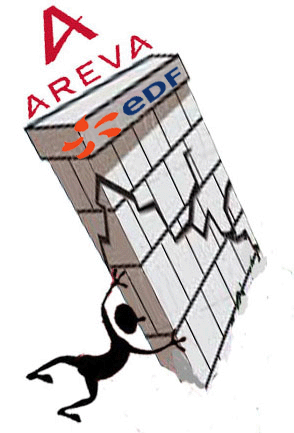 Hinkley Point – Edf to decide whether to build nuclear power station next week By Central Somerset Gazette January 19, 2016 A DECISION on whether a nuclear power station is built at Hinkley Point could be announced next week.
Reports in the French press indicate that the board of directors of the French state electricity generator EDF will meet on January 27 to make a final investment decision on the construction of two nuclear reactors at Hinkley Point near Bridgwater.
The final investment decision on the project has been delayed due to the lengthy negotiations with Chinese partners.
However even now there are concerns that the board might defer the decision for the ninth time……….
EDF is also locked in negotiations surrounding a complex deal to buy a French nuclear reactor builder, Areva, and in the disposal of it’s stake in eight current British nuclear power stations, five in the US, one in Finland and a number of Polish coal fired plants
Preparation of the site stopped last year when negotiations over the financing of the power station stalled.
Campaigners opposed to the building of Hinkley Point C are sceptical that the project will ever see the light of day.
Stop Hinkley spokesperson Roy Pumfrey said: “I’ll believe it when I see it. This is the ninth time EDF has said a final investment decision is imminent. Just last October the chairman of EDF, Jean-Bernard Levy, said work would be starting before the end of 2015. It would be completely reckless of the Board to give the go-ahead to this £25 billion project when the company is in such a parlous state.” http://www.centralsomersetgazette.co.uk/8203-Hinkley-Point-Edf-decide-build-nuclear-power/story-28559932-detail/story.html
Nuclear reactor Legal struggle continues between AREVA and Finland’s TVO
 Areva, TVO have month to settle nuclear reactor claims-minister http://af.reuters.com/article/commoditiesNews/idAFL8N154366 PARIS Jan 20 (Reuters) French nuclear reactor maker Areva and Finnish customer Teollisuuden Voima (TVO) will try to settle mutual claims over a long-delayed nuclear reactor within a month, French Economy Minister Emmanuel Macron said on Wednesday.
“I had the chance at the start of the week to speak to (Finnish Economy Minister) Olli Rehn, and we gave ourselves a month to let the companies and shareholders find the conditions for an agreement or way out,” Macron said on the sidelines of a New Year event.
Finnish utility TVO and an Areva-led consortium with Siemens are claiming billions of euros from one another in an arbitration suit over cost overruns and delays to the EPR reactor Areva is building in Olkiluoto, in Finland, for TVO.
The unsettled claims are holding up a planned takeover of Areva’s reactor arm by French utility EDF, which does not want to be responsible for them.
TVO has a 2.6 billion euro ($2.8 billion) claim against the Areva-Siemens consortium at the International Chamber of Commerce’s (ICC) arbitration court, while Areva-Siemens have a 3.4 billion euro counter-claim.
While the French state – which owns 85 percent of EDF and 87 percent of Areva – has a big stake in a speedy resolution of the Olkiluoto claims, TVO is a private company and the Finnish government’s position so far has been not to intervene.
TVO’s owners include paper companies UPM and Stora Enso as well as utility Fortum. (Reporting by Michel Rose and Yann Le Guernigou; Writing by Geert De Clercq; Editing by James Regan and Susan Thomas)
Canbada’s national security could be at risk in extending life of Pickering nuclear station

 Decisions at nuclear plant could compromise national security: safety commission, Global News, 20 Jan 16 By Monique Muise and Jacques Bourbeau
Ontario Power Generation Inc. was slapped with a $31,690 fine in a notice of violation issued on Jan. 12. The Canadian Nuclear Safety Commission states that on two occasions, the company “made unilateral decisions to cease corrective actions necessary for compliance with conditions of their Power Reactor Operating Licence” at the Pickering Nuclear Generating Station.
“If not corrected, this behavior could in the future result in unreasonable risks to national security, the health and safety of persons and the environment,” the notice says. “This (penalty) is issued to (Ontario Power Generation) to promote compliance with conditions of their licence and to deter reoccurrence.”……..
Nuclear power plants have always represented a potential security risk given the materials they contain, but in recent years it’s the risk of cyber-attacks that has governments concerned. Nuclear facilities are increasingly reliant on digital systems, which could potentially be hacked and – in a worst-case scenario – trigger a disaster……..
The notice was issued just one day after Ontario’s Liberal government announced that it wants to squeeze four more years of life out of the Pickering nuclear station. It will also start a $12.8 billion refurbishment of the Darlington power station this fall to extend that plant’s life by about 30 years.
Nuclear reactors at the stations were originally scheduled to be decommissioned in 2020. http://globalnews.ca/news/2466527/decisions-at-nuclear-plant-could-compromise-national-security-safety-commission/
Nuclear industry survived only because of ‘liability cap’
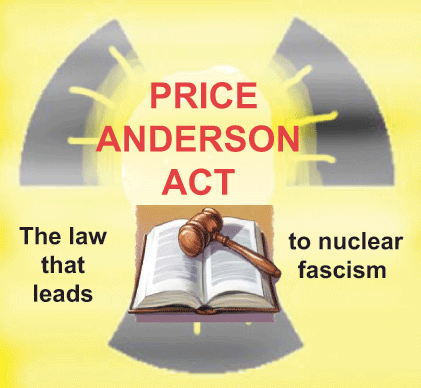
After 60 years of nuclear power, the industry survives only on stupendous subsidies, Ecologist, Pete Dolack 4th January 2016 Without ‘liability caps’ the industry would have been dead long ago
The British government, for instance, currently foots more than three-quarters of the bill for radioactive waste management and decommissioning, and for nuclear legacy sites. A report prepared for Parliament estimates that total public liability to date just for this program is around £50 billion, with tens of billions more to come.
Liability caps for accidents are also routine. In the US the Price-Anderson Act, in force since 1957, caps the total liability of nuclear operators in the event of a serious accident or attack to $10.5 billion. If the total is higher, as it surely would be, taxpayers would be on the hook for the rest.
As a further sweetener, the Bush II / Cheney administration, in 2005, signed into law new nuclear subsidies and tax breaks worth $13 billion. The Obama administration, attempting its own nuclear push, has offered an additional $36 billion in federal loan guarantees to underwrite new reactor construction, again putting the risk on taxpayers, not investors.
The Vermont Law School paper aptly sums up this picture with this conclusion: [page 69]
“If the owners and operators of nuclear reactors had to face the full liability of a nuclear accident and meet the alternatives in competition that is unfettered by subsidies, no one would have built a nuclear reactor in the past, no one would build a reactor today, and anyone who owned one would exit the nuclear business as quickly as they could.”
If we had a rational economic system, they surely would.http://www.theecologist.org/News/news_analysis/2986749/after_60_years_of_nuclear_power_the_industry_survives_only_on_stupendous_subsidies.html
Record $329BN GLOBAL INVESTMENT IN 2015 in RENEWABLE ENERGY
 CLEAN ENERGY DEFIES FOSSIL FUEL PRICE CRASH TO ATTRACT RECORD $329BN GLOBAL INVESTMENT IN 2015, Bloomberg New Energy Finance, JAN 14, 2016

View this press release in PDF.
2015 was also the highest ever for installation of renewable power capacity, with 64GW of wind and 57GW of solar PV commissioned during the year, an increase of nearly 30% over 2014.
London and New York, 14 January 2016 – Clean energy investment surged in China, Africa, the US, Latin America and India in 2015, driving the world total to its highest ever figure, of $328.9bn, up 4% from 2014’s revised $315.9bn and beating the previous record, set in 2011 by 3%.
The latest figures from Bloomberg New Energy Finance show dollar investment globally growing in 2015 to nearly six times its 2004 total and a new record of one third of a trillion dollars (see chart on page 3), despite four influences that might have been expected to restrain it.
These were: further declines in the cost of solar photovoltaics, meaning that more capacity could be installed for the same price; the strength of the US currency, reducing the dollar value of non-dollar investment; the continued weakness of the European economy, formerly the powerhouse of renewable energy investment; and perhaps most significantly, the plunge in fossil fuel commodity prices.
Over the 18 months to the end of 2015, the price of Brent crude plunged 67% from $112.36 to $37.28 per barrel, international steam coal delivered to the north west Europe hub dropped 35% from $73.70 to $47.60 per tonne. Natural gas in the US fell 48% on the Henry Hub index from $4.42 to $2.31 per million British Thermal Units.
Michael Liebreich, chairman of the advisory board at Bloomberg New Energy Finance, said: “These figures are a stunning riposte to all those who expected clean energy investment to stall on falling oil and gas prices. They highlight the improving cost-competitiveness of solar and wind power, driven in part by the move by many countries to reverse-auction new capacity rather than providing advantageous tariffs, a shift that has put producers under continuing price pressure.
“Wind and solar power are now being adopted in many developing countries as a natural and substantial part of the generation mix: they can be produced more cheaply than often high wholesale power prices; they reduce a country’s exposure to expected future fossil fuel prices; and above all they can be built very quickly to meet unfulfilled demand for electricity. And it is very hard to see these trends going backwards, in the light of December’s Paris Climate Agreement.”
Looking at the figures in detail, the biggest piece of the $328.9bn invested in clean energy in 2015 was asset finance of utility-scale projects such as wind farms, solar parks, biomass and waste-to-energy plants and small hydro-electric schemes. This totalled $199bn in 2015, up 6% on the previous year.[1]
The biggest projects financed last year included a string of large offshore wind arrays in the North Sea and off the coast of China. These included the UK’s 580MW Race Bank and 336MW Galloper, with estimated costs of $2.9bn and $2.3bn respectively, Germany’s 402MW Veja Mate, at $2.1bn, and China’s Longyuan Haian Jiangjiasha and Datang & Jiangsu Binhai, each of 300MW and $850m………
National trends
China was again by far the largest investor in clean energy in 2015, increasing its dominance with a 17% increase to $110.5bn, as its government spurred on wind and solar development to meet electricity demand, limit reliance on polluting coal-fired power stations and create international champions.
Second was the US, which invested $56bn, up 8% on the previous year and the strongest figure since the era of the ‘green stimulus’ policies in 2011. Money-raising by quoted ‘yieldcos’, plus solid growth in investment in new solar and wind projects, supported the US total……..http://about.bnef.com/press-releases/clean-energy-defies-fossil-fuel-price-crash-to-attract-record-329bn-global-investment-in-2015/
Kansai Electric plans to restart another nuclear reactor
Japan to restart another nuclear reactor Jan. 29, 1st on MOX fuel, Kyodo News, TOKYO, Jan. 21, Kyodo A nuclear plant in Fukui Prefecture is expected to restart operations on Jan. 29, the first that will run on uranium-plutonium mixed oxide fuel under new safety regulations, sources close to the matter said Thursday.
Final arrangements are under way to restart the No. 3 reactor of Kansai Electric Power Co.’s Takahama plant, the third such case after Japan returned to nuclear power generation last summer following the loss of nuclear energy amid safety concerns in the wake of the 2011 Fukushima disaster.
Last April, a district court banned Kansai Electric from restarting the Nos. 3 and 4 reactors of the Takahama plant citing safety concerns. But since the court lifted the injunction last month, the utility is now making preparations to reactivate the two reactors on the Sea of Japan coast, with the restart of the No. 4 unit planned for late February…..http://english.kyodonews.jp/news/2016/01/393890.html
Former nuclear power executive sentenced for fraud
 Former Executive of Nuclear Power Company Sentenced Jennifer R. Ransom to Serve 30 Months in Prison, Clearwater Tribune, 8 jan 16 BOISE – Jennifer R. Ransom, 41, of Meridian, Idaho, was sentenced Jan. 7 in United States District Court to 30 months in prison followed by three years of supervised release—the first six months of which is home confinement–for the crime of securities fraud, U.S. Attorney Wendy J. Olson announced. Senior United States District Judge Edward J. Lodge also ordered Ransom to forfeit $580,780 and pay $116,138 in restitution to victim-investors. Ransom pleaded guilty to one count of securities fraud on April 21, 2015.
According to the plea agreement, Ransom was the Senior Vice President of Administration of Alternate Energy Holdings, Inc. (“AEHI”). AEHI was a development stage company headquartered in Eagle, Idaho, that planned to construct and operate a nuclear power plant in Payette County, Idaho.
According to the plea agreement, Ransom joined AEHI in late 2007. Prior to joining AEHI, Ransom took and passed the Series 63 examination, one of the tests required to become a licensed Securities Agent, and knew it was wrongful and unlawful to engage in conduct that was designed to defraud or deceive investors by artificially controlling or fraudulently affecting the price of securities. Notwithstanding, she agreed with her co-defendant, Donald L. Gillispie, the former President and CEO of AEHI, and other “nominees” to a scheme to defraud or deceive AEHI investors……..
n May of 2015, Ms. Ransom’s co-defendant, Donald Gillispie, failed to appear for two scheduled arraignment hearings. He remains a fugitive and is being pursued by the United States Marshals Service.
The case was investigated by the Internal Revenue Service, Criminal Investigation Division, and the Federal Bureau of Investigation.
Today’s announcement is part of efforts underway by President Obama’s Financial Fraud Enforcement Task Force (FFETF), which was created in November 2009 to wage an aggressive, coordinated and proactive effort to investigate and prosecute financial crimes http://www.clearwatertribune.com/news/online_only_news/former-executive-of-nuclear-power-company-sentenced/article_658d5ea2-b65a-11e5-81af-1b4cc23d91cb.html
Pro nuclear Bill moves to Wisconsin Senate
Nuclear options, ISTHMUS, 21 Jan 16 January 21, 2016 (Wisconsin) “…….Under current law, state regulators are barred from approving new nuclear power plants unless there is a federal facility to store nuclear waste and the new plant is not a financial burden for ratepayers. No such federal facility exists. A proposal from Rep. Kevin Petersen (R-Waupaca) removing those provisions made it through committee with bipartisan support last month and passed in the Assembly on Jan. 12.
Now, it moves on to the Senate. A spokeswoman for Senate Majority Leader Scott Fitzgerald did not respond to an Isthmus request for comment on the status of the bill. Gov. Scott Walker has said he supports lifting the moratorium………
Alliant Energy spokesman Scott Reigstad says the company is focusing on transitioning its energy generation mix away from large, coal-fired plants and ramping up natural gas generation, which produces 50% to 60% less carbon. Alliant also owns wind farms and hydroelectric dams and has seen growth in customer-owned renewables, like solar panels.
Madison Gas and Electric recently launched a renewable energy initiative, Energy 2030, which aims to supply 30% of its retail energy sales from renewable sources by 2030. The plan makes no mention of nuclear power, says Dana Brueck, MGE spokeswoman.
Environmental groups agree on the need to cut carbon emissions. But many say renewable energy sources like wind and solar offer a cheaper option for generating power.
“If we want to reduce customers’ bills, energy efficiency is the answer,” says Mitch Brey, organizer for renewable energy advocacy group RePower Madison. He says that instead of exploring nuclear options, the Legislature should focus on reducing the state’s dependency on coal. Wisconsin is one of the biggest coal consumers in the nation — more than 60% of the net electricity generation came from burning the fossil fuel in 2013, according to the U.S. Department of Energy.
Renewable energy is also safer than nuclear power, say environmentalists, who fear the prospect of nuclear catastrophes like those that occurred at Chernobyl, Three Mile Island and Fukushima.
“There’s a saying that when you have a solar spill, it’s called a sunny day,” says Elizabeth Ward, a program coordinator with the Sierra Club-John Muir Chapter.
Ward says nuclear power plants are unlikely to help Wisconsin meet the EPA’s Clean Power Plan goals by the 2030 deadline. Facilities are costly and time-consuming to construct, and utility companies have no plans to build in the near future.
“There’s no way we could see a proposal, approval and construction of a nuclear power plant by that time,” she says.
Ward also warns of a possible “unintended consequence” of the legislation. She believes if the moratorium is lifted, it would “strongly signal” to the U.S. Department of Energy that Wisconsin is open to storing nuclear waste. President Barack Obama halted plans to store spent nuclear fuel at Yucca Mountain in Nevada, but the DOE has also identified Wisconsin’s Wolf River Batholith as a possible site for a repository.
“That does not bode well,” Ward says……….
Nuclear power: high costs, massive subsidies – some details
 After 60 years of nuclear power, the industry survives only on stupendous subsidies, Ecologist, Pete Dolack 4th January 2016 It’s a global phenomenon
“………….Numerous research papers paint a fuller picture. A Congressional Research Service report found that nuclear power had received $74 billion for research and developmentby the US government for the period 1948 to 1998, more than all such money given for fossil fuels, renewables and energy efficiency combined.
A report by the venture-capital firm DBL Investors, Ask Saint Onofrio, reports that nuclear energy cumulatively has received four times more subsidies than solar energy in California, and that nuclear subsidies were higher than solar in 2011 and all previous years. Nuclear has received $8.2 billion in subsidies in California, while providing the state with 3% of its power in 2012.
The uneconomical state of nuclear power is a global phenomenon, not limited to any one place. A comprehensive study prepared for the Green Party of Germany’s Heinrich Böll Stiftung, The Economics of Nuclear Power: An Update, reports:
“Up to now, nuclear power plants have been funded by massive public subsidies. For Germany the calculations roughly add up to over €100 billion and this preferential treatment is still going on today. As a result the billions set aside for the disposal of nuclear waste and the dismantling of nuclear power plants represent a tax-free manoeuvre for the companies.
“In addition the liability of the operators is limited to €2.5 billion – a tiny proportion of the costs that would result from a medium-sized nuclear accident.”
The paper later says: “Successive studies by the British government in 1989, 1995, and 2002 came to the conclusion that in a liberalised electricity market, electric utilities would not build nuclear power plants without government subsidies and government guarantees that cap costs. In most countries where the monopoly status of the generating companies has been removed, similar considerations would apply.”
Yet new plants are being built, with new subsidies
Significant cost overruns are the norm in building nuclear power plants, and it isn’t investors who are on the hook for them. Three nuclear projects are under construction in the United States and two in Western Europe, a group that features an assortment of cost overruns and generous guarantees:
- The two new Vogtle reactors in Georgia are already $3 billion over budget although their completion date is three and a half years away. The largest owner, Southern Company, has received $8.3 billion in federal loan guarantees. Overruns at this plant are not unprecedented; the two existing reactors cost $8.7 billion instead of the promised $600 million, resulting in higher electricity rates.
- The Watts Bar 2 nuclear reactor in Tennessee, which received its license to operate in October, has seen its cost rise to $6.1 billion from $2.5 billion. (This is technically a restart of a unit on which construction was suspended in 1985.) The existing reactor at this site has a history of safety problems.
- The Summer 2 and 3 reactors being built in South Carolina have already caused rate payers there to endure a series of rate increases. Cost overruns just since 2012 havetotaled almost $2 billion.
- In October 2013, British authorities approved a new nuclear reactor at Hinkley Point, England, that features subsidies designed to give the owner, Électricité de France, aguaranteed 10% rate of return on the project. Power from the plant will be sold at a fixed price, indexed to the consumer inflation rate.
In other words, The Independent reports, “should the market price fall below that [agreed-upon] level the Government would make up the difference.” The agreed-upon fixed price set by the Cameron government at the time was double the wholesale pricefor electricity. Since then the gap has only widened. - Olkiluoto-3 in Finland was supposed to have cost €3 billion, but is 10 years behind schedule and €5 billion over budget.
High costs despite high subsidies
There would at least be a small silver lining in this dark picture if the electricity produced were cheap. But that’s not the case. From the mid-1970s to the mid-1990s, the cost of producing electricity from nuclear power in France tripled and in the United States the cost increased fivefold, according to the Vermont Law School paper [page 46].
Then there are the costs of nuclear that are not imposed by any other energy source: What to do with all the radioactive waste? Regardless of who ultimately shoulders these costs, the environmental dangers will last for tens of thousands of years.
In the United States, there is the fiasco of the Yucca Mountain nuclear waste dump in Nevada. The US government has collected $35 billion from energy companies to finance the dump, which is the subject of fierce local opposition and appears to have no chance of being built.
Presumably, the energy companies have passed on these costs to their consumers but nonetheless are demanding the government take the radioactive waste they are storing at their plants or compensate them. As part of this deal, the US government made itself legally responsible for finding a permanent nuclear waste storage facility.
And, eventually, plants come to the end of their lives and must be decommissioned, another big expense that energy companies would like to be borne by someone else.
As the Heinrich Böll Stiftung study says, [page 17], “there is a significant mismatch between the interests of commercial concerns and society in general. Huge costs that will only be incurred far in the future have little weight in commercial decisions because such costs are ‘discounted’. This means that waste disposal costs and decommissioning costs, which are at present no more than ill-supported guesses, are of little interest to commercial companies.
“From a moral point of view, the current generation should be extremely wary of leaving such an uncertain, expensive, and potentially dangerous legacy to a future generation to deal with when there are no ways of reliably ensuring that the current generation can bequeath the funds to deal with them, much less bear the physical risk. Similarly, the accident risk also plays no part in decision-making because the companies are absolved of this risk by international treaties that shift the risk to taxpayers.” http://www.theecologist.org/News/news_analysis/2986749/after_60_years_of_nuclear_power_the_industry_survives_only_on_stupendous_subsidies.html
No response fro India’s PM Modi to Shiv Sena’s report on Jaitapur nuclear plant
PMO yet to respond to Shiv Sena’s report on Jaitapur nuclear plant By PTI | 21 Jan, 2016, MUMBAI: Shiv Sena is yet to receive a response from the Prime Minister’s Office (PMO) on a report it sent more than a month ago detailing “adverse” impact the proposed Jaitapur nuclear power plant would have on the green belt in Maharashtra’ Konkan region.
Nothing Resolved at Fukushima, Japan Must Not Sponsor the Olympic Games

I strongly support “an honorable retreat from the 2020 Olympic Games” which is called for by former PM Hatoyama and a former Japanese Ambassador to Switzerland Mitsuhei Murata.
Hatoyama says, in an interview with the Japan Times, “In a situation in which nothing has been resolved at #Fukushima, Japan must not sponsor something like the Olympic Games.”
Hatoyama also said “There are still many inhabitants of the Tohoku region living in temporary housing. Moreover, the government has yet to admit the truth about the accident despite its having been more severe than Chernobyl. It is regrettable that the government has failed in its duty to inform both the people of Japan and the world about the true situation. The government even goes so far as to deny the increased incidents of thyroid cancer in the Fukushima region are connected to radiation releases from the multiple meltdowns.”
Hatoyama believes the government claimed the situation at nuclear plant was “under control” in order to lure the 2020 Olympic Games to Tokyo. “The government was successful in this ploy,” he says, “but this was a complete lie. Far from having been under control then, it is still not under control even now. This is a grave situation.”
He also shared interesting comments about Okinawa and the US base issues in the following exclusive interview with the Japan Times.
Hatoyama dreams of a Japan anchored within a united Asia
“I wish to apologize to the Japanese people for having betrayed their expectations,” says Yukio Hatoyama halfway through our interview, lowering his head and bowing deeply.
Hatoyama, prime minister for nine months of the Democratic Party of Japan’s three years in power between 2009 and 2012, is discussing the reasons behind his resignation in June 2010 — specifically, his failure to live up to his party’s promise to block the contentious U.S. Marine Corps base construction now underway at Henoko in Okinawa.
Recently, the former DPJ leader has been in the news for other mea culpas in Nanjing and Seoul — apologies made, he says, on behalf of Japanese for colonial-era crimes in Asia. These unsanctioned trips have incensed the ruling Liberal Democratic Party, which has painted Hatoyama as a charlatan and even a traitor for his foreign escapades.
For those having trouble placing Hatoyama among the three DPJ figures who served as prime minister in that brief, heady period when power in postwar Japan changed hands, he is the one who led the DPJ to that historic victory. You know — the “alien.”
Hatoyama, now 68 and retired from politics, has never been able to shake that nickname. Coined by the domestic media in 2001 during his first stint as DPJ leader, the foreign press had a field day with Hatoyama’s extraterrestrial appellation, rejoicing in the fact that they finally had a Japanese leader who stood out from the crowd.
But what was it that made Hatoyama appear so otherworldly? True, his saucer-like eyes did give him a vague resemblance to E.T., but his nickname was not just the product of his looks and his manner; it also owed much to his proposals — proposals that were and remain anathema to Japan’s conservative establishment.
But how did Hatoyama, who came from a well-known, politically conservative family, become a maverick? In an exclusive interview with The Japan Times, Hatoyama discussed a range of issues, including Okinawa, the relationship between the Fukushima No. 1 disaster and the 2020 Tokyo Olympic Games, and his proposal for the creation of an “East Asian EU.” He began by explaining the circumstances that led him to resign the prime minister’s post in 2010 after only nine months in office.
“The DPJ, of which I was leader, proposed a revision of the Japan-U.S. Status of Forces Agreement in our manifesto for the 2009 House of Representatives election. We also proposed the realignment of the U.S. military in Japan, including a review of the state of U.S. bases,” he explains. “As for the relocation of the U.S. Marine base to Henoko, I personally said that at the very least, it should be moved outside (Okinawa) Prefecture. However, as soon as the DPJ took power, bureaucrats close to the U.S. in the Foreign Ministry and Defense Ministry moved to crush my proposal.”
In the end, Hatoyama’s idea went nowhere, and Henoko was confirmed as the proposed site for the new base. Many Okinawans — and DPJ voters — felt betrayed, and the party began to fear defeat in the Upper House elections of July 2010. “So I decided to resign,” Hatoyama confesses. “There was no excuse.”
During his time in office, Hatoyama also emphasized the need for a less lopsided Japan-U.S. relationship.
“I thought that as prime minister, it was only natural for me to seek an equal relationship with the United States. However, there are many (Japanese) politicians and bureaucrats who believe that because Japan is dependent on the U.S. in so many ways, it isn’t appropriate to seek an equal relationship. Once again, my proposal ended in failure.”
This was the first time in the postwar period that a Japanese prime minister had made such a demand. Hatoyama even dared suggest that Japan’s security could be achieved without a permanent U.S. troop presence. None of this was welcomed by those, on both sides of the Pacific, long accustomed to Japan’s subservience to U.S. interests.
Hatoyama was born in 1947 and graduated from the University of Tokyo before going to earn a Ph.D. in industrial engineering at Stanford. Upon graduation, he initially pursued an academic career, but later decided to run for the House of Representatives in 1986.
His lofty aim was to “restore sovereign power to the people, breaking from a system dependent on the bureaucracy,” he says, and to “transform Japan from a centralized state to one of regional and local sovereignty, and from an insular island to an open maritime state.”
During his campaign, Hatoyama took advantage of his experience as a researcher and garnered public attention with his unique appeal for “a scientific approach to politics.” Following his election, he quickly became a controversial figure for, among other things, revealing the huge scale of political campaign funding the LDP was receiving from business interests — even though he was a member of the party at the time.
“I eventually left the Liberal Democratic Party because of repeated incidents involving money and politics, such as the Recruit insider-trading and corruption scandal of 1988 and Shin Kanemaru’s huge tax evasion affair of 1992,” Hatoyama says. “Political reform was urgently called for, but the LDP was unwilling to act.”
A messy political realignment soon followed, eventually leading to the creation of the current iteration of the Democratic Party of Japan in 1998. Hatoyama went on to lead the party between 1999 and 2002, and again from May 2009. The DPJ grew steadily until finally, in September 2009, it succeeded in ousting the scandal-tainted LDP.
Hatoyama became Japan’s 93rd prime minister, though he would not remain so for long. Government bureaucrats, long accustomed to running the country behind the scenes, acted quickly to undermine his administration and hasten its demise.
Hatoyama says that Defense Ministry officials attempted to scuttle his plan to relocate the U.S. Marine Corps’ Futenma air base outside of Okinawa by claiming that any replacement facility must be located within 65 miles (105 km) of the marines’ Northern Okinawa Training Area. “The bureaucrats and ministers who should have been doing their best to support me were in fact attempting to resolve the matter by supporting the U.S.,” Hatoyama says.
The 65-mile requirement effectively precluded moving the base off the main island of Okinawa, which is a convenient 70 miles long. Yet the source of this apparent requirement remains elusive. Hatoyama says the Defense Ministry simply claimed that this figure was included in a U.S. military document. “Whether or not this requirement was expressly stated in the document remains unclear even now,” he notes.
But what about the U.S.? Were American officials also involved in the attempt to derail Hatoyama’s base relocation plans? Apparently not, Hatoyama says.
“No documents on the U.S. side support the claim of Defense Ministry officials. Thus, it can be said their claim was groundless,” he explains. “It’s possible it was just their way of forcing me to abandon my proposal. However, when we consider the feelings of the Okinawan people, there’s no way they would grant permission for the base to be relocated within Okinawa.”
At this point in the interview, Hatoyama bowed and offered his apology.
Another blow to the fledgling DPJ administration came in December 2009, when it was revealed that Hatoyama had received some ¥1.2 billion in political donations that had been improperly reported. Most of the money came from his mother, the wealthy heiress to the Bridgestone empire, though ¥400 million of this was listed as coming from fictitious donors — including some who were deceased.
While Hatoyama denied personal knowledge of the donations, he later apologized to the nation for the scandal and promised to pay more than ¥600 million in gift taxes on donations made to him by his mother that were first deemed as “loans.” Hatoyama recognizes the major impact this issue had on his tenure as prime minister, admitting, “The political donations I received from my mother were the second major reason I had to resign.”
Prosecutors declined to bring charges against Hatoyama, citing insufficient evidence of criminal activity. They did, however, indict two of his former secretaries, resulting in a ¥300,000 fine for one and a suspended sentence for the other. While no question of corporate bribery or political favors was involved, the incident nevertheless served to raise questions in the public’s mind about just how different the DPJ was from the money-tainted politics of the long-ruling LDP.
The media was unforgiving. After all, Hatoyama had already managed to upset both the establishment media and their new-media competitors. The former fought against his proposal to open up the prime minister’s news conferences to journalists from outside the cozy “press club,” and the latter were angry after he failed to follow through on that pledge.
“When I became prime minister, I tried to abolish the press-club system, which had become a vested interest for its members,” Hatoyama explains. “However, I was subject to a fierce counterattack.”
One club-affiliated reporter told Hatoyama that the prime minister’s press conferences were not something he was in charge of but, rather, something the press club sponsored.
Although by March 11, 2011, Naoto Kan was prime minister, Hatoyama was still a member of the House of Representatives, and the multiple disasters — especially the nuclear meltdowns at Fukushima No. 1 plant — affected him deeply. In the December 2011 issue of the magazine Nature, Hatoyama co-authored an article expressing his concerns about both the radioactive and political fallout from the accident.
Titled “Nationalize the Fukushima Daiichi atomic plant,” Hatoyama first pointed out the need “to know precisely what happened (on March 11, 2011) and what is continuing to happen now.” He further argued that only when all the evidence relating to the accident had been gathered and made public “will the world be able to have faith in the containment plan developed by Tepco or be able to judge how it should be modified.”
Hatoyama and two fellow Diet members formed a committee to conduct an independent investigation of the accident. The group reached two major conclusions, outlined in the Nature article. First: “The Fukushima Daiichi nuclear power plant must be nationalized so that information can be gathered openly. Even the most troubling facts should be released to the public.” Second: “A special science council should be created to help scientists from various disciplines work together on the analyses. That should help to overcome the dangerous optimism of some of the engineers who work within the nuclear industry.”
Although Hatoyama is no longer a Diet member, he has not lost interest in this issue. Recently, he joined former Japanese Ambassador to Switzerland Mitsuhei Murata in calling for “an honorable retreat from the 2020 Olympic Games.” Echoing Murata, who was also present at the interview, Hatoyama says, “In a situation in which nothing has been resolved at Fukushima, Japan must not sponsor something like the Olympic Games.”
Hatoyama elaborates: “There are still many inhabitants of the Tohoku region living in temporary housing. Moreover, the government has yet to admit the truth about the accident despite its having been more severe than Chernobyl. It is regrettable that the government has failed in its duty to inform both the people of Japan and the world about the true situation. The government even goes so far as to deny the increased incidents of thyroid cancer in the Fukushima region are connected to radiation releases from the multiple meltdowns.”
Hatoyama believes the government claimed the situation at nuclear plant was “under control” in order to lure the 2020 Olympic Games to Tokyo. “The government was successful in this ploy,” he says, “but this was a complete lie. Far from having been under control then, it is still not under control even now. This is a grave situation.”
Hatoyama’s change of mind is significant because as prime minister in October 2009 he had given a speech in Copenhagen in support of Tokyo’s failed bid for the 2016 Games. At the time, he sought to promote a new image of the Olympics centered on environmental protection, held in harmony with nature and celebrating simplicity.
March 11, 2011, however, changed everything. Again, like Murata, Hatoyama stresses that he is not opposed to the Olympics per se, but asks: Why now, and why Tokyo — especially in the absence of any pressing need to do so? Hatoyama nods in assent when Murata states: “At this point there is no other solution than to stage an honorable retreat from the games. Failure to do so will ultimately lead to a disgraceful retreat, dishonoring our country. The time to act is now!”
Hatoyama’s reservations about Japan’s future are not limited to either Fukushima or the Olympics. Politically and militarily, Hatoyama believes Japan is moving in an ever more dangerous direction.
“Prime Minister (Shinzo) Abe’s recent passage of the collective security bills has made it possible for America to call upon Japan to participate in its wars,” he says. “However, the Constitution states that Japan will never again wage war and, accordingly, rejects the threat or use of force as means of settling international disputes.”
He continues: “Given this, I deeply regret that the road to our participation in war has been opened once again. It may be presumptuous of me to say this now that I am no longer a politician, but in light of the wrong direction our country is currently heading in, I earnestly hope for an end to the Abe regime.”
Just as relations between Tokyo and Beijing were sinking to new lows over historical and territorial issues, Hatoyama infuriated the Abe government with his decision to visit Nanjing in January 2013. At the Nanjing Massacre Memorial Hall, he bowed and offered a silent prayer, later explaining, “As a Japanese, I feel responsible for the tragedy, and I am here expressing my sincere apology.”
While in Nanjing, Hatoyama also urged the Japanese government to acknowledge the dispute between the two countries concerning sovereignty of the islands known the Senkakus in Japanese and Diaoyu in China. “The Japanese government says there are no territorial disputes, but if you look at history, there is a dispute,” he says.
Hatoyama’s comments led Japanese government officials to criticize him for admitting the existence of a territorial dispute with China, something they adamantly deny. The defense minister at the time went so far as to use the word “traitor.”
“If his remarks have been politically used by China, I’m unhappy,” said Itsunori Onodera. “At that moment, the word ‘traitor’ arose in my mind.”
In March 2015, Hatoyama made another controversial trip, this time to Crimea, where he expressed his belief that Japan should “normalize” relations with Russia by lifting sanctions imposed after Moscow’s annexation of the Ukrainian territory. Hatoyama defended the referendum in the region as constitutional, stating, “Crimea wasn’t annexed unilaterally under pressure from Russia. In fact, people reached a conclusion based on their own strong will.”
Once again, Hatoyama’s remarks earned him the condemnation of the Japanese government. “It’s unthinkable that such action and comments came from a person who was once prime minister,” said Chief Cabinet Secretary Yoshihide Suga. Suga also described Hatoyama’s behavior as “extremely imprudent.”
In August 2015, just prior to Prime Minister Abe’s statement commemorating the 70th anniversary of the end of World War II, Hatoyama visited the Seodaemun Prison History Hall in Seoul. He knelt down in front of a memorial stone to apologize to Korean independence activists jailed, tortured and executed during Japan’s colonial control of Korea from 1910 to 1945.
“In the hope that no such mistake is made in the future, I regard, in a spirit of humility, these irrefutable facts of history, and express here once again my feelings of deep remorse and state my heartfelt apology,” he said.
Though Hatoyama’s actions may seem quixotic or even deliberately provocative to some, they are best understood through the prism of his world view, which stands in stark contrast to one of the guiding principles of modern Japan in the years following the Meiji Restoration. Promoted by the famous Meiji educator Yukichi Fukuzawa, this principle is known as Datsu-A Ron or the “Goodbye Asia doctrine.” Fukuzawa maintained, “It is better for us to leave the ranks of Asian nations and cast our lot with the civilized nations of the West.”
While not turning his back on the West, Hatoyama nevertheless seeks to redirect Japan’s focus away from the U.S. and back to its geographical location in Asia. He imagines a Japan at peace with its neighbors — from Russia in the north to China and South Korea — and at ease with its position on the edge of the continent.
With this dream in mind, Hatoyama created the East Asian Community Research Institute in March 2013, with the ultimate goal of creating something resembling an East Asian EU. With membership open to the general public, the institute, through its educational arm, Sekai Yuai Forum, holds lectures and other events to promote Hatoyama’s vision.
All of which brings us back to the issue of the U.S. military presence on Okinawa. Hatoyama continues to be concerned about the struggle of the Okinawan people against the construction of the new U.S. base at Henoko. This led to a series of trips to Okinawa seeking a solution to this intractable problem. As recently as November, Hatoyama visited the island to encourage the anti-base demonstrators at Henoko.
Hatoyama envisions a future for Okinawa not as a “keystone of the Pacific” for the U.S. military but as a “keystone of peace” for the countries of Asia. He has called for the creation of an “East Asian Community” headquartered in Okinawa and composed of the 10 members of the Association of Southeast Asian Nations plus Japan, China and South Korea.
“It is important for the countries of East Asia to become self-reliant, helping one another by developing win-win relationships,” he explains. “Should, however, they engage in a military arms race, it would only lead to a decline in deterrent power.”
“If Europe can do it,” says Hatoyama, pointing to the continent’s postwar integration, “there is no reason East Asia can’t.”
Source : Japan Times
http://www.japantimes.co.jp/community/2016/01/20/our-lives/hatoyama-dreams-japan-anchored-within-united-asia/#.VqFRnFLzN_k
Special credits to Mari Inoue & Libbe Halevy
Global Warming Forecasts | #climatechange
#auspol NO #coal #thorium #uranium #nuclear

Expert Global Warming Forecasts
GR: This reference covers global warming forecasts that scientists have made for the years 2015, 2020, 2025, 2030, 2035, 2040, 2050, 2080, 2090, and 2100. Projections by well-known scientists and peer-reviewed publications make this a dependable resource. Reading it, you might be amazed that there has been so much doubt and so little action on global warming.
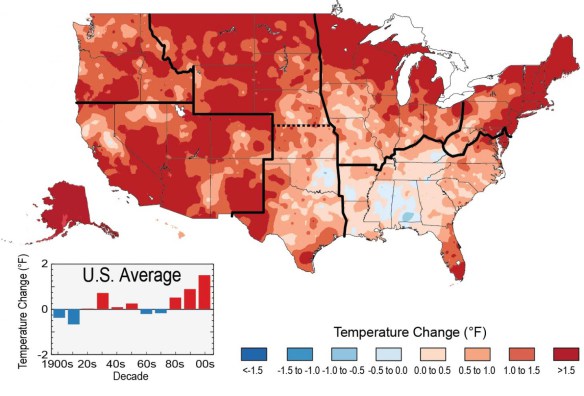 This map shows what has actually happened in the U. S. “The colors on the map show temperature changes over the past 22 years (1991-2012) compared to the 1901-1960 average for the contiguous U.S., and to the 1951-1980 average for Alaska and Hawaii. The bars on the graph show the average temperature changes by decade for 1901-2012 (relative to the 1901-1960 average). The far right bar (2000s decade) includes 2011 and 2012. The period from 2001 to 2012 was warmer than any previous decade in every region.” (U.S. Global…
View original post 360 more words
Foreign Corporations Operating UK Radioactive Waste Site “Self-Monitor” Radioactive Air Emissions: Drigg on the Irish Sea


French State Owned AREVA, Swedish Studsvik & California URS “Self Monitor” Radioactive Waste Gaseous Emissions in the UK at Drigg Radioactive waste dump, which they operate. Scandal-ridden AREVA would be bankrupt, if it were not a French State owned company, supported by the French taxpayer (and apparently the British and US taxpayer).
Two of the consortium members running the Drigg radioactive waste dump – URS and AREVA- are consortium members at the WIPP nuclear waste dump which has had major problems with emissions of radiation into the air.
WIPP nuclear waste accident led to unplanned gaseous radioactive emissions
Since that time URS was sold to AECOM (finalized Oct. 2014), also of California.
UK Environmental Agency Response to Marianne of Radiation Free Lakeland:
“From: CMBLNC Info Requests
Environment Agency
19 January 2016
Dear Marianne
Enquiry regarding Who Monitors Drigg Radioactive Waste Site
Thank you for your enquiry which was received…
View original post 858 more words
January 20 Energy News
#auspol #NuclearCommissionSAust NO #thorium #nuclear

Opinion:
¶ Why An Overflowing Oil Supply Won’t Drown Renewable Energy
Growth • Conventional wisdom posits that continuously cheap oil also poses a threat to the development of renewable energy. But for the most part, oil doesn’t compete with renewables, which are still growing in the face of cheap oil. [Huffington Post]
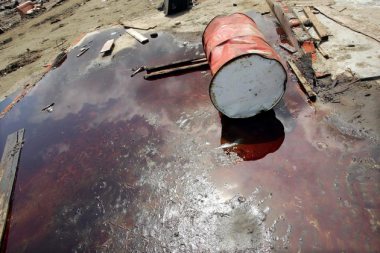
A barrel lies in a pool of oil at a damaged petroleum plant after an earthquake in Indonesia. Spencer Platt via Getty Images
Science and Technology:
¶ The cost of storing energy in batteries could fall by as much as 70% over the next 15 years as new solar battery technology and other technical advances drive prices down, the World Energy Council said. Grid-scale electricity storage would make the variable supply of renewable sources more flexible. [Times of India]
¶ Carbon capture and sequestration is expensive because each step, capture, distribution, and sequestration, is…
View original post 670 more words
1 This Month
Chernobyl: The Lost Tapes – A good documentary on Chernobyl on SBS available On Demand for the next 3 weeks– https://www.sbs.com.au/ondemand/tv-program/chernobyl-the-lost-tapes/2352741955560

of the week–London Campaign for Nuclear Disarmament

Tell the Ukrainian Government to Drop Prosecution of Peace Activist Yurii Sheliazhenko
To see nuclear-related stories in greater depth and intensity – go to https://nuclearinformation.wordpress.com
-
Archives
- April 2026 (152)
- March 2026 (251)
- February 2026 (268)
- January 2026 (308)
- December 2025 (358)
- November 2025 (359)
- October 2025 (376)
- September 2025 (257)
- August 2025 (319)
- July 2025 (230)
- June 2025 (348)
- May 2025 (261)
-
Categories
- 1
- 1 NUCLEAR ISSUES
- business and costs
- climate change
- culture and arts
- ENERGY
- environment
- health
- history
- indigenous issues
- Legal
- marketing of nuclear
- media
- opposition to nuclear
- PERSONAL STORIES
- politics
- politics international
- Religion and ethics
- safety
- secrets,lies and civil liberties
- spinbuster
- technology
- Uranium
- wastes
- weapons and war
- Women
- 2 WORLD
- ACTION
- AFRICA
- Atrocities
- AUSTRALIA
- Christina's notes
- Christina's themes
- culture and arts
- Events
- Fuk 2022
- Fuk 2023
- Fukushima 2017
- Fukushima 2018
- fukushima 2019
- Fukushima 2020
- Fukushima 2021
- general
- global warming
- Humour (God we need it)
- Nuclear
- RARE EARTHS
- Reference
- resources – print
- Resources -audiovicual
- Weekly Newsletter
- World
- World Nuclear
- YouTube
-
RSS
Entries RSS
Comments RSS
 nuclear-news