EDF in a’panic’ over decision to be made on UK’s Hinkley nuclear power station
 Hinkley Point: EDF set for decision on nuclear plant amid claims of board ‘panic’, The Independent, Sources in France say decision on whether to give the green light to controversial project would be made on Wednesday Geoffrey lean , 24 Jan 16
- The final decision on whether to build Britiain’s first nuclear power station in decades is set to be made by energy giant EDF this week, amid claims of “panic” among the French firm’s board over the viability of the £18bn project.
- Sources in France said the decision on whether to give the green light to its controversial plant at Hinkley Point, Somerset – on which ministers are depending to “kick-start a major new generation of nuclear power stations” – would be made on Wednesday. But the largely state-owned company refused to comment, or even to confirm or deny that the meeting is taking place.
This secrecy reflects the extreme sensitivity about the decision with practicalities and politics pulling in opposite directions. The project suffered a serious blow last week when French regulators delayed a decision on what to do about safety flaws in a similar reactor. But cancelling it would be a huge humiliation for British ministers, and could cause a cross-Channel diplomatic row.
- The “final investment decision” by EDF’s board – repeatedly delayed over the past two years – is the project’s only remaining hurdle.
Last October the government persuaded China to invest heavily in the plant, filling a funding shortfall, and the Energy Secretary Amber Rudd is awaiting the decision before signing a deal to allow the company to charge double the present price for the electricity generated from Hinkley’s twin reactors. Three similar European Pressurised Reactor (EPR) projects are planned for Britain if it succeeds…….
- there are signs of last minute jitters. Union leaders are reportedly warning the company of “financial, industrial and legal risks” in the project, while the French financial journal Boursier.com has suggested that there is “panic on board”.
Last week the French nuclear regulator delayed until the end of the year a decision on what to do about “very serious” weaknesses detected in the pressure vessel of a similar EPR being built at Flamanville, Normandy. The same fault – which could lead to a nuclear accident – was detected in the vessels for the Hinkley reactors, which had been built and will now have to be replaced.
- The Flamanville plant is five years behind schedule and its cost has trebled, while the only other EPR being built in Europe, in Finland, is almost a decade late, and the cost has more than doubled. Two other EPRs being built in China are also thought to be over-running while the cost of Hinkley has already soared.
EDF’s share price has plunged to record lows, and the company is considering selling billions of pounds of assets to fund building Hinkley. On top of all that, Austria is taking Britain to the European Court, alleging it is subsidising the plant illegally.Some British experts believe that, faced with all these difficulties, EDF will defer a final decision again. http://www.independent.co.uk/news/uk/home-news/hinkley-point-edf-set-for-decision-on-nuclear-plant-amid-claims-of-board-panic-a6830456.html
Japan wrestling with problem of compensation for victims of nuclear accidents
Panel begins debate on limit of compensation in event of nuclear accident http://www.japantimes.co.jp/news/2016/01/24/national/panel-begins-debate-limit-compensation-event-nuclear-accident/#.VqUt4Jp97Gh JIJI The Japan Atomic Energy Commission has started full discussions by experts on whether to limit the power plant operator’s liability to pay damage compensation in the event of a nuclear accident.
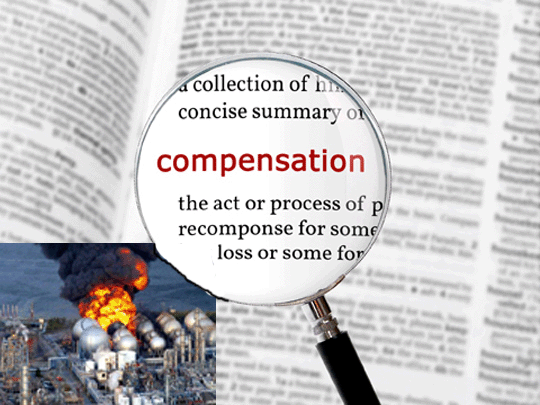
Currently, nuclear plant operators in Japan bear unlimited liability for compensation, but some experts demand that a ceiling be set for their responsibility.
The discussions are expected to be difficult, as limiting the liability would raise the problem of how to compensate affected people and businesses for the damage in excess of the limit.
For the March 2011 triple meltdown accident at Tokyo Electric Power Co.’s disaster-stricken Fukushima No. 1 plant, Tepco shoulders full liability for compensation under the nuclear compensation law.
But as Tepco alone cannot finance all the costs for compensation payments and decontamination work, the government set aside ¥9 trillion in assistance, which has been provided to the company through Nuclear Damage Compensation and Decommissioning Facilitation Corp., a public-private organization. Tepco repays the aid little by little.
Electric power industry people have been pushing for a cap on nuclear plant operators’ liability for compensation. “If the sky’s the limit for compensation, we cannot project an outlook for our nuclear energy business,” a senior official of a major power utility said.
In line with the government’s policy of continuing to use nuclear energy, an expert panel of the Japan Atomic Energy Commission started debate last year on any problems with the current compensation regime.
Some panel members argued for a limited liability system. “Shouldering risks that go beyond the limit of the private sector will impede fund procurement by electric power companies,” one member said.
On the other hand, a separate member said, “Limited liability is not an option, considering the current situation of Fukushima.”
There are also concerns that a narrower scope of responsibility for power companies could be detrimental to their commitment to safety.
With the panel divided sharply, a government official said no conclusion is expected at an early date.
The expert panel plans to produce a report on their discussions next year, and the government will subsequently start working on any necessary amendments to the nuclear compensation law.
Even if the nuclear compensation system is revised, past nuclear accidents will not be covered by a limited liability system.
Among countries that impose limits on an electric power company’s liability of compensation for a nuclear accident, the United States sets the maximum liability at $12.6 billion and Britain has a ceiling of £140 million ($199.7 million), according to the Japan Atomic Energy Commission. Under the U.S. system, if the scale of nuclear damage exceeds the limit, the president proposes a supplementary compensation program to the Congress.
France’s President Hollande visits India, hoping to market nuclear reactors
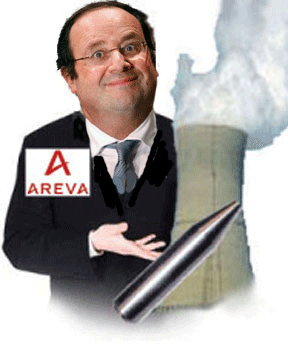 France Signals Rafale, Nuclear Progress as Hollande Visits India, Bloomberg, HeleneFouquet January 24, 2016 France signaled a state-to-state accord with India could be signed on Monday over a deal for 36 Dassault Aviation SA Rafale fighter jets, and that a six-year-old plan to build nuclear reactors in the South Asian nation would see some progress…………
The reactors are planned for Jaitapur, a coastal town in India’s western province of Maharashtra. Areva was seeking further clarity from India on its nuclear liability law before moving ahead with what would be India’s biggest nuclear plant.
The agreement India and the U.S signed recently over insurance-related issues for nuclear plants will help in overcoming certain hurdles, Royal said.
Wisconsin won’t get nuclear power, whether or not they lift the moratorium
 Tom Still: Repeal nuclear moratorium — but don’t expect new power plants in Wisconsin, Madison.com TOM STILL | Wisconsin Technology Council president, 24 Jan 16
It’s hard to find a more knowledgeable advocate of nuclear energy than Michael Corradini, a professor of engineering physics at UW-Madison, a past president of the American Nuclear Society and a longtime advisor to governments at home and abroad.
But if you ask Corradini whether a bill lifting a 1983 moratorium on building nuclear plants in Wisconsin will make a tangible difference any time soon, his answer is a starkly practical “no.”
The reasons for his pessimism reflect the reality of the costs of building such a plant in a state where incentives to do so are virtually non-existent. Barriers include the low global cost of oil and natural gas, decades of planning and approval time, continued opposition by most environmental groups and a state regulatory structure that doesn’t allow owners of a nuclear plant to recover costs in any reasonable amount of time.
Toss in the fact that energy demand in Wisconsin is relatively stagnant – the result of conservation efficiencies as well as economic trends – and the prospects for a “next-generation” nuclear power plant popping up in the Badger state are dimmer than a candle in a coal mine……..
- Some utility companies are adopting wind and solar power more quickly than others as they strive to stay a step ahead of current regulations, not to mention those they may face if President Obama’s Clean Power Plan and international standards take hold. Costs are falling for wind and solar, although low oil and gas costs are slowing adoption in some cases.
- Breakthroughs in energy storage technologies can help smooth out the bumps in intermittent energy sources such as wind and solar. Mechanical, thermal, compressed air and other technologies can make it possible to efficiently store electricity produced when the wind is blowing and the sun is shining…….. http://host.madison.com/wsj/business/tom-still-repeal-nuclear-moratorium-but-don-t-expect-new/article_4af610da-8dbc-55e7-a720-1ffb0f82f3af.html
South Carolina would do better to switch to renewable energy not to nuclear dead end
 Nuclear power enjoys large subsidies http://www.greenvilleonline.com/story/opinion/readers/2016/01/24/letter-nuclear-power-enjoys-large-subsidies/79131694/ Michael Kohl January 24, 2016 J. Winston Porter’s recent opinion piece regarding eliminating energy credits for wind and solar was misleading considering his support of nuclear energy. The nuclear industry has the highest degree of subsidization. Normally, utilities rely upon a variety of funding sources including corporate bonds. After the financal collapse of the Washington Public Power Supply System in 1983 with the loss of $2.3 billion to municipal bond investors, no financially prudent fund or investor will invest in the building of new reactors.
If nuclear power has a blank check for building new reactors in South Carolina, why is the nuclear industry concerned about solar and wind power? Perhaps it is that financially prudent utilities such as Duke Power and SCE&G are beginning to hedge their bets; not only investing in these alternative sources of power but also encouraging their customers to do so.
For less astute utilities such as Santee Cooper, the choice is to stay with coal where the cost of pollution control continues to rise. Nuclear reactors that are economically competitive, safe for the population and deal with the unresolved issues of nuclear waste require a level of ingenuity similar to that for expeditions to Mars.
Unfortunately for the nuclear industry, today’s most successful technical entrepreneurs are interested in going to Mars and building electric cars but not in the further development of nuclear power. What utilities in South Carolina today face is whether it is better to cut their losses on nuclear power and concentrate on becoming a 21st century utility that serves a distributive source for maintaining power generated by gas, hydropower, solar and wind, or stick with a government-sponsored boondoggle called nuclear power.
Chinese President Xi Jinping likely to attend nuclear summit in US
Chinese President Xi Jinping tipped to attend nuclear summit in US, South China Morning Post, Sidney Leng sidney.leng@scmp 24 Jan 16 Despite disagreement on North Korea, Beijing and Washington ‘have much common ground’President Xi Jinping is expected to make his second visit to the United States in less than a year to attend the Nuclear Security Summit in Washington in March, according to national defence and military experts from both countries.
During Xi’s state visit to the US in September, the two countries agreed to deepen cooperation on nuclear security. Beijing has not confirmed Xi’s attendance, but several Chinese academics and analysts at a China Energy Fund Committee conference in Hong Kong yesterday said he would probably go.
A White House fact sheet dated September also said the two countries might hold a meeting before the summit to discuss nuclear security.
“The two countries share common interests in intercepting nuclear terrorism, so I think there is plenty of room for cooperation on it, among other issues,” said Zhang Tuosheng, from the China Foundation For International and Strategic Studies.
READ MORE: China will work with US to implement Iran nuclear deal, Xi tells Obama……..
Chinese foreign policy strategists say China has already put enough pressure on North Korea, made denuclearisation a priority in the region and insisted on addressing the issue through dialogue.
“If the six-party talks [involving the two Koreas, Japan, China, Russia and the US] don’t work, then I propose trilateral dialogues, such as ones between China, the US and South Korea. The most important thing is managing a crisis,” Zhang said. http://www.scmp.com/news/china/diplomacy-defence/article/1904776/chinese-president-xi-jinping-tipped-attend-nuclear
Decontamination of minds
A Japanese organization called “declaration of safety in Fukushima” (福島 安全 宣言) or something like that launched a campaign for the “decontamination of minds” (心 の 除 染) to convince that radioactivity is safe.
In a video taken in the twenty kilometers zone, sill evacuated, a person takes radiation readings and states that it is safe as it is well below 100 mSv. But the video avoids the most contaminated areas and confuses microsieverts and microsieverts / hour. When the Japanese authorities say there is no risk below 100 mSv, it is on the whole life span. To compare that value to microsieverts per hour or millisieverts per year is meaningless.
There are also videos of pseudo-scientific conferences to affirm that radiation in Fukushima is safe. The audience seems very small.
The group calls for the lifting of the evacuation orders and the return of inhabitants, and also for the restart of the declared safe nuclear reactors.
Another similar initiative, already presented by the Blog of Fukushima, has been to make children to pick up garbage along the highway 6 that passes thru the forbidden zone. This time, it was an organization called “Happy Road Net” which was the organizer. http://happyroad.net/wordpress/wp-content/uploads/2015/09/Image150915145225.pdf
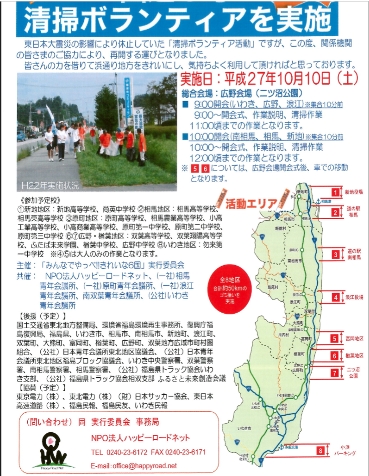
Let us remember that it is internationally recognized that there is no safe limit for radiation and that each radiation dose has an impact that is proportional to it. In such a context, it is recommended that the radiation exposure should be justified by a benefit. What was the benefit for these children?
It’s a safe bet to say that the decontamination of minds will be no more effective than the decontamination of the contaminated territories was …
Source: http://fukushima.eu.org/la-decontamination-de-lesprit/
January 24 Energy News

Science and Technology:
¶ Lake Poopó is more than 12,000 feet above sea level on Bolivia’s semi-arid Andean plains. Even though the lake has dried up before, according to experts, this time the recovery will no longer be possible. “This is a picture of the future of climate change,” a glaciologist says. (The lake’s area was about 250,000 acres.) [Laurel Leader Call]
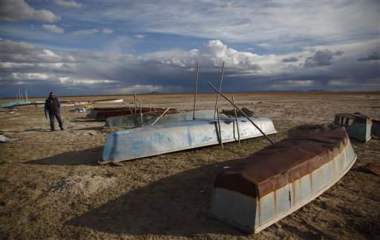 Fishing boats on what was once a shore.
World:
¶ Based on research done by Stanford University, led by Mark Z. Jacobson, The Solutions Project is popularizing the maps and plans. It has created infographics highlighting which future energy mix will theoretically be the best to achieve the zero-emission target for each of these 139 countries. [CleanTechnica]
¶ Swiss battery manufacturer Leclanché has been selected by Hecate Canada Storage II, LLP to deliver a 13-MW/53-MWh system. Leclanché will team with Deltro Energy Inc on the…
View original post 552 more words
Radioactive Wild Monkey Poops from Namie-city, Fukushima
January 23, 2016
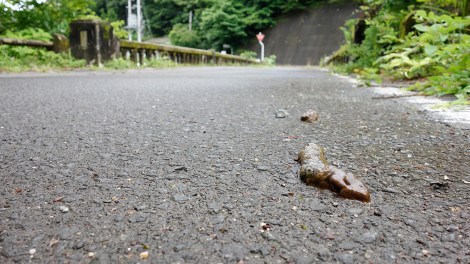
An example of bio-accumulation of radioactive material in Fukushima:
According to the following post, wild monkey poops from Namie-city, Fukushima had more than 150,000Bq/kg in terms of radioactive Cs137 & Cs134.
Cs137: 133987 Bq/kg
Cs134: 25186 Bq/kg
K40: 225 Bq/kg
The surrounding ground surface was about 500~600cpm.
More details at the Japanese blog :
http://www.autoradiograph.org/info/%E6%96%B0%E4%BD%9C35%EF%BC%9A%E3%82%B5%E3%83%AB%E3%81%AE%E7%B3%9E2/
USA changes law to make it harder for nuclear radiation victims to get compensation
the directive signals an initial step toward trying to dismantle or rein in a $12 billion compensation program that has made payments to more than 53,000 sickened workers or their survivors since 2001.
 Nuclear workers fear new policy will make it harder to win compensation
Department of Labor says nuclear facilities are much safer since 1995
Workers and advocates worry it will be more difficult to prove cases
A fight is underway to get policy repealed in order to protect sick employees
BY LINDSAY WISE, ROB HOTAKAINEN AND FRANK MATT McClatchy Washington Bureau, 22 Jan 16 WASHINGTON
Abelardo Garza was working near tanks full of toxic sludge at Hanford nuclear reservation in Washington state last Aug. 14 when one of his co-workers noticed a strange smell.
Within minutes, Garza’s nose started bleeding. The next morning, he awoke gasping for breath.
It was the fourth time in five years that Garza would end up in the hospital after suspected exposure to chemical vapors at Hanford, a 586-square-mile site where workers once made plutonium for the bomb dropped on Nagasaki, Japan.
Now Garza, 65, worries that a new federal directive the government says was intended to speed up compensation claims by sick and dying nuclear workers could harm his chances of qualifying for benefits if his health worsens in the future.
The directive, which became effective in December 2014, orders claims examiners to conclude that workers at Department of Energy nuclear facilities have not have any significant exposure to toxins since 1995 “in the absence of compelling data to the contrary.”
To Garza, the wording of the government’s directive feels like a dismissal. Continue reading
Trans Pacific Partnership lets corporations override environmental laws
the TPP would give foreign corporations like TransCanada broad power to demand compensation for policies that do not conform to their “expectations.”
In other words, any time our government takes an “unexpected” step to protect our air, our water, our economy, or the health of our families from dangerous projects like Keystone XL, corporations could use that as a reason to ask a tribunal to order the government to pay.
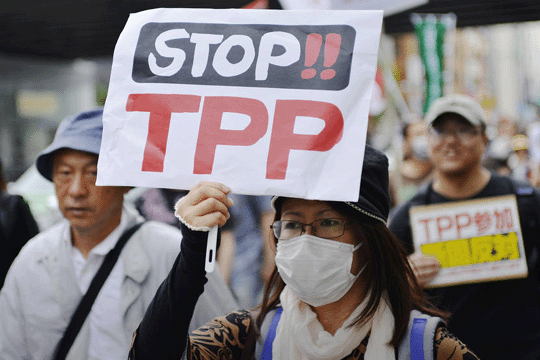
TPP provisions would undermine environmental efforts http://www.msnbc.com/msnbc/opinion-tpp-provisions-would-undermine-environmental-efforts?utm_content=buffer4500f&utm_medium=social&utm_source=twitter.com&utm_campaign=buffer 01/21/16 03 By Michael Brune For years the Sierra Club has warned that international trade deals could be used by corporations to undermine U.S. environmental protections. Now the Canadian oil company TransCanada is attempting to do exactly that in response to President Obama’s rejection of its Keystone XL tar sands pipeline.
This dispute won’t be settled in a normal court of law, though. Instead, it will be argued in a trade tribunal with no accountability to any domestic legal system — a private legal system that is outside U.S. law. No judge will hear the case. Instead, three private lawyers will issue a binding ruling that cannot be appealed. Many of these tribunal lawyers actually rotate between rendering judgments and representing corporations in their cases against governments. Therefore, it’s no great surprise when corporations come out on top and ordinary people either foot the bill or lose environmental and health protections.
This is unfair and unjust, pure and simple. We should be doing all we can to defend the environmental and health safeguards that keep us safe — not make them even more vulnerable to corporate attacks. Why would we want to lower our environmental standards to a lowest-common denominator dictated by the expectations of corporations who have proven they’d put profits before people?
Furthermore, at a time when virtually the entire world just agreed at the Paris climate talks that we must keep dirty fuels in the ground to avoid climate disaster, giant fossil fuel corporations see toxic trade agreements like the TPP as a way to trump the health and environmental protections that can keep dirty fuels in check and promote clean energy.
Luckily, opposition to the TPP is steadily growing, just as it did for the Keystone XL pipeline. Environmental groups, labor unions, public health advocates, and an array of diverse constituencies are voicing their opposition, whether because of investor-state dispute settlement provisions or one of the sweeping deal’s other controversial provisions. Many members of Congress from both parties are already saying no to the TPP.
We’ve seen what can happen when we come together to say no to a bad idea. We defeated the Keystone XL pipeline, and we can defeat the Trans-Pacific Partnership. We need a new model of trade that puts the health and safety of people before the profits of big corporations that are already polluting our air and water.
Michael Brune is the executive director of the Sierra Club, the nation’s largest grassroots environmental organization. Brune is the author of “Coming Clean — Breaking America’s Addiction to Oil and Coal.”
Washington State Bill Calls Nuclear “CLEAN”!
 Bill includes nuclear in Washington plan for clean power, Tri City Herald, 22 Jan 16
Sen. Sharon Brown wants nuclear to be included to maximum extent possible
Sen. John McCoy says no reason to call out nuclear above all other power sources
Bill passed out of committee 5-1

BY ANNETTE CARY acary@tricityherald.com A bill that would promote nuclear power in Washington state as a clean power source was passed out of a Senate committee this week, but with some opposition.
Sen. Sharon Brown, R-Kennewick, the lead sponsor of the bill, proposed the legislation to maximize the use of nuclear power in the state’s carbon reduction strategy. She is particularly interested in the possibilities for small modular reactors.
The legislation would require any state plan submitted to the U.S. Environmental Protection Agency related to its Clean Power Plan or any rule adopted by the state under the federal plan provide for the use of nuclear generation to the maximum extent allowed. Small modular reactors are specifically mentioned.
The reactors are proposed to be manufactured in factory and then shipped in modules to where they would be used, with more modules added as needed.
EPA set carbon pollution limits for the nation’s existing power plants in August in a rule called the Clean Power Plan. It set plans for individual states to reduce carbon pollution from existing plants and requires them to submit plans to ensure they meet carbon emission goals……..
Washington state law does not include any provisions against nuclear power, said Sen. John McCoy, D-Tulalip.
“Nuclear is part of the power mix,” he said. “The issue is, ‘Do we move nuclear to the top of the list and only support nuclear?’ The answer is no.”
It requires too much water and requires that uranium be mined, he said. He also pointed out that the nation has no repository for storing used nuclear fuel, he said. But it should still be considered part of the overall mix of energy for the state.
He voted against passing the bill out of committee, with Brown and four other senators in favor……..
However, a representative of the Oregon and Washington chapters of Physicians for Social Responsibility, Charles Johnson, said operation of a NuScale small modular reactor would require a vote of the people.
In 1981, state residents passed an initiative requiring voter approval before bonds are issued for energy production projects with a capacity of 250 megawatts or more. NuScale is proposing 50 megawatt reactors that could be linked together in groups of up to 12 to generate 600 megawatts.
“It is premature for us to decide to add this to the Clean Power Plan,” Johnson said. http://www.tri-cityherald.com/news/local/hanford/article56194035.html
Dangerous situation in Los Angeles gas crater
 LA gas well has ‘destabilized’, large crater develops in area — Officials: “Could be catastrophic” — TV: Risk of massive fire, possible explosion — Expert: “If wellhead fails, the thing is just going to be full blast… a horrible, horrible problem” — Company refuses to provide photos or media access (VIDEO) http://enenews.com/la-gas-destabilized-officials-could-be-catastrophic-tv-experts-highly-flammable-gas-creating-risk-massive-fire-explosion-professor-wellhead-fails-going-be-full-blast-itll-be-horrible-horrible-pr?utm_source=feedburner&utm_medium=email&utm_campaign=Feed%3A+ENENews+%28Energy+News%29
Los Angeles Times, Jan 15, 2016 (emphasis added): Efforts to plug Porter Ranch-area gas leakworsened blowout risk, regulators say — Southern California Gas Co… is trying to avoid a blowout, which state regulators said is now a significant concern after a seventh attempt to plug the well created more precarious conditions at the site. If a blowout occurs, highly flammable gas would vent directly up through the well… rather than dissipating as it does now… State officials said a blowout would increase the amount of leaked gas… That natural gas also creates the risk of a massive fire… The risk of fire already is so high that cellphones and watches are banned from the site… [The gas company’s attempts to stop the leak] expanded a crater around the wellhead, state and gas company officials said. The crater is now 25 feet deep, 80 feet long and 30 feet wide, those officials said… [The gas company] declined repeated requests from The Times… The gascompany would not provide current photos of the site or allow media access… In one internal state report obtained by The Times, an agencyofficial described [one] kill effort as a “blowout to surface.” “A large column of gas, aerated mud, and rock formed a geyseraround the wellhead,” the state observer wrote.
Scott McGurk, senior oil and gas field regulator assigned to daily watch at Aliso Canyon, Jan 15, 2016: The site and wellhead were made more unstable by the gas company’s attempts to stop the leak by pumping a slurry directly into the well… The wellhead sits exposed within the cavernous space, held in place with cables attached after it wobbled during the plugging attempt… During one of [the plugging] attempts Nov. 13, a hole in the ground opened 20 feet north of the well… Gas that had seeped through diffuse rock fissures on the western side of the narrow ridge began streaming instead from the new vent… the vent allowed a “serious amount of gas” to escape.
Gene Nelson, a physical sciences professor at Cuesta College, Jan 15, 2016: “If the wellhead fails, the thing is just going to be full blast… It will be a horrible, horrible problem. The leak rates would go way up.”
Don Drysdale, California Department of Conservation spokesman, Jan 15, 2016: Thepossibility of fire [is] “a concern” even without a blowout.
Los Angeles Times, Jan 16, 2016: [There’s] new evidence the [Puclic Utility Commission] is concerned that the compromised well site in Aliso Canyon is vulnerable to either a blowout… an explosion, or both… PUC includes a warning that damage to the well system, which was subjected to two months of aggressive high-pressure pumping to try to plug the leak, might now permit air to mix with methane in a way that “could be catastrophic.”… [T]he utility began a series of increasingly aggressive attempts to plug the well with heavy mud… those efforts instead scoured a 25-foot-deep crater around the well, blew out a large vent from which gas could escape more freely, and threatened the stability of the wellhead itself… The Department of Conservation says those facilities present “a direct and ongoing threat to public health, safety, and the environment”…
NPR, Jan 15, 2016: Adding to concerns over the disaster, efforts to stop the leak appear to have destabilized the well, the Los Angeles Times reports, raising the risk of a blowout… SoCalGas’ efforts to cap the well have actually increased the risk of a blowout. Seven attempts to plug the leak have made the area less stable… even without a blowout, the leak could catch on fire.
FOX LA transcript, Jan 16, 2016: “Trying to avoid a blowout, state regulators say it’s now a big concern after SoCalGas has tried to plug a leaking well near Porter Ranch seven times. If a blowout happens, experts say highly flammable gas would go up the well, creating a risk of a massive fire — possibly even an explosion.”
Watch FOX LA’s broadcast here (wait for 2nd video to play autonatically)
Legal action over Los Alamos failure to complete radioactive trash cleanup
 Nuclear Watch to sue over LANL cleanup problems By Mark Oswald / Journal Staff Writer January 21st, 2016 Albuquerque Journal SANTA FE – Nuclear Watch New Mexico on Wednesday put the federal Department of Energy and the private contractor that manages Los Alamos National Laboratory on official notice that it will file suit over the lab’s failure to meet cleanup goals established in a legally binding 2005 consent order.
The notice mailed Wednesday notes the lab missed a December final deadline for completion of Los Alamos clean-up work and hasn’t asked for an extension of the now-expired schedule that was set a decade ago.
That makes DOE and Los Alamos National Security LLC (LANS), the lab’s private manager, liable for civil penalties and subject to injunction, says the notice by attorney Jonathan Block of the New Mexico Environmental Law Center.
“We are putting the weaponeers on notice that they have to clean up their radioactive and toxic mess first before making another one for a nuclear weapons stockpile that is already bloated far beyond what we need,” said Jay Coghlan, executive director of Nuke Watch, a nonprofit watchdog group. He was referring to DOE’s recent preliminary approvals for changes at Los Alamos, including new underground facilities, to accommodate re-starting production of plutonium “pits,” the triggers for nuclear weapons……..
The Environment Department has plans to revise the 2005 cleanup consent order with DOE and LANS, a private consortium that includes Bechtel and the University of California.
The order was a result of the Environment Department’s 2002 finding that decades worth of radioactive and hazardous waste at Los Alamos posed an “imminent” threat to health and the environment. The state issued an order requiring LANL to investigate its 40-square-mile property for waste. DOE and the lab argued their own cleanup schedule was better and sued.
The 2005 consent deal ending the dispute laid out milestones toward “fence-to-fence” cleanup by 2015, enforceable by financial penalties. But getting enough funding for the work – federal dollars have been mostly in the range of $185 million to $200 million annually – became increasingly difficult, and it was clear in recent years that the lab would come nowhere near meeting deadlines set in the 2005 document. In November, state Environment Secretary Ryan Flynn said he believes it will cost much more than DOE’s own $1.2 billion estimate to finish the job.
Nuke Watch’s Coghlan said Wednesday that cleanup at Los Alamos “continues to be delayed, delayed, delayed,” despite plans to spend a trillion dollars over 30 years to rebuild the U.S. nuclear weapons force……..
Nuke Watch also has been pushing for a formal public hearing process – which Nuke Watch contends is required and allows interested parties to submit materials and question witnesses – as a revised consent order on cleanup is developed. Flynn has said that would cause delays and promised opportunities for public comment instead in other settings, such as meetings of a citizens advisory board.
Flynn also has insisted that before a new consent order is negotiated, DOE must come to final agreement with the state over plans for $73.5 million that the federal agency agreed to pay for a radioactive leak that has shut down the nation’s nuclear waste repository near Carlsbad. Two years ago, a waste drum from LANL, improperly packed, breached at the Waste Isolation Pilot Plant and contaminated the storage facility. http://www.abqjournal.com/709455/news/nuke-watch-files-suit-over-missed-clean-up-deadlines-at-los-alamos.html
Report on errors in nuclear missile incident is classified ‘secret’
 US airmen damage nuclear missile as ‘troubleshooting’ mission goes wrong, Guardian, 23 Jan 16
The air force stripped the three airmen of their nuclear certification following the incident in 2014 and quietly launched an accident investigation. Errors by three airmen troubleshooting a nuclear missile in its launch silo in 2014 triggered a “mishap” that damaged the missile, prompting the Air Force to strip the airmen of their nuclear certification and quietly launch an accident investigation.
In a statement, the Air Force declined to provide details of the incident or a copy of the report produced last November by the Accident Investigation Board, saying the information was classified and too sensitive to be made public.
Under the Air Force’s own regulations, Accident Investigation Board reports are supposed to be made public. The Air Force did release a brief summary to the Associated Press after it repeatedly sought answers for more than a year. The summary said the full report was classified by General Robin Rand, who took over as commander of Air Force Global Strike Command in July 2015……..
The accident follows a period of turmoil inside the nuclear missile corps amid an emerging national debate about the costs and benefits of investing hundreds of billions of dollars to modernize the entire strategic nuclear force at a time when war craft is changing………..
The investigation report summary said the actual cause of the accident, established by “clear and convincing evidence,” is classified. ……http://www.theguardian.com/world/2016/jan/23/us-airmen-damage-nuclear-missile-as-troubleshooting-mission-goes-wrong
1 This Month
Chernobyl: The Lost Tapes – A good documentary on Chernobyl on SBS available On Demand for the next 3 weeks– https://www.sbs.com.au/ondemand/tv-program/chernobyl-the-lost-tapes/2352741955560

of the week–London Campaign for Nuclear Disarmament

Tell the Ukrainian Government to Drop Prosecution of Peace Activist Yurii Sheliazhenko
To see nuclear-related stories in greater depth and intensity – go to https://nuclearinformation.wordpress.com
-
Archives
- April 2026 (114)
- March 2026 (251)
- February 2026 (268)
- January 2026 (308)
- December 2025 (358)
- November 2025 (359)
- October 2025 (376)
- September 2025 (257)
- August 2025 (319)
- July 2025 (230)
- June 2025 (348)
- May 2025 (261)
-
Categories
- 1
- 1 NUCLEAR ISSUES
- business and costs
- climate change
- culture and arts
- ENERGY
- environment
- health
- history
- indigenous issues
- Legal
- marketing of nuclear
- media
- opposition to nuclear
- PERSONAL STORIES
- politics
- politics international
- Religion and ethics
- safety
- secrets,lies and civil liberties
- spinbuster
- technology
- Uranium
- wastes
- weapons and war
- Women
- 2 WORLD
- ACTION
- AFRICA
- Atrocities
- AUSTRALIA
- Christina's notes
- Christina's themes
- culture and arts
- Events
- Fuk 2022
- Fuk 2023
- Fukushima 2017
- Fukushima 2018
- fukushima 2019
- Fukushima 2020
- Fukushima 2021
- general
- global warming
- Humour (God we need it)
- Nuclear
- RARE EARTHS
- Reference
- resources – print
- Resources -audiovicual
- Weekly Newsletter
- World
- World Nuclear
- YouTube
-
RSS
Entries RSS
Comments RSS
 nuclear-news