nuclear-news

The News That Matters about the Nuclear Industry Fukushima Chernobyl Mayak Three Mile Island Atomic Testing Radiation Isotope

NRA’s data shows contamination level in Tokyo tap water higher than Fukushima by 24 percent

NRAs-data-shows-contamination-level-in-Tokyo-tap-water-higher-than-Fukushima-by-24-percent-800x500_c

According to NRA (Nuclear Regulation Authority), Cs-134/137 density in Tokyo tap water is 24% higher than Fukushima.
The report was released on 10/30/2015, titled as “Readings of radioactivity level in drinking water by prefecture” to cover from July to September in 2015.
From this report, only 0.0015 Bq/Kg of Cs-137  was detected in Fukushima drinking water. Cs-134 was not supposed to be detected. On the other hand, 0.00036 Bq/Kg of Cs-134 and 0.0015 of Bq/Kg were detected from Tokyo drinking water.
The measurement of Cs-134 is due to Fukushima accident.
NRA comments each data is based on the reports from prefectures.
It is not mentioned by Fukushima prefectural government why Cs-134 was not detected in their drinking water.

Click to access 194_20151030.pdf

NRA’s data shows contamination level in Tokyo tap water higher than Fukushima by 24 percent

January 28, 2016 Posted by | Fukushima 2016 | , | 1 Comment

Group to monitor trial of former TEPCO executives to clarify truth about Fukushima disaster

gghk

From left, Ruiko Muto, Kazuyoshi Sato and Takashi Soeda hold a news conference in Fukushima on Jan. 19 to announce a planned group that will monitor the trial of three former executives of Tokyo Electric Power Co.

Lawyers, journalists and scientists will form a group to help expose the truth and spread details about the Fukushima nuclear disaster during the criminal trial of three former executives of Tokyo Electric Power Co.
“We will encourage the court to hold a fair trial while transmitting information regarding the trial across the nation,” said an official of the planned organization, whose name is translated as “support group for the criminal procedure on the Fukushima No. 1 nuclear power plant.”
Tsunehisa Katsumata, former chairman of TEPCO, the operator of the crippled plant, and two former vice presidents, Sakae Muto and Ichiro Takekuro, face mandatory charges of professional negligence resulting in death and injury.
Although the trial is still months away, 33 people are now setting up the group, including Ruiko Muto, who heads an organization pursuing the criminal responsibility of TEPCO and government officials for the Fukushima nuclear disaster.
Tetsuji Imanaka, an assistant professor of nuclear engineering at the Kyoto University Research Reactor Institute, and Norma Field, a professor emeritus of East Asian Studies at the University of Chicago, have also joined.
Three reactors melted down at the Fukushima No. 1 nuclear plant after the Great East Japan Earthquake and tsunami struck on March 11, 2011. A number of hospital patients died in the chaotic evacuation.
About 14,000 residents of Fukushima Prefecture filed a criminal complaint against TEPCO executives, government officials and scientists in 2012, saying they were aware of the dangers to the Fukushima nuclear plant from a tsunami, but they failed in their responsibility to take proper countermeasures.
Tokyo prosecutors twice decided not to indict the three former TEPCO executives. However, the Tokyo No. 5 Committee for the Inquest of Prosecution, a panel of citizens, decided to forcibly indict the three in July last year.
“It has been almost five years since the disaster, but many details, including their foreseeability of the tsunami, remain unclear,” said science writer Takashi Soeda, one of the group’s co-founders. “As TEPCO has not unveiled a sufficient amount of information even in inquiries conducted by the Diet and the government or in civil lawsuits, the truth must be uncovered through the legal force of a criminal trial.”
Five lawyers appointed by the Tokyo District Court will act as prosecutors in the trial.
Legal experts expect the lawyers will indict the former TEPCO executives and release a statement naming the victims around March 11, the fifth anniversary of the triple disaster that still haunts the Tohoku region.
http://ajw.asahi.com/article/0311disaster/fukushima/AJ201601270055

January 28, 2016 Posted by | Fukushima 2016 | | 1 Comment

Nuclear reactor mockup to be used to advance decommissioning technology

jklmNARAHA, Fukushima Prefecture–A life-size model of a section of the crippled Fukushima No. 1 nuclear power plant that will be used in developing decommissioning technology is almost complete.

The mockup of the lower part of a reactor containment vessel will be used to develop remote-control technology used to locate the section from where radioactive water is leaking in order to repair damage, the Japan Atomic Energy Agency said.

A group of reporters from the Japan National Press Club were allowed to enter the test building of the JAEA’s Naraha Remote Technology Development Center in the town of Naraha.

The model is being built at the center by a consortium comprised of electric utilities and nuclear plant manufacturers. It is scheduled to be completed in mid-March.

Radiation levels near the reactors that went in meltdown in the aftermath of the 2011 earthquake and tsunami disaster remain too high for workers to approach. The development of remote-control technology is key to smoothly conducting the decommissioning work, which is estimated to take 30 to 40 years.

The Naraha center also houses a massive screen on which a 3-D image of the interior of a reactor building can be viewed by wearing special eyeglasses.

http://ajw.asahi.com/article/0311disaster/fukushima/AJ201601270040


January 28, 2016 Posted by | Fukushima 2016 | | 1 Comment

Radiation in Tokyo’s water at higher level than in Fukushima’s

water-radiationflag-japanNRA’s data shows contamination level in Tokyo tap water higher than Fukushima by 24 percent http://fukushima-diary.com/2016/01/nras-data-shows-contamination-level-in-tokyo-tap-water-higher-than-fukushima-by-24-percent/  According to NRA (Nuclear Regulation Authority), Cs-134/137 density in Tokyo tap water is 24% higher than Fukushima.

The report was released on 10/30/2015, titled as “Readings of radioactivity level in drinking water by prefecture” to cover from July to September in 2015.

From this report, only 0.0015 Bq/Kg of Cs-137  was detected in Fukushima drinking water. Cs-134 was not supposed to be detected. On the other hand, 0.00036 Bq/Kg of Cs-134 and 0.0015 of Bq/Kg were detected from Tokyo drinking water.

The measurement of Cs-134 is due to Fukushima accident.

NRA comments each data is based on the reports from prefectures.

It is not mentioned by Fukushima prefectural government why Cs-134 was not detected in their drinking water.

January 28, 2016 Posted by | Japan, water | 1 Comment

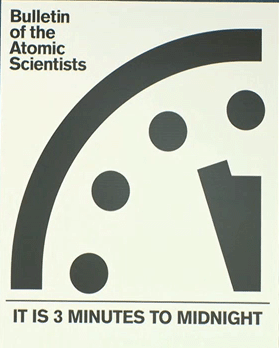
Doomsday Clock to stay at 3 minutes to midnight

Doomsday clock 2016‘Doomsday Clock’ to stand still amid nuclear tensions http://www.bbc.com/news/world-us-canada-35412454  26 January 2016  The so-called Doomsday Clock will remain set at three-minutes-to-midnight amid global perils such as climate change and nuclear proliferation.

The Bulletin of the Atomic Scientists (BPA), the group behind the clock, said the standing still is “not good news”.

The minute hand on the Doomsday Clock is a metaphor for how vulnerable the world is to catastrophe.

“It remains the closest it has been over the past 20 years,” said Rachel Bronson, BPA’s executive director.

In addition to nuclear arms and climate change, the group also cited growing cyber threats and an uptick in terrorist attacks in their decision to keep clock unchanged.

Lawrence Krauss, chairman of the BPA’s Board of Sponsors said that the Iran nuclear agreement and the Paris climate accord were good news, but said it remained unclear if the Paris agreement would actually reduce greenhouse gas emissions.

He also noted increased tensions between the US and Russia as a sore point.

Last year, the scientists moved the clock up from five-minutes-to-midnight, noting the threat of climate change, the modernisation of nuclear weapons as well as large nuclear arsenals.

At the time, they said the threats were “extraordinary and undeniable threats to the continued existence of humanity”.

The Bulletin of the Atomic Scientists was founded at the University of Chicago in 1945 by a group of scientists who helped develop the first atomic weapons. Their metaphorical clock was created two years later.

Today, the group includes physicists and environmental scientists from around the world, who decide whether to adjust the clock in consultation with the group’s Board of Sponsors – which includes 17 Nobel laureates.

The closest the clock has come to midnight was in 1953, when it was moved to two minutes from the apocalyptic midnight, following hydrogen bomb tests by the US and Russia.

January 28, 2016 Posted by | 2 WORLD, weapons and war | 1 Comment

Toshiba might sell off its unprofitable nuclear business in Japan

piggy-bank--nuke-sadStruggling Toshiba may spin off ailing Japan nuclear power business, Japan Times,  28 Jan 16, KYODO Scandal-hit Toshiba Corp. will consider splitting off its flagging nuclear power business in Japan and rebuilding it as a separate company as part of a sweeping restructure following an accounting scandal, sources said.

The 2011 Fukushima No. 1 nuclear plant disaster has made it difficult to build reactors in Japan amid safety concerns.

Toshiba’s subsidiary, Westinghouse Electric Co., which is in charge of its overseas nuclear power business, will seek to secure orders in emerging markets, the sources said Tuesday.

The move could trigger a realignment of the country’s nuclear power industry at a time when the government is aware of the need to bolster the competitiveness of domestic players, observers said…….

Toshiba said in November that Westinghouse had written down its assets by $1.3 billion in fiscal 2012 and 2013, revealing the difficulties facing the subsidiary in achieving profitability at the level anticipated by Toshiba.

Hit by the accounting scandal, Toshiba is proceeding with restructuring its unprofitable businesses….. http://www.japantimes.co.jp/news/2016/01/27/business/corporate-business/struggling-toshiba-may-spin-off-ailing-japan-nuclear-power-business/#.Vqkyc5p97Gh

January 28, 2016 Posted by | business and costs, Japan | Leave a comment

Fatal rockfall at planned French repository site

World Nuclear News  26 January 2016 One person was killed and another injured today by a tunnel collapse within an underground laboratory operated by French waste management agency Andra. The laboratory, near Bure in the Meuse/Haute Marne area, is assessing the site for its suitability to house a national radioactive waste repository.

According to an Andra statement, the working face of the gallery within the laboratory collapsed at 12.20pm. Geophysical surveys were being carried out at the time and the rockfall is believed to have happened as drilling was taking place. The gallery has now been evacuated and its stability is being assessed……. http://www.world-nuclear-news.org/RS-Fatal-landslide-at-planned-French-repository-site-2601165.html

January 28, 2016 Posted by | France, incidents | Leave a comment

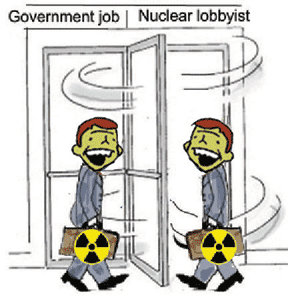
The nuclear revolving door: Former Labour MP appointed boss of nuclear industry trade body

 revolving-door1

STV News 27 Jan 16  A former Labour MP has been appointed chief executive of the trade body for the civil nuclear industry.Ex-MP for Rutherglen and Hamilton West Tom Greatrex will take up the post at the Nuclear Industry Association next week, succeeding Keith Parker.

Mr Greatrex was an opposition spokesman on energy until he lost his seat in last May’s general election.

He said: “I am delighted to be joining the Nuclear Industry Association at such an exciting time……http://news.stv.tv/west-central/1340504-former-labour-mp-appointed-boss-of-nuclear-industry-trade-body/

January 28, 2016 Posted by | politics, UK | Leave a comment

It’s looking increasingly as if the Hinkley C Nuclear EPR is dead in the water.

protest-Hinkley-Cflag-UKUnable to raise Hinkley C nuclear cash, EDF turns to French government, http://www.theecologist.org/News/news_round_up/2986989/unable_to_raise_hinkley_c_nuclear_cash_edf_turns_to_french_government.html Oliver Tickell 26th January 2016   Just as EDF was due to make its ‘final investment decision’ on Hinkley C, writes Oliver Tickell, Another delay. In spite of incredibly generous subsidies, the company is unable to finance it. Its last hope is to persuade the French state to take a 10% stake in the doomed project.

It was the decision a lot of people had been waiting for – EDF workers, the UK government, and campaigners for and against nuclear power in the UK.

As reported on The Ecologist today, The EDF board was due to make its ‘final investment decision’ on its controversial Hinkley Point C nuclear power station in Somerset, England, at a long-scheduled meeting tomorrow.

But now it has emerged in French newspaper reports that the decision has been deferred – indefinitely. No decision is now expected until after EDF presents its accounts on 16th February.

John Sauven, Executive Director of Greenpeace UK – the only national green NGO to campaign visibly on the issue – said today: “The EDF board is clearly rattled as they delay yet again this crucial investment decision. It could well signal curtains for Hinkley. EDF managers as well as employee representatives on the board are deeply concerned this project is too risky and too expensive.

All three EPR projects are massively delayed and hugely over budget. There isn’t a shred of evidence that it’ll be fourth time lucky in Somerset. The UK government needs to join the 21st century and start backing the renewable technologies that are proven to work, are cheaper than nuclear power, create jobs in the UK and contribute to the fight against climate change.”

EDF: ‘We haven’t got the cash!’

The revelation comes in the French newspaper Les Echos, which has been consistently ahead of the pack with high-level leaks from EDF. According to its report, published today, the parastatal corporation has been unable to raise the full sum – some £18 billion – with which to progress the project:

“Two years ago EDF built a financial plan in which it would take 40-50% of the shares, which allowed it not to consolidate the investment in its accounts and so not to weigh too heavily on its balance sheet. Areva was to hold 10% and foreign shareholders the balance.

“But the difficulties of Areva, coupled with the delayed EPR under construction at Flamanville (Manche), changed last autumn: Areva will not participate in the round, and only Chinese investors (CGN), which see it as a gateway for developing their own reactors in Europe, will participate in the consortium, at 33.5%.”

The report goes on to cite the severe financial embarrassment that has overtaken EDF – its collapsing share price, negative credit outlook, increasing nuclear waste disposal liabilities, which just increased by around €10 billion yesterday, steep falls in the French wholesale power price (€37 to €28/MWh) reducing its income by €2 billion a year, and its forced €2.5 billion purchase of  its bankrupt sister company, Areva.

Now EDF is demanding French Government support too But then comes the surprise: unable to raise funds it needs for Hinkley Point C through open market financing channels, it is asking the French Government to step in with a huge direct investment in the project, according to Les Echos:

“In this context, according to our information, EDF is now putting pressure on the State, its 84.5% shareholder, to find new financing. Since Areva would have contributed up to 10% in the project, EDF wishes to replace it with another entity.”

Considering that EDF has been casting around the world in its increasingly desperate search for cash, that can only mean one thing – that the French state should step in to make good the 10% funding gap left in the wake of Areva’s financial collapse.

But just consider the implications. First, EDF is itself effectively owned by the French state as 84.5% shareholder.

Second, it is being supported by the British government with a subsidy package of guaranteed index-linked power prices for 35 years at more than double the current wholesale price, plus ceilings on decommissioning and waste disposal costs, plus £10 billion loan finance guarantees, independently valued at over €100 billion over the project lifetime, all giving EDF an estimated 10% per annum return on capital.

Third, unable to obtain open market financing even with this UK energy user and taxpayer-financed package of amazing generosity behind it, it has been forced to turn to a third state-owned entity, China General Nuclear Company (CGN) to take a 33.5% stake in the project.

But now, fourth, even that’s not enough – and EDF needs to go back to its owner, the French government, to demand that it takes (or otherwise procures) a direct 10% stake in the project – because no one else will.

If anyone ever needed any convincing that nuclear power is utterly unable to survive in a free market economy, this is it.

But of course if any such thing happens, that would trigger yet another European Commission investigation into ‘illegal state aid’ for the Hinkley project. And even it it passes the hurdles, fresh legal challenges would surely follow, and further years of delay.

The final question – will any EPR ever be built?

It’s looking increasingly as if the Hinkley C EPR is dead in the water. The Flamanville EPR in France is facing huge problems with its metallurgical flaws in the reactor vessel and lid and it’s odds on that it will never be completed due to the massively escalating costs, delays, and safety uncertainties.

There are also big questions over the Olkiluoto EPR in Finland, as the costs of completing the hugely over-time, over budget reactor may be greater to EDF and Areva than walking away and abandoning the site.

Most likely to be completed is the twin-reactor Taishan EPR in China, which was meant to come in last of the bunch but is now well ahead. However there are widespread suspicions that its reactors, supplied by Areva, may suffer from the same flaws as those at Flamanville, explaining a long delay in construction activity.

So even if it ever is ‘built out’, Chinese safety regulators may never allow it to be turned on.

Sic transit gloria mundi.

January 28, 2016 Posted by | general | Leave a comment

North Carolina Environment Chief aims to restrict solar power, promote nuclear power!

Buy politicians

Flag-USANC environmental chief backs restriction on solar farms, incentives for nuclear plants. WRAL.com By Laura Leslie 28 Jan 16 RALEIGH, N.C— The solar industry has blossomed in North Carolina since lawmakers granted solar farms tax breaks nine years ago as part of renewable energy standards that require utilities to get a portion of their power from renewable sources.

 North Carolina ranks fourth nationally in solar energy capacity, and the industry employs about 5,600 people in the state, according to the Solar Energy Industries Association. Capitol Broadcasting Co., the parent company of WRAL, operates a solar farm near Garner.
 Now, critics of solar are trying to rein in the industry by rewriting state laws, and the head of the state Department of Environmental Quality is leading the charge, pushing the state Energy Policy Council to recommend some major changes.
 One proposal discussed Wednesday would require a state permit for any new solar farm. That would give the state the final say on whether a property owner can lease his or her land for solar. It would also require a bond for eventual removal of the equipment……..

Brian O’Hara, senior vice president of Chapel Hill-based Strata Solar, said the state and other stakeholders have already drafted a model ordinance to help local officials negotiate. He said the solar industry wasn’t consulted about the proposed state permit.

 “We’ve learned lot as an industry over the last couple of years,” O’Hara said. “We’ve grown dramatically, and there is a forum for looking at best practices around permitting, but I think that forum should include all the stakeholders.”
 A second proposal would redefine the state’s renewable energy standard to include nuclear energy. The proposed “clean energy standard” would even allow incentives for new nuclear plants, which van der Vaart said are needed to back up less dependable sources such as solar…….

Chatham County homeowner Sharon Garbutt, who lives 17 miles from the Shearon Harris nuclear plant in southwest Wake County, told the panel

 “If it’s clean energy, why do they need sirens to warn people in the event of an accident at that plant?” Garbutt said.
 The Energy Policy Council delayed voting on the two recommendations after members voiced concerns about how the policy changes would affect the energy industry. They plan to tweak the proposals and and discuss them again at their next meeting in March.  http://www.wral.com/nc-environmental-chief-backs-restriction-on-solar-farms-incentives-for-nuclear-plants/15284709/#KVmGgSsaF4GTTe9e.99

January 28, 2016 Posted by | politics, USA | Leave a comment

Safety concerns cause China to halt construction of two nuclear reactors

safety-symbol-Smflag-ChinaChina admits nuclear emergency response ‘inadequate’ as safety concerns halt construction of two Guangdong reactors, South China Morning Post,  Wednesday, 27 January, 2016, Stephen Chen  China admitted on Wednesday its nuclear emergency response mechanism is “inadequate” for coping with “new situations and challenges” arising from its nuclear power plants.

The central government also said it had halted construction of two new-generation nuclear reactors in Guangdong province, because of safety concerns, but vowed that they would not be abandoned……..

Concerns over nuclear safety in Hong Kong and Macau have caught particular attention of the central government. A section in the white paper was dedicated to the issue with promise to “answer public concerns in time” and “clear the doubts”.

Xu Dazhe, chairman of the China Atomic Energy Authority, told a press conference on Wednesday that the construction of the two European Pressurised Reactors in Taishan, in Guangdong, had been delayed owing to safety concerns…….

State-owned nuclear companies are also trying to sell their technology and reactors to other countries, including Britain, while considering controversial projects such as building a floating nuclear power plant in the South China Sea to provide remote islands in disputed waters. http://www.scmp.com/news/china/policies-politics/article/1906287/china-admits-nuclear-emergency-response-inadequate

January 28, 2016 Posted by | China, safety | Leave a comment

The growing climate problem of data farms’ consumption of energy

the only long-term solution to the energy problem will have to involve significant cuts to our internet use at some point in the future. This could be through some kind of tax or charge on data use – for example, imposing a fee for uploading photographs on to Facebook – or even a straightforward rationing of activity

data farm

Global warming: Data centres to consume three times as much energy in next decade, experts warn 416.2 terawatt hours of electricity world’s data centres used last year was far higher than UK’s total consumption,The Independent  Tom Bawden Environment Editor @BawdenTom 24 January 2016 The amount of energy consumed by the world’s data centres – the repositories for billions of gigabytes of information – will treble in the next decade, putting an enormous strain on energy supplies and dealing a hefty blow to efforts to contain global warming, experts say. 

Whether you’re “liking” something on Facebook, streaming the latest Tarantino movie or posting an instagram from the pub, every internet activity involves huge amounts of data that needs to be stored somewhere. And as the “internet of everything” brings innovations such as driverless cars and high-definition video watches ever closer, the vast network of data centres that have sprung up in the past decade will spread.

This wouldn’t be a problem if these facilities – which range from a small room with a few servers to vast 150,000 square metre “farms” – didn’t consume such enormous amounts of energy.

  • Already, data centres have mushroomed from virtually nothing 10 years ago to consuming about 3 per cent of the global electricity supply and accounting for about 2 per cent of total greenhouse gas emissions. That gives it the same carbon footprint as the airline industry.
  • To put the size of this consumption into even sharper relief – the 416.2 terawatt hours of electricity the world’s data centres used last year was significantly higher than the UK’s total consumption of about 300 terawatt hours.Massive as data centre energy use may already be, this is nothing to what lies in store, analysts warn. Ian Bitterlin, Britain’s foremost data centre expert and a visiting professor at the University of Leeds, says the amount of energy used by data centres is doubling every four years – despite the innovations in hardware that massively increase their capacity to store data. As a result, analysts forecast that data centres will consume roughly treble the amount of electricity in the next decade.

    One way to curb their carbon footprint is to increase the amount of renewable energy they use – a development that is already under way but has much, much further to go to offset the exponential growth in internet traffic, experts say. Even if the industry were able to shift to 100 per cent renewable electricity, the volume of energy they would need would put intolerable pressure on the world’s power systems.

  • “If we carry on going the way we have been it would become unsustainable – this level of data centre growth is not sustainable beyond the next 10 to 15 years. The question is, what are we going to do about it?” says Professor Bitterlin.He points to a study focused on Japan which suggests that its data centres would consume its entire electricity supply by 2030 if growth continues at today’s rate.

    “We need to be more responsible about what we use the internet for … Data centres aren’t the culprits – it’s driven by social media and mobile phones. It’s films, pornography, gambling, dating, shopping – anything that involves images. It’s a great example of the Jevons paradox – the easier you make it to consume the product the greater the consumption will be.”

  • Unless there is some kind of game-changing breakthrough on data storage – such as the development of a far-superior alternative to silicon – the world’s internet use is eventually going to have to be significantly rationed. Professor Bitterlin added that a form of carbon known as graphene could potentially revolutionise data storage.But even with a revolution in data storage capacity, he believes the only long-term solution to the energy problem will have to involve significant cuts to our internet use at some point in the future. This could be through some kind of tax or charge on data use – for example, imposing a fee for uploading photographs on to Facebook – or even a straightforward rationing of activity; but he acknowledges that these kind of moves would probably be “political suicide”. Other measures – such as switching from colour to black and white photographs – could also go a long way to reducing data consumption.

    Governments across the world, including the UK, are starting to wake up to the data centre problem at the same time as they encourage the roll-out of data-hungry broadband networks to ever remoter locations. The roll-out is primarily designed to help small businesses, but the bulk of the faster internet access is enjoyed by consumers. And some internet companies – such as Facebook, Google and Apple – are leading efforts to be more environmentally responsible. The measures being taken include housing data centres in cold climates – which dramatically reduces the energy needed to cool the facilities – with a ready supply of renewable energy. …..http://www.independent.co.uk/environment/global-warming-data-centres-to-consume-three-times-as-much-energy-in-next-decade-experts-warn-a6830086.html

January 28, 2016 Posted by | 2 WORLD, climate change, ENERGY | 1 Comment

Solar panel costs to fall 10% every year

piggy-ban-renewablesSolar panel costs predicted to fall 10% a year  Climate Home: Power from the sun could supply 20% of energy worldwide by 2027 on current technology trends, say UK researchers, Guardian, Megan Darby, 27 Jan 16,  Solar power costs are tumbling so fast the technology is likely to fast outstrip mainstream energy forecasts.That is the conclusion of Oxford University researchers, based on a new forecasting model published in Research Policy.

Since the 1980s, panels to generate electricity from sunshine have got 10% cheaper each year. That is likely to continue, the study said, putting solar on course to meet 20% of global energy needs by 2027.

By contrast, even in its “high renewable” scenario, the International EnergyAgency assumes solar panels will generate just 16% of electricity in 2050. Its widely cited future energy scenarios in previous years failed to predict solar’s rapid growth.

Mathematics professor Doyne Farmer, who co-wrote the paper, said the research could help to shape clean energy policy.

“Sceptics have claimed that solar PV cannot be ramped up quickly enough to play a significant role in combatting global warming,” he said.

“In a context where limited resources for technology investment constrain policy makers to focus on a few technologies… the ability to have improved forecasts and know how accurate they are should prove particularly useful.”

Farmer’s model, jointly developed with economist Francois Lafond, draws on historical data from 53 different technologies……http://www.theguardian.com/environment/2016/jan/26/solar-panel-costs-predicted-to-fall-10-a-year

January 28, 2016 Posted by | 2 WORLD, renewable | Leave a comment

Former PM Naoto Kan says Fukushima nuclear disaster is still unfolding


logo-Tokyo-OlympicsFukushima nuclear accident not over yet, says ex-PM Kanhttp://www.japantoday.com/category/politics/view/fukushima-nuclear-accident-not-over-yet-says-ex-pm-kan 
 JAN. 28, 2016  WASHINGTON —

Former Prime Minister of Japan Naoto Kan says the nuclear accident at the Fukushima Daiichi power plant is not over, despite nearly five years having passed since a massive earthquake and tsunami triggered the disaster.

“There is no doubt” radioactive materials have been seeping into the sea after mixing with underground water, Kan, who has been a vocal critic of nuclear energy since the accident, told the National Press Club in Washington on Tuesday.

Prime Minister Shinzo Abe has said the issue of water contaminated with radioactive substances at the Fukushima plant is “under control” on various occasions including his presentation to pitch Tokyo as host of the 2020 Olympic Games.

“The accident is still unfolding” at the nuclear plant operated by Tokyo Electric Power Co., Kan said.

Kan was prime minister when the world’s worst nuclear crisis after Chernobyl occurred following the massive earthquake and tsunami on March 11, 2011.

Kan, a lawmaker of the opposition Democratic Party of Japan, also criticized Abe’s decision to raise the ratio of electricity produced by atomic energy to 20-22 percent of the total output in 2030.

“The goal is not achievable” unless Japan extends the maximum legal period of nuclear plant operation or build a new nuclear plant, Kan said.Japan has halted most nuclear reactors since the Fukushima disaster out of concerns about the safety.

Kansai Electric Power Co. is set to reactivate a nuclear reactor at its Takahama plant on the Sea of Japan coast Friday in what would be the third restart since new safety standards were put in place after the quake.

January 28, 2016 Posted by | Japan, opposition to nuclear | Leave a comment

What if EDF says no to Hinkley Point?

protest-Hinkley-CEDF is still at the table, but nuclear could go critical for Osborne, Guardian,  Nils Pratley, 28 Jan 16 The UK’s nuclear energy strategy will be in meltdown if the French pull out of Hinkley. The best guess is, they’ll find the cash

What if EDF says no to Hinkley Point? What if the French power generator, under pressure from its unions and potential lenders, decides it can’t finance the £18bn project, even with the Chinese chipping in?

After all, the disgruntled French workers make a reasonable point. EDF’s last big foreign adventure, in Finland, is nine years behind schedule and massively over-budget, so why risk another expedition? EDF’s share price, remember, is down 85% since 2004: the company is in a weak position to resist its local critics.

The short answer is that the UK’s nuclear strategy would be in tatters if EDF backs out. If EDF can’t get financing for Hinkley, then Sizewell C, the company’s intended follow-on project in Suffolk, would also bite the dust. The same goes for the next plant at Bradwell in Essex, where Chinese constructors are supposed to be taking the lead, but are relying on Hinkley’s and Sizewell’s infrastructure and momentum.

And, if the UK’s nuclear strategy becomes a non-runner, then the government’s entire energy policy is dead. By the mid-2030s, Hinkleyand other new nuclear plants are supposed to have replaced the current clapped-out fleet and added capacity on top………http://www.theguardian.com/business/nils-pratley-on-finance/2016/jan/27/edf-hinkley-point-nuclear-power-strategy-uk-george-osborne-chinese-sizewell-bradwell

January 28, 2016 Posted by | general | Leave a comment