Japan considering building network of tunnels beneath seabed to store thousands of tonnes of nuclear waste

Government agencies are discussing the plan as a ‘long-term solution’ while environmentalists have dismissed it as an expensive ‘pipe dream’.
A team of experts from Japan’s Nuclear Waste Management Organisation is examining the possibility of storing thousands of tonnes of highly radioactive nuclear waste in tunnels deep beneath the Pacific Ocean.
Japan already has a stockpile of some 40,000 units of vitrified nuclear waste, with each of the stainless steel containers containing around 500kg of radioactive material, with more waste being produced.
Two of Japan’s 55 nuclear reactors resumed operations last year, after their operations were subjected to detailed scrutiny as a result of the disaster at the Fukushima nuclear plant, caused by the 2011 earthquake and tsunami.
A number of additional reactors have applied to restart operations, while dozens of the older plants will now have to be decommissioned as they have reached the end of their operational lives. Japan has never before decommissioned a reactor and does not have a dedicated storage facility for high-level nuclear waste.
“We are presently looking for a site and one of the options being considered is for tunnels beneath the seabed,” Kenichi Kaku, a spokesman for the agency, told the South China Morning Post.
“We are looking for a long-term solution to the issue that also meets the terms of the law on the storage of high-level waste,” Kaku explained.
A preliminary report suggests that tunnels could be excavated from the land to a distance of several kilometres offshore. The final disposal chamber would need to be in bed rock at a depth of at least 300 metres below the seabed.
The tunnels would need to be within 20km of a port, which would be required to transport vitrified waste over long distances, and the containers would be taken to the sub-seabed storage chamber by remote-controlled vehicle.
As well as being more secure from human interference, storage chambers beneath the seabed are less affected by the movement of groundwater and fluctuation in sea levels.
The experts, appointed to complete a full study by the ministry of industry, will now carry out a study of the technical issues that will need to be overcome. They will start by examining geographical features to identify possible seismic fault zones.
Kaku admitted that one result of the 2011 disaster at Fukushima is that “the Japanese public has lost confidence in science and we need to rebuild our credibility”.
Key considerations will be ensuring security in the transportation phase of highly radioactive waste, he said, while a great deal of work needs to be done to ensure that the storage chamber cannot be breached after the tunnel has been closed off.
“We need to identify active faults and volcanic regions so the waste is not affected in any way and we are looking to the experience of other countries for our plans,” Kaku said.
Environmental organisations have been quick to condemn the plan, however, with Aileen Mioko-Smith, an activist with Kyoto-based Green Action Japan, telling the Post that the proposal is “a pipe dream”.
“They talked about an ‘ice wall’ that was meant to stop ground water at the Fukushima plant becoming contaminated with radiation, but that was a pipe dream,” she said. “This is another one. It may look good on paper but how could it ever be achieved at a reasonable cost?
“And that’s before we even consider the safety of putting high-level nuclear waste beneath the seismically active seabed off Japan. It just doesn’t make sense.”
http://www.scmp.com/news/asia/east-asia/article/1906306/japan-considering-building-network-tunnels-beneath-seabed-store
1 Comment »
Leave a reply to Albert Michall Cancel reply
1 This Month
26 April – Chernobyl: Inside the Meltdown airs on National Geographic on Sunday 26th April from 4pm

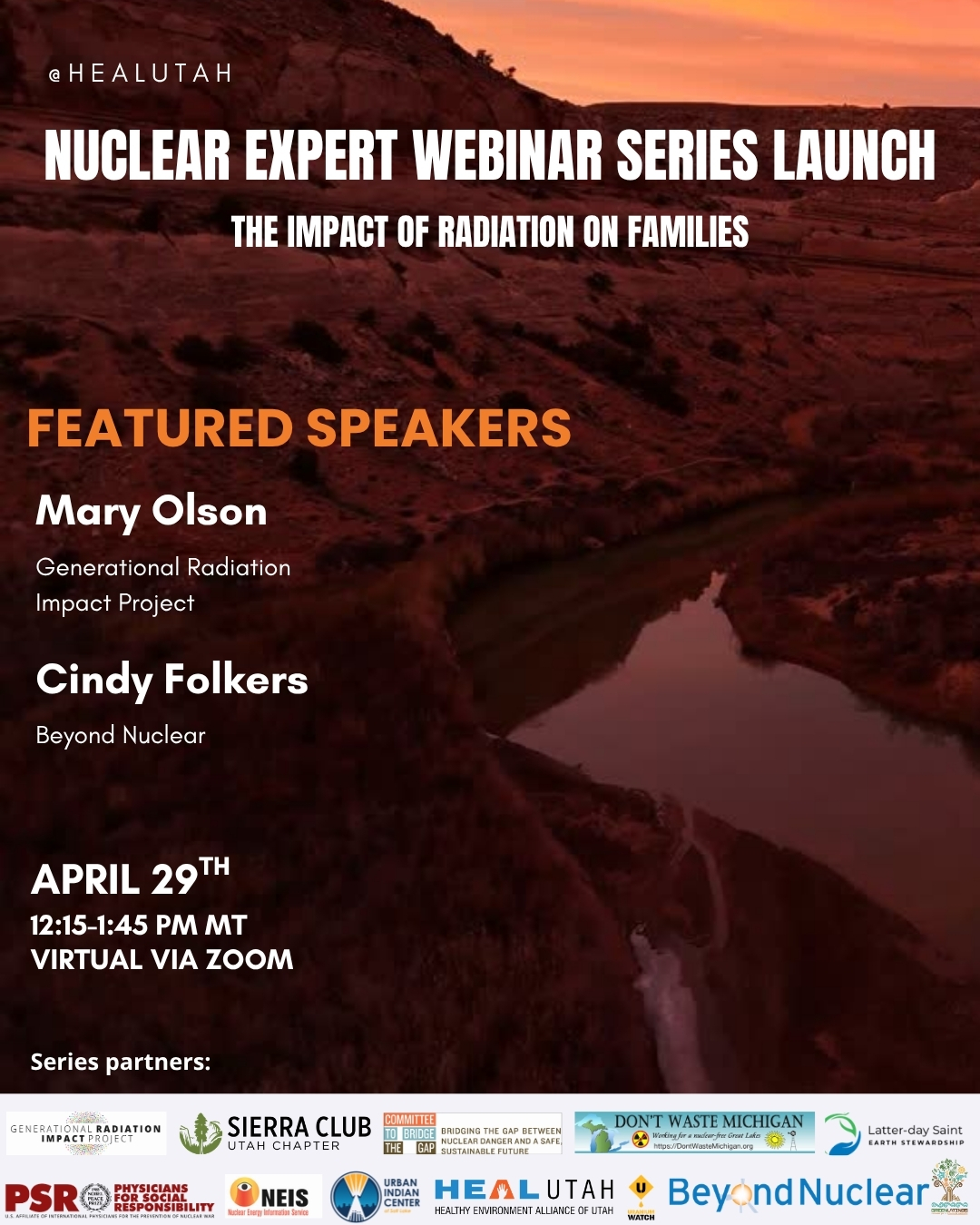
29 April – Nuclear Expert Webinar #1 – Radiation Impacts on Families with Mary Olson and Cindy Folkers
- 12:15 PM MT – 1:45 PM MT
- Location: Virtual – REGISTER TODAY

4 May -West Suburban Peace Coalition to discuss Iran war at May Educational Forum
Monday, May 4, 7:00 – 8:00 PM Central Standard Time
Title: : How Trump’s Narrative Tries to Shape the Reality of the War on Iran.
Contact Walt Zlotow, zlotow@hotmail.com 630 442 3045 for further information
14 May – online event From Bombs to Data Centres: the Face of Nuclear Colonialism

Pine Ridge Uranium is the real threat, not Tehran- Tell Burgum: Stop the Extraction.
Chernobyl: The Lost Tapes – A good documentary on Chernobyl on SBS available On Demand for the next 3 weeks– https://www.sbs.com.au/ondemand/tv-program/chernobyl-the-lost-tapes/2352741955560
To see nuclear-related stories in greater depth and intensity – go to https://nuclearinformation.wordpress.com
-
Archives
- April 2026 (338)
- March 2026 (251)
- February 2026 (268)
- January 2026 (308)
- December 2025 (358)
- November 2025 (359)
- October 2025 (376)
- September 2025 (257)
- August 2025 (319)
- July 2025 (230)
- June 2025 (348)
- May 2025 (261)
-
Categories
- 1
- 1 NUCLEAR ISSUES
- business and costs
- climate change
- culture and arts
- ENERGY
- environment
- health
- history
- indigenous issues
- Legal
- marketing of nuclear
- media
- opposition to nuclear
- PERSONAL STORIES
- politics
- politics international
- Religion and ethics
- safety
- secrets,lies and civil liberties
- spinbuster
- technology
- Uranium
- wastes
- weapons and war
- Women
- 2 WORLD
- ACTION
- AFRICA
- Atrocities
- AUSTRALIA
- Christina's notes
- Christina's themes
- culture and arts
- Events
- Fuk 2022
- Fuk 2023
- Fukushima 2017
- Fukushima 2018
- fukushima 2019
- Fukushima 2020
- Fukushima 2021
- general
- global warming
- Humour (God we need it)
- Nuclear
- RARE EARTHS
- Reference
- resources – print
- Resources -audiovicual
- Weekly Newsletter
- World
- World Nuclear
- YouTube
-
RSS
Entries RSS
Comments RSS
 nuclear-news
Are you kidding ? Insane
On Wed, Jan 27, 2016 at 11:53 PM, nuclear-news wrote:
> dunrenard posted: ” Government agencies are discussing the plan as a > ‘long-term solution’ while environmentalists have dismissed it as an > expensive ‘pipe dream’. A team of experts from Japan’s Nuclear Waste > Management Organisation is examining the possibility of storing t” >