Exelon dithers about closing uneconomic nuclear power plants in Illinois
EXELON DELAYS CLOSURE DECISION ON 2 ILLINOIS NUCLEAR PLANTS http://abc7chicago.com/business/exelon-delays-closure-decision-on-2-illinois-nuclear-plants/977661/ September 10, 2015 Exelon Corp. says it is delaying for one year its decision about whether to close nuclear plants in the Quad Cities and Byron.
Chicago-based Exelon owns Illinois’ 11 nuclear reactors. It has previously said its generating stations in the Quad Cities, Byron and Clinton were in danger of closing.
Exelon said Thursday that it plans to continue operating its Quad Cities nuclear power plant through at least May 2018 and the Byron plant will operate through May 2019. The company said the Clinton station remains “economically challenged” and could be closed if conditions don’t improve.
Exelon president and CEO Chris Crane called the decision a “short-term-reprieve.” He said policy reforms are needed to level the clean energy playing field and position Illinois to meet EPA carbon reduction rules.
Nuclear power just isn’t the answer to climate change
 http://www.gazettetimes.com/news/opinion/as-i-see-it/as-i-see-it-nuclear-power-isn-t-the-answer/article_e1344eb7-11a0-584c-ae40-5b3135957709.html September 09, 2015 DEBRA HIGBEE-SUDYKA
However, there are real concerns about the resurgence of nuclear power, and how this energy source will impact the environment and our economy. We need a comprehensive clean energy policy that supports the most efficient, economical and environmentally safe energy sources. These sources must not only reduce greenhouse gases but also do so in the cleanest, fastest, and safest way possible.
The Sierra Club does not see how new nuclear power, including small modular reactors, meets the criteria necessary for a safe and secure energy future. We wish to call attention to some of the reasons why Sierra Club believes nuclear is the wrong choice:
• Nuclear energy does not address climate change: Building a fleet of new reactors will take decades, not nearly fast enough to address climate change. And nuclear energy is not carbon-free, especially if you factor into the equation of the construction of the plant, the sourcing of uranium, the transportation and ultimately the long-term storage of its waste. Climate change and energy independence can be achieved much cheaper and faster through efficiency measures as well as readily available clean renewable resources.
• It’s too expensive for consumers and taxpayers: Nuclear power is not just expensive; it is becoming the most cost-prohibitive energy source. The estimated costs of new nuclear power plants have tripled since 2000. Cost comparisons show that building a new fleet of nuclear power plants (especially small modular reactors, which lack economies of scale) will far exceed the costs of other, better energy options.
The Congressional Budget Office estimates the likelihood of default for loans made to nuclear reactor developers to be “well above 50 percent.” The signal coming from the market place is clear: the nuclear industry, even after high levels of cradle-to-grave subsidies, handouts, and incentives provided by the federal government, is too expensive and risky. Overall, electricity produced by new reactors would cost two to three times more than renewable energy and efficiency measures.
• Nuclear power is not “homegrown”: Virtually every part of the nuclear chain is dependent on foreign corporations, governments, or nationalized companies. In 2013, more than 83 percent of the uranium used for U.S. nuclear power plants was imported from other countries. The United States’ high-priced uranium resources, subject to world uranium price volatility, mean that our dependence on foreign uranium is not likely to change significantly in the future.
Nuclear power is an ineffective and risky choice for addressing the global challenge of climate change. The Sierra Club believes in options that will not only be cheaper, cleaner and faster to bring on-line, but also will create more jobs, stimulate our economy, be truly homegrown and will not contribute to the risk of terrorism or require centuries of waste management.
Debra Higbee-Sudyka, of Corvallis is a Conservation Committee member of the Oregon Chapter of the Sierra Club and is active with the Sierra Club Nuclear Free Campaign.
German utility E.ON gives up plan to set up anew nuclear company, in view of new liability law proposed
E.ON Faces Massive Loss After Scrapping German Nuclear Spinoff
Utility said it would post a hefty net loss this year after booking billions of euros in impairments, WSJ, MONICA HOUSTON-WAESCH and FRIEDRICH GEIGER Sept. 10, 2015 BERLIN—E.ON SE will post a massive loss this year after ditching plans to unload its German nuclear operations into a new company, in a nod to government proposals to saddle utilities with liabilities related to nuclear energy.
E.ON expects to book impairment costs this quarter of as much as €9 billion ($10 billion), triggering a multibillion-euro loss. Its shares plunged to an all-time low on Thursday, dropping 6% to €9.09.
The German utility had planned to move its nuclear operations into Uniper, a company being established to operate conventional power, trading, exploration and production. The spinoff will proceed but without German nuclear activities, said E.ON, which also has Swedish nuclear operations……..
E.ON’s decision was prompted by government proposals for legal changes that would make utilities permanently liable for the costs of nuclear waste and plant decommissioning……..
E.ON now plans to bundle its German nuclear operations into an independent unit within E.ON. Its Swedish nuclear operations will be spun off into Uniper as planned……http://www.wsj.com/articles/e-on-drops-plan-to-spin-off-german-nuclear-plants-1441865094
South Australia’s Nuclear Fuel Chain Royal Commission – conflict of interest revealed.
 Submission To The Nuclear Fuel Cycle Royal
Commission Regarding Issues Papers 1 and 4 byYurij Poetzl http://nuclearrc.sa.gov.au/app/uploads/2015/09/Yuri-Poetzl-24-07-2015.pdf
 I’m a private citizen and have no vested interest in the nuclear industry; however the nuclear industry does direct ly impact me, my family and my friends As a member of the public I wish to give evidence and express my concerns in regard to the issues being examined by the Royal Commission.
It is valid to examine economics and risks relating to the nuclear industry; however is the Royal Commission a fair and objective examination of the Nuclear Cycle? It has been disclosed that Kevin Scarce Is a shareholder in the Rio Tinto Group,who own and operate  uranium mines in Australia and internationally. ls this a conflict of interest for the Royal Commissioner? It is of great concern that the Royal Commissioner has selected predominantly pro-nuclear experts for the R.C’s Advisory Committee (the single exception being Professor lan Lowe). See Appendix 1.
It also seems remiss that there isn’t any health or medical professionals engaged in the R.C’s Expert Advisory Committee or Key Commission staff. It’s well documented that by-products of the nuclear industry can have adverse effects on the health of the global community for many future generations. The omission of health experts makes me question whether the R.C is truly considering what is in my and the general public’s best interest.
The Public Health Association of Australia have made their position clear in regard to the R.C and the Nuclear Industry, see http :1 /www .phaa. net. au/ documents/item/51 0 or http://www .phaa.net.au/documents/item/264 The Royal Commission could prove to be pivotal in South Australia’s future having significant and far reaching consequences, affecting many future generations; however, was the process leading toward the establishment the Royal Commission flawed?
The S.A. public (and wider global communit y) deserve a balanced and unbiased assessment of the issues raised Appendix 2. Contains questions regarding issues papers 1 and 4 Yours sincerely Yurij Poetzl
Appendix. 1 4 of the 5 Royal Commissions Expert Advisory Committee appear to be pro nuclear. They are Professor Barry Brook, Dr Timothy Stone, John Carlson AM and Dr Leanna Read. Below is a brief summary oftheir involvement in the nuclear industry Professor Barry Brook is an active advocate of the Nuclear Industry. The self described”Promethean Environmentalist” is openly critical of people who have concerns regarding the Industry. Professor Brook is the author of, or contributor to several pro nuclear publications such as; Key role for nuclear energy in global biodiversity conservation, Australia’s nuclear options and, An Open Letter to Environmentalists on Nuclear Energy. To name a few.
Dr Timothy Stone is an advocate for nuclear power generation and nuclear industrial expansion in Australia. In the UK Dr Stone has held the position of Expert Chair ofthe Office for Nuclear Development and he is currently on the board of Horizon Nuclear Power as non-executive Director John Carlson AM has been Director General of the Australian Safeguards and Non-Proliferation Office. In part 6 of the introduction to Mr Carlson’s paper “Nuclear power for Australia”- an outline of the key issues he claims “Nuclear has a major advantage over other energy sources”. Later in the same document Mr Carlson states “Currently both major parties say that nuclear power is “offlimits”. While this is disappointing, at least it ensures neither side is making statements tlhat will later be embarrassing to retract” It is clear that Mr Carlson is pro nuclear providing the appropriate safeguards are met
Dr Leanna Read has publicly stated that she “has an open mind” regarding the Nuclear Industry. Dr Read is a Fellow of the Australian Academy ofTechnological Sciences and Engineering, which advocated for nuclear power in Australia in August 2014. This seems to contradict Dr Read’s claims of impartiality toward the nuclear industry Given the information in Appendix 1, can the Royal Commission be considered truly independent?
Appendix 2
- Question: 1. Even with best practice and best intentions, industrial accidents happen. What infrastructure is currently in place, should a truck loaded with uranium oxide be involved in an accident in the Metropolitan area and whilst doing so, have a breach of its load or catch fire?
- Question: 2. Is it possible to insure against a nuclear mishap and how is Public Liability insurance affected in an accident scenario?
- Question: 3.Many environmentalists believe that The Roxby Downs Indenture Act 1982 al lows wide ranging exemptions from key environmental laws such as the SA Environmental Protection Act 1993, Freedom of information Act 1991 and the Natural Resources Act 2004 critical water resources and Great Artesian Basin. Is this true?
- Question: 4. If the answer to question 3 is true, please explain how these exemptions are in the public interest?
- Question: 5.1s it possible that similar exemptions will be extended to waste dumps, uranium enrichment operations or nuclear power stations?
- Question: 6. Recent revelations by the EPA {Environmental Protection Agency) reveal widespread and irreversible groundwater contamination by industrial practices in several of Adelaide’s suburbs. Wouldn’t it be prudent for the Commissions terms of reference to contain a review of current uranium mining and transport practices?
- Question: 7. Would it be sensible to hold a review of the current condition of waterways and aquifers affected by mining practices before an expansion of SA’s nuclear industry commences?
- Question: 8. Since the proposed expansion of Olympic Dam a few years ago, has the SA public been receiving fair and balanced media coverage on the nuclear Industry, particularly in printed media?
- Question: 9. What has been the ratio of Pro/Con nuclear industry stories and editorials in the Advertiser Newspaper since 201 0?
- Question: 10. What influence has this ratio had on the general public’s current view towards the nuclear industry?
- Question: 11. Will the commission call on medical and health specialists to give their perspectives on the nuclear industry and its impact on workers within the industry and the wider community?
- Question: 12. Can Nuclear Energy really be defined as a low carbon emission energy source when millions of litres of Diesel are consumed in the Nuclear Cycle annually, particularly in the mining and transport of uranium oxide?
- Question: 13. Uranium waste products can take hundreds of thousands of years to halve their level of toxicity. Pyramids are amongst the oldest surviving manmade structures and are no more than 5000 years old. Therefore what assurances are there, that nuclear waste can be safely stored over much longer periods oftime?
- Question 14.1f South Australia is perceived to be a nuclear waste site by the global community, what will the impact be on Tourism, Real Estate, Food, Wine and manufacturing industries be?
- Question 15.Highly toxic Radon gas is released by the mining activities at Roxby downs and apparently can be detected in Antarctica. This gas must pass through Adelaide to get there. What is the effect of Radon gas to workers in the mines and what impact does it have on the wider community?
- Question: 16. What is the volume of airborne radioactive dust released into atmosphere by mining and storage of tailings exposed to the wind?
- Question: 17.What impact does radioactive dust released by mining practices, have on the Australian public, fauna and flora?
- Question: 18.Presumably nuclear waste will be transported from Port Adelaide to its storage destination. What would be the outcome, in the advent of an accident, or fire to the transport within the M etropolitan area?
- Question: 19. 33.6 percent of Australian uranium is exported to North America. The US military has depleted uranium coated ammunitions and armaments, such as bullets and tank shielding. There have been reports claiming an alarming rise of birth defects to children of returned US soldiers and civilians occupying militarised zones. These reports claim the birth defects can be attributed to use of depleted uranium coated ordnance. What checks are in place to guarantee no Australian uranium or its by-products is used to coat US military
- Question: 20. Has uranium coated ordinance or tank shielding been used by the United States Army in war games in central Australia?
- Question: 21. Prior to his selection as “Chair of the Royal Commission” Kevin Scarce had aligned himself with CEDA (the Committee for Economic Development In Australia). CEDA’s Policy Perspectives of Nov 2011 clearly supports and promotes the growth of South Australia’s nuclear industry. Is this a conflict of interest for the Royal Commissioner?
- Question: 22.There are cl ips on You T ube(see Aug 12th 2014) where Kevin Scarce confirms his association with CEDA, using terms like “we were able to get our draft report considered by government. ” Given his connection with CEDA and their pro nuclear stance, is Kevin Scarce truly impartial and unbiased in regard to South Australia’s nuclear issues?
- In Summary To be considered an effective, balanced, honest and legitimate assessment of SA’s role in the nuclear cycle, the Royal Commission needs to assess and answer many more tough questions than the ones listed above. Kind regards Yu.rij Poetzl Adelaide South Australia
Reflections of a #nuclear engineer
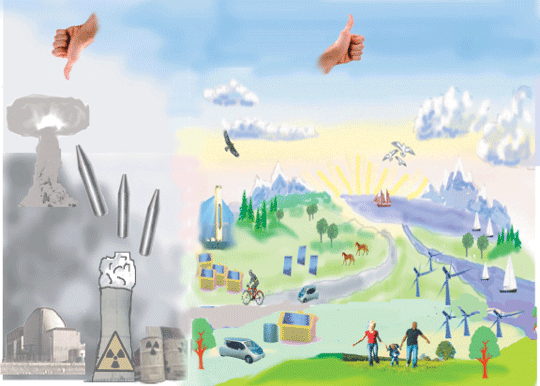 Peter Smith, 5 Sept 15 Fighting the nuclear industry can feel like trying to stop the tide! But know that nuclear are on the run and are becoming desperate because they can see, at least those not in a total delusional state, that the Renewables Revolution is the death nail for them.
Nuclear power plants are truly amazing places to work in, particularly to an engineer. A very diverse range of technical disciplines, some of it at one time working on the frontiers of technology, then there are chemical and reactor scientists, a very interesting mix. But none of this makes it right.
I believe most educated supporters of nuclear are either in a state of denial or deluded or both. Having worked in the power industry for for 40 years with 30 in the nuclear industry it’s a big step turning my back on nuclear and fossil power, because all my technical expertise is based on large steam turbines most of which is irrelevent in a decentralised, distributed Renewables energy world. But if that’s the way to go and it it, then you have to learn to adapt and change, and I have.
Cs-134/137 density of plant port water keeps increasing since last week

Cs-134/137 density reached the highest level at 2 of those 4 points mentioned above, according to Tepco. The sampling date was 9/7/2015.
These 2 points are in front of water intakes of Reactor 1 and Reactor 2. Both of them are outside of underground wall to prove high level of contamination is still leaking to the sea.
Also, Cs-134/137 density in the south of these 2 points reached the highest level. This is also outside of the underground wall, but the density went up approx. 170 % of the previous highest reading. The newly highest Cs-134/137 density was 152,000 Bq/m3.
http://www.tepco.co.jp/nu/fukushima-np/f1/smp/2015/images/2tb-east_15090801-j.pdf
Source: Fukushima Diary
Cs-134/137 density of plant port water keeps increasing since last week
CSRP 2015 – The Fifth Citizen-Scientist International Symposium on Radiation Protection


Beginning in March 2011, the Tokyo Electric Fukushima Daiichi nuclear power plant catastrophe continues even now with no end in sight. We have sought out ways to reduce even a little, or possibly prevent, health effects due to radiation exposure. Whether radiation exposure leads to health effects, or what the potential health effects might be, has generated much interest in our society. However, up to now, no discussion has been openly carried out amongst scientists with various viewpoints. The nuclear power plant accident and the dispersed radioactivity exert influences over extensive social areas, affecting individuals as well as the society. What is called for now is societal decision-making regarding such influences for the purpose of radiation protecton, through discussions between the victims, the political decision-makers, the researchers, and the non-governmental organizations.
Currently, the exposed and the highly exposed human populations are either ignored by the government or they become inadvertent subjects of observation by scientists, while silently and helplessly observing incidences of illness creeping up within themselves. Epidemiological studies, deemed essential in putting public health into practice, are not cold science by any means. The purpose of epidemiological studies should include, in addition to the elucidation of frequency and causes of illnesses, the creation of frameworks to minimize health effects by reducing or preventing them. Furthermore, the true goal of epidemiological studies is for them to be utilized in reducing or preventing societal effects which could worsen the catastrophe.
What approaches are needed for science to become a survival tool for humans in the challenge of radiation protection? We shall think about this issue together at the Fifth Citizen-Scientist International Symposium on Radiation Protection,
On Day 1 of the symposium, we will approach this issue from the diverse intellectual interactions between science and art.
On Day 2, we will explore epidemiology as a science in addition to a general overview of radiation protection measures based on the latest biological findings.
Lastly, on Day 3, we will verify from societal aspects what language, law and ethics are necessary in order to put such measures into practice.
For more details and registration → http://csrp.jp/csrp2015/
Live streaming → http://csrp.jp/csrp2015/live
Tepco’s index-topping gains fueled by electricity shake-up
Japan’s reform of its energy market is proving a boon to investors in the company at the center of the Fukushima No. 1 nuclear plant disaster.
Tokyo Electric Power Co.’s shares have surged 59 percent in the six months through Tuesday’s close, making it the best performer on the Nikkei 225 Stock Average and the 174-member Bloomberg World Utilities Index.
Tepco, owner of the wrecked plant, is seen as an early beneficiary of government-backed power reform. By April, residential power customers will be able to choose their provider for the first time. And by 2020, utilities will be required to separate their transmission, distribution and retail businesses.
“Looking towards the electricity market reform to be completed by 2020, a company the size of Tepco is an attractive investment,” Mana Nakazora, an analyst at BNP Paribas Securities (Japan) Ltd., said by email.
While the company’s stock price has surged this year, it is still less than half of where it was before the Fukushima disaster. The shares fell 3.1 percent to ¥751 at the close of Tokyo trading on Tuesday. They closed at ¥2,153 the day before Fukushima, but have increased 55 percent since Tepco announced on May 1 that it will transition to a holding company beginning in April.
Tepco was rated new overweight on Tuesday with a target price of ¥1,000 a share by Yuji Nishiyama, an analyst at JPMorgan Securities Japan Co.
Spokesman Tatsuhiro Yamagishi declined to comment on the performance of the company’s stock.
For Tepco, a more open energy market in Japan offers the opportunity for growth at a company whose survival was in question just a few years ago. The Fukushima disaster put it on the verge of default, with the head of Japan’s biggest stock market telling the company to file for bankruptcy protection. Tepco was saved by a ¥1 trillion infusion from the government in 2012, the nation’s largest bailout since the 1990s.
The power company received ¥5.61 trillion from the state-backed Nuclear Damage Compensation and Decommissioning Facilitation Corp. to deal with payouts to victims of the Fukushima meltdown, Tepco reported last month.
Under the April reorganization, Tepco’s nuclear operations will be placed into a holding company, while debt investors will be repaid from the funds of a spun-off power grid company.
Tepco’s probability of debt nonpayment has dropped to 0.309 percent from about 1.121 percent on Oct. 16, according to the Bloomberg default-risk model, which considers factors such as share prices and debt. The probability of debt nonpayment was as high as 6.156 percent in 2012.
“The company’s default risk has disappeared,” said BNP Paribas’s Nakazora.
The government’s power reform began this year with the creation of an organization to manage the nation’s supply and demand balance. Next year’s full retail liberalization, the second stage of the reform, will allow utilities to more freely expand outside their traditional regions. The government aims to remove rate regulations by 2020.
A drop in fuel costs saw Tepco increase operating profit threefold in the quarter ended June 30. The price of liquefied natural gas imported into Japan fell to a six-year low in June, while crude oil prices are near a record low.
“Investors expected first-quarter profits to have a big increase due to the drop in oil then liquefied natural gas,” Syusaku Nishikawa, a Tokyo-based analyst at Daiwa Securities Co., said by email.
Yet challenges remain. Liabilities related to the Fukushima disaster and Tepco’s responsibilities will continue to pressure the company’s credit quality in the long term, according to Mariko Semetko, a vice president at Moody’s Japan K.K., which rates the company’s outlook as negative.
Tepco, which operates the world’s biggest nuclear plant by capacity at its Kashiwazaki-Kariwa facility in Niigata Prefecture, has yet to restart any of its nuclear reactors. Resuming operations at the facility would boost profit by as much as ¥32 billion a month, the company has said.
“The recent improvements in profitability are definitely a plus,” Semetko said by phone. “But the company hasn’t yet started its Kashiwazaki-Kariwa plant and there are a lot of uncertainties around costs related to Fukushima. With all of that in mind, we haven’t been able to stabilize the outlook yet.”
Source: Japan Times
http://www.japantimes.co.jp/news/2015/09/09/business/corporate-business/tepcos-index-topping-gains-fueled-electricity-shake/#.VfBQvZeFSM8
Third ceiling panel removed from Fukushima reactor
Workers at the Fukushima Daiichi nuclear plant have removed half of the ceiling panels covering a damaged reactor building. The work is part of efforts to decommission the facility.
The No.1 reactor building was heavily damaged by a hydrogen explosion during the 2011 meltdown. Tokyo Electric Power Company installed a cover around it to prevent the spread of radioactive material.
The utility is now removing the cover so it can clean up debris inside the facility. Two of the 6 ceiling panels that make up the cover were removed between late July and early August.
The utility then halted the work to monitor radiation levels and check the conditions of the debris. Since no abnormalities were found, workers removed a 3rd panel on Tuesday using a remote-controlled crane.
TEPCO says there’s been no change in radiation levels around the reactor buildings. It says measurements taken before the work on Tuesday showed that wind blowing inside the cover was weaker than expected.
The utility plans to finish dismantling the cover by around late next year.
Source: NHK
http://www3.nhk.or.jp/nhkworld/english/news/20150908_21.html
Groundwater to be released into the sea on Monday
The operator of the Fukushima Daiichi nuclear plant plans to start releasing groundwater from around reactor buildings into the sea next Monday.
The government and the operator, Tokyo Electric Power Company, are to formally decide on the discharge date on Wednesday. The water has already been decontaminated.
Officials hope the move will help to curb the accumulation of radioactive wastewater in the reactor buildings. The contaminated water is increasing at a rate of 300 tons a day as the groundwater flows in.
The officials plan to first release some 4,000 tons of water pumped up from the wells around the buildings on a trial basis since August last year.
They say they will continue to pump up water and release it after removing radioactive materials.
Later this week, the utility also plans to resume the construction of steel walls along the coast to stop the groundwater seeping directly into the sea.
The construction work has been suspended until the release of the groundwater becomes possible.
Source: NHK
http://www3.nhk.or.jp/nhkworld/english/news/20150909_05.html
Can Towns Near Japan’s Fukushima Nuclear Plant Recover?
” There are more decontamination workers than townspeople. It’s like we’ve been taken over,” says carpenter Koichi Takeda, who evacuated to nearby Iwaki City and was in town to help a friend clean her house.
He has a number of clients renovating their houses in Naraha, but most of them are undecided about whether they will actually return. “It’s like keeping a vacation home here,” he said.”
A few signs of life are returning to this rural town made desolate by the Fukushima nuclear disaster four-and-a-half years ago: Carpenters bang on houses, an occasional delivery truck drives by and a noodle shop has opened to serve employees who have returned to Naraha’s small town hall.
But weeds cover the now rusty train tracks, there are no sounds of children and wild boars still roam around at night. On the outskirts of town, thousands of black industrial storage bags containing radiation-contaminated soil and debris stretch out across barren fields.
This past weekend, Naraha became the first of seven towns that had been entirely evacuated to reopen since the March 11, 2011, disaster, when a tsunami slammed into the Fukushima Dai-ichi nuclear power plant, causing meltdowns and a massive radiation leak.
The town’s viability is far from certain, and its fate will be watched closely by authorities and neighboring towns to see if recovery is indeed possible on this once-abandoned land.
Just over a tenth of Naraha’s population of 7,400 say they plan to move back soon, and only a few hundred have actually returned, most of them senior citizens. Schools won’t reopen for another two years, and many families with children are staying away due to concerns about radiation levels, which authorities say are below the annual allowable limit. Residents are given personal dosimeters to check their own radiation levels if they want.
One thing that won’t change is the town’s dependence on the nuclear industry — only this time it will involve dismantling damaged reactors, not building and running them.
An economic revival plan centers on a giant 85 billion yen ($700 million) facility that is being built on the edge of town to research, develop and test specialized robots and other technology — part of the government’s “Innovation Coast” plan to turn the disaster-hit region into a hub for nuclear plant decommissioning technology.
The complex will include mock-ups of sections of the wrecked Fukushima reactors to train workers on robot operations. Dismantling the Dai-ichi plant and removing its melted reactor cores will take about 40 years, the government estimates.
The facility is expected to draw hundreds of workers, and the town also seeks to host laborers to decontaminate buildings and outdoor areas in the area. Naraha is also home to a second nuclear power plant — Fukushima Dai-ni — that barely survived the tsunami but may be scrapped due to local opposition to its restart. So it may also be dismantled.
Returning residents are determined to make a go of it, but they wonder if the town will survive economically — and mourn that it will never be the same cozy place it was five years ago.
“There are more decontamination workers than townspeople. It’s like we’ve been taken over,” says carpenter Koichi Takeda, who evacuated to nearby Iwaki City and was in town to help a friend clean her house.
He has a number of clients renovating their houses in Naraha, but most of them are undecided about whether they will actually return. “It’s like keeping a vacation home here,” he said.
Source: ABC News
http://abcnews.go.com/International/wireStory/towns-japans-fukushima-nuclear-plant-recover-33597508
“Radiation is Good for You!” and Other Tall Tales of the Nuclear Industry
The U.S. Nuclear Regulatory Commission is considering a move to eliminate the “Linear No-Threshold” (LNT) basis of radiation protection that the U.S. has used for decades and replace it with the “radiation hormesis” theory—which holds that low doses of radioactivity are good for people.
The change is being pushed by “a group of pro-nuclear fanatics—there is really no other way to describe them,” charges the Nuclear Information and Resource Service (NIRS) based near Washington, D.C.
“If implemented, the hormesis model would result in needless death and misery,” says Michael Mariotte, NIRS president. The current U.S. requirement that nuclear plant operators reduce exposures to the public to “as low as reasonably achievable” would be “tossed out the window. Emergency planning zones would be significantly reduced or abolished entirely. Instead of being forced to spend money to limit radiation releases, nuclear utilities could pocket greater profits. In addition, adoption of the radiation model by the NRC would throw the entire government’s radiation protection rules into disarray, since other agencies, like the EPA, also rely on the LNT model.”
“If anything,” says Mariotte, “the NRC radiation standards need to be strengthened.”
The NRC has a set a deadline of November 19 for people to comment on the proposed change. The public can send comments to the U.S. government’s “regulations” website.
Comments can also be sent by regular mail to: Secretary, U.S. Nuclear Regulatory Commission, Washington, DC 20555-0001, Attention:Rulemakings and Adjudications Staff. Docket ID. Needed to be noted on any letter is the code NRC-2015-0057.
If the NRC agrees to the switch, “This would be the most significant and alarming change to U.S. federal policy on nuclear radiation,” reports the online publication Nuclear-News. “The Nuclear Regulatory Commission may decide that exposure to ionizing radiation is beneficial—from nuclear bombs, nuclear power plants, depleted uranium, x-rays and Fukushima,” notes Nuclear-News. ”No protective measures or public safety warnings would be considered necessary. Clean-up measures could be sharply reduced…In a sense, this would legalize what the government is already doing—failing to protect the public and promoting nuclear radiation.”
In the wake of the Manhattan Project, the U.S. crash program during World War II to build atomic bombs and the spin-offs of that program—led by nuclear power plants, there was a belief, for a time, that there was a certain “threshold” below which radioactivity wasn’t dangerous.
But as the years went by it became clear there was no threshold—that any amount of radiation could injure and kill, that there was no “safe” dose.
Low levels of radioactivity didn’t cause people to immediately sicken or die. But, it was found, after a “latency” or “incubation” period of several years, the exposure could then result in illness and death.
Thus, starting in the 1950s, the “Linear No-Threshold” standard was adopted by the governments of the U.S. and other countries and international agencies.
It holds that radioactivity causes health damage—in particular cancer—directly proportional to dose, and that there is no “threshold.” Moreover, because the effects of radiation are cumulative, the sum of several small exposures are considered to have the same effect as one larger exposure, something called “response linearity.”
The LNT standard has presented a major problem for those involved in developing nuclear technology notably at the national nuclear laboratories established for the Manhattan Project—Los Alamos, Oak Ridge and Argonne national laboratories—and those later set up as the Manhattan Project was turned into the U.S. Atomic Energy Commission.
On one hand, Dr. Alvin Weinberg, director of Oak Ridge National Laboratory, declared in New Scientist magazine in 1972: “If a cure for cancer is found the problem of radiation standards disappear.”
Meanwhile, other nuclear proponents began pushing a theory they named “radiation hormesis” that claimed that the LNT standard was incorrect and that a little amount of radioactivity was good for people.
A leader in the U.S. advocating hormesis has been Dr. T. D. Luckey. A biochemistry professor at the University of Missouri-Columbia and visiting scientist at Argonne National Laboratory, he authored the book Hormesis and Ionizing Radiation and Radiation Hormesis and numerous articles. In one, “Radiation Hormesis Overiew,” he contends: “We need more, not less, exposure to ionizing radiation. The evidence that ionizing radiation is an essential agent has been reviewed…There is proven benefit.” He contends that radioactivity “activates the immune system.” Dr. Luckey further holds: “The trillions of dollars estimated for worldwide nuclear waste management can be reduced to billions to provide safe, low-dose irradiation to improve our health. The direction is obvious; the first step remains to be taken.” And he wrote: “Evidence of health benefits and longer average life-span following low-dose irradiation should replace fear.”
A 2011 story in the St. Louis Post Dispatch quoted Dr. Luckey as saying “if we get more radiation, we’d live a more healthful life” and also noted that he kept on a shelf in his bedroom a rock “the size of a small bowling ball, dotted with flecks of uranium, spilling invisible rays” It reported that “recently” Dr. Luckey “noticed a small red splotch on his lower back. It looked like a mild sunburn, the first sign of too much radiation. So he pushed the rock back on the shelf, a few inches farther away, just to be safe.”
At Brookhaven National Laboratory (BNL), set up by the U.S. Atomic Energy Commission in 1947 to develop civilian uses of nuclear technology and conduct research in atomic science, a highly active proponent of hormesis has been Dr. Ludwig E. Feinendegen. Holding posts as a professor in his native Germany and a BNL scientist, he authored numerous papers advocating hormesis. In a 2005 article published in the British Journal of Radiology he wrote of “beneficial low level radiation effects” and asserted that the “LNT hypothesis for cancer risk is scientifically unfounded and appears to be invalid in favor of a threshold or hormesis.”
The three petitions to the NRC asking it scuttle the LNT standard and replace it with the hormesis theory were submitted by Dr. Mohan Doss on behalf of the organization Scientists for Accurate Radiation Information; Dr. Carol Marcus of the UCLA medical school; and Mark Miller, a health physicist at Sandia National Laboratories.
The Nuclear Information and Resource Service points out that the U.S. Environmental Protection Agency or EPA is fully supportive of LNT.
The agency’s reason for accepting LNT—and history of the standard—were spelled out in 2009 by Dr. Jerome Puskin, chief of its Radiation Protection Division.
The EPA, Dr. Puskin states, “is responsible for protecting the public from environmental exposures to radiation. To meet this objective the agency sets regulatory limits on radionuclide concentrations in air, water, and soil.” The agency bases its “protective exposure limits” on “scientific advisory bodies, including the U.S. National Academy of Sciences, the International Commission on Radiological Protection, the United Nations Scientific Committee on the Effects of Ionizing Radiation, and the National Council on Radiation Protection and Measurements, with additional input from its own independent review.” The LNT standard, he writes, “has been repeatedly endorsed” by all of these bodies.
“It is difficult to imagine any relaxation in this approach unless there is convincing evidence that LNT greatly overestimates risk at the low doses of interest,” Dr. Puskin goes on, and “no such change can be expected” in view of the determination of the National Academies of Sciences’ BEIR VII committee. (BEIR is for Biological Effects of Ionizing Radiation.)
BEIR VII found that “the balance of evidence from epidemiologic, animal and mechanistic studies tend to favor a simple proportionate relationship at low doses between radiation dose and cancer risk.”
As chair of the BEIR VII committee, Dr. Richard Monson, associate dean of the Harvard School of Public Health, said in 2005 on issuance of its report: “The scientific research base shows that there is no threshold of exposure below which low levels of ionizing radiation can be demonstrated to be harmless or beneficial.”
A European expert on radioactivity, Dr. Ian Fairlie, who as an official in the British government worked on radiation risks and has been a consultant on radiation matters to the European Parliament and other government entities, has presented detailed comments to the NRC on the petitions that it drop LNT and adopt the hormesis theory.
Dr. Fairlie says “the scientific evidence for the LNT is plentiful, powerful and persuasive.” He summarizes many studies done in Europe and the United States including BEIR VII. As to the petitions to the NRC, “my conclusion is that they do not merit serious consideration.” They “appear to be based on preconceptions or even ideology, rather than the scientific evidence which points in the opposite direction.”
An additional issue in the situation involves how fetuses and children “are the most vulnerable” to radiation and women “more vulnerable than men,” states an online petition opposing the change. It was put together by the organization Beyond Nuclear, also based near Washington, D.C. It is headed “Protect children from radiation exposure” and advises: “Tell NRC: A little radiation is BAD for you. It can give you cancer and other diseases.” It continues: “NRC should NOT adopt a ‘little radiation is good for you’ model. Instead, they should fully protect the most vulnerable which they are failing to do now.”
How might the commissioners of the NRC decide the issue? Like the Atomic Energy Commission which it grew out of, the NRC is an unabashed booster of nuclear technology and long devoted to drastically downplaying the dangers of radioactivity. A strong public stand—many negative comments—over their deciding that radioactivity is “good” for you could impact on their positions.
INSIGHT: Failing to see dangers of nuclear power right under one’s nose
Fifty-three months after the fateful nuclear disaster, the Sendai nuclear power plant in Kagoshima Prefecture has become the first in Japan to resume after all were taken offline for safety inspections.
But the restart callously disregards the lives of so many people who were uprooted from their irreplaceable ancestral land, jobs, families and friends by the accident at the Fukushima No. 1 nuclear power plant in 2011.
Inspections of nuclear facilities certainly became more stringent after the Fukushima nuclear disaster. But that is no guarantee of their safety. An “unforeseeable” event may occur at any moment, and the cost will be too tragically enormous for anyone to grasp.
Why does the government not want to face up to that fact in earnest? And what about the public, which is allowing the government to move in that direction? While I was furious about these issues, I had the chance to attend a preview of a movie. Seeing it was like getting smacked up the side of the head.
Titled “Tenku no Hachi” (The Big Bee), the action epic, which features an act of terrorism on a nuclear plant, is based on a work of fiction by Keigo Higashino, a best-selling author.
To my surprise, the work both fully and scrupulously presented all the major problems of nuclear power generation that came under the public spotlight after the Fukushima disaster, such as the vulnerability of spent nuclear fuel storage pools, the fictional nature of the safety myth about nuclear power and the merciless way nuclear plants are being forced on depopulated communities in exchange for subsidies.
The original book was written 20 years ago.
Higashino has commented on the work as follows: After his initial plan for it, he spent five years conducting a lot of research on the issue. He was filled with confidence when he finished writing the novel, but received no reaction at all. He thought that, obviously, his work was being ignored on purpose.
If somebody was purposefully “ignoring” the work, who was it?
I WAS PART OF ‘NUCLEAR VILLAGE’
I encountered the issue of nuclear power generation for the first time 27 years ago, when I was a reporter based in The Asahi Shimbun’s Takamatsu bureau in Kagawa Prefecture.
An “output modulation test” was staged at Shikoku Electric Power Co.’s Ikata nuclear power plant in Ehime Prefecture.
A nuclear reactor continues to generate electric power at constant levels day and night, so there is a nighttime surplus of electricity. The test was conducted to raise and lower output levels to enhance efficiency.
Opponents of nuclear power generation reacted angrily to what they argued was a “dangerous” experiment. Thousands of people arrived from all parts of Japan to stage a boisterous protest outside Shikoku Electric’s head office in Takamatsu on the day of the test.
A senior colleague of mine, who had been engaged in a student movement, appeared excited, as he said he was seeing a protest for the first time in a long while. However, local residents gave a chilly reception to the abrupt emergence of the hippie-like band of protesters, which was an uncommon sight.
“What are we supposed to do when all these outsiders suddenly show up and tell us this and that?” went the typical refrain.
I was, frankly, also fed up with the protesters.
The general thinking at the time was: “Japan has great technology. Speaking of possible accidents won’t get you anywhere. After all, modern life is impossible without nuclear power. ”
The anti-nuclear agenda was an unrealistic argument being made by only a few, and was less than catchy as far as news reporting was concerned.
No sooner did I write a halfhearted article about the protest than I returned to covering the police beat–making morning and evening calls to the homes of police detectives in a desperate bid to learn about hidden cases they were pursuing.
That was the way to scoop the competition and enhance my standing at the newspaper. I never attempted, then or afterward, to look into the dilemma of nuclear power generation, although I would have had access to, if only I had sought, a trove of public documents and other materials.
I didn’t even know how many nuclear reactors Japan had, and in which parts of the country, when I was confronted by the Fukushima disaster.
If our eyes are clouded and we are only eager to read the situation and act smartly, we don’t see anything even if something important is hanging right under our noses or if hints are tossed out in our direction.
We use the phrase “nuclear village” to refer to a community of people who rely on benefits generated by the nuclear power industry, which actually represents a major national project. It is exactly those people that created the safety myth and ended up causing the latest disaster. Higashino may have had the nuclear village in mind as the culprit for ignoring the presence of his book.
After all, I was also possibly a member of the nuclear village. I relied on the safety myth as an excuse for looking away from the sorrow and dilemma of those whom nuclear plants were being forced upon, taking the convenient availability of electric power for granted and continuing to scoff at a deluge of alarms.
I was part of the group of people who ignored Higashino’s work, which he had produced with all his might and competence.
LOOKING AT WHAT I SHOULD LOOK AT
One phrase has long stuck in my mind.
I visited a community last year that lies about a 10-kilometer radius from the disaster site. Its deserted landscapes that were frozen in time and were silently tumbling away appeared so eerie that a lump formed in my throat as I realized the exorbitant price of an affluent life.
I blurted out to a local resident who was guiding me around, “Can you forgive Japan for moving to restart its nuclear reactors, oblivious of a disaster of this magnitude?”
The resident remained silent for a while and then muttered, “If nobody changes, nothing will probably ever change.”
Will I be able to change? Will I be able to keep myself separate from the popular sentiment of the time, refuse to conform to the general trend, look at what I should look at and say what I should say?
Source: Asahi Shimbun
Overflowing from a Drainage Ditch into the Sea
Contaminated rain water overflowing from a drainage ditch into the sea at Fukushima Daiichi on September 7, 2015.
毎日新聞映像グループ
Evacuation order lifted for Fukushima town
The evacuation order has been lifted for the town of Naraha in Fukushima prefecture, allowing residents to permanently return to their homes there. Naraha, located within 20 kilometres of the damaged Fukushima Daiichi nuclear power plant, is the first of seven municipalities that were fully evacuated to have its order removed.

The town’s entire population of 8011 people were evacuated on 12 March 2011, the day after a large earthquake and tsunami struck the nearby Fukushima Daiichi plant. The loss of power at the plant led to core meltdowns at three of the plant’s six units, resulting in the spread of radioactive materials across the area.
The municipality was redesignated as a zone being prepared for the lifting of the evacuation order in August 2012, which meant that residents were allowed to enter the town during daytime hours.
Japan’s Ministry of Economy, Trade and Industry (METI) announced that, following decontamination and reconstruction work, as of midnight on 5 September residents of Naraha were free to return to their homes.
The government aims to lift all evacuation orders by March 2017, except for certain areas where radiation levels are expected to remain high.
Source: World Nuclear News
http://www.world-nuclear-news.org/RS-Evacuation-order-lifted-for-Fukushima-town-0709154.html
1 This Month
Chernobyl: The Lost Tapes – A good documentary on Chernobyl on SBS available On Demand for the next 3 weeks– https://www.sbs.com.au/ondemand/tv-program/chernobyl-the-lost-tapes/2352741955560

of the week–London Campaign for Nuclear Disarmament

Tell the Ukrainian Government to Drop Prosecution of Peace Activist Yurii Sheliazhenko
To see nuclear-related stories in greater depth and intensity – go to https://nuclearinformation.wordpress.com
-
Archives
- April 2026 (139)
- March 2026 (251)
- February 2026 (268)
- January 2026 (308)
- December 2025 (358)
- November 2025 (359)
- October 2025 (376)
- September 2025 (257)
- August 2025 (319)
- July 2025 (230)
- June 2025 (348)
- May 2025 (261)
-
Categories
- 1
- 1 NUCLEAR ISSUES
- business and costs
- climate change
- culture and arts
- ENERGY
- environment
- health
- history
- indigenous issues
- Legal
- marketing of nuclear
- media
- opposition to nuclear
- PERSONAL STORIES
- politics
- politics international
- Religion and ethics
- safety
- secrets,lies and civil liberties
- spinbuster
- technology
- Uranium
- wastes
- weapons and war
- Women
- 2 WORLD
- ACTION
- AFRICA
- Atrocities
- AUSTRALIA
- Christina's notes
- Christina's themes
- culture and arts
- Events
- Fuk 2022
- Fuk 2023
- Fukushima 2017
- Fukushima 2018
- fukushima 2019
- Fukushima 2020
- Fukushima 2021
- general
- global warming
- Humour (God we need it)
- Nuclear
- RARE EARTHS
- Reference
- resources – print
- Resources -audiovicual
- Weekly Newsletter
- World
- World Nuclear
- YouTube
-
RSS
Entries RSS
Comments RSS
 nuclear-news