Dead dolphins near Fukushima show sign of radiation poisoning
Japanese scientists find signs of radiation poisoning in 17 dead dolphins near Fukushima, by David Gutierrez The Watcher on August 06, 2015 Seventeen dolphins found mysteriously beached near the site of the crippled Fukushima Daiichi nuclear power plant may have died from radiation-induced heart damage, a scientific analysis has suggested…….
White lungs a sign of radiation poisoning?
In April 2015, scientists from Japan’s National Science Museum conducted autopsies on the beached dolphins. They found that nearly all of them had lungs that were entirely white, indicating a condition known as ischemia – that is, loss of blood to the organs. The animals’ internal organs showed no signs of infection or any other disease.
“I have never seen such a state,” the chief researcher said.
While the researchers did not draw the connection themselves, ischemia is a well known symptom of radiation poisoning. In particular, studies have shown that small doses of radiation over time can produce ischemic heart disease (IHD). Higher rates of IHD have been observed among workers at the Mayak nuclear facility in Russia, with a higher risk among those exposed to greater levels of gamma radiation. Increases in IHD rates were also observed among emergency workers who responded to the 1986 Chernobyl disaster, as well as among residents exposed to radioactive fallout from the disaster. In the latter case, rates of IHD had increased by two to four times by 1988………
Some Pacific nations are certainly taking the possibility seriously. In 2011, nineteen Pacific states launched a study into the possible impacts of radioactive releases from Fukushima on the Asia-Pacific region specifically and the Pacific Ocean more generally.
The United States did not participate in the study. http://thewatchers.adorraeli.com/2015/08/06/japanese-scientists-find-signs-of-radiation-poisoning-in-17-dead-dolphins-near-fukushima/
This Week: Hiroshima, Nagasaki, and Nuclear News
GLOBAL: Independent assessment of the state of the nuclear industry. Bleak outlook for Generation IV nuclear reactors, as Generation III look like failing. Nuclear lobby promotes a new ‘health disorder’ – radiophobia.
(TOPICS THAT I’M IGNORING:
- The psychological effects of Fukushima nuclear catastrophe. The internet is awash with articles about this. I am sure that it is true – that the mental and stress effects are huge, and taking a huge toll on health. My problem is – that the nuclear lobby is using this fact to propagandise their idea that ionising radiation is not harmful to the body.
- Sickness and death of marine animals. The Internet is also awash with this, and many are naming Fukushima ionising radiation as the cause. And it might be. But there are other possible causes – such as the direct and indirect effects of ocean warming, and other climate change features. We need to scrutinise these news items, with a sceptical eye.)
HIROSHIMA. Commemorative events around the world. And let us not forget Nagaskai’s experience of nuclear bombing. Every year, thousands of Hiroshima survivors treated for radiation-induced illnesses. Japan’s nuclear bombing survivors speak out against nuclear power
CLIMATE CHANGE: Climate change brings increasing dangers and costs to nuclear stations The nightmares of climate change are already upon us. Ecomigration happening as climate change already submerging islands.
JAPAN: Problems ahead, if Japan restarts mothballed nuclear reactors. Judicial review panel votes to indict ex-Tepco executives. Nuclear watchdog proposes raising maximum radiation dose to 250 millisieverts. Japan’s Abe Government Risks Fukushima Victims’ Lives with “Forced Return” to Contaminated Areas.
Fukushima: Damaged fuel rod containers, suspicious death at Fukushima nuclear plant. TEPCO exploits homeless, mentally disabled men, in Fukushima nuclear clean-up. Discharge Canal Contamination Rising in Fukushima Daiichi. Fukushima buildings sinking — Structures decaying, getting more unstable. China sends back infant milk formula to Fukushima.
USA: Obama props up a failing nuclear industry, with nuclear energy a centerpiece of his climate push! New nuclear reactor technologies benefit from the U.S. Environmental Protection Agency’s Clean Power Plan. The Plan does not support existing nuclear reactors. USA government makes rules on ionising radiation in water more lax. Will USA’s Nuclear Regulatory Commission allow the nuclear lobby to set radiation standards? Postponed indefinitely – the opening of U.S. government’s Waste Isolation Pilot Plant. Hundreds Flee California Wildfires as Governor Declares State of Emergency. $10 billion bonanza to save Exelon nuclear plants in Illinois? Problem for Modular Nuclear Reactors – they’re just as costly as the old ones
UK: Top bank advises UK government to delay or cancel Hinkley nuclear project. Bradwell: Handing Future UK nuclear Infrastructure to the Chinese. Labor leader candidate Jeremy Corbyn sets out plans for UK nuclear disarmament.
FRANCE: The end of the line for AREVA’s model of “birth to grave” nuclear processes. €7bn needed to keep loss-making nuclear company AREVA alive.
FINLAND: Fennovoima the last hurrah for nuclear industry in Finland.
SPAIN: Dispute in Spain about where to put radioactive trash.
SOUTH AFRICA: facing a R1-trillion nuclear financial disaster.
The atomic bombing of Nagasaki, and its aftermath – theme for this week
Entering the nuclear age, body by body — the Nagasaki experience, Asia Times, BY AT EDITOR on AUGUST 6, 2015 (From TomDispatch.com)
By Susan Southard [This essay has been adapted from chapters 1 and 2 of Susan Southard’s new 
book, Nagasaki: Life After Nuclear War, with the kind permission of Viking.] “…….The five-ton plutonium bomb plunged toward the city at 614 miles per hour. Forty-seven seconds later, a powerful implosion forced its plutonium core to compress from the size of a grapefruit to the size of a tennis ball, generating a nearly instantaneous chain reaction of nuclear fission. With colossal force and energy, the bomb detonated a third of a mile above the Urakami Valley and its 30,000 residents and workers, a mile and a half north of the intended target. At 11:02 a.m., a superbrilliant flash lit up the sky — visible from as far away as Omura Naval Hospital more than 10 miles over the mountains — followed by a thunderous explosion equal to the power of 21,000 tons of TNT. The entire city convulsed.
At its burst point, the center of the explosion reached temperatures higher than at the center of the sun, and the velocity of its shock wave exceeded the speed of sound. A tenth of a millisecond later, all of the materials that had made up the bomb converted into an ionized gas, and electromagnetic waves were released into the air. The thermal heat of the bomb ignited a fireball with an internal temperature of over 540,000 degrees Fahrenheit. Within one second, the blazing fireball expanded from 52 feet to its maximum size of 750 feet in diameter. Within three seconds, the ground below reached an estimated 5,400 to 7,200 degrees Fahrenheit. Directly beneath the bomb, infrared heat rays instantly carbonized human and animal flesh and vaporized internal organs.
As the atomic cloud billowed two miles overhead and eclipsed the sun, the bomb’s vertical blast pressure crushed much of the Urakami Valley. Horizontal blast winds tore through the region at two and a half times the speed of a category five hurricane, pulverizing buildings, trees, plants, animals, and thousands of men, women, and children. In every direction, people were blown out of their shelters, houses, factories, schools, and hospital beds; catapulted against walls; or flattened beneath collapsed buildings.
Those working in the fields, riding streetcars, and standing in line at city ration stations were blown off their feet or hit by plummeting debris and pressed to the scalding earth. An iron bridge moved 28 inches downstream. As their buildings began to implode, patients and staff jumped out of the windows of Nagasaki Medical College Hospital, and mobilized high school girls leaped from the third story of Shiroyama Elementary School, a half mile from the blast.
 The blazing heat melted iron and other metals, scorched bricks and concrete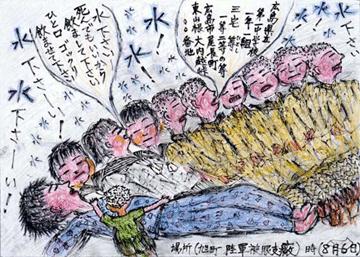
buildings, ignited clothing, disintegrated vegetation, and caused severe and fatal flash burns on people’s exposed faces and bodies. A mile from the detonation, the blast force caused nine-inch brick walls to crack, and glass fragments bulleted into people’s arms, legs, backs, and faces, often puncturing their muscles and organs. Two miles away, thousands of people suffering flesh burns from the extreme heat lay trapped beneath partially demolished buildings.
At distances up to five miles, wood and glass splinters pierced through people’s clothing and ripped into their flesh. Windows shattered as far as eleven miles away. Larger doses of radiation than any human had ever received penetrated deeply into the bodies of people and animals. The ascending fireball suctioned massive amounts of thick dust and debris into its churning stem. A deafening roar erupted as buildings throughout the city shuddered and crashed to the ground……http://www.tomdispatch.com/blog/176032/ http://atimes.com/2015/08/entering-the-nuclear-age-body-by-body-the-nagasaki-experience/
70 years on, the nuclear threat looms as large as ever
Ban the bomb: 70 years on, the nuclear threat looms as large as ever, The Conversation, Tilman Ruff
Associate Professor, International Education and Learning Unit, Nossal Institute for Global Health, School of Population and Global Health at University of Melbourne August 6, 2015 “……..The bombing of Hiroshima and Nagasaki

Rumours had been circulating in Hiroshima that the city was being saved for something special. It was. The burst of ionising radiation, blast, heat and subsequent firestorm that engulfed the city on August 6 killed 140,000 people by the end of 1945. Many were incinerated or dismembered instantly; others succumbed over hours, days, weeks and months from cruel combinations of traumatic injury, burns and radiation sickness.
Three days later, another B-29 carrying a bomb equivalent to 21,000 tons of TNT headed for Kokura. Because of clouds blocking visibility, its cargo was dropped over Nagasaki instead, raining similar radioactive ruin and killing 90,000 people by the end of 1945.
In both cities, ground temperatures reached about 7000° Celsius. Radioactive black rain poured down after the explosions.
In both weapons, less than one kilogram of material was fissioned. The physics of the Hiroshima bomb were so simple and predictable that the bomb was not tested prior to use. The Nagasaki plutonium bomb required a more sophisticated design. A prototype was exploded at Alamogordo in New Mexico on July 16, 1945, detonated by Australian nuclear physicist Ernest Titterton.
The survivors of the two bombings bore the legacy of terrible injuries and scars on top of the cataclysmic trauma of what they witnessed. They also faced discrimination and ostracism, reduced opportunities for employment and marriage, and increased risks of cancer and chronic disease, which stalk them, even 70 years later, for the rest of their days.
Over the past 30 years I have had the privilege of visiting Hiroshima and Nagasaki on a number of occasions. What never ceases to amaze me is the extraordinary compassion, wisdom and humbling humanity of hibakusha. Never have I heard even the slightest hint of an understandable desire for revenge or retribution.
An unfulfilled quest
The constant yearning of hibakusha is that no-one else should ever suffer as they have suffered: nuclear weapons must be removed from the face of the earth.
In the newly established United Nations, there was the same understanding. The first resolution passed at the first meeting of the UN General Assembly in London in January 1946 established a commissionto draw up a plan “for the elimination of national armaments of atomic weapons”.
Today, there is ample cause for existential despair and a poor prognosis for human custodianship of the biosphere. No nuclear disarmament negotiations are in train. Even reduced from their Cold War peak, massively bloated nuclear arsenals of 15,650 weapons jeopardise not only the living but those yet to be born.
Were one Hiroshima bomb to be detonated every two hours from the end of 1945, the global arsenal would not yet be consumed. All the nuclear-armed states continue to invest massively in development and modernisation of their arsenals. In the Conference on Disarmament, it has not been possible to agree even on an agenda for 19 years.
The five-yearly review conference of the nuclear Non-Proliferation Treaty, the principal treaty regulating nuclear weapons and legally binding nuclear-armed states to disarm, recently ended in failure. Britain, Canada and the US (acting for Israel, not even a party to the treaty), refused to accept a March 2016 deadline for a conference, promised for 20 years, to discuss a zone free of weapons of mass destruction in the Middle East.
Meanwhile, conflict in Ukraine and Crimea has re-inflamed Cold War risks of armed confrontation and nuclear war between NATO and Russia.
However, there are grounds to be hopeful about decisive progress on a circuit-breaker. The first ever intergovernmental conferences on the humanitarian impacts of nuclear weapons have been held – three in the past two years. These have led to 113 nations signing a humanitarian pledge committing them to work to fill the legal gap for the prohibition and elimination of nuclear weapons……..
In appealing to the 1982 UN Second Special Session on Disarmament, Hiroshima Mayor Takeshi Araki said:
Hiroshima is not merely a witness of history. Hiroshima is an endless warning for the future of humankind. If Hiroshima is ever forgotten, it is evident that the mistake will be repeated and bring human history to an end.
Nagasaki Mayor Hitoshi Motoshima added:
Nagasaki has to be forever the last city in the world bombed by nuclear weapons!
On the 70th anniversary of the bombings, banning nuclear weapons is long overdue. The remaining survivors should see negotiations on a ban treaty underway by the time a new year dawns. https://theconversation.com/ban-the-bomb-70-years-on-the-nuclear-threat-looms-as-large-as-ever-45491
One living witness to the history of Hiroshima bombing survivors
Survivor Koko Kondo shares horror of Hiroshima’s ground zero by: YUKA HAYASHI The Wall Street Journal August 06, 2015 Every year, Koko Tanimoto Kondo tours her hometown carrying the tiny, tattered pink tunic she wore on the day, 70 years ago, she and her family survived the world’s first atomic bombing.On storytelling tours around the August 6 anniversary, Ms Kondo, who was eights months old when the bomb hit, tells students about the devastation that destroyed her home and haunted her for decades.She recalls when her American fiance abandoned her days before their wedding because his relatives thought radiation exposure had made her unable to bear children.
She shares the humiliation she felt as a teenager, standing naked on a stage while doctors and scientists scrutinised her for signs of radiation’s long-term effects on the body.
She offers tales of ordinary Americans who sent food and built homes for the victims, and continued for decades after the war to send cheques on birthdays to sons and daughters of Hiroshima connected through “moral adoption”.Ms Kondo’s father, Kiyoshi Tanimoto, was a US-educated minister at a church in Japan. When Hersey visited Hiroshima in the spring of 1946, Tanimoto shared with him a detailed account of the horror and chaos he witnessed. In the book, Tanimoto is described as passing by “rank on rank of the burned and bleeding”, scurrying to find water for dying victims, and removing a dead body from a rowboat to carry those who were still alive, after apologising to the dead man for doing so.
Ms Kondo and her mother were buried under the parsonage of her father’s church. Her mother managed to hoist her out of the rubble after chipping away at “a chink of light” that they could eventually fit through. When Tanimoto was reunited with his wife and baby, he was “so tired that nothing could surprise him”. Hersey wrote in his account, which first appeared in the New Yorkermagazine in August 1946, a year after Hiroshima and Nagasaki became the first and only cities in history to experience a nuclear bombing………..
Ms Kondo shows the visitors where her father’s church stood before it collapsed, burying her under the rubble. She takes them to the river her father crossed in a rowboat to carry victims, some grotesquely burned, to escape the devastation. They go to the Red Cross Hospital, where thousands went for refuge. Ms Kondo’s brief appearance in the book Hiroshima, by journalist John Hersey, set her on a path to become a messenger from ground zero. http://www.theaustralian.com.au/business/wall-street-journal/survivor-koko-kondo-shares-horror-of-hiroshimas-ground-zero/story-fnay3ubk-1227471529950?from=public_rss&utm_source=The%20Australian&utm_medium=email&utm_campaign=editorial
The nightmares of climate change are already upon us
 The Point of No Return: Climate Change Nightmares Are Already Here
The worst predicted impacts of climate change are starting to happen — and much faster than climate scientists expected, Rolling Stone, By Eric Holthaus August 5, 2015 Historians may look to 2015 as the year when shit really started hitting the fan. Some snapshots: In just the past few months, record-setting heat waves in Pakistan and India each killed more than 1,000 people. In Washington state’s Olympic National Park, the rainforest caught fire for the first time in living memory. London reached 98 degrees Fahrenheit during the hottest July day ever recorded in the U.K.; The Guardian briefly had to pause its live blog of the heat wave because its computer servers overheated. In California, suffering from its worst drought in a millennium, a 50-acre brush fire swelled seventyfold in a matter of hours, jumping across the I-15 freeway during rush-hour traffic. Then, a few days later, the region was pounded by intense, virtually unheard-of summer rains. Puerto Rico is under its strictest water rationing in history as a monster El Niño forms in the tropical Pacific Ocean, shifting weather patterns worldwide.
On July 20th, James Hansen, the former NASA climatologist who brought climate change to the public’s attention in the summer of 1988, issued a bombshell: He and a team of climate scientists had identified a newly important feedback mechanism off the coast of Antarctica that suggests mean sea levels could rise 10 times faster than previously predicted: 10 feet by 2065. The authors included this chilling warning: If emissions aren’t cut, “We conclude that multi-meter sea-level rise would become practically unavoidable. Social disruption and economic consequences of such large sea-level rise could be devastating. It is not difficult to imagine that conflicts arising from forced migrations and economic collapse might make the planet ungovernable, threatening the fabric of civilization.”
Eric Rignot, a climate scientist at NASA and the University of California-Irvine and a co-author on Hansen’s study, said their new research doesn’t necessarily change the worst-case scenario on sea-level rise, it just makes it much more pressing to think about and discuss, especially among world leaders. In particular, says Rignot, the new research shows a two-degree Celsius rise in global temperature — the previously agreed upon “safe” level of climate change — “would be a catastrophe for sea-level rise.”
Hansen’s new study also shows how complicated and unpredictable climate change can be. Even as global ocean temperatures rise to their highest levels in recorded history, some parts of the ocean, near where ice is melting exceptionally fast, are actually cooling, slowing ocean circulation currents and sending weather patterns into a frenzy. Sure enough, a persistently cold patch of ocean is starting to show up just south of Greenland, exactly where previous experimental predictions of a sudden surge of freshwater from melting ice expected it to be. Michael Mann, another prominent climate scientist, recently said of the unexpectedly sudden Atlantic slowdown, “This is yet another example of where observations suggest that climate model predictions may be too conservative when it comes to the pace at which certain aspects of climate change are proceeding.”
Since storm systems and jet streams in the United States and Europe partially draw their energy from the difference in ocean temperatures, the implication of one patch of ocean cooling while the rest of the ocean warms is profound. Storms will get stronger, and sea-level rise will accelerate. Scientists like Hansen only expect extreme weather to get worse in the years to come, though Mann said it was still “unclear” whether recent severe winters on the East Coast are connected to the phenomenon.
 And yet, these aren’t even the most disturbing changes happening to the Earth’s biosphere that climate scientists are discovering this year.
For that, you have to look not at the rising sea levels but to what is actually happening within the oceans themselves.
Water temperatures this year in the North Pacific have never been this high for this long over such a large area — and it is already having a profound effect on marine life………http://www.rollingstone.com/politics/news/the-point-of-no-return-climate-change-nightmares-are-already-here-20150805?page=7
China sends back infant milk formula to Fukushima
The principle radioactive poison that is being tested for in Japanese foods is cesium-137. Unfortunately, there are also other deadly poisons that have been spewed in lesser amounts by Fukushima disaster. These include americium-241, plutonium-236, uranium-238, thorium-232 and the extremely dangerous isotope, strontium-90. All of these contaminants may also be found in food from Japan, including in baby formula.
Fukushima Baby Milk Formula Declared Unfit by China http://www.huntingtonnews.net/11938 August 5, 2015 – BY JOHN LAFORGE Chinese authorities seized more than 881 pounds of baby milk formula that had been imported from Japan because it had been produced in areas known to be heavily contaminated with radioactive material emitted by three damaged nuclear reactors at the Fukushima-Daiichi complex. Continue reading
Damaged fuel rod containers, suspicious death at Fukushima nuclear plant
 Vice: ‘Suspicious’ death at Fukushima plant — Officials: Damaged nuclear fuel containers found in Unit 3 pool after removal of massive piece of debris — “High radioactivity prevented workers from carrying out the removal smoothly” — Concern about “new fuel failure” (PHOTOS & VIDEO) http://enenews.com/vice-suspicious-death-fukushima-plant-officials-damaged-nuclear-fuel-rod-containers-found-unit-3-pool-after-debris-removed-concern-about-new-fuel-failure-high-radioactivity-prevented-workers?utm_source=feedburner&utm_medium=email&utm_campaign=Feed%3A+ENENews+%28Energy+News%29
NHK, Aug 4, 2015 (emphasis added): Fuel rod casings found damaged by debris… workers have found damaged fuel rod containers after removing a device that had fallen on them during the 2011 disaster. They’re now checking whether the damage will affect their plan to remove fuel from the pool. A 20-ton device for moving fuel rods in and out of the pool on the building’s top floor was removed on Sunday… High radioactivity prevented workers from carrying out the removal smoothly… Workers found that the metal casings of 4 assemblies had been distorted and have twisted handles. This is evident in images released by the operator… The utility is checking for other damage and studying how to remove the distorted casings from the pool.
TEPCO (pdf), Aug 4, 2015: Unit 3 Spent Fuel Pool… we found bent handles of 4 nuclear fuel assemblies located under the Fuel Handling Machine which was removed on August 2nd… there is no indication ofnew fuel failure by the removal… In the future, when discussing fuel removal, we will consider how to deal with the bent handles of nuclear fuel assemblies.
Vice News, Aug 4, 2015: A 30 year-old man died this weekend as he worked on decommissioning Japan’s Fukushima nuclear plant… It is not yet known whether the man’s death was due to radiation exposure, and an autopsy is pending… In a statement released Monday, [Tepco] said that the man had been taken to the emergency room after complaining that he wasn’t feeling well. “His death was confirmed early in the afternoon,” Tepco said. Isabelle Dublineau, the head of the experimental radiotoxicology laboratory for France’s Institute for Radiological Protection and Nuclear Safety (IRSN), said… it was “too early” to comment on the death… While the latest death has already been branded suspicious in the media, Tepco has so far denied that any of the deaths are related to radiation exposure… The worker who died over the weekend was working… on the construction of the “ice wall”…
Fukushima: ALL EVIDENCE POINTS TO MELT DOWNS IN BOTH NUCLEAR REACTORS 5 AND 6
Fukushima; Reactors And/Or SFP’s In #5 And #6 Melted Down – Total of 7 Melt Down’s, Melt Outs, Nuclear Explosions A Green Road Blogspot, 12 July 15,
- massive amounts of hydrogen/tritium gas released out of holes cut in the buildings
- high levels of cesium in the drains coming from 5 and 6
- radioactive water in the basements, hauled away by US military barge
- white smoke from both buildings
- melted fuel in pipe picture
- broken pipes in all buildings
- report of melted down fuel
- report of radioactive xenon gas releases months after disaster
Gov’t model shows Fukushima radioactive gas near Tokyo skyrocketed to 10,000,000,000 times normal levels soon after 3/11 – “Very high concentrations” recorded at all monitoring posts in northern hemisphere (VIDEO)
http://enenews.com/noaa-model-shows-fukushima-radioactive-gas-tokyo-skyrocketed-10-billion-times-normal-levels-after-311-very-high-concentrations-recorded-all-monitoring-posts-northern-hemisphere-video
Radioactivity in the drains, in the gas/air and in the water in the basements comes from melting down fuel rods, not normal operations from a shut down and cooled off reactor and spent fuel pools, wouldn’t you agree?
And where did all of that highly radioactive water from the basements of the #5 and #6 buildings go, by the way, in that US supplied barge? Where did the high level radiation in the water come from? Where did that melted fuel in the pipe go?
In all of the other buildings, the high level radiation in the basements comes from broken reactors with melted down fuel in them. Certainly radioactive water does not come from the tsunami, because the tsunami wave was clean, pure ocean water. And pray tell TEPCO, what was the radiation level in that water, from buildings 5 and 6, hmmmmmm?
MELTDOWN OF THE TRUTH AROUND BUILDINGS 5 AND 6
Problems ahead, if Japan restarts mothballed nuclear reactors
Japan Heads Toward Nuclear Unknown With Post-Fukushima Restarts, Bloomberg by Stephen Stapczynski Yuriy Humber August 6, 2015 Japan is about to do something that’s never been done before: Restart a fleet of mothballed nuclear reactors.
The first reactor to meet new safety standards could come online as early as next week. Japan is reviving its nuclear industry four years after all its plants were shut for safety checks following the earthquake and tsunami that wrecked the Fukushima Dai-Ichi station north of Tokyo, causing radiation leaks that forced the evacuation of 160,000 people.
Mothballed reactors have been turned back on in other parts of the world, though not on this scale — 25 of Japan’s 43 reactors have applied for restart permits. One lesson learned elsewhere is that the process rarely goes smoothly. Of 14 reactors that resumed operations after four years offline, all had emergency shutdowns and technical failures, according to data from the World Nuclear Association, an industry group.
In Sweden, E.ON Sverige AB closed the No. 1 unit at its Oskarshamn plant in 1992 and restarted it in 1996. It had six emergency shutdowns in the following year and a refueling that should have taken 38 days lasted more than four months after cracks were found in equipment……..The challenges facing the NRA are “absolutely unique worldwide,” said John Large, chief executive at Large & Associates, a London-based engineering consultant to the nuclear industry. “You have had the whole nation’s fleet of nuclear power plants closed down for four years.”
Long-Dormant
As problems can arise with long-dormant reactors, the NRA “should be testing all the equipment as well as the operator beforehand in preparation,” Macfarlane of the U.S. said by e-mail. …….http://www.bloomberg.com/news/articles/2015-08-05/japan-heads-toward-nuclear-unknown-with-post-fukushima-restarts
How radioactive isotopes impact on the human body
Lies, damn lies, and radiation health, A Prosperous Way Down by Mary Logan Health impacts of unseen dangers

Each isotope has different rates of biomagnification and then uptake and also different impacts in the body. Strontium follows calcium pathways in the body, so it settles in bone marrow, replacing structure and weakening bones and teeth, and causing leukemia.Cesium follows potassium pathways, lodging in muscle such as the heart. Many other isotopes act in other damaging ways in the body.
The dangers are probably still small for most foods, but hazards are tenfold to a hundredfold for children, infants, and fetuses, who have the fastest rates of mitosis and development. Rapidly dividing cells in the young are most sensitive in any organism. Similarly, organs with rapidly dividing cells are affected (bone marrow, digestive tract, skin). So risk avoidance is most important for the young.
Some of the list of long-term impacts for human health include the following:
- Circulatory damage (high blood pressure, rhythm disturbances, MI, stroke, cardiomyopathies, rhythm disturbances artery spasm, especially during cardiac stress such as temperature extremes, physical/emotional stress) (Bandazhevsky, 2001)
- Hematologic problems (leukemias especially)
- Endocrine problems (especially Hypothyroidism, thyroid nodules/Cancer, and Diabetes)
- Immune system
- Uro-genital system
- Musculoskeletal system
- Dental problems as cesium replaces calcium in teeth and bones
- Central nervous system and psyche
- The eye (cataracts and retinopathies)
- Increase in congenital malformations
- Increase in cancers
- Accelerated aging
- Increased frequency of mutations
- Fertility problems and Change in secondary sex ratio (Yablokov, 2012)
- Because exposure to radiation is invisible and difficult to detect, it is far under-represented as risk factor for disease. Causes of mortality for radiation exposure are difficult to track beyond the obviously linked leukemias and cancer. Manmade radiation from above-ground testing beginning in the 1950s has been added to by military depleted uranium from expanding use in the Middle East and expanding failures in the 435 nuclear power plants (NPPs) around the world, along with the reprocessing plants. Radiation is often ignored as a reason for immunosuppression, various cancers, and perhaps even endocrine dysfunction, especially thyroid. Because radiation impacts have not been measured in the general population, radiation’s contribution to cancers and other diseases go unnoticed. Women are more vulnerable than men, and children are at least ten to perhaps hundreds of times as vulnerable as adults, because of the rapid mitosis of their cells as they grow. Fetuses are even more vulnerable…..http://prosperouswaydown.com/epistemology-radiation-health/
USA government makes rules on ionising radiation in water more lax

 EPA raises permissible levels of radiation in drinking water https://thewrongblogg.wordpress.com/2015/08/04/epa-raises-permissible-levels-of-radiation-in-drinking-water/ The White House has given final approval for dramatically raising permissible radioactive levels in drinking water and soil following “radiological incidents,” such as nuclear power-plant accidents and dirty bombs. The final version, slated for Federal Register publication as soon as today, is a win for the nuclear industry which seeks what its proponents call a “new normal” for radiation exposure among the U.S population, according Public Employees for Environmental Responsibility (PEER).
Issued by the Environmental Protection Agency, the radiation guides (called Protective Action Guides or PAGs) allow cleanup many times more lax than anything EPA has ever before accepted. These guides govern evacuations, shelter-in-place orders, food restrictions and other actions following a wide range of “radiological emergencies.” The Obama administration blocked a version of these PAGs from going into effect during its first days in office. The version given approval late last Friday is substantially similar to those proposed under Bush but duck some of the most controversial aspects: Continue reading
Medical science’s blind spot about the causes of cancer, especially about ionising radiation
These days, our science is often directed by funding, and funding increasingly is directed by large corporations whose incentives are to increase profit. This research emphasis leads to a focus on tertiary treatment in high-tech healthcare centers, while blind spots develop about the causes of illness, especially environmental ones, including PCBs, heavy metals, radiation, and pesticides.
Lies, damn lies, and radiation health, A Prosperous Way Down by Mary Logan 2013,Recent news about Hanford leaks, a flurry of news surrounding the two-year anniversary of Fukushima, and today’s news about breast cancer rates in the US center my thoughts on blind spots in health research. I will use ionizing radiation again as an illustration of environmental linkages to disease, beginning with the trigger for this post, which was a new World Health Organization (WHO) report. Previous posts about nuclear hazards are linked here and here.
This week, the WHO published a preemptive report on Fukushima, only two years after the disaster. The WHO concluded that “for the general population inside and outside of Japan, the predicted risks are low and no observable increases in cancer rates above baseline rates are anticipated.” This conclusion is from the same organization that has been muzzled on the topic of ionizing radiation contamination of our environment since 1959, when they agreed to misinform the public in subordination to the global nuclear governing body, the IAEA, to protect civil and military nuclear interests. If you believe that Fukushima has not increased background risk and there will be no increases in cancer rates, I have a bridge to sell you. Mark Twain’s maxim about lies, damn lies, and statistics can be applied here. The point of this post is to examine western medicine’s epistemology of disease, specifically examining how we select the risk factors that are involved in cancer and other diseases.
Epistemology is the study of the nature and scope of knowledge. Our society lacks a broad understanding of how ionizing radiation behaves once it is accidentally released into the environment. There are two main reasons for this. Bednarz (2010) describes Mitroff and Silvers’ discussion of Type 3 errors, where we unintentionally solve the wrong problems through our narrow worldview and reductionist focus in science, and Type 4 errors, where we intentionally solve the wrong problems, because we are pursuing goals such as profit that subverts the science. In our western system of medical research, we commit both Type 3 and Type 4 errors as a result of our narrow worldview and our economic mandate for profit and growth. These type 3 and 4 errors result in blind spots, especially regarding environmental linkages to disease.
In another medical report this week, a new epidemiological study of breast cancer reports increasing rates of breast cancer in young women (Johnson, Chien, & Bleyer, 2013). The pattern of increased incidence in younger patients would be compatible with the epidemiology of radiation-caused cancers, which are more common in the young who have faster cell division/turnover. The increased incidence could also be compatible with many other accumulating environmental toxins.
“The number of American women ages 25 to 39 diagnosed with metastatic breast cancer — which has already spread to other organs by the time it’s found — rose about 3.5% a year from 2000 to 2009, according to a study in today’s Journal of the American Medical Association. The trend began in the 1970s, although the most rapid increases occurred in about the last decade, the study says. The study doesn’t provide any clues about what might be driving the increase, says study author Rebecca Johnson, a pediatric and adolescent oncologist at Seattle Children’s Hospital. . . .
The number of women in this age range diagnosed with advanced disease rose from about 250 a year in 1976 to about 850 a year in 2009, Johnson says. The largest increases were in the youngest women, from ages 25 to 34, the study says. There were also slight increases in metastatic diagnoses among women ages 40 to 54, but no increase in older women” (USA Today, 2/27/13).
Western medicine’s emphasis on treatment and pharmaceuticals, with abandonment of science that is focused on prevention and risk factors in fields such as epidemiology, public health, and environmental medicine points to reductionist science and the influence of money in directing the focus of research. Recently, Dr. Susan Love said that “. . . her experience [of a recent diagnosis of acute myelogenous leukemia] has emboldened her in her quest to focus on the causes of disease rather than new drugs to treat it.” This aha! moment from a well-known breast cancer researcher illustrates our blind focus on research oriented towards treatment with increasingly costly drugs that may not cure.These days, our science is often directed by funding, and funding increasingly is directed by large corporations whose incentives are to increase profit. This research emphasis leads to a focus on tertiary treatment in high-tech healthcare centers, while blind spots develop about the causes of illness, especially environmental ones, including PCBs, heavy metals, radiation, and pesticides. In Love’s case, her leukemia is even more likely to be attributable to radiation exposure than other diseases. Strontium-90 is a bone-seeker, playing havoc with bone marrow. Should we be focusing on and funding genetic testing and treatment as the future of medicine, or should we be widening our view to encompass better science about preventive care and attention to burgeoning environmental risk factors? Especially since the cost of healthcare in America is now at 18% of GDP, and rising without brakes.http://prosperouswaydown.com/epistemology-radiation-health/
Every year, thousands of Hiroshima survivors treated for radiation-induced illnesses
Hiroshima nuclear bomb 70th anniversary: New research shows thousands of survivors treated every year August 6, 2015 Julie Power Reporter
“…….New Red Cross data released on Thursday shows that even 70 years after the atomic blasts, Japanese hospitals treat thousands of survivors each year, mostly for cancer which has caused two-thirds of deaths. In the past 12 months, the Red Cross hospitals treated nearly 11,000 survivors.
The full impact of the blast on the survivors and their children who are now reaching 50 years of age, is still not fully known, Dr Masao Tomonaga, the director of the Japanese Red Cross Nagasaki Atomic Bomb Hospital and a survivor told Fairfax Media this week.
As well as suffering higher rates of cancer, new research by the Red Cross hospitals showed survivors who had lived close to the epicentres were also 1.5 times more likely to suffer from heart attacks and angina.
“I couldn’t imagine (these results) before we started this research some 65 years ago (when the hospitals were built.) This means atomic bomb radiation is a life-long effect, with evidence of a life-long susceptibility to cancers, leukaemia and heart attacks,” Dr Tomonaga said.
Of the 16,000 nuclear weapons held today, 1800 are launch ready and any one would make Little Boy or Fat Man “look tiny” and wipe out a city like Sydney, said Robert Tickner, the CEO of the Australian Red Cross. No country or medical service could handle the immediate or long-term impacts, including the millions who would go hungry, Red Cross research has found.
Mr Tickner is calling on Australians and their leaders to support a ban on nuclear weapons for humanitarian reasons.
The author Junko Morimoto drawing as a young girl near what became the Hiroshima Peace Memorial.Photo: Junko Morimoto
“If the world has moved on biological and chemical weapons as illegal weapons of war, if we have moved on clusters, landmines and had conventions to tackle those to deal with them as a weapon of war, what madness is it that we have not taken a similar stand on nuclear weapons.They are the standout greatest threat to the planet,” he said.
Around 113 countries have now signed the Austrian Pledge to prohibit and eliminate nuclear weapons because of their unacceptable humanitarian consequences. The federal government hasn’t signed, but the ALP ‘s new party platform, amended at last month’s conference, agrees to “prohibiting and eliminating nuclear weapons is a humanitarian imperative.”…..http://www.smh.com.au/nsw/hiroshima-nuclear-bomb-70th-anniversary-new-research-shows-thousands-of-survivors-treated-every-year-20150804-girqz8.html#ixzz3i4jl5UGt
Scary part of Fukushima is the sheer epic scale of this mega nuclear disaster
Fukushima; Reactors And/Or SFP’s In #5 And #6 Melted Down – Total of 7 Melt Down’s, Melt Outs, Nuclear Explosions A Green Road Blogspot, 12 July 15, “………CONCLUSION
Building 1 – melted out
Building 2 – melted out
Building 4 – melted out from at least the equipment pool
Building 5 – melted down
Building 6 – melted down
1 This Month
Chernobyl: The Lost Tapes – A good documentary on Chernobyl on SBS available On Demand for the next 3 weeks– https://www.sbs.com.au/ondemand/tv-program/chernobyl-the-lost-tapes/2352741955560

of the week–London Campaign for Nuclear Disarmament

Tell the Ukrainian Government to Drop Prosecution of Peace Activist Yurii Sheliazhenko
To see nuclear-related stories in greater depth and intensity – go to https://nuclearinformation.wordpress.com
-
Archives
- April 2026 (189)
- March 2026 (251)
- February 2026 (268)
- January 2026 (308)
- December 2025 (358)
- November 2025 (359)
- October 2025 (376)
- September 2025 (257)
- August 2025 (319)
- July 2025 (230)
- June 2025 (348)
- May 2025 (261)
-
Categories
- 1
- 1 NUCLEAR ISSUES
- business and costs
- climate change
- culture and arts
- ENERGY
- environment
- health
- history
- indigenous issues
- Legal
- marketing of nuclear
- media
- opposition to nuclear
- PERSONAL STORIES
- politics
- politics international
- Religion and ethics
- safety
- secrets,lies and civil liberties
- spinbuster
- technology
- Uranium
- wastes
- weapons and war
- Women
- 2 WORLD
- ACTION
- AFRICA
- Atrocities
- AUSTRALIA
- Christina's notes
- Christina's themes
- culture and arts
- Events
- Fuk 2022
- Fuk 2023
- Fukushima 2017
- Fukushima 2018
- fukushima 2019
- Fukushima 2020
- Fukushima 2021
- general
- global warming
- Humour (God we need it)
- Nuclear
- RARE EARTHS
- Reference
- resources – print
- Resources -audiovicual
- Weekly Newsletter
- World
- World Nuclear
- YouTube
-
RSS
Entries RSS
Comments RSS
 nuclear-news