Thorium nuclear fuel. They make out that it’s safe. But it’s not
 Is the “Superfuel” Thorium Riskier Than We Thought? A new study in Nature says that using thorium as a nuclear fuel has a higher risk for proliferation into weapons than scientists had believed. Popular Mechanics 16 May 14, By Phil McKenna Imagine a cheap, plentiful source of energy that could provide safe, emissions-free power for hundreds of years without refueling and without any risk of nuclear proliferation. The fuel is thorium, and it has been trumpeted by proponents as a “superfuel” that eludes many of the pitfalls of today’s nuclear energy. But now, as a number of countries including China, India, and the United States explore the potential use of thorium for nuclear power, researchers say one of the biggest claims made about the fuel—its proliferation resistance—doesn’t add up.
But Ashley and his co-authors say a simple tweak in the thorium irradiation recipe can sidestep the radioactive isotope’s formation. If an element known as protactinium-233 is extracted from thorium early in the irradiation process, no uranium-232 will form. Instead, the separated protactinium-233 will decay into high purity uranium-233, which can be used in nuclear weapons.
“Eight kilograms of uranium-233 can be used for a nuclear weapon,” Ashley says. “The International Atomic Energy Agency views it the same as plutonium in terms of proliferation risk.” Creating weapons-grade uranium in this way would require someone to have access to a nuclear reactor during the irradiation of thorium fuel, so it’s not likely a terrorist group would be able to carry out the conversion. The bigger threat is that a country pursuing nuclear energy and nuclear weapons (say, Iran) could make both from thorium. “This technology could have a dual civilian and military use,” Ashley says. …..

Top secret cargo. Plutonium from Canada?
 Covert mission: Plutonium source might be Canada Questions being asked about mystery cargo BY IAN MACLEOD, OTTAWA CITIZEN MARCH 30, 2014 The nuclear fuel carrier Pacific Egret slipped into the harbour at Charleston, South Carolina, on March 19 and unloaded a top-secret cargo at the port’s Naval Weapons Station.
Fitted with naval guns, cannons and extensive hidden means of repelling a terrorist assault, the three-year-old British vessel was purpose-built to transport plutonium, highly enriched uranium (HEU) and mixed-oxide (MOX) nuclear fuel on the high seas.
Its previous publicly reported position had been exiting the Mediterranean at the Strait of Gibraltar almost two weeks earlier on March 7, carrying a delicate nuclear cargo loaded at the La Spezia naval base in northern Italy.
As the vessel entered the North Atlantic that day, its tracking image vanished from an online marine traffic monitoring system. The ship the size of a football field became all but invisible to unauthorized eyes.
Questions are now being raised about whether the sensitive cargo included recycled plutonium that originated here in Canada.
The clandestine business of transporting shiploads of fissile nuclear materials between nations rarely comes into public view. An eight-kilogram piece of plutonium-239 the size of a grapefruit could obliterate much of Ottawa in seconds — as it did to Nagasaki in August 1945. It’s aptly named after the ancient Greek god of the underworld……… Continue reading
USA Energy Dept in a fix about legal cases and no answer for nuclear wastes

they should stop making this toxic radioactive trash
 Tiny nuclear waste fee added up to billions LA Times, 17 May 14 A charge for electricity that millions of Americans didn’t even know they pay will suddenly disappear Friday, after the Energy Department this week quietly notified utilities across the country that it was suspending its fees for a future nuclear waste dump.
The Energy Department has been collecting $750 million from electricity bills every year  for such a dump since 1983, putting it into a trust fund that now contains $31 billion.
The court-ordered suspension may be a modest victory for consumers, but it reflects the government’s failure over the last 40 years to get rid of what is now nearly 70,000 metric tons of highly radioactive spent fuel, accumulating at 100 nuclear reactors across the nation……… Continue reading
Nuclear industry’s frantic campaign for Small Modular Reactors as solution to climate chnage

Mark Cooper, Ph.D. Senior Fellow for Economic Analysis Institute for Energy and the Environment Vermont Law School May 2014
EXECUTIVE SUMMARY
The Marshall Islands Nuclear Zero Lawsuit deserves all our support
The Nuclear Zero Lawsuits: Who will speak for the people? http://thehill.com/blogs/congress-blog/homeland-security/206271-the-nuclear-zero-lawsuits-who-will-speak-for-the-people#ixzz3216oOGyg By Jody Williams and Robert Dodge, M.D. 16 May 14, The U.N. just concluded the Nuclear Non-Proliferation Treaty (NPT) Preparatory Committee with representatives from the 189 signatory nations and of civil society. The meeting was in preparation for next year’s NPT conference and to discuss the current status of fulfilling the obligations under the treaty and in particular, the mandate of the nuclear weapons states for global disarmament. The outcome was a continued foot dragging by the nuclear states motivating a demand for meaningful steps and progress toward disarmament by the other 184 nations in view of current international events.
Recent scientific studies by the International Physicians for the Prevention of Nuclear War on the humanitarian consequences of limited nuclear war have shed additional light on the danger these weapons pose. Describing a hypothetical conflict between India and Pakistan using less than ½ of 1 percent of the global nuclear arsenals, the studies confirm 2 billion people would be at risk of dying due to global climatic change.
Combined with recent scandals involving U.S. ICBM missile controllers and a growing accounting of nuclear mishaps and near misses in our nuclear forces over the years, the sense of urgency for disarmament is greater than ever. It has become a question of who will step forward and speak for humanity.
On April 24, the Republic of the Marshall Islands (RMI) filed the Nuclear Zero Lawsuits in the International Court of Justice against all nine nuclear-armed nations, as well as against the United States in U.S. Federal District Court. RMI claims that the nuclear weapon states are in breach of Article VI of the Non-Proliferation Treaty (NPT), which entered into force 16,121 days prior to the filing. In this David vs. Goliath action this tiny island nation has found the voice to speak on behalf of the world and the other nations signatory to the Treaty.
The case for the Nuclear Zero Lawsuit comes directly from the NPT where Article VI states: “Each of the Parties to the Treaty undertakes to pursue negotiations in good faith on effective measures relating to cessation of the nuclear arms race at an early date and to nuclear disarmament, and on a treaty on general and complete disarmament under strict and effective international control.”
This was the grand bargain that convinced many non-nuclear weapon states to sign the treaty and agree not to develop nuclear weapons of their own. Forty-four years later, with no meaningful negotiations on the horizon and no end in sight to the “step-by-step” process heralded by the permanent five members of the UN Security Council (P5), the RMI has stepped in to change the discourse on nuclear disarmament.
RMI is seeking declaratory relief from the courts that will compel the leaders of the Nuclear Weapons States (NWS) to initiate good-faith negotiations for an end to the nuclear arms race and to nuclear disarmament. They are challenging the leaders of the NWS to answer, on the record, why 44 years have passed and nuclear arsenals continue to be modernized, national security strategies continue to place nuclear weapons at the top of the list, and the P5 don’t even expect to have a “Glossary of Key Nuclear Terms” to talk about nuclear disarmament until 2015.
In addition to the five Nuclear Weapon States named in the NPT, the lawsuit also includes the four nuclear weapon states that are not parties to the NPT – Israel, India, Pakistan and North Korea – which, RMI argues, are bound to Article VI obligations under customary international law.
The RMI is a small sovereign nation, among the smallest in the world. However, their courage could not be greater. Having been a testing ground for 67 nuclear tests between 1946 and 1958, the Marshall Islanders have seen their land, sea and people poisoned from radiation. These tests had an equivalent explosive force greater than 1.5 Hiroshima bombs being detonated daily for 12 years. The Marshall Islanders paid a heavy price in terms of their health and well-being for these destructive tests. They have experienced firsthand the horrible destruction caused by nuclear weapons and those that possess them. They are willing to stand up to the nine nuclear giants and say, “Never again. We have seen the destructive impact of these horrific weapons and vow to do all we can so the world never sees such atrocities again.”
The RMI does not act alone in this action. A consortium of NGOs working to highlight the legal and moral issues involved in the Nuclear Zero Lawsuit has come together around the world coordinated by the Nuclear Age Peace Foundation in Santa Barbara. Respecting the courage of the plaintiff in bringing these lawsuits against some of the most powerful nations in the world they have developed a call to action.
The consortium urges everyone to join them by raising your voice in support of the Nuclear Zero Lawsuit. Go to www.nuclearzero.org, where you can read more about the lawsuits and sign the petition encouraging leaders of the Nuclear Weapon States to begin good-faith negotiations.
Williams received the 1997 Nobel Peace Prize for her work with the International Committee to Ban Landmines (ICBL) and is chair of the Nobel Women’s Initiative. Dodge is a family physician on the Board of the Nuclear Age Peace Foundation and Physicians for Social Responsibility Los Angeles. PSR is the U.S. affiliate of the International Physicians for the Prevention of Nuclear War – recipient of the 1985 Nobel Peace Prize.
6.5 million jobs already in renewable energy
 Renewable Energy Jobs Rise To Nearly 6.5 Million Worldwide http://www.the9billion.com/2014/05/15/renewable-energy-jobs-rise-to-nearly-6-5-million-worldwide/ by JOHN JOHNSTON on 05/15/2014 The number of renewable energy jobs rose to nearly 6.5 million worldwide in 2013, a new report from the
  International Renewable Energy Agency has found.
The report found that the rise was pushed by the growing solar market in China. Solar installations grew five-fold from 2011 to 2013 in China, and accounted for 1.6 million jobs. Globally, the solar industry accounted for about 2.3 million jobs. The price of solar panels has been declining steadily, and this has contributed to a rise in new solar installations and jobs globally.
After the strong solar sector, liquid biofuels managed to account for 1.4 million jobs globally, and the wind power and biomass sectors drew even with around 800,000 jobs each.
Interestingly, many of these renewable energy jobs were to be found in so-called developing countries. China accounted for 2.64 million jobs overall, with the European Union renewable energy job market positioned second with 1.25 million jobs. Brazil was third with 894,000, and the United States was fourth with 625,000 jobs.
In the United State the solar sector was also a big driver of growth within renewable energy, reaching 143,000 jobs in 2013. This was a 20% increase over the year before, and a 53% increase since 2010.
With about 6.5 million people now employed in renewable energy, the industry is becoming a significant force in job creation worldwide. No doubt these numbers will rise a lot more in coming years, as solar power continues to get cheaper and enters the mainstream.
Complex arrangements – a “bad bank” for Germany’s dead nuclear reactors
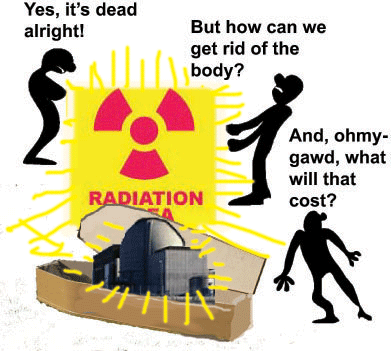 A bad bank for nuclear, as public assumes risk for closure costs http://reneweconomy.com.au/2014/a-bad-bank-for-nuclear-as-public-assumes-risk-for-closure-costs-39365 By Craig Morris on 16 May 2014 Energy Transition Over the weekend, there were reports of talks about the creation of a “bad bank” for German nuclear plants, which are to be shut down successively by the end of 2022.
Critics charge that the proposal is yet another attempt to privatize profits and nationalize losses. But Craig Morris has a bit more understanding for the firms’ position. At the end of February, the German hard coal sector made a proposal that revealed the sector’s actual situation: a bad bank. We continue to hear many reports about coal making a comeback in Germany, but in reality the uptick in 2013 will prove to be short-lived; coal power is already dramatically down in Q1 2014. And going forwards, hard coal in particular will be squeezed out even during the nuclear phaseout.
Now, the firms that run coal and nuclear plants think the idea might be useful to them during the nuclear phaseout. A quick glance at the idea is enough to make your hair stand on end, and the comments on German news websites (such as here – in German) are filled with outrage:
- The provisions set aside for the dismantling of the nuclear plants would be transferred to a state-owned foundation (the bad bank), which would then use the money for the phaseout.
- The government – meaning “the public” – would then run the risks, specifically if the costs exceed the provisions.
- In return, the power firms would drop their lawsuits against the German government with the ICSID (International Centre for Settlement and Disputes) settlements court in DC. Sweden’s Vattenfall has a minority holding in the Brokdorf nuclear plant in Germany along with Eon and is suing the German government in DC.
- Surprisingly, while Eon and EnBW (Vattenfall is apparently not involved in the negotiations for a bad bank) would be able to hand over their provisions, RWE would reportedly need a capital increase – has the firm spent its nuclear provisions on something else?
The case of Vattenfall is especially interesting. In the fall of 2010, the German government reneged on the original nuclear phaseout agreement of 2002 and extended the service lives of nuclear plants by 8 to 14 years, depending on the plant. In return, the government imposed a tax on the nuclear fuel rods to be consumed – allegedly to prevent windfall profits. But after Fukushima – only a few months later – those power plant extensions were revoked, but the tax remained.
In all likelihood, the four utilities agreed that the foreigner – Vattenfall, the one with the smallest nuclear assets – would “test the waters” and see whether a court case against the nuclear tax could be won. Last month, a German court ruled that the nuclear tax was illegal, so the current negotiations may be taking place against that backdrop.
There are, however, different readings of who wants what now. German economics daily Handelsblatt writes in its newsletter on Monday that “the government in Berlin wants to have the roughly 35 billion euros in nuclear provisions from Eon, RWE, EnBW, and Vattenfall,” the four utilities that run nuclear plants and Germany. This report in English at the Financial Times also makes it sound like the German government has plans of its own.
Technically, of course, the public already runs the risks. If anything goes wrong, the liability of these firms is limited. And while this limited liability has often been decried as unfair, we should keep in mind that the power firms themselves – from the US to Germany – never wanted to build nuclear plants. The nuclear power sector was originally an attempt to make the production of nuclear weapons more palatable to the public. The power sector wanted nothing to do with the technology, which they did not understand and did not trust. Once the government had limited their liability, they essentially began building the kind of power plants they understood but merely boiled the water with nuclear fuel rods instead of coal. Some 50 years ago, RWE in particular felt that nuclear would conflict with its fleet of coal plants. The result is hundreds of nuclear plants of crappy design, with numerous design options having barely been investigated.
The German government thus forced these companies into nuclear decades ago and now it is forcing them out. All of this is unfair to these firms. It’s also unfair to the German public, which never asked for nuclear power but has to pay for the entire mess. Whatever the outcome, perhaps the main argument against nuclear is that it’s hard to do it fairly.
Why Small Modular Nuclear Reactors are not viable, and no cure for climate change
 WHY SMALL MODULAR REACTORS ARE PART OF THE PROBLEM,
 First, the viability of SMRs is dependent on the very economic processes that have eluded the industry in the past. The ability of the small modular reactor technology to reverse the cost trajectory of the industry is subject to considerable doubt. The empirical analysis of learning processes in the “Great Bandwagon Market” discussed in Section I and the failure of regulatory streamlining, advanced design and standardization in the “nuclear renaissance” certainly question the ability of the new technology to produce such a dramatic turnaround. As a result, even under the best of circumstances, the SMR technology will need massive subsidies in the early stages to get off the ground and take a significant amount of time to achieve the modest economic goal set for it.
Second, even if these economic processes work as hoped, nuclear power will still be more costly than many alternatives. Over the past two decades wind and solar have been experiencing the cost reducing processes of innovation, learning and economies of scale that nuclear advocate hoped would benefit the “Renaissance” technology and claim will affect the small modular technology. Nuclear cost curves are so far behind the other technologies that they will never catch up, even if the small modular technology performs as hoped.
Third, the extreme relaxation of safety margins and other changes in safety oversight is likely to receive a very skeptical response from policymakers. This is just the latest skirmish in a 50 year battle over safety. The push to deploy large numbers of reactors quickly with a new safety regime recalls the mistake of the early “Great Bandwagon Market.”
Fourth, the type of massive effort that would be necessary to drive nuclear costs down over the next couple of decades would be an extremely large bet on a highly risky technology that would foreclose alternatives that are much more attractive at present. Even if the technology could be deployed at scale at the currently projected costs, without undermining safety, it would be an unnecessarily expensive solution to the problem that would waste a great deal of time and resources, given past experience.
Finally, giving nuclear power a central role in climate change policy would not only drain away resources from the more promising alternatives, it would undermine the effort to create the physical and institutional infrastructure needed to support the emerging electricity systems based on renewables, distributed generation and intensive system and demand management.
The paper concludes that the prudent approach to resource acquisition is to build the institutional and physical infrastructure that achieves the maximum contribution from the more attractive resources available in the near and mid-term. With a clear path of more attractive resources, we do not have to engage in the hundred year debate today, although there is growing evidence that prospects for high penetration renewable scenarios for the long terms are quite good. The available and emerging alternatives can certainly carry the effort to meet the demand for electricity with low carbon resources a long way down the road, certainly long enough that the terrain of technologies available may be much broader before we have to settle for inferior options like nuclear power…
“Tactical” nuclear weapons useless and dangerous
Nothing tactical about nuclear weapons Express Tribune, By Zahir Kazmi May 17, 2014 The term ‘tactical nuclear weapon’ is a Cold War relic not applicable to the subcontinent. There is nothing tactical about these weapons, as their use would have strategic fallouts. Their ideal purpose should be to deter adversaries from contemplating actions that can lead to crises, conflicts and wars. For nuclear-armed states, the key would then be to exercise self-deterrence and avoid triggering conflicts.
A potential nuclear war between India and Pakistan would be a chain of unfortunate events, possibly triggered by another spectacular terrorist attack in India by Pakistan-based quasi-state extremists. India would trade the ‘Gandhian restraint’ for a dance of destruction to punish Pakistan without activating a nuclear response.
In times of defence, Pakistan’s hand would be forced to defeat advancing Indian forces either by conventional forces or by using low-yield nuclear weapons. India threatens a massive retaliation against limited nuclear use, discounting assured Pakistani quid pro quo. There will be no winners in a nuclear war.
Escalating a crisis on the grave assumption that Pakistan would be involved in a future terrorist attack is a commitment trap. The rational choice of investigating such an event with Pakistani help would be an easy option. Fighting terrorism in all its forms is essential. Having a military-to-military joint intelligence sharing mechanism in times of peace would be another ideal worth considering. Pakistan had made such an offer after the Mumbai incident.
Likewise, relying on a massive nuclear retaliation threat in hopes to deter Pakistani response to limited war strategy is a naive assumption at best.
The two risky extremes seem impervious to the certainty that there is no way both sides would be able to guarantee either to dominate or control a crisis from escalating. ……http://tribune.com.pk/story/709277/nothing-tactical-about-nuclear-weapons/
Environment: Ingesting radioactive materials from Fukushima impacts butterflies
… consuming leaves that contain relatively small levels of artificial cesium released by the Fukushima Dai-ichi NPP has measurable effects on the butterflies’ survival, growth and development…

http://www.natureasia.com/en/research/highlight/9275
Scientific Reports
May 15, 2014
Butterfly larvae that ingest radioactive plant materials collected from the vicinity of the Fukushima Dai-ichi nuclear power plant may be more prone to abnormalities and early death. The findings are published in Scientific Reports this week.
The accident at the Fukushima Dai-ichi nuclear power plant (NPP) in March 2011 led to the release of a large amount of radioactive materials into the environment. Previous research has indicated that exposure to such radioactive materials may have physiological and genetic effects on the Japanese pale grass blue butterfly (Zizeeria maha). Now Joji Otaki and colleagues examine how radiation from the contaminated region around Fukushima may contribute to lifetime ingestion of radionuclides by butterflies, and the potential biological consequences. The authors fed radioactive plant materials from locations around Fukushima to Japanese pale grass blue butterfly larvae from Okinawa – a Japanese prefecture about 1,000 miles south of Fukushima.
They show that consuming leaves that contain relatively small levels of artificial caesium released by the Fukushima Dai-ichi NPP has measurable effects on the butterflies’ survival, growth and development. Further research is needed to explore the potential implications of these findings for other organisms.
DOI:10.1038/srep04946 | Original article
Article has been pulled off this link however Nature has still got the details on their web site. Here is the information I was able to get;
The biological impacts of ingested radioactive materials on the pale grass blue butterfly
http://www.nature.com/srep/2014/140515/srep04946/full/srep04946.html
Dr. Rima Truth Reports – The Conscience of Fukushima with Misuhei Murata
http://drrimatruthreports.com/fukushima-against-the-will-of-heaven-and-earth/
 By on May 15, 2014
His Excellency Misuhei Murata, Former Japanese Ambassador to Switzerland, in an exclusive interview with Natural Solutions Foundation, identifies the Will of Heaven and Earth to repair Fukushima and end, once and for all, the use of nuclear power.
. . General Bert Stubblebine joins us in one of his rare appearances in this amazing interview.
The Interview Archive Podcast here: http://youtu.be/-9WRJlZ_Hfc
. . Fukushima is not like Chernobyl. There, a single reactor went bad and, although controlling the contamination took 7 years, 110,000 worker’s lives, it was a relatively straight forward task.
. . Fukushima Daiici (No. 1) is far different: Murata-San confirmed my information that there are 4 more reactors nearby at Fukushima Daiini (No. 2) which, while not as badly deteriorated as those at Fukushima, brings to 10 the number of dangerously compromised reactors.
. . His Excellency Ambassador Maurata has refused to remain silent, despite global inattention to the cataclysmic problems Fukushima represents for the entire world. He has formed the Japan Society for Global Systems and Ethics, https://sites.google.com/site/jasgseenglish and has posted a number of his missives to world leaders on Dr Rima Truth Reports: http://drrimatruthreports.com/ambassador-murata-continues-to-speak-truth-to-power/
. . TEPCO’s solutions are inadequate. The response of the Japanese government has been to criminalize truthful speech about radiation hazards in general and Fukushima in particular.
. . The Natural Solutions Foundation and Ambassador Murata have joined forces to bring this looming cataclysm to the world’s attention so it can be fixed.
. . Currently, there are no real fixes, there are only band aides. For that reason, the Natural Solutions Foundation has searched for novel or underused technologies which have the potential to actually fix the problem. These technologies have been made available to Murata-San and the Japanese government. The silence of the government is, quite literally, deafening.
. . Ambassador Murata has reached out to world leaders, including UN Secretary General Ban Ki Moon and Pope Frances, Presidents Obama and Carter, among others, asking for the Will of Heaven and Earth, the reassertion of ethical behavior, to make itself felt.
We join in his call for a return to humane ethics.
. . We reject the crony corporatist system that treats human life and well-being as expendables. We reject the political decisions that led to the uninsurable risk of nuclear power and join Murata-San in calling for a Zero Nuclear Option. The First Rule of Ethics must be, “Do no harm!”
. . This remarkable interview with Murata-San brings General Bert, Counsel Ralph and Dr. Rima together for the first time to consider how health, health freedom, ethics, common sense and survival can solve the greatest threat to human kind ever created and, at the same time, become a spring board for a level of positive change the world has never seen.
Ambassador Murata calls for “an honorable retreat” for Japan, resigning the position of Olympic Host for the 2020 games. Since Fukushima is already contaminating Tokyo, says Murata-San, bringing people there in large numbers for the games (and the workers building the facilities before that event) is immoral and unethical.
. . He has called for an independent study group to visit Japan and make their recommendation to the International Olympic Committee. Only public pressure will accomplish that. Add your voice here to that cry for sanity: http://TinyURL.com/FukushimaHope.
 http://tinyurl.com/FukushimaHope
. . Such an outcry, and such a commission, would reveal just how bad the situation is and force world response. Right now, without the data available (remember, disseminating such data is currently illegal in Japan) there is no world will to respond to the problem presented by Fukushima, and the larger problem presented by nuclear power.
HUman Rights Watch lets activists and victims down!
Published on 16 May 2014
Abby Martin speaks to Keane Bhatt, journalist and activist about a recent open letter he and many prominent figures signed calling for the non-profit organization Human Rights Watch to close its revolving door with the U.S. government.
https://nacla.org/blogs/keanebhatt
http://www.globalresearch.ca/the-hypocrisy-of-human-rights-watch/5367940
Over more than a decade, the rise of the left in Latin American governance has led to remarkable advances in poverty alleviation, regional integration, and a reassertion of sovereignty and independence. The United States has been antagonistic toward the new left governments, and has concurrently pursued a bellicose foreign policy, in many cases blithely dismissive of international law.
So why has Human Rights Watch (HRW)—despite proclaiming itself “one of the world’s leading independent organizations” on human rights—so consistently paralleled U.S. positions and policies? This affinity for the U.S. government agenda is not limited to Latin America. In the summer of 2013, for example, when the prospect of a unilateral U.S. missile strike on Syria—a clear violation of the UN Charter—loomed large, HRW’s executive director Kenneth Roth speculated as to whether a simply “symbolic” bombing would be sufficient. “If Obama decides to strike Syria, will he settle for symbolism or do something that will help protect civilians?” he asked on Twitter. Executive director of MIT’s Center for International Studies John Tirman swiftly denounced the tweet as “possibly the most ignorant and irresponsible statement ever by a major human-rights advocate.”1
HRW’s accommodation to U.S. policy has also extended to renditions—the illegal practice of kidnapping and transporting suspects around the planet to be interrogated and often tortured in allied countries. In early 2009, when it was reported that the newly elected Obama administration was leaving this program intact, HRW’s then Washington advocacy director Tom Malinowski argued that “under limited circumstances, there is a legitimate place” for renditions, and encouraged patience: “they want to design a system that doesn’t result in people being sent to foreign dungeons to be tortured,” he said, “but designing that system is going to take some time.”2
Similar consideration was not extended to de-facto U.S. enemy Venezuela, when, in 2012, HRW’s Americas director José Miguel Vivanco and global advocacy director Peggy Hicks wrote a letter to President Hugo Chávez arguing that his country was unfit to serve on the UN’s Human Rights Council. Councilmembers must uphold the highest standards in the promotion and protection of human rights, they maintained, but unfortunately, “Venezuela currently falls far short of acceptable standards.”3 Given HRW’s silence regarding U.S. membership in the same council, one wonders precisely what HRW’s acceptable standards are.
One underlying factor for HRW’s general conformity with U.S. policy was clarified on July 8, 2013, when Roth took to Twitter to congratulate his colleague Malinowski on his nomination to be Assistant Secretary of State for Democracy, Human Rights and Labor (DRL). Malinowski was poised to further human rights as a senior-level foreign-policy official for an administration that convenes weekly “Terror Tuesday” meetings. In these meetings, Obama and his staffers deliberate the meting out of extrajudicial drone assassinations around the planet, reportedly working from a secret “kill list” that has included several U.S. citizens and a 17-year-old girl.4
Malinowski’s entry into government was actually a re-entry. Prior to HRW, he had served as a speechwriter for Secretary of State Madeline Albright and for the White House’s National Security Council. He was also once a special assistant to President Bill Clinton—all of which he proudly listed in his HRW biography. During his Senate confirmation hearing on September 24, Malinowski promised to “deepen the bipartisan consensus for America’s defense of liberty around the world,” and assured the Foreign Relations Committee that no matter where the U.S. debate on Syria led, “the mere fact that we are having it marks our nation as exceptional.”5
Power Lines, Fallout and Childhood Leukemia
http://www.counterpunch.org/2014/05/09/power-lines-fallout-and-childhood-leukemia/
by CHRIS BUSBY
Weekend Edition May 9-11, 2014
The risk of leukemia for children living near power lines closely tracks levels of radiation from nuclear bomb test fallout, writes Chris Busby. The obvious explanation the ‘experts’ have chosen to ignore: the electro-magnetic fields increase radiation exposure.
The Childhood Cancer Research Group (CCRG) has recently published the results of a study of child leukemia near high voltage powerlines.
The conclusions have been widely reported as proving that there is no excess risk, as in Medical News Today:
“No childhood leukemia risk from power lines – Children who spend their early years living near overhead power lines are not at greater risk of developing childhood leukemia, according to researchers at the University of Oxford in the UK, who report their findings in the British Journal of Cancer.”
However it is a tortured interpretation of what the results really showed. What they found answers one of the most important questions in the area of childhood cancer, and one that I have been involved in for 20 years.
Enter the nuclear establishment’s wet blanket
The CCRG, based in Oxford, was set up originally in the 70s by Dr Gerald Draper. Draper began his career working for the late Dr Alice Stewart, whose ground-breaking research and data identified radiation as one cause of the increasing rates of the then largely new disease, childhood leukemia.
Alice told me she didn’t trust him. He quickly left her to set up the CCRG, an operation largely to parallel her own acquisition of childhood cancer data, but (mysteriously) much better funded.
The CCRG are essentially part of the environmental risk fire brigade funded by the government. Any suggestion that there is a problem (with radiation near nuclear sites, with high voltage powerlines, mobile phones, etc) is ‘independently’ investigated by CCRG – and the public are reassured.
It was CCRG that examined child cancer near nuclear sites and (through questionable methodology) recently gave an ‘all clear’. In my own studies of child leukemia in the UK (e.g., the Irish Sea, Aldermaston/ Harwell, Chepstow, Dumfries) Draper has popped up to have a go at me, and to play down any suggestion of links with radiation.
In 2005, however, CCRG went off at a tangent. Draper and colleagues carried out a study of childhood leukemia near high voltage powerlines.
This is an issue which has been an area of controversy since the 1970s when Wertheimer and Leeper first reported an association between low frequency (wiring) electromagnetic (EM) fields and childhood cancer. [4]
It’s a highly controversial area which has now generated enormous amount of research and which has spilled into the mobile phone-and-cancer arguments.
Identified – an excess of child leukemia near power lines
The Draper 2005 study or ‘CCRG study’ was a case-control study of a large number of children living in England and Wales diagnosed with cancer and leukemia living near high voltage power lines.
Results demonstrated a modest but statistically significant excess of child leukemia 0-14 in those living less than 600m away. For those children within 200m the relative risk RR was 1.64. That means that there was a 64% greater chance of developing childhood leukemia if the child lived less than 200m from a high voltage power line.
The study covered 1962-95 and involved 9,700 children with leukemia and the same number of controls. The powerlines examined were the 400 and 275kV lines. This result was, of course, rather embarrassing for the government and particularly the electricity supply industry.
Various committees were set up, including one, SAGE which, since I had carried out some research in this area (funded by Children with Leukemia CWL) I was invited to join when it began in 2004. I agreed, but the government found out, and I was suddenly dis-invited.
Burying the evidence
Clearly, something had to be done. Draper retired from CCRG and a new study was funded by the charity Children with Cancer – the same outfit as CWL with a name change.
The senior researcher was Kathryn Bunch (as in bunch of flowers or bunch of crooks) and it is the result of this extension of the earlier Draper et al 2005 study that turned up a most amazing and important result.
And having made they extraordinary and important discovery, they wrote it off in a remarkable scientific misinterpretation of the findings. This finding is the subject of this article.
The Bunch study increased the number of children with leukemia to 16,620 by extending the period to from 1962 to 2008, and adding Scotland to England and Wales. The authors found that over the whole period and for all the children, the effect declined over time from a relative risk of 4.5 in the 60s to 0.71 in the 2000s.
They conclude that “a risk declining over time” cannot arise from any physical effect of the powerlines and is “more likely to be a result of changing populations of those living near powerlines.”
This conclusion is absurd. We are to believe that the explanation of this extraordinary finding is that the types of people that chose to live near high voltage powerlines changed from leukemia sensitive individuals in the 1960s to leukemia resistant individuals today.
Can I have heard right? What do the journalists who report these conclusions think? Do they think at all?
From 1960s to present, a declining risk – but why?
There are two initial results which are key. The first is that the original effect found by Draper et al 2005 [3] is actually found at a greater level in the results from Bunch et al for the period from 1962 to 1999. The Relative Risks in the 0-200m region are given in Table 1 below for the periods used.
Thus the initial observation of a link is supported by the more recent study.
| Period | Leukemia RelativeRisk 0-200m | Cases0-200m | Controls0-200m | Total Numberof cases |
| 1962-1969 | 4.5 | 14 | 4 | 1107 |
| 1970-1979 | 2.46 | 40 | 22 | 3519 |
| 1980-1989 | 1.54 | 52 | 36 | 3578 |
| 1990-2000 | 0.99 | 67 | 64 | 4325 |
| 2000-2008 | 0.71 | 48 | 59* | 3999 |
Table 1. Results Relative Risk (by regression) for childhood leukemia 0-14 Bunch et al 2014. All data including 132kV lines. * = adjusted for higher control numbers.
What is quite clear is that up to 1990 there were 106 case and 62 controls within 200m, which is a crude population weighted Relative Risk of 2.33. The figure may be compared with the curiously lower Draper figure of 1.6.
Taking all the data to 2000 the RR = 1.86. Also statistically significant as is the result for the entire period to 2008 (1.58). However, the second (and most important) finding is that the reduction of the risk over time is remarkable and is statistically significant.
Wildfires threaten San Onofre nuclear power plant
 Fires sweep southern California and prompt partial evacuation of San Onofre nuclear power plant news.com.au 15 May 14 FIREFIGHTERS are scrambling to control multiple blazes in southern California on the second day of a sweltering heatwave.
 San Diego County officials say there are nine wildfires burning in the region covering more than 36 square kilometres.
At a press conference today, fire and emergency officials said the greatest concern is now in the city of San Marcos north of San Diego, where a new blaze broke out in the late afternoon and some 21,000 evacuation notices have been sent to residents……One fire prompted the partial evacuation of the San Onofre nuclear power plant, theLos Angeles Times is reporting……..
The blazes, which also closed a major north-south highway, come amid record temperatures in the western US state, where the annual wildfire season typically starts much later in the year………http://www.news.com.au/world/fires-sweep-southern-california-and-prompt-partial-evacuation-of-san-onofre-nuclear-power-pant/story-fndir2ev-1226918410622
New nuclear reactor plans for Ontario stopped by Federal Court ruling

 Ontario nuclear reactor plans go back to drawing board http://metronews.ca/news/canada/1035484/reactor-plans-go-back-to-drawing-board/TORONTO – A Federal Court ruling has thrown out the preliminary approvals for a series of new nuclear power reactors in Ontario.
Ruling in a case brought by environmental groups, Justice James Russell says the environmental assessment for the proposed expansion of the Darlington nuclear plant fell short.
Russell says the assessment should have examined the environmental effects of radioactive fuel waste, a Fukushima-type accident and hazardous emissions. As a result of the decision, the whole project is stalled until a panel can redo the assessment.
Ontario Power Generation’s plan to expand Darlington has been in the works since 2006 and would have seen up to four new reactors built.
Environmentalists welcomed the ruling.“This is a win for Canadians’ right to meaningfully participate in environmental reviews and understand the risks of nuclear power,” said Theresa McClenaghan, executive director of the Canadian Environmental Law Association. The group was part of the suit, along with Lake Ontario Waterkeeper, Northwatch and Greenpeace.
“This is a common sense ruling,” said Shawn-Patrick Stensil of Greenpeace. “It boggles the mind that the federal authorities approved new reactors without first considering the environmental effects of radioactive waste and reactor accidents.”
The Ontario government decided last October to suspend its reactor plans. But the ruling means that the project cannot be revived without more assessment.
“The Federal Court has confirmed that federal authorities must do more than simply kick the tires before approving new nuclear reactors,” said lawyer Justin Duncan.“Fully assessing radioactive waste, major accidents, and hazardous emissions is essential to protecting the health of Ontarians.”
1 This Month
26 April – Chernobyl: Inside the Meltdown airs on National Geographic on Sunday 26th April from 4pm

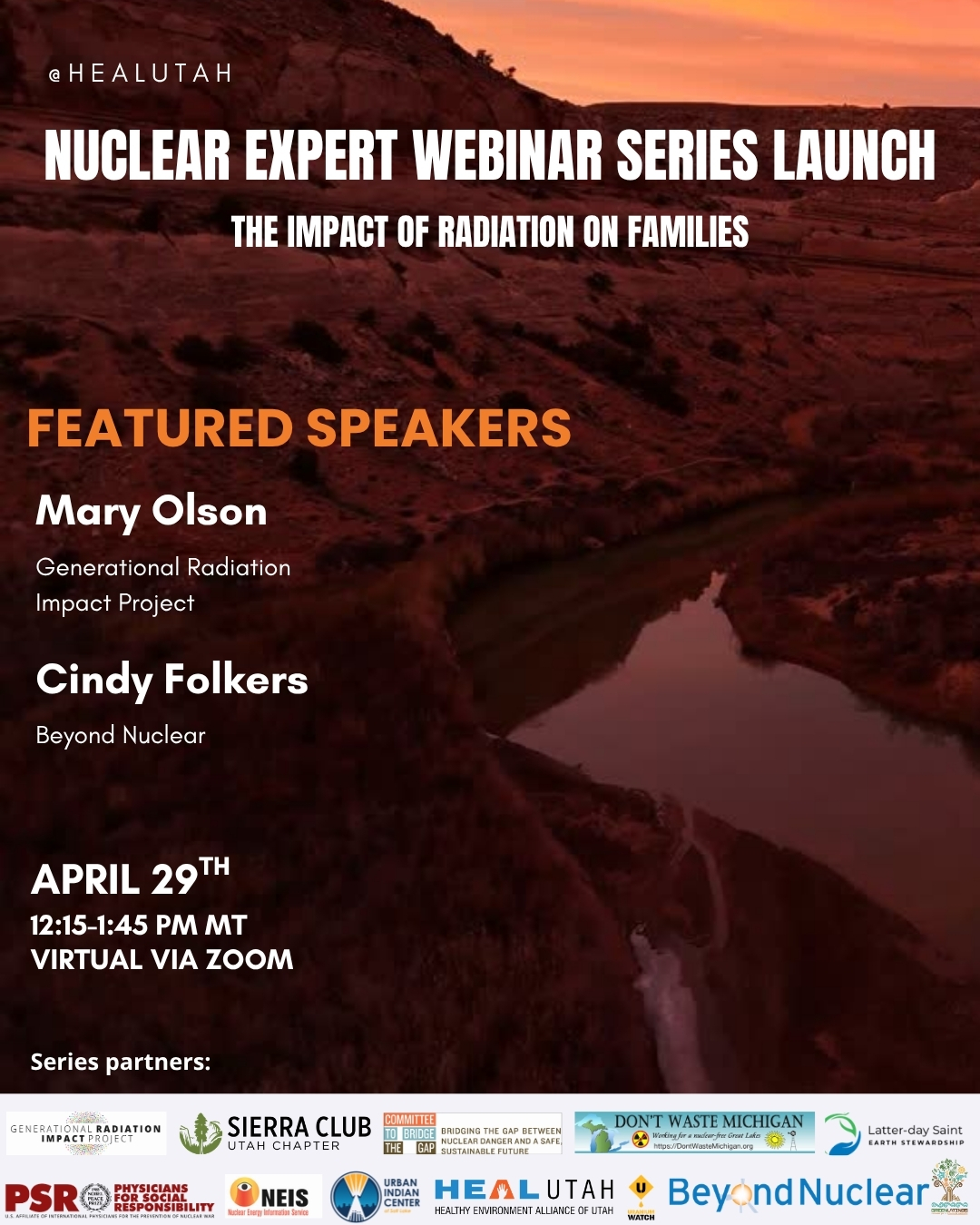
29 April – Nuclear Expert Webinar #1 – Radiation Impacts on Families with Mary Olson and Cindy Folkers
- 12:15 PM MT – 1:45 PM MT
- Location: Virtual – REGISTER TODAY

4 May -West Suburban Peace Coalition to discuss Iran war at May Educational Forum
Monday, May 4, 7:00 – 8:00 PM Central Standard Time
Title: : How Trump’s Narrative Tries to Shape the Reality of the War on Iran.
Contact Walt Zlotow, zlotow@hotmail.com 630 442 3045 for further information
14 May – online event From Bombs to Data Centres: the Face of Nuclear Colonialism

Pine Ridge Uranium is the real threat, not Tehran- Tell Burgum: Stop the Extraction.
Chernobyl: The Lost Tapes – A good documentary on Chernobyl on SBS available On Demand for the next 3 weeks– https://www.sbs.com.au/ondemand/tv-program/chernobyl-the-lost-tapes/2352741955560
To see nuclear-related stories in greater depth and intensity – go to https://nuclearinformation.wordpress.com
-
Archives
- April 2026 (288)
- March 2026 (251)
- February 2026 (268)
- January 2026 (308)
- December 2025 (358)
- November 2025 (359)
- October 2025 (376)
- September 2025 (257)
- August 2025 (319)
- July 2025 (230)
- June 2025 (348)
- May 2025 (261)
-
Categories
- 1
- 1 NUCLEAR ISSUES
- business and costs
- climate change
- culture and arts
- ENERGY
- environment
- health
- history
- indigenous issues
- Legal
- marketing of nuclear
- media
- opposition to nuclear
- PERSONAL STORIES
- politics
- politics international
- Religion and ethics
- safety
- secrets,lies and civil liberties
- spinbuster
- technology
- Uranium
- wastes
- weapons and war
- Women
- 2 WORLD
- ACTION
- AFRICA
- Atrocities
- AUSTRALIA
- Christina's notes
- Christina's themes
- culture and arts
- Events
- Fuk 2022
- Fuk 2023
- Fukushima 2017
- Fukushima 2018
- fukushima 2019
- Fukushima 2020
- Fukushima 2021
- general
- global warming
- Humour (God we need it)
- Nuclear
- RARE EARTHS
- Reference
- resources – print
- Resources -audiovicual
- Weekly Newsletter
- World
- World Nuclear
- YouTube
-
RSS
Entries RSS
Comments RSS
 nuclear-news