Will Australia’s scientifically illiterate government be sucked in to buying Small Modular Nuclear Reactors (SMRs)?
 Strange time to suggest a LEGO nuclear future for Australia ,Independent Australia, Noel Wauchope 21 April 2014, By 2022, Australia could have many “Lego-like” small nuclear reactors in operation, dotted about the nation. This is being proposed now, not just by the long-term fervent believers in Small Modular Reactors (SMRs), but in formal submissions to the coming Energy White Paper……
The BHP-funded Grattan Institute’s submission envisages a string of these little nuclear reactors, connected to the grid, along Australia’s Eastern coast.
Keith Orchison reports on the Grattan Institute submission:
‘The Abbott government is being told that now is the time to flick the switch to “technology neutral,” opening the way for nuclear options.’
Orchison described the advantages of SMRs as ‘Lego-like’.
Why now?
In 2014, it was becoming clear that Small Modular Reactors (SMRs) were not likely to become an operational reality for many decades — and perhaps never.
America was the pioneer of small reactor design in the 1970s. Again recently, Westinghouse and Babcock and Wilcox have been the leaders in designing and developing SMRs.
But in 2014, the bottom has fallen out of these projects………..
It should be noted that nowhere in [the original article about China, does the author] Chen mention “small” reactors. However, Australian proponents of ‘small’ reactors welcomed this article, as the Thorium Small Nuclear Reactor is the favourite type proposed for Australia from all 15 possible small designs.
So, while we’re being told that China is racing ahead in the scramble to get these wonderful SMRs, in fact, China has been very much encouraged and helped into this by the U.S. Department of Energy.
This is understandable, seeing that for China it is a government project, with no required expectation of being commercially viable.
In their enthusiasm for China’s thorium nuclear project, writers neglected to mention the sobering points that Stephen Chen made in his South China Morning Post article, such as:
- ‘Researchers working on the project said they were under unprecedented ‘war-like’ pressure to succeed and some of the technical challenges they faced were difficult, if not impossible to solve.’
- ‘… opposition from sections of the Chinese public.’
- ‘… technical difficulties – the molten salt produces highly corrosive chemicals that could damage the reactor.’
- ‘The power plant would also have to operate at extremely high temperatures, raising concerns about safety. In addition, researchers have limited knowledge of how to use thorium.’
- ‘… engineering difficulties .…The thorium reactors would need years, if not decades, to overcome the corrosion issue.’
- ‘These projects are beautiful to scientists, but nightmarish to engineers.’……….
Australia’s SMR enthusiasts discount the known problems of SMRs. Some brief reminders from the September 2013 report, from the United States’ Institute for Energy and Environmental Research:
- ‘Economics: $90 billion manufacturing order book could be required for mass production of SMRs …the industry’s forecast of relatively inexpensive individual SMRs is predicated on major orders and assembly line production.’
- ‘SMRs will lose the economies of scale of large reactors.’
- ‘SMRs could reduce some safety risks but also create new ones.’
- ‘It breaks, you bought it: no thought is evident on how to handle SMR recalls.’
- Not a proliferation solution. ‘The use of enriched uranium or plutonium in thorium fuel has proliferation implications.’
- Not a waste solution: ‘The fission of thorium creates long-lived fission products like technetium-99 (half-life over 200,000 years).’
- Ongoing technical problems. ……….http://www.independentaustralia.net/environment/environment-display/strange-timing-to-suggest-a-lego-nuclear-future-for-australia,6404
Another new nuclear gimmick fails economic test
 Another one (or more) bites the dust …http://johnquiggin.com/2014/04/20/another-one-or-more-bites-the-dust/ April 20th, 2014 John Quiggin Coming back yet again to nuclear power, I’ve been arguing for a while that nuclear power can only work (if at all) on the basis of a single standardised design, and that the only plausible candidate for this is the Westinghouse AP1000. One response from nuclear enthusiasts has been to point to possible future advances beyond the Gen III+ approach embodied by the AP1000 (and less promising competitors like EPR). The two most popular have been Small Modular Reactors and Generation IV (fast) reactors. Recent news suggests that both of these options are now dead.
The news on the Small Modular Reactor is that Babcock and Wilcox, the first firm to be selected by the US Department of Energy to develop a prototype, has effectively mothballed the project, sacking the CEO of its SMR subsidiary and drastically scaling back staff. Westinghouse already abandoned its efforts. There is still one firm left pursuing the idea, and trying (so far unsuccessfully) to attract investors, but there’s no reason to expect success any time soon.
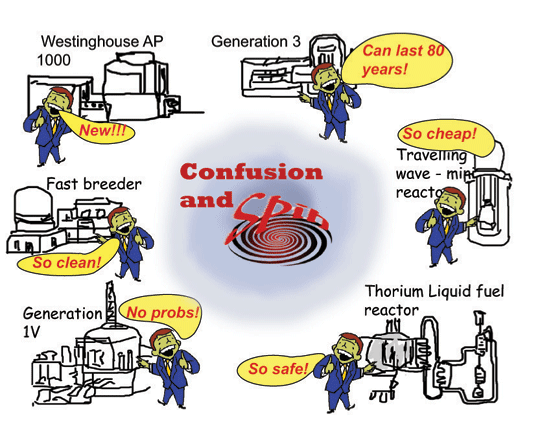
As regards Generation IV, the technology road map issued by the Gen IV International Forum in 2002 has just been updated. All the timelines have been pushed out, mostly by 10 years or more. That is, Gen IV is no closer now than it was when the GenIV initiative started. In particular, there’s no chance of work starting on even a prototype before about 2020, which puts commercial availability well past 2035. Allowing for construction time, there’s no prospect of electricity generation on a significant scale before 2050, by which time we will need to have completely decarbonized the economy.
Only available remedy for irradiated sailors is to sue TEPCO
Is America Abandoning its Bravest Heroes Yet  Again?, WhoWhatWhy By Karen Charman on Apr 21, 2014Legal Remedy Sought“………Meanwhile, the only remedy available to Cooper, Goodwin, Sebourn, Simmons, and the others is to sue the Japanese operator of the nuclear plant, TEPCO. Lead attorney for the class action suit, Paul Garner, believes he will be able to prove that TEPCO knew on the first day of the accident that the plant was spewing deadly radiation, but concealed that information from the world. He also expresses confidence he will be able to prove that if the military had been aware of the radiation levels, it would not have sent or kept U.S. troops in harm’s way.
But Judge Janis L. Sammartino, who is hearing the case in San Diego, has set a high bar, ruling in November 2013 that the plaintiffs must show:
…not only that TEPCO misrepresented the condition of the FNPP [Fukushima nuclear power plant] and the risk to soldiers operating near the damaged facility, but also that TEPCO’s allegedly wrongful conduct, as opposed to other factors, caused the commanding officers of the Reagan “(1) to move the strike force and associated personnel into an area of dangerous radiation exposure; (2) to do so without undertaking radiation testing and research; and (3) to fail to order the necessary precautions, such as locking down the Reagan and supplying radiation monitoring.…”
And further:
At a minimum, Plaintiffs must show that, but for TEPCO’s allegedly wrongful conduct, the military would not have deployed personnel near the FNPP or would have taken additional measures to protect service members from radiation exposure. Thus, Plaintiffs’ success inevitably hinges on the conclusion that the military’s precautions were inadequate or unreasonable and that had it not been for TEPCO’s misstatements, military commanders would have adopted a different course of action…….http://whowhatwhy.com/2014/04/21/america-abandoning-bravest-heroes-yet/
The new cold war, and renewed nuclear threat
 Cold War 2.0 and the Threat of Nuclear Warfare Podcast by Corbett 21 April 2014, As the world’s attention turns to events in eastern Europe, rising tensions between the world’s nuclear superpowers is once again raising the specter of the cold war. And just as in the cold war, this conflict, too, brings with it the prospect of nuclear warfare. This is the GRTV Backgrounder on Global Research TV.TRANSCRIPT “……..Last month’s nuclear security summit at the Hague saw the usual politicians spouting the usual platitudes about the need to reduce the threat of nuclear warfare.
 But this was far from your average nuclear security summit. Tensions in Ukraine between Russia and the NATO powers provided a dramatic subtext to the meeting, with the G7 powers meeting behind the scenes to suspend Russia from the G8and make the boldest steps yet in what is already being dubbed the “New Cold War.” And just as in the original cold war, the threat of nuclear warfare between the great powers is the unspoken fear raised by the conflict.
 In line with the rising geopolitical friction, stories have begun to emerge that both sides have heightened their levels of nuclear readiness. NATO, for its part, has continued build-up of its European “missile shield.” In February, the USS Donald Cook arrived at port in Rota, Spain to begin its deployment as part of the so-called Ballistic Missile Defense plan. It is the first of four advanced destroyers that the US is deploying as part of the shield, which they say is aimed at defending the continent from the theoretical future threat from a theoretically nuclear-armed Iran.
That these destroyers, and NATO’s missile shield in general, is being deployed to counter a threat from Iran is not believedoutside of narrow America-centric propagandistic circles, however.
In truth, the term “missile defense” is a misnomer, as it is a universally acknowledged tenet of nuclear warfare doctrine that advanced missile defense systems are integral to “escalation dominance,” or the ability to engage in warfare at any level of violence, including nuclear warfare. And the threat that NATO envisions does not come from Iran, a nation that has never been shown to be pursuing nuclear weapons, let alone actually possessing them, but Russia, still the world’s second nuclear superpower.
This was made explicit in the last round of Russia-NATO missile shield consultations, started in Lisbon in 2010 and nowofficially suspended by the Pentagon in the wake of recent developments in Ukraine. The consultations, launched on the premise that the two sides could work together on countering any supposed threat from outside Europe, had been deadlocked for years after Washington stonewalled Moscow’s demands for a legal guarantee that their strike forces would not target Russia’s deterrence capabilities.
Meanwhile, Russia, for its part, is also ramping up the nuclear posturing. According to a new study by the Federation of American Scientists, Moscow deployed 25 new strategic nuclear launchers in the past six months, bringing its total of deployed launchers to 498 with 1512 associated nuclear warheads. And just last Thursday, the Russian military held a massive three-day nuclear exercise involving 10,000 soldiers in its Strategic Missile Forces.
These developments seem light years removed from the feelgood rhetoric about nuclear disarmament that the UN Security Council was spouting at the beginning of the Obama presidency.
This rhetoric, of course, was always just that: rhetoric. The US government has never seriously considered giving up its nuclear stockpile, or even renouncing a first-use nuclear doctrine.
As Dr. Yuki Tanaka of Hiroshima University explains, the Obama administration has not simply continued the aggressive Bush-era stance on America’s nuclear arsenal, but actually extended it.
In reality, the Obama administration has simply reaffirmed and even extended the existing US nuclear policy allowing for a first-strike, offensive nuclear war against its enemies.
In its 2010 Nuclear Posture Review, the US government admitted that it reserves the right to wage a first-strike offensive nuclear war, although it hoped to work toward the goal of one day setting policies to restrict nuclear deployment to defensive situations. The Obama administration’s 2013 Nuclear Employment Strategy document only reaffirms this:……..http://www.corbettreport.com/cold-war-2-0-and-the-threat-of-nuclear-warfare/
Time for Washington to disclose information on alleged Israeli nuclear theft
 Former Officials Seek U.S. Disclosure on Alleged Israeli Nuclear Theft National Journal 21 Apr 14 Two former atomic officials say revealing U.S. findings on a decades-old alleged nuclear theft by Israel may bolster Washington’s present-day diplomacy.
 Declassifying all investigative data on the 1960s-era disappearance of weapon-grade uranium from a Pennsylvania atomic plant could boost U.S. credibility in current nuclear negotiations, former Nuclear Regulatory Commission officials Victor Gilinsky and Roger Mattson argued in e-mail responses to questions from Global Security Newswire.
In an article published last week by the Bulletin of the Atomic Scientists, they said public details have already cast suspicion on Israel, which also is widely believed to possess an unacknowledged atomic arsenal.
“We’ve lost a great deal of respect around the world on the subject of nonproliferation,” Gilinsky told GSN. Citing one example, the former NRC commissioner said Washington’s reluctance to openly discuss Israel’s nuclear activities has hampered the U.S. ability to overtly press its Middle Eastern ally to participate in a plannedconference on eliminating weapons of mass destruction from the Middle East.
“The president doesn’t even acknowledge that Israel has nuclear weapons, which means no one in the government can, either,” he told GSN. “Leveling on [this] affair, painful as it might be in the short run, would be a step toward what you might call a reality-based policy in this area.”
For disclosure to be likely, though, President Obama must “see it in his political benefit to do so,” Gilinsky wrote. “If he wanted to, he could do it at any time, but I am not holding my breath.”……http://www.nationaljournal.com/global-security-newswire/former-officials-seek-u-s-disclosure-on-alleged-israeli-nuclear-theft-20140421
Questions on nuclear radiation, that the US Navy cannot answer
Is America Abandoning its Bravest Heroes Yet Again?, WhoWhatWhy By Karen Charman on Apr 21, 2014 “……….What Did the U.S. Navy Know?
Whether the plaintiffs succeed in holding the Japanese utility liable, the case raises important questions about the role and responsibility of the U.S. Navy:
Why did the U.S. Navy insist from the beginning that it was safe for its troops to remain in the vicinity of three reactor meltdowns?
After having gone to the trouble of setting up a medical registry to track radiation-related illnesses—the Operation Tomodachi Registry—why did the U.S. Department of Defense decide not to monitor the health of the nearly 75,000 DOD-affiliated citizens—military personnel and their family members—who were in or near Japan during and after the Fukushima meltdowns?
Why is there no mention of radiation exposure in many of the sailors’ military medical files, even those people specifically assigned jobs involving radiation decontamination?
Why, given the mounting evidence of illnesses known to be triggered by radiation exposure, is radiation dismissed as a possible cause?………http://whowhatwhy.com/2014/04/21/america-abandoning-bravest-heroes-yet/
Dissension in Taiwan politics over nuclear power
 Premier, DPP head fail to reach consensus over nuclear plant, Focus Taiwan Taipei, April 21 (CNA) Premier Jiang Yi-huah and the leader of the main opposition Democratic Progressive Party (DPP) failed to reach a consensus on the future of the controversial fourth nuclear power plant during a meeting Monday.
The premier said he could not unilaterally announce the halt of the construction of the plant, and the two disagreed on whether a referendum on the project should follow the threshold set in Taiwan’s Referendum Act or use another formula.
Jiang supported maintaining the law’s requirement of a 50 percent turnout for a referendum to be valid, while DPP Chairman Su Tseng-chang favored dropping the turnout threshold and having the vote decided by a simple majority.
During the nearly 90-minute meeting, Su expressed the hope that the Executive Yuan would stop the plant’s construction by issuing an executive order……..http://focustaiwan.tw/news/aipl/201404210044.aspx
Nuclear Regulatory relaxes rule for hot water discharge from nuclear plant
Connecticut’s nuclear plant can use warmer water WSJ, 21 Apr 14 HARTFORD, Conn. — Connecticut’s nuclear power plant won permission to use warmer water from Long Island Sound for cooling at one of its two units in Waterford, the Nuclear Regulatory Commission announced Monday.
The Millstone 2 plant may use water as warm as 80 degrees Fahrenheit, up from 75 degrees, said the Nuclear Regulatory Commission, which is considering a similar request for Millstone 3.
Millstone 2 shut down for nearly two weeks in August 2012 because the water was warmer than the 75-degree limit. It was the first shutdown of a nuclear power plant on an open body of water. Water is used to cool key components of the plant and is discharged back into the Sound……http://online.wsj.com/article/AP66936a3af568444f9afefe577df90c23.html
Is it OK to release radioactive wastes into the ocean?
“The ocean itself can be used as an infinite heatsink,” says Buongiorno. “It’s possible to do cooling passively, with no intervention. The reactor containment itself is essentially underwater.”Another important part of the design is how it would lessen the dangers of decommissioning the plant in fifty years: Rather than undertaking the long, slow process of removing the rods and demolishing the plant, it would be towed “to a central facility, as  is done now for the Navy’s carrier and submarine reactors.” If a meltdown occurred, the plant could “vent radioactive gasses underwater” rather than releasing them into the atmosphere and forcing millions to evacuate.
Wouldn’t releasing radioactive gasses underwater also be pretty terrible, environmentally? Why not just stop building nuclear power plants altogether? That’s not really the question these engineers set out to answer. This is about making the plants, whether or not countries chose to build them, safer.
But it’s hard to ignore the extraordinary moral implications of that particular detail. Given the choice between spraying humans with radioactive fumes and spraying the ocean floor, most of us would probably choose the latter. It’s tough to argue with that, but it’s also tough to endorse it. [MIT]
!8 demolished US nuclear missile facilities inspected by Russians
Russians inspect demolished missile facilities http://helenair.com/news/state-and-regional/russians-inspect-demolished-missile-facilities/article_14343d6d-0f7d-587f-9125-51b77eac9abc.html HELENA, Mont. (AP) — Air Force officials say Russian inspectors visited Montana this month to verify that 18 nuclear missile launch facilities have been demolished as part of a 2011 arms-control treaty.
Malmstrom Air Force Base officials said Monday the inspectors spent 12 hours on April 9 viewing the facilities in central Montana to see the doors had been removed and the launcher tubes filled with earth and gravel.
Treaty compliance chief Richard Bialczak of the 341st Missile Wing says the inspection was the first of its kind at Malmstrom.
The demolished facilities were operated by the 564th Missile Squadron, which was deactivated in 2008. Three other missile squadrons are responsible for the 150 intercontinental ballistic missiles at Malmstrom.
Air Force officials say all 50 of the 546th squadron’s launch facilities will be demolished.
Update – Lawyer Yabe, Mr Hosami, Ms.Shimotani and friends target Mari Takenouchi in a disgusting campaign of hate and sexual abuse! With no comment from the ETHOS child killers!
Err… some slight editing of this article has been done by Arclight2011 (So sue me Yabe! Grr call yourself a man? you have NO honour! ) .. And here is a picture of Ms. Shimotani 
“We know through serious research that there is a subtle but real connection between the objectification of women and violence against women..” ; http://www.independent.co.uk/voices/comment/women-are-complicit-in-misogyny-too-8877406.html
Heres is a picture of Mr Hosami and Yabe baby….


Question – Are these “gentlemen” misogynists? (arclight2011part2)
“I’ve been doing some research on misogyny lately; mainly its symptoms and characteristics. Firstly, I should explain that misogyny is a deep hatred or contempt for women. It is a mental/psychological disorder which affects more men than I realized, and it can manifest itself in a variety of ways ranging from chauvinism or sexism to physical abuse and rape.” More here ; http://health.wikinut.com/The-Twisted-Mind-of-the-Misogynist/t87p4922/
Some days ago, a Kyoto resident, Mr. Koichi Hosomi who has been continuously harassing Mari Takenouchi sometimes in combination with the lawyer Yabe sent the following tweet.
“Fly to Okinawa (where Takenouchi lives) and go suck Takenouchi’s nipples.”
Original article is here in Japanese and English ; http://savekidsjapan.blogspot.ie/2014/04/2nd-consulation-to-kyoto-bar.html?spref=tw
12 April 2014
2nd consultation to Kyoto Bar Association of Japan

Image source courtesy of ETHOS 🙂 ; http://ethos-fukushima.blogspot.ie/
I, Mari Takenouchi-is a freelance Japanese journalist. I have been supporting ideas that are designed to save children of Fukushima. Thus, my main targets have been UN agencies, the Japanese government and the Fukushima ETHOS group. (Though, some people have laughed at me, a single mother for challenging these organisations)..
Accordingly, lawyer Yoshiro Yabe who has been harassing me on twitter, is not my actual target at all. However, since his harassment has been malicious and continuous, I talked today with the vice president of Kyoto Bar Association, Lawyer Kenji Akiyama. I talked to another lawyer in Kyoto Bar Association, but the situation has not been dealt with by this person at all.
I asked Mr. Akiyama to notify Mr. Yabe regarding the 6 points I informed him of. However, as I spoke, my voice became spontaneously loud with rage. I added my apologies to Mr. Akiyama who had heard my angry tone of voice.
As I write this blog, Mr. Yabe is making an excuse saying that his initial advice on my petition (to be forwarded to prosecutors not to indict me) was actuallyfor the sake of me. This was a blatant lie.
The petition is not legally binding and the format is not specified. Yet, Mr. Yabe repeatedly tweeted that Mari Takenouchi’s petition is null and void, though I had asked him repeatedly to stop. That was the beginning of my communication with the lawyer Yabe, and there was much more…
Please read 6 points I offered below..
America’s loyalty to the nuclear industry, rather than to sick, irradiated navymen
Is America Abandoning its Bravest Heroes Yet Again?, WhoWhatWhy By Karen Charman on Apr 21, 2014Reason for Navy Cover-up?“………..Because U.S. military personnel are prevented from suing the government, their only recourse is to go after TEPCO. But given the interests involved, the outcome for the Operation Tomodachi victims remains very much in doubt. Robert Alvarez, the nuclear investigator and former DOE deputy assistant secretary, points out that about a quarter of a million U.S. soldiers were subjected to open air nuclear weapons testing in the 1940s, 50s and 60s.
“If you use the treatment of atomic veterans who were involved in atmospheric testing as a benchmark, the government did everything it could to downplay the hazards, because from the military perspective, the mission is all important,” he says.
“Right now, the United States government and Japan are closing ranks because of their nuclear-related relationships,” he says. Although Japan’s 54 power-generating nuclear reactors are currently offline, the country still has the third largest number of nuclear reactors in the world.
But more important, Alvarez says, is the “extraordinary co-dependence” with Japan on nuclear-energy-related matters. “Because the U.S. has lost much of its capability in designing and building reactors, we have to depend on the Japanese and the French if we’re going to build any reactors or fabricate fuel or do anything to service the existing reactor fleet,” he explained. “We’re dependent on companies that are now owned by Japan and France.”
The case of the ill Operation Tomodachi veterans shines a spotlight on the intersection of competing interests between victims of radiation exposure, the nuclear power industry, and the U.S. government and its unwavering commitment to nuclear technology for both military and civilian use. So far, by denying the harm from the radiation U.S. military personnel were exposed to as they helped Japan clean up after the devastating earthquake and tsunami in March 2011—a position that supports the Japanese government and nuclear industry—the U.S. government is doing what it has almost always done: protect nuclear interests rather than its victims.
As the number of ill Operation Tomodachi veterans climbs, it remains to be seen whether their sacrifice will be acknowledged or if they, like so many others, will be left to fend for themselves. http://whowhatwhy.com/2014/04/21/america-abandoning-bravest-heroes-yet/#sthash.YiyEeRT1.dpuf
Climate Change: coastal properties already threatened by sea level rise
 Rising tides threaten communities on the beach — and far from it, too USA Today, Matt Alderton, Green Living April 19, 2014 The mud in Folsom Lake, near Sacramento, Calif., is dry and chapped, like cracked heels. The bottom of the reservoir, once under water, now is largely barren, save for its shallow center and a smattering of stray puddles.
That’s because California is in the midst of one of the worst droughts in state history. Conditions are so bad that
Gov. Jerry Browndeclared a state emergency in January. He urged state residents to voluntarily reduce personal water consumption by 20 percent.
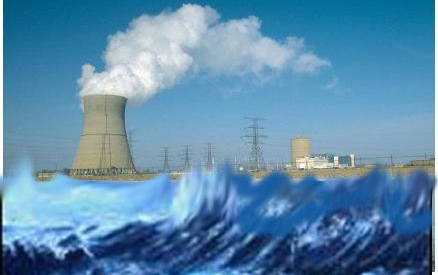
In the context of having so little water, it might seem strange to worry about having too much. And yet, that’s exactly the dilemma facing California today. Even as it reels from drought, it must begin planning for floods. And make no mistake: Floods are coming. Not only to California, but to coastal cities across the country and around the world, which face a certain influx of water as oceans rise under the specter of climate change.
“We analyzed 55 different water level stations throughout the United States and found that for about two-thirds of them, sea level rise from climate change has already more than doubled the risk of extreme flooding,” says Dr. Ben Strauss, director of the Program on Sea Level Rise at Climate Central, a nonprofit organization dedicated to communicating the science and effects of climate change.
Based on the analysis, Climate Central developed Surging Seas, an interactive website (sealevel.climatecentral.org) that maps the flood threats from sea level rise and storm surges. The map shows how more than 3,000 coastal communities in the contiguous United States would be affected if sea levels were to rise from 1 to 10 feet.
“Sea level rise is already happening, and its continuation is inevitable,” Strauss says. “At some point it will be obvious to every family living in a coastal area, and every community will be looking to protect itself.”
A scary proposition
Multiple forces are colluding to make the oceans swell.
One is warming oceans. “Because of that, you have an expansion of ocean waters, and the only place they can go is up,” says Rachel Cleetus, a senior economist in the Climate and Energy Program at the Union of Concerned Scientists, an alliance of citizens and scientists who collaborate on solutions to global problems.
Another is melting land-based ice forms such as glaciers and ice sheets. “You’re adding volume to the world’s oceans, and that’s causing them to rise,” Cleetus says.
Because the rate of ice loss is accelerating, oceans are rising faster than ever before. Cleetus says sea level could rise anywhere from 8 inches to 6.5 feet by the end of the century. Some scientists put estimates as high as 10 or 15 feet. That’s on top of approximately 8 inches of sea level rise already logged in the last century.
“Those 8 inches of sea level rise from climate change are already making every single coastal flood bigger, deeper and more damaging,” Strauss says.
Although scientists typically project sea level rise through the year 2100, communities likely will be impacted much sooner than that. The culprit? Incremental storm surges……….
Ultimately, then, the best solution might be the hardest to swallow: retreat.
“We need to pull back, in essence, from the shore,” says environmental and land-use planning consultant Barry Chalofsky. “If you live (in a coastal floodplain) and you’re counting on your house to be your nest egg when you retire, or you want to pass it on to your children, I would strongly think about elevating your property, then selling it over the next five to 10 years.” http://www.usatoday.com/story/life/2014/04/19/green-living-coastal-communities/7871349/
The dangerous myth of “Chernobyl wild paradise”
 Decay takes a holiday: the wickedness beneath the “Chernobyl wild paradise” myth and the rotten implications for ecosystems and radiation science http://www.beyondnuclear.org/russia-ussr/2014/4/18/decay-takes-a-holiday-the-wickedness-beneath-the-chernobyl-w.html 21 April 14
Zombie forest?
April 26, 2014 will mark 28 years since the Chernobyl nuclear reactor exploded causing an unprecedented nuclear catastrophe. In a creepy revelation, the forests around Chernobyl are having difficulty decomposing. A recently published study indicates that forest matter in the contaminated areas around Chernobyl is taking years or even decades longer to decay than it should. In the areas with low radiation, 70 to 90 percent of the leaves were gone after a year. Where radiation levels were higher, “leaves retained around 60 percent of their original weight…”(Smithsonian.com) This indicates a fundamental disruption to the natural cycle of death feeding life, and calls into question the forest’s longer-term viability. Creatures responsible for decay such as microbes, fungi and some types of insects, are essential components of any ecosystem because they recycle organic material back into the soil. Unfortunately, they do not function properly in the areas around Chernobyl, leaving a forest full of “petrified-looking pine trees that no longer seem capable of rotting.” GIZMODO
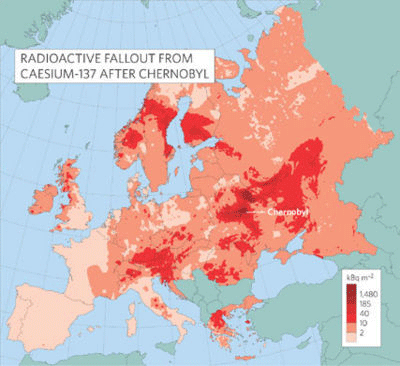
Radiation’s effect on decay processes should be expected, considering how it impacts microbes in food; or considering the results of a bizarre, cavalier and extremely ill-advised series of experiments performed using a “naked reactor” in the late 1950’s and early 1960’s. These experiments intentionally irradiated a number of varying materials and forest land 40 miles north of Atlanta, GA. Wood subjected to this radiation was produced in small-scale and called “Lockwood”, for Lockheed Aircraft Corporation who operated the Georgia Nuclear Laboratory. The building and land is still contaminated with radionuclides.
The lack of decomposer activity has researchers worried that nutrients which trees require for grow are not being recycled, causing trees in the area to grow more slowly. Improper plant decay has potential implications for animal decay as well, although there do not appear to be any Chernobyl studies investigating this yet.
Actual in-the-field examinations of regions contaminated by radioactivity from Chernobyl also reveal evidence for increased mutation rates, abnormal sperm with reduced swimming ability, developmental abnormalities, cataracts, tumors, smaller brains in both birds and mammals, and decreased tree growth rates, a finding of fundamental importance for ecosystem functioning that likely relates to effects on the microbial community. Fewer spiders and insects including bees, butterflies and grasshoppers—live there. Animals and plants show other impacts of radiation after the Three Mile Island nuclear disaster in the US and the Fukushima nuclear disaster in Japan.
Timothy Mousseau, a biologist at the University of South Carolina, Columbia, who collaborated on many of these studies, contends that, fundamentally, this evidence indicates low-dose rate exposures cause significant measurable impacts for the biota inhabiting contaminated regions of Chernobyl. Further, this evidence supports a hypothesis that suggests effects down to very low levels. Further implications for Fukushima should not be ignored.
Humans and animals alike: healthy looking on the outside, disintegrating on the inside
Referencing studies summarized in his book, Chernobyl: Consequences of the Catastrophe for People and the Environment, Alexey Yablokov states:
“Wildlife in the heavily contaminated Chernobyl zone sometimes appears to flourish, but the appearance is deceptive,” says Yablokov. “Levels of incorporated radionuclides remain dangerously high for mammals, birds, amphibians, and fish. Long-term observations of both wild and experimental animal populations in the heavily contaminated areas show significant increases in morbidity and mortality that bear a striking resemblance to changes in the health of humans – increased occurrence of tumours and immunodeficiencies, decreased life expectancy, early aging, changes in blood and the circulatory system, malformations, and other factors that compromise health.
“All of the populations of plants, fishes, amphibians and mammals studied there are in poor condition,” he continues. “This zone is analogous to a ‘black hole’, in which there is accelerated genetic degeneration of large animals – some species may only persist there via immigration from uncontaminated areas. The Chernobyl zone is a micro-evolutionary ‘boiler’, where gene pools of living creatures are actively transforming, with unpredictable consequences. We ignore these findings at our peril.”
Dr. Yablokov’s statement deftly presents the dichotomy between what is observed by a dilettante’s eye – such as lots of members in a wild animal population — versus what is actually happening to these members over time. What is happening to this wildlife has parallel implications for human health.
So where did this “paradise for wildlife” and “biodiversity sanctuary” myth come from? In 2006 the International Atomic Energy Agency, a nuclear power promoter and a member body of the United Nations, released a report entitled Environmental Consequences of the Chernobyl Accident and their Remediation: Twenty Years of Experience. This report references the creation of a nature preserve within the Chernobyl Exclusion Zone and remarks “Without a permanent residence of humans for 20 years, the ecosystems around the Chernobyl site are now flourishing. The CEZ has become a wildlife sanctuary…, and it looks like the nature park it has become.” From another report: “Indeed, the Exclusion Zone has paradoxically become a unique sanctuary for biodiversity.”
The Chernobyl Forum coalition makes this statement in support of “unique biodiversity” in spite of their recognition that “Genetic effects of radiation, in both somatic and germ cells, have been observed in plants and animals of the Exclusion Zone during the first few years after the Chernobyl accident. Both in the Exclusion Zone, and beyond, different cytogenetic anomalies attributable to radiation continue to be reported from experimental studies performed on plants and animals.” They conclude, however, “[w]hether the observed cytogenetic anomalies in somatic cells have any detrimental biological significance is not known.” In order to know this, one has to actually look.
The study summaries compiled by Alexey Yablokov, et al. (studies which had been mostly unavailable in the west until 2009) and the published examinations of researchers Mousseau, et al., indicate rather strongly that there is significant biological detriment to wildlife in the contaminated areas surrounding Chernobyl. And unlike these studies, the Chernobyl Forum documents provide very few references (under ten total) for any claims they make regarding the flourishing of wildlife.
Concern over radiation level in foodstuffs from Japan
 Concerned officials now considering ban on Japan food items — Nuclear scientists previously told gov’t to halt all imports after finding high radiation levels — Never implemented due to fear of hurting bilateral relationship http://enenews.com/concerned-officials-now-consideingr-ban-on-japan-food-items-nuclear-scientists-previously-told-govt-to-halt-all-imports-after-finding-high-radiation-levels-never-implemented-due-to-fear-of-hur?utm_source=feedburner&utm_medium=email&utm_campaign=Feed%3A+ENENews+
The Nation,Apr. 18, 2014: Pakistan may ban Japan edible items […] in case if traces of radioactive material are found on them. Federal Minister of Commerce Khurum Dastgeer Khan told the Senate on Thursday, currently the Ministry of National Food Security and Research is tasked to conduct thorough research to determine either the edible items from Japan were infected by radioactive rays or not. […] Senator Suriya Amiruddin who was interested to know whether there is any proposal under consideration of the Government to impose ban on import of edible items from Japan to avoid negative effect of radiation in those items. […] in April 2011, Pakistan Nuclear Regulatory Authority had directed authorities dealing with Cargo arriving directly or indirectly from Japan to screen all types of consignments including edible/non-edible, for radiation. […] The directives were issued from the country’s well-reputed institution Pakistan Nuclear Regulatory Authority […] The PNRA made clearance mandatory for every consignment being imported from Japan. It is worthy of mentioning here that country’s nuclear scientists had advised the federal government three years back to halt all types of goods from Japan to minimize the threat of radiation following the Fukushima Nuclear Crisis in Japan. The scientists had advised the government after they detected high level of Iodine from the consignments imported from Japan. […] in view that the move to ban imports from Japan may hurt bilateral relationship between the two friendly countries, the Pakistani government never imposed ban on import of goods from Japan.
Khurum Dastgeer Khan, Federal Minister of Commerce: “Concerned officials have been advised to investigate the matter relating to import of edible items from Japan following the incident of radioactivity in Japan. It is up to Ministry of Food Security and Research to advise Ministry of Commerce to continue import of edible items from Japan or impose ban on it.”See also: Award-winning project finds seafood sold in Canada with high radiation levels — Many samples well over contamination limit — “Incredible discovery; Something unexpected may be lurking in Canadian waters” — Believes dangerous Fukushima pollution carried across ocean — “I hope people will open their eyes”
-
Archives
- February 2026 (228)
- January 2026 (308)
- December 2025 (358)
- November 2025 (359)
- October 2025 (376)
- September 2025 (258)
- August 2025 (319)
- July 2025 (230)
- June 2025 (348)
- May 2025 (261)
- April 2025 (305)
- March 2025 (319)
-
Categories
- 1
- 1 NUCLEAR ISSUES
- business and costs
- climate change
- culture and arts
- ENERGY
- environment
- health
- history
- indigenous issues
- Legal
- marketing of nuclear
- media
- opposition to nuclear
- PERSONAL STORIES
- politics
- politics international
- Religion and ethics
- safety
- secrets,lies and civil liberties
- spinbuster
- technology
- Uranium
- wastes
- weapons and war
- Women
- 2 WORLD
- ACTION
- AFRICA
- Atrocities
- AUSTRALIA
- Christina's notes
- Christina's themes
- culture and arts
- Events
- Fuk 2022
- Fuk 2023
- Fukushima 2017
- Fukushima 2018
- fukushima 2019
- Fukushima 2020
- Fukushima 2021
- general
- global warming
- Humour (God we need it)
- Nuclear
- RARE EARTHS
- Reference
- resources – print
- Resources -audiovicual
- Weekly Newsletter
- World
- World Nuclear
- YouTube
-
RSS
Entries RSS
Comments RSS
 nuclear-news