The world will be changed by China’s renewable energy revolution
 China’s Renewable Energy Revolution Has Global Implications, Clean Technica John Mathews and Hao Tan, 8 April 14, China’s renewable energy revolution is powering ahead, with the year 2013 marking an important inflection point where the scales tipped more towards electric power generated from water, wind and solar than from fossil fuels and nuclear. This means that its energy security is being enhanced, while carbon emissions from the power sector can be expected to soon start to fall.
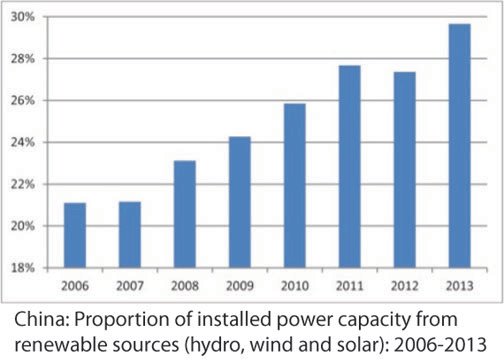
China’s energy revolution, which underpins its transformation into the world’s largest manufacturing system (the new “workshop of the world”), continues to astonish all observers, and terrify some. China is known widely as the world’s largest user and producer of coal, and the world’s largest emitter of carbon dioxide and other greenhouse gases. This is true. Less noticed has been the fact that China is also building the world’s largest renewable energy system – which by 2013 stood at just over 1 trillion kilowatt-hours – already nearly as large as the combined total of electrical energy produced by the power systems of France and Germany.1
The energy landscape continues to give the clearest indication of the trends in industrial dynamics and prospects for the future. China is powering ahead with renewables while at the same time it expands its reliance on fossil fuels; the US by contrast is further locking in its dependence on fossil fuels. The distinction is critical………
We need to sketch in the background to China’s energy revolution, so that the enormity of its commitment to renewables may be appreciated. ……. While coal for thermal power continues to rise, the overall consumption of coal appears to be ‘capped’ at 3,500 million tonnes – a desperate measure taken no doubt in response to the blackening skies and poisoning of water and air
In just the space of eight years, China has become the world’s most important generator of wind power, with the world’s largest capacity and the largest addition of new power capacity in the year 2013. The increase in all three sources of renewables – hydro, wind and solar PV – is shown in Fig. 3, in terms of the proportion of power generated by renewables and its relentless rise (apart from a dip in 2012, following world recession in 2011).
The proportion reached by 2013, of close to 30% of electrical energy generated from renewable sources (hydro, wind and solar), is what gives China its international influence in renewables – and it demonstrates a relentless trend towards greater reliance on manufacturing systems for production of, e.g. wind turbines and solar cells, as opposed to the reliance elsewhere on alternative fossil fuels such as coal seam gas and shale oil…….
The sharp rise in renewables reflects particularly the new commitment to wind power – and it looks set to continue through industrial logistic dynamics. We will develop an argument below for the significance of this date……….
3. Investment trends
Expenditure in building new power generating infrastructure can reveal more than data on capacity and generating additions. The CEC has released investment data for 2013, which reveal the following trends. In terms of investment, China spent more on its grid in 2013 than on new power generation facilities………The significance of this is that China is spending on infrastructure to accommodate more renewable power facilities, as well as on the facilities themselves. Of the new generation facilities, investment in new energy sources accounted for more than 40% of the total investment in new power generation facilities…….
Thus our conclusion that in 2013, China’s leading edge of change in its electric power system is now more “green” than “black”. We have demonstrated above that this is unambiguously so in terms of capacity added and in terms of investment, while in terms of new generation of electrical energy thermal still marginally outranks renewables (180 billion kWh generated to 160 billion kWh)………
at the leading edge, for the year 2013 alone, China added 94 GW of new capacity, of which 55.3 GW came from renewables (59%), and just 36.5 GW (or 39%) came from thermal sources – a dramatic reversal of past trends;…….
our analysis that China’s carbon emissions are set to peak and then to fall – and fall faster than in the US or in Europe……..http://cleantechnica.com/2014/04/08/chinas-renewable-energy-revolution-global-implications/
Nuclear industry PR ignores the latency period for cancer from radiation
 When life becomes a shadow – after nuclear catastrophe, Ecologist Robert Jacobs 8th April 2014“…….It is disingenuous when nuclear industry apologists say things like “no one died at Fukushima” since they are well aware that for most of the people who will eventually get sick this process will take time.
We are currently in the latency period for these illnesses, a point not missed by nuclear industry PR people.
 Losses of homes, community and identity
Areas that experience radioactive contamination often have to be abandoned by those who live there. The levels of radiation may be high enough that continued habitation can be dangerous to health.
In these cases people lose their homes – often traditional homes that may have been the primary residences for a family for multiple generations. In these cases one’s identity may be deeply connected to the home and the land around the home.
For communities that have to be abandoned the bonds that have been built up and that sustain the wellbeing of the community are disintegrated. Friends are separated, extended families are often separated, and schools are closed.
People who have lived in the same place all of their lives have to make a fresh start, sometimes in old age, sometimes as children, and lose the communal structures that have supported them – shopkeepers who know them, neighbors who can be relied on, the simple familiarity that we have by being known and knowing our way around.
Loss of land and continuity
What is lost when a person is no longer able to eat an apple from a tree planted by their parent or grandparent? With the loss of community many people lose their way of making a living. This is especially true in less industrialized places where many people have been farmers or fishers or herders for generations.
When someone who has only known farming is taken from the land they have tended, when someone who is a fisher can no longer fish in areas where they understand the natural rhythms and habits of the fish, it can be impossible to start over.
Often such people are forced to enter service positions or become dependent on state subsidies, which further erodes their sense of self and wellbeing. Usually, those removed from their land because of contamination are placed into temporary housing.
In almost all cases this housing is not temporary, but becomes permanent. Since it is initially intended to be temporary housing it is often very shoddy and cramped.
It can become impossible for multigenerational families that have been living together for decades to remain together. This can remove care for the elderly, childcare for young families and further erodes to continuity of family identity, knowledge and support. Ill health from processed or radioactive food
Removal from land also is accompanied by the loss of a traditional diet. Those without access to the lands and seas that have provided food for their families for generations often begin a journey of ill health fostered by a new diet composed of processed foods.
In some communities such as the small villages around the former Soviet nuclear test site in Kazakhstan the people simply continue to live in dangerously contaminated homes. The state responsible for their exposures no longer exists and no government feels the responsibility to evacuate them.
They live very traditional lives and most of their food is from their own gardens and from livestock raised on their contaminated land. Many of the long-lived radionuclides simply cycle through this ecosystem and those living here can be contaminated and recontaminated over many generations.
Loss of traditional knowledge
In some remote places survival is dependent on centuries old understandings of the land. In Australia the areas where the British conducted nuclear testing in the outback are very difficult places to live.
Traditional communities in these areas often have songs that hold and transmit essential knowledge about how to survive in such a harsh environment, such as – where to find water, when to hunt specific animals, when to move to various areas.
When the British relocated them to live in areas hundreds of kilometers from their traditional homes this knowledge became broken. It became impossible for the refugee population to survive living a traditional life in areas where they had no knowledge of the rhythms of the land and animals.
This removal from their traditional lands led quickly to dependence on governmental assistance and severed what had been millennia of self-reliance. This led to the further erosion of community, familial and personal wellbeing……. http://www.theecologist.org/blogs_and_comments/Blogs/2351503/when_life_becomes_a_shadow_after_nuclear_catastrophe.html
Sickness and mortality due to ionising radiation
 When life becomes a shadow – after nuclear catastrophe, Ecologist Robert Jacobs 8th April 2014“…….Sickness and mortality
Sickness and even death are the results of exposure to radiation that people expect. It is important to know that there are many different ways that people can become ill after exposure to radiation.
When people are exposed to high levels of gamma radiation they can suffer from acute radiation sickness and death can come in a matter of days, weeks or months. Tens of thousands of people died of acute radiation sickness in Hiroshima and Nagasaki after they survived the nuclear attacks.
A nuclear weapon gives off a very large burst of gamma radiation that only lasts a very short time, but if the whole body is exposed to high levels it can cause illness and death relatively quickly.
For those who were not close to the detonation of a nuclear weapon, or within a short distance of a disaster like the Chernobyl or Fukushima disasters, illness is often the result of internalized alpha emitting particles. With nuclear detonations this comes down as ‘fallout’.
In the case of Chernobyl and Fukushima these came down over large areas as the plumes of the explosions there settled back to Earth. Alpha emitting particles cannot penetrate the skin like gamma radiation can, but rather are internalized through inhalation or swallowing or through cuts in the skin.
These particles don’t give off a large amount of radiation, but if they lodge in the body they continue to expose a small number of cells 24 hours a day often for the rest of a person’s life. This can result in cancers and immune disorders that develop later in life, sometimes a few years, sometimes after one or several decades.
Since the plumes of the three explosions at Fukushima deposited large amounts of alpha emitters across a large area, this is the primary danger to those living in the contaminated areas………http://www.theecologist.org/blogs_and_comments/Blogs/2351503/when_life_becomes_a_shadow_after_nuclear_catastrophe.html
Solar energy growing, solar prices falling
 There are more and more places across the globe where renewable energy is being installed without any subsidy, or the renewables are being installed because they’re cheaper than the available fossil fuel technology,
Cheap Solar Power Is Fueling Global Renewable Energy Growth: Report http://www.huffingtonpost.com/2014/04/07/solar-power-renewable-energy-growth_n_5107150.html 7 April 14
The share of total global electricity production generated by renewable energy is climbing, mainly because solar photovoltaic systems are becoming less expensive, according to a report released Monday by the United Nations Environment Programme and Bloomberg New Energy Finance.
Wind, solar and other renewables, excluding hydropower, were 8.5 percent of total global electric power generation last year, up from 7.8 percent in 2012, the report says. Continue reading
China’s motives in developing renewable energy
China is serious in its pursuit of renewables, because it seems to believe that its future prosperity depends on building the industries that produce power – complementing its activities in searching for fossil fuels supplies all around the world. There is a lesson here for all other developing countries, and notably for India and Brazil. And not only developing countries.
China’s Renewable Energy Revolution Has Global Implications, Clean Technica John Mathews and Hao Tan, 8 April 14, “……The motives Finally, we need to ask what are the motives for China’s dramatic shift to a renewables trajectory? The common assumption is that it is concern over climate change (global warming) that drives the shift. Important as this motive is, we believe it is the least likely of the explanations for China’s shift. We believe the more plausible explanation for China’s new trajectory – and for the determination with which it is being pursued – is energy security and industrial development. Continue reading
Temporary URL links to Libbe Halevy of Nuclear hotseat issue number #146

Nuclear Hotseat #146; download directly from:
http://lhalevy.audioacrobat.com/download/1a1ba8c9-5529-9e3b-4a42-98a476bb2688.mp3 OR – get it from iTunes under Podcasts.
A message from Libbe Halevy
Nuclear Hotseat website still down, but that doesn’t stop the program! Latest details on WIPP site radiation release in Carlsbad, NM w/Don Hancock; new anti-nuclear “holiday” on April 10: Bequerels Awareness Day (BAD – because Radiation is BAD to eat!) to contact your Senators and Congressional Reps to demand a reduction in “allowable” radiation levels in US food; and;
NUMNUTZ of the WEEK is an EVIL NUMNUTZ – UNSCEAR’s lying, manipulative 300-page “report” that tries to convince the world that there will be no increase in cancer rates because of Fukushima radiation. How stupid do they think we are? Oh, wait… we aren’t, are we?
Anxiety over potential radiation risks in North Korea’s nuclear site
 U.S. think tank says North Korea is having radiation issues at primary nuclear site Raw Story, By Agence France-Presse Monday, April 7, 2014 The United States and its allies warned North Korea against provocations as researchers reported potential radiation risks due to problems at the regime’s main nuclear complex…….
Obama’s new nuclear weapons strategy
Obama’s new nuclear weaponshttp://theweek.com/article/index/259589/obamas-new-nuclear-weapons The U.S government today released a precise accounting of its strategic nuclear forces, something it is required to do by treaty, and it’s worth a careful read.
The world now knows that, by February of 2018, the U.S. will have approximately 400 intercontinental ballistic missiles, down from 450; 240 submarine-launched ballistic missiles, down about 50; and 60 nuclear-capable heavy bomber fighters (B-2As and B-52Hs), converting 30 B-52s to a non-nuclear role.
Since most of the nuclear payloads contain multiple warheads, the U.S. must also disclose the number of strategic nuclear weapons it will maintain on an alert status. As of 2018, that will be 1,550.
The good news: the number of viable nuclear warheads in the world will go down. President Obama has prioritized nuclear arms reduction, and the Senate in 2010 ratified a treaty with Russia that reduces to 700 the number of nuclear delivery vehicles. (The U.S. can keep an extra 100 platforms in storage.)
The timing is interesting, of course, but the decisions to reduce certain types of weapons is even more interesting. Of the three “guns,” the silo-based ICBMs are the oldest, the least efficient, and operated by missileers who have had well-publicized troubles with cheating and morale. But the cuts to that “leg” of the triad are much smaller, proportionally, than the cuts sustained by the Air Force’s nuclear fighter wings and the Navy’s ballistic missile submarines.
It may well be that the Obama administration decided to boost the confidence of the missileers, but the plan to keep most of the ICBMs might serve another purpose. It will require future administrations to cut the ICBM force more heavily, while giving nuclear planners more time to adapt the new set of platforms to existing targets. The composition of the nuclear force is unclassified; virtually everything else about nuclear war remains a state secret.
For example: cutting the number of strategic warheads will force a big change to the Joint Strategic Capabilities Supplement annex to the current nuclear war plan, OPLAN 8010-12 Strategic Deterrent and Force Employment, as well as to the exercises used to test forces on the plan and the intelligence that guides it. Also, the U.S. maintains a stockpile of battlefield nuclear weapons, which have “yields,” or explosive power equivalent to as little as 300 tons of TNT. Most are kept in storage in bunkers across the world. Their locations, types, and numbers are classified, although the U.S. admits to a force of at least 500 “battlefield” weapons.
The U.S. also keeps a big reserve of nuclear weapons material and equipment — the “nuclear strategic reserve,” which, while disassembled, do not count towards any of the treaty’s red lines. As of 2010, the reserve stock was equivalent to 2,800 weapons. These are intended (in nuclear doctrine) to hedge against strategic surprise, but the number is probably significantly higher than it needs to be, particularly if the classified target countries (China, North Korea, Russia, Iran, Syria) are no longer formally chartered enemies.
Though President Obama has changed the policy undergirding the employment of nuclear weapons, the exact language of the war plan, as well as the thresholds that might trigger the consideration for the use of nuclear weapons, remain classified, even though there is considerable ambiguity built into the precision. It is not known, for example, how flexible the U.S. can be in response to a conventional attack from a non-nuclear country, like Syria. After 9/11, a “WMD hedge” was built into the war plan, too. The U.S. does not rule out using nuclear weapons to respond to a terrorist attack from a non-state actor.
Discrimination and the mental effects of being afflicted by ionising radiation
When life becomes a shadow – after nuclear catastrophe, Ecologist Robert Jacobs 8th April 2014 “……Discrimination
 People who may have been exposed to radiation usually experience discrimination in their new homes and often become social pariahs. We first saw this dynamic with the hibakushain Hiroshima and Nagasaki.
They found it very difficult to find marriage partners since prospective spouses feared they would have malformed children, found it difficult to find jobs since employers assumed that they would be sick more often, and often become the targets of bullying. It became very common to hide the fact that one’s family had been among those exposed to radiation.
Many people are familiar with the story of Sadako Sasaki who died at the age of twelve after being exposed to radiation from the nuclear attack on Hiroshima ten years earlier.
Sadako folded paper cranes in accordance with a Japanese tradition that someone who folds 1,000 paper cranes is granted a wish. Sadako’s story has become well known and children around the world fold paper cranes when they learn her story, many of which are sent here to Hiroshima.
While Sadako has become a symbol of the innocence of so many hibakusha who were victims of the nuclear attack, her father tried to hide this fact so that his family would not suffer discrimination and was upset that his daughter had become so famously afflicted.
Fukushima victims bullied
Children whose families evacuated from Fukushima prefecture after the triple meltdowns at Fukushima found themselves the victims of bullying at their new schools. Cars with Fukushima license plates were scratched when parked in other prefectures.
Often this is the result of the natural fear of contamination that is associated with people exposed to a poison. In the Marshall Islands those who were evacuated from Rongelap and other atolls that became unlivable after being blanketed with radioactive fallout from the Bravo test in 1954 have had to live as refugees on other peoples atolls for several generations now.
The Marshall Islands have a very small amount of livable land and so being moved to atolls that traditionally belonged to others left them with no access to good soil and good locations for fishing and storing boats. They have had to live by the good graces of their new hosts, and endure being seen as interlopers.Becoming medical subjects – or ‘objects’?
Many people who have been exposed to radiation then become the subjects of medical studies, often with no information about the medical tests to which they are subjected.
For example Hibakusha of the nuclear attacks on Hiroshima and Nagasaki became medical subjects of the Atomic Bomb Casualty Commission during the American occupation of Japan after World War Two.
This study has continued to this day under the now jointly US-Japan operated Radiation Effects Research Foundation. In the early days of the study Japanese hibakusha had no choice about being subjected to the medical exams.
An American military jeep would appear in front of their homes and they had to go in for an examination, whether it was a good time or not. They were not given information about the results of their tests. This has happened in many radiation-affected communities.
In 1966 a US nuclear bomber blew up in midair and its debris fell on the small village of Palomares, Spain. Four H-bombs fell from the plane, one into the sea, and three onto the small village. None exploded but two broke open and contaminated part of the town with plutonium and other radionuclides.
To this day some of the residents of Palomares are taken to Madrid each year for a medical examination as the effects of exposure on their health is tracked.
They have never been given any of the results of the tests nor informed if any illnesses they develop were related to their exposures. They are subjects, not participants in the gathering and assessing of the effects of radiation on their bodies.
There is no doubt that such studies contribute data to our understanding of the health consequences of radiation exposures (the data itself is contentious for reasons that I won’t go into here), however for those from whom the information is gathered, being studied but not informed reduces ones sense of integrity and agency in one’s own health maintenance.
Many Pacific islanders exposed to radiation by the nuclear tests of the US, the UK and France had such experiences where they were examined and then sent off with no access to the results. Many report feeling as if the data had been harvested from them.
Anxieties belittled
Often the first thing that those exposed to radiation are told is that they have nothing to worry about. Their anxieties are belittled.
Radiation is a very abstract and difficult thing to understand. It is imperceptible – tasteless, odorless, invisible – adding to uncertainty that people feel about whether they were exposed, how much they were exposed to, and whether they and their loved one’s will suffer any health effects.
The dismissal of their anxieties by medical and governmental authorities only compounds their anxiety. When other members of their community develop health problems, such as thyroid cancer and other illnesses years later it can cast a pall over their own sense of wellbeing for the rest of their lives.
Every time that they run a fever, every time that they experience pain in their stomachs, nosebleeds, and other common ailments this anxiety rears up and they think – this is it, it’s finally got me. These fears extend to their parents, their children and other loved ones. Every fever that their child runs triggers horrible fears that their child will die.
Sadako was healthy for nine years following her exposure to radiation when she was two years old in Hiroshima. Then suddenly her neck began to swell and she was soon diagnosed with leukemia. This is the nightmare world that the parents of children exposed to radiation experience on a daily basis. Every ailment can rip them apart.
Radiophobia and ‘blaming the victim’ Radiophobia and ‘blaming the victim’
Iit is often the case that who is and isn’t exposed to radiation, especially to internalized alpha emitting particles, is unknown. So large numbers of people near a nuclear detonation, a nuclear production plant, a nuclear power plant accident, a uranium mining location and countless other sources of exposure to radiation worry about their health and the health of their loved ones.
Among this group, some have been exposed and some have not. The uncertainty is part of the trauma. Often, as is currently the case for the people of Northern Japan, all of these people are dismissed as having undue fear of radiation, and are often told that their health problems are the result of their own anxieties. In some cases that may well be true but it is beside the point.
For those who have experienced some radiological catastrophe – who may have been removed from their homes and communities and lost those bonds and support systems, who are uncertain as to whether each flu or stomach ache is the harbinger of the end, and who cannot be certain that contamination from hard to find alpha emitting particles is still possible when their children play in the park – anxiety is the natural response.
Even if it does cause health problems, it is not their fault: forces outside of their control have upended their lives and they now must live a life of uncertainty and often experience discrimination.
Of course they are going to suffer from the anxiety that this situation produces. To blame them for this is to blame the victims in the situation and is a further form of traumatization.
Their lives will be divided in two parts – before, and after
Radiation makes people invisible. It makes them second class citizens who no longer have the expectation of being treated with dignity by their government, by those overseeing nuclear facilities near to them, by the military and nuclear industry engaged in practices that expose people to radiation, and often by their new neighbors when they become refugees.
People exposed to radiation often lose their homes, either through forced removal or through contamination that makes living in them dangerous.
They lose their livelihoods, their diets, their communities, and their traditions. They can lose the knowledge base that connects them to their land and insures their wellbeing.
Radiation can cause health problems and death, and even when it doesn’t it can cause devastating anxiety and uncertainty that can become crippling. Often those exposed to radiation are blamed for all of the problems that follow their exposures.
After a nuclear disaster we count the victims in terms of those who died – but they are only a small fraction of the people who are truly victimized by the event. Countless more suffer the destruction of their communities, their families, and their wellbeing. The devastation that a nuclear disaster truly wreaks is unknowable.
The lives of those exposed to radiation, or those in areas affected by radiation but uncertain about their exposures, will never be the same. As Natalia Manzurova, one of the ‘liquidators’ at Chernobyl said in an interview published two months after the Fukushima triple meltdowns:
“Their lives will be divided into two parts: before and after Fukushima. They’ll worry about their health and their children’s health. The government will probably say there was not that much radiation and that it didn’t harm them. And the government will probably not compensate them for all that they’ve lost. What they lost can’t be calculated.”
American energy chief finds Japan’s nuclear safeguards inadequate
FirstEnergy nuclear chief finds Japan’s nuclear safeguards lacking after visiting Fukushima Tim Schooley Reporter–Pittsburgh Business Times, 8 April 14, “………Sena was one of a number of U.S.-based chief nuclear officers who visited Fukishima last September. He found the plant’s location was an issue……He told the audience the regulatory requirements are much stricter for nuclear power plants in the United States. That starts with the location requirements and the higher margin for safety U.S. plants must achieve for all types of environmental disasters…….Describing the industry here as under major cost pressures, Sena said the impact Fukushima has had on the American industry is a heightened awareness of just how big an environmental damage to prepare against…….
He also saw major cultural reasons for Japan’s nuclear nightmare at Fukushima, seeing a conformist culture and a technological arrogance that helped lead to a lack of training, licensing and emergency training in place for the country’s 50 nuclear plants.
None of those plants are in use now in Japan, which has few natural resources of its own. Japan is considering new energy options, including buying natural gas from Russia, he added. http://www.bizjournals.com/pittsburgh/blog/energy/2014/04/firstenergy-nuclear-chief-finds-japans-nuclear.html
Alarm over BJP party raises idea of pre-emptIve nuclear strike
 Indian election alarm as BJP raises prospect of nuclear weapons rethink Hindu nationalist opposition party, which is tipped to win lower house majority, causes concern with manifesto The Hindu nationalist opposition party tipped to win India’s election has sparked concern with a manifesto which, though largely devoted to economic development, setss out uncompromising hardline positions on contentious issues and raises the prospect of a revision of the country’s policy on use of its nuclear weapons………
It is the prospect of a revision of India’s nuclear doctrine, whose central principle is that New Delhi would not be first to use atomic weapons in a conflict, that has worried many in the region and beyond. Party sources involved in drafting the document told Reuters the “no first use” policy introduced would be reconsidered. The policy was introduced after India, then under a BJP government, conducted a series of nuclear tests in 1998. Pakistan, India’s neighbour responded within weeks with nuclear tests of its own…….. http://www.theguardian.com/world/2014/apr/07/indian-election-bjp-manifesto-nuclear-weapons
Nuclear hotseat hacked again! Its just that good! Plus some advise from the Dalai Lamai
Posted by Arclight2011part2
posted to nuclear-news.net
PLEASE SHARE
I will keep this brief and to the point.
Nuclear Hotseat has been taken down for the third time in a week. This happened after Libbe Lahavey organised an expansion of her marketing to cover the ENTIRE GLOBE. To do this she dispatched a couple of mischievous bloggers and sending them forth into the cyber world to post last weeks show as her engineers had corrected the Nuclear Hotseat website.
Then As Libbe was preparing to post this weeks show and reap the rewards of her marketing bonanza, she found her website blocked to her, and indeed everyone, apart from the all powerful NSA.
The message on the site was “Access denied”
To say show was miffed is an understatement.. libbe was blooming furious and asked me to let all out there know that a delay in this weeks show is on the cards.
However, as always Libbe is slaving away to bring you her excellent show and has solutions that she is working on. So;
DONT PANIC

“The practice of patience guards us against losing our presence of mind. It enables us to remain undisturbed, even when the situation is really difficult. It gives us a certain amount of inner peace, which allows us some self-control, so that we can choose to respond to situations in an appropriate and compassionate manner, rather than being driven by our disturbing emotions.”
UPDATE:
Libbe Lahavrey says:
Nuclear Hotseat website still down, but that doesn’t stop the program! Latest details on WIPP site radiation release in Carlsbad, NM w/Don Hancock; new anti-nuclear “holiday” on April 10: Bequerels Awareness Day (BAD – because Radiation is BAD to eat!) to contact your Senators and Congressional Reps to demand a reduction in “allowable” radiation levels in US food; and NUMNUTZ of the WEEK is an EVIL NUMNUTZ – UNSCEAR’s lying, manipulative 300-page “report” that tries to convince the world that there will be no increase in cancer rates because of Fukushima radiation. How stupid do they think we are? Oh, wait… we aren’t, are we? Nuclear Hotseat #146;
download directly from:
http://lhalevy.audioacrobat.com/download/1a1ba8c9-5529-9e3b-4a42-98a476bb2688.mp3
OR – get it from iTunes under Podcasts.
lhalevy.audioacrobat.com
Edward Snowden is ready to testify on the US wiretapping of Angela Merkel’s phone if Germany will grant him political asylum — and Merkel may just take him up on the offer.
“My government continues to treat dissent as defection, and seeks to criminalize political speech with felony charges that provide no defense,” Snowden wrote German officials. “Speaking the truth is not a crime.”
Edward Snowden will never be safe if he returns to the US, and temporary asylum in a country notorious for its own civil liberties abuses won’t work in the long run. But if Merkel lets him stay on German soil, Snowden could have a life again — which is the least we can do for the whistleblower who exposed the NSA.
Berlin has a growing reputation for standing up against civil liberties abuses. But if Merkel turns Snowden down, it will look as though she supports the Obama administration’s disregard for privacy and mockery of international law — now let’s make sure she knows that before she makes her decision.
PETITION TO ANGELA MERKEL’S GOVERNMENT: Stand up to the NSA’s encroachment and protect the man whose whistleblowing exposes the US’ betrayal of Germany — grant Edward Snowden asylum in exchange for his testimony now.
Click here to sign — it just takes a second.
Thanks,
— The folks at Watchdog.net
Glenn Greenwald (2014) “The Future of Edward Snowden” with Bart Gellman and Laura Poitras – Journalism under threat!
Published on 8 Apr 2014
“Journalism is coming to a standstill in the USA“
A debate on the situation that journalists find themselves in when faced with an all encompassing surveillance state held in March 31, 2014.
Edward Snowden is ready to testify on the US wiretapping of Angela Merkel’s phone if Germany will grant him political asylum — and Merkel may just take him up on the offer.
“My government continues to treat dissent as defection, and seeks to criminalize political speech with felony charges that provide no defense,” Snowden wrote German officials. “Speaking the truth is not a crime.”
Edward Snowden will never be safe if he returns to the US, and temporary asylum in a country notorious for its own civil liberties abuses won’t work in the long run. But if Merkel lets him stay on German soil, Snowden could have a life again — which is the least we can do for the whistleblower who exposed the NSA.
Berlin has a growing reputation for standing up against civil liberties abuses. But if Merkel turns Snowden down, it will look as though she supports the Obama administration’s disregard for privacy and mockery of international law — now let’s make sure she knows that before she makes her decision.
PETITION TO ANGELA MERKEL’S GOVERNMENT: Stand up to the NSA’s encroachment and protect the man whose whistleblowing exposes the US’ betrayal of Germany — grant Edward Snowden asylum in exchange for his testimony now.
Click here to sign — it just takes a second.
Thanks,
— The folks at Watchdog.net
WHO (World Health Organisation) stops critical mobile phone research into connections with cancer – Shades of Fukushima – Chris busby proved right!
This video came from this link
Youtube carries now my presentation at FELO Conference in Oslo, Norway on March 28, 2014 is now available in full, not only slides (DL presentation FELO, Oslo, March 2014) but now also audio and video. Duration 1.29 mins
Published on 6 Apr 2014
DARIUSZ LESZCZYNSKI has a doctorate in molecular biology and is an expert in biological and health effects of mobile phone radiation. He is associated professor of biochemistry at the University of Helsinki, Finland. Participated in the World Health Organisation WHO‘s cancer panel IARC, which in 2011 classified radiation from mobile phones, wireless networks and the like as possible carcinogens.
Dariusz Leszczynski was research professor at the Finnish radiation protection STUK during the period 2000-2013, research on the biological effects of radiofrequency fields.
Leszczynski was under strong pressure of censorship by STUK and was recently dismissed due. to their critical views on the Interphone study – though economic cutbacks was the official reason that he alone among 20 researchers had to stop.
would like to extend my thanks to FELO for hosting my talk, to Solveig Glomsrød for inviting me to FELO conference and to Jan Erik Pedersen for video-recording my talk.
Uploaded on 20 Jun 2011
Duration 13.40 mins
” A schoolboy could have figured out” Chris Busby
The WHO (World Health Organisation) admits a possible connection with mobile phones and cancer. He explains how the Lorenz force and mobile phone emission interactions damage the DNA. He explains how radioactive radiation causing cancer works in a similar way. He is briefly interrupted by a “Latvian person”. (PS happy birthday to the “Latvian person” 🙂 9 April 2014)
Christopher Busby libeled by military-industrial lobby
http://owndoc.com/radiation/christopher-busby-attacked-by-militaryindustrial-lobby/
Fukushima Warrior 710 robot flounders and fails – design fault?
Powerful and rugged, the iRobot 710 Warrior is a multi-mission robot that carries heavy payloads, travels over rough terrain and climbs stairs.
“Versatile”
The 710 Warrior is designed to meet the demands of dangerous situations.
“Rugged”
Suitable for indoor and outdoor use, 710 Warrior maintains mobility on tough terrain, in urban environments and in all weather conditions.
“Expandable”
The 710 Warrior accommodates a wide range of payloads and accessories,enabling multiple missions.”
“How to switch on”
The on-off switch is large, clearly marked and on the vehicle!
Technical data from the irobot sales brochure
500 lbs (226.8 kg) with arm installed
Runtime of 4 to 10 hours
Wireless range – 2600 ft (800 m)
Digital radio- 2.4 GHz or 4.9 GHz
About 60 seconds battery removal and replacement
Allows use of other ethernet radios
Deployment takes about 60 seconds
“Special” technical modification
Attached a wire for charging only


Working military version used by the US military to pick up a cheese sandwich – Photo from advertising brochure found here ; http://www.irobot.com/~/media/Files/Robots/Defense/Warrior/iRobot-710-Warrior-Specs.pdf

This Picture is a non working Warrior from the fukuleaks article linked below and will remain in place defending that hole for the rest of eternity.
April 7th, 2014
More pictures on link
http://www.fukuleaks.org/web/?p=12766
TEPCO released some images and information about the work progress on the 5th floor refueling floor of unit 2. This is where the Warrior robot became stranded and had to be abandoned after they were unable to restart it.
They have managed to cut down one of the reactor well fences using the Warrior robot. The second fence further across the refueling floor is where Warrior failed. It appears to have hung itself up while cutting loose the reactor well fence on the far side.
This caused TEPCO to change the concrete sampling locations for the (2.5 ton) MEISTeR robot. It took samples near the blow out panel door and on the concrete reactor cover. Those have been extracted and taken for testing.
The Warrior robot as it sits stranded on the unit 2 refueling floor. After the battery discharged workers are unable to restart it even after recharging it. The “on” switch can only be manually activated on the robot itself. Since the radiation levels on the refueling floor are so high workers can not go in to restart it.
Human errors strand robot in Fukushima Daiichi reactor building
Extract from ; http://enformable.com/2014/03/human-errors-strand-dead-robot-fukushima-daiichi-reactor-building/
The utility later discovered that the battery of the “Warrior” robot was designed to automatically cut-off power from the external cable when the battery was fully charged, a fact that workers did not know when they sent the robot into the reactor building.
This design meant that the battery could not be charged by the external power cord unless workers manually flipped a switch on the body of the robot.
Workers were unable to access the areas where the robot was inspecting due to the high radiation levels in the reactor building and decided to abandon it.
The “Warrior” robot is the second robot to be abandoned in the Unit 2 reactor building. In 2011, the “Quince” robot, designed by the Chiba Institute of Technology was also abandoned after becoming immobilized on the third floor of the reactor building.
Source: JiJi Press – Translated by Yuri Hiranuma for Enformable
1 This Month
26 April – Chernobyl: Inside the Meltdown airs on National Geographic on Sunday 26th April from 4pm
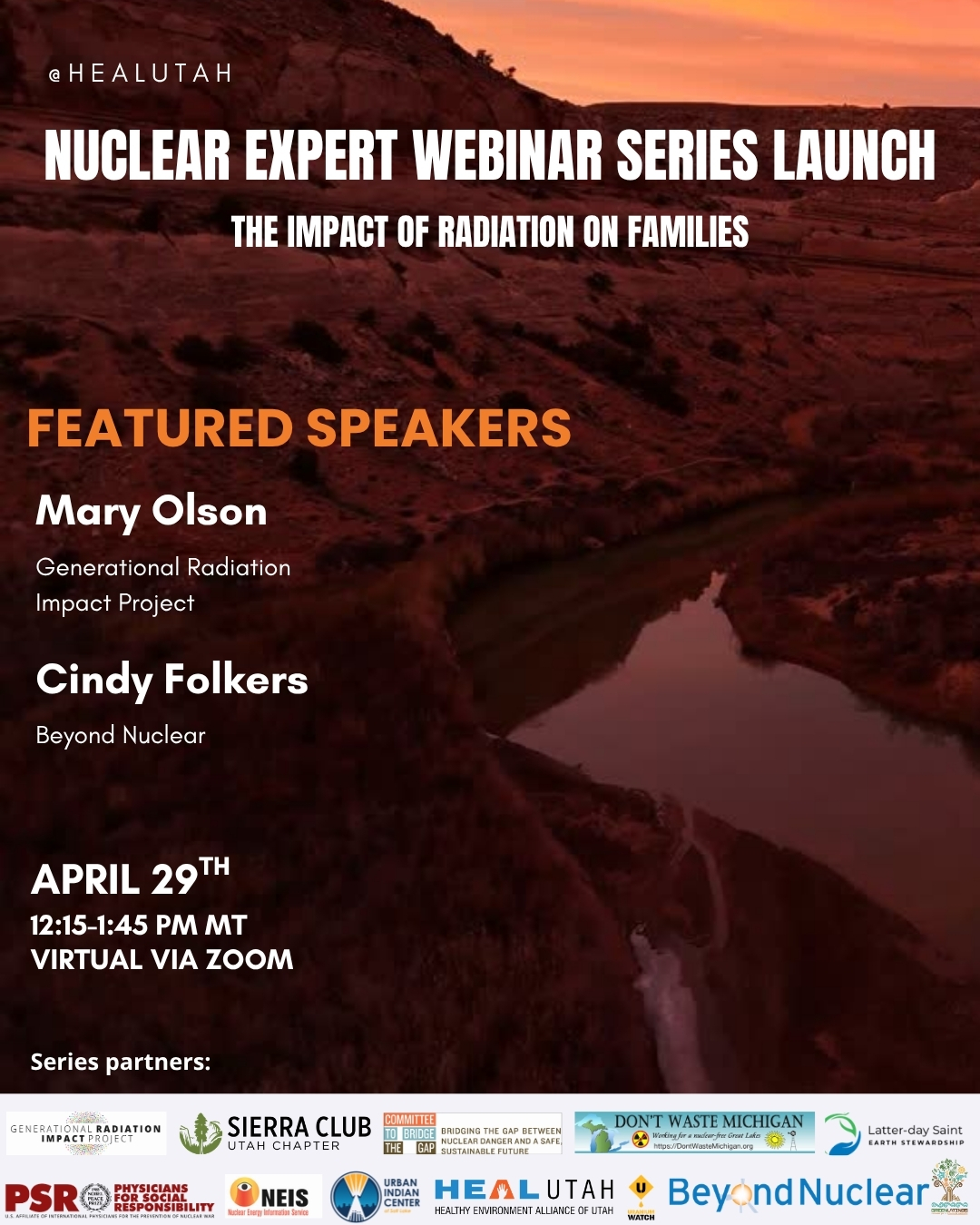
29 April – Nuclear Expert Webinar #1 – Radiation Impacts on Families with Mary Olson and Cindy Folkers
- 12:15 PM MT – 1:45 PM MT
- Location: Virtual – REGISTER TODAY

4 May -West Suburban Peace Coalition to discuss Iran war at May Educational Forum
Monday, May 4, 7:00 – 8:00 PM Central Standard Time
Title: : How Trump’s Narrative Tries to Shape the Reality of the War on Iran.
Contact Walt Zlotow, zlotow@hotmail.com 630 442 3045 for further information
14 May – online event From Bombs to Data Centres: the Face of Nuclear Colonialism

Pine Ridge Uranium is the real threat, not Tehran- Tell Burgum: Stop the Extraction.
Chernobyl: The Lost Tapes – A good documentary on Chernobyl on SBS available On Demand for the next 3 weeks– https://www.sbs.com.au/ondemand/tv-program/chernobyl-the-lost-tapes/2352741955560
To see nuclear-related stories in greater depth and intensity – go to https://nuclearinformation.wordpress.com
-
Archives
- April 2026 (327)
- March 2026 (251)
- February 2026 (268)
- January 2026 (308)
- December 2025 (358)
- November 2025 (359)
- October 2025 (376)
- September 2025 (257)
- August 2025 (319)
- July 2025 (230)
- June 2025 (348)
- May 2025 (261)
-
Categories
- 1
- 1 NUCLEAR ISSUES
- business and costs
- climate change
- culture and arts
- ENERGY
- environment
- health
- history
- indigenous issues
- Legal
- marketing of nuclear
- media
- opposition to nuclear
- PERSONAL STORIES
- politics
- politics international
- Religion and ethics
- safety
- secrets,lies and civil liberties
- spinbuster
- technology
- Uranium
- wastes
- weapons and war
- Women
- 2 WORLD
- ACTION
- AFRICA
- Atrocities
- AUSTRALIA
- Christina's notes
- Christina's themes
- culture and arts
- Events
- Fuk 2022
- Fuk 2023
- Fukushima 2017
- Fukushima 2018
- fukushima 2019
- Fukushima 2020
- Fukushima 2021
- general
- global warming
- Humour (God we need it)
- Nuclear
- RARE EARTHS
- Reference
- resources – print
- Resources -audiovicual
- Weekly Newsletter
- World
- World Nuclear
- YouTube
-
RSS
Entries RSS
Comments RSS
 nuclear-news