Just off Fukushima coast – earthquake magnitude 4.9
Quake hits just off Fukushima plant, felt along 500 kilometer stretch of Japan coast — Seismic intensity of 4 on scale up to 7 — Camera shakes for about 1 minute (VIDEO) http://enenews.com/quake-hits-just-off-fukushima-plant-felt-along-500-kilometers-of-japan-coast-camera-shakes-for-about-1-minute-video?utm_source=feedburner&utm_medium=email&utm_campaign=Feed%3A+ENENews+%28Energy+News%29
Japan Meteorological Agency, Apr. 13, 2014:
Time: 18:16 JST
Date: Apr. 13, 2014
Depth: 60 km
Location: Fukushima-ken Oki
Coordinates: 37.3N 141.2E
Magnitude: 4.9
Seismic Intensity: 4 out of 7
[Centered 30 km east of Fukushima Daiichi]Watch video of the quake here (at 8:00 in, 2x speed)
Deformities in Fukushima plants and insects
 Fairewinds Video: ‘Anomalies’ in plants and animals documented by Fukushima residents, some severely deformed — Scientists: Genetic mutations observed in Fukushima include trees with peculiar distortions, insect abnormalities, tumors in birds, more (PHOTO) http://enenews.com/fairewinds-video-anomalies-in-plants-and-animals-documented-by-fukushima-residents-some-severely-deformed-scientists-genetic-mutations-observed-in-fukushima-include-trees-with-peculiar-disto?utm_source=feedburner&utm_medium=email&utm_campaign=Feed%3A+ENENews+%28Energy+News%29
Fairewinds Energy Education, Apr. 10, 2014 — Chiho Kaneko, member of the Board of Directors of Fairewinds originally from Iwate, Japan (at 11:15 in): It’s not just people who are sicker. I met a home gardener who lives in Kawamata, Fukushima, 30-miles from Fukushima Daiichi. She grows luffas, whose fruit is often dried to make bath sponges. Last year, with some trepidation, she used the seeds saved from the year before. She found flower buds directly growing out of the fruit. Some of her pole beans were abnormally gigantic. Near Fukushima city, another person saw a frog so severely deformed that, at first, it was difficult to tell that it was a frog, save for its hopping. These are true events described by people I met who took notes and photographs of these environmental anomalies.
Asian Perspective Vol. 37, No. 4, Anders Pape Møller and Timothy A. Mousseau, Oct.-Dec. 2013: A careful observer [who visits Chernobyl or Fukushima] will quickly become aware of the peculiar distortions of tree growth, numerous abnormalities in insects, and tumors and cataracts in birds, all caused by genetic mutations induced by exposure to the radiation […] radiation causes damage to DNA molecules (leading to mutations if not repaired) […] We have known for more than eighty years that low-dose radiation has cytotoxic effects and causes mutations. […] we looked at 373 effect sizes from forty-six different studies […] they showed a statistically significant negative effect of radiation […] on mutation, physiology, immunology, and disease. As one would expect, effects were stronger on plants, which are stuck in one place, than on animals that can move around […] As the first scientists in both Chernobyl and Fukushima, we have performed [fifteen] published tests, of organisms ranging from plants and insects to birds and mammals in Chernobyl, that support the hypothesis that low-dose radiation disrupts development, and all fifteen studies show a higher degree of asymmetry in the more contaminated plots. […] we have assembled effect sizes from all published studies of mutation rates from Chernobyl, in total 151 estimates of mutations in forty-five studies of thirty-three species ranging from bacteria and plants to insects, birds, and mammals, including humans [The] findings are robust in showing a general, strong overall mean effect size of radiation on mutation rates. […] Mutations accumulate with time and across generations, so we may only be seeing the first stages of the negative public health consequences […] for humans.
SMR & Thorium proponents desperately promoting their failed plans to Australia

Christina Macpherson’s websites & blogs
While the BHP-funded Grattan Institute and a number of other “authoritative” bodies tout Small Modular Nuclear Reactors (SMRs) – powered by Thorium, for Australia, the bottom is falling out of the SMR project. The big firms involved are pulling out. Westinghouse already has. Babcock and Wilcox will be next.
Lobbyists like the USA’s nuclear front group, the Breakthrough Institute, have worked successfully on Australia’s pro nukers to flog off these (so far non-existent) SMRs to Australia. Note that they leave out the word “nuclear”, knowing that this word gives their project a bad smell.
However, – forget the associated bad smells of terrorism targets, proliferation dangers, waste problems that go with these nasty little nuclear reactors.
The biggy is economics. They just don’t stack up economically. (It’s such bad taste to mention this – but reneweable energy does stack up economically. And when you’re talking about small decentralised power sources – well – solar and wind are obviously the go.)
Small Modular Nuclear Reactors (SMRs) uneconomic: Babcock and Wilcox pulling out?
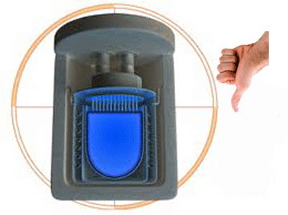 B&W scales back its small nuclear reactor project, Charlotte Observer, By Bruce Hendersony, Apr. 14, 2014 Charlotte-based Babcock & Wilcox said Monday it will scale back its mPower small modular nuclear reactor program after being unable to attract needed investors or contracts. The president of its mPower subsidiary, Christofer Mowry, left the company as of Sunday, B&W said in a securities filing. Mowry was terminated “without cause,” the filing said. William Fox III will replace him.
Announced in 2009, small modular reactor technology had been the company’s largest research and development project……Babcock & Wilcox announced an “accelerated” search for additional investors in the program last November.
But the project struggled to find additional investors or construction contracts that would bring in enough revenue to continue its development, B&W said Monday……..mPower recorded an $87 million operating loss in 2013, B&W said in a March proxy statement. http://www.charlotteobserver.com/2014/04/14/4841485/bw-scales-back-its-small-nuclear.html
Personal account from Tokyo, of government’s duplicity in radiation readings
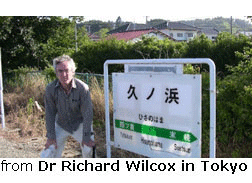 Japan’s Radioactive Potemkin Village: The Government’s Double-Dealing Data, rense.com. By Richard Wilcox, PhD, 4-12-14 “…….Can You Trust The Government?
According to the Japanese government official website, the Nuclear Regulation Authority , gamma radiation in Tokyo is just 0.034 microsieverts per hour (mcr sv pr hr) . This reading is taken 22 meters above the ground, in Shinjuku, a main hub of urban Tokyo. As luck would have it, I live not far from there and took a reading out my window several stories up in my apartment building and it regularly reads 0.13 mcr sv pr hr. According to the government chart, an estimated reading of 0.061 mcr sv pr hr is given for one meter above ground level. I measured one meter above ground where I live and the reading was 0.12 mcr sv pr hr.
What accounts for the noticeable discrepancy? Could it be the equipment or the location of measurement? The government chart gives an average reading for the ENTIRE CITY OF TOKYO, of 0.061, as if that is remotely accurate. I believe the government and authorities use two main tactics:
1. The place measurement monitoring devices high above the ground where it won’t read the worst radiation which naturally settles on the ground or in ditches;
2. They scrub and decontaminate the area in the immediate vicinity of the monitoring device in order to create a lower reading.
It could also be that tampering with the way devices are calibrated in order to get lower readings, or manipulating published data could occur, but I have no personal proof of these speculations.
Much of the problem with radiation science promoted by the nuclear establishment and their minions is that they limit the factors involved in their methodology and avoid the precautionary principle when drawing conclusions. In other words: don’t worry, be happy (even if your mitochondrial DNA is being damaged).
After the Fukushima accident I personally measured my kid’s school grounds. My readings were consistently higher what was reported by the school who simply measured above the ground in order to avoid the worst radiation.
When I was in the midwest in the US in March, I took outdoor readings above and on the ground that measured between 0.08 to 0.13 mcr sv pr hr. We now live in a manmade radioactively contaminated world due to above ground nuclear tests, nuclear power plant emissions, and nuclear accidents, in addition to natural background radiation from the sun or soil.
What I have witnessed first hand in Nihonmatsu is scientific fraud and misrepresentation of the facts. This is verified by my own dosimeter readings, and by the testimony of both Mr. Honda, the head of the temporary housing facility, and the experienced construction and decontamination worker who I talked with…..”
* Richard Wilcox is a Tokyo-based teacher and writer who holds a Ph.D. in environmental studies and is a regular contributor to the world’s leading website exposing the Fukushima nuclear disaster, Rense.com. He is also a contributor to Activist Post. His radio interviews and articles are archived at http://wilcoxrb99.wordpress.com and he can be reached by email for radio or internet podcast interviews to discuss the Fukushima crisis at wilcoxrb2013@gmail.com. http://www.rense.com/general96/jpsradioctv.html
Fukushima considered world’s worst nuclear accident
National Geographic: Fukushima considered world’s worst nuclear accident — Physician: Fukushima remains a “global health concern” — Kaku: “It’s so bad, they don’t even have a picture of melted core… the agony is unending” (VIDEO)
Asian Perspective Vol. 37, No. 4, Tilman A. Ruff, physician and Associate Professor in the Nossal Institute for Global Health at University of Melbourne, Oct.-Dec. 2013: A Public Health Perspective on the Fukushima Nuclear Disaster — The Fukushima nuclear disaster is far from over and remains a global health concern. While evacuations, sheltering, reducing intake of contaminated food, and other measures reduced radiation exposures, both the immediate and longer-term public health responses to the disaster leave major room for improvement. Commercially and institutionally, vested interests have undermined public health and safety. […]
National Geographic, Apr. 14, 2014: The meltdown at the Chernobyl power plant in 1986 made front-page news and, until Japan’s Fukushima disaster of 2011, was considered the world’s worst nuclear accident. […] Early estimates by the Associated Press (Dec. 16, 2000) were that the health of 3.4 million of Ukraine’s 50 million people was negatively affected, including 1.26 million children […]
Michio Kaku,Mar. 18, 2014 (at 1:18:00 in): The agony of 3 simultaneous meltdowns in Northern Japan […] The accident is not over at all. A small earthquake will send the accident starting all over again. You will realize that the reactor is so radioactive workers cannot even get in for more than just a few minutes at a time. […] The next thing they want to do is insert cameras into the water to see where the melting is. It’s so bad, they don’t even have a picture of the melted core. We know it’s 100 percent melted. […] The agony is unending. […] Japan said we will go nuclear because we have no oil or coal, but there is a price you have to pay — that is, you sell your soul to the devil.
69% of Japanese want nuclear power to be phased out
 Japan’s Profound Ambivalence Over Nuclear Energy , TIME, Per Liljas, 14 April 14 Prime Minister Shinzo Abe has unveiled a pro-nuclear blueprint for the country’s energy future around the three-year mark of the disaster at Fukushima, a move that most Japanese appear to disagree with, even those who returned to Fukushima to rebuild their lives ……On a national level, too, there is a lack of consensus. Produce from Fukushima, even from villages
  unconnected to the disaster, does not inspire confidence among consumers despite official O.K.s. And nobody can agree on the future of Japan’s nuclear-energy sector…….“They want to restart the reactors because of money, but it’s irresponsible, Japan is too unsafe to have nuclear power,” says activist Kaori Echigo, before taking to a podium in front of the parliament building in Tokyo and leading a crowd in the chanting of anti-nuclear slogans. The crowd at these gatherings, which have been held weekly since the disaster, has dwindled to a few hundred. But the last time a reactor was restarted, in 2012, thousands came onto the streets—as they are likely to do again if Abe goes ahead with his plan.
A poll by the Tokyo Shimbun newspaper last month found that 69% of respondents wanted nuclear power to be phased out. That number could rise even higher if Japan makes it through another summer without blackouts…….Spread out through the village are fields covered with black plastic bags, each one filled with contaminated topsoil that has been collected from the surroundings. Watanabe says she feels life is coming back to Tamura when she sees children in the streets, but then remembers that they are only allowed half an hour’s outdoor playtime per day because of radiation fears.
“I don’t want my grandchildren to grow up here,” she says. “I don’t know which health problems they may get.” Even that old saw about marrying somebody from Tamura means nothing now. “I want my grandchildren to get married” Watanabe adds, “and I don’t know which suitors would ever come here.” http://time.com/59096/fukushima-nuclear-daiichi-japan-tamura/
Likely political and economic damage to Abe’s government as result of pro nuclear decision
 Tokyo’s decision on nuclear power plants ‘may backfire’
It could cost PM Abe politically and set back his economic policies: analysts Business Times BY ANTHONY ROWLEY, 14 April 14, IN TOKYO JAPANESE Prime Minister Shinzo Abe has entered a high-stakes gamble with the decision announced last Friday to restore nuclear power to the nation’s menu of electricity generation sources in the wake of the Fukushima nuclear meltdown three years ago.
The controversial decision goes against the non-nuclear policy adopted by the Democratic Party of Japan government before Mr Abe’s Liberal Democratic Party returned to power at the end of 2012 and could backfire in a number of ways, analysts say.
With polls showing a significant proportion of Japanese remaining opposed to the restart of the nation’s 50 or so nuclear reactors that have been idled since the Fukushima disaster, the political price of restoring nuclear power could be high for Mr Abe, some claim.
At the same time, there could be economic consequences such as setting back the policy being pursued by the Bank of Japan (BOJ) under pressure from Mr Abe to replace deflation with annual inflation of 2 per cent. So far much of the progress towards this target has been driven by “imported inflation” in fuel costs…..(subscribers only) http://www.businesstimes.com.sg/premium/world/tokyos-decision-nuclear-power-plants-may-backfire-20140414
Tatsuya Murakami, influential ex-mayor leads community opposition to Japan’s nuclear power push
 Ex-mayor of nation’s nuclear birthplace comes out swinging against atomic power Japan Times, BY KEIJI HIRANO, 13 April 14, KYODO THE FORMER MAYOR OF A VILLAGE THAT HAD A PIONEERING ROLE IN THE NATION’S NUCLEAR DEVELOPMENT EXPRESSED HIS OPPOSITION SUNDAY TO THE COUNTRY CONTINUING TO LOOK TO NUCLEAR POWER AS AN ENERGY SOURCE.
“It has been said that a local community can enjoy benefits by hosting a nuclear power plant, but it is just an illusion,” Tatsuya Murakami, who served as mayor of Tokaimura, Ibaraki Prefecture, for 16 years until his retirement last September, told a public gathering in Tokyo.
Around one-third of the village’s general account budget was from nuclear facilities located there while he was mayor, “but the ‘nuclear money’ has made our industrial structure disproportionately depend on nuclear-related businesses,” he said. “As a result, we have failed to cultivate other businesses.”
The village’s shipment of manufactured goods stands at only ¥30 billion, compared with that of Myoko, Niigata Prefecture, with a population almost the same as Tokaimura’s, at ¥140 billion, according to Murakami.
“The nuclear operators are just like lords of the community, and people seek cozy ties with them. To criticize the lords is taboo,” Murakami said as he talked about the situation in the village where nation’s first research reactor achieved criticality in 1957.
His comments came after the government of Prime Minister Shinzo Abe decided Friday on a national energy policy that supports the use of nuclear power now and in the future, retracting a nuclear phaseout goal introduced by the previous Democratic Party of Japan-led government in the wake of the 2011 Fukushima nuclear disaster.
Murakami has served as a co-representative of the Mayors for a Nuclear Free Japan, which comprises around 90 former and incumbent mayors supporting the nuclear phaseout policy. Incumbent mayors include those of major cities, such as Sapporo, Aomori and Nagoya………
Six months after retiring, Murakami now gives lectures several times a month around the nation to encourage people to raise their voices against nuclear power.
“I had been thinking about how to reconstruct our village in the wake of the nation’s first criticality accident in 1999,” which killed two workers at a nuclear fuel processor and exposed hundreds of residents to radiation, he said. “We were thrust into notoriety — Tokaimura was contaminated with radiation and the villagers were not being chosen as marital partners.
“I believe now that a local municipality should break away from the old mindset focusing only on economic development,” he said. “Rather, we need to create a sustainable society, taking good care of the environment as well as ourselves.”http://www.japantimes.co.jp/news/2014/04/13/national/ex-mayor-of-nations-nuclear-birthplace-comes-out-swinging-against-atomic-power/
USA bumping up its weapons exports to Asian region
 World Cuts Back Military Spending, But Not Asia, Inter Press Service Analysis by John Feffer WASHINGTON, Apr 14 2014 (IPS) – For the second year in a row, the world is spending a little less on the military. Asia, however, has failed to get the memo. The region is spending more at a time when many others are spending less.
Last year, Asia saw a 3.6 percent increase in military spending, according to figures just released by the Stockholm International Peace Research Institute. The region — which includes East Asia, South Asia, Central Asia and Oceania — posted topping off a 62 percent increase over the last decade. In 2012, for the first time Asia outpaced Europe in its military spending. That year, the world’s top five importers of armaments all came from Asia: India, China, Pakistan, South Korea, and (incredibly) the city-state of Singapore.
China is responsible for the lion’s share of the increases in East Asia, having increased its spending by 170 percent over the last decade. It has also announced a 12.2 percent increase for 2014.
But China is not the only driver of regional military spending. South Asia – specifically the confrontation between India and Pakistan – is responsible for a large chunk of the military spending in the region. Rival territorial claims over tiny islands – and the vast resources that lie beneath and around them — in both Northeast and Southeast Asia are pushing the claimants to boost their maritime capabilities.
Even Japan, which has traditionally kept its military spending to under one percent of GDP, is getting into the act. Tokyo has promised of a 2.8 percent increase in 2014-15.
The United States, a Pacific power whose military spending is not included in the Asia figures, has also played an important role in driving up the expenditures in the region. The Barack Obama administration’s “Pacific pivot” is designed to reboot the U.S. security presence in this strategically critical part of the world………
The modest reduction in Pentagon spending will not necessarily lead to a corresponding decline in exports. In fact, the opposite is likely to be true, as was the case during the last Pentagon slowdown in the 1990s. The Obama administration has pushed through a streamlining of the licensing process in order to facilitate an increase in military exports – in part to compensate U.S. arms manufacturers for a decline in orders from the Pentagon…..
Asia and Oceania represent the primary target for U.S. military exports, absorbing nearly half of all shipments. Of that number, East Asia represents approximately one-quarter (South Asia accounts for nearly half).
The biggest-ticket item is the F-35 fighter jet, which Washington has already sold to Japan, South Korea, and Australia. Long-range missile defence systems have been sold to Japan, South Korea, and Taiwan. Overall between 2009 and 2013, Australia and South Korea have been the top U.S. clients. With its projected increase in military spending, Japan will also likely rise much higher on the list.
The more advanced weaponry U.S. allies purchase, the more they are locked into future acquisitions. The United States emphasises “interoperability” among its allies. Not only are purchasers dependent on the United States for spare parts and upgrades, but they must consider the overall system of command and control (which is now C5I — Command, Control, Communications, Computers, Combat systems and Intelligence).
Although a French fighter jet or a Russian naval vessel might be a cheaper option in a competitive bid, the purchasing country must also consider how the item integrates with the rest of its hardware and software……
The continued increase in military spending by countries in East Asia and the massive influx of arms into the region are both symptoms and drivers of conflict. Until and unless the region restrains its appetite for military upgrades, the risk of clashes and even all-out war will remain high.
In such an increasingly volatile environment, regional security agreements – on North Korea’s nuclear programme, the several territorial disputes, or new technological threats like cyberwarfare – will be even more difficult to achieve.
Most importantly, because of these budget priorities, the region will have fewer resources and less political will to address other pressing threats, such as climate change, which cannot be defeated with fighter jets or the latest generation of battle ship. http://www.ipsnews.net/2014/04/world-cuts-back-military-spending-asia/
India will keep is ‘no first use’ nuclear weapons policy
 No-first-use nuclear policy to stay: Rajnath Kumar Uttam, Hindustan Times 13 Apil 14, The BJP will leave unchanged India’s stand not to be the first side to use nuclear weapons in a conflict, the party said Sunday, ending speculation about one of the defining principles of New Delhi’s foreign policy. The no-first-use policy for nuclear weapons was a well thought out stand of the NDA government led by Atal Behari Vajpayee. We don’t intend to reverse it,” BJP chief Rajnath Singh told HT.
Party leaders say the policy has not only boosted India’s standing in the international community but also gives a certain amount of leverage in foreign-policy matters.
David Cameron acknowledges damage to nuclear test veterans and their offspring
- David Cameron gives nuclear test veterans glimmer of hope after our 12-year campaign for justice
 http://www.mirror.co.uk/news/uk-news/david-cameron-gives-nuclear-test-3406479
- Apr 12, 2014 Prime Minister has promised to investigate setting up a £25 million health fund for descendants of those exposed to genetic suffering genetic defects
David Cameron has at last given hope to families of nuclear test veterans after a 12-year Sunday Mirror campaign for justice.
The Prime Minister has promised to investigate setting up a £25million health fund for descendants suffering genetic defects passed down by servicemen exposed to 1950s blasts.
He will also look at offering personal thanks to the veterans and recognising their sacrifice with a medal.
Campaigners say the breakthrough at a half-hour meeting is the closest they have been to formal recognition of the suffering caused by the South Pacific explosions.
It came days after the Sunday Mirror called for the PM to recognise the plight ofchildren like 15-month-old Ella Denson, who was born with a deformity linked to her great-grandad Eric Denson’s exposure to radiation on Christmas Island in 1958.
The meeting between Mr Cameron and Tory MP John Baron last Wednesday was the first time the veterans have had their case put forward to any prime minister.
Mr Baron, patron of the British Nuclear Test Veterans’ Association, told the PM descendants had 10 times the normal rate of birth defects, their wives had elevated rates of miscarriage, and no other veterans’ group had suffered harm which spread down the generations.
A New Zealand study found veterans’ genes had three times the damage of Chernobyl survivors. The tests have never been repeated here.
Scientists say effects could last for 20 generations.
As Mr Cameron listened, Ella, of Morden, South London, was recovering from her latest hospital admission to deal with her severe defect. She was born with two tubes to a kidney instead of one and needs daily antibiotics to stop infection before having surgery at three.
At the weekend she was rushed to hospital for the third time in her short life. Her brother Jamie and mum Kimberley have teeth deformities.
Ella’s great-gran Shirley Denson, 79, had four daughters with bomb veteran husband Eric and has seen more than a third of his descendants suffer.
She said: “I pray the Prime Minister does the right thing, for the sake of my Ella and all the thousands like her.”
Eric was one of 22,000 men ordered to witness the detonation of nuclear bombs between 1952 and 1967.
He later suffered crippling headaches and killed himself in 1976. Fewer than 3,000 veterans survive.
France, the US, Australia, New Zealand, Russia, China and even the Isle of Man recognise and compensate test veterans. The MoD has always insisted no harm befell the men.
Mr Baron said: “The meeting with Mr Cameron was constructive. He is going to get back to me.”
UK urged to triple or quadruple renewable energy, after IPCC
UN urges huge increase in green energy to avert climate disaster http://www.theguardian.com/environment/2014/apr/12/un-urges-increase-green-energy-avert-climate-disaster-uk
A report by the world’s leading authorities will expose a growing gulf between a Tory party intent on halting construction of more onshore windfarms and the world’s leading scientists, who see them as one of the cheapest ways to provide energy while at the same time saving the environment.
Mitigation of Climate Change, by the UN’s Intergovernmental Panel on Climate Change (IPCC), a panel of 200 scientists, will make it clear that by far the most realistic option for the future is to triple or even quadruple the use of renewable power plants. Only through such decisive action will carbon dioxide levels in the atmosphere be kept below the critical level of 480 parts per million (ppm), before the middle of the century. If levels go beyond this figure, the chances of curtailing global mayhem are poor, they will say.
The report – the third in a series by the IPCC designed to highlight the climate crisis now facing the planet – is intended as an urgent wake-up call to nations to commit around 1-2% of GDP in order to replace power plants that burn fossil fuels, the major cause of global warming, with renewable sources.
Japan’s return to nuclear power will not be easy or soon
Japan reverses its withdrawal from nuclear power, DW 13 April 14 The Japanese government has decided not to phase out nuclear power. But a fast turnaround in energy policy is also not possible, even if only a third of the nuclear reactors will be restarted again. Japan’s conservative government has drawn different conclusions from the Fukushima disaster than did the German government, which chose to phase out nuclear power. Its new energy plan, which Shinzo Abe’s Liberal Democratic Party (LDP) cabinet approved on Friday (11.04.2014), calls nuclear power the country’s most important power source…….
But the nuclear power plants will have to meet tighter safety requirements. The government wants to allow the operation of power plants classified as safe by the reformed Nuclear Supervisory Authority. The first two reactors could gain approval before summer.
A majority of Japanese oppose nuclear power, according to polls. But this has had no effect on any elections since the Fukushima disaster. With the new energy plan the government satisfies the wish of the economy to use nuclear power as reliable energy source.
The new policy also allows the construction of new nuclear reactors. The government will determine the necessary amount of nuclear power, the paper says. But analysts doubt that it is possible to push through the construction of new reactors. They would have to be build at places where nuclear power plants already exist due to public reluctance.
The energy market is to be liberalized by the end of the decade and that could make the construction of new reactors too expensive. And the future of the decommissioned reactors also looks bleak.
Since last summer the eight electricity suppliers asked the Nuclear Supervisory Authority for permission to restart only 17 of the 48 reactors. Another 14 reactors are heavily disputed politically. There is widespread public rejection of any attempt by operator Tepco to restart Fukushima 2. The Hamaoka nuclear complex with three reactors is located in a heavily populated area in an earthquake zone. The remaining 17 reactors won’t ever go in operation again because security retrofitting won’t pay off due their age……..http://www.dw.de/japan-reverses-its-withdrawal-from-nuclear-power/a-17563405
Fukushima: Sending People Back To The Death Zone
Japan’s Radioactive Potemkin Village: The Government’s Double-Dealing Data, rense.com. By Richard Wilcox, PhD, 4-12-14 “…..Sending People Back To The Death Zone
Japan has coordinated its big push to force residents back into the Death Zone with the cheerful news from the UN that there is “no increase in Fukushima cancer rates” due to radiation (20). While some residents are homesick and want to return, many are wary of returning due to radiation dangers (21).
The excellent website Simply Info summarizes the gist of a recent UN report which fallaciously claims there will be no cancers from Fukushima:
“UNSCEAR uses the fact that cancer can not be traced back to an origin to explain away any potential cancers from the Fukushima disaster. This tactic is well known among the tobacco and asbestos industries.
The source of the data used by UNSCEAR is primarily the IAEA, TEPCO and the Japanese government. Anyone who has been following events in Fukushima knows none of these sources are considered unbiased or accurate. Much dispute about the validity of the data from these entities exists. All of the data from other sources is ignored by UNSCEAR” (22).
A number of studies question the safety of both low and high radiation levels as well as the validity of the UN’s risk assessment model (23; 24; 25; 26; 27; 28).
Irrefutable proof of harm to living organisms from radiation are shown in studies that have already found innumerable forms of damage to wildlife in both Chernobyl, over a quarter a century ago, and in Fukushima today (29; 30). Birds of a feather in the nuclear age drop dead together …..”
* Richard Wilcox is a Tokyo-based teacher and writer who holds a Ph.D. in environmental studies and is a regular contributor to the world’s leading website exposing the Fukushima nuclear disaster, Rense.com. He is also a contributor to Activist Post. His radio interviews and articles are archived athttp://wilcoxrb99.wordpress.com and he can be reached by email for radio or internet podcast interviews to discuss the Fukushima crisis at wilcoxrb2013@gmail.com.
http://www.rense.com/general96/jpsradioctv.html
‘.
* Richard Wilcox is a Tokyo-based teacher and writer who holds a Ph.D. in environmental studies and is a regular contributor to the world’s leading website exposing the Fukushima nuclear disaster, Rense.com. He is also a contributor to Activist Post. His radio interviews and articles are archived at http://wilcoxrb99.wordpress.com and he can be reached by email for radio or internet podcast interviews to discuss the Fukushima crisis at wilcoxrb2013@gmail.com.
1 This Month
26 April – Chernobyl: Inside the Meltdown airs on National Geographic on Sunday 26th April from 4pm

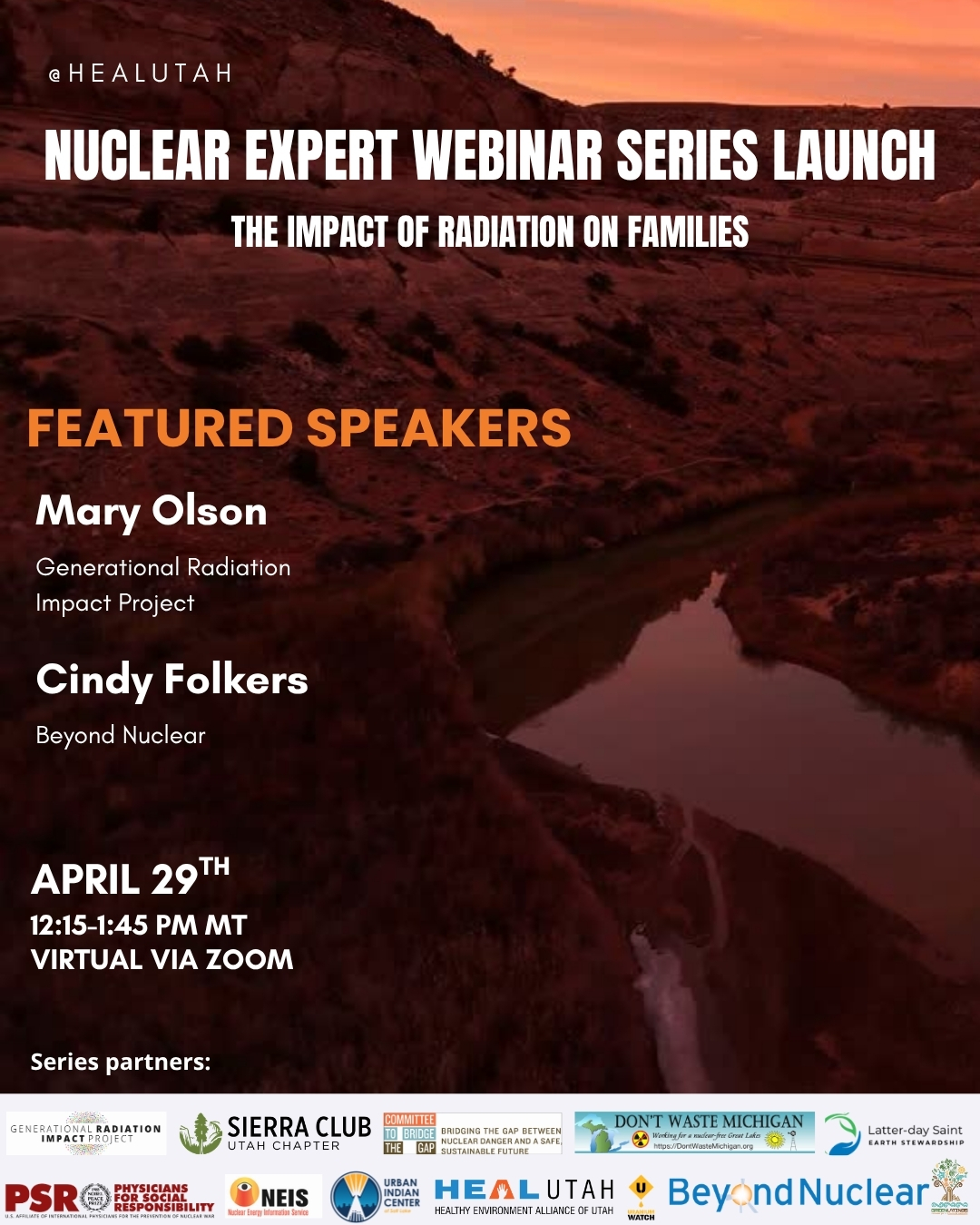
29 April – Nuclear Expert Webinar #1 – Radiation Impacts on Families with Mary Olson and Cindy Folkers
- 12:15 PM MT – 1:45 PM MT
- Location: Virtual – REGISTER TODAY

4 May -West Suburban Peace Coalition to discuss Iran war at May Educational Forum
Monday, May 4, 7:00 – 8:00 PM Central Standard Time
Title: : How Trump’s Narrative Tries to Shape the Reality of the War on Iran.
Contact Walt Zlotow, zlotow@hotmail.com 630 442 3045 for further information
14 May – online event From Bombs to Data Centres: the Face of Nuclear Colonialism

Pine Ridge Uranium is the real threat, not Tehran- Tell Burgum: Stop the Extraction.
Chernobyl: The Lost Tapes – A good documentary on Chernobyl on SBS available On Demand for the next 3 weeks– https://www.sbs.com.au/ondemand/tv-program/chernobyl-the-lost-tapes/2352741955560
To see nuclear-related stories in greater depth and intensity – go to https://nuclearinformation.wordpress.com
-
Archives
- April 2026 (288)
- March 2026 (251)
- February 2026 (268)
- January 2026 (308)
- December 2025 (358)
- November 2025 (359)
- October 2025 (376)
- September 2025 (257)
- August 2025 (319)
- July 2025 (230)
- June 2025 (348)
- May 2025 (261)
-
Categories
- 1
- 1 NUCLEAR ISSUES
- business and costs
- climate change
- culture and arts
- ENERGY
- environment
- health
- history
- indigenous issues
- Legal
- marketing of nuclear
- media
- opposition to nuclear
- PERSONAL STORIES
- politics
- politics international
- Religion and ethics
- safety
- secrets,lies and civil liberties
- spinbuster
- technology
- Uranium
- wastes
- weapons and war
- Women
- 2 WORLD
- ACTION
- AFRICA
- Atrocities
- AUSTRALIA
- Christina's notes
- Christina's themes
- culture and arts
- Events
- Fuk 2022
- Fuk 2023
- Fukushima 2017
- Fukushima 2018
- fukushima 2019
- Fukushima 2020
- Fukushima 2021
- general
- global warming
- Humour (God we need it)
- Nuclear
- RARE EARTHS
- Reference
- resources – print
- Resources -audiovicual
- Weekly Newsletter
- World
- World Nuclear
- YouTube
-
RSS
Entries RSS
Comments RSS
 nuclear-news