Death and disease among uranium workers in Rio Tinto’s mines
 Uranium workers dying after time at Namibia mine, report warns http://www.theguardian.com/environment/2014/apr/15/uranium-workers-dying-cancer-rio-tinto-namibia-mine
A study based on questionnaires of current and former workers at the giant Rio Tinto-owned Rössing uranium mine in Namibia says that everyone questioned was aware of people who are now suffering lung infections and unknown illnesses thought to be linked to their work.
The mine, in the Namib desert, produces around 7% of the world’s uranium but was operated with rudimentary safety when it opened in 1976. “People get sick. We are seeing it in people that have worked for Rössing for a long time. They just go back and die after working at Rössing,” one man told researchers working with Earthlife Namibia and the Labour Resource and Research Institute.
The study, which is expected to be published this week, accepts that working conditions in the mine have greatly improved but says that all workers questioned said that they were exposed to high levels of dust.
“Two current workers are on sick leave since 2000 and 2003. One worked as a laboratory technician for 24 years and claims to have proof he was radiated,” says a summary of the paper seen by the Guardian.
Rössing, which mines millions of tonnes of rock a year to extract uranium, employs more than 1,500 people. “Most workers stated that they are not informed about their health conditions and do not know if they have been exposed to radiation or not. Some workers said they consulted a private doctor to get a second opinion,” say the authors.
“The older workers all said they know miners dying of cancers and other illnesses. Many of these are now retired and many have already died of cancers,” says the report.
Aerial view of the discharge channels from Rössing, the world’s largest opencast uranium mine. Photograph: Yann Arthus-Bertrand/CorbisA spokesman for Rio Tinto said that Rössing has been recognised by independent consultants as one of the world’s safest mines. “The health and safety of our employees is the top priority. We have health management systems in place to make sure that everyone goes home safe and healthy every day. Effective controls ensure that radiation exposures to employees are kept well below the Rössing standard for occupational radiation exposure.
“The company keeps detailed records of the health status of its workforce from the day of employment to the day they leave the company. It therefore does not need to speculate on health issues of its employees.”
One former worker said: “Yes, I have cancer now. In the beginning they [Rio Tinto] did not want to give money for the treatment but later when they referred me to a doctor for an operation they gave me money for treatment.”
“Doctors were told not to inform us with our results or tell our illness. They only supply you with medications when you are totally finished up or about to die,” said another.
During the first years of operation, Rössing operated with a migrant labour system which the International Commission of Jurists declared illegal and said was similar to slavery. Black workers lived on the mine premises and were exposed to dust and radiation 24 hours a day and the mine became the focus for protests by anti-apartheid and anti-nuclear groups.
Shares in the mine are owned 69% by UK-based Rio Tinto, and 15% by the government of Iran. The Namibian government has denied supplying Iran with Namibian uranium which could be used for nuclear weapons.
The Erongo region is home to Rössing mine, the oldest and third-largest producer of uranium in the world. The mine sustains the small satellite town (population 7,600) of Arandis, which is visible near the top of the image. Photograph: ALI/EO-1/NASA“Uranium companies generally deny that workers get sick because of exposure to radiation. They blame the bad health conditions to unhealthy lifestyles such as eating habits, tobacco smoking and alcohol,” says the study.
Former Rössing mineworkers and people from communities adversely affected by Rio Tinto mines in west Papua, Madagascar, Namibia, Mongolia and the US will petition Rio Tinto shareholders at Tuesday’s annual meeting in London.
“Rio Tinto is enormous. Its history of attacks on workers’ rights, and environmental destruction has had a particularly damaging impact across the world,” said Richard Solly, co-ordinator of LondonMining Network, an alliance of human rights, development, environmental and solidarity groups.
The danger of a nuclear Saudi Arabia
The risks of a nuclear Saudi Arabia April 7, 2014 by Nick Butler”……….The issue is set out in an excellent new paper for the Belfer Center at Harvard by Olli Heinonen and Simon Henderson. The Saudis’ explanation of their newfound interest in nuclear technology is that they want to use it to produce electric power and to converse oil supplies which can be exported. There is a core of truth in this of course – Saudi Arabia’s domestic oil consumption is rising inexorably and is now more than 3m barrels a day. But, of course, this is exactly the argument used by Iran for its own nuclear research.
Heinonen and Henderson believe the Saudis are preparing the way and giving themselves the option of being able to move beyond civil nuclear power to the point where they could within a matter of months produce some form of weapon. The country undoubtedly has the money to buy whatever is needed and they have close and dangerous allies within Pakistan, a country which is already a nuclear state. Scrutiny by the International Atomic Energy Agency is minimal (bizarrely the organisation spends more money monitoring Jordan) and the Saudis could go a long way down the path to nuclear capability without it becoming obvious until very late in the day.
The prospect of nuclear weapons in the hands of the fragile government of Saudi Arabia is bad enough. The country is fundamentally unstable – held together only by force and by the flow of oil money to an ever growing number of citizens who high expectations and low productivity. But equally concerning is that any further conflict in the region – even at a level below the nuclear threshold – could shake the global energy economy to its foundations……..” http://blogs.ft.com/nick-butler/2014/04/07/the-risks-of-a-nuclear-saudi-arabia/
Clean up Hanford nuclear waste – strong directive from Yakama Nation
 Yakama Nation Tells DOE to Clean Up Nuclear Waste By Michelle Tolson YAKAMA NATION, Washington State, U.S. , Apr 14 2014 (IPS) – The Department of Energy (DOE), politicians and CEOs were discussing how to warn generations 125,000 years in the future about the radioactive waste at Hanford Nuclear Reservation, considered the most polluted site in the U.S., when Native American anti-nuclear activist Russell Jim interrupted their musings: “We’ll tell them.”
He tells IPS “they looked around and saw me. I said, ‘We’ve been here since the beginning of time, so we will be here then.’ That was when they knew they’d have a fight on their hands.” With his long braids, the 78-year-old director of the Environmental Restoration & Waste Management Programme (ERWM) for the Yakama tribes cuts a striking figure, sitting calmly in his office located on the arid lands of his sovereign nation.
The Yakama Reservation in southeast Washington has 1.2 million acres with 10,000 federally recognised tribal members and an estimated 12,000 feral horses roaming the desert steppe. Down from the 12 million acres ceded by force to the U.S. government in 1855, it is just 20 miles west from the Hanford nuclear site.
Though the nuclear arms race ended in 1989, radioactive waste is the legacy of the various sites of the former Manhattan Project spread across the U.S.
While the Yakama have successfully protected their sacred fishing grounds from becoming a repository for nuclear waste from other project sites by invoking the treaty of 1855 which promises access to their “usual and accustomed places,” Hanford is far from clean, though the DOE promised to restore the land.
“The DOE is trying to reclassify the waste as ‘low activity.’ They are trying to leave it here and bury it in shallow pits. Scientists are saying that it needs to be buried deep under the ground,” Jim explains.
Tom Carpenter of Hanford Challenge watchdog group tells IPS “it is a battle for Washington State and the tribes to get the feds to keep their promise to remove the waste. There are 42 miles of trenches that are 15 feet wide and 20 feet deep full of boxes, crates and vials of waste in unlined trenches.”
There are a further 177 underground tanks of radioactive waste and six are leaking. Waste is supposed to be moved within 24 hours from leak detection or whenever is “practicable” but the contractors say there is not enough space.
Three whistleblowers working on the cleanup raised concerns and were fired. Closely followed by a local news station, it is an issue that is largely neglected by mainstream media and the Yakama’s fight seems all but ignored. “We used to have a media person on staff but the DOE says there is no need as ‘everything is going fine,” says Russell Jim. His department lost 80 percent of its funding in 2012 after cutbacks. His tribe doesn’t fund ERWM, the DOE does. “The DOE crapped it up, so they should pay for it.”
But everything is not fine. With radioactive groundwater plumes making their way toward the river, the Yakama and watchdog groups says it is an emergency. Some plumes are just 400 yards from the river where the tribe accesses Hanford Reach monument, according to treaty rights.
Hanford Reach nature reserve, a buffer zone for the site, is the Columbia’s largest spawning grounds for wild fall Chinook salmon
Washington State reports highly toxic radioactive contamination from uranium, strontium 90 and chromium in the ground water has already entered the Columbia River.
“There are about 150 groundwater ‘upwellings’ in the gravel of the Columbia River coming from Hanford that young salmon swim around,” explains Russell Jim………..
“The DOE tells congress the river corridor is clean. It’s not clean but they are afraid of damages being filed against them.” A cancer survivor, Jim’s tribe received no compensation for damages from radioactive releases from 1944 to 1971 into the Columbia as high as 6,300,000 curies of Neptunium-239……….
teven G. Gilbert, a toxicologist with Physicians for Social Responsbility, tells IPS there is a lack transparency and data on the Hanford cleanup. “It is a huge problem,” he says, adding that contaminated groundwater at Hanford still interacts with the Columbia River, based on water levels.
Though eight of the nine nuclear reactors next to the river were decommissioned, the 1,175-megawatt Energy Northwest Energy power plant is still functioning
“Many people don’t know there is a live nuclear reactor on the Columbia. It’s the same style as Fukushima,” Gilbert explains.
In the middle of the fight are the tribes, which are sovereign nations. Russell Jim says they are often erroneously described as “stakeholders” when they are separate governments.
“We were the only tribe to take on the nuclear issue and testify at the 1980 Senate subcommittee. In 1982 we immediately filed for affected tribe status. The Umatilla and the Nez Perce tribes later joined.”,,,,,,,,http://www.ipsnews.net/2014/04/yakama-nation-tells-doe-clean-nuclear-waste/
#IHeartRenewables Week Earth Day (Tuesday, April 22)
It is the week before Earth Day (Tuesday, April 22) and we are asking American wind power supporters to share why they love wind energy on Twitter and Facebook.
Similar to our #iheartwind week a couple months back, we are asking supporters to use the#iheartrenewables hashtag to tell your followers, your friends, everyone why you love wind power in the spirit of celebrating Earth Day and all the successes wind power has achieved so far.
You can participate in many ways, including:
- Simply telling everyone why you love wind power and other renewables. For ex:
#iheartrenewables b/c U.S.#windpower avoids enough carbon dioxide emissions a year to take the equivalent of 17 million cars off the road! - Taking a picture of yourself at a wind farm
- Taking a picture of yourself at work, at home, or anywhere and holding up a sign for why you “heart” renewables.
- You can even tell us why you support federal policy, like the Production Tax Credit or PTC, that encourages American wind power’s growth.
- There are a number of ways you can creatively show your support!
Some of our friends over at @SEIA, @ACORE, and elsewhere will be joining in on the fun as well.
Iberdrola Renewables already kicked things off with their tweet below of a wind farm using the #iheartrenewables hashtag. You can post @AWEA on Twitter by using our handle @AWEA. You can find our Twitter page here:
You can post on AWEA’s Facebook page here:
https://www.facebook.com/AmericanWindEnergyAssociation
Interested in telling your elected officials why love wind power year-round? Sign up to receive updates from AWEA’s Power of Wind advocacy network.
Also, don’t forget that WINDPOWER 2014 is happening May 5–8 this year in Las Vegas, Nevada. It’s not too late to sign-up!
Australia, under PM Abbott is now an active Climate Change Denier
 Australia Remains Silent Amid Global Warming And Calls For Renewable Energy Use http://au.ibtimes.com/articles/548241/20140415/australia-global-warning-climate-change-tony-abbott.htm By Reissa Su | April 15, 2014
Australia’s Great Barrier Reef is known as a World Heritage site and the worsening effects of climate change have sparked fears that it would soon be destroyed and die. Recent scientific studies have shown a significant loss of coral cover in the past 27 years. The damage to corals is caused by climate change, storms and the increasing population of crown of thorns starfish. Reducing the number of the starfish species is the key factor to restore coral cover based on research studies.
Despite the mounting fears, climate scientists observed Australia may not be fully committed to battle out climate change. According to reports, Australia is one of the biggest and most active “climate change deniers” in the world. While the United Nations‘ Intergovernmental Panel on Climate Change (IPCC) is encouraging countries to do their part in reducing greenhouse gas emissions, Australia is focusing on coal which is considered the biggest contributor to the ozone’s destruction. Continue reading
South Africa’s growth in renewable energy
Africa: South Africa to Procure Still More Renewable Energy http://allafrica.com/stories/201404151599.html15 APRIL 2014 South Africa’s Department of Energy is to increase the amount of energy it will be procuring under the third window of its renewable energy programme for independent power producers, Energy Minister Ben Martins announced on Tuesday.
In November, the department signed agreements with 17 new preferred bidders in the third round of the programme, following the signing off of 47 projects in the first and second rounds, bringing to 64 the total number of renewable energy projects approved by the government since December 2011.
Once they are all operational, the 64 projects – representing foreign and domestic investment of over R100-billion – will add around 3 900 megawatts (MW) of wind, solar photovoltaic and concentrating solar power to South Africa’s energy mix.
On Tuesday, Martins said in a statement that this department would be allocating additional megawatts to the third window of the programme, thus including additional bidders, due to the increasingly competitive pricing offered by the round three bids.
Business Day reported in November that the average price offered for power generated from wind – which received the bulk of the third-round allocation – had dropped from R11.43 per kilowatt hour (kWh) in the first round to R6.65/kWh in the third round.
“The department will, in this regard, follow due procurement process to include additional bidders under window 3,” Martins said, giving no further specifics.
He added that submissions for the fourth window of the programme, which entails the procurement of a further 1 000 MW of renewable energy, was on track to close in August. The programme has five windows altogether.
While renewable energy accounted for less than 1% of South Africa’s energy mix in 2012, this is expected to reach 12% by 2020. According to research released in October by analysts Frost & Sullivan, this would place South Africa in the “global top 15 countries” with regard to the implementation of renewable energy projects.
Announcing the latest 17 preferred bidders in November, Martins noted that South Africa was currently rated as the 12th most attractive investment destination for renewable energy.
“This bodes very well for South Africa, as the programme has achieved international acclaim for fairness, transparency and certainty of programme,” Martins said, adding that there had been a progressive increase in the local content and job creation numbers offered by the bidders.
The department’s director-general, Nelly Magubane, said that some bidders had exceeded the local content requirement of no less than 40%, with some indicating that their projects would involve up to 56% local content.
Martins said the energy sector was expected to play a major role in creating green sector jobs, developing skills and transferring technology into South Africa’s economy.
Employment boost for South Africa due to renewable energy projects
Green energy IPPs create 14 000 jobs http://www.iol.co.za/business/companies/green-energy-ipps-create-14-000-jobs-1.1675332 April 14 2014 Independent power producers (IPPs) using renewable energy had created about 14 000 jobs over the past three years, Energy Minister Ben Martins said on Friday. “One of the imperatives of government is to ensure that all departments assist in job creation. Through the independent power producers programme, more than 14 000 have been created,” Martins said following a summit with 61 IPPs. “At the meeting, we acknowledged and expressed appreciation of the fact that to date more than R100 billion has been invested into this particular sector.” IPPs are entities which either own and or operate facilities that generate electric power. They then sell the power to a utility, central government buyer or to end users. The meeting was also attended by representatives of the Development Bank of Southern Africa, Eskom and the Public Investment Corporation. Diplomats representing Denmark, Spain, Germany, Norway, and the UK were also present at the Pretoria meeting. Martins said the IPP project had brought significant direct foreign investment. – Sapa
UK’s defence heavies are bullying Scotland
Defenders of union come under fire over tactics, FT.com, 15 April 14 By George Parker, Political Editor Philip Hammond, defence secretary, on Tuesday concluded two weeks of heavy pounding by the British military on Alex Salmond, the Scots first minister, in the latest attempt to halt his advance ahead ofSeptember’s independence referendum.
If recent experience is repeated, Mr Salmond will emerge unscathed, leaving his opponents to dwell on the effectiveness, co-ordination and tone of the campaign to save the United Kingdom………
Meanwhile Mr Hammond has orchestrated a campaign in recent days, featuring former armed forces chiefs and the First Sea Lord Sir George Zambellas, warning that independence would jeopardise the security of Scotland and the rest of Britain……. http://www.ft.com/intl/cms/s/0/aa22fc54-c4ab-11e3-b2fb-00144feabdc0.html
The world’s terminal illnesses – climate change and nuclear weapons
Lawrence Wittner: Nuclear arms a terminal illness, Battle Creek EnquirerApr. 15, 2014 Your doctors are worried about your health — in fact, about your very survival.
No, they’re not necessarily your own personal physicians, but, rather, medical doctors around the world, represented by groups like International Physicians for the Prevention of Nuclear War (IPPNW).
As you might recall, that organization, composed of many thousands of medical professionals from all across the globe, won the Nobel Peace Prize in 1985 for exposing the catastrophic effects of nuclear weapons.
Well, what seems to be the problem today? The problem, as a new IPPNW report indicates, is that the world is showing growing symptoms of a terminal illness. Continue reading
Nuclear Hotseat #147 – Libbe Halevey – BREAKING: ASLB approves new Texas nukes with foreign backing!
Nuclear Hotseat #147
15 April 2014
(site still hacked but you can get the show by direct link below)
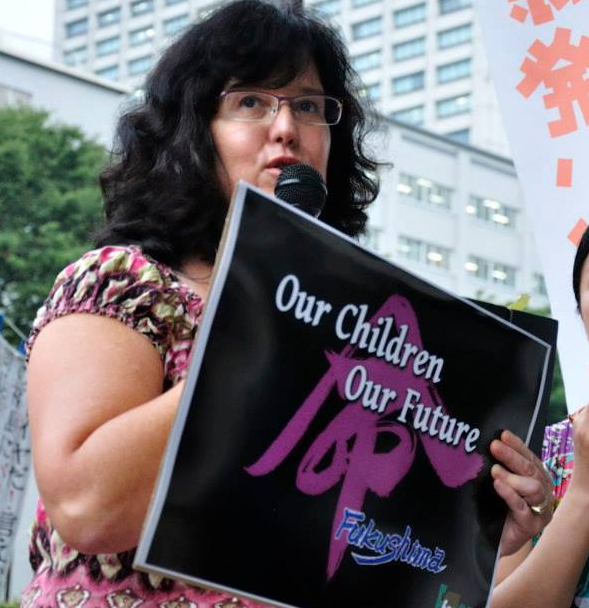
Beverly Findlay-Kaneko is at a Demonstration in 2013
Beverly Findlay-Kaneko on the April 27 SoCal event, “Childhood in Fukushima: Finding Hope in Adversity,” with former Fukushima elementary school principal Sensuke Shishido.
BREAKING: ASLB approves new Texas nukes with foreign backing!
Texas environmental watchdog SEED Coalition’s Karen Hadden provides the information.

PLUS: Interview with Italy’s anti-nuclear bulldog Massimo Greco on where Italian nuke waste ends up and his pending lawsuit;
Here’s the direct link from my service provider
: http://lhalevy.audioacrobat.com/download/3f6e5c1a-2b95-a05c-caf1-bd5a2a5f50db.mp3
Google gets into the military drone surveillance game as well as sidelinening anti nuclear activism searches in Ireland – Traitors to internet freedom, Yahoo is the future!
NUCLEAR-NEWS THOUGHT FOR THE DAY
Abby Martin discusses the drone issues here @7 mins in with Manuel Rapalo
I recently highlighted issues in Ireland with Google search blocking independent voices on nuclear issues. And pointed out that Yahoo moved its servers to Dublin from the UK because of spying in the UK (TEMPORA).
GOOGLE IS BEING SNEAKY ..
Time for people to vote with their feet and leave Google behind!
Drones Kill and they spy!
Which search engine is upholding YOUR freedoms of expression!!
NOT GOOGLE OBVIOUSLY!
GOOGLE SHOULD GET OUT OF IRELAND AND TAKE THE US MILITARY BASE NEAR THE SHANNON WITH IT (PRISM)
GOOGLE ARE WAR MONGERS!
USE YAHOO!
Why are Entergy executives selling their stock? – Rats leaving a sinking ship?
http://safeenergy.org/2014/04/15/why-are-entergy-execs-selling/
April 15, 2014
By Tim Judson.
Over the last few months, there has been a bit of a selling spree of Entergy stock. But this sell-off isn’t coming from just anybody: these sales are by some of the corporation’s top executives. Between December and early April, five Entergy execs sold off large portions of stock they hold in their employer. On December 3, 2013, Entergy CEO Leo Denault sold more than half of his Entergy stock (55.7%, or 33,949 shares valued at $2,103,480). On February 20, the Chief Financial Officer, Andrew Marsh, sold 20.7% of his stock (2,808 shares valued at $181,902). On February 27, Senior Vice President for Federal Government, Regulatory, and Policy Affairs Kimberly Despeaux sold 20.8% of her stock (3,024 shares valued at $193,113). And most recently, on April 9, Chief Accounting Officer Alyson Mount sold 45.9% of her stock (4,929 shares valued at $347,495). Also, on December 16 and October 16, Senior VP of Human Resources and Chief Diversity Officer Donald Vinci twice sold more than 16% of his Entergy holdings.
There was nothing illegal about any of this, they are all above-board transactions properly reported to the Securities and Exchange Commission and covered in the investment press. But if the three people who know most about Entergy’s finances (the CEO, CFO and CAO) and the person in charge of the company’s government and regulatory affairs—which are central to the company’s economic future (see below)—don’t feel that Entergy stock is a better long-term investment, you have to wonder whether there’s some big news on the horizon.
We have posted a lot recently about economic troubles in the nuclear garden, and the industry’s gambit to rescue itself from financial collapse (see here and here, for instance). The two largest players in this are Exelon and Entergy, the #1 and #2 nuclear operators in the country. As Wall Street has become aware of the serious problems facing the nuclear energy business over the last year, Entergy and Exelon have increasingly been named among the riskiest investments among major energy companies. In terms of gross numbers, Exelon has the greatest exposure to the economic crisis facing “merchant” nuclear reactors – that is, those operating in deregulated energy markets, where power plants sell electricity on a wholesale market rather than as part of a utility company with ratepayers. All of Exelon’s 22 reactors operate in deregulated markets, and more than 25% of them have been listed as at risk of closure.
But in some ways, Entergy may be even more at risk than Exelon, If insiders voting with their portfolios is any indication. After all, no one is reporting on Exelon executives selling stock like their counterparts at Entergy. Entergy currently owns 11 reactors, six of which are part of the corporation’s merchant power division, Entergy Wholesale Commodities (EWC); five are part of Entergy’s utility business in Arkansas, Louisiana, and Mississippi. Nearly all of the merchant reactors face some imminent threat of closure—that is, all but Vermont Yankee, which Entergy already has announced will close in 2014.

Among the others, FitzPatrick (NY) and Pilgrim (MA) have been singled out by industry analysts as two of the most economically troubled plants. Palisades (MI) is only profitable now because of a sweetheart contract with the reactor’s former owner, but has a growing list of major maintenance issues, including an embrittled reactor vessel. Indian Point’s two reactors near New York City are Entergy’s only currently profitable merchant nuclear “assets,” but are still considered vulnerable to closure due to major public and political opposition and legal challenges to their relicensing. That means within the next couple years, literally every reactor and the entirety of Entergy’s merchant power division could go belly-up.
That has investor analysts concerned. Of the thirteen investment firms “following” Entergy’s stock, two recommend investors sell their Entergy stock, eight are “neutral,” five firms have downgraded Entergy in the last year,* and only one has “upgraded” their rating. So that’s reason enough to be worried if you own Entergy stock. Entergy has had other problems recently, not least of which is the failure of a major deal to sell off the company’s electricity transmission infrastructure in the south, rejected by Mississippi regulators.
1,500 Children likely to develop heart problems on a yearly basis- Effects of the Fukushima nuclear disaster
This is a defect in the heart of children caused by radiation from Chernobyl, and it causes physical holes in the heart of the child, along with a host of other issues.

Image and quote source; http://www.chernobyl-international.com/programmes/medical-programmes-projects/cardiac-mission
Op Ed Arlight2011part2
Posted to nuclear-news.net
15th April 2012
In an attempt to work out the possible figures of children that will be born annually in Japan with birth defects, I have used the figures below to make an estimation of the likely impact. Based on figures from Chernobyl from Yablakov (2010) of 8, 300, 000 against a similar area in Fukushima Prefecture and the NW Myiagi prefecture (ACRO France) with a population living in contaminated areas of under 2, 500, 000. The figures seem to point to 1,500 children a year are likely to be born in future years with birth defects.
There is obviously some dispute as to the figures and areas of contamination. Also, the contamination in the mountains is likely to hit cities like Koriyama that are downhill of this unknown and untested for contamination. there are also some small issues with the population statistics though they seem about right to me.
Japan has no free health services and I would recommend that people not conceive in such a a place and subject their unborn Fetus to the high levels of Gamma radiation. Thanks to local initiatives food contamination is presently being contained mainly but as time goes on, like in Belarus etc, testing becomes lax. So evacuation is a good idea for young people wanting to raise a family. The issue of contaminated food is an international one that needs independent analysis to ascertain the depths of the problem and the IAEA and WHO are not up to the job because they have a nuclear bias. The quotes and links follow for you to decide if I am right or not;
From Chernobyl Children International
Today in Belarus, over 7000 children await treatment for cardiac conditions that would be practically routine matters in the United States or Europe. The country’s health services are already stretched to the breaking point, and the waiting list grows by an estimated 800 to 1000 children every year.
[..]
Since its establishment, Chernobyl Children’s Project International has built and maintained a fleet of over 140 ambulances in Belarus and Western Russian
http://www.chernobyl-international.org/programs.html
Quote from the Irish Independent newspaper – April 2014
“The €3m spent so far on establishing and maintaining the program has been raised entirely in Ireland by CCI donors and volunteer fund raising activities.
[..]
For the past 10 years, the program has been treating a significant portion of the 6,000 Ukrainian children born with genetic heart diseases every year. Many of these conditions, known as the ‘Chernobyl heart’, have been linked to the radiation leaks from the Chernobyl nuclear plant accident in 1986.”
[..]
Quotes from Chernobyl Children International CEO Adi Roche 2014

Wiki Information
According to reports from Soviet scientists, 28,000 square kilometers (km ², or 10,800 square miles, mi²) were contaminated by caesium-137 to levels greater than 185 kBq per square meter. Roughly 830,000 people lived in this area. About 10,500 km ² (4,000 mi²) were contaminated by caesium-137 to levels greater than 555 kBq/m². Of this total, roughly 7,000 km² (2,700 mi²) lie in Belarus, 2,000 km² (800 mi²) in the Russian Federation and 1,500 km² (580 mi²) in Ukraine. About 250,000 people lived in this area. These reported data were corroborated by the International Chernobyl Project.[13]
http://en.wikipedia.org/wiki/Effects_of_the_Chernobyl_disaster
Ratical website information
Arclight moves to Ireland and gives you a nuclear news update from Limerick
Some links for you to check out
Activists in Japan are under attack.. Legal Bar Association enjoys that!! GRRRRR!!
https://nuclear-news.net/2014/04/14/lawyer-yabe-ms-shimoya-and-friends-target-mari-takenouchi-in-a-disgusting-campaign-of-hate-and-sexual-abuse-with-no-comment-from-the-ethos-child-killers/
Deformities in Fukushima
Radiation cover up in Japan
Personal account from Tokyo, of government’s duplicity in radiation readings
Prime minister Cameron gets PR advice from WPP corporation (Tony Blair offers more advice on “Image Perception”?)
David Cameron acknowledges damage to nuclear test veterans and their offspring
IPCC wnats renewables not nuclear as advertised by corporate media
UK urged to triple or quadruple renewable energy, after IPCC
A nuclear future for us all?
Dwindling group of Hiroshima survivors bear witness to the nuclear horror
Ukraine “revolutionaries” need to talk as children are going to die
Kiev crisis halts Chernobyl charity’s €3m surgery plan – Children at risk!
Sellafield kills the Sea and everything
Japanese government’s double dealing on radiation data
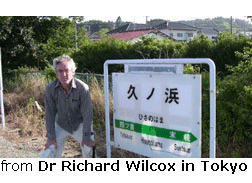 Japan’s Radioactive Potemkin Village: The Government’s Double-Dealing Data, rense.com. By Richard Wilcox, PhD, 4-12-14 I stand to be corrected but what I recently witnessed first hand and face to face in the city of Nihonmatsu can be interpreted as nothing other than scientific fraud and blatant misrepresentation of the facts on the part of the Japanese government regarding gamma radiation levels, leading to the early deaths of tens of thousands of residents . I visited a large nuclear refugee camp in a beautiful location near Nihonmatsu, a modest sized city just outside the evacuation zone of the Fukushima Nuclear Power Plant No. 1 (FNPP#1) disaster site . Continue reading
1 This Month
26 April – Chernobyl: Inside the Meltdown airs on National Geographic on Sunday 26th April from 4pm

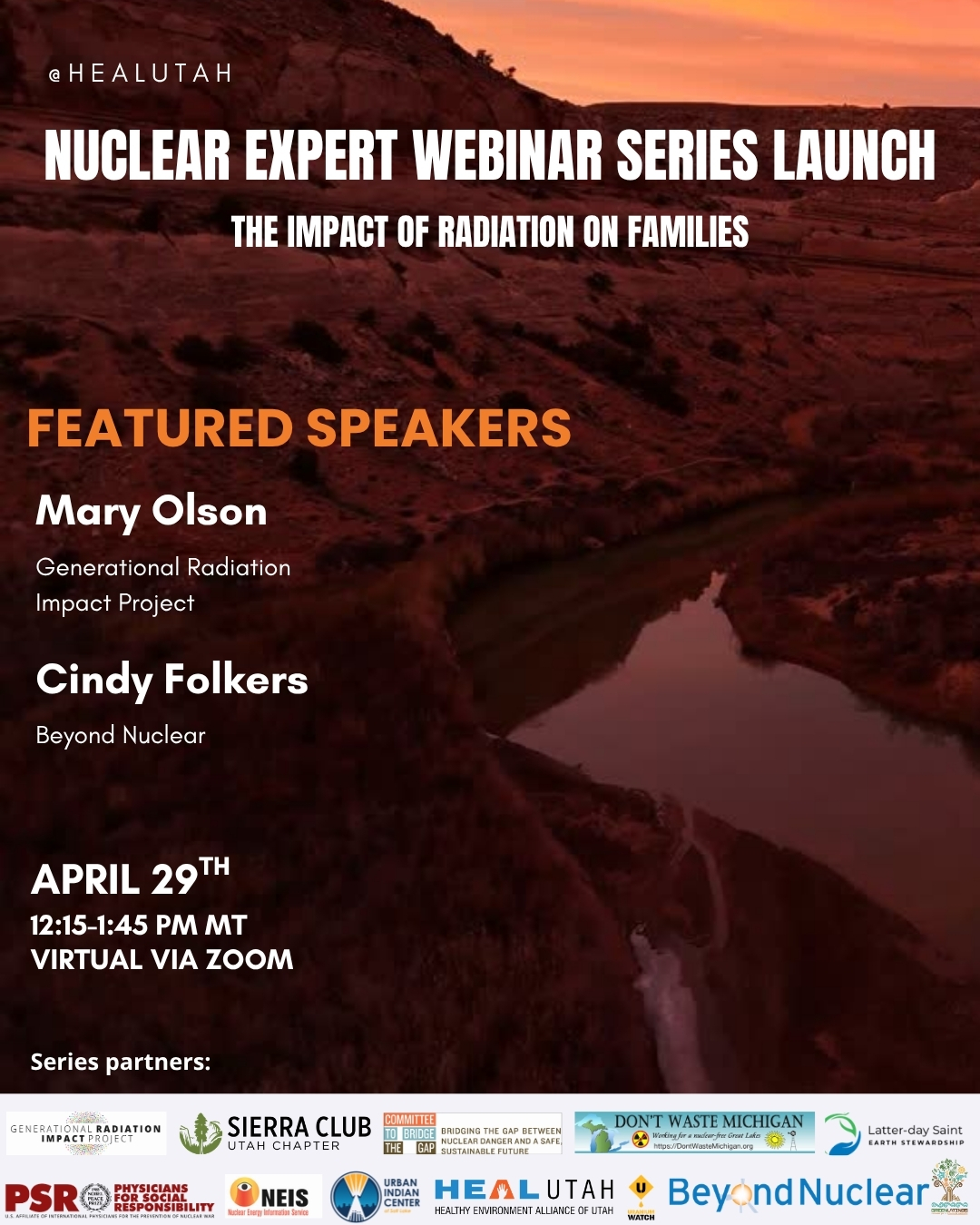
29 April – Nuclear Expert Webinar #1 – Radiation Impacts on Families with Mary Olson and Cindy Folkers
- 12:15 PM MT – 1:45 PM MT
- Location: Virtual – REGISTER TODAY

4 May -West Suburban Peace Coalition to discuss Iran war at May Educational Forum
Monday, May 4, 7:00 – 8:00 PM Central Standard Time
Title: : How Trump’s Narrative Tries to Shape the Reality of the War on Iran.
Contact Walt Zlotow, zlotow@hotmail.com 630 442 3045 for further information
14 May – online event From Bombs to Data Centres: the Face of Nuclear Colonialism

Pine Ridge Uranium is the real threat, not Tehran- Tell Burgum: Stop the Extraction.
Chernobyl: The Lost Tapes – A good documentary on Chernobyl on SBS available On Demand for the next 3 weeks– https://www.sbs.com.au/ondemand/tv-program/chernobyl-the-lost-tapes/2352741955560
To see nuclear-related stories in greater depth and intensity – go to https://nuclearinformation.wordpress.com
-
Archives
- April 2026 (288)
- March 2026 (251)
- February 2026 (268)
- January 2026 (308)
- December 2025 (358)
- November 2025 (359)
- October 2025 (376)
- September 2025 (257)
- August 2025 (319)
- July 2025 (230)
- June 2025 (348)
- May 2025 (261)
-
Categories
- 1
- 1 NUCLEAR ISSUES
- business and costs
- climate change
- culture and arts
- ENERGY
- environment
- health
- history
- indigenous issues
- Legal
- marketing of nuclear
- media
- opposition to nuclear
- PERSONAL STORIES
- politics
- politics international
- Religion and ethics
- safety
- secrets,lies and civil liberties
- spinbuster
- technology
- Uranium
- wastes
- weapons and war
- Women
- 2 WORLD
- ACTION
- AFRICA
- Atrocities
- AUSTRALIA
- Christina's notes
- Christina's themes
- culture and arts
- Events
- Fuk 2022
- Fuk 2023
- Fukushima 2017
- Fukushima 2018
- fukushima 2019
- Fukushima 2020
- Fukushima 2021
- general
- global warming
- Humour (God we need it)
- Nuclear
- RARE EARTHS
- Reference
- resources – print
- Resources -audiovicual
- Weekly Newsletter
- World
- World Nuclear
- YouTube
-
RSS
Entries RSS
Comments RSS
 nuclear-news