Czechs’ nuclear expansion plan goes out with a whimper
 Czechs pull plug on nuclear expansion, The Economist Apr 16th 2014 by B.C. | PRAGUE More than five years of international intrigue went out with a whimper on April 10th as Czech utility company ČEZ officially cancelled the planned expansion of the Temelín nuclear power plant (120 km south of Prague in the South Bohemia region)—the project undone by a collapse in market electricity prices and hard-learned lessons from a botched state energy scheme in years past.
The plan had called for adding two reactors to the existing two at Temelín (a second Czech nuclear plant, Dukovany, operates four reactors). The price tag was an estimated $15 billion, and the project made less and less sense as the wholesale price of electricity fell. Prices are now less than half what they were when bidding on the contract began in 2009. For much of that time the tender process was viewed through a cold war lens with the two final bidders being the American firm Westinghouse (now a division of the Japanese conglomerate Toshiba) and a consortium leadby Russia’s state-owned Atomstroyexport. The American and Russian ambassadors openly lobbied on behalf of their favoured firms and the companies themselves tried to outdo one another by signing highly contingent contracts with local suppliers to sweeten their offers…….
“There is absolutely no appetite from the state to get involved in something new like this now,” said David Marek, chief economist with Patria Finance, a Prague-based investment bank…….. the widespread perception that the Temelín project was doomed to be a financial failure, saw ČEZ stock surge on the announcement that the nuclear project was cancelled. Such are power politics. http://www.economist.com/blogs/easternapproaches/2014/04/power-plant-failures
3 French nuclear plants fail safety test

 French nuclear watchdog singles out 3 plants for safety shortfall By Michel Rose PARIS, April 16 (Reuters) – France’s nuclear watchdog singled out three of EDF’s 19 nuclear power stations for having a below-average safety performance in its annual safety report, which also asked for more enforcement powers such as the ability to impose fines….. There were 127 level-1 incidents on the 7-level International Nuclear and Radiological Event Scale (INES) in France in 2013, ASN said, and two level-2 incidents.
Level-1 incidents are minor procedural infringements and level-2 incidents can refer to cases of minor exposure to radiation…….
The watchdog also mentioned shortfalls in terms of radiation protection at Cattenom near the German border and in terms of impact on the environment at Belleville in the Loire valley, Chooz near Belgium, and Chinon.
Chevet said the ASN needed a more graduated array of sanction powers on operators such as EDF.
The watchdog can at anytime stop operations at a nuclear plant if it considers it presents a danger for the public and can also issue public warnings, but Chevet said an ability to impose fines for each day of safety breaches would be useful.
“We clearly lack intermediary sanction tools, for when shortfalls last for one, two, three years, but don’t require a shutdown of the plant,” he said.
The presentation to parliament of a much-delayed energy transition bill planned in July could be the opportunity to introduce such powers, he added. (Reporting by Michel Rose. Editing by Jane Merriman) http://in.reuters.com/article/2014/04/16/france-nuclear-safety-idINL6N0N74K120140416
$4billion boost to renewable energy and energy efficiency in USA

 US Plans New $4 Billion Renewables Support Program http://www.energymatters.com.au/index.php?main_page=news_article&article_id=4266 17 April 14 The USA’s Department of Energy (DoE) has issued a draft loan guarantee solicitation for renewable energy and energy efficiency projects that could make as much as USD $4 billion in loan guarantees available.
“Through our existing renewable energy loan guarantees, the Department’s Loan Programs Office helped launch the U.S. utility-scale solar industry and other clean energy technologies that are now contributing to our clean energy portfolio,” said Secretary Ernest Moniz. “We want to replicate that success by focusing on technologies that are on the edge of commercial-scale deployment today.”
The five key technology areas of interest to the DoE are : advanced grid integration and storage; drop-in biofuels; waste-to-energy; enhancement of existing facilities and efficiency improvements.
The Department’s Loan Programs Office has been no slouch in supporting renewables and energy efficiency; with more than $30 billion in loans, loan guarantees, and commitments supporting dozens of projects throughout the nation.
Among the beneficiary projects was the Caithness Shepherds Flat wind project, an 845 MW wind farm located in eastern Oregon. The Department of Energy provided a $1.3 billion partial loan guarantee that was crucial to the project’s success. Another project to benefit was the Agua Caliente Solar project, a 290-megawatt solar panel based power station Yuma County, Arizona. The Department of Energy provided a USD $967 million loan guarantee for this project.
Before the latest program is rolled out, the Department is inviting public comment; which will be considered in defining the scope of the final solicitation. The draft solicitation can be viewed here.
The DoE’s Loan Programs enables the body to work with private companies and financiers to mitigate the financing risks associated with clean energy projects, “and thereby encourage their development on a broader and much-needed scale.”
Investors wary of South Dakota uranium mining project, and with good reason
Action of S Louis County women prods EPA into testing for radiation
 EPA to test for radiation at West Lake Landfill http://www.ksdk.com/story/news/2014/04/16/epa-radiation-testing-west-lake-landfill/7797061/Allison Sylte, KSDK7:28 p.m. CDT April 16, 2014 BRIDGETON, Mo. (KSDK) –The Environmental Protection Agency has agreed to test for radiation outside the West Lake Landfill.
This news comes after a group of neighbors announced that if the EPA wasn’t going to do it, they were going to test for radiation themselves.
A lawyer donated $16,000 to help them buy a “mobile radiation detector.”
The EPA insists the radioactive waste at West Lake is not a threat to the surrounding area. Testing will begin in less than six months.
The community group is holding an informational meeting Thursday night at 6:30 p.m. at the Union Hall on Hollenburg Drive in Bridgeton.
St Louis County women organise radiation monitoring
Video: Moms want to test for radiation in Bridgetonhttp://www.ksdk.com/story/news/2014/04/15/bridgeton-landfill-radiation-testing/7762985/Casey Nolen, KSDK10:55 p.m. CDT April 15, 2014 ST. LOUIS COUNTY (KSDK) – If the federal government won’t test for radiation, some West Lake Landfill neighbors say they’ll do it themselves.
Dawn Chapman and her group, Just Moms STL, plan to deploy radiation detectors in St. Louis County by the end of the week.
They hope to monitor the air for any possible high levels of radiation that they believe could be coming from the nearby West Lake Landfill, where old nuclear waste is buried.
Politicians purchased Geiger counters for these birdhouse-like stationary sensors.
Tuesday, an attorney, who is suing the landfill, gifted the group a $16,000 portable radiation detection lab called Gamma Pal. Chapman says they’ll hire a certified contractor to operate it – paid for with community dollars.
Chapman says she’d rather not use the device at all. She’s told the EPA she has it, and hope that will encourage the agency to start its own testing sooner than it plans.
“I would love nothing more than at the end of this week, somebody to say ‘my god, this community is desperate, someone help them right now,'” she said. The EPA said it does plan to start testing for radiation for the first time, outside West Lake’s boundaries.
They say the timeline could be less than six months. The agency still insists that the site is safe.
Uranium mining company ERA holds Kakadu and its people to ransom
 http://www.mirarr.net/media_releases/held-to-ransom-rio-tinto-s-radioactive-legacy-at-kakadu hTHThe Mirarr Traditional Owners of Kakadu National Park (Australia) have accused mining giant Rio Tinto of holding the World Heritage area to ransom by revealing it will not guarantee the rehabilitation of the controversial Ranger uranium mine unless the company’s plans to expand operations at the site are approved.
ERA, 68% majority owned by Rio, has revealed in its annual report that funding for
rehabilitation, despite being legally required, is now likely contingent on securing approval for the proposed ‘Ranger 3 Deeps’ underground expansion of the mine.
…if the Ranger 3 Deeps mine is not developed, in the absence of any other successful
development, ERA may require an additional source of funding to fully fund the
rehabilitation of the Ranger Project Area. (ERA Annual Report p.17)
At its London AGM this week Rio Tinto boss Sam Walsh attempted to distance the parent
company from Ranger’s rehabilitation, saying it was an issue for ERA. However, Mirarr
Traditional Owners said the company has failed in its obligations despite profiting massively from mining the area for the past 30 years.
“The attitude of Rio and ERA demonstrates little has changed in the more than three decades since Galarrwuy Yunupingu described talks over the Ranger mine as ‘like negotiating with a gun to my head’,” CEO of Gundjeihmi Aboriginal Corporation Justin O’Brien said.
“The mining giants have made enormous profits at the expense of Mirarr traditional lands and are now holding the Word Heritage listed area to ransom.”
This comes just months after the spill of 1.4 million litres of toxic slurry, while the mine is shut down and under investigation and while ERA develops its proposal for further mining at Ranger.
“Rio Tinto is a tenant on Mirarr land. They come and they go. If a tenant told you they weren’t prepared to fix the damage they caused to your house unless you agreed to give them a longer term lease, you’d laugh them out of the building – what does this type of announcement say about these tenants?” asked Mr O’Brien.
“It is inconceivably thoughtless and arrogant of any mining company to manage its corporate social responsibilities in this way and regrettably brings to mind the comment made by Mirarr Senior Traditional Owner Yvonne Margarula in 2003: ‘The promises never last, but the problems always do’”.
Cameron is Fracking M.A.D. – 38 Degrees petition
This weekend saw yet another official report calling for action on climate change – and an urgent end to our reliance on coal, oil and gas. [1] But right now, David Cameron is pulling out all the stops to make sure dirty fracking goes ahead in the UK.

Image source ; http://www.mirror.co.uk/news/uk-news/david-cameron-fracking-mess-overstates-2142311
He’s recklessly stepping up the UK’s investment in it, by giving tax breaks to fracking companies and buying off councils. [2] He’s even trying to change trespass laws so it’s harder to oppose fracking near you.
But it’s not working. And that’s because of people power. Public support is at a low, local councils are refusing to be bought off and local opposition is making it tough for fracking companies to start drilling. [3]
The momentum is with us now. So let’s get ahead of it and unite the tidal wave of opposition from across the UK. How? Let’s start with a petition – we need to show in numbers how many people want a frack free future – to ramp up the pressure David Cameron is feeling right now.
Will you sign the petition now? It’ll only take a minute:
https://secure.38degrees.org.uk/sign-now-for-a-frack-free-uk
In this dash for shale gas and dirty oil, David Cameron is ignoring the real threats of climate change: its impact on the world’s poorest people, our wildlife and our natural environment.
And the claims Cameron and the fracking industry are making about the benefits of fracking are being torn apart. As for Cameron’s argument that fracking will make us better off, the government’s own energy advisor says it’ll do nothing to reduce our energy bills. [4]
A huge petition signed by thousands of people is exactly what we need to demonstrate that people simply don’t want fracking in the UK. [5] But that’s just the first step. Together we can deliver the petition to every MP, and make sure fracking is a top priority for every one of them in the run up to the election.
We’ve joined forces with our friends at Greenpeace and Friends of the Earth to build a huge people powered petition that no one can ignore. It’s already got more than 100,000 signatures. Can we make it 200,000 today?
Will you sign the petition now? Please click here:
https://secure.38degrees.org.uk/sign-now-for-a-frack-free-uk
Media coverage below;
Building of Chernobyl’s nuclear reactor tomb delayed again
Chernobyl Sarcophagus Jeapordised by Crisis in Ukraine, Sourceable, 15 April 14, The political crisis in Ukraine is severely hampering efforts to build a new radioactive containment structure over the site of the Chernobyl nuclear meltdown. Efforts to build an immense steel mausoleum to house the Chernobyl nuclear meltdown site are being stymied by the Ukrainian crisis, as channels of funding dry up amidst the country’s political upheaval.

Work on the New Safe Confinement arch (NSC) project first commenced in 2010, with the goal of containing the radioactive contamination produced by Chernobyl for at least a century into the future.
While the project was originally scheduled for completion by 2015, Ukrainian officials now concede that it will be impossible to meet the original timeline as a result of political turmoil, while others question whether or not construction will ever be completed.
The Ukrainian government and the European Bank for Reconstruction and Development are footing the hefty $2.1 billion bill for the project. The political crisis in Ukraine has left the country starved of cash, however, while also scaring off donor nations and foreign investors.
“In our financial analysis we are of course making the working assumption that it will not receive any money from Ukraine in the near term,” said Vince Novak, director of nuclear safety at the EBRD to trade publication NuclearEngineering……….http://sourceable.net/chernobyl-sarcophagus-jeapordised-by-crisis-in-ukraine/
Ukraine crisis: a good opportunity for USA to put even more nuclear missile bases in Europe?
 After Ukraine, Countries That Border Russia Start Thinking About Nuclear Deterrents, NewsWeek, By Elisabeth Braw / April 15, 2014“………In a new report, Doran and several co-authors, including The Economist’s Europe editor Edward Lucas, argue that since Russia violated international treaties by annexing Crimea, NATO can renege on its promise not to base nuclear weapons in former Warsaw Pact states……
The West arranges to allow Israel to take part in nuclear trade

 International nuclear body to curry favor with Israel: Exposed Press TV, 15 April 14 The US and some European allies seek deeper nuclear ties with Israel and other non-members of the Nuclear Non-Proliferation Treaty (NPT), a confidential paper reveals. Israel which by policy does not confirm its estimated stockpile of 80 or more nuclear warheads, is the first on the list, according to the report…….The paper also outlined different types of “possible benefits the NSG could consider granting” an entity that is even not in the 48-member group.
These could include sharing of information, access to NSG meetings and “facilitated export arrangements,” suggesting possible access to some nuclear trade with NSG members.
Israel, the only possessor of nuclear weapons in the Middle East, is widely known to have between 200 and 400 nuclear warheads.
The Israeli regime rejects all the regulatory international nuclear agreements — the NPT in particular — and refuses to allow its nuclear facilities to come under international regulatory inspections.http://www.presstv.ir/detail/2014/04/15/358676/nuclear-body-to-curry-favor-with-israel/
Germany’s renewable energy output lowers European electricity prices

 Electricity Prices Fall In Europe As German Renewable Energy Output Increases http://www.triplepundit.com/2014/04/electricity-prices-fall-europe-german-renewable-energy-increases/ Gina-Marie Cheeseman | Tuesday April 15th, 2014 For the fifth consecutive month, electricity prices in countries neighboring Germany have decreased, recently released Platts data reveals, due in large part to increased solar and wind generation in Germany.
The Platts Continental Power Index (CONT), described as a “demand-weighted base load average of day-ahead contracts assessed in Germany, Switzerland, France, Belgium and the Netherlands,” dropped steadily in early 2014. The index decreased to €35.06 (or about $48.50) per megawatt hour in March, an 18 percent drop from February. Overall, the index is down by more than 39 percent since peaking at €50.50/MWh in November of last year.
“A mid-March surge in German wind output followed seven days of peak solar output, which rose above 20 gigawatts (GW) to a new monthly record of 23 GW on March 20,” Andreas Franke, Platts managing editor of European power and gas said in a news release.
“German power prices for March 16 delivery turned negative as wind power output rose above 24 GW combined with stronger solar production,” Franke continued. “Further along the curve, German year-ahead power prices fell below €34/MWh in March for the first time in more than nine years as the price CO2 fell drastically and coal prices retreated.”
Germany currently gets about 25 percent of its electricity from renewable energy, and the goal is to increase that number to at least 80 percent by 2050. German wind and solar output for the first three months of 2014 increased by 40 percent — or 6.5 terawatt-hours — compared with last year, according to the Platts data. Wind power increased 31 percent from the first quarter of 2013, while solar power increased 74 percent from more than a year earlier. Germany’s combined wind and solar portfolio is more than 70 gigawatts, making them the country’s largest sources of power when measured by installed capacity.

Data for the past three years from the Fraunhofer Institute shows that wind and solar power generation increased, while energy generation from natural gas fired power plants decreased significantly. Solar and wind power generation in Germany in 2013 increased by 36 percent in export surplus from 2012 levels. Photovoltaic power also increased by 44 percent from 2011 to 2012.
Reuters reported last week that German Chancellor Angela Merkel’s cabinet approved a reform measure for the country’s renewable energy law. The reform measure “will slow the growth of green energy…and force new investors in green power to take some risk,” according to Reuters. The German government wants to keep electricity affordable while allowing the renewable energy sector to grow. And growth in renewables is something that the government wants. Under the reform measure, the government wants to increase renewable energy generation to 40 to 45 percent of total electricity production by 2025 and 55 to 60 percent by 2035.
Strong reasons why UK should abandon Trident nuclear weapons system
 Five interesting stories about Trident http://www.leftfootforward.org/2014/04/five-interesting-stories-about-trident/
1. Strikes at Faslane
In March, hundreds of workers at the Faslane naval base staged theirfirst walkout in 42 years, following negotiations over pay. Faslane is home to the UK’s Vanguard-class nuclear-powered and nuclear-armed submarines. The Scotsman reported that employees responsible for fitting out boats and loading weapons were involved in the action. The Unite union said that further stoppages were planned, as well as a work to rule and ban on overtime.
2. Top Tory says No James Arbuthnot, veteran chairman of the Defence Select Committee, has publicly questioned the logic of replacing Trident. In a recent interview with the Guardian he stated, “Nuclear deterrence does not provide the certainty that it seemed to in the past. It’s not an insurance policy, it is a potential booby trap.”
Despite voting for replacement in 2007, Arbuthnot referred to Trident at the time as ‘of doubtful usefulness’.
3. Resignations at AWE Burghfield
In January, junior defence minister Anna Soubry confirmed that 44 Ministry of Defence Police officers based at the Atomic Weapons Establishment in Burghfield were subject to a major misconduct investigation. AWE Burghfield hosts facilities in which the UK’s nuclear weapons are built and maintained. Seven officers resigned during the course of the investigation, with some media reporting that a number had missed patrols due to being ‘asleep’.
4. UK’s youth disapprove
A recent ComRes survey suggests that younger people are opposed to like-for-like Trident replacement. Of the respondents, only 19 per cent of those aged 18-35 supported renewing Trident at its current size and capacity (this compared to 33 per cent of over 35s). The poll was commissioned by WMD Awareness, who launched this campaign last week to get the UK’s youth debating nuclear weapons.
5. Radioactive leaks in Caithness
In March, Scotland’s first minister Alex Salmond demanded an apology for failing to be informed for over two years about problems with a submarine test reactor. This was in response to defence secretary Philip Hammond’s confirmation that “low levels of radioactivity were detected in a prototype core” at the Vulcan Naval Reactor Test Establishment at Dounreay, Caithness, in 2012. These kinds of spats suggest nuclear defence will continue to be an issue in the Scottish independence campaign.
The above stories touch on some major problems with Trident: it’s unpopular, politically contentious, and the system relies on shaky security arrangements. Anyone for abandoning it?
Renewable energy an effective, relatively cheap, weapon against global warming
UN Touts Ambitious (But Cheap) Investment in Renewable Energy Epoch Times, By Jeremy Hance, news.mongabay.com | April 15, 2014 The world is warming rapidly due to greenhouse gas emissions, threatening everything from our food supply to our ecosystems, but the solution may be surprisingly cheap, according to the third and final reportfrom the Intergovernmental Panel on Climate Change (IPCC). The report recommends a rapid and aggressive switch from fossil fuel-based energy to renewables. While this isn’t exactly surprising, the new report finds that an ambitious green revolution would shave only 2-4 percent off total economic growth over the century, a figure that doesn’t take into account the economic benefits of shifting to clean energies.
“There is a clear message from science: To avoid dangerous interference with the climate system, we need to move away from business as usual,” Ottmar Edenhofer, a co-chair of the IPCC’s Working Group III, said. The IPCC’s Working Group III was responsible for the new report, which focuses on climate change mitigation; the first report explored the science behind current warming, while the second reported on the impacts.
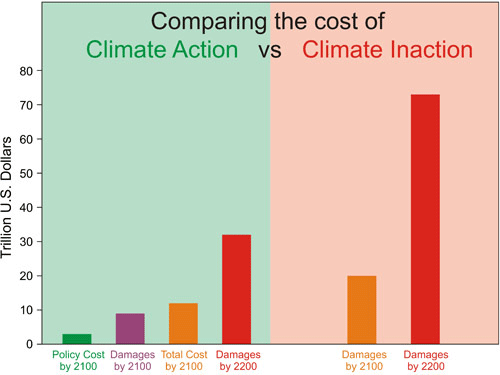
The new report finds that global society must more than triple investment in green energies by 2050 in order to have a reasonable chance of keeping temperatures from rising more than two degrees Celsius above pre-industrial levels, a goal agreed on by the world’s governments. However such a revolution–which would need to cut emissions to near zero by 2100–need not break the bank as some critics of climate change action have warned in the past.
“It is actually affordable to do it and people are not going to have to sacrifice their aspirations about improved standards of living,” co-chair Jim Skea told the Guardian. “It is not a hair-shirt change of lifestyle at all that is being envisaged and there is space for poorer countries to develop too.” According to the report, ambitious mitigation of climate change would reduce global economic growth–set at around 1.6 to 3 percent–by just 0.06 percent over the century. Moreover this analysis doesn’t take into effect the economic pluses of clean energy, such as reduced air and water pollution, new jobs, increased efficiency, and greater stability for energy prices.
“The loss in consumption is relatively modest,” the chairman of the IPCC, Rajendra Pachauri, told the Associated Press.
The report finds that this shift would reduce profits for the coal and oil industries, though may not hurt gas in the near-term; in fact, fossil fuel investments would need to drop by around $30 billion annually. Not surprisingly, lobbying from the powerful fossil fuel industry has proven one of the largest obstacles to governments taking bolder action on greenhouse gas emissions……..
according to the IPCC, the bulk of emissions reductions must come from a sped-up and scaled-up clean energy revolution and a phase-out of fossil fuels.
The IPCC, the world’s global authority on the science of climate change, releases new reports every six years meant to guide current negotiations over the global crisis. Nations are set to sign a new treaty on tackling global climate change in 2015….http://www.theepochtimes.com/n3/621996-un-touts-ambitious-but-cheap-investment-in-renewable-energy/?photo=2
No more delays can be tolerated, to clean up Hanford’s radioactive pollution
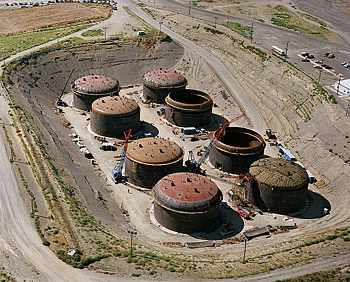 No more ‘wait and see’ at Hanford nuclear sitehttp://www.oregonlive.com/opinion/index.ssf/2014/04/no_more_wait_and_see_at_hanfor.html By Brett VandenHeuvel Recently, Washington Gov. Jay Inslee and Attorney General Bob Ferguson took a stand against the Department of Energy’s “wait and see” approach toward the cleanup of the Hanford nuclear site. Looking out for the best interest of the Northwest, they unveiled a plan to improve accountability of the cleanup of Hanford. Gov. Inslee created a deadline for Energy that requires waste is removed from leaky single-shell tanks by 2040 (26 years might seem like a long time, but beats not having a deadline at all) and presented a schedule to complete the waste treatment plant.
At the same time, Energy released a counterplan, full of empty promises, that doesn’t protect northwest communities or the Columbia River from the dangers of Hanford’s nuclear waste. Hanford is the most contaminated site in the western hemisphere, where the federal government produced plutonium to fuel our nation’s Cold War nuclear arsenal. Energy wants to develop milestones for cleanup on a rolling basis as technical issues are resolved.
We don’t have time to waste on Energy’s “wait and see” approach. Residents of the Tri-Cities depend on the Columbia River, just downstream from the Hanford nuclear site, for their drinking water. This area of the Columbia River, known as the Hanford reach, is the most productive spawning ground for endangered Chinook salmon on the Columbia River, producing 52 million juveniles every year. Public lands bordering the reach are home to 48 rare, threatened or endangered species. Leaving pollution in the leaking tanks, to slowly seep into the Columbia River, puts the water supply and salmon at risk.
And Energy doesn’t have a good track record when it comes dealing with the public’s concern in a timely fashion. For example, more than a year ago, Energy revealed that a double shell tank, AY-102, was leaking nuclear waste. They don’t plan to begin removing waste for two more years. That’s three years while we wait to see whether the tank can withstand the heat and corrosion of the waste inside.
Their plan fails to protect public health and was so inconsistent with public sentiment that Washington issued an administrative order requiring pumping of nuclear waste from AY-102 by September 2014.
Just days later, noxious gases at the tank farm sent workers to the hospital. The Hanford Advisory Board and watchdog groups like Columbia Riverkeeper and Hanford Challenge have brought concerns about worker safety at the tank farms to Energy’s attention. But it is obvious Energy is not taking the necessary steps to watch over their contractors and protect employees.
It seems like common sense: Energy needs to take more aggressive action to immobilize Hanford’s nuclear waste and to protect workers, tribes, citizens of the Northwest, and the environment. Later this month, we all have an opportunity and a responsibility to give the Energy our two cents about Hanford cleanup and to encourage Washington state to hold the Energy accountable for keeping nuclear waste out of the Columbia River. The Hanford State of the Site meetings are scheduled for 6pm April 16 at the Portland Doubletree and April 17 at the Hood River Best Western. See you there.
Brett VandenHeuvel is executive director of Columbia Riverkeeper
1 This Month
26 April – Chernobyl: Inside the Meltdown airs on National Geographic on Sunday 26th April from 4pm

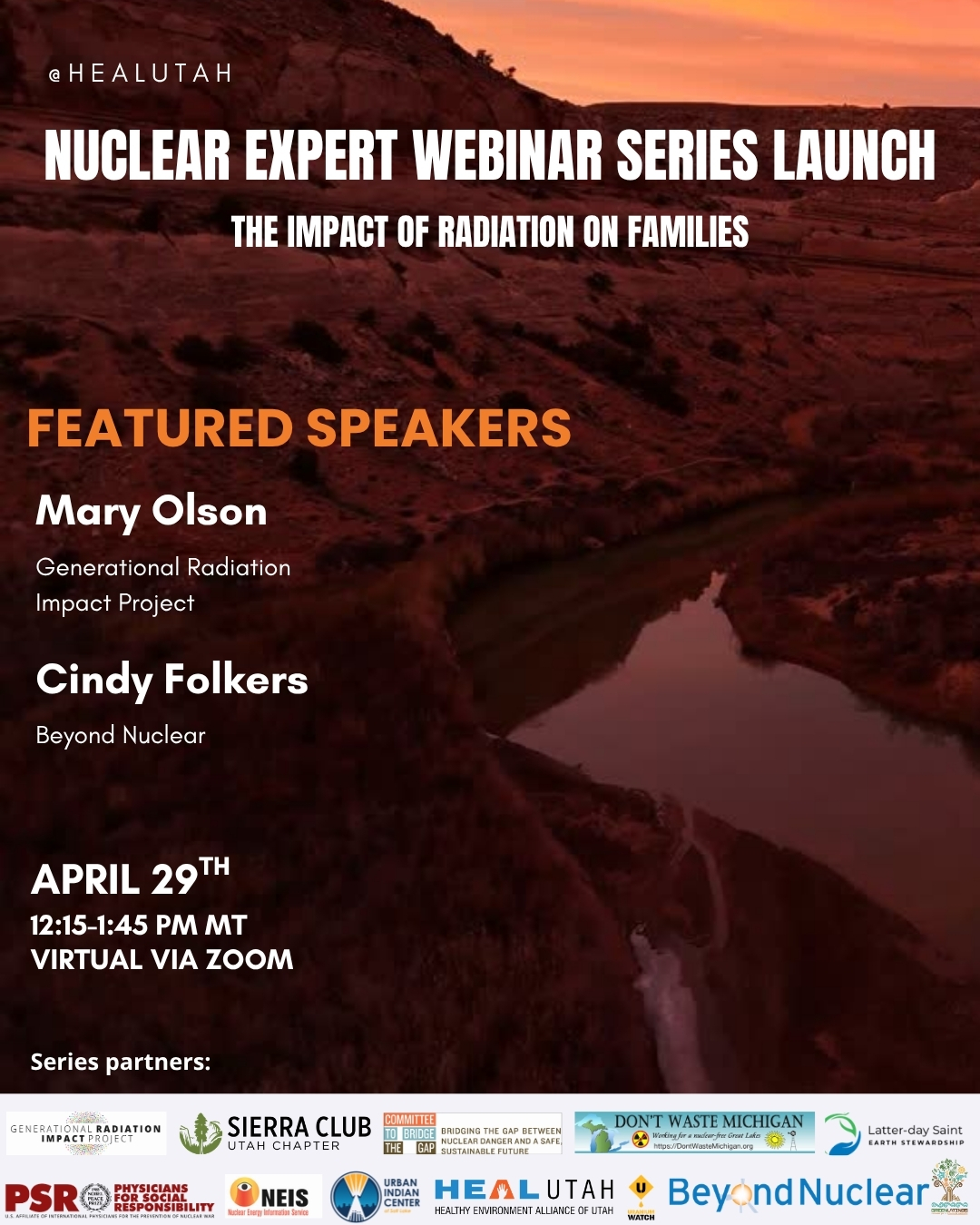
29 April – Nuclear Expert Webinar #1 – Radiation Impacts on Families with Mary Olson and Cindy Folkers
- 12:15 PM MT – 1:45 PM MT
- Location: Virtual – REGISTER TODAY

4 May -West Suburban Peace Coalition to discuss Iran war at May Educational Forum
Monday, May 4, 7:00 – 8:00 PM Central Standard Time
Title: : How Trump’s Narrative Tries to Shape the Reality of the War on Iran.
Contact Walt Zlotow, zlotow@hotmail.com 630 442 3045 for further information
14 May – online event From Bombs to Data Centres: the Face of Nuclear Colonialism
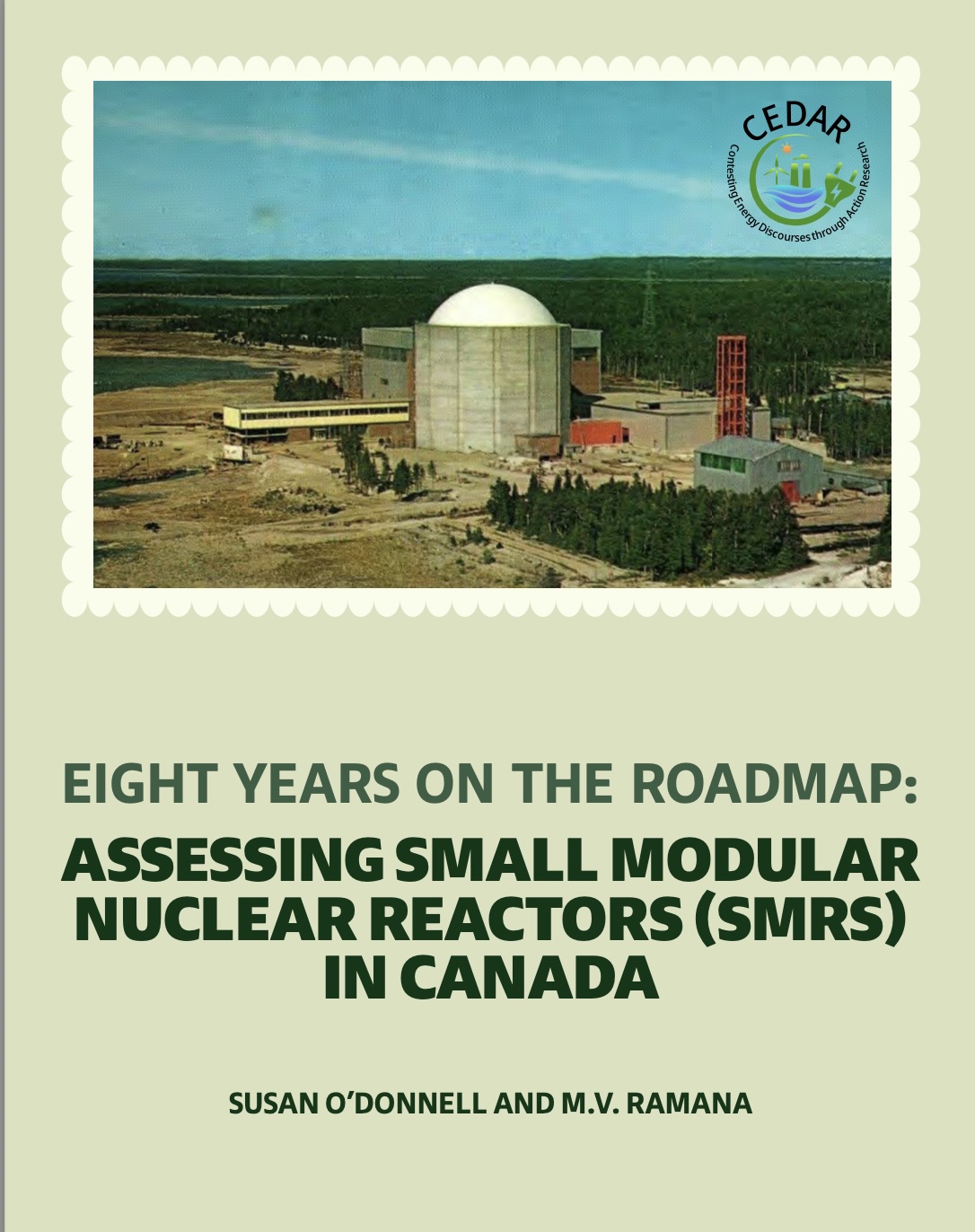

Pine Ridge Uranium is the real threat, not Tehran- Tell Burgum: Stop the Extraction.
Chernobyl: The Lost Tapes – A good documentary on Chernobyl on SBS available On Demand for the next 3 weeks– https://www.sbs.com.au/ondemand/tv-program/chernobyl-the-lost-tapes/2352741955560
To see nuclear-related stories in greater depth and intensity – go to https://nuclearinformation.wordpress.com
-
Archives
- April 2026 (288)
- March 2026 (251)
- February 2026 (268)
- January 2026 (308)
- December 2025 (358)
- November 2025 (359)
- October 2025 (376)
- September 2025 (257)
- August 2025 (319)
- July 2025 (230)
- June 2025 (348)
- May 2025 (261)
-
Categories
- 1
- 1 NUCLEAR ISSUES
- business and costs
- climate change
- culture and arts
- ENERGY
- environment
- health
- history
- indigenous issues
- Legal
- marketing of nuclear
- media
- opposition to nuclear
- PERSONAL STORIES
- politics
- politics international
- Religion and ethics
- safety
- secrets,lies and civil liberties
- spinbuster
- technology
- Uranium
- wastes
- weapons and war
- Women
- 2 WORLD
- ACTION
- AFRICA
- Atrocities
- AUSTRALIA
- Christina's notes
- Christina's themes
- culture and arts
- Events
- Fuk 2022
- Fuk 2023
- Fukushima 2017
- Fukushima 2018
- fukushima 2019
- Fukushima 2020
- Fukushima 2021
- general
- global warming
- Humour (God we need it)
- Nuclear
- RARE EARTHS
- Reference
- resources – print
- Resources -audiovicual
- Weekly Newsletter
- World
- World Nuclear
- YouTube
-
RSS
Entries RSS
Comments RSS
 nuclear-news