Madhya Pradesh. India, takes to renewable energy in a big way
Renewable energy projects worth Rs 30,000 crore being implemented in Madhya Pradesh Economic Times India By Shreya Jai, ET Bureau | 23 Jan, 2014 NEW DELHI: Renewable energy projects worth Rs 30,000 crore are being implemented in Madhya Pradesh, which have quietly reached out to companies and attracted GE, Reliance Power, Spanish wind major Gamesa and others, giving tough competition to Gujarat in the sector.
Solar power for Pakistan’s Parliament House will save $millions
Pakistan Parliament House Going Solar, Renewable Energy News, 23 Jan 14 A 1.8 megawatt (MW) solar farm is being installed at the Parliament House building in Pakistan’s capital city Islamabad.
According to Trust.org, the USD $60 million project has been funded by the Chinese government; which also recently assisted in the preparation of a solar park project on over 10,000 acres that could ultimately host 1,000 MW of solar panel capacity.
The Parliament House project will not only save Pakistan’s government around a million dollars a year in electricity costs, it’s hoped the high profile array will also spur on broader adoption……http://www.energymatters.com.au/index.php?main_page=news_article&article_id=4138
Nuclear power project stalled in Vietnam
Vietnam delays nuclear plant project Bangkok Post, : 22 Jan 2014
The Vietnamese government has decided to defer a plan to build a nuclear power plant for at least two years to ensure safety measures are put in place.
Vietnam planned to launch the project this year but Vietnamese Science and Technology Minister Nguyen Quan expected the delay due to additional safety measures, the Vietnam News reported……http://www.bangkokpost.com/breakingnews/390931/vietnam-delays-nuclear-plant-project
Calvert Cliffs nuclear power plant shut down due to electric malfunction
Electric malfunction shuts down Calvert Co. power plant By Nayana Davis, The Baltimore Sun, 22 Jan 14
Calvert Cliffs nuclear power plant shut down on Tuesday evening following an electric malfunction.
The outage, which occurred at around 9:25 p.m., resulted from a breakdown on the non-nuclear side of the Calvert County facility, according to a news release. http://www.baltimoresun.com/business/bs-md-power-plant-closure-20140122,0,4226643.story#ixzz2rEnyJIhc
Lucky they fixed nuclear reactor’s coolant leak
Workers discovered the leak Monday in a valve on a water line that carries reactor water back to the reactor after it has run through the plant’s steam turbine and then been condensed back into water.
The leaky valve was in a pipe contained in a hallway-sized steam tunnel running from the turbine and generator building through a second, auxiliary equipment building and then back into the reactor containment building, said Young.
Cameras monitoring the tunnel 24 hours a day first spotted the small spray of water and steam coming from the pipe, she said. ……http://www.cleveland.com/open/index.ssf/2014/01/perry_nuclear_power_plant_trit.html
Radiation health debate – LNT: an idea which should be retired? No, it should be retained!

Last year I wrote a post expressing regret that ill-informed journalists and others often wrote nonsense articles about radiation risks.
Sadly, it’s happened again.
Stewart Brand, founder of the Whole Earth Catalogue, has recently stated that the Linear No Threshold theory of radiation’s effects should be retired because it “.. is based on no knowledge whatever.” In fact, much powerful evidence backs the LNT. Some of this is discussed here.
Brand also states ” Below 100 millisieverts per year, however, no increased cancer incidence has been detected…” Well again he’s plain wrong. At least ten studies show effects below 100 mSv: they are listed here.
Mr Brand is an American so he should be aware of the US government’s premier body on radiation risks – the US National Academy of Sciences’s BEIR committee. Its 2005 report, BEIR VII, strongly supported LNT with a great deal of scientific evidence. (BEIR stands for Biological Effects of Ionizing Radiation). It gave a very clear account of why LNT should be used down to very low doses: Mr Brand would be able to understand it.
The problem for Mr Brand and others like him is that radiation’s cancer and genetic risks are anonymous and remote in time so can be difficult to grasp. Here’s a good way to understand them. If 100,000 US adults were each exposed to one mSv of radiation, 10 to 15 would die of radiation-induced cancer several years even decades later. Such exposures act like a reverse lottery: each exposed person would get a reverse ticket and some unlucky people would later die. For example, after the Chernobyl nuclear disaster in 1986, tens of millions of Europeans were exposed to low levels of radioactive fallout. They received reverse lottery tickets and many will ultimately die from cancers from the fallout’s radiation. The same occurred to Japanese people after Fukushima.
By the way, credit for the reverse lottery analogy goes to Jan Beyea in the US.
Japan – “A Young Girl Died of Leukemia” – 2013
Published on 7 May 2013
From a weekly protest gathering outside the Prime Minister’s official residence.
On April 12, 2013.
Filmed by Koki Kiyose
http://www.youtube.com/user/starslife…
Translated by Fukushima Voice
http://fukushimavoice-eng.blogspot.co…
Edited by the Fukushima Collective Evacuation Trial Team
http://fukushima-evacuation-e.blogspo…
Military: China Conducts Long-Range Nuclear Missile Drill
http://mobile.defensenews.com/article/301230037
AGENCE FRANCE-PRESSE
Posted: Thursday Jan 23, 2014
China’s military has released images of an intercontinental ballistic missile with enough range to reach the United States, as Beijing is involved in a series of rows threatening to embroil Washington.

A truck carries a Chinese Dongfeng 31 ICBM to a 2009 military parade rehearsal in Beijing. China is pursuing a capability to equip ICBMs with multiple nuclear warheads, a Chinese state-controlled newspaper said this week (AP Photo/Ng Han Guan).
Image source ; http://www.nti.org/gsn/article/chinese-missile-push-seeks-counter-us-protections-experts/
The pictures of Chinese soldiers test-firing a Dongfeng-31 missile, which is said by experts to be able to carry nuclear warheads 8,000 kilometers (4,960 miles), appeared in the People’s Liberation Army Daily newspaper on Tuesday.
Further images showing soldiers dressed in protective suits, suggesting that the drill was simulating the launch of an armed warhead, were also posted on the sohu.com news portal, attributed to the newspaper.
Sohu.com said it was the first time that images of such an exercise had been released.
The images could not be found on the PLA Daily’s website when checked by AFP on Thursday.
China is embroiled in a series of territorial disputes with its neighbors in the South China Sea, and is locked in a row with Japan in the East China Sea over islands administered by Tokyo and claimed by Beijing.
The US has a security alliance with Japan and Vice President Joe Biden said last month that a strategic shift to Asia would continue.
UK gets carte blanche to expand nuclear power, fracking under new EU energy goals
http://rt.com/news/nuclear-power-wind-farms-077/
January 23, 2014
New energy goals set out by the European Union for 2030 will allow Britain to meet emissions targets by building more nuclear power plants instead of wind farms and expand fracking operations, despite criticism by green campaigners.
The European Commission has proposed a new target for 2030 across the EU – to provide 27 percent of energy from renewable sources. Each country will decide for itself how to meet the target in order to limit rising energy costs. The commission decided not to introduce any laws on environmental damage during the extraction of shale gas by the potentially dangerous drilling process known as fracking.
On Wednesday, the EC stated that EU governments should cut their greenhouse gas emissions by 40 percent compared with 1990 levels. Current national targets aimed at boosting the share of renewable energy to 20 percent would not be renewed after 2020.
“What we are presenting today is both ambitious and affordable,” EC President Jose Manuel Barroso stated.
For Germany, France and Italy – which spoke in favor of the wind and solar power development – the new goals came as a disappointment, while Britain welcomed them. The UK will still have to provide 15 percent of its energy from renewable power by 2020, but after that benchmark there will be no target.
The new policy gives the UK government the long-awaited go-ahead to develop nuclear power and fracking as its key energy source. The less stringent rules allow Britain to use a mix of energy sources, including nuclear, to tackle emissions in a cost-effective way.
“This is a really good package,” UK Energy Secretary Ed Davey said. “It looks very much in line with the things the coalition has been arguing for.”
DEC to State Senate: Fukushima Radiation Not a Risk to Alaska’s Fish
Thursday, January 23 2014
The state Senate Resources Committee got an overview Wednesday of how Alaska is dealing with potential impacts of radiation from the 2011 Fukushima nuclear disaster and tsunami in Japan.
Environmental Conservation commissioner Larry Hartig told committee members that his department is monitoring marine debris washing ashore in Southeast Alaska and the Prince William Sound.
“For now, we have a lot more debris than we used to have that came in from Japan, and Alaska got more than its share of it,” he said. “Most of it’s been just solid waste — it hasn’t been anything that’s what we would deem as hazardous waste.”
He said the DEC doesn’t have a separate program to keep an eye out for radiation in the debris. Since it flows here via California and Washington, he said federal programs in those states have it covered.
“They have been monitoring for radiation, and they’re not seeing any kind of levels of human concern,” he said. “So when we look at this, there hasn’t been a driving need in Alaska to try to institute a program, particularly where we’d be starting it from scratch.”
Committee members wanted reassurance that Alaska’s fish stocks weren’t at risk, either. Hartig said the programs in the Lower 48 (?? – arclight2011) are testing fish that swim between the Gulf of Alaska, the West Coast and Japan, and they’re sure the fish are safe to eat.
“It worries me, frankly, when you see speculation, because we sell our fish in the international market, and there’s people that would love to discourage Alaska fish,” he said. “We’ve got to be careful when we throw things out there that we have an industry that’s dependent on the reputation of our fish.”
He said they’re working with other groups in the state to reassure buyers that Alaskan fish aren’t contaminated.
Hartig’s presentation was part of a committee overview of all of DEC’s programs. It was the committee’s first meeting of the new legislative session.
101 East : Japan: The next wave – What is the truth of the increase in childrens thyroid cancer?
Published on 23 Jan 2014
We investigate the long-term effects of the 2011 tsunami, including a potential cancer threat for Fukushima’s children.
Congenital Hypothyroidism and Fukushima Fallout in the US
http://southweb.org/lifewise/congenital-hypothyroidism-and-fukushima-fallout-in-the-us/
By Dr Mae-Wan Ho of the Institute of Science in Society:
Plume of airborne radioactive iodine arrival in the US correlates with increased rates of congenital hypothyroidism among the new born.
A new study finds congenital hypothyroidism in the US rising 28 % in the two and a half months after the arrival of the Fukushima fallout of radioactive iodine (I-131) [1]. Researchers and authors Joe Mangano and Janette Sherman from the Radiation and Public Health Project [2] have done a thorough job based on data from the US government
ExtractMangano and Sherman stress that the findings should be regarded as preliminary, and require confirmation and expansion, including long-term follow-up of infants and other children. CH is only one indicator for the health impacts of the Fukushima fallout. Other indicators of foetal/infant health include foetal deaths, premature births, low weight births, neonatal deaths, infant deaths and birth defects; and those should also be monitored. While any adverse impacts would be expected to affect first the most susceptible foetus and infant, changes in the health status of older children and adults may also occur.
Sure enough, thyroid cancer among the young has shot up in Fukushima, and scores of US sailors exposed while performing rescue work near Fukushima in March 2011 have been diagnosed with thyroid cancer, testicular cancer, leukaemia, and other illnesses…..
As I See It: Include risks of major volcanic eruptions in nuclear reactor safety assessment in Japan
Nuclear power plants and their surrounding areas would be buried under volcanic ash, making it impossible to control nuclear reactors for long periods of time. Even if radioactive materials were to leak from the reactors, we would not be able to reach the facilities to do anything about it. It would put the very survival of the country at risk.
h/t ; http://fukushima-is-still-news.over-blog.com/
http://mainichi.jp/english/english/perspectives/news/20140122p2a00m0na007000c.html
January 22, 2014
The risks of earthquakes and tsunami causing nuclear disasters have garnered much attention among experts and the public, but I feel a grave need to raise awareness on how much greater a risk a massive volcanic eruption poses on nuclear reactors in Japan.
Volcano experts surveyed for a Mainichi Shimbun article published last December said they were most concerned with the impact of a major volcanic eruption on Kyushu Electric Power Co.’s Sendai Nuclear Power Plant, located in Kagoshima Prefecture, followed by Hokkaido Electric Power Co.’s Tomari Nuclear Power Plant in Hokkaido.
Some 10 years ago, a volcanologist told me that pyroclastic sediment was commonly found in the surrounding areas of both Sendai and Tomari nuclear power stations. I was working at the Mainichi Shimbun’s Shimabara Local Bureau in Nagasaki Prefecture at the time, and had been learning about earthquakes and volcanoes through my coverage of the eruption of Mount Unzen-Fugendake that began in 1990.
Consisting of high-temperature substances such as lava and volcanic ash, pyroclastic flows spread at rapid speeds and are some of the most terrifying phenomena resulting from volcanic eruptions. In 1991, a Mainichi Shimbun photographer and 42 others were killed by pyroclastic currents from Mount Unzen-Fugendake.
In volcanology terms, however, the Mount Unzen-Fugendake eruptions are considered minor. Pyroclastic currents from a massive eruption would be beyond comparison.
Massive eruptions, which have occurred in Japan about once every 6,000 to 10,000 years, cause pyroclastic flows that can bury an area within several dozen to over 100 kilometers of the volcano, and create calderas measuring over 10 kilometers in diameter. Volcanic ash from a massive eruption can cover the entire Japanese archipelago, or even parts of the rest of the world.
TPP – Sacrificing the Environment for Corporate Interests – Wikileaks
http://wikileaks.org/tpp-sacrificing-the-environment.html
15 January 2014
The leaked secret draft of the TPP´s (Trans-Pacific Partnership) Environment Chapter, published today by WikiLeaks, underscores how multinational corporate interests rule the negotiating process of this important 12-nation treaty, representing more than 40 per cent of the world’s GDP and one-third of world trade.
On 13 November last year, WikiLeaks released the secret draft text of the Intellectual Property Rights Chapter, which showed how nations were forced to change laws and to prosecute in defence of the biggest corporate interests in the field of IP rights.
In sharp contrast, the Environment Chapter does not include enforcement mechanisms serving the defence of the environment; it is vague and weak, and adheres to the lowest common denominator of environmental interests.
The word “appropriate” is found in various forms in 43 places in the draft text, in such contexts as: “Where possible and appropriate, the Parties shall seek to complement and utilise their existing cooperation mechanisms and take into account relevant work of regional and international organizations.” The word “may” is also found 43 times in the 23-page draft.
In the draft Consolidated Text, governments are urged to “…make every effort to arrive at a mutually satisfactory resolution…”, “…by any technological means available agreed by the consulting Parties…”, “…on the basis of objectivity, reliability and sound judgment…”, “…provided that the disputed Parties so agree…”, “…take measures to prevent…”, “…shall make best efforts…”, “…exercise restraint in taking recourse…”, “…in recognition of the importance…”, “…each Party retains the right to make decisions…”, “…adopt or maintain appropriate measures…”.
A selection of other favourite words in the draft include: “enhance” (12), “consider” (12), “encourage” (11), “address” (10), “endeavour” (9) and “seek” (9).
The Environment Chapter clearly shows the intention to first and foremost protect trade, not the environment. The principle is spelled out in this draft that local environmental laws are not to obstruct trade or investment between the countries. Furthermore, there is great emphasis on the self-regulatory principle when it comes to environmental protection, and emphasis on “…flexible, voluntary mechanisms, such as voluntary auditing and reporting, market-based incentives, voluntary sharing of information and expertise and public-private partnership”. But even such measures should be designed in a manner that “…avoids the creation of unnecessary barriers to trade”.
The Consolidated Text of the Environment Chapter of the TPP Agreement was drafted by Canadian officials after bilateral consultations with other TPP Parties. It is dated November 24, 2013, the last day of the TPP Chief Negotiators’ summit in Salt Lake City, Utah. It outlines what the Chairs of the TPP Environment Working Group evaluate as a compromise of the Parties’ different positions across issues. In a separate four-page document the Chairs of the Environment Working Group outline the main obstacles to agreement between the negotiating countries.
It is noteworthy in the assessment by the Chairs that the US government is isolated in its interest in placing enforcing mechanisms into the treaty to protect the environment. Without access to the negotiating table, it is hard to assess if the US representatives fought for this principle with the same vigour as they did for policing and enforcement on behalf of intellectual property interests, as can be seen in the leaked IP Chapter.
The TPP negotiations have been shrouded in secrecy during the three years the treaty has been in the making. The United States, as the largest of the 12 economies party to the negotiations, had originally pushed for the closure of the agreement before the end of 2013. According to recent reports quoting Andrew Robb, the Australian trade minister, the negotiations are in the final stages and the treaty is “ready to be sealed”.
The Obama administration wants to fast-track the TPP treaty through the US Congress, preventing Congress from amending or discussing any part of it. A bill to this effect was released last Thursday, 9 January, by the leaders of the Congressional committees with jurisdiction over US free trade agreements.
With the WikiLeaks release of the drafts of two of the most controversial chapters of the TPP, the media has now an opportunity to critically dissect the issues with the public interest in mind.
The TPP negotiations have wider implications than for the 800 million people in the 12 negotiating countries because the US administration, the dominant Party at the table, has declared that the principles outlined in the TPP will be a benchmark in the equally secretive US-EU trade talks for the TTIP (Transatlantic Trade and Investment Partnership) initiated in January 2013.
Current TPP negotiation member states are the United States, Japan, Mexico, Canada, Australia, Malaysia, Chile, Singapore, Peru, Vietnam, New Zealand and Brunei.
by Kristinn Hrafnsson, WikiLeaks Spokesperson
Press release: Secret Trans-Pacific Partnership Agreement (TPP) – Environment Chapter
http://wikileaks.org/tpp-enviro/pressrelease.html
Today, 15 January 2014, WikiLeaks released the secret draft text for the entire TPP (Trans-Pacific Partnership) Environment Chapter and the corresponding Chairs’ Report. The TPP transnational legal regime would cover 12 countries initially and encompass 40 per cent of global GDP and one-third of world trade. The Environment Chapter has long been sought by journalists and environmental groups. The released text dates from the Chief Negotiators’ summit in Salt Lake City, Utah, on 19-24 November 2013.
The way towards Nuclear Fascism- the Price Anderson Act
Is Nuclear Experimentation Fascism? 1/22/2014 By Ethan Indigo Smith (about the author) opednews.com
“….Today, the United States of America is fascist. So is China, Japan, Russia, France, England, Japan and every single nuclear nation.
Australia is de facto fascist, being a major extractor of uranium for the nuclear fuel chain.
The United States of America is fascist by way of one single act: The Price Anderson Nuclear Industries Indemnity Act. There are many more acts and laws that strengthen nuclear fascism in the United States, but The Price Anderson Act seals the deal. Its main purpose is to indemnify the nuclear industry against liability claims arising from nuclear incidents. And other countries have their own nuclear deals which also guarantee that those who profit from the nuclear industry are not held accountable for their work.
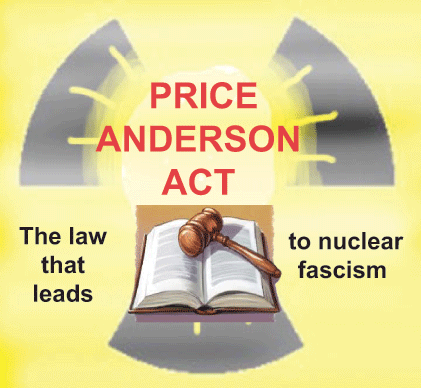
The Price Anderson Act illustrates the U.S.A.’s fascist trail, and that nuclear experiment cleared the way for it in the first place. The Act makes it so that nuclear power generation experiments can operate at all, otherwise no insurance corporation would insure them. The insurance companies that deal with nuclear experimentation only do so because the Act limits their responsibility in the event of an accident, such as the Fukushima meltdown. If there is an accident that costs more than the capped amount, insurance companies pay out up to and including their cap, and communities and governments foot the bill for the remaining clean up costs. Put simply”. they profit, you pay. Not to mention the non-financial costs of human and planetary health.
The Price Anderson Act endorses fascism in the United States, and in the bigger picture, nuclear experimentation guarantees fascism no matter what nation is doing the experimenting — whether Israel, China, Iran or the U.S. or Japan. The nuclear power industry could not survive without placing all the risk on the shoulders of taxpayers. And by doing so, the Price Anderson Act enables nuclear oligarchical fascists to make a fortune by endangering everyone and everything on the planet.
Even if nuclear facilities operated to their original design specifications rather than running components on extended operation (by years) and over-crammed fuel pools, as is the case today, the industry is still unworkable. But today, most if not all nuclear power generation experiments in the U.S.A. have fuel pools loaded with waste material beyond original design specifications, but the nuclear industry and its regulators seem content continuing down this path — and waiting for our grandchildren to figure out what to do with the mess they leave behind…. http://www.opednews.com/articles/Is-Nuclear-Experimentation-by-Ethan-Indigo-Smith-Fukushima_Nuclear-Cover-up_Nuclear-Meltdown_Nuclear-Waste-140122-627.html
Nuclear Hotseat #135: Fukushima – On the Ground in Japan with Beverly Findlay-Kaneko – Report
DOWNLOAD HERE:
http://lhalevy.audioacrobat.com/download/c3ca353a-7c23-a7e5-9138-3e36ea746626.mp3
INTERVIEW: Beverly Findlay-Kaneko of Families for Safe Energy reports on the deeply human side of Fukushima following her recent trip back home. Learn how nuclear refugees cope with radiation and catch up with the heartbreaking story of former Fukushima resident Setsuko Kida, previously interviewed on Nuclear Hotseat #127.
– See more at: http://www.nuclearhotseat.com/1679/#sthash.QPQt8Rkl.dpuf
1 This Month
26 April – Chernobyl: Inside the Meltdown airs on National Geographic on Sunday 26th April from 4pm
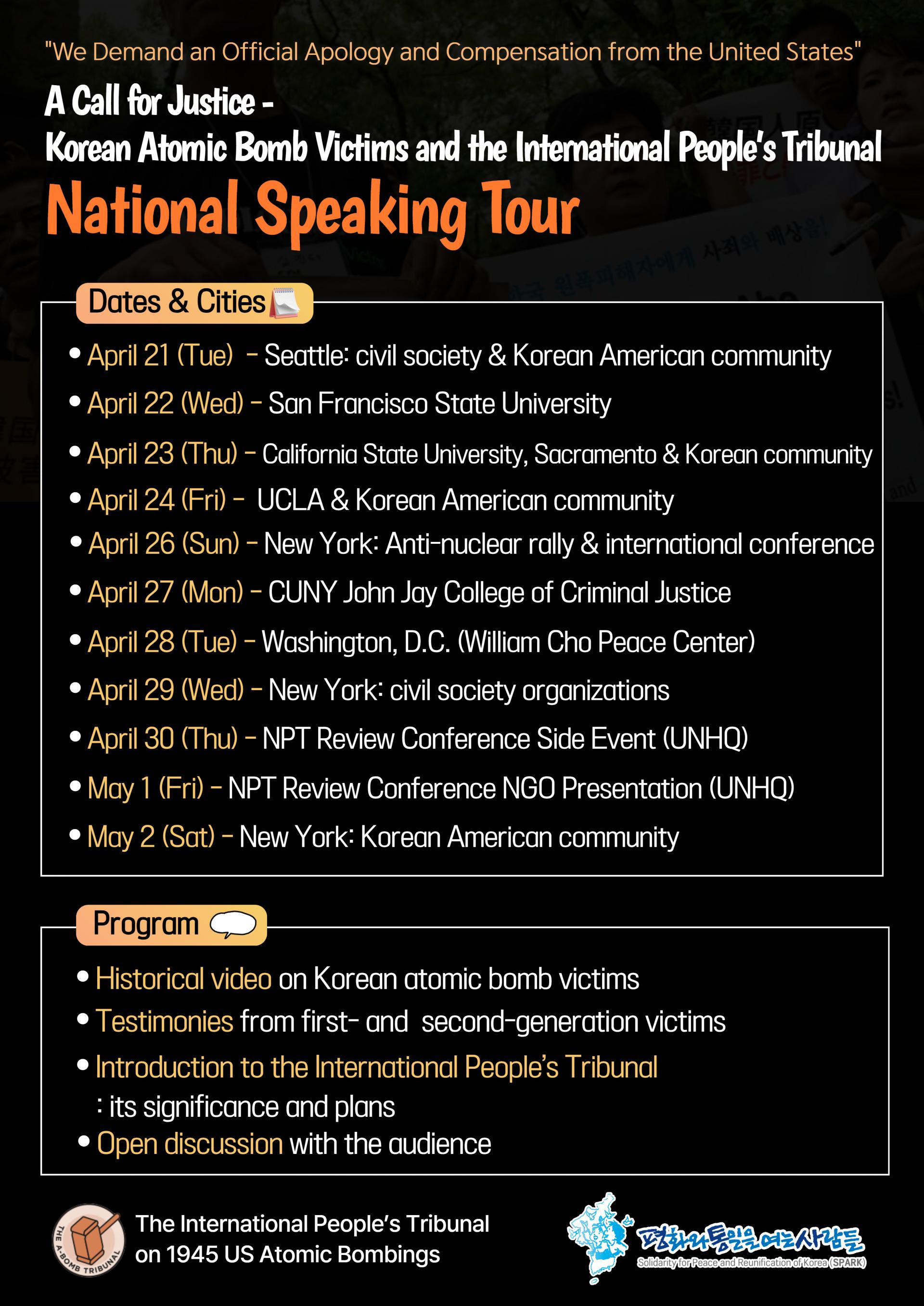
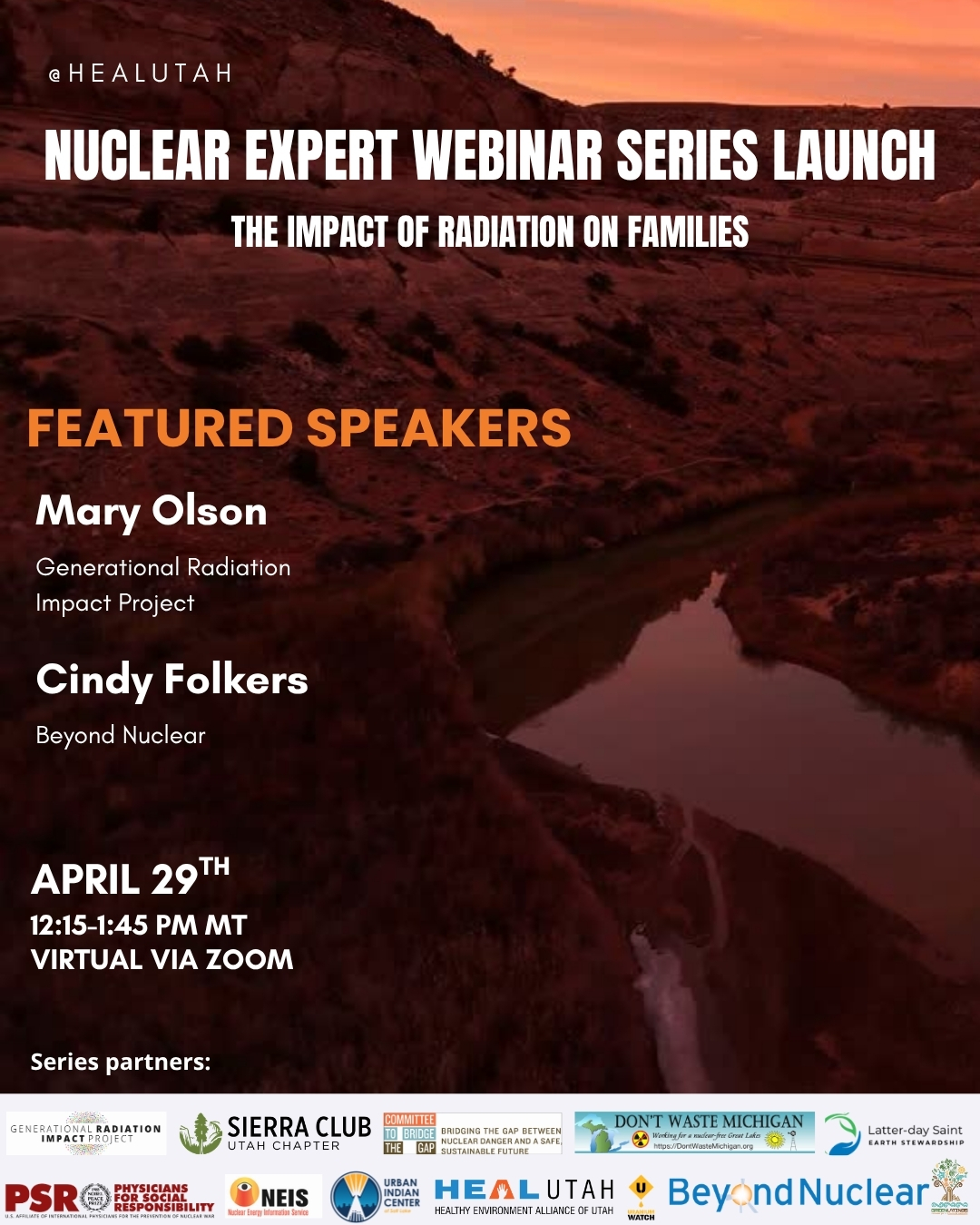
29 April – Nuclear Expert Webinar #1 – Radiation Impacts on Families with Mary Olson and Cindy Folkers
- 12:15 PM MT – 1:45 PM MT
- Location: Virtual – REGISTER TODAY

4 May -West Suburban Peace Coalition to discuss Iran war at May Educational Forum
Monday, May 4, 7:00 – 8:00 PM Central Standard Time
Title: : How Trump’s Narrative Tries to Shape the Reality of the War on Iran.
Contact Walt Zlotow, zlotow@hotmail.com 630 442 3045 for further information
14 May – online event From Bombs to Data Centres: the Face of Nuclear Colonialism
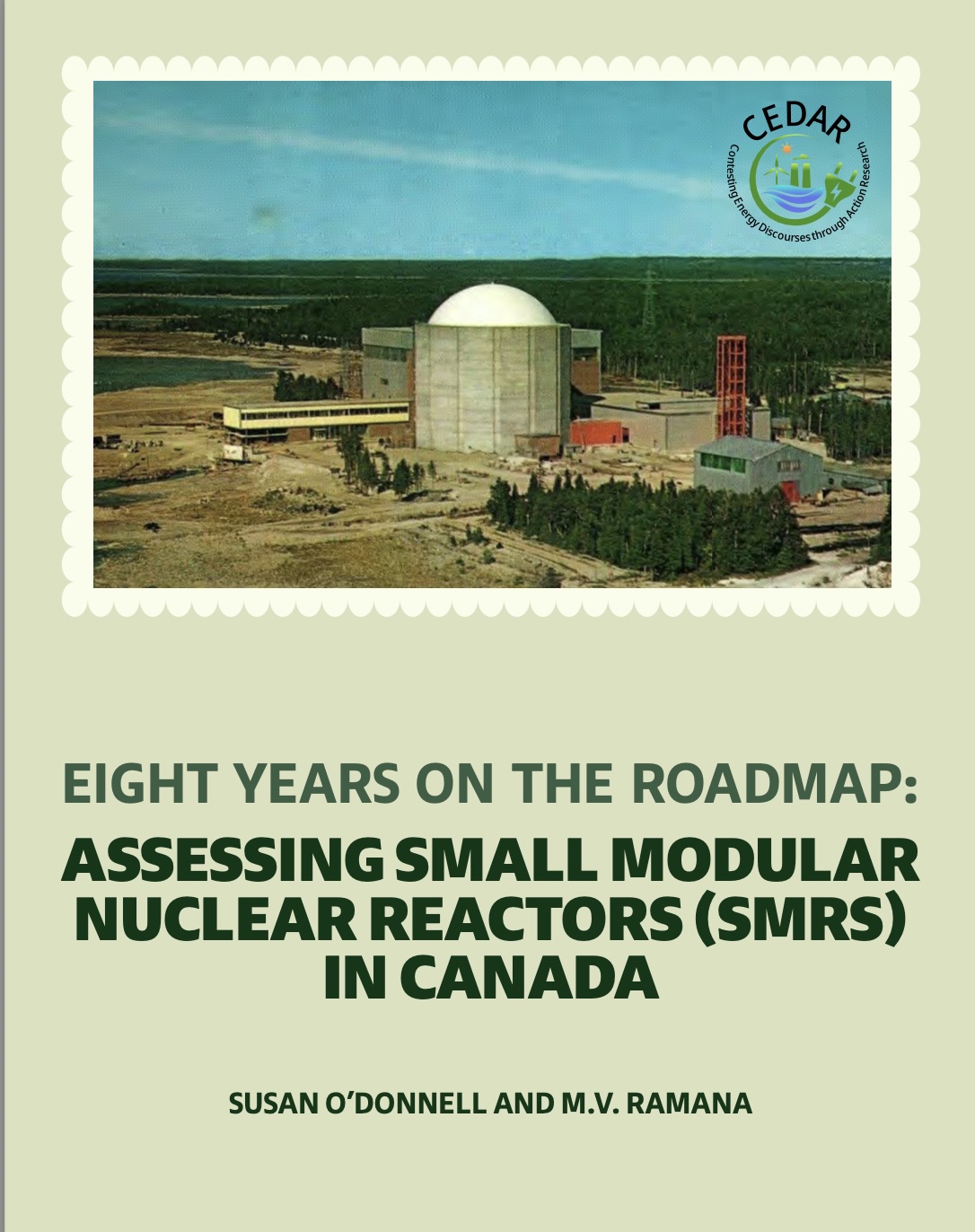

Pine Ridge Uranium is the real threat, not Tehran- Tell Burgum: Stop the Extraction.
Chernobyl: The Lost Tapes – A good documentary on Chernobyl on SBS available On Demand for the next 3 weeks– https://www.sbs.com.au/ondemand/tv-program/chernobyl-the-lost-tapes/2352741955560
To see nuclear-related stories in greater depth and intensity – go to https://nuclearinformation.wordpress.com
-
Archives
- April 2026 (288)
- March 2026 (251)
- February 2026 (268)
- January 2026 (308)
- December 2025 (358)
- November 2025 (359)
- October 2025 (376)
- September 2025 (257)
- August 2025 (319)
- July 2025 (230)
- June 2025 (348)
- May 2025 (261)
-
Categories
- 1
- 1 NUCLEAR ISSUES
- business and costs
- climate change
- culture and arts
- ENERGY
- environment
- health
- history
- indigenous issues
- Legal
- marketing of nuclear
- media
- opposition to nuclear
- PERSONAL STORIES
- politics
- politics international
- Religion and ethics
- safety
- secrets,lies and civil liberties
- spinbuster
- technology
- Uranium
- wastes
- weapons and war
- Women
- 2 WORLD
- ACTION
- AFRICA
- Atrocities
- AUSTRALIA
- Christina's notes
- Christina's themes
- culture and arts
- Events
- Fuk 2022
- Fuk 2023
- Fukushima 2017
- Fukushima 2018
- fukushima 2019
- Fukushima 2020
- Fukushima 2021
- general
- global warming
- Humour (God we need it)
- Nuclear
- RARE EARTHS
- Reference
- resources – print
- Resources -audiovicual
- Weekly Newsletter
- World
- World Nuclear
- YouTube
-
RSS
Entries RSS
Comments RSS
 nuclear-news