History of Bomb Strontium and Cesium Isotopes in Pacific Compared to Fukushima Sources
The weakness of this approach is that there are other pressures (ocean acidification, warming, oxygen depletion) on the marine environment that one could qualitatively say might make the ecosystem more vulnerable to these very small increases in radiation. But again the increases in exposure are orders of magnitude lower than organisms are presently exposed to by the uptake of naturally occurring Po-210.
via Daily Kos / January 15, 2014 / The purpose of this diary is to compare the concentrations of Sr-90 and Cs-137 in the North Pacific Ocean over the last 50 years to the concentrations predicted to arrive on the west coast associated with waters affected by release of radionculides from the Fukushima-Daiichi Nuclear Power Plant. Given present levels that are being measured in the eastern Pacific and barring release rates that significantly exceed past rates in March-April 2011 the impact on marine organisms and the marine environment is going to be very minimal. What follows below the fold is a comparison of the concentrations measured and predicted over much of the Pacific owing to Fukushima to the concentrations that were present in the mid-1960s from the fallout of atmospheric weapons testing that is free from any discussion of safe doses or models of radiation exposure to organisms.
Let us consider Cs-137 and Sr-90 both because they are potentially dangerous to marine organisms through bioaccumulation, they have similar half-lives and persistence in the environment, and because their history in the North Pacific and release from Fukushima are relatively well understood (Povinec and others (2013) Biogeosciences, Casacuberta and others (2013), Povinec and others (2012) ES&T). Of course there is a whole suite of radionuclides that were released by weapons tests and from Fukushima but we can use Cs and Sr to trace the distribution and impact I think.
A total of about 950 PBq (PBq = 10^15 Bq) Cs-137 and 600 PBq Sr-90 were released through weapons test with about 600 PBq Cs-137 and 380 PBq Sr-90 deposited to the oceans. This resulted in maximum concentrations of Cs-137 of 80 mBq/L and similar concentrations of Sr-90. These concentrations decreased up until the Fukushima disaster (with a perceptible bump from Chernobyl in 1986) through decay, mixing and sinking of isotopes associated with particulate matter. Cs-137 had an effective half-life in the surface of 13 yr and Sr-90 had a half-life of 14 yr.

Temporal variations of 137Cs concentrations in surface water of the western North Pacific: (A) subtropical gyre (25–36° N); (B) mixed region (36–45° N); black circles, open ocean waters; empty squares, coastal water off Tokai; blue squares, coastal water off the Fukushima Dai-ichi NPP
Fukushima inputs are much smaller in magnitude and despite ongoing release unlikely to exceed weapons fallout.
Fukushima No. 1 engineer’s warning to Taiwan: Nuclear power unstable
h/t http://fukushimaupdate.com/fukushima-no-1-engineers-warning-to-taiwan-nuclear-power-unstable/
via Japan Times / January 16, 2014 / A Japanese engineer who helped build reactor 4 at the Fukushima No. 1 nuclear plant said such plants are inherently unstable, urging Taiwan to ditch atomic energy for renewable resources.
Mitsuhiko Tanaka (pictured), arriving in Taipei on Tuesday with a delegation of Diet members for a six-day visit, told a press conference Wednesday that the 1986 Chernobyl disaster changed his views on nuclear power.
“Nuclear accidents are bound to happen someday, only that we don’t know when they will happen,” he said.
Tanaka, who helped build part of reactor 4 while working at Hitachi Ltd. in 1974, quit the company in 1977 and became a writer. He chronicled the discovery of a manufacturing defect in reactor 4, and the subsequent coverup, in a book in 1990.
When he went in 1988 to the then-Ministry of International Trade and Industry to report the cover-up, the government refused to investigate it and Hitachi denied his accusations.
Little did he know that the manufacturing defect would resurface decades later after the March 11, 2011, magnitude-9 earthquake off the Pacific coast rocked the plant, spawning a tsunami that robbed it of all power and disabled its cooling systems, triggering three core meltdowns.
NPR Affiliate: Fukushima cesium detected in Alaska salmon sample — Radioactive plume has already reached West Coast — Concerned fishermen forced to pay for tests since officials not doing it — “People don’t trust gov’t… they don’t trust corporations” (AUDIO)
Published: January 16th, 2014 at 9:10 am ET
By ENENews
Loki Fish Co., Jan. 7, 2014: […] In response to customer concerns over radiation releases into the Pacific Ocean from Fukushima, fisherman-owned Loki Fish Company [paid for] radiation testing on seven stocks of wild salmon. […] Although the FDA contends that there is no evidence that radionuclides from Fukushima are present in Alaskan and Pacific Northwest seafood at a level that would be harmful to human health, it has not published results. […] Of the seven samples, five did not register detectable levels of radionuclides. Two of the samples registered at trace levels – Alaskan Keta at 1.4Bq/kg for Cesium 137, and Alaskan Pink at 1.2Bq/kg for Cesium 134 [Cesium-134 is a “clear fingerprint” for Fukushima’s nuclear contamination].
Pete Knutson, fisherman and co-owner of Loki Fish Co.: “As fishing families who put salmon on the table of consumers, we are as concerned as anyone about the health of our marine ecology.”
Oregon Public Broadcasting (NPR Affiliate), Jan. 16, 2014: Scientists Say Stop Worrying About Fukushima Radioactivity In Fish[…] Japan’s nuclear disaster released hundreds of millions of gallons of radioactive water in 2011**, sparking rampant speculation that a contaminated plume would reach the waters of North America’s West Coast. […] There is radioactive material from Fukushima making its way across the Pacific Ocean and it has already reached the West Coast in small amounts. […] Scientists are still debating how high those radioactivity levels could be. […]
**After years of denials, Fukushima plant officials have recently admitted around 400 metric tons of radioactive water has been flowing into the Pacific every day for nearly 3 years
More from Loki Fish Co. co-owner Pete Knutson: “We had people passing on our fish this year. It was directly because they were worried about Fukushima. […] People do not trust governmental authorities. They don’t trust corporations. They don’t trust explanations and they don’t have a good science background.”
And the scientists demanding the public ‘stop worrying about Fukushima radioactivity in fish” may want to tell their colleagues the same thing and see how they respond:
- Senior Scientist: I’m very concerned about sea life on West Coast accumulating radioactive material; Some contamination will arrive in concentrated pockets (AUDIO)
- CBC Headline: Radiation from Fukushima arrives on Alaska coast — University scientists concerned — “Is the food supply safe?… I don’t think anyone can really answer that”
- Physician in Canada on Cancer Estimates: Epidemic of Fukushima radiation-related deaths from fish in Pacific may have started — “Vast implications for human health” — “I eat so much salmon… I’m vulnerable”
Related Posts
- Tokai Mayor: “We don’t trust the govt’s nuclear policies” — “We cant feel safe unless the mistrust is resolved” (VIDEO) October 27, 2011
- “They’re All Gone”: Shock as sardines vanish off California — Fishermen didn’t find a single one all summer — Scientist: This is about the entire Pacific coast… Canada, Mexico, U.S. — NOAA: We don’t know why; The young aren’t surviving January 14, 2014
- Gundersen: Radioactive plume to impact West Coast in a year — Not going away after it hits… likely to only get stronger — Fukushima will keep releasing contamination for years to come — Must demand officials test fish and make data public (AUDIO) August 27, 2013
- Senior Scientist: Plume of Fukushima nuclear material from initial releases to reach U.S. West Coast before August 2014 — Will continue for years as contamination never stopped flowing into ocean (AUDIO) August 9, 2013
- More cancers in Fukushima children — Mother: We don’t know what’s actually going on, I can’t trust gov’t — TV: Private hospital finds cysts after ‘official’ tests were all clear (VIDEO) November 13, 2013
New Director Watches Over URI Nuclear Reactor
Keeping it running is also cheaper than shutting it down, as the estimated cost to decommission the URI plant is about $30 million. The cost of building a new one at URI or anywhere else would be even more.
“As far as life, as long as we keep replacing fuel as it gets used up, there is no real age limit,” Goodwin said.
By TIM FAULKNER/ecoRI News staff
http://www.ecori.org/renewable-energy/2014/1/13/new-director-watches-over-uri-nuclear-reactor.html
NARRAGANSETT — Rhode Island’s nuclear reactor has a new boss overseeing several changes to the little-known research and test facility. Cameron Goodwin, 35, took over in September as director of the Rhode Island Nuclear Science Center, a state agency operated in partnership with the University of Rhode Island and other area universities.
The 50-foot cement box that houses the small nuclear reactor stands in plain sight on URI’s Bay Campus, but hardly draws much attention. Academic research is the primary function, with some testing conducted by the biomedical industry. High-school science classes also take tours and participate in laboratory experiments using radiation.
Within the past few months, the facility has been visited or used by students and researchers from URI, Providence College, Brown University, The Greene School, Three River Community College in Connecticut, Central Falls High School, Rogers High School in Newport, BioPAL Laboratories of Worcester, Rhode Island Hospital and even the Boy Scouts.
“We’re really here just to promote education and research,” Goodwin said.
Nuclear in New England
New England is home to four nuclear power plants: the Millstone Power Station in Waterford, Conn.; Pilgrim Nuclear Power Station in Plymouth, Mass.; Vermont Yankee Nuclear Power Station in Vernon, Vt.; and Seabrook Station in Seabrook, N.H. Less known are three nuclear research and test reactors at the Massachusetts Institute of Technology, the University of Massachusetts Lowell and the one at URI. All were built about 50 years ago as part of a federal initiative to promote atomic research.
Japan approves Tepco temporary turnaround plan, clears way for more state funding (as funders from europe exit TEPCO shares)
- Tokyo Electric Power (TKECF, TKECY) wins government approval for a restructuring that will help pave the way for another ¥4T ($38.3B) in additional state funding.
- An important part of the plan is for the restart of two reactors at another facility in northern Japan, which faces strong criticism after the company failed to take proper precautions at the Fukushima plant, which was hit by an earthquake and tsunami in 2011.
- The new plan does not offer a clear path for a return to financial health as Tepco struggles with the high costs of cleaning up Fukushima and compensating those in the area affected by the release of high levels of radiation.
Troubled nuclear company USEC announces bankruptcy plans, rakes in millions in spending bill – MOST APPRECIATIVE
Updated 5:06 p.m. ET, 1/16/2014
Washington (CNN) – Tucked into the $1.1 trillion dollar spending bill racing toward passage in Congress this week is a provision sending tens of millions of dollars to a uranium enrichment company that just last month announced it is filing for bankruptcy.
USEC, a government supported company formerly known as the United States Enrichment Corporation, has already received nearly a quarter billion in federal subsidies in the last two years, and billions over the last two decades. The latest multimillion dollar lifeline to USEC comes even though it has been rejected for loan guarantees by the federal government, despite support from House Speaker John Boehner and other members of the Ohio congressional delegation.
Ryan Alexander with Taxpayers for Common Sense, a government watchdog, points out USEC is in such dire straits the company’s stock was nearly de-listed by the New York Stock Exchange last year.
That was not the company’s only setback in 2013. USEC also closed its only functioning uranium enrichment plant, an outdated facility located in Kentucky that dates back to the early years of the Cold War.
“If you just look at the facts it seems absurd that we continue to throw money at a company that’s failing, that announces, ‘We’re about to declare bankruptcy,’” Alexander said.
USEC, the last remaining American-owned company still in the uranium enrichment business, announced December 16 it planned to file Chapter 11 bankruptcy in the first quarter of 2014.
The company admits it’s been hit hard by plummeting demands for nuclear fuel in the aftermath of the disaster at the Fukushima nuclear power plant nearly three years ago. A USEC spokesperson declined a request for an interview. But in a statement provided to CNN, a USEC spokesman said the company appreciates the latest infusion of federal support.
This week’s nuclear news

Christina Macpherson’s websites & blogs
Fukushima. There’s tacit acceptance by world leaders that the crippled nuclear plant is in a perilous state. Now it is hard to get information: mainstream media is quiet , but Japanese sources highlight the costs, and problems, as the clean-up efforts go on by many contract and casual workers, with health outcomes, and even deaths not reported. The new Japanese secrecy law takes effect concerning radiation health effects TEPCO –Workers deaths are not reported 報道されない原発作業員の死亡について
Japan’s energy and nuclear program delayed, as public anti nuclear sentiment rises. Two former Japanese Prime Ministers speak outagainst nuclear power
Scientist Ken Buesseler organises a thorough study into assessing radioactive isotopes in the Pacific Ocean.
France and Germany to co-operate in a project to reduce nuclear power and develop renewable energy.
Canada: At long last, Port Hope’s radioactive trash problem is being addressed
The new Japanese secrecy law takes effect concerning radiation health effects
 Arclight2011 OpEd
15 January 2014
nuclear-news.net
 Image source ; http://www.dianuke.org/thoughts-on-3-11-and-9-11-linda-ayres/
The Japanese Secrecy Law might actually have begun when the IAEA and the Fukushima Medical University reached an agreement to cover up the future health effects of ionising radiation and toxic/metal poisoning as reported here;
Fukushima Medical University Signed Secrecy Pact With IAEA
Fukushima government refused to our formal request of age breakdown and more detailed information concerning of thyroid cancer victims since March 2011… It was disclosed that Fukushima had the investigation committee had several secret meetings, I feel the response concerning this issue is unthinkable for a democratic nation.
http://fukushimavoice-eng2.blogspot.co.uk/2014/01/tokyo-shimbun-article-regarding.html
And to do this they had to stop any information getting out that might connect future health effects from being connected with the triple meltdowns at the beleaguered Fukushima Daichi nuclear plant.
The Japanese government had already stopped a genetic test that needed to be done within three years of the disaster. In 2013 the Japanese government said they could not do this test as the families might discover illegitimate children and so, the government would need to debate the simple genetic test on grounds of ethical reasons. No such debate has happened since and no genetic test on blood have been done.
The only other way to test for radiation damage and possible future health effects on the population is by an even more simple white blood cell count (WBC) test. This was done but the full results have been blocked from publication although the ultrasound test results have been published, and a link to that is here;
小児甲状腺エコーの結果は公表されるが、小児血液検査の結果は公表されないまま
第7回検討委員会(2012年6月12日)配布資料
http://www.pref.fukushima.jp/imu/kenkoukanri/240612shiryou.pdf
I might point out I found some a report on WBC tests on radiation workers in the fukushima prefecture, where there was some slight findings though mostly non definitive and they also tested for the red blood cell count and Hemoglobin content test or hematocrit test. A link to that 2012 report under this paragraph. (I might point out that the study done in 2010 and 2012 was deeply flawed as it did not input any personal epidemiological data concerning nuclear worker smokers whose white blood cells could swamp any readings relevant to ionising radiation). Also the temporary Yakuza employed homeless would be given the high dose jobs that would quickly get them over the 500 millisievert maximum dose in a very short time so they dont get the regular health checks the more protected full time workers get so the study will be slewed.
http://www.mhlw.go.jp/english/topics/2011eq/workers/tepco/lhc/pr_130920_a02.pdf
The study also says nuclear workers should be regularly tested and better epidemiological practice to be put in place for 2013. In 2013 we found out about various scandals concerning the workers from criminal gangs running operations and employing homeless people (who likely would be smokers?) and disabled people. How could good nuclear health practise be put in place? heres an extract from the legal requirements concerning nuclear workers;
General medical examination is required at the time of employment and once within every year (every 6 months for those engaged in specified work such as radiation work) on a regular basis.
So are there health effects? Are there any deaths attributable to the nuclear disaster? We have reported health effects such as polydactyl as well as a raft of symptoms in the local population in the early months of the disaster such as the only epidemiological census that was taken (I will post the video at the bottom of this article).
There appears to be a high incidence of the younger generations dying being reported at the obituaries section of the local Fukushima prefectural newspaper. Below is a sample of the paper showing the ages of people under 58 years of age that died and you can compare that with amount of older deaths. The Japanese population in that area has a large percentage of elderly people
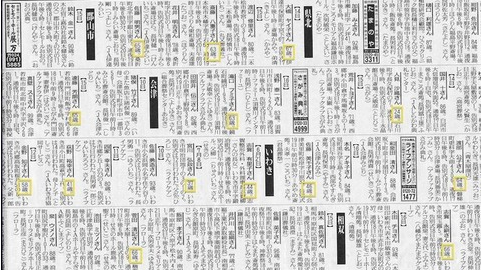 Obituary page from local news paper covering Fukushima prefecture
享年が若すぎる福島の新聞のお悔やみ欄。
24歳、34歳、37歳、41歳、44歳、46歳、53歳、58歳…..
The above are the ages of the youngest and they are highlighted on the above page and show in various places around the Fukushima prefecture.
All the above information is liable to come under the new secrecy act that looks to place Japanese bloggers under threat of a five year prison sentence.
From this link
http://blog.livedoor.jp/home_make-toaru/archives/7493393.html
There will be no hope for the “transparency” that Geraldine Thomas (UK Academic) has called for and I am sure that the IAEA and ICRP will find a statistical way to confound the startlingly high incidence of thyroid cancers in young children.
In todays Democracy Now (15 Jan 2014) in an interview with David Mc Neil (A UK connected academic/journalist) said that the childrens thyroid cancer incidence was confounded because no studies have been done in other prefectures . It seems no one wants to admit there is a problem with these confirmed cancer incidences and the nuclear accident timing is likely to be just a coincidence?
Geraldine Thomas @ 12 mins in;
http://www.youtube.com/watch?v=9vX_Jurl8Cs&feature=youtu.be&t=6m43s12%20Jan
More info on the plight of the children of Fukushima here;
https://nuclear-news.net/?s=school
A health survey in Fukushima covered up by the Japanese national Media?
An independent local news source did what the big boys couldn’t here;
The Mount Pelerin Society – home of Climate Science Denialism
Mont Pelerin Society Revealed As Home To Leading Pushers Of Climate Science Denial DESMOGBLOG.COM, GRAHAM READFEARN, 14 JAN 14 THERE’S a popular talking point coming from climate change denialists that all people who accept the science and the need to act on it are somehow blinded by faith.
In Australia, climate science contrarian columnists can barely touch their keyboards without typing out the words “global warming faith” or explaining how human-caused global warming is some sort of “new religion”.
This “climate religion” narrative often goes hand-in-hand with another favourite denialist talking point where climate scientists are only doing what they do because there’s a dollar in it.
Presumably the laws of physics, the melting ice sheets, the increasing risk of bushfires, the hottest decades on record and the acidifying oceans are also waiting for their cash…….
Among the notable members is Charles Koch (list excerpt here), the US oil billionaire who has been a Mont Pelerin Society member since 1970.
Charles and his brother David have used their charitable foundations to funnel tens of millions of dollars into free market think tanks which fight environmental protection and deny the dangers of human-caused climate change
The Mont Pelerin Society
The Mont Pelerin Society was established in 1947 by free market economist and philosopher Friedrich von Hayek……
DeSmogBlog has obtained a full list of the society’s members that includes senior representatives of many of the world’s foremost “free market” think tanks actively pushing back on proposed policy solutions to tackle climate change.
The list, from 2010, includes almost 500 people from 52 countries, with the bulk of members coming from the United States and the United Kingdom. The 70-page list includes private contact details. DeSmogBlog has decided to publish only extracts with contact details redacted…..
Mont Pelerin in the United States
The US cohort of Mont Pelerin members includes many senior staff associated with “free market” think tanks that have manufactured doubt about the science of human-caused climate change or the need to act quickly.
Alongside Charles Koch, DeSmogBlog’s document shows that Mont Pelerin Society members include senior staff, directors and associates from groups his family foundations have helped to fund. These include the Cato Institute, Heritage Foundation, the Acton Institute, the Reason Foundation and the American Enterprise Institute.
Other members include Wall Street Journal editor and columnist Mary O’Grady and John O’Sullivan, a columnist with the conservative National Review.
The UK and Mont Pelerin
Members of UK free market think tanks including The Adam Smith Institute, CIVITAS and the Institute of Economic Affairs have also gained membership with the Mont Pelerin Society.
Long-standing climate science sceptic Julian Morris is also listed as a member.
Another UK member is Linda Whetstone, the daughter of Antony Fisher who founded the influential UK neo-liberal think tank, the Institute of Economic Affairs.
Antony Fisher established the Atlas Economic Research Foundation – a vast network of about 400 think tanks around the world that share the ideals of limiting the power of government. Alejandro Chafuen, the current president of Atlas, is also listed as a 2010 Mont Pelerin Society member.
Global network
The Mont Pelerin Society got its name from the location of the very first meeting in Switzerland, and members continue to have ample chance to network in their annual meetings. …….
It should come as no surprise that the Mont Pelerin Society has more than its fair share of climate science deniers within its ranks.
Research has shown that belief in free market ideology is a predictor of the rejection of climate change science. This link was also revealed in Merchants of Doubt, a book by science historians Erik Conway and Naomi Oreskes.
About four out of every five climate denial books ever published, according to one study, have links to conservative and free market think tanks either through the authors or the publishers.
When it comes to efforts to block meaningful policy to tackle climate change, it seems free market groups and societies extolling their version of “freedom” are in fact a “ground zero” for climate science denial. http://www.desmogblog.com/2014/01/15/exclusive-mont-pelerin-society-revealed-home-leading-pushers-climate-science-denial
Fukushima breaking news; GREBES DEAD on the Great Salt Lake in HUGE NUMBERS, Kevin D. blanch 1/15/14
Published on 15 Jan 2014
The Bald Eagle ACUTE UTAH Deaths are being correlated with the GREBES acute death,
“Every time grebes die,” she says, “we send some of the dead birds to a laboratory for testing. Usually, avian cholera jumps out as the cause of death. This year, though, the initial laboratory results were not as conclusive. That led us to believe that something else might have killed the grebes this year.”
France and Germany join in plan to reduce nuclear power, develop renewable energy
France, Germany to coordinate renewable energy development http://www.pennenergy.com/articles/pennenergy/2014/01/france-germany-partner-on-renewable-energy-development.html January 15, 2014
“We have a strong interest in the closest possible cooperation on energy policy whether on a political or corporate level,” a spokesman for the German Economy Ministry, which oversees energy, told reporters.
Both nations are looking to diversify their energy sources for power generation and plan to gradually decrease dependence on nuclear power. French President Francois Hollande said the country will lower nuclear power to 50 percent by 2025, down from 75 percent currently. The French-German Office for Renewable Energies is expected to head the coordination effort between the two countries.
“We have already established the structure,” a government source told Reuters. “Now the ministers need to give it the necessary impetus.”
French Environment Minister Philippe Martin said in December that France has started to plan subsidies for renewable energy development, Businessweek reported.
World leaders silent about the huge danger of Fukushima nuclear plant’s situation
TV: Fukushima confirms nightmarish potential of nuclear power; Public living with threat of worst-case scenarios on daily basis — Author: “Super catastrophe” looms at plant(VIDEO) http://enenews.com/tv-fukushima-confirms-nightmarish-potential-of-nuclear-power-under-threat-of-worst-case-scenario-on-dail-y-basis-author-super-catastrophe-looms-at-plant-video
Dr. Michael Parenti, Ph.D.(Yale University) political scientist, historian, author, Jan. 13, 2014: […] President Obama has been as mute about the calamity looming at Fukushima as the Japanese government itself—-and for the same reasons. First, the potential danger is stupendous and it is in the manner of leaders, when facing something that might develop into a super catastrophe, to keep the public’s mind off it. The last thing they want is to put the public into a fright and fury about their own survival […] Should Obama broach the subject of Fukushima he would leave himself open to a host of questions […] It would become apparent that he and the others have no sure answer regarding how they are going to decommission the nuclear plants […]
January 16, 2014 Posted by Christina MacPherson | Uncategorized | Leave a Comment | Edit
Ill treatment of Fukushima workers, afraid to speak out
Sickened Fukushima Worker: “Tepco is God… we are slaves” — Employees beaten, threatened with death for speaking out (VIDEO) http://enenews.com/tv-fukushima-employees-beaten-threatened-with-death-for-speaking-out-sickened-worker-tepco-is-god-we-are-slaves-video
America Tonight, , Al Jazeera America, Jan. 7, 2014:
Anonymous Fukushima worker ‘Tanaka’: “My job was to help workers remove their gear when they came back from dealing with contaminated water and debris, and to check them with a Geiger counter for contamination […] We used to wear charcoal filters, but because of the cost cuts, we got dust filters, like those you’d buy at a convenient store. Tepco employees wore charcoal filters in all locations. […] Tepco is God, the main contractors are kings, and we are slaves. […]
Michael Okwu, Al Jazeera correspondent: Like many nuclear workers approaching their radiation limit it’s unlikely that Tanaka will ever be hired at Fukushima again. He’s since lost his apartment, and is constantly sick. […]
Tanaka: Fatigue, tiredness, I get really tired. I can’t say whether radiation is the cause, but since used-up nuclear workers don’t get any compensation, I’m worried about my future. So some of it could be psychological.
Part II at 2:00 in
Michael Okwu, Al Jazeera correspondent: Unlike some, [Fukushima worker] Sato escaped violent retribution when he complained and then quit.
Takeshi Katsura, a laborer helps workers exploited by the Japanese mafia: I’ve had workers tell me that they’ve been beat up and told, ‘I’ll kill you.’ Threatened with, ‘You know what will happen to you.’
Our nuclear power plants are dangerous, admits pro nuclear scientist
Fox Business: Leading ‘pro-nuclear’ scientist admits our nuclear plants are “dangerous” and “error-prone” — Agrees we don’t even know true extent of Fukushima disaster or its impact(VIDEO) http://enenews.com/fox-business-leading-pro-nuclear-scientist-admits-our-nuclear-plants-are-dangerous-and-error-prone-agrees-we-dont-even-know-true-extent-of-fukushima-disaster-and-its-impact-video
Fox Business, , Jan. 3, 2014 (at 2:00 in):
Lou Dobbs, host: Your thoughts on nuclear power and why you think that’s so critical, given the direction of our climate?
Ken Caldeira, climate scientist in the Carnegie Institution Department of Global Ecology at Stanford University: […] If we look at nuclear power, the facts about the objective risks are also fairly well established, in that nuclear power seems far less risky than coal. And yes, there are risks — we’ve seen Fukushima, and we know that there’s waste disposal issues — but there’s nothing fundamental about nuclear power that says that it can’t be substantially safer than what we’re currently doing.
Dobbs: I don’t want to get into the issue nuclear power itself, other than to say Fukushima — as you put it aside here — I mean, we don’t even know the true extent of that disaster and its impact. You would agree with that right?
Caldeira: I would agree with that. I think Fukushima shows us that the current generation and our current way of operating nuclear power plants is dangerous, but we don’t throw the baby out with the bathwater just because something is error-prone today doesn’t mean we can’t make it better.
(Caldeira was one of four top climate scientists who recently distributed a much publicized open letter “To those influencing environmental policy but opposed to nuclear power”)
Note that both Carnegie Endowment and Stanford University are included in a Tepco document that shows a small group of U.S. entities “working together” with Tepco to “disseminate” Fukushima-related information.
Watch the broadcast here
A thorough study planned to assess Fukushima radioactive isotopes in the Pacific occean
To trace the path of radiation through the ocean, researchers measure the amount of two tell-tale radioactive isotopes. They measure the levels of cesium-134, which has a short half-life—half of it decays every two years. The sole source of cesium-134 in the ocean is from Fukushima. They also measure cesium-137, an isotope that has been in the oceans for half a century, dispersed from atomic weapons testing in the 1960s. The ratio can tell them how much of the radiation is caused by isotopes coming from Japan.
Crowdsourced radiation monitoring website to measure Fukushima’s footprint http://www.boston.com/news/science/blogs/science-in-mind/2014/01/14/crowdsourced-radiation-monitoring-website-measure-fukushima-footprint/U1B4mLiqWbpkwfcS1YGaJM/blog.html
Ken Buesseler, a senior scientist at Woods Hole, announced Tuesday the launch ofourradioactiveocean.com, a website that will allow people and communities to propose sampling sites along the Pacific coast.
Buesseler is quick to point out that the levels of radiation exposure predicted by a number of models is well below the federal regulations for acceptable radiation exposure in drinking water. The expected radiation exposure in waters off the West Coast range from 1 to 30 Becquerels per cubic meter– far below the federal drinking water limit of 7,400 Becquerels per cubic meter.
He does not expect to find unsafe levels of radiation, but he thinks the levels should be measured to allay people’s fears and to contribute to science, allowing regulators and oceanographers to get a better handle on how ocean currents travel. He is specifically interested in parts of the northern United States and Alaska, because the radioactive isotopes are projected to arrive there first.
“Without data, it’s easy to speculate and alarm people,” Buesseler said. “I’m concerned about radioactivity being dangerous, but I want to know what those levels are, and my concern scales with those numbers. … I think we owe it to the public to make those measurements and I think it’s a pity our government hasn’t taken this on directly.” Continue reading
1 This Month
26 April – Chernobyl: Inside the Meltdown airs on National Geographic on Sunday 26th April from 4pm

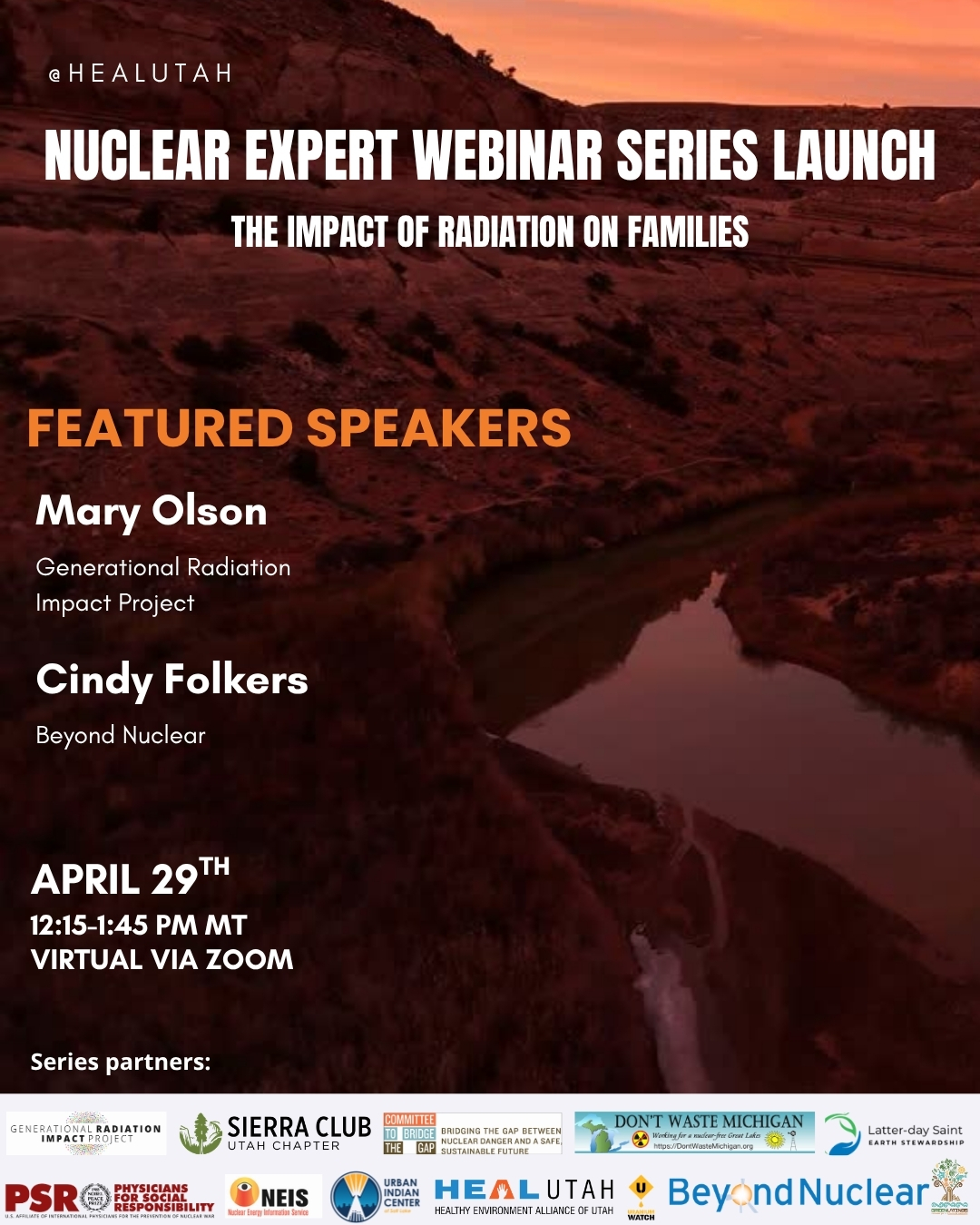
29 April – Nuclear Expert Webinar #1 – Radiation Impacts on Families with Mary Olson and Cindy Folkers
- 12:15 PM MT – 1:45 PM MT
- Location: Virtual – REGISTER TODAY

4 May -West Suburban Peace Coalition to discuss Iran war at May Educational Forum
Monday, May 4, 7:00 – 8:00 PM Central Standard Time
Title: : How Trump’s Narrative Tries to Shape the Reality of the War on Iran.
Contact Walt Zlotow, zlotow@hotmail.com 630 442 3045 for further information
14 May – online event From Bombs to Data Centres: the Face of Nuclear Colonialism

Pine Ridge Uranium is the real threat, not Tehran- Tell Burgum: Stop the Extraction.
Chernobyl: The Lost Tapes – A good documentary on Chernobyl on SBS available On Demand for the next 3 weeks– https://www.sbs.com.au/ondemand/tv-program/chernobyl-the-lost-tapes/2352741955560
To see nuclear-related stories in greater depth and intensity – go to https://nuclearinformation.wordpress.com
-
Archives
- April 2026 (288)
- March 2026 (251)
- February 2026 (268)
- January 2026 (308)
- December 2025 (358)
- November 2025 (359)
- October 2025 (376)
- September 2025 (257)
- August 2025 (319)
- July 2025 (230)
- June 2025 (348)
- May 2025 (261)
-
Categories
- 1
- 1 NUCLEAR ISSUES
- business and costs
- climate change
- culture and arts
- ENERGY
- environment
- health
- history
- indigenous issues
- Legal
- marketing of nuclear
- media
- opposition to nuclear
- PERSONAL STORIES
- politics
- politics international
- Religion and ethics
- safety
- secrets,lies and civil liberties
- spinbuster
- technology
- Uranium
- wastes
- weapons and war
- Women
- 2 WORLD
- ACTION
- AFRICA
- Atrocities
- AUSTRALIA
- Christina's notes
- Christina's themes
- culture and arts
- Events
- Fuk 2022
- Fuk 2023
- Fukushima 2017
- Fukushima 2018
- fukushima 2019
- Fukushima 2020
- Fukushima 2021
- general
- global warming
- Humour (God we need it)
- Nuclear
- RARE EARTHS
- Reference
- resources – print
- Resources -audiovicual
- Weekly Newsletter
- World
- World Nuclear
- YouTube
-
RSS
Entries RSS
Comments RSS
 nuclear-news