USA’s nuclear missile force has more serious problems than those exam cheating men
Cheating officers aren’t the most worrisome scandal to hit the nuclear missile The Week, By Peter Weber 16 Jan 14, “……….The previous scandals range from 17 officers at the Minot ICBM base being temporarily stripped of launch duties last April for flubbing a missile launch test to the demotion of Vice Adm. Tim Giardina — the No. 2 officer at the U.S. Strategic Command, in charge of America’s nuclear arsenal — for gambling with counterfeit chips at an Iowa casino. CNN and the AP have lists of the various snafus.
But two gross errors in judgment strike me as more worrisome that the rest — certainly more dangerous than a little cheating on a monthly test or smoking a little synthetic marijuana (presumably) on your off time. The first is the 2007 incident in which a B-52 flew from across the middle of the country, from Minot to Barksdale Air Force Base in Louisiana, with six nuclear-armed Advanced Cruise Missiles attached to the bomber’s wings; the warheads were supposed to have been removed from the to-be-decommissioned missiles. Heads rolled for that.
More recently, the USAF general who oversaw the three ICBM bases, Maj. Gen. Michael Carey, wasrelieved of duty in October for “conduct unbecoming a gentleman” during a trip to Russia in July. That’s almost a polite way of describing what the USAF’s investigation found.
The problems started during a layover in Switzerland, en route to an official visit to Russia, when Carey started talking loudly about his responsibilities as commander of a large nuclear arsenal,boasting that he “saves the world from war every day.” In Moscow, he went on a bender with an unidentified male, staying out late partying with two “foreign national women” — or as he bragged the next day, when he was 45 minutes late for an official briefing, he’d “met two hot women the night before.”
During a subsequent visit to a monastery, he reportedly slurred his words while repeatedly interrupting the tour guide. Then, at a Mexican restaurant, the drunk general pestered The Beatles cover band to let him on stage to sing with them. He also left his colleagues to go sit with the women from the night before. “There was no indication Carey’s behavior compromised sensitive nuclear information or went beyond drinking, dancing, and fraternizing with the women,” sayCNN‘s Holly Yan and Faith Karimi. That doesn’t seem like the sort of gamble we should have to put up with.
Those breaches were far more serious than the new cheating scandal, in my opinion. But that doesn’t let the 34 officers off the hook, or the 11 accused of dropping Ecstasy and smoking Spice. “There’s no making this better,” former Pentagon official Kathleen Hicks tells The New York Times. Any potentially dangerous lapse in judgment among the people tending to America’s nuclear arsenal is “worrisome. Period. Full Stop.” And so it is.http://theweek.com/article/index/255211/cheating-officers-arent-the-most-worrisome-scandal-to-hit-the-nuclear-missile-corps
TEPCO gets approval from Japanese govt for business plan for Kashiwazaki Kariwa nuclear plant
Japanese Government Approves Revival Plan For Owner Of Fukushima Nuclear Power Plant, Climate Progress, BY ARI PHILLIPS ON JANUARY 16, 2014 On Wednesday Japan’s trade ministry approved a 10-year business plan for Tokyo Electric Power Company (Tepco), owner of the Fukushima Daiichi nuclear plant in northeast Japan that went into meltdown after being devastated by an earthquake and tsunami off Japan’s eastern coast nearly three years ago.
The plan is Tepco’s second attempt at proposing a new path forward. The first plan was discarded after it was made clear that the Kashiwazaki Kariwa nuclear plant could not be restarted, which would help relieve the cost of using fossil fuels to generate power. The new plan involves switching back on some of the reactors at the Kashiwazaki plant, which is the largest in the world.
Tepco, Japan’s largest utility, is under huge financial pressure and is fighting to survive. The company is majority owned by the Japanese government after receiving a previous bailout. If the company goes under it could have ripple effects across Japan’s fragile economy.
The new plan also makes deeper cuts to operation costs and staff than the previous version…….
Before restarting the Kashiwazaki reactor, Tepco must get permission from local politicians, including the local governor in Niigata, Hirohiko Izumida. According to Agence France-Presse “Governor Hirohiko Izumida remains critical of TEPCO, and has demanded the utility first explain to him exactly what happened at the Fukushima plant before seeking his permission to restart reactors in his region.”
The Japanese government recently admitted that it was hopelessly behind in the Fukushima cleanup schedule, which will take decades to dismantle and require the use of new technologies……..
The removal of nuclear energy from Japan’s energy mix has also helped lead to a revival of solar power, with the country experiencing a projected 350 percent solar market growth from 2012 to 2013. Need for land, lack of grid access, and lack of qualified engineers and construction companies is what’s holding back further growth. Japan was already expected to be the world’s largest solar market in terms of revenue last year.http://thinkprogress.org/climate/2014/01/16/3171861/japan-tepco-nuclear-revival/
Secondary cancer risk in radiation therapy for proatate cancer
Radiation for prostate cancer may lead to more complications than surgery: study Sheryl Ubelacker, The Canadian Press Jan 16, 2014 Men with prostate cancer, deciding whether to opt for radiation or surgical removal of the gland can be a daunting prospect, as both carry the risk of unpleasant side-effects such as urinary incontinence and erectile dysfunction.
But a large study suggests that radiation treatment may lead to a higher incidence of other adverse effects in the years following treatment for localized prostate cancer, depending on a man’s age and other medical conditions.
The study, published Thursday in the journal Lancet Oncology, found men treated with radiotherapy had fewer minimally invasive urological procedures, compared to those who chose surgery. But over time, the radiation group had a higher proportion of hospital admissions, rectal or anal procedures, related surgeries and secondary cancers…….http://www.680news.com/2014/01/16/radiation-for-prostate-cancer-may-lead-to-more-complications-than-surgery-study/

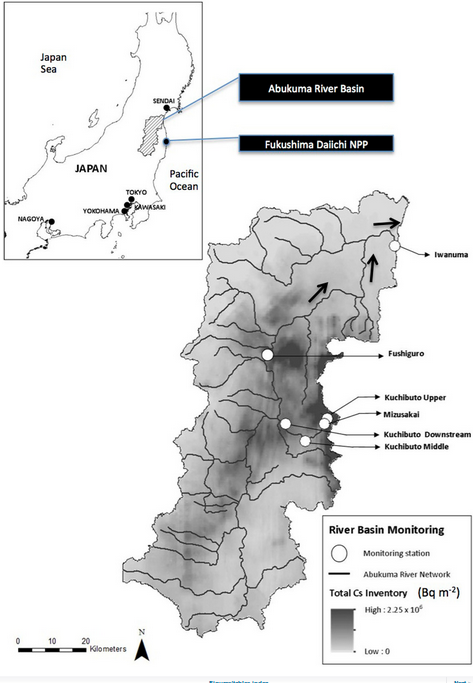
Quantify the flux of radiocesium in the Abukuma Basin (5,172km2)
Personal thanks to KitagawaTakashi
【速報】水脈による放射能汚染状況:
”This study aimed to quantify the flux of radiocesium in the AbukumaBasin (5,172km2), the largest river system affected by fallout fromthe Fukushima Daiichi Nuclear Power Plant (FDNPP) event.
Inthe period from 10 August 2011 to 11 May 2012 an estimated 84 to 92%of the total radiocesium transported in the basin’s fluvial systemwas carried in particulate form.”
極めて重要な情報が公開された。
振り落ちた放射能物質は、多くはそこに留まる。
風に乗りプルームによって運ばれたものも、
雨などによって降下し、多くはその場所に留まる。
その後、土壌に浸潤し、一部は、植物、動物などを通じ、
食物連鎖に入る。多くの移動は、環境循環による。
その最大のものが、水脈によるものである。(一部は海に流れる)
この懸念は、当初からあったが、その詳細が初めて公開された。
(Published16 January2014)
図は、阿武隈川流域の水脈と、現実にどの程度放射能物質が、
どの範囲に広がっているかの詳細図である。
色の濃さが、汚染度を表すが、濃い部分は、200万ベクレル/m^2にまで達している。
この図は、放射能汚染被害の範囲、ホットスポットの場所、
その汚染の程度を、地域ごとに詳細に示すものとして極めて有用であり、今後の基礎資料となるものであろう。
”
Duringthis monitoring period Typhoon Roke (September 2011) was observed toinduce a significant and temporally punctuated redistribution ofradiocesium. The storm-mobilised radiocesium was an estimated 6.18Terabecquerels corresponding to 61.4% of the total load delivered tothe coastal zone during the observation period.
The totalflux of radiocesium into the Pacific Ocean estimated at the outletstation (basin area 5,172km2) was 5.34TBq for 137Cs, and 4.74TBq for134Cs, corresponding to 1.13% of the total estimated radiocesiumfallout over the basin catchment (890TBq).
This wasequivalent to the estimated amount of direct leakage from FDNPP tothe ocean during June 2011 to September 2012 of 17TBq and the Level 3Scale Leakage on 21August 2013 (24TBq).”
Source: Published16 January 2014
“Initial flux of sediment-associatedradiocesium to the ocean from the largest river impacted by FukushimaDaiichi Nuclear Power Plant” By Yosuke Yamashiki, Yuichi Onda,Hugh G. Smith, William H. Blake,et.al.”
http://www.nature.com/srep/2014/140116/srep03714/full/srep03714.html
The activity concentrations of 137Cs, 134Cs, 90Sr, 238Pu, 239,240Pu, 241Pu and 241Am in soil and in animals causing transgenerationally-transmitted damage
Personal thanks to Jan Hemmer
Japan, listen: “The activity concentrations of 137Cs, 134Cs, 90Sr, 238Pu, 239,240Pu, 241Pu and 241Am in soil and in animals were measured at five monitoring sites with different ground deposition of radionuclides at different distances from the destroyed reactor.
The observed temporal pattern of the radionuclide activity concentration in the studied animal populations reflects the changes in biological availability of these isotopes for biota, mostly due to fuel particle destruction and appearance of dissolved and exchangeable forms of radionuclides.
Maximal values of the whole-body absorbed dose rates occurred during the year of deposition, followed by a decrease in the subsequent period. Generally, this decrease was monotonic, mainly determined by the decrease of the external c-ray dose rate, but there were exceptions due to the delayed maximum of internal exposure.
The inter-individual distributions of radionuclide concentrations and lifetime whole-body absorbed doses were asymmetric and close to log-normal, including concentrations and doses considerably higher than the population mean values.”
http://www.enfants-tchernobyl-belarus.org/extra/pdf-divers/telecharge.php?pdf=etb-037.pdf
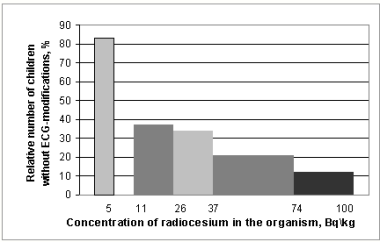 Image source ; http://belrad-institute.org/UK/doku.php?id=publications:articles:mesures_of_radiation
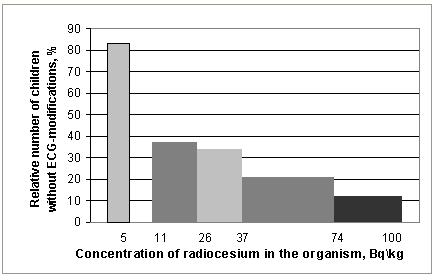
“Transgenerational accumulation of radiation damage in small mammals chronically exposed to Chernobyl fallout” PDF:http://www.enfants-tchernobyl-belarus.org/extra/pdf-divers/telecharge.php?pdf=etb-068.pdf“With regard to the continuous buildup of transgenerationally-transmitted damage in the course of chronicradiation exposure of the parental generations, we will shortly speak of the transgenerational accumulation of transmitted biological damage” ignored by World’s Science.
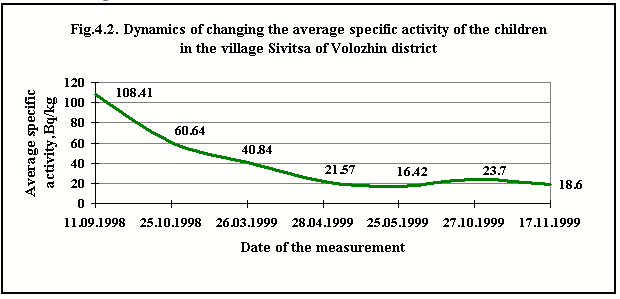
Maps of Belarus:Whole Body Counter Check ups of Children (Cesium 137).
I got these “maps” from BELRAD (http://belrad-institute.org/).Yablokov / Nesterenko showed a few in their famous study “Chernobyl: Consequences of the Catastrophe for People and the Environment”. Here you can see all of them. I did this article about my trip and the information you can see on them:http://tekknorg.wordpress.com/2012/04/14/children-radiation-maps-2/
Detected to Plutonium and Uranium at Takahagi City, Ibaraki Prefecture. 茨城県高萩市
Detected to Plutonium and Uranium 茨城県高萩市

On April 5 2013
We had detected the plutonium and uranium in Takahagi City, Ibaraki Prefecture.
Many children has been living also in this city.

[[ Special Thanks ]]
Yuko Sugimoto
Fukushima report: Plutonium should be in the leakage! 汚染水問題に関する小出先生のコメント、報道するラジオより。 追加報告:プルトニウムも汚染水に混じっているはず! (repost)
Op Ed by Mia (JANUK)
http://fukushimaappeal.blogspot.co.uk/
…..The last one was plutonium241, which had radiation dose about 50 times as much as the total of the other three(PU238, PU239 & PU240)…..
….The underground tanks were meant to store low level of radioactive water after being filtered through ALPS. But they have been using them to store high level of radioactive water (including β (beta) emitting nuclide, Strontium and α (alpha)emitting nuclide, Plutonium)…..

Thursday, 18 April 2013
A MBS radio interview with Prof. Koide: the repeated leaking problems at Fukushima Crippled Plant. Additional report: Plutonium should be in the leakage! 汚染水問題に関する小出先生のコメント、報道するラジオより。 追加報告:プルトニウムも汚染水に混じっているはず!
The most recent report on the leakage problem said that about 22 liters of radioactive water had leaked from gaps between the pipes used to transfer it from underground water storage tank into an another tank, and that the level of radioactivity in the water was 290,000Bq/m3.

Tepco has been trying to get ALPS to work for some time but it’s still in its trial stage. ALPS is supposed to filter 62 radioactive nuclides. However Tepco seems not wanting to mention the α (alpha) emitting nuclide isotopes.

The last one was plutonium241, which had radiation dose about 50 times as much as the total of the other three(PU238, PU239 & PU240).A Plutonium contamination map by MEXT published on 12/8/12.
[…Prefecture – city/town/village – 緯度 latitude – 経度 longitude – PU241(lower limit of detection)-…]
by MEXT on 30/9/11Half life: PU238(88y) decays into PU234(245,000y), PU239(24,100y), PU240(6,600y), PU241(13.2y) decays into Am241(=silver, 433y)Multi-nuclide Removal Equipment (ALPS)
(Reference) http://blog.goo.ne.jp/tarutaru22/e/a8f8b3e66c246ef3c3df8699b3a2ec45http://home.hiroshima-u.ac.jp/er/ReneN_P_P1.html
“….There’s a lot of Pu-241 produced in reactor fuel – more activity
of Pu-241 than any other actinide (with the exception of
short-lived Np-239). The Pu-241 decays to Am-241 and thence
to Np-237 and decay series nuclides, adding to the
radio-toxicity.Given the copious amounts of Pu-241 produced
(on the order of 10^5 curies per ton of fuel)
it shouldn’t surprise anyone that it’s showing up.
It should also be no surprise that potential dose from Pu-241
is higher than from other nuclides since there’s so much
of it produced……”
Leaked TEPCO report: 120 billion Becquerels of plutonium, 7.6 trillion Becquerels of neptunium released in first 100 hours — Media concealed risk to public
Published: October 15th, 2011 at 8:21 pm ET
By ENENews
Amy Goodman gets behind the truth of the now empty town of Futaba (Fukushima)

17 January 2014
On our final day of our special broadcast from Tokyo, we speak with a Japanese resident from the town that housed part of the Fukushima Daiichi nuclear power plant who is participating in weekly protests against the resumption of nuclear power in her country. “We couldn’t bring anything from our houses. We didn’t have a toothbrush, we didn’t have a blanket. We didn’t have towels. We had nothing. It was truly hell, and we thought it would be much better to die. But now, we are here, and we can’t really give up. We want to fight for this cause,” Yukiko Kameya said as she attended a demonstration outside Prime Minister Shinzo Abe‘s official residence. “We told the prime minister many times, every week here, that we are against the re-opening of the nuclear facilities, but it doesn’t seem that he gets it. He just does whatever he wants to do anyway.”

We speak with Katsutaka Idogawa, former mayor of the town of Futaba where part of the Fukushima Daiichi Nuclear power plant is located. The entire town was rendered uninhabitable by the nuclear disaster. We ask him what went through his mind after the earthquake and tsunami hit on March 11, 2011. “It was a huge surprise, and at the time I was just hoping nothing that had happened at the nuclear power plant. However, unfortunately there was in fact an accident there,” Idogawa recalls. He made a decision to evacuate his town before the Japanese government told people to leave. “If I had made that decision even three hours earlier, I would have been able to prevent so many people from being exposed to radiation.” For years he encouraged nuclear power development in the area; now he has become a vocal critic.
Click here to go directly to the channel, and please visit S2e TV to watch at anytime!
Fukushima: An Ongoing Warning to the World – Amy Gooman
Here in Tokyo, Sophia University Professor Koichi Nakano says of the new law, “Of course, it concerns primarily security issues and anti-terrorist measures. But … it became increasingly clear that the interpretation of what actually constitutes state secret could be very arbitrary and rather freely defined by government leaders. For example, anti-nuclear citizen movements can come under surveillance without their knowledge, and arrests can be made.”
Posted on Jan 15, 2014
 |
By Amy Goodman
http://www.truthdig.com/report
TOKYO—“I write these facts as dispassionately as I can in the hope that they will act as a warning to the world,” wrote the journalist Wilfred Burchett from Hiroshima. His story, headlined, “The Atomic Plague” appeared in the London Daily Express on Sept. 5, 1945. Burchett violated the U.S. military blockade of Hiroshima, and was the first Western journalist to visit that devastated city. He wrote: “Hiroshima does not look like a bombed city. It looks as if a monster steamroller had passed over it and squashed it out of existence.”
Jump ahead 66 years, to March 11, 2011, and 600 miles north, to Fukushima and the Great East Japan Earthquake, which caused the tsunami. As we now know, the initial onslaught that left 19,000 people dead or missing was just the beginning. What began as a natural disaster quickly cascaded into a man-made one, as system after system failed at the Fukushima Daiichi nuclear power plant. Three of the six reactors suffered meltdowns, releasing deadly radiation into the atmosphere and the ocean.
Three years later, Japan is still reeling from the impact of the disaster. More than 340,000 people became nuclear refugees, forced to abandon their homes and their livelihoods. Filmmaker Atsushi Funahashi directed the documentary “Nuclear Nation: The Fukushima Refugees Story.” In it, he follows refugees from the town of Futaba, where the Fukushima Daiichi plant is based, in the first year after the disaster. The government relocated them to an abandoned school near Tokyo, where they live in cramped, shared common areas, many families to a room, and are provided three box lunches per day. I asked Funahashi what prospects these 1,400 people had. “There’s none, pretty much. The only thing the government is saying is that [for] at least six years from the accident, you cannot go back to your own town,” he told me.
Wide Gulf and Angry Words In Indian Point Labor Talks
“We made it very clear,” said Melia, “that we are determined to get a fair shake. Entergy is playing fast and loose with the welfare of thousands of people, and fast and loose with the nuclear power facilities they own and operate.
http://spoonsenergymatters.wordpress.com/
January 17, 2014
By Roger Witherspoon
Rye, N.Y. – Two days of contract talks with federal mediators ended Thursday night with angry union negotiators and no deal in sight on the last day of the contract between Entergy Nuclear and nearly 400 workers at the Indian Point power plant.
Talks between company representatives and the Utility Workers Union of America, Local 1-2 broke up shortly before 10 PM Thursday at the Rye Hilton, where both sides have been sequestered since Wednesday morning. Union local President James Slevin huddled with mediators from the U.S. Federal Mediation and Conciliation Service after angrily leaving the contract discussions.
“The company doesn’t seem like it’s ready to get serious about negotiating a fair contract,” said UWU spokesman John Melia. “They haven’t put anything on the table except takeaways and a regressive offer. It doesn’t seem like they are ready to negotiate in good faith. It seems as if Entergy is trying to provoke a labor dispute.
“They have a pattern of doing this. They are very anti-labor and have a mindset that every shareholder should get rich and no one else.”
Melia referred to the five-week lockout by Entergy of UWU members at its Pilgrim Nuclear Power Station in Massachusetts in June, 2012. The lockout occurred during negotiations and after union leaders had agreed to two contract extensions so the talks could continue without a plant interruption. At the time of the lockout, Entergy was demanding concessions in pay, benefits, health care, and work rules. The final contract included 3% raises for the unionized workers.
Entergy representatives declined to comment Thursday. Neither of the parties nor the mediators are publicly discussing contract specifics. However, Entergy is believed to be seeking – at least in its initial stage of discussions – wage cuts and increased employee contributions to health care.
China Moon Landing Seen As Nuclear threat
Japan already has approximately four times as many major warships as the British Navy and more tanks than Germany. Despite being an island nation that emphasizes sea and air power, Japan has trained special-forces, a fleet of sophisticated diesel-electric submarines and is working with the U.S. Marines on amphibious capabilities.
[…]
Most nations in Asia have opposed a renewal of Japanese nationalism and a military build-up as an existential threat. But the moon landing and threats to free passage through international waters are being seen as intentional demonstrations of “coercive power” by China.
From: Chriss Street
http://bizlawnews.com/news/48101/china-moon-landing-seen-nuclear-threat/
China’s December 15th soft-landing of an unmanned spacecraft on the moon was celebrated by the Xinhua news agency as, “The dream for lunar exploration once again lights up the China Dream”. China’s neighbors saw the action as a nightmare demonstration of China’s ability to launch a Multiple Reentry Vehicle ballistic missile, whose payload can deploy multiple nuclear warheads aimed to hit a group of targets. With the United States becoming a less reliable guarantor of peace in the region, China’s provocative military moves are creating a muscular arms race in Asia.
Carnegie Endowment for International Peace published a major report last May arguing China would be a “coercive power” in enforcement of its way with Japan, but emphasized that economic interdependence with the United States and the rest of Asia would prevent a major Cold-War style confrontation with China in the region. Carnegie claimed that despite hawkish rhetoric from Japan’s new Prime Minister Shinzo Abe, Japan’s economic troubles and political paralysis would prevent it from countering China’s increasing military capabilities. Carnegie obviously failed to consider Japan’s last two decades of increasing militarization. When it comes to intimidation, Japan and an increasing number of Asian nations will aggressively confront China.
Kazahkstan – Nazarbayev urges to develop nuclear energy

Image source ; http://www.telegraph.co.uk/news/politics/tony-blair/9102135/Why-is-Tony-Blair-lending-credibility-to-Kazakhstans-dictator.html
17 January 2014, 13:05
http://www.inform.kz/eng/article/2621983
ASTANA. January 17. KAZINFORM – President Nursultan Nazarbayev urged to get rid of “Fukushima syndrome” and develop nuclear energy, this has been announced during his annual address to the people of Kazakhstan in the Palace of Independance.
“We should not forget about the prospects of nuclear energy development. The word’s need of cheap nuclear power in the foreseeable future will only grow. And since this type of energy will be demanded as clean energy, we can not fall behind”, said the President.
The President stressed that Kazakhstan is one of the world leaders in the production of uranium, that is why it is necessary to develop nuclear power plants’ fuel production and build atomic power stations.
My article on nuclear power as a viable option for Croatia
Russia’s Rosatom is gobbling up new build projects across Europe now in the nuclear sector, even getting its proverbial foot in the door in Finland and the United Kingdom. Thus, there are clearly new nuclear plant projects out there—as good as Rosatom is, this needs to be a competitive arena with US and Canadian participation, too.
The entire article is only available in the print edition, but my article on nuclear power as an option for sustainable energy in Croatia is the lead article in the new issue of SEE: A Fortnight in Review, one of Eastern Europe’s leading business/finance trade journals:
I’m very glad they ran this article, because having worked on energy issues in earnest over the past year especially in Serbia and Croatia, I have found the current approaches of these emerging nations to largely ignore nuclear as a future option. While Croatia has partial ownership of a nuclear power plant, its discussions for future plants have often began in earnest yet been sidelined by uninformed opposition or the mistaken view that natural gas, oil, and hydroelectric are better alternatives to nuclear. The problem is, while Croatia should be praised for their innovative applications of hydroelectric and other non-fossil fuel power generation approaches, it is doubtful these modalities will ensure independent power in the long run without some reliance on Russia or other oil/gas producers. Serbia’s situation is more dire and the Serbs have been less inclined to even examine nuclear.
Indian Point Nuclear Power Plant Supervisor Gets $500 Fine For Falsifying Facility Records
WILSON admitted that he had fabricated the test results so that Indian Point would not have to shut down.
Submitted by Tyler Durden on 01/16/2014
The infamous ‘scourge on insider-traders everywhere’ Preet Bharara has taken a day off from Wall Street duties to focus on what could be considerably more of a concern. The NY Attorney General just disclosed that Daniel Wilson – the Chemistry Manager at the Indian Point Nuclear Power plant – falsified and fabricated test results for diesel fuel contamination used to power emergency generators.. in order that the plant would not have to be shut down. Have no fear though US public… especially those who live near White Plains, Bharara’s punishment for this potentially disastrous ‘deliberate misconduct’ – a $500 fine and 18 months probation. Well that will teach him, eh?
Full statement:
Former Indian Point Supervisor Sentenced In White Plains Federal Court For Falsifying Nuclear Facility Records
FOR IMMEDIATE RELEASE
Thursday, January 16, 2014
Preet Bharara, the United States Attorney for the Southern District of New York, announced that DANIEL WILSON was sentenced today in White Plains federal court to 18 months’ probation for engaging in deliberate misconduct while serving as Chemistry Manager at Indian Point Energy Center (“Indian Point”), a nuclear power plant in Westchester County. WILSON was sentenced by United States District Judge Nelson Román, who also imposed a $500 fine.
U.S. Attorney Preet Bharara stated: “The safe operation of the Indian Point nuclear power facility is of critical importance to our communities in and around it. This Office will be vigilant about prosecuting criminal misconduct that takes place at the facility.”
According to the felony Information to which WILSON pleaded guilty, the Complaint, and information provided for purposes of sentencing:
Indian Point maintains a backup system of emergency generators for use in part to provide power in the event of a power outage and shutdown. WILSON, the Chemistry Manager at Indian Point from 2007 through 2012, was responsible for, among other things, ensuring that certain aspects of the operation at Indian Point were in compliance with technical specifications required by the Nuclear Regulatory Commission (“NRC”).
One such requirement related to the amount of particulate matter in the diesel fuel used to power emergency generators at Indian Point, which could not exceed a set limit. In 2011, tests of the diesel fuel maintained for use in powering the emergency generators at Indian Point showed that the ratio of particulate matter in the diesel fuel exceeded the limit set by the NRC.
In February 2012, WILSON concealed material facts from his employer and the NRC by fabricating test data, falsely showing that resampling tests of diesel fuel tested below the applicable NRC limit. In fact, no such resamples were taken, and the purported test data were fabrications. Later in February 2012, WILSON, in response to questioning by other employees of Indian Point in advance of an inspection by the NRC, wrote a report – the kind on which the NRC ordinarily relies in inspecting nuclear facilities for safety – in which he gave a false explanation for the lack of supporting documentation for his fabricated test results. In a subsequent interview with NRC personnel, WILSON admitted that he had fabricated the test results so that Indian Point would not have to shut down.
In April 2012, Wilson resigned from Indian Point.
On October 16, 2013, WILSON pleaded guilty to a one-count Information charging him with deliberate misconduct in connection with a matter regulated by the NRC, in violation of Title 42, United States Code, Section 2273.
* * *
Mr. Bharara praised the efforts of the NRC Office of Investigations in connection with the investigation.
The prosecution is being handled by the Office’s White Plains Division. Assistant U.S. Attorney Benjamin Allee is in charge of the prosecution.
Tepco measured 5,100,000 Bq/m3 of Strontium-90 from groundwater in August 2013 / Concealed for 5 months
Posted by Mochizuki on January 15th, 2014
Following up this article.. Tepco concealed wrong analysis of seawater for over 6 months / Tepco “Too busy to verify” [URL]
5,100,000 Bq/m3 of Strontium-90 was measured from groundwater last August, but Tepco didn’t publish the data for 5 months.
For press’s question about why Tepco doesn’t publish Strontium-90 data of seawater and groundwater samples, Tepco explained it is because they found technical errors in some of the analysis data.
On 1/15/2014, Tepco released the concealed Strontium-90 data along with the wrongly analysis data.
The newly published data reveals the fact that Tepco was aware of the significant Strontium-90 contamination in groundwater and seawater.
Except for the samples still “under analysis” for 6 months, Tepco measured Strontium-90 from all the groundwater samples taken from the seaside of reactor1 and 2. The highest reading was 5,100,000 Bq/m3 (8/22/2013). This is 94 times much as the former highest reading measured last May.
Also, Strontium-90 was measured from 97% of seawater samples taken in Fukushima plant port. The data shows Strontium-90 was detected in various locations in the port, from upper layer and lower layer, and also the entrance of port. The highest reading was 720,000 Bq/m3 (9/22/2013). This is 97 times higher than the former highest reading measured last June.
http://www.tepco.co.jp/nu/fukushima-np/f1/smp/2014/images/2tb-east_14011502-j.pdf
The 4 Myths The Nuclear Industry Wants You to Believe
via Fairewinds.org / January 16, 2014 /
h/t http://fukushimaupdate.com/what-are-the-4-myths-the-nuclear-industry-wants-you-to-believe/
In order to produce more nuclear electricity, the nuclear corporations and proponents need you to believe that nuclear power is safe, no one has ever died or become ill from nuclear power accidents, nuclear power will counteract global warming, and it is the cheapest form of power. Listen to Fairewinds’ Arnie Gundersen tell you the truth about these myths.
1 This Month
26 April – Chernobyl: Inside the Meltdown airs on National Geographic on Sunday 26th April from 4pm

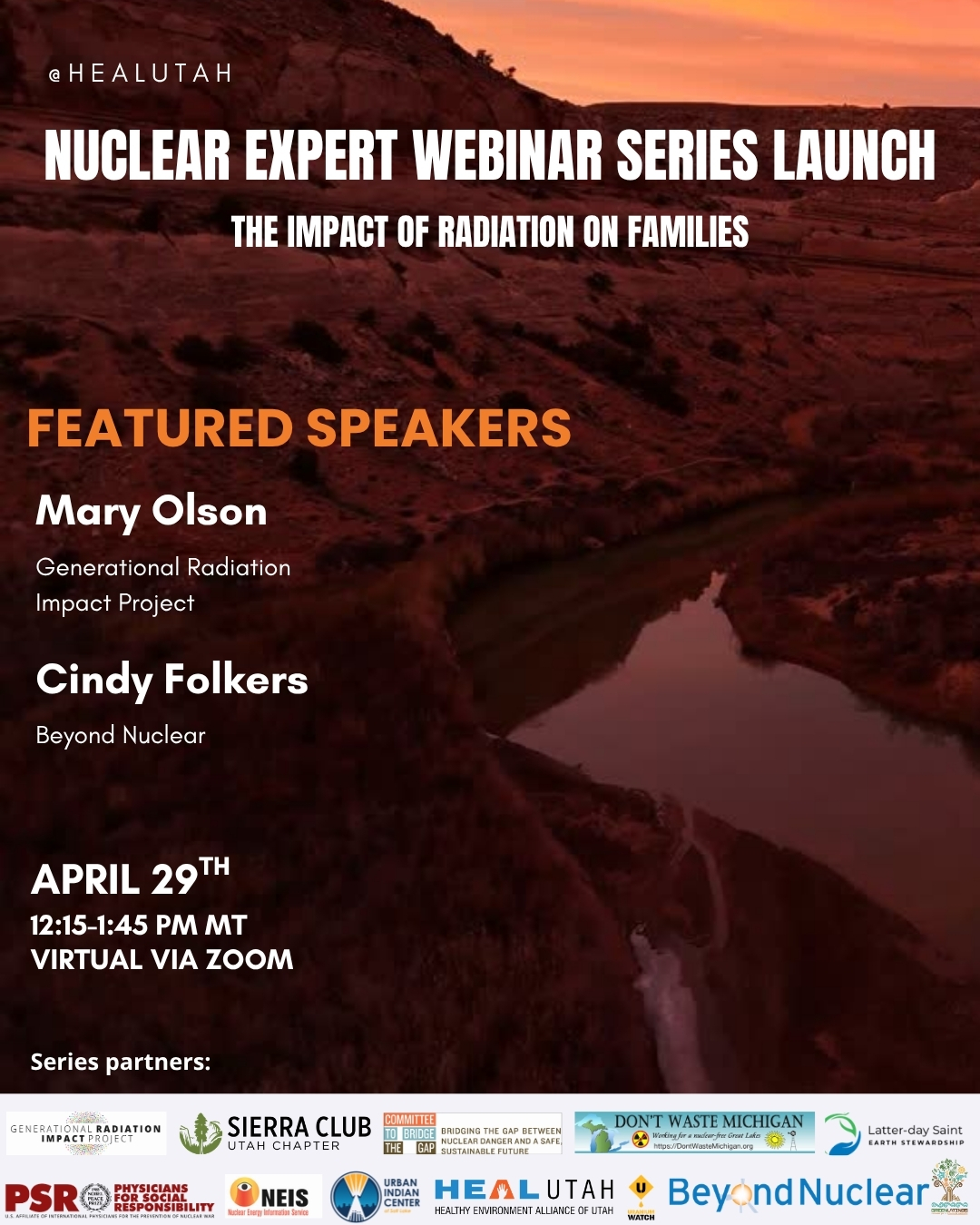
29 April – Nuclear Expert Webinar #1 – Radiation Impacts on Families with Mary Olson and Cindy Folkers
- 12:15 PM MT – 1:45 PM MT
- Location: Virtual – REGISTER TODAY

4 May -West Suburban Peace Coalition to discuss Iran war at May Educational Forum
Monday, May 4, 7:00 – 8:00 PM Central Standard Time
Title: : How Trump’s Narrative Tries to Shape the Reality of the War on Iran.
Contact Walt Zlotow, zlotow@hotmail.com 630 442 3045 for further information
14 May – online event From Bombs to Data Centres: the Face of Nuclear Colonialism
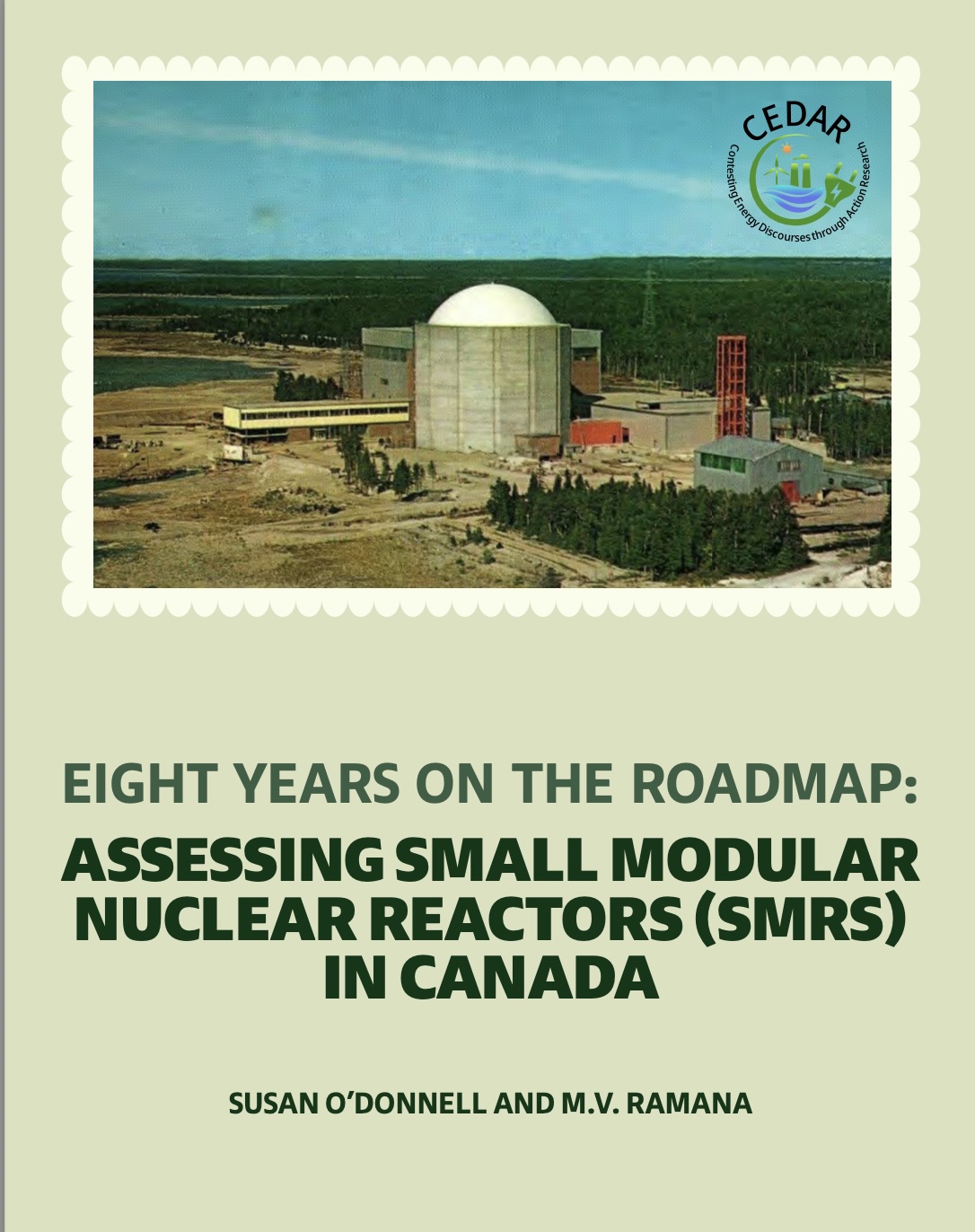

Pine Ridge Uranium is the real threat, not Tehran- Tell Burgum: Stop the Extraction.
Chernobyl: The Lost Tapes – A good documentary on Chernobyl on SBS available On Demand for the next 3 weeks– https://www.sbs.com.au/ondemand/tv-program/chernobyl-the-lost-tapes/2352741955560
To see nuclear-related stories in greater depth and intensity – go to https://nuclearinformation.wordpress.com
-
Archives
- April 2026 (288)
- March 2026 (251)
- February 2026 (268)
- January 2026 (308)
- December 2025 (358)
- November 2025 (359)
- October 2025 (376)
- September 2025 (257)
- August 2025 (319)
- July 2025 (230)
- June 2025 (348)
- May 2025 (261)
-
Categories
- 1
- 1 NUCLEAR ISSUES
- business and costs
- climate change
- culture and arts
- ENERGY
- environment
- health
- history
- indigenous issues
- Legal
- marketing of nuclear
- media
- opposition to nuclear
- PERSONAL STORIES
- politics
- politics international
- Religion and ethics
- safety
- secrets,lies and civil liberties
- spinbuster
- technology
- Uranium
- wastes
- weapons and war
- Women
- 2 WORLD
- ACTION
- AFRICA
- Atrocities
- AUSTRALIA
- Christina's notes
- Christina's themes
- culture and arts
- Events
- Fuk 2022
- Fuk 2023
- Fukushima 2017
- Fukushima 2018
- fukushima 2019
- Fukushima 2020
- Fukushima 2021
- general
- global warming
- Humour (God we need it)
- Nuclear
- RARE EARTHS
- Reference
- resources – print
- Resources -audiovicual
- Weekly Newsletter
- World
- World Nuclear
- YouTube
-
RSS
Entries RSS
Comments RSS
 nuclear-news