Why Obama and USA nuclear authorities won’t admit seriousness of Fukushima radiation
Over the years numerous other experts voiced concerns over the GE Mark 1 BWR. All have gone unheeded.
There are 23 nuclear plants in the United States where the used fuel rods are suspended, in a pond, 100 feet above the ground. (source)
Any admission that radiation has spread across the Pacific Ocean and contaminated American soil is an admission that the technology was flawed, and that same flawed technology is being used in the United States.
 The President of the United States knows that the radiation from Fukushima is worse than it would have been had the reactors used at the plant been of a different design.
The President of the United States knows that the delicate and hazardous task of removing and storing the spent fuel rods is going to take years and that one mistake can exacerbate the problems ten-fold.
The President of the United States knows that 23 sites in America are using the same flawed reactors and he is doing nothing about it.
Why Obama Won’t Admit Fukushima Radiation is Poisoning Americans…Connecting the Dots –http://www.thedailysheeple.com/why-obama-wont-admit-fukushima-radiation-is-poisoning-americansconnecting-the-dots_012014 “……..I suggest that the United States government know only too well that the West Coast is polluted with radiation and that the situation is getting worse by the day.
I suggest that the United States government and General Electric knew that Fukushima was a disaster waiting to happen, and they did nothing to prevent it.
I suggest that they know that the many of nuclear reactors in the United States are also prone to catastrophic meltdown, and they are doing nothing about it.
I suggest that research by doctors and scientists is being suppressed, and that research by private citizens is being written off purely because they have no scientific background.
All the warnings were ignored
The narrative that leads us to the state we are in today starts in 1972. Stephen Hanauer, an official at the atomic Energy Commission recommended that General Electric’s Mark 1 design be discontinued as it presented unacceptable safety risks.
The New York Times reported:
In 1972, Stephen H. Hanauer, then a safety official with the Atomic Energy Commission, recommended that the Mark 1 system be discontinued because it presented unacceptable safety risks. Among the concerns cited was the smaller containment design, which was more susceptible to explosion and rupture from a buildup in hydrogen — a situation that may have unfolded at the Fukushima Daiichi plant. Later that same year, Joseph Hendrie, who would later become chairman of the Nuclear Regulatory Commission, a successor agency to the atomic commission,said the idea of a ban on such systems was attractive. But the technology had been so widely accepted by the industry and regulatory officials, he said, that “reversal of this hallowed policy, particularly at this time, could well be the end of nuclear power.” (source)
Then, three years later in 1975, Dale Bridenbaugh and two colleagues were asked to review the GE Mark 1 Boiling Water Reactor (BWR). They were convinced that the reactor was inherently unsafe and so flawed in its design that it could catastrophically fail under certain circumstances. Continue reading
Federal and State lawmakers seek some restraints on advance charging of customers for nuclear construction
 Castor seeks more accountability from states using nuclear advance fee Tampa Bay Times Ivan Penn 17 Jan 14 U.S. Rep. Kathy Castor wants more accountability in use of state laws that allow utilities to charge customers in advance for construction of new nuclear power plants.
Castor is filing legislation that would require states to conduct analyses that show use of the advance fee would be a “good business decision” and that detail how the projects will be financed. Prompted by reports in the Tampa Bay Times about how Duke Energy customers will pay about $1.5 billion for the now cancelled Levy County nuclear project, Castor and state Rep. Dwight Dudley have been working to change Florida energy policy.
“Consumers should not be on the hook for bad business decisions,” Castor said during a press conference Friday at Dudley’s legislative office in St. Petersburg.
On the state level, Dudley is drafting legislation that would repeal use of the Nuclear Cost Recovery Clause or what he calls a “utility tax” in Florida. Dudley and Castor are also proposing legislation that would enable and support greater use of renewable energy such as solar power.
The lawmakers said they believe these changes would help save consumers money at a time when Tallahassee focuses more on building profits for utility companies. They said current laws incentivize utilities to build big box power plants for greater profits rather than use energy efficiency or renewable sources.
“The deck is stacked against consumers,” Castor said. “We do not have a level playing filed here in Florida.”……..utilities make their money by building new power plants rather than finding ways to reduce energy consumption and take advantage of renewable energy to save customers money and reduce the carbon footprint. http://www.tampabay.com/news/business/energy/castor-seeks-more-accountability-from-states-using-nuclear-advance-fee/2161532
Radiation mapping of every street in Japan, a Safecast crowdsourcing initiative
Volunteers Crowdsource Radiation Monitoring to Map Potential Risk on Every Street in Japan http://www.democracynow.org/2014/1/17/volunteers_crowdsource_radiation_monitoring_to_map Amy Goodwin, Safecast is a network of volunteers who came together to map radiation levels throughout Japan after the Fukushima Daiichi nuclear power plant disaster in 2011. They soon realized radiation readings varied widely, with some areas close to the disaster facing light contamination, depending on wind and geography, while others much further away showed higher readings. Safecast volunteers use Geiger counters and open-source software to measure the radiation, and then post the data online for anyone to access.
Broadcasting from Tokyo, we are joined by Pieter Franken, co-founder of Safecast. Continue reading
Japan in violation of U.S. nonproliferation regime, in allowing Turkey to enrich uranium or reprocess spent nuclear fuel
Problematic nuclear accord Japan Times 17 Jan A The Abe administration wants the Diet in its next session (starting Jan. 24) to finalize a civil nuclear accord that Tokyo and Ankara signed in May 2013 during Prime Minister Shinzo Abe’s visit to Turkey.
The accord is problematic because, in theory, it would enable Turkey to reprocess spent nuclear fuel — which would result in the extraction of uranium and plutonium. Because plutonium can be used to make nuclear weapons, curbing access to it is key to global efforts to prevent nuclear proliferation……
Abe’s sales activities led to a $22 billion plan under which ATMEA, a joint venture of Mitsubishi Heavy Industries Ltd. of Japan and Areva SA of France, will build four 1.11 million-kW pressurized lighter water reactors at Sinop, a northern city bordering the Black Sea. A clause in the nuclear accord states that Turkey can enrich uranium or reprocess spent nuclear fuel if Japan and Turkey agree in writing on a specific instance of enrichment or reprocessing.
The Japan-Turkey accord contrasts starkly with similar civil nuclear accords that Japan signed with the United Arab Emeritus, Jordan and Vietnam. Those accords clearly state that the countries cannot enrich uranium or reprocess spent nuclear fuel.
When the accord was being drawn up, Turkey reportedly requested in strong language that Japan insert a clause allowing it to enrich uranium and reprocess spent nuclear fuel.
After the Liberal Democratic Party’s foreign affairs committee raised concerns about this, Foreign Minister Fumio Kishida told the Lower House foreign affairs committee in November that Japan has no intention of allowing Turkey to enrich uranium or reprocess spent nuclear fuel. If so, why did Japan agree to insert such a clause in the nuclear accord with Turkey in the first place?
This agreement also raises the possibility that Japan may violate the U.S. nonproliferation regime. Under a civilian nuclear accord between the United States and Japan, Japan may not carry out uranium enrichment or spent nuclear fuel reprocessing or export related technologies to a third country without U.S. permission.http://www.japantimes.co.jp/opinion/2014/01/17/editorials/problematic-nuclear-accord/#.Utqa-tLTnMw

US Congress approves big grant for nearly bankrupt USEC uranium enrichment company
Federal spending bill has $118M for Piketon uranium plant The Columbus Despatch. 16 Jan 14, WASHINGTON — The massive $1.1 trillion spending bill approved by Congress today includes $118 million for the soon-to-be bankrupt company that wants to launch a uranium-enrichment facility in southeastern Ohio. ….
Nuclear power is the hot issue in Japan’s Feb 9 gubernatorial election
Election spotlight on nuclear power Japan Times, 16 Jan 14, Whether Japan should rely on nuclear power generation will be a main theme in the Feb. 9 Tokyo gubernatorial election as a result of former Prime Minister Morihiro Hosokawa’s announcement Tuesday that he will run in the election on a “zero nuclear” platform.
His entry will have a great impact on the gubernatorial race as he has secured the wholehearted support of former Prime Minister Junichiro Koizumi, who has renounced his earlier stance favoring nuclear power and now is a strong anti-nuclear advocate, causing embarrassment to Prime Minister Shinzo Abe and his Liberal Democratic Party. Making a zero-nuclear goal the focus of policy debate in the gubernatorial election is both timely and welcome in view of the devastation that the meltdowns at Tokyo Electric Power Co.’s Fukushima No. 1 nuclear power plant have caused and of the fact that Japan is a quake-prone country.
Moreover, there is no established technology that will ensure safe storage of high-level radioactive waste from nuclear power plants for tens of thousands years.Kenji Utsunomiya, a former head of the Japan Federation of Bar Associations, had already announced his candidacy focusing on abandoning nuclear power…..Whether Japan should abandon nuclear power or not will be a major election issue. Given the scope of the Fukushima nuclear crisis, the vulernability of nuclear power plants in this quake-prone country and the absence of technology to safely store high-level radioactive waste, clearly much is at stake regarding Japan’s future………http://www.japantimes.co.jp/opinion/2014/01/16/editorials/election-spotlight-on-nuclear-power/#.UtmkJNJdV9U
Japanese protestors strengthen opposition to nuclear power, and call out to the world to join them
Protests Grow in Japan: “We Want to Bring Our Message to the World to Stop Nuclear Power Plants” http://www.democracynow.org/2014/1/17/protests_grow_in_japan_we_want Recent moves by the Japanese government to restart the country’s nuclear power plant facilities have been met by growing protests. “I think this is a problem of the world, not just of Japan,” Kato Keiko told Democracy Now! at a protest outside the prime minister’s private residence in Tokyo. She describes how there is increasing expectation that voters will decide which candidate to choose in the upcoming election based on their position on nuclear power.
TRANSCRIPT
This is a rush transcript. Copy may not be in its final form.
AMY GOODMAN: We’re broadcasting for the last of three days from Tokyo, Japan. We turn right now to what took place just before we made it to the studio. Hundreds of people gathered outside the official residence of the Japanese prime minister to voice their concern about nuclear power.
KEIKO KATO: [translated] My name is Keiko Kato. I belong to this organizers’ group which organized this demonstration. And we’ve been here for two years to demonstrate against the nuclear power facilities. I think this is a problem of the world, not for just Japan. So, for us, for Japanese to be able to abolish the nuclear facility, this would save the world from the nuclear powers……..
There will be gubernatorial elections next month, and one of the issues that we are discussing is either the candidate is for nuclear power plant or against the nuclear power plant. And that will be a serious issue that has to be discussed. And we can send a message from Tokyo to the Japanese government for nuclear policies. We are trying very hard to stop this movement that is starting. We want you to bring our message to the world to stop nuclear power plant facilities…..
Refugees from Fukushima join in anti nuclear protest
“We Want to Fight For This Cause”: Nuclear Refugees from Fukushima Join Anti-Nuke Protests http://www.democracynow.org/2014/1/17/we_want_to_fight_for_this “…….Three years later, Japan is still reeling from the impact of the disaster. More than 340,000 people became nuclear refugees, forced to abandon their homes and their livelihoods. Entire towns were forced to evacuate, including Futaba, a town that housed part of the Fukushima Daiichi plant. Before March 11, 2011, nearly 7,000 people lived in the town. Today Futaba is a nuclear ghost town. The government relocated many of the residents to an abandoned school near Tokyo, where they live in cramped, shared common areas, many families to a room, are provided with three box lunches per day. The refugees were given permits to return home to collect personal items, but only for two hours.
Just before this broadcast, Democracy Now! producer Mike Burke spoke with an evacuee from Futaba. She was one of hundreds of anti-nuclear protesters who were outside the official residence of the Japanese prime minister demonstrating.
YUKIKO KAMEYA: [translated] My name is Yukiko Kameya. I’m from Futaba, which was 2.1 kilometers from Fukushima Daiichi nuclear facility. Right now, we have evacuated, and we are living in a temporary housing in Tokyo in a space provided by the government. It’s close here, so I’m coming here every Friday to demonstrate against the nuclear power facilities. ……
A graphic look at the American Nuclear Arsenal
A Look at the American Nuclear Arsenal, From 1945 to 2013 http://www.nationaljournal.com/defense/a-look-at-the-american-nuclear-arsenal-from-1945-to-2013-20140117 By Matt Vasilogambros
With the Air Force’s handling of the nuclear arsenal in question this week, here’s a look at the program itself in one chart. When it comes to America’s nuclear arsenal, any error could be catastrophic.
That’s why news of corruption and crime coming out of the U.S. Air Force this week was so alarming. On Wednesday, the Air Force said that 34 officers responsible for launching this country’s nuclear missiles were suspended because they were cheating on their monthly proficiency tests on how to operate the warheads.
Additionally, other Air Force officers in charge of nuclear codes are involved in an investigation involving illegal drugs.
Air Force officials say the country’s nuclear arsenal is safe. But what does it actually look like?
Using statistics from a Bulletin of the Atomic Scientists study from September, here is a look [see chart] at nuclear weapons since 1945. The number of nuclear weapons stopped its steady incline in 1986 after the U.S. and Soviet Union agreed to two nuclear arms reduction treaties.
Army military expert opposes USA getting nuclear-capable F-35 Joint Strike Fighter
Schwartz: Move away from nuclear F-35 Military Times, By Aaron Mehta WASHINGTON 17 Jan 14— Barring investment from European allies, the Pentagon should abandon the goal of a nuclear-capable F-35 Joint Strike Fighter in favor of spending funds elsewhere, according to former Air Force Chief of Staff Norton Schwartz……http://www.militarytimes.com/article/20140117/NEWS04/301170014
British Ministry of Defence responsible to clean up radioactive trash on Dalgety Beach
They include excavation, containment or simply putting up a fence or warning signs.
The proposals are due to be published next week.
Thousands of radioactive particles have been found on the shore.
It is believed they came from instruments from WW2 aircraft that were destroyed and dumped there.
The MoD has been formally named as the polluter by the environment agency Sepa. An MoD agency has now drawn up management options to deal with the problem……Scottish Environment Secretary Richard Lochhead said: “Local residents of Dalgety Bay have been waiting decades for this mess to be cleaned up.
“A Sepa investigation last year concluded the MoD were responsible for the contamination. Any remediation options must address the clean-up adequately as soon as possible to the satisfaction of the local residents.”http://www.bbc.co.uk/news/uk-scotland-edinburgh-east-fife-25769900
Why isn’t General Electric being held accountable for Fukushima radiation?
Why Obama Won’t Admit Fukushima Radiation is Poisoning Americans…Connecting the Dots –The Daily Sheepie Jan 14“…….Why isn’t GE being held accountable? Why wouldn’t GE be held accountable? Here’s one possibility: Jeffery Immelt is the head of GE. He is also the head of the United States Economic Advisory Board. He was invited to join the board personally by President Obama in 2009 and took over as head in 2011 when Paul Volcker stepped down in February 2011, just a month before the earthquake and tsunami that devastated Fukushima.
Paul Volcker was often seen as being at odds with the administration and many of his ideas were not embraced by the government. The appointment of Immelt, a self described Republican, was seen as a move to give Obama a leg up when dealing with the Republican majority in the House.
There have been calls from many organizations for GE to be held accountable for the design faults in the reactors that powered the Fukushima plant. The fact that they had been known for so long does seem to indicate that the company ignored and over-ruled advice from nuclear experts.
GE ran Fukushima alongside TEPCO, but it isn’t liable for the clean-up costs.
A year after the disaster, Tepco was taken over by the Japanese government because it couldn’t afford the costs to get the damaged reactors under control. By June of 2012, Tepco had received nearly 50 billion dollars from the government.
The six reactors were designed by the U.S. company General Electric (GE). GE supplied the actual reactors for units one, two and six, while two Japanese companies Toshiba provided units three and five, and Hitachi unit four. These companies as well as other suppliers are exempted from liability or costs under Japanese law.
Many of them, including GE, Toshiba and Hitachi, are actually making money on the disaster by being involved in the decontamination and decommissioning, according to a report by Greenpeace International.
“The nuclear industry and governments have designed a nuclear liability system that protects the industry, and forces people to pick up the bill for its mistakes and disasters,” says the report, “Fukushima Fallout“.
“If nuclear power is as safe as the industry always claims, then why do they insist on liability limits and exemptions?” asked Shawn-Patrick Stensil, a nuclear analyst with Greenpeace Canada.
Nuclear plant owner/operators in many countries have liability caps on how much they would be forced to pay in case of an accident. In Canada, this liability cap is only 75 million dollars. In the United Kingdom, it is 220 million dollars. In the U.S., each reactor owner puts around 100 million dollars into a no-fault insurance pool. This pool is worth about 10 billion dollars.
“Suppliers are indemnified even if they are negligent,” Stensil told IPS. (source)
GE will not have put anything into this ‘pot’ to cover Fukushima ,as it is not in the United States. They have walked away, even though they knew their reactors have design faults……http://www.thedailysheeple.com/why-obama-wont-admit-fukushima-radiation-is-poisoning-americansconnecting-the-dots_012014
Big rise in miliatary’s use of renewable energy cuts expenses for USA armed forces
Armed forces see rise in renewable energy By Shan Li January 16, 2014, 12:23 p.m.http://www.latimes.com/business/moneymil/la-fi-mo-clean-tech-military-20140116,0,2774448.story#axzz2qhRNKuzj The use of clean energy technology has seen a sharp rise in military sites in the U.S., as the armed forces push into green sources of power around the country, a report said.
The Army, Navy, Air Force and Marine Corps. have looked for ways to reduce its energy bills in recent years even as the Pentagon‘s budget is squeezed. Combined, the U.S. military goes through $4 billion worth of power on its bases, according to a report from Pew Charitable Trusts.
The armed forces have moved to quickly adopt green energy solutions, the report said.
Renewable-energy projects at military installations run by the Defense Department jumped 54% to 700 from 2010 to 2012, the report said. Energy-saving and efficiency projects more than doubled to 1,339 from 630 during that time.
Phyllis Cuttino, who directs Pew’s project on national security, energy and climate, said the U.S. military was using the private sector to get projects off the ground.
“The military’s clean energy installation initiatives are gathering momentum, enhancing base energy security,” Cuttino said in a statement.
The military has taken advantage of novel financing methods created by the solar industry. Those include power-purchasing agreements, in which the solar developer pays to install panels onto rooftops and then sells the electricity generated to customers.
IAEA hosts meeting on radiation protection (or is it for nuclear industry protection?)
INTERNATIONAL EXPERTS MEETING IN VIENNA TO DISCUSS RADIATION PROTECTION by Michael Madsen / via IAEA / January 15, 2014 / “………As a result of the disaster, and in line with the IAEA Action Plan on Nuclear Safety, the IAEA is hosting an International Experts’ Meeting (IEM) on Radiation Protection after the Fukushima Daiichi Accident: Promoting Confidence and Understanding. The IEM will be held in Vienna from 17 to 21 February 2014 and will bring some of the world’s foremost experts and speakers on radiation protection to discuss a wide range of issues……A formal report is expected to be published after eeting; the presentations and discussions at the IEM will also be made available on the IAEA website. http://fukushimaupdate.com/international-experts-meeting-in-vienna-to-discuss-radiation-protection/ Fukushima Update
Scratched off the nuclear waste dump list – 2 Bruce County communities
No nuclear waste for two Bruce County communities Two Bruce County communities have been ruled unsuitable as sites to store used nuclear fuel The Star, 16 Jan 14 Two Bruce County communities have been scratched from the list of possible sites for a high-level nuclear waste storage site.
Neither Saugeen Shores nor neighbouring Arran-Elderslie have the physical characteristics to make them suitable to store high-level nuclear waste, theNuclear Waste Management Organization (NWMO) has concluded.
Eliminating the two communities still leaves three others in the area One town in Saskatchewan also remains a candidate for the waste site, as do a string of locations in Northern Ontario.
The proposed waste site has split opinion in the Saugeen Shores area, which is not far from the Bruce nuclear station, the region’s biggest employer in the running: Brockton, South Bruce, and Huron-Kinloss…….
Cheryl Grace of Save Our Saugeen Shores said Thursday that her group is “enormously pleased and relieved” that the “highly inappropriate” proposal to put the waste site in the town has been scrapped……
In Saugeen Shores, which covers a smaller area but is more built-up, the NWMO couldn’t find a suitable location largely because of surface development. http://www.thestar.com/business/economy/2014/01/16/bruce.html
1 This Month
26 April – Chernobyl: Inside the Meltdown airs on National Geographic on Sunday 26th April from 4pm

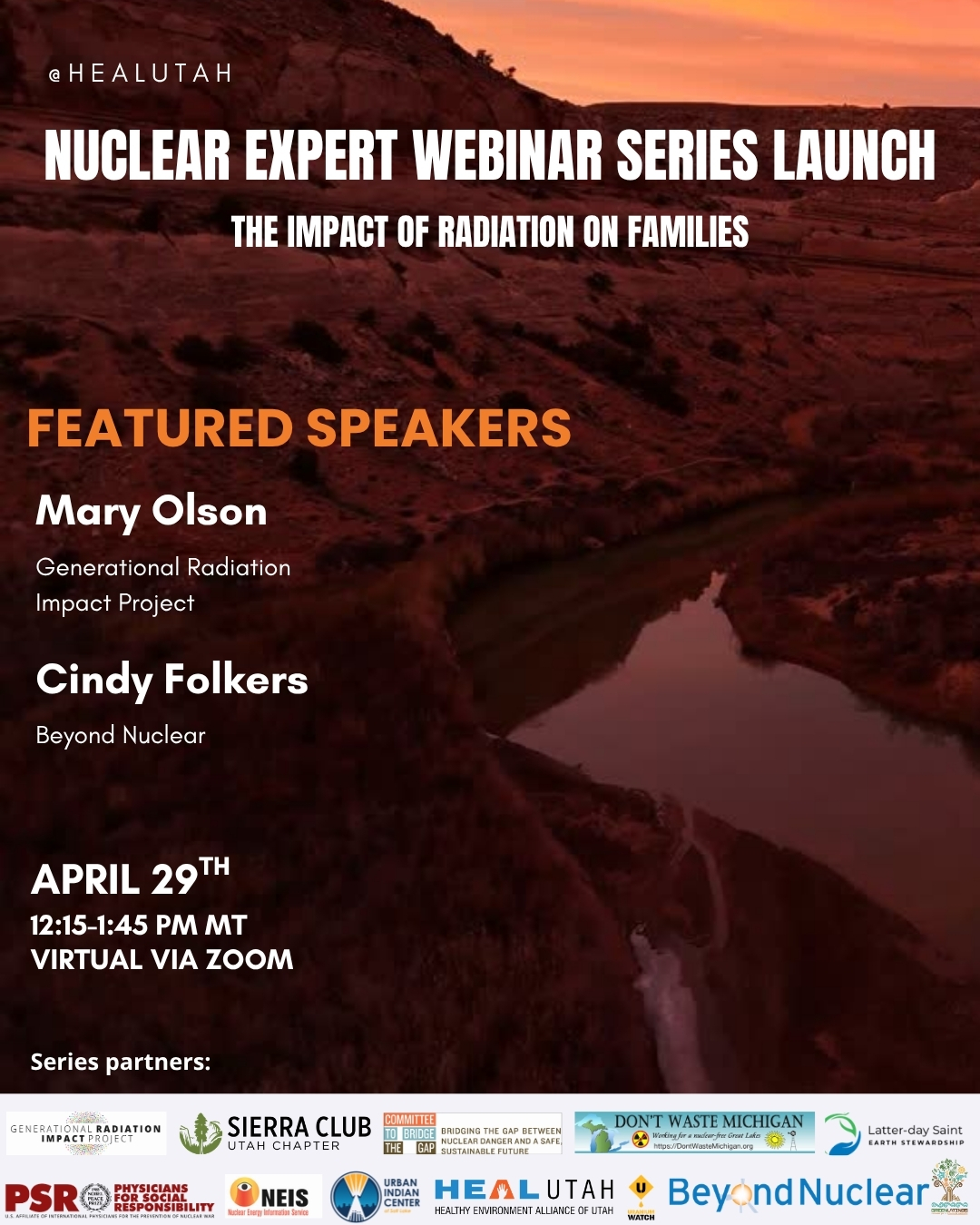
29 April – Nuclear Expert Webinar #1 – Radiation Impacts on Families with Mary Olson and Cindy Folkers
- 12:15 PM MT – 1:45 PM MT
- Location: Virtual – REGISTER TODAY

4 May -West Suburban Peace Coalition to discuss Iran war at May Educational Forum
Monday, May 4, 7:00 – 8:00 PM Central Standard Time
Title: : How Trump’s Narrative Tries to Shape the Reality of the War on Iran.
Contact Walt Zlotow, zlotow@hotmail.com 630 442 3045 for further information
14 May – online event From Bombs to Data Centres: the Face of Nuclear Colonialism

Pine Ridge Uranium is the real threat, not Tehran- Tell Burgum: Stop the Extraction.
Chernobyl: The Lost Tapes – A good documentary on Chernobyl on SBS available On Demand for the next 3 weeks– https://www.sbs.com.au/ondemand/tv-program/chernobyl-the-lost-tapes/2352741955560
To see nuclear-related stories in greater depth and intensity – go to https://nuclearinformation.wordpress.com
-
Archives
- April 2026 (288)
- March 2026 (251)
- February 2026 (268)
- January 2026 (308)
- December 2025 (358)
- November 2025 (359)
- October 2025 (376)
- September 2025 (257)
- August 2025 (319)
- July 2025 (230)
- June 2025 (348)
- May 2025 (261)
-
Categories
- 1
- 1 NUCLEAR ISSUES
- business and costs
- climate change
- culture and arts
- ENERGY
- environment
- health
- history
- indigenous issues
- Legal
- marketing of nuclear
- media
- opposition to nuclear
- PERSONAL STORIES
- politics
- politics international
- Religion and ethics
- safety
- secrets,lies and civil liberties
- spinbuster
- technology
- Uranium
- wastes
- weapons and war
- Women
- 2 WORLD
- ACTION
- AFRICA
- Atrocities
- AUSTRALIA
- Christina's notes
- Christina's themes
- culture and arts
- Events
- Fuk 2022
- Fuk 2023
- Fukushima 2017
- Fukushima 2018
- fukushima 2019
- Fukushima 2020
- Fukushima 2021
- general
- global warming
- Humour (God we need it)
- Nuclear
- RARE EARTHS
- Reference
- resources – print
- Resources -audiovicual
- Weekly Newsletter
- World
- World Nuclear
- YouTube
-
RSS
Entries RSS
Comments RSS
 nuclear-news