Fukushima Daiichi tank leaks 120 tons of radioactive water
Kyodo: Radioactive leak is up to 120 tons from Fukushima Daiichi tank http://enenews.com/kyodo-radioactive-leak-is-up-to-120-tons-from-fukushima-daiichi-tank-video 7 April 13
Kyodo News April 6, 2013: Tokyo Electric Power Co. said Friday that up to 120 tons of contaminated water may have leaked into soil from one of the seven underground reservoir tanks at the crippled Fukushima Daiichi nuclear power plant. Around 13,000 cubic meters of contaminated water remain in the tank, with TEPCO having begun transferring it to other tanks nearby on Saturday morning, the utility said. It will take roughly two weeks to complete the transfer, TEPCO added. […]
NHK WORLD English: Tokyo Electric Power Company says a small amount of radioactive water may have seeped out of an underground water storage facility at the Fukushima Daiichi nuclear power plant. The water contained strontium. […] The level of radioactivity is considered by the utility to be low. […] The utility recently constructed 7 large-scale underground facilities for storing the water after removing some radioactive substances. Each facility can accommodate up to 14,000 tons of water. […]
RIA Novosti: : The company operating the disaster-hit Fukushima Daiichi nuclear power plant (NPP) in northern Japan warned about the possibility of radioactive water leak, the Kyodo news agency reported on Friday. […] Radioactive substances have been detected in the water that accumulated outside the tank, covered by three layers of waterproof sheets. The exact volume of leak is unknown, but radiation levels in the water stand at about 6,000 Becquerel per cubic centimeter. […]
Sea lions sickness might be result of starvation, not radiation
Starvation, Not Radiation Likely Cause of Ailing Sea Lion Pups: Expert By Monica Garske, Apr 7, 2013 More than 1,000 ailing sea lion pups have been washed ashore in Southern California over the past three months, and a national fisheries expert says a lack of food source is likely the cause, not radiation as reported by some media outlets.
The National Oceanic and Atmospheric Administration (NOAA) has assembled a team of experts to research the cause of the beached sea lion pup problem.
NOAA has been granted an official declaration of what’s called an Unusual Mortality Event (UME). The status allows for the establishment of a panel of experts to convene to look for answers and will also provide for extra funding.
On Thursday, NOAA held a conference to discuss that research. Experts said the leading hypothesis their panel is looking at focuses on a lack of food source, starvation and dehydration. Other potential causes being studied include possible infectious diseases or pollutants in the ocean.
Experts believe pups are being affected in greater numbers than adult sea lions because they are limited in how far they can travel and unfamiliar with the environment.
Over the weekend, some news outlets reported that radiation from Japan’s March 2011 Fukushima nuclear power plant disaster is also being looked at as a possible cause for the UME concerning sea lion pups……
“Radiation is being looked at, just like everything else. We haven’t ruled it out, but we really don’t suspect this at all,” Milbury told NBC 7. “We don’t suspect radiation because this would also mean other animals in the ocean would be affected, especially in the oceans of Hawaii, closer to Japan, and we haven’t seen any of that.”Milbury says the more plausible cause is simply starvation….. http://www.nbcsandiego.com/news/local/Starvation-Not-Radiation-Likely-Cause-Sick-Sea-Lion-Pups-NOAA-201844981.html#ixzz2PuGOCdw0
North Korea’s longstanding fear of a USA nuclear attack
as more nations like North Korea obtain nuclear weapons, and as the US struggles to keep a credible nuclear umbrella over its allies from Asia to Europe to the Middle East, the world needs to find a replacement for the current system of maintaining stability based on the mutual fear of nuclear war.
North Korea’s threats show just how urgent that need is.
 North Korea Has Feared An American Nuclear Attack For Decades http://au.businessinsider.com/north-korea-has-feared-an-american-nuclear-attack-for-decades-2013-4 THE CHRISTIAN SCIENCE MONITORTODAY THOSE AMERICANS WHO MAY BE FEARFUL OF NORTH KOREA‘S VERBAL THREATS AND ITS MISSILE-LAUNCH PREPARATIONS SHOULD TAKE NOTE: ITS LEADERS HAVE LONG EXPRESSED A FEAR OF AN AMERICAN NUCLEAR ATTACK.
 As historian Ward Wilson points out in a new book, “Five Myths About Nuclear Weapons,” atomic bombs “were born out of fear, nurtured in and sustained by fear.” Their power to devastate requires a mutual fear to avoid their use.
The current escalation of threats between the US and North Korea illustrates how this reliance on fear can falter. Nations that rely on maximizing fear as a primary tool for defence will find the emotion very difficult to manage in all cases.
The North’s threats, for example, have now led South Korea to consider ending its ban on developing its own nuclear weapons. It is asking for US support to start a nuclear program.
Many in Seoul, South Korea, see the American people as too weary for war and the Obama administration as too eager to reduce the US nuclear arsenal unilaterally. They fear that the American “nuclear umbrella,” which has protected South Korea for 60 years, may no longer be credible enough to deter North Korea from either launching nuclear weapons or using them as blackmail.
MONITOR’S VIEW: Cyberattack on South Korea needs constructive responseFor two decades, the US has tried to talk down North Korea from possessing nuclear weapons by offering hope in place of fear. It tried to convince Pyongyang that the US was not a threat while offering its food aid and oil supplies in return for nuclear disarmament. It hasn’t worked, despite some limited help from China.
Similar persuasion is now being tried on Iran: Give up your nuclear ambitions and instead become a regional power through the strength of your economy, ideas, and culture. In other words, replace the fear that looks to nuclear power for comfort and instead build up your nation’s “soft power.”
President Obama, who came into office with the goal of eliminating the world’s nuclear weapons, has had a difficult time making his case. Instead, he has to now send B-2 bombers near North Korea to assure South Korea of the US nuclear umbrella and as a threat to North Korea. The tit-for-tat of fear only keeps rising.
MONITOR’S VIEW: In Obama trip to Israel, signs of US redirectionHis recent trip to Israel was designed in part to persuade Iran to cease its uranium enrichment. His visit was an attempt to reinforce faith in the US nuclear umbrella for the region, especially Israel. But as with North Korea, the logic of deterrence assumes that the leaders in Iran will be both fearful and rational.
In the past few decades, a dozen countries have given up their nuclear programs or handed over nuclear weapons on their soil. After the breakup of the Soviet Union in 1991, for example,Kazakhstan cooperated with Russia and the US to hand over the weapons in its possession. Most of those nations chose to seek safety in being a nation of peace, goodwill, and prosperity while also relying on an international system that depends to a large degree on the US maintaining it.
And most nations abide by international agreements banning the use of chemical and biological weapons. Fear of those weapons has been largely contained.
Yet as more nations like North Korea obtain nuclear weapons, and as the US struggles to keep a credible nuclear umbrella over its allies from Asia to Europe to the Middle East, the world needs to find a replacement for the current system of maintaining stability based on the mutual fear of nuclear war.
North Korea’s threats show just how urgent that need is.
Diplomatic talks with Iran will continue
Iran says nuclear talks with P5+1 group to go on TEHRAN, April 7 (Xinhua) — The head of Iran’s Majlis ( parliament) National Security and Foreign Policy Commission said Sunday that the talks between Iran and world powers will continue, semi-official Fars news agency reported.
Boroujerdi said that the talks with the P5+1 group, namely the five permanent UN Security Council members plus Germany, should encompass Iran’s considerations……
While Iranian officials stressed that any mechanism to settle Iran’s nuclear issue in the talks should take into consideration the recognition of Iran’s right to uranium enrichment activities, the revised proposal by the world powers asked Iran to suspend its uranium enrichment and shut down its underground Fordow enrichment facilities in return for limited sanction relief…. http://news.xinhuanet.com/english/world/2013-04/07/c_132290704.htm
Scotland wants to be free of UK’s nuclear missile fleet
Salmond open to non-nuclear Nato bases in Scotland Reuters/New York 8 Apr 13 Alex Salmond wants to see an independent Scotland free of submarines laden with nuclear missiles, but he says he is open to hosting Nato bases without weapons of mass destruction.
As leader of the Scottish National Party (SNP), which controls the Scottish parliament in Edinburgh, the Scottish first minister announced last month that on September 18, 2014, Scots would have a chance to decide whether or not to break from the United Kingdom after more than 300 years.
A Scotland free of British Trident nuclear submarines has been a long-standing aim of the SNP….. http://www.gulf-times.com/uk-europe/183/details/348256/salmond-open-to-non-nuclear-nato-bases-in-scotland
New York’s progress towards 100% renewable energy
“Exclusive of hydropower, the state has developed more renewable energy than any other state in the Northeast,” “Including hydropower, New York’s renewable energy capacity is comparable to the entire renewable energy capacity of the other eight states in the Northeast.”
NY Renewable Energy Study Finds New York Could Soon Be Powered By Wind, Water And Sunlight HUFFINGTON POST, AP By MICHAEL HILL, 5 April 13— A new study says New York could get the power it needs from wind, water and sunlight by 2030 with a concerted push, though the state’s decade-long effort to significantly boost green energy shows how challenging that could be.
The study, led by researchers from Stanford and Cornell universities, provides a theoretical road map to how New Yorkers could rely on renewable energy within 17 years. It would require massive investments in wind turbines, solar panels and more from the windy shores off Long Island to sun-exposed rooftops upstate.
“It’s doable,” said co-author Robert Howarth, a Cornell professor of ecology and environmental biology. “It’s way outside of the realm of what most people are talking about … But I think people have been too pessimistic about what can be done.”
In fact, New York has been committed to significantly increasing green energy production for the past nine years under its renewable portfolio standard, which is funded by a surcharge of less than a dollar on monthly electricity bills. Then-Gov. George Pataki began the program in 2004 with the goal of New York relying on renewable resources for a quarter of its electricity by 2013. Continue reading
Today in history
In 1966, the U.S. Navy recovered a hydrogen bomb that the U.S. Air Force had lost in the Mediterranean Sea off Spain following a B-52 crash.
In 1978, President Jimmy Carter announced he was deferring development of the neutron bomb, a high-radiation weapon. http://abcnews.go.com/US/wireStory/today-history-18899295#.UWMieKJwpLu
There is a slight Problem with Mangano, Sherman Paper on Congenital Hypothyroidism in the US and Radiation from Fukushima
http://ex-skf.blogspot.co.uk/2013/04/ot-slight-problem-with-mangano-sherman.html
Sunday, April 7, 2013

From “Elevated airborne beta levels in Pacific/West Coast US States and trends in hypothyroidism among newborns after the Fukushima nuclear meltdown”, by Joseph J. Mangano, Janette D. Sherman, page 3 (link):
A national study conducted by the National Geological Survey examined concentrations of wet depositions of fission-produced isotopes in soil at sites across the US, for several radioisotopes, between March 15 and April 5, 2011. Results showed that for I-131, the highest depositions, in becquerels per cubic meter, occurred in northwest Oregon (5100), central California (1610), northern Colorado (833), coastal California (211), and western Washington (60.4). No other station recorded concentrations above 13. Similar results were observed for Cesium-134 and Cesium-137 [42]. All the cited locations are on or near the Pacific coast, with the exception of Colorado, in the western US.
Cubic meter??? That would be indeed catastrophic.
However, from “Wet Deposition of Fission-Product Isotopes to North America from the Fukushima Dai-ichi Incident, March 2011” by USGS, as cited by the authors (link):
Variable amounts of 131I, 134Cs, or 137Cs were measured at approximately 21% of sampled NADP sites distributed widely across the contiguous United States and Alaska. Calculated 1- to 2-week individual radionuclide deposition fluxes ranged from 0.47 to 5100 Becquerels per square meter during the sampling period.
It was “square meter”.
Open file report by USGS: http://pubs.usgs.gov/of/2011/1277/
Table 2 on pages 17 and 18 of the USGS report shows I-131, Cs-134, Cs-137 deposition. Many places have only Cs-137 detected, some places with I-131 and Cs-137, some with I-131 and Cs-134. For locations that have both Cs-134 and Cs-137, the ratio is mostly not in line with those of Fukushima-origin (Cs-134:Cs-137=1:1 to =1:1.2)
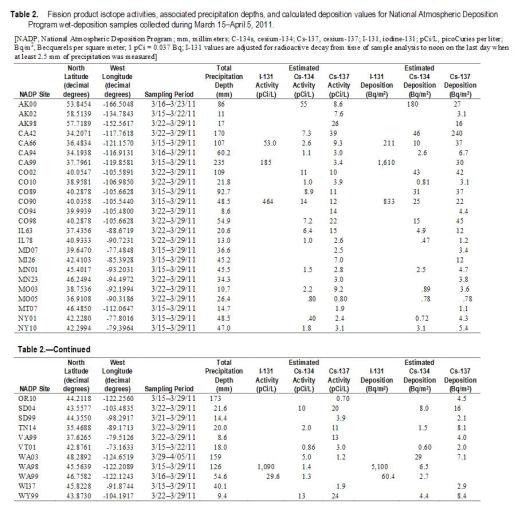
1,090 picocurie is 40.33 becquerels. 40.33 becquerels/liter was calculated into 5,100 becquerels/square meter, with the conversion factor of about 126.
Fukushima Leaking Even MORE Radioactive Water, Squishing Sludge update 4/7/13
Published on 7 Apr 2013
Dang, I’m running out of inventive titles for this Nuclear Catastrophe at Fukushima Daiichi in Japan (and the world). It occurs to me that Japan Wants someone to Bomb it into the Ocean so they don’t have to Deal with it any more. TEPCO gave up on it LONG ago (a day or so after the Earthquake/Tsunami) and wanted to throw it’s hands up and walk away. From their actions, they are simply going through the motions of trying to “fix” the triple plus meltdown hoping either someone bombs it into the Pacific Ocean, or Mother Nature shakes it into the pacific ocean.
I think my updates from now on should just be: “Fukushima, still fucked today. It’s just more fucked today than yesterday” and leave it at that. It’s all the same in the end, right?
Yes, MORE leaking radioactive water tanks with a lot of radioactive Strontium ETC.
Ooh, someone figured out how to reduce radioactive sludge to be smaller. Pop Quiz, where did the other radioactivity go to? Is it just more concentrated in volume, or did it “evaporate” back into the atmosphere? After all, BURNING the radioactive debris is “fair game” … and TEPCO already admitted to hoping it would “evaporate” due to storage problems! Did I mention nobody has offered to “take” said reduced radioactive sludge?
PM Abe (albeit an unfair election by the pronuclear – still being contested) insists on REBUILDING the Fukushima area – and “the future of Japan Depends on it’s rebuilding of the area?!!!! WTF. I swear they said that a while ago, if you can only imagine!!!
North Korea posturing to shot a missile at Japan. Just think about all the targets it could hit with all the Nuclear power plants there. (I’m biting my tongue here at the keyboard).
Ooh, here’s a good one, a single fish got the fuck out of Japan safely and hit the Oregon shores. And people were kind enough to put it in an aquarium and google at it.
Joni Mitchell Big Yellow Taxi
http://www.youtube.com/watch?v=xWwUJH…
Embassy evacuations due to North Korea threats.
Latest Headlines:
http://enenews.com/
US Reviews New Preconditions For The Iran Uranium Swap because of shortage of medical isotopes

…..Currently, Canada’s only source of the isotope is the reactor in Chalk River, Ont., which produces about a third of the world’s supply. But the reactor has been plagued with safety and operational problems, leading to worldwide shortages, and its license is set to expire in 2016………
Image source ; http://seekingalpha.com/article/1317151-medical-isotope-producers-could-be-lucrative-investment-ventures?source=google_news (diagram only shows Canada producing 4 percent instead of 33 percent ???)
Noam Chomsky in conversation with Jonathan Freedland
From 1.36 mins for Chomsky`s statement on the Brasil/Turkey brokered deal
Iran’s Proposed Nuclear Fuel Swap
2010
In a deal brokered by Turkey and Brazil, Iran has agreed to turn over more than half (2,640 pounds) of its low-enriched uranium to Turkey in exchange for 265 pounds of medium-enriched fuel for medical isotopes for treating Iranian cancer patients. Under the terms of the agreement, the fuel will remain the property of Iran but will be monitored by the UN. David Cortright, a nuclear policy expert, says the swap is a positive development that the U.S. should support…
http://kroc.nd.edu/newsevents/quickquestions/iran-s-proposed-nuclear-fuel-swap-621
US Reviews New Preconditions For The Iran Uranium Swap
- US Intelligence
- April 7, 2013
Brokering a deal to swap Iranian uranium stockpiles, Brazilian and Turkish leaders started a collision between Tehran and Washington; utimately starting a fourth round of sanctions. Securing a crucial agreement with all the permanent members of the UN Security Council, the United States was moving into it’s fourth round of sanctions. Addressing the reporters the P-5 (US, Russia, China, Britain, and France) spoke to them after a closed door meeting drafting a resolution that was presented to the council’s 10 non permanent members.
Alu scholars selected a case in which to analyze their international relations elective. They were given a short time frame with which to come up with varied solutions. The solutions were then ran thru simulation to test the results.
The Brazil–Turkey initiative allows Iran to move ahead with it’s uranium enrichment. The P5 had reached a point of no return. Turkey and Brazil, both being non permanent members met with Iran and signed an agreement to ship 1.2 tons of low enriched uranium to Turkey in exchange later for 120kg of enriched isotope for it’s medical nuclear reactor in Tehran. Considered a breakthrough, in the aftermath of the long stalled negotiations over Iran’s nuclear program, it failed to allay western concerns the Turkey is working secretly violating international agreements to seek nuclear weapons technology.
The Brazilian and Turkish leaders claimed a diplomatic goal and filed a motion for the sanctions to be lifted; this was followed by a draft resolution by the US to all their members of the Manhatten based chamber the next day. A New York based Foreign Council analyst Steven Cook stated, “The central thrust of US diplomacy has been that Iran is not trustworthy, that Iranian intentions regarding weaponization are clear and the deal isn’t as good as the Turks and the Brazilians were making it out to be.”
Mining Corporations seek radioactive rethink of risk assessment! Profit before health?
- by: Annabel Hepworth
- From: The Australian (subscription only)
- April 08, 2013 12:00AM
URANIUM miners have demanded changes to laws so that the “mild” radioactivity that is unique to the sector is no longer a trigger for federal environmental assessments.
The Australian Uranium Association — whose members include BHP Billiton and the operator of the Ranger mine at Jabiluka in the Northern Territory, ERA — says that uranium mining and the milling that makes yellowcake should no longer be defined as a “nuclear action” under the federal law known as the Environment Protection and Biodiversity Conservation Act.

…..Australia is obliged to provide for safe and secure management of radioactive waste under the Joint Convention on the Safety of Spent Fuel Management and on the Safety of Radioactive Waste Management, and report on the implementation of its obligations every three years………….This total does not include uranium mining wastes, which are disposed of at mine sites.
Over half the volume of Australia’s current low level and short-lived intermediate level waste is some ten thousand drums of lightly contaminated soil – a legacy of CSIRO research into processing radioactive ores during the 1950s and 1960s. …….
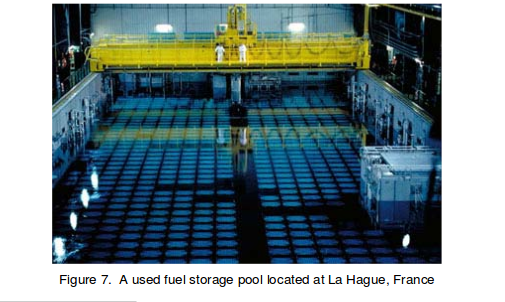
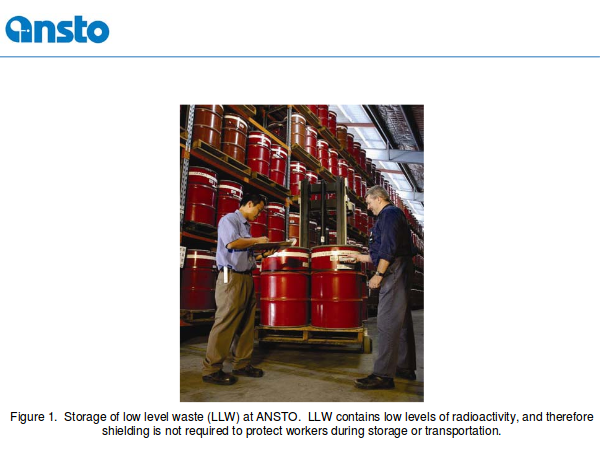
…….Under the current international guidance, there is not a precise boundary between each of the waste categories, as limits on the acceptable level of activity concentration will differ between individual radionuclides or groups of radionuclides. Waste acceptance criteria for a particular near surface disposal facility will be dependent on the actual design of and planning for the facility………
…….Previously, a contact dose rate of 2 mSv/h was generally used to distinguish between LLW and ILW…….
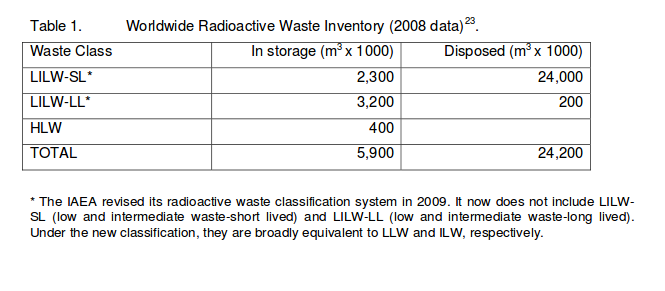
,,,,,,Waste is often stored indefinitely in facilities that were not designed for long term storage of such material. Such storage, while currently safe, is not ideal. In many cases, storage facilities were not designed for this use and are nearing capacity.,,,,,,
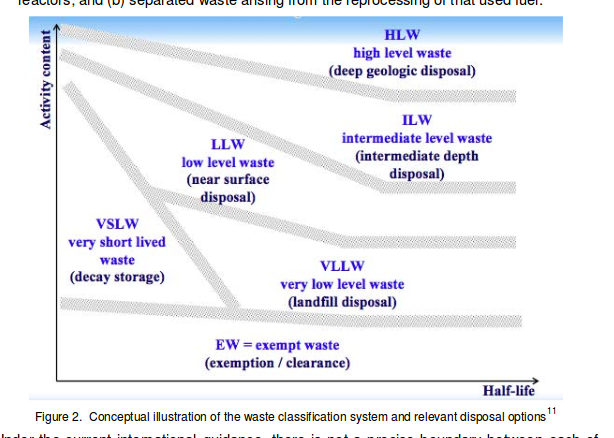
Radioactive waste is a subset of the much broader category of hazardous wastes.
Current global hazardous waste production is approximately 400 million tonnes per annum.
Radioactive waste from nuclear power plants and the fuel cycle support facilities comprises approximately 0.4 million tonnes per annum, or approximately 0.1% of global hazardous waste. Low level and short-lived intermediate level waste is already being disposed of in many countries. Over three quarters of all radioactive waste (on a volume basis) has already been sent for disposal.
Because of the wide variety of nuclear applications, the amounts, types and even physical forms of radioactive wastes vary considerably. They include solid, liquid and gaseous wastes. Some wastes (such as the small radioactive sources found in smoke detectors) carry little or no safety or security risk; however, some other wastes are highly radioactive and must be managed appropriately to address safety and security issues. Internationally, the major source of radioactive waste has been from the development and production of fissile materials for weapons manufacture, especially dating from the cold war period (often referred to as ‘legacy wastes’). The major sources of non-military waste internationally are fission products and contaminated and activated materials from nuclear power generation, including various process wastes arising from parts of the nuclear fuel cycle such as reprocessing, and the decommissioning of nuclear facilities.
ANSTO conducts extensive research in the area of radioactive waste and has developed wasteforms to treat radioactive wastes using a technology called HIP (hot-isostatic pressing) under the ANSTO Synroc brand. The waste is combined with a ceramic material and using the high pressure and temperature of the HIP, it is compressed and sealed into a ceramic wasteform. This process is designed to safely encapsulate the waste for tens of thousands of years. The product is then stored inside shielded containers. …..
Australia has accumulated approximately 4,000 cubic metres (m3) – less than the volume of two Olympic swimming pools – of low level and short-lived intermediate level radioactive waste from over fifty years of research, medical and industrial uses of radioactive materials.
Fukushima Rad News 4/6/13: Radioactive Water Seeping Into the Ground?; Strontium Detected In Spill
Published on 6 Apr 2013
TEPCO: Radioactive water may seeped into ground
Tokyo Electric Power Company says a small amount of radioactive water may have seeped out of an underground water storage facility at the Fukushima Daiichi nuclear power plant. The water contained strontium.
The utility spokesperson says that on Friday engineers detected a radioactive substance in the water between the layers of waterproof sheets covering the storage facility. The level of radioactivity is considered by the utility to be low.
RADIATION EFFECTS IN ORGANIC COMPOUNDS
http://nuclearpowertraining.tpub.com/…
http://nuclearpowerradiation.tpub.com…
TEPCO removing radioactive water
Tokyo Electric Power Company has begun transferring radioactive water from a leaking storage tank at its Fukushima Daiichi nuclear plant.
The company says radioactive strontium and other substances were detected on the ground around a storage tank from Wednesday to Friday.
Abe promises to rebuild disaster-hit area
Prime Minister Shinzo Abe says his government will do all it can to help rebuild areas devastated by the earthquake and tsunami that hit northeastern Japan on March 11th, 2011.
Abe visited the stricken areas on Saturday. It was his 5th such visit since taking office in December.
New Fukushima facility shrinks nuclear sludge
The city of Fukushima now has Japan’s first facility capable of reducing the volume of the radioactive sludge from the 2011 nuclear disaster.
The facility was installed by the Environment Ministry in a municipal sewage treatment plant. A ceremony was held in the city on Saturday.
Removal of radioactive water continues
Tokyo Electric Power Company is working to transfer radioactive water from a leaking storage tank at its damaged Fukushima Daiichi nuclear plant.
Radioactive water stored in a large underground tank was found to be leaking between Wednesday and Friday.
The utility estimates that 120 tons have leaked so far.
This is the same amount that leaked from storage tank plumbing in March of last year. The leakage is likely to continue, making it the largest leak since the government announced that the reactors had been brought to a state of cold shutdown in December of 2011.
Workers using 4 pumps started to transfer the water to an adjacent tank on Saturday morning.
To shorten the time for the operation, they later began to transfer the water to another tank south of the one that is leaking. Five pumps are being used to transfer 200 tons per hour. TEPCO says it will take more than 3 days to complete the work.
TEPCO estimates that 710 billion becquerels of radioactive strontium, or about 3 times more than the annual allowable limit at the complex, has leaked.
The utility says the contaminated water has not flowed into the ocean, but the leakage is expected to continue until the transfer is completed.
TEPCO is planning to monitor the state of leakage and its impact on the environment by measuring levels of radioactive materials in the soil around the tank.
Apr. 6, 2013 – Updated 17:38 UTC
100 tones of contaminated water may have already leaked to the ground
Photos
http://fukushima-diary.com/2013/04/10…
http://fukushima-diary.com/2013/04/le…
http://fukushima-diary.com/2013/04/71…
http://www.cbs8.com/story/21840275/se…
Fukushima: Massive Leaks Continuing On a Daily Basis … For Years On End
You may have heard that Tepco — the operator of the stricken Fukushima nuclear power plants — announced a large leak of radioactive water.
You may have heard that the cooling system in the spent fuel pools at Fukushima has failed for a second time in a month.
This is newsworthy stuff … but completely misses the big picture.
Japanese experts say that Fukushima is currently releasing up to 93 billion becquerels of radioactive cesium into the ocean each day.
http://peakoil.com/enviroment/fukushi…
RADIATION EFFECTS IN ORGANIC COMPOUNDS
http://nuclearpowertraining.tpub.com/…
Hanford Waste Plan Under Debate In New Mexico
http://www.opb.org/news/article/npr-h…
VIDEO: Plymouth selectman asks NRC to organize meeting of 104 nuke towns
Read more: VIDEO: Plymouth selectman asks NRC to organize meeting of 104 nuke towns – News – Plymouth, MA – Wicked Local Plymouth http://www.wickedlocal.com/plymouth/n…
“Radiation epidemic” killing So. California sea lions? Gov’t experts now checking animals for contamination from Fukushima Daiichi
Published: April 6th, 2013 at 10:21 am ET
By ENENews

Image source ; http://fox5sandiego.com/2013/04/01/sea-lion-pups-washing-up-on-socal-beaches-at-alarming-rate/#axzz2PmiHzCp7
(Subscription Only) Title: NOAA investigates: natural die-off, radiation?
Source: The Orange County Register
Author: ERIKA I. RITCHIE
Date: April 6, 2013 at 1:46a ET
NOAA investigates: natural die-off, radiation?
A team of experts assembled by the National Oceanic and Atmospheric Agency is looking into radiation from Japan’s nuclear disaster as one of several possible causes of the ongoing sea lion stranding along Southern California beaches. […]
Sea lions keep washing ashore, many in more critical condition than in the weeks before.
[…] All sea lions present similar symptoms, including dehydration and starvation. Some are also showing secondary infections. In Ventura County, mammal centers are finding a high amount of lice. […]
“The radiation epidemic could be a potential cause,” [Sarah Wilkin, NOAA’s California stranding coordinator] said. “We need to look at what’s different in 2013 as compared to 2012, 2011 and 2010. “We will work with lab tests that look at radionuclide signatures. Scientifically, we don’t think radiation is the cause but without testing and data we can’t say for sure. We need to rule it in or out.” […]
“Marine mammals are sentinels of the eco system,” Wilkin said. […]
Watch video from the Orange County register here
Update and clarification on Japanese deep sea waste dumps
Op-Ed by Arclight2011
7 March 2013
One of the overlooked subjects concerns the undersea waste dumps located approximately 200 Km off the Japanese coast. These dumps need monitoring for more than just cesium.
Recent evidence shows us the approximate position of these dumps and I have been collecting the data together to find out if these dumps were affected by the great earthquake of March 2011 that caused 3 meltdowns at Fukushima Daichi.
The first evidence to look at is from Ian Fairlies presentation from the Helen Caldicott Symposium in New York. Below is a diagram of the area most impacted by the initial Large earthquake.
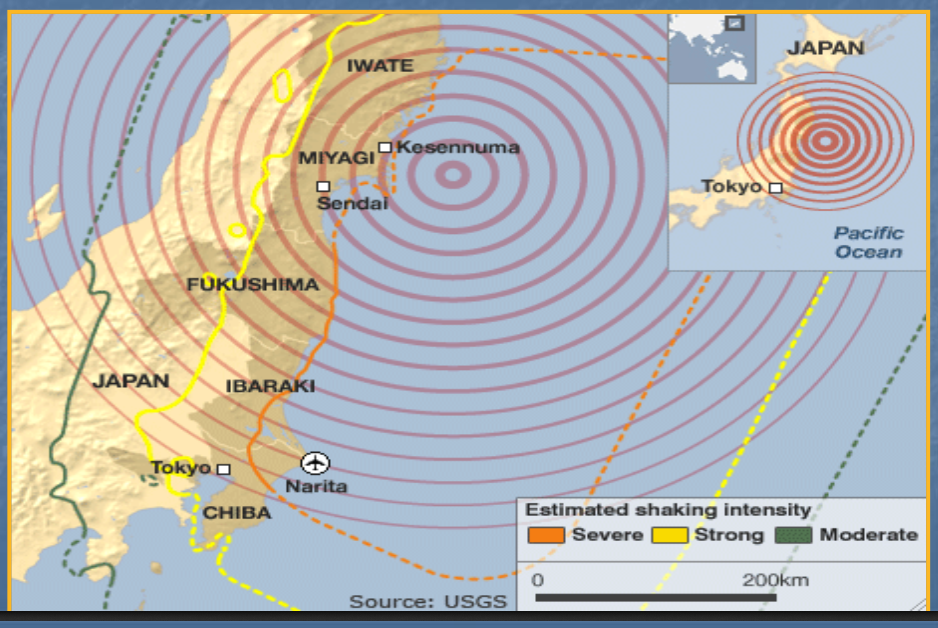
(It might be worth noting that the area of extreme shaking stops at the coast, leaving the nuclear power stations seemingly unaffected. I am only suspicious as Ian Fairlie also used data from Richard Wakeford (a Professor and ex BNFL sellafield) as evidence for the dose measurements. So, the dose measurements found on this PDF are likely an underestimate. There are many reasons to distrust Richard Wakeford to go into here. Please google his name for details in alternate news blogs, LLRC and Green Audit etc. Also, google his name with Chris Busby for interesting information.)
Next is the diagram of the dumps themselves. You will notice that area A3 and A2 seem to be possible targets from the heavy shaking area.

Next is the deposition of Cs 134 and 137 found by the recent released evidence from this report
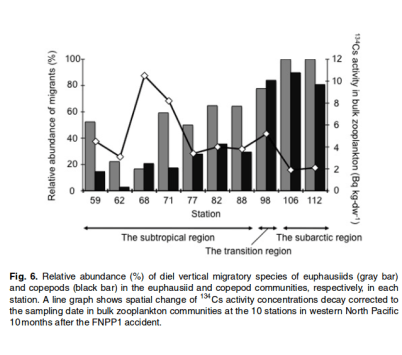
Horizontal distribution of Fukushima-derived radiocesium in
zooplankton in the northwestern Pacific Ocean
Received: 31 December 2012 – Accepted: 27 February 2013 – Published: 2 April 2013

The area near Waste Dump A2 has a proportionally higher levels of cesium 137 Graphic D on Figure 2
The currents took the radioactive effluent North East following the main current shown here;

There was this curious quote from a report.
“…Activity concentrations of radiocesium in zooplankton might be influenced not only environmental radiocesium activity concentration but also other factors that is still unknown….”
and this quote too!
“….……Regardless of how it got there, “there must be some loaded organic material somewhere in the sediment”, Kanda says…….”
And of course there was more than one earthquake and the other dumpsites A3 and A4 may also be effected.
Watch the visualisation video next to the above pictures to match hits on the dumps…..”
2011年の日本の地震 分布図 Japan earthquakes 2011 Visualization map
http://www.youtube.com/watch?v=eKp5cA2sM28
Links to resources
http://www.env.go.jp/en/wpaper/1992/eae210000000000.html#1_1_1_3
http://www.biogeosciences-discuss.net/10/6143/2013/bgd-10-6143-2013.pdf
http://www.totalwebcasting.com/tamdata/Documents/hcf/20130312-1/FairlieFukushimaNYCMarch12.pdf
http://www.nature.com/news/ocean-still-suffering-from-fukushima-fallout-1.11823
“….The oceans may have become ticking time bombs after years of U.S. military dumping have gone almost virtually unregulated, according to government documents. Legislation on the books for this fiscal year requires that the secretary of defense issue a yearly report naming the location and quantity of the dumped military munitions in U.S. waters. The National Defense Authorization Act for Fiscal Year 2007 also mandates sampling and water analysis be done around the disposal sites selected by the secretary. The size of the dump sites as well as the types and quantities of military munitions should also be identified. “The U.S. Army and DoD (Department of Defense) are working deliberately with other federal agencies to verify locations and dates of military sea disposal operations,”……”
“…..”The question always comes up that if there is no release of the munitions, is it worth the risk to pull it up and treat it,” said Siegel. “The answer isn’t clear. We don’t want to risk exposing people to ordnances unless there is a fairly present risk of danger.” The question of whether or not to pull up these sunken canisters continues to baffle and concern environmentalists, politicians, government officials and the general public. “With the initial breach of these canisters, the local impact on the biological communities will be quite high,” said McClain. “Do I think something should be done? Yes. Do I know what should be done about it? No.”…..”
http://abcnews.go.com/blogs/headlines/2007/07/underwater-tick/
And here is a map of undersea dump sites.. The Japanese sites are claimed to be unknown on this interactive map.
http://cns.miis.edu/stories/090806_cw_dumping.htm
……The team will publish all study results, Wilkens says. That’s particularly important because the issue of chemical weapons in the oceans has been kept largely under wraps in many countries, Brewer says. “The topic has pretty much been a black hole.”……. Brewer and Noriko Nakayama of the University of Tokyo wrote in a 2008 article in Environmental Science & Technology. Researchers routinely sample the water column in most of the known dumping areas, “often within a few meters of the seafloor” and “without regard for or knowledge of the disposed materials,” the duo wrote. ……. But no one knows exactly where the weapons are……
….. The records usually don’t contain coordinates. In some cases, historical information only specifies “Atlantic Ocean” or “Pacific Ocean,” according to a 2007 Congressional Research Service report……
http://www.earthmagazine.org/article/danger-deep-chemical-weapons-lie-our-coasts
“….Finally, the Russians were dumping unprocessed nuclear waste into The Sea of Japan. As late as October 1993, the Russians confirmed that one of their ships discharged 900 tons of radioactive water from scrapped nuclear submarines….”
1 This Month

Protect Sazan Island from the Trump family! https://secure.avaaz.org/campaign/en/protect_sazan_island_from_the_trump_family_loc/?bqFCVab&v=174511&cl=22707147157&_checksum=5e9dde668860e8231c33699735e16a1fbf22ab2cb01da50c999fe8732b9775ef&utm_source=email&utm_medium=blast_email&utm_campaign=174511
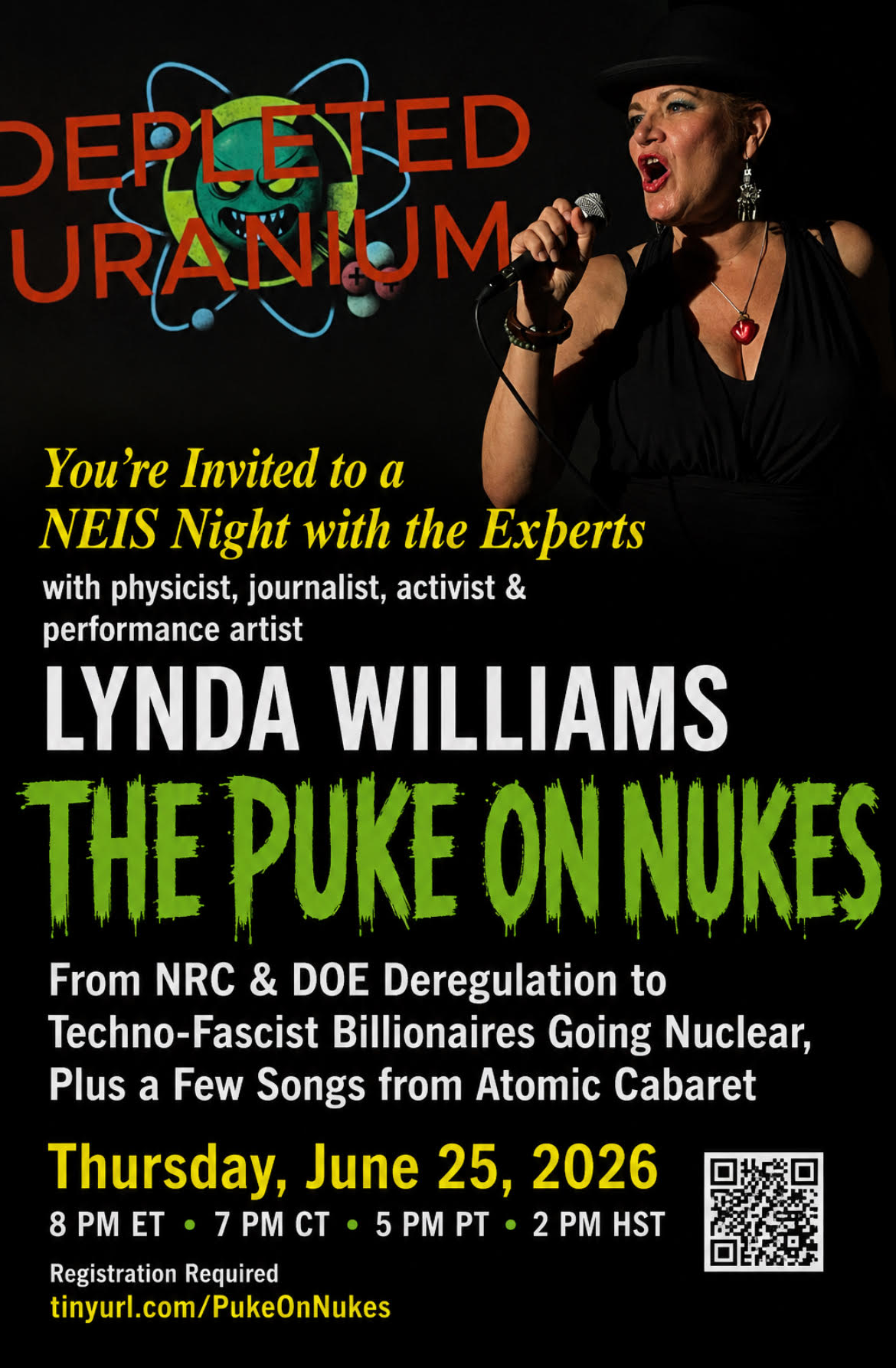
25 June- THE PUKE ON NUKES
Thursday, June 25, 2026
7pm Central Time (8pm ET, 6pm MT, 5pm PT) UTC – 5
From NRC & DOE Deregulation to Techno-Fascist Billionaires Going Nuclear, Plus a Few Songs from Atomic Cabaret REGISTER
26 June – Radiation Trainwreck at the NRC / Join the Protect Better Campaign – https://us02web.zoom.us/meeting/register/4ZlZ5_qLSHGiLSCg8FF6Bg#/registration


Cuba Is Not a Failed State – It Is a Besieged State
PETITION: “Global Appeal to Endorse Palestinian Right of Return of Refugees”
To see nuclear-related stories in greater depth and intensity – go to https://nuclearinformation.wordpress.com
-
Archives
- June 2026 (140)
- May 2026 (306)
- April 2026 (356)
- March 2026 (251)
- February 2026 (268)
- January 2026 (308)
- December 2025 (358)
- November 2025 (359)
- October 2025 (376)
- September 2025 (257)
- August 2025 (319)
- July 2025 (230)
-
Categories
- 1
- 1 NUCLEAR ISSUES
- business and costs
- climate change
- culture and arts
- ENERGY
- environment
- health
- history
- indigenous issues
- Legal
- marketing of nuclear
- media
- opposition to nuclear
- PERSONAL STORIES
- politics
- politics international
- Religion and ethics
- safety
- secrets,lies and civil liberties
- spinbuster
- technology
- Uranium
- wastes
- weapons and war
- Women
- 2 WORLD
- ACTION
- AFRICA
- Atrocities
- AUSTRALIA
- Christina's notes
- Christina's themes
- culture and arts
- Events
- Fuk 2022
- Fuk 2023
- Fukushima 2017
- Fukushima 2018
- fukushima 2019
- Fukushima 2020
- Fukushima 2021
- general
- global warming
- Humour (God we need it)
- Nuclear
- RARE EARTHS
- Reference
- resources – print
- Resources -audiovicual
- Weekly Newsletter
- World
- World Nuclear
- YouTube
-
RSS
Entries RSS
Comments RSS
 nuclear-news