Bellona’s St. Petersburg office meets with Norwegian PM Stoltenberg over Russian NGO crackdowns
Charles Digges, 05/04-2013
Bellona.org
Norwegian Prime Minister Jens Stoltenburg today met with representatives of the Environment and Rights Center (ERC) Bellona to discuss onerous fines the Russian Prosecutor General is hinting it will levy against the organization and the situation of Russian NGOs in general.

The meeting, which took place at the Norwegian consulate, comes quickly on the heels of a meeting ERC Bellona’s Executive Director Nikolai Rybakov had with prosecutors on Wednesday, where they hinted ERC Bellona could be fined some $20,000. Prosecutors said then that they were still compiling evidence and told Rybakov a final decision on the fine would be made next Wednesday.
Rybakov said that Stoltenberg, who is in St. Petersburg to attend the meeting of Baltic Sea Countries later on Friday, promised to bring up the concerning situation of Russian NGOs with Russian Prime Minister Dmitry Medvedev, who is also attending the meeting.
Bellona’s General Director Nils Bøhmer in Oslo said that, “It is vitally important that Prime Minister Stoltenberg take a vigorous position defending not only Bellona’s work, but the work of thousands of other NGOs in Russia.”
“We are not spies,” he added. “Our work is centered on 20 years of supporting Russian citizens’ rights to a clean environment.”
A month of ‘unannounced inspections’
ERC Bellona is just one of thousands of NGOs that have been swooped on by a variety of Russian official bodies from the tax inspectorate to health and fire officials over the last month, apparently as part of a new enforcement effort of Russia’s new laws requiring civil society organizations engaged in vaguely defined “political activity” to register with the Ministry of Justice as “foreign agents.”
Dr. O. Turk-Warshawsky’s warnings on Fukushima radiation to USA’s West Coast
 Transcript of radio broadcast by Dr. O. Turk-Warshawsky March 17, 2011., Long Beach, California,
 Today I would like to describe a current situation on the US West coast due to Japanese nuclear disaster, go over the possible dangers and provide recommendation how to minimize exposure to the radioactive particles.
I received many questions and would like to address them in my presentation
Can the radiation reach the US West coast?
The answer is yes; the air masses during this season are going at high speed across the Pacific, however most heavy elements such as plutonium and strontium will be deposited near the station (as it happened during Chernobyl disaster back in 1986)
In my opinion we should expect to detect cesium 137- and possible iodine-131 isotopes Continue reading
Japan’s oversight of Fukushima radiation too lax: public concern about food
Japan nuclear safety plans too lax for crowded, quake-prone nation, say nuclear experts The Star, By: Mari Yamaguchi The Associated Press, Apr 08 2013 TOKYO—Experts who investigated Japan’s nuclear crisis said Monday that government oversight of the crippled plant’s operator is still too lax, as public concern has grown over recent safety problems.
A power failure last month caused by a rat that short-circuited a switchboard left the Fukushima Dai-ichi nuclear plant’s fuel storage pools without cooling water for more than a day. Last Friday another cooling failure occurred, and hours later the operator reported a large leak of radioactive water from underground tanks.
The plant’s operator, Tokyo Electric Power Co., revealed Saturday that up to 120 tons of highly contaminated water escaped from a temporary underground tank and a smaller amount from another tank. TEPCO said it believes the water has not flowed into the ocean.
Regulators asked TEPCO on Monday to determine the cause and contain the problem quickly.
But the investigators told parliament on Monday that the recently formed Nuclear Regulation Authority is merely rubber-stamping TEPCO’s work at the plant, Continue reading
Korean nuclear conflict would result in utter devastation
Putin warns Korean nuclear conflict could make Chernobyl ‘a fairy tale’ TV NZApril 09, 2013 Source: ReutersRussian President Vladimir Putin says any nuclear conflict on the Korean peninsula could make Chernobyl look like a fairy tale.
His remark came as North Korea suspended its sole remaining major project with the South, after weeks of threats against the United States and South Korea.
Putin said conflict on the peninsula could cause greater devastation than the Chernobyl nuclear disaster in 1986.
“I would make no secret about it, we are worried about the escalation on the Korean peninsula, because we are neighbours,” he told a joint news conference with German Chancellor Angela Merkel during a visit to a trade fair in Germany.
“And if, God forbid, something happens, Chernobyl which we all know a lot about, may seem like a child’s fairy tale. Is there such a threat or not? I think there is… I would urge everyone to calm down… and start to resolve the problems that have piled up for many years there at the negotiating table.”
Reclusive North Korea’s decision to all but close the Kaesong industrial park coincided with speculation that it will carry out some sort of provocative action – another nuclear weapons test or missile launch – in what has become one of the most serious crises on the peninsula since the end of the Korean War in 1953….. http://tvnz.co.nz/world-news/putin-warns-korean-nuclear-conflict-could-make-chernobyl-fairy-tale-5399414
South Korea: backdown on claims about North Korea’s nuclear test preparations
S. Korea official backpedals on North’s nuclear test preparation Pyongyang has underground tunnels for nuclear tests CBC News, 9 Apr 13 The Associated Press A top South Korean official says he misspoke when he told legislators there is an “indication” that North Korea is preparing for a nuclear test. But that doesn’t change what Seoul has been saying for months: that Pyongyang has already prepared a tunnel for a nuclear blast and can use it whenever it wants….. http://www.cbc.ca/news/world/story/2013/04/08/north-korea-fourth-nuclear-test-possible-south-korea.html
Fukushima radiation levels rise in rivers, in food 225 miles away
 Deadly levels of radiation found in food 225 miles from Fukushima: Media blackout on nuclear fallout continues
http://thewatchers.adorraeli.com/2013/04/08/deadly-levels-of-radiation-found-in-food-225-miles-from-fukushima-media-blackout-on-nuclear-fallout-continues/ – Source: NaturalNews By Ethan A. HuffAPRIL 8, 2013 NEW DATA  RELEASED BY JAPAN’S MINISTRY OF HEALTH, LABOR AND WELFARE (MHLW) SHOWS ONCE AGAIN THAT THE FUKUSHIMA DAIICHI NUCLEAR DISASTER IS FAR FROM OVER. DESPITE A COMPLETE MEDIA BLACKOUT ON THE CURRENT SITUATION, LEVELS OF CESIUM-137 (CS-137) AND CESIUM-134 (CS-134) FOUND IN PRODUCE AND RICE CRACKERS LOCATED ROUGHLY 225 MILES (~ 362 KM) AWAY FROM FUKUSHIMA ARE HIGH ENOUGH TO CAUSE RESIDENTS TO EXCEED THE ANNUAL RADIATION EXPOSURE LIMIT IN JUST A FEW MONTHS, OR EVEN WEEKS. Continue reading
Arrests as protestors gather against Uranium Processing Facility
Protest against Uranium Processing Facility http://blogs.knoxnews.com/munger/2013/04/protest-against-uranium-proces.html 6 April 13, Peace activists gather across from the Y-12 nuclear weapons plant this afternoon to protest the government’s plans to construct the multi-billion-dollar Uranium Processing Facility at the Oak Ridge site. Newly installed barriers prevented the protesters from gathering at the Y-12 sign near the plant entrance, a traditional spot for protests, and Oak Ridge police routed the protesters — who marched to Y-12 from a city park — to the other side of Scarboro Road. Three protesters (Gyoshu Utsumi of Newport, Bill Ramsey of Asheville, N.C., and Larry Coleman of Knoxville) were reportedly arrested during the march for impeding traffic.
TEPCO on a tightrope in attempt to move tons of radioactive water
 Japan nuclear safety plans too lax for crowded, quake-prone nation, say nuclear experts The Star, By: Mari Yamaguchi The Associated Press,Apr 08 2013 TOKYO
“…….TEPCO is moving tons of highly radioactive water from the temporary tanks to two similar ones nearby to minimize the leak. They are among seven underground tanks of different sizes which employ the same design.
TEPCO admitted Sunday it had dismissed earlier signs of water loss as within a margin of error and waited until a spike in radiation levels around the tanks was detected. Critics suspect cash-strapped TEPCO built poorly designed underground pits instead of safer and more manageable steel tanks to save money. TEPCO has also been criticized for delaying replacement of makeshift equipment, raising questions about whether the plant is really under control.
The underground tanks, several times the size of an Olympic swimming pool and similar to an industrial waste dump, are dug directly into the ground and protected by double-layer polyethylene linings inside an outermost clay-based lining, with a felt padding between each layer. Officials suspect there were ruptures in the linings due to the weight of the water.
Contaminated water at the plant, which suffered multiple meltdowns after the 2011 disaster, has escaped into the sea several times during the crisis. Experts suspect a continuous leak into the ocean through an underground water system, citing high levels of contamination in fish caught in waters just off the plant.
The contaminated water in the tanks is part of more than 270,000 tons of water used to cool melted fuel at the plant’s reactors damaged in the disaster. So much water has been used that TEPCO is struggling to find storage space. The water is also kept in hundreds of steel tanks.
NRA commissioner Toyoshi Fuketa told reporters Monday that the water leak poses a more immediate threat to the plant’s water management than to the environment. He questioned TEPCO’s risk evaluation in the tanks’ design process, but acknowledged that regulators have to allow TEPCO to use the remaining underground tanks for now.
“Although we need more long-term plans, we have to tackle the most immediate problem first. TEPCO’s decommissioning process is a tightrope situation to begin with,” he said. http://www.thestar.com/news/world/2013/04/08/japan_nuclear_safety_plans_too_lax_for_crowded_quakeprone_nation_say_nuclear_experts.html
Japan – Spent nuclear fuel reprocessing costs nearly triples, a blow to utilities!
“Britain plans to shut down its reprocessing plant after the last shipment of radioactive waste to Japan is finished,” Sawai said. “Japan should abandon the planned reprocessing activity and rather ponder how to restore and manage spent nuclear fuel.”
April 08, 2013
By SHIN MATSUURA/ Staff Writer
Source : The Asahi Shimbun
http://ajw.asahi.com/article/0311disaster/fukushima/AJ201304080007
The cost for overseas reprocessing of spent nuclear fuel from Japanese nuclear power stations has nearly tripled since 1995 because of problems at a contracted British plant, which is likely to further hurt utilities and be passed along in rate hikes for electricity users.
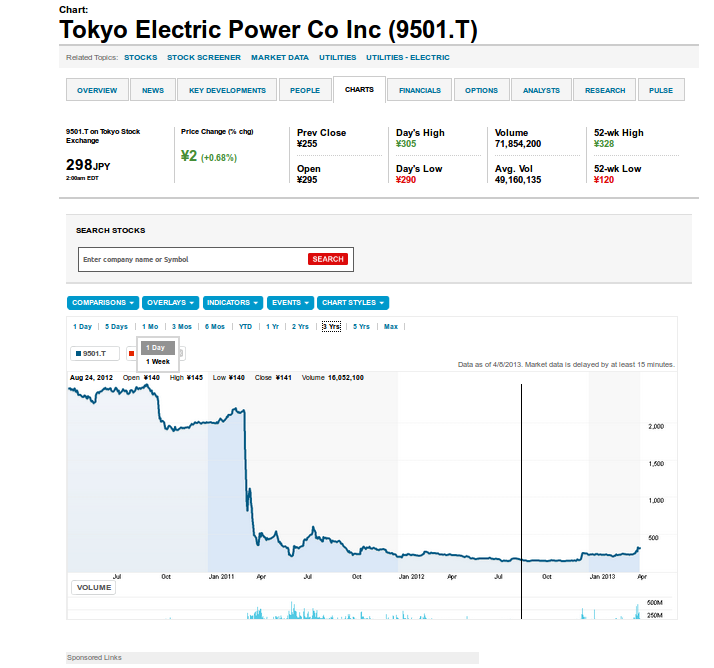
Image source ; http://www.reuters.com/finance/stocks/chart?symbol=9501.T
The cost surged apparently because the plant is plagued with a slew of problems, including leakage of waste liquid.
The current cost at the plant that Japanese utilities commissioned for reprocessing is 122 million yen ($1.28 million) per container of vitrified high-level radioactive waste. That compares with 44 million yen in 1995, when the shipment of such waste from France back to Japan started.
The overall cost for reprocessing spent nuclear fuel into 790 more containers of waste that are scheduled to be returned to Japan is expected to be around 100 billion yen.
A rise in reprocessing costs is will strain utilities’ balance sheets further, and to be passed on to consumers, according to experts.
Shipments of spent nuclear fuel from Japanese power stations to reprocessing plants in Britain and France started in the 1970s to extract plutonium and make nuclear fuel out of it. Large amounts of high-level radioactive waste, which is left over in the reprocessing work, is shipped back to Japan.
Ma Zhaoxu Attends Talks on Iran Nuclear Issue in Almaty
8 April 2013

From April 5 to 6, 2013, a new round of talks on the Iran nuclear issue was held in Almaty, Kazakhstan. Six countries on the Iran nuclear issue – the U.S., Britain, France, Russia, China and Germany as well as Iran attended the talks. China’s Assistant Foreign Minister Ma Zhaoxu led the Chinese delegation.
Ma pointed out that this round of talks is constructive and significant. For the first time the two parties conducted sincere, in-depth and substantive discussions on the solution to the Iran nuclear issue. They have common concerns while differences still exist in their stances. The Chinese side expects that all relevant parties, by continuing to narrow the gaps and gradually expand consensus during negotiations, would provide conditions where a comprehensive and long-term solution to the issue is possible. China is consistently committed to talks of peace and is ready to work with all sides to make continued and constructive efforts toward that end.
During the meeting, Ma also met with representatives of the U.S., Russia, Iran and France.
Breaking! EDF ‘in big trouble’ says French nuclear expert
Mr Schneider said that EDF with debts of €39bn (£33.3bn) might not have the cash to put into Hinkley and added: “It’s not certain it will go ahead.
“There are a long list of issues that need to be agreed, not only the strike price. Even if there is an agreement the financing package has to be put together. It’s a very long-term investment of very uncertain levels of realisation.”
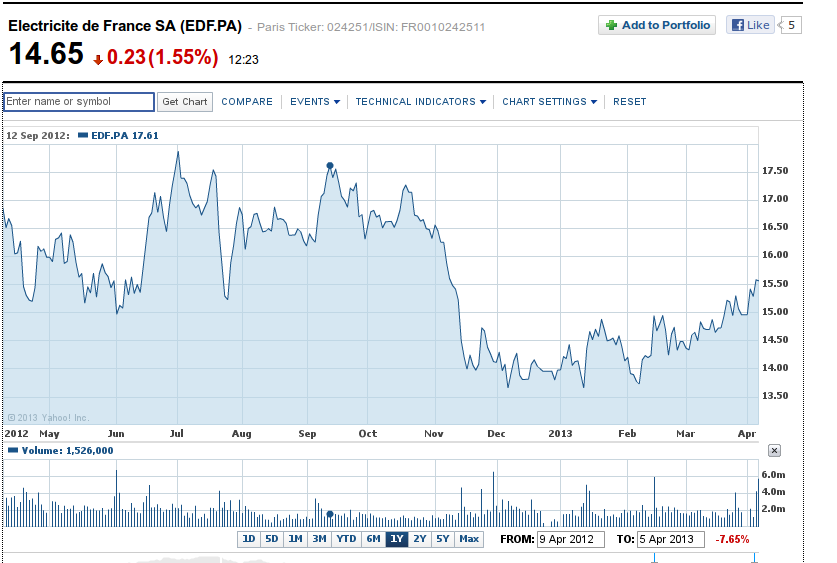
The top graph is the reaction to the news and the bottom graph shows you the dire situation over the last year (even with all the “good” news)
Telegraph
8 April 2013
Financial problems facing EDF (Paris: FR0010242511 – news) could force the French energy giant to pull out of the £14bn project to build the first of a new generation of nuclear power plants in Britain, a French expert has warned.
Mycle Schneider, a former energy adviser to the French government, questioned whether EDF could finance the investment.
“EDF is in big trouble. The whole of the nuclear power industry in France is in big trouble,” he said.
His comments, on the BBC Radio 4 Today programme, came as David Cameron prepared to raise the nuclear power issue with the president of France, Francios Hollande, during his lightning tour to try to win support for EU reforms.
President Hollande is seen as a pivotal figure because he wants state controlled EDF to curb its nuclear power ambitions and invest heavily in improving safety at plants in France as well as giving a higher priority to renewable energy.
Negotiations on a deal between EDF and the Government over the construction of a massive plant at Hinkley Point in Somerset are deadlocked because the two sides have failed to agree on a price for electricity and a range of other guarantees.
EDF is also trying to find a partner to fill the gap left by Centrica (LSE: CNA.L – news) which has abandoned nuclear power.
Lord Deighton, Treasury Commercial Secretary and former chief executive of the London Olympic organising committee, has been given the task of hammering out an agreement the Government regards as crucial to meet its nuclear power ambitions to reinforce the electricity generating network and avoid the “lights going out.”
Mr Schneider said that EDF with debts of €39bn (£33.3bn) might not have the cash to put into Hinkley and added: “It’s not certain it will go ahead.
“There are a long list of issues that need to be agreed, not only the strike price. Even if there is an agreement the financing package has to be put together. It’s a very long-term investment of very uncertain levels of realisation.”
http://uk.finance.yahoo.com/news/edf-big-trouble-says-french-104450052.html
Caldicott Versus The Nuclear Industry – an impressive symposium

 Conference Highlights Fukushima Consequences http://rense.com/general95/confhigh.htm By Richard Wilcox Ph.D.
4-6-13 ”….Caldicott Versus The Nuclear IndustryLong time activist and medical doctor, Helen Caldicott, recently assembled some of the world’s top experts to enlighten us about the situation:
“The Medical and Ecological Consequences of the Fukushima Nuclear Accident,” a two-day conference is now posted onlinehttp://www.totalwebcasting.com/view/?id=hcf#
North Korea not in a position for nuclear strike to reach USA
 North Korea lacks means for nuclear strike on US, experts say WASHINGTON (Reuters) 8 Apr 13—North Korea’s explicit threats to strike the United States with nuclear weapons are rhetorical bluster, as the isolated nation does not yet have the means to make good on them, Western officials and security experts say.
Pyongyang has slowly and steadily improved its missile capabilities in recent years and U.S. officials say its missiles may be capable of hitting outlying U.S. territories and states, including Guam, Alaska and Hawaii. Some private experts say even this view is alarmist. There is no evidence, the officials say, that North Korea has tested the complex art of miniaturizing a nuclear weapon to be placed on a long-range missile, a capability the United States, Russia, China and others achieved decades ago.
In other words, North Korea might be able to hit some part of the United States, but not the mainland and not with a nuclear weapon. Continue reading
Another water storage tank leaking at Fukushima Daiichi power plant
Second leak detected at Fukushima nuclear plant Reuters | Apr 8, 2013, TOKYO: Radioactive water has apparently leaked from another underground storage tank at the crippled Fukushima Daiichi power plant, Tokyo Electric Power Co (Tepco) said on Sunday.
The volume of the latest leakage was believed to be small, it said. On Saturday, it said as much as 120 tonnes of radioactive water may have %leaked from another nearby storage tank.
The plant’s seven storage tanks are lined with water proof sheets meant to keep the contaminated water from leaking into the soil.The power company has faced a range of problems with leaks and with the plant’s cooling system.
Tepco said on Friday it lost the ability to cool radioactive fuel rods in one of the plant’s reactors for about three hours, the second cooling system failure at the plant in three weeks.
Nuclear fuel, even after use, has to be kept cool to prevent it from overheating and beginning a self-sustaining atomic reaction that could lead to meltdown http://timesofindia.indiatimes.com/world/rest-of-world/Second-leak-detected-at-Fukushima-nuclear-plant/articleshow/19435752.cms
Rise in hypothyroidism in USA’s west Coast babies
US Babies sick with congenital hypothyroidism from Fukushima radiation http://ecochildsplay.com/2013/04/07/us-babies-sick-with-congenital-hypothyroidism-from-fukushima-radiation/ by JENNIFER LANCE APRIL 7, 2013 Despite assurances by the US government, many of us living on the West Coast were very concerned after the fallout from the Fukushima nuclear disaster. We stocked up on seaweed and potassium iodine. We gavekelp to our pets. Two years ago, I wrote
Japan Nuclear Crisis: Protect Your Family Naturally From Radioactive Emissions:
The magnitude of the Japanese earthquake is beyond comprehension. My children have watched images on the news, and my six-year-old son repeatedly asks, “Why?” I do my best to explain plate tectonics, but the truth is I have no idea how to explain to my children about the imminent nuclear catastrophe, other than we live in One World.
We live on the west coast. Prevailing winds will bring radioactive emissions to us in three to ten days, from various sources I have read. Some of it has probably already reached us.
Then, the news a year later was that the radioactive fallout that reached the United States was potentially responsible for an increase in deaths, especially for children under one year of age.
Despite assurances from the US government that the amount of radiation reaching America from the nuclear disaster at Japan’s Fukushima plant following the tragic earthquake were safe, many of us felt the need to protect our families. We were told radiation levels were no greater than taking a flight on an airplane or receiving dental x-rays, yet the fact that this was additional radiation to these “normal” sources was largely overlooked.
Did this increase in radiation from the nuclear disaster contribute to health problems that led to an increase in US death rates, especially for children under one year of age?
Now, a peer-reviewed study has examined the increase in US deaths following Japan’s nuclear disaster, and the numbers are staggering and comparable to Chernobyl. Continue reading
1 This Month

Protect Sazan Island from the Trump family! https://secure.avaaz.org/campaign/en/protect_sazan_island_from_the_trump_family_loc/?bqFCVab&v=174511&cl=22707147157&_checksum=5e9dde668860e8231c33699735e16a1fbf22ab2cb01da50c999fe8732b9775ef&utm_source=email&utm_medium=blast_email&utm_campaign=174511
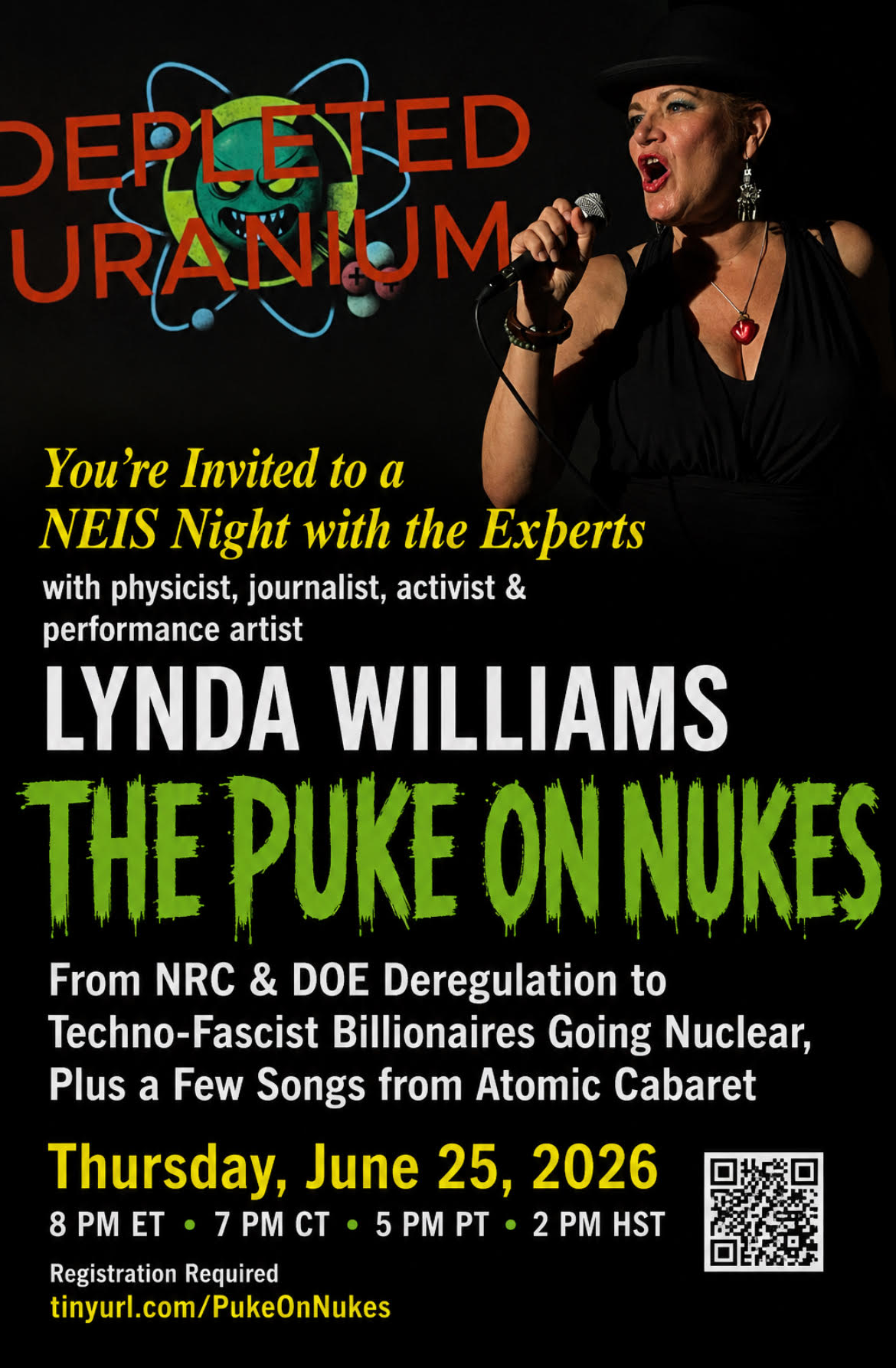
25 June- THE PUKE ON NUKES
Thursday, June 25, 2026
7pm Central Time (8pm ET, 6pm MT, 5pm PT) UTC – 5
From NRC & DOE Deregulation to Techno-Fascist Billionaires Going Nuclear, Plus a Few Songs from Atomic Cabaret REGISTER
26 June – Radiation Trainwreck at the NRC / Join the Protect Better Campaign – https://us02web.zoom.us/meeting/register/4ZlZ5_qLSHGiLSCg8FF6Bg#/registration


Cuba Is Not a Failed State – It Is a Besieged State
PETITION: “Global Appeal to Endorse Palestinian Right of Return of Refugees”
To see nuclear-related stories in greater depth and intensity – go to https://nuclearinformation.wordpress.com
-
Archives
- June 2026 (138)
- May 2026 (306)
- April 2026 (356)
- March 2026 (251)
- February 2026 (268)
- January 2026 (308)
- December 2025 (358)
- November 2025 (359)
- October 2025 (376)
- September 2025 (257)
- August 2025 (319)
- July 2025 (230)
-
Categories
- 1
- 1 NUCLEAR ISSUES
- business and costs
- climate change
- culture and arts
- ENERGY
- environment
- health
- history
- indigenous issues
- Legal
- marketing of nuclear
- media
- opposition to nuclear
- PERSONAL STORIES
- politics
- politics international
- Religion and ethics
- safety
- secrets,lies and civil liberties
- spinbuster
- technology
- Uranium
- wastes
- weapons and war
- Women
- 2 WORLD
- ACTION
- AFRICA
- Atrocities
- AUSTRALIA
- Christina's notes
- Christina's themes
- culture and arts
- Events
- Fuk 2022
- Fuk 2023
- Fukushima 2017
- Fukushima 2018
- fukushima 2019
- Fukushima 2020
- Fukushima 2021
- general
- global warming
- Humour (God we need it)
- Nuclear
- RARE EARTHS
- Reference
- resources – print
- Resources -audiovicual
- Weekly Newsletter
- World
- World Nuclear
- YouTube
-
RSS
Entries RSS
Comments RSS
 nuclear-news