USA’s rapidly accumulating, highly toxic radioactive nuclear wastes

There are 104 U.S. commercial nuclear reactors operating at 64 sites in 31 states that are holding some of the largest concentrations of radioactivity on the planet in onsite spent fuel pools.
Occupy the NRC (Nuclear Regulatory Commission), 29 Sept 12, And we thought Fukushima was bad? Check out what is in our backyards. Spent fuel is dangerous stuff. If something bad happens at a plant, it  is not just the fuel in the reactor has the potential to be released in the atmosphere. SCARY. NOT FEAR MONGERING. REALITY PEOPLE, REALITY
Reactor operating cycles in the US have been doubled from 12 to 24 months in order to generate more electricity. As a result, more spent fuel with higher radioactivity
and thermal heat is being offloaded into evermore- crowded pools during each refueling outage. Continue reading
Experts: Strike may speed up nuclear plan
Ynet
|
In article titled, ‘How to help Iran build a bomb,’ New York Times quotes scholars and military experts who argue that airstrike on Iran’s nuclear facilities could actually lead Tehran to ensure realization of bomb
On the backdrop of Prime Minister Benjamin Netanyahu‘s “red lines” address at the United Nations General Assembly this week, leading American media outlets continue to engage in the Iranian nuclear issue.
In a New York Times article titled, “How to help Iran build a bomb,” writer William J. Broad says a surprising number of experts argue that an airstrike on Iran’s nuclear facilities could actually lead to Iran’s speeding up its efforts, ensuring the realization of a bomb and hastening its arrival.
A new arms race? 2 billion dollars spent in 10 years USA just on missile technology.
http://english.pravda.ru/russia/politics/25-09-2012/122266-hypersonic_weapons-0/
Pravda
Russia tries to catch up with USA’s level of hypersonic weapons
25.09.2012
Last week, the U.S. tested X-51 WaveRider hypersonic missile, which, as reported by the media, was unsuccessful. However, the missile is capable of reaching the speed of nearly 7,000 kilometersper hour, which is six times the speed of sound. The appearance of such systems in the modern army may considerably change the existing missile parity.Russia officially returned to this topic in 2009, when the Defense Ministry ordered to resume research works to develop hypersonic arms systems. Now, according to Rogozin, the Russian defense industry must “cut corners” to reach the technological level the USA has already achieved.

A super holding will be established on the basis of the group of companies Tactical Missiles and Military-Industrial Corporation (NPO Mashinostroyenia). The new organization will operate in the field of hypersonic technologies and their development, Deputy Prime Minister Dmitry Rogozin said. Russia thus tries to keep up with the West, where supersonic missiles will form the basis of strike and missile defense systems.
As the official said, this issue had been discussed for almost six months. “In the first stage, it goes about the creation of a big superholding on the base of Tactical Missiles and the Military-Industrial Corporation,” said Rogozin.
Tactical Missiles Corporation was created in 2002 on the basis of Zvezda-Strela federal state unitary enterprise. The corporation includes a number of companies that produce highly efficient missiles, guided bombs and air, land and sea-based arms systems.
“We found an acceptable solution, as to how the superholding will be created. “The project of the decision contains the basic idea – the hypersonic technology,” said the official.
Russia is inferior to America in the field of the development of hypersonic technologies. The Pentagon generously spends money on the program of the development of hypersonic aircraft. During the past ten years, the Pentagon has spent about $2 billion on the program.
Last week, the U.S. tested X-51 WaveRider hypersonic missile, which, as reported by the media, was unsuccessful. However, the missile is capable of reaching the speed of nearly 7,000 kilometersper hour, which is six times the speed of sound. The appearance of such systems in the modern army may considerably change the existing missile parity.Russia officially returned to this topic in 2009, when the Defense Ministry ordered to resume research works to develop hypersonic arms systems. Now, according to Rogozin, the Russian defense industry must “cut corners” to reach the technological level the USA has already achieved.
A super holding will be established on the basis of the group of companies Tactical Missiles and Military-Industrial Corporation (NPO Mashinostroyenia). The new organization will operate in the field of hypersonic technologies and their development, Deputy Prime Minister Dmitry Rogozin said. Russia thus tries to keep up with the West, where supersonic missiles will form the basis of strike and missile defense systems.
As the official said, this issue had been discussed for almost six months. “In the first stage, it goes about the creation of a big superholding on the base of Tactical Missiles and the Military-Industrial Corporation,” said Rogozin.
Tactical Missiles Corporation was created in 2002 on the basis of Zvezda-Strela federal state unitary enterprise. The corporation includes a number of companies that produce highly efficient missiles, guided bombs and air, land and sea-based arms systems.
“We found an acceptable solution, as to how the superholding will be created. “The project of the decision contains the basic idea – the hypersonic technology,” said the official.
Russia is inferior to America in the field of the development of hypersonic technologies. The Pentagon generously spends money on the program of the development of hypersonic aircraft. During the past ten years, the Pentagon has spent about $2 billion on the program.
UPDATE: Interview with Tozen Union Activist in Tokyo Japan | Labor Issues in Japan
Update:
There seems to be some internet intermittent blocking on this video (below). It is currently working. The Labour Unions site is not available.
“Which leads me to the second part. I try not to be too conspiracy-minded, and I really dislike those who see black hands behind every move, but I cannot help but wonder if the abolishment of the personal scheme is not in some way linked to the fact that the national scheme is losing its ass in the markets. Could it be possible that the Japanese Govenrment is using its power to govern to legalize a massive capital grab?”
Graham (JT poster)
And the obvious reason might be found here (please read the comments as well)
Labor ministry to scrap employee pension insurance system
POLITICS SEP. 29, 2012
[…]
After a scandal in which pension funds placed in the hands of AIJ Investment Advisors Co vanished, the ministry set up a task force to deal with the financial problems faced by Japan’s pension system. The task force proposed scrapping the employees’ pension insurance system. Financial analysts say many employees’ pension insurance system funds were AIJ customers.
At a press conference this week, senior vice welfare minister Yasuhiro Tsuji, who leads the task force, said the system is scheduled to be scrapped after a transitional period, Sankei Shimbun reported. Continue reading
Courage of Margaret Chan WHO Director General, on ionising radiation
 HISTORY WAS MADE. Marion Odell, 29 Sept 2012 On May 12, 2011 history was quietly made when courageous WHO Director-General Margaret Chan said “There is no safe low level of radiation.”
Until May 12, 2011, the World Health Organization (WHO) always followed the lead of the International Atomic Energy Agency (IAEA) on nuclear health effects issues as there is a 1959 agreement that WHO would accept the findings of that organization. This agreement is still in effect and hopefully will be rescinded soon.
However this most likely will need some considerable political pressure from the
public. It is imperative that we support this tremendously important pronouncement and spread the message far and wide. This is a breakthrough that will impress the public because of the prestige of the World Health Organization and the integrity of the
Director-General Dr. Margaret Chan.

The letter to Director-General Dr. Margaret Chan from the International Institute of Concern for Public appears below. It can also be seen at iicph.org/330. Continue reading
India interrogates, deports visitors who have anti nuclear opinions
The three activists were going to visit India for only a few days. They had hoped to avail of the tourist visa on arrival to visit the “temples of modern India”. They came in solidarity, good will and peace. Neither they nor their friends in India had imagined that being “anti-nuclear” would be seen as a threat by the Indian government.

 Are you going to Kudankulam? http://www.dnaindia.com/analysis/column_are-you-going-to-kudankulam_1745780 29 Sept 12, Bela Bhatia | Agency: DNA , September 27, 2012 On Tuesday this week, three Japanese visitors who are part of the anti-nuclear movement in Japan were refused entry to India and deported on arrival at Chennai. Reading the account sent by them from Kuala Lumpur makes for not-exactly-pleasant reading.
“When we got off the plane and approached the immigration counter, one personnel came to us smiling… [and took] us to the immigration office. [There were more than five personnel there.] … one asked me [Yoko Unoda] whether I am a member of No Nukes Asia Forum Japan. ‘You signed the international petition on Kudankulam, didn’t you?’ … another person asked, ‘Mr Watarida … he is involved in the anti-nuclear movement in Kaminoseki, right?’
‘Are you going to Kudankulam? Who invited you all? … Who will pick you up at Tuticorin airport? [they had a copy of the itinerary of the domestic flight] Tell me their names. Tell me their telephone numbers. Continue reading
The nuclear industry – one continuing experiment – ON US!
 An Experiment Gone Awry Activist Post, Richard Wilcox 29 Sept 12, Activist Post, an informative journal which is concerned with disturbing social trends, recently featured an author who prescientlyand saliently observes that:
Whether it is nuclear power generation or nuclear detonation, all nuclear industry is experimental …. Continue reading
Comprehensive study of Fukushima threat: 60 minute video
 Paul Currier’s Space: http://paulcurrier.tumblr.com/post/32210303255/this-is-a-60-minute-film-that-may-save-your-life This is a 60 minute film that may save your life. If you, like me, live on
 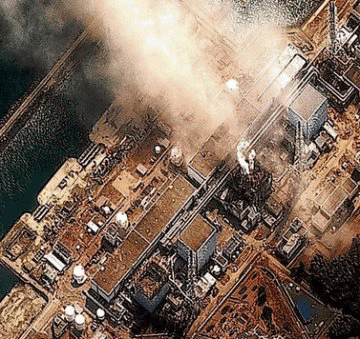 the West Coast of the USA, it’s probably too late, and you may as well just go on in your ignorance. Then again, if you care about your self or others you love, you may want to spend one hour of your life to grasp the full scope of our common situation.
No worries! India’s government says it can handle Fukushima type disaster
 Kudankulam can handle Fukushima type disaster: NPCIL tells SC First Post India 27 sept 12, New Delhi: The Supreme Court was Thursday told that the Kudankulam Nuclear Power Project (KNPP) in Tamil Nadu was absolutely safe and fully equipped to deal even with Fukushima type of accident.
The Nuclear Power Corporation of India Limited (NPCIL) told the apex court bench of Justice KS Radhakrishnan and Justice Dipak Misra that KNPP was “absolutely safe” even without the 17 recommendations by the Atomic Energy Regulatory Board (AERB), which were being put in place out of abundant caution….. Pointing to the rarity of such incidents at nuclear power plants, the NPCIL said that there had been only three major nuclear plants accidents that includes 1979 Three Mile Island accident, 1985 Chernobyl disaster and 2011 Fukushima Daiichi nuclear disaster…. http://www.firstpost.com/india/kudankulam-can-handle-fukushima-type-disaster-npcil-tells-sc-471173.html
Democratic freedoms trampled: the sorry story of India’s Kudankulam nuclear power project
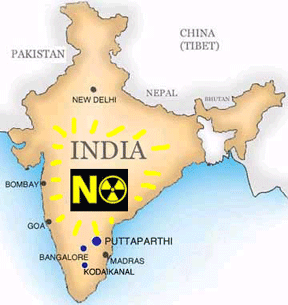 Despite mass opposition, India pushes ahead with operationalizing nuclear plant WSWS, By Arun Kumar and Kranti Kumara 27 September 2012 Despite mass protests by villagers, the Indian government in partnership with the Tamil Nadu state government is pushing ahead with the loading of nuclear fuel at the recently built 2000 MW Kudankulam Nuclear Power Plant (KNPP) located on the Tamil Nadu coast.
This massive power plant is a joint venture between India and Russia and has cost 172 billion Rupees (about $3.2 billion) to build. The plant currently houses two nuclear pressurized water reactors (PWR) reactors, each capable of driving a 1000 MW electric generator. But there are plans to construct four additional reactors at the site…..
Despite the deep misgivings of the population, the Indian elite, without any democratic debate, is rushing feverishly ahead, claiming that nuclear plants are essential to satisfying growing domestic electricity needs.
This particular plant is causing great concern among villagers and fishermen living in its vicinity, because it is situated right next to the ocean just like the Japanese Fukushima plant. Built at the southern tip of the state, KNPP is highly vulnerable to undersea earthquakes and tsunami that are an ever-present danger in the Indian Ocean region. That such concerns are far from hypothetical was demonstrated when the plant installations got inundated from ocean waves unleashed by the massive undersea earthquake that occurred in the Indian Ocean in 2004….
Last April witnessed a particularly brutal response by joint forces deployed by the Indian and the state governments. The police cut off water, food and power-supply to protesting villagers and imposed a curfew in the villages where the agitation has been centered. Nearly 200 people were arrested including women and children. Subsequently protests abated somewhat as the People’s Movement against Nuclear Energy (PMANE), which has led the agitation, called it off in the hope that the Tamil Nadu and Indian judiciaries would intervene on its behalf.
However, by late August the Madras High Court gave the green light to the Indian government to proceed with the steps it needs to take to make the plant operational. An appeal was then filed by an anti-nuclear activist with the Indian Supreme Court asking the court to halt further progress on operationalizing the plant, since 11 of the 17 critical safety measures recommended by the government’s own Atomic Energy Regulatory Board (AERB) had not been implemented.
Around this time, widespread protests resumed and the police responded with still greater violence. On Sept. 10 a protesting fisherman, 48 year-old Antony John, was shot dead. A young girl was also trampled to death when police resorted to charges to break up the protests. To observe and terrify those conducting a water protest, the Coast Guard flew low-flying aircrafts. One of the protesting fisherman named Sathyam panicked when a surveillance aircraft flew low, then slipped hitting his head against a boulder and subsequently died. Sathyam’s funeral became a rallying point for opposition to the nuclear power plant attracting large number of villagers from neighbouring areas.
Earlier this month, India’s Supreme Court refused to even hear the petition against operationalizing KNPP. In so doing, the court ignored publicly available evidence of shoddy workmanship, the dangers inherent from using an untested reactor design, and the fact that over 1 million people live within a 30 Km. radius of the plant, which violates even the AERB’s feeble safety regulations.
Following this, the Indian government proceeded post-haste to begin loading enriched-uranium fuel rods into one of the reactors. The government has said that it expects the fuel loading to be complete by Sept. 28 and the plant fully operational soon afterwards.
This move provoked the villagers into intensifying their agitation.
On Saturday, Sept. 22, over 500 fishing boats laid siege for several hours to the Tuticorin port about 100 Km north of KNPP. This port is used for unloading nuclear fuel rods from ships for transportation to the reactor at the plant. Simultaneously other protestors including villagers led by PMANE undertook “Jal Satyagraha” (Water Agitation), by standing in waist-deep water in the ocean near the plant and forming a human chain.
Solidarity protests also sprung up across the state. But the police repression has continued unabated with arrest warrants being issued for activist-leaders, many of whom including PAME leader Udayakumar have now gone into hiding. Under the pretext of looking for protest leaders, the police in bands of 10 have gone on a rampage, breaking down doors and ransacking the houses of villagers living in the Kudankulam area. This is clearly an attempt by the government to terrorize the populace into submission.
Kudankulam has been practically sealed off by armed policemen who are allowing only the transport of essential goods into the area. Public transport has also been barred from entering some of the areas surrounding the plant.
To the consternation of the authorities, the protests have now snowballed with growing numbers of people, including students, advocates and villagers, joining protests across the state and even in the Bangalore, the capital of the neighbouring state of Karnataka. … http://www.wsws.org/articles/2012/sep2012/indi-s27.shtml
Document analysing the (un)safety status of San Onofre Nuclear Power Plant
 San Onofre Nuclear Waste Generating Station Decommission San Onofre 29 sept 12 Aging Nuke Plants On Fault Lines In Tsunami Hazard Zones = Fukushimas… Any Questions? PLEASE Turn off a light for Fukushima USA / San Clemente
The Number 1 US Nuclear Safety Concern ==> San Onofre’s Replacement Steam Generators The DAB Safety Team is thankful to numerous anonymous concerned SONGS Workers, who have provided factual information in the interest of the Public Safety to us so that we could arrive at these “Reasonable Conclusions” regarding SONGS Replacement Steam Generators
Degradation. We acknowledge Fairewinds Energy Association, Professor Daniel Hirsch, Friends of the Earth, San Clemente Green, Media, News Papers and the SD Reader, whose material has contributed to the successful completion of this document. Continue reading
Radiation exposure to Nevada’s Native American communities
The assessment of radiation exposures in Native American communities (Nevada) http://nuclearhistory.wordpress.com/2012/09/28/the-assessment-of-radiation-exposures-in-native-american-communities-nevada/
http://www.ncbi.nlm.nih.gov/pubmed/10795343
Risk Anal. 2000 Feb;20(1):101-11.
The assessment of radiation exposures in Native American communities from nuclear weapons testing in Nevada.
Frohmberg E, Goble R, Sanchez V, Quigley D.
Source
Clark University, Center for Technology, Environment, George Perkins Marsh Institute, Worcester, MA 01610, USA.
Abstract
Native Americans residing in a broad region downwind from the Nevada Test Site during the 1950s and 1960s received significant radiation exposures from nuclear weapons testing. Because of differences in diet, activities, and housing, their radiation exposures are only very imperfectly represented in the Department of Energy dose reconstructions. There are important missing pathways, including exposures to radioactive iodine from eating small game. The dose reconstruction model assumptions about cattle feeding practices across a year are unlikely to apply to the native communities as are other model assumptions about diet. Thus exposures from drinking milk and eating vegetables have not yet been properly estimated for these communities. Through consultations with members of the affected communities, these deficiencies could be corrected and the dose reconstruction extended to Native Americans. An illustration of the feasibility of extending the dose reconstruction is provided by a sample calculation to estimate radiation exposures to the thyroid from eating radio-iodine-contaminated rabbit thyroids after the Sedan test. The illustration is continued with a discussion of how the calculation results may be used to make estimates for other tests and other locations.
PMID: 10795343 [PubMed – indexed for MEDLINE]
The truly fearful state of Fukushima’s nuclear reactors

 http://ifyoulovethisplanet.org/?p=6282 Arnold Gundersen with the latest on Fukushima, including the perilous worldwide consequences if reactor no. 4 collapses
Doomed Planet For A Failed Species? Fukushima’s Tragic Nuclear Consequences Richard Wilcox Activist Post 29 Sept 12“……….Gundersen was also recently interviewed by the intrepid Helen Caldicott, medical doctor and long time anti-nuclear  campaigner (12). The entire interview is highly recommended listening, not only for its incredible technical information, but also to enjoy the brilliance and humor of two of our most venerable activists.
Where are the leagues of other nuclear engineers speaking out with such  expertise? There are not many. Gundersen has intimate knowledge of what is happening at the FNPS and one wonders how he gets his information. Other than that in the public domain are there at least some concerned officials feeding him data? Gundersen tends to speak conservatively and there is certainly room for other interpretations of the situation. He may be sugar-coating the truth at times, but I think he rarely or never exaggerates the dangers.
These are main points summarized from Gundersen and Caldicott’s conversation:
- Unit 4 is being cleaned up so that Tepco can put in place the crane to remove the fuel rods. This work will not be completed before 2015 or 2016. Tepco plans to construct a building on top of what is currently there at Unit 4 in order to put in place a huge crane for removing the rods, which will then be placed in casks on the ground.
- There are concerns that the fuel rods will be damaged, but ideally they can just pull them out and put them into dry cask storage. There is a chance they will not be removed easily and get “jammed” when they try pull them out. This could take years!
- It is a very long, involved process. “They are taking way too long.” This process has to be repeated for the other reactor fuel pools as well. In the meantime we have to hope there is not another large earthquake, even though geologists think there is a likely chance of one.
- The fuel in Units 1, 2, 3 is melted down to the bottom of the reactors or “lying on the concrete” at the foundation of the reactor buildings. It took ten years to remove fuels from a melted reactor at Three Mile Island after its disaster in the US in 1979. TMI was a minor accident compared to Fukushima.
- The three reactor units at Fukushima are so highly radioactive that a million bq/liter is measured in water in surrounding buildings. That means that in the reactor buildings themselves the radiation would be exponentially higher.
- Gundersen believes the radiation is so high in the reactor areas that workers cannot do the job. The only “solution” will be to pour concrete on top of the units while “walking away for three hundred years, obviously monitoring it.” This could happen in a few years from now.
- However, Caldicott points out that the radiation will seep down into the water table for the rest of time. Arnie agrees: there is no good solution. Although “the solution would be to bore holes from underneath, and constantly pull water from out from under the building so it can be treated.” This would have to be done for a couple of hundred years to prevent contamination of the Pacific Ocean.
- If Japan’s economy shrinks, cracks, contracts and or collapses due to a variety of factors, will they have the knowledge and money to carry on with this project? Gundersen estimates the cost of the Fukushima disaster will be 500 billion dollars. The Japanese taxpayer will pay for it.
- Weighed against Japan’s rapidly aging and declining population the Japanese will be carrying a huge economic burden. The detrimental health effects from radiation will effect a substantial proportion of Japan’s population into the mists of time but will be covered up and hidden from public view, even as they perish…… http://www.activistpost.com/2012/09/doomed-planet-for-failed-species.html
Japan’s new Nuclear Regulation Authority setting new guidelines
 Nuclear Regulation Authority to set new guidelines http://japandailypress.com/nuclear-regulation-authority-to-set-new-guidelines-2713469 By Ida Torres / September 27, 2012 The newly launched Nuclear Regulation Authority is set to come up with new guidelines on nuclear disaster management, particularly expanding the area for urgent measures in the event of a nuclear accident.
Currently, the area is just at a 8-10 kilometer radius, but after the Fukushima power plant crisis in 2011, they believe the area should be expanded to a 30 kilometer radius.
The authority will also survey a fault under the Oi nuclear power plant in Fukui Prefecture after an independent survey by KEPCO showed that the fault might be active.
Part of the new guidelines that the authority is expected to draft would be to make these guidelines sanctioned under special regulation so that the local governments and entities would be required to comply and obey the instructions. Also, prefectural and municipal governments will be required to come up with new or revised disaster management
plans so authorities can determine which areas will be under priority measures. They also need to devise detailed evacuation plans for residents, especially those that are in the radius of the power plants.
The government is doing all it can to be more prepared for nuclear meltdown threats, especially after the aforementioned Fukushima events. They abolished the Cabinet Office’s Nuclear Safety Commission, which initially drafted these guidelines, to give way to the Nuclear Regulation Authority
Lithuania’s pro nuclear ruling party’s mud-slinging campaign against anti nuclear activists
 Pro-nuclear mudslinging in Lithuania’s nuclear referendum http://www.greenpeace.org/international/en/news/Blogs/nuclear-reaction/pro-nuclear-mudslinging-in-lithuanias-nuclear/blog/42350/
by Jan Haverkamp – September 28, 2012 On 14 October, the people of Lithuania go to the polls to vote in a referendum on whether the country should build new nuclear reactors in the town of Visaginas. Will they join the people of Austria who gave a resounding “NO!” in 1978 and the people of Italy who said “NO!” not once but twice in 1987 and 2011? Lithuania’s referendum campaign has begun but instead of a lively debate about energy strategies and the risks of nuclear power, the country’s ruling party, along with several others, have decided that their strategy to get support for nuclear will be mud-slinging. Everyone critical of nuclear power is basically accused of being an agent for Russia.
Mud-slinging and smear campaigns. It’s a very familiar tactic. In Russia, critics of the government are called “foreign agents”. In Belarus, anti-nuclear activists are jailed under accusations of “hooliganism” Is Lithuanian’s Prime Minister Kubilius trying to match Presidents Putin and Lukashenko?
In October and in alliance with local anti-nuclear campaigners, Greenpeace will join an “Ask the Expert” tour to some of the largest towns in Lithuania. You’ll find us in Klaipeida on October 9, Siauliai on October 10, Kaunas on October 11, and Vilnius on October 12.
There are many compelling reasons why there is no need for nuclear reactors in Lithuania and the wider region: Continue reading
1 This Month

of the week – Shut Down Drone Warfare!


Tell the Ukrainian Government to Drop Prosecution of Peace Activist Yurii Sheliazhenko

Petition to revoke the licensing of the Near Surface Nuclear Disposal Facility (NSDF) at Chalk River. https://www.ourcommons.ca/petitions/en/Petition/Details?Petition=e-7247
To see nuclear-related stories in greater depth and intensity – go to https://nuclearinformation.wordpress.com
-
Archives
- April 2026 (68)
- March 2026 (251)
- February 2026 (268)
- January 2026 (308)
- December 2025 (358)
- November 2025 (359)
- October 2025 (376)
- September 2025 (257)
- August 2025 (319)
- July 2025 (230)
- June 2025 (348)
- May 2025 (261)
-
Categories
- 1
- 1 NUCLEAR ISSUES
- business and costs
- climate change
- culture and arts
- ENERGY
- environment
- health
- history
- indigenous issues
- Legal
- marketing of nuclear
- media
- opposition to nuclear
- PERSONAL STORIES
- politics
- politics international
- Religion and ethics
- safety
- secrets,lies and civil liberties
- spinbuster
- technology
- Uranium
- wastes
- weapons and war
- Women
- 2 WORLD
- ACTION
- AFRICA
- Atrocities
- AUSTRALIA
- Christina's notes
- Christina's themes
- culture and arts
- Events
- Fuk 2022
- Fuk 2023
- Fukushima 2017
- Fukushima 2018
- fukushima 2019
- Fukushima 2020
- Fukushima 2021
- general
- global warming
- Humour (God we need it)
- Nuclear
- RARE EARTHS
- Reference
- resources – print
- Resources -audiovicual
- Weekly Newsletter
- World
- World Nuclear
- YouTube
-
RSS
Entries RSS
Comments RSS
 nuclear-news