No solution to ever-growing nuclear wastes
the intractability of the nuclear-waste problem confronting the power sector and the failure of policymakers to find a permanent solution.……the president and the energy secretary are looking to a new blue ribbon commission to recommend “a safe, long-term solution” to the waste problem

Solutions Remain Few on Issue of Nuclear- Waste Storage – Atomic Waste Gets ‘Temporary’ Home, WSJ.com, JUNE 1, 2010 By REBECCA SMITH Three months after the U.S. cancelled a plan to build a vast nuclear-waste repository in Nevada, the country’s ad hoc atomic-storage policy is becoming clear in places like Wiscasset, Maine. Continue reading
Uranium milling company won’t be able to pay for clean-up
Cash-strapped Energy Fuels can pay for uranium mill but not for clean up « Colorado Independent, 2 June 2010, Gulf spill underlines need for companies to put aside vast sums in advance By David O. Williams 6/2/10 12 A Canadian company looking to build the first new uranium mill in the United States in nearly three decades is burning through cash at a rate that could leave it broke right about the time it hopes to secure its final approvals from Colorado public health officials. Continue reading
Birth defects from depleted uranium bring lawsuit
Atomic radiation has increased the number of babies born with defects in the southern provinces of Iraq.


Fallujah babies born with birth defects as a result of Depleted Uranium WMD contaminated dust. 1 June 2010, Iraq WILL sue US and Britain over depleted uranium bombs FULL story here- http://www.presstv.ir Ministry for Human Rights will file a lawsuit against Britain and the US over their use of depleted uranium bombs in Iraq, an Iraqi minister says. Continue reading
Glut of uranium as prices plummet
 Uranium Remains Weak FNArena News – June 01 2010 By Chris Shaw Spot uranium has given up some recent gains, leading industry consultant TradeTech to reduce its indicative spot market price another US25c last week to at US$40.50 per pound. The fall reflects aggressive attempts by sellers to motivate buying interest, which is coming via material being offered at lower prices.
Nuclear giants stockpile fuel while price is cheap Times Online, June 1, 2010 Some of the world’s biggest energy companies are stockpiling the nuclear fuel used to power reactors as they try to capitalise on rock-bottom uranium prices.An oversupply of nuclear fuel on international commodity markets has followed five successive years of rapid growth in uranium ore production in Kazakhstan, which has nearly quadrupled its output since 2004.
Raw uranium prices have tumbled to around $40 per pound — almost one quarter of the levels of $140 in 2007……About one third of the world’s total supply of nuclear fuel comes from Russian nuclear weapons that have been decommissioned as part of a disarmament agreement struck with the United States at the end of the Cold War. Nuclear giants stockpile fuel while price is cheap – Times Online
Short term approach to nuclear wastes masks reality of the problem
as the world’s nuclear military powers are discovering the costs continue after the submarines and power stations have been decommissioned from active service. The equipment and reactors cannot easily or cheaply be dismantled and will remain radioactive for hundreds of years
Nuclear and radioactive waste disposal – by Patrick Boniface – Helium, 30 May 2010, Nuclear waste is dangerously toxic, its environmental impact if released would be devastating, as was witnessed during both the Chernobyl explosion, the American Three Mile Island scare and the Windscale fire of 1957.In these cases radioactive material was released into the atmosphere. With the Windscale fire some 15,000 terabequerels (TBq) of radioactive material (notably Iodine-131) were released (3).
A report compiled by Crick & Linsley in 1983 estimated that 260 people would eventually die from dieases, such as thyroid cancers, related to the release of the material during the fire, (4).
Other aspects that environmentalist’s voice concerns over include the storage of spent nuclear fuels, from commercial nuclear reactors and increasingly from redundant nuclear warships such as submarines.
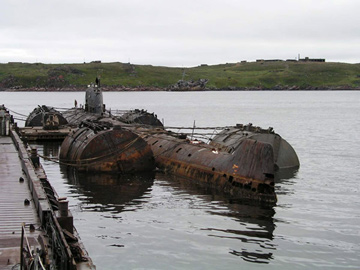
In particular in the former Soviet Union around the submarine base of Arkangel in Northern Russia there are around sixty nuclear submarines that are rotting away but still with large amounts of nuclear material contained within their hulls.
The Russian economy is unable to afford the costs of de-commissioning these submarines. The cost of decommissioning is between $100-300 million per submarine (5). Continue reading
Nuclear company AREVA’s waste dumping in Russia
 Less than 10% of the uranium mass shipped from France to Russia over the past four years “came back”….Considering the fact that the total amount of spent fuel reprocessed in France is about 38,000 tons, a significant share has gone elsewhere. It is clear now that most of it ended up in Russia
End of reprocessed uranium exports to Russia? Fissile material, By Mycle Schneider on May 29, AREVA’s controversial shipments of uranium wastes from France to Russia could be terminated as early as July 2010, according to media reports and a press release by the French chapter of the environmental group Greenpeace. Continue reading
Nuclear wastes, like diamonds, are forever
THE NUCLEAR INDUSTRY AND RADIOACTIVE WASTES – our theme for June 2010. “The question whether one generation of men has a right to bind another, seems never to have been started either on this or our side of the water. Yet it is a question of such consequences as not only to merit decision, but place also, among the fundamental principles of every government.” – Thomas Jefferson, September 6, 1789
Half-life is the period of time it takes for a radioisotope atom to degrade to a state having half of its original intensity
As you can see the continued production, use, and dumping of such waste materials as depleted uranium and plutonium, into the world’s air, land, and water leaves a permanent problem for our children, grandchildren. great-grand-children ….


U.S. politicians wake up to nuclear scam, postpone “Emergency Bill” bonus for nukes
 HOUSE APPROPRIATIONS COMMITTEE POSTPONES CONSIDERATION OF EMERGENCY BILL, $9 BILLION IN NEW REACTOR LOANS, Nuclear Information and Resource Centre, 28 May 2010, About 3 pm yesterday, the House Appropriations Committee suddenly postponed its scheduled 5 pm meeting to consider the emergency supplemental funding bill, which right now includes a provision that would allow $9 Billion in new taxpayer loans for nuclear reactor construction.
The meeting has not yet been rescheduled, but will take place after the Memorial Day recess; most likely the week of June 14.
Many Appropriations Committee members apparently didn’t even realize the nuclear loans are in this bill. And because of the way they are described–as $90 million for nuclear and $90 million for renewables under the byzantine Congressional budgeting procedures–some members may not have understood that translates into $9 Billion in taxpayer loans for new reactors.
AREVA’s uranium enrichment plant a danger to Idaho’s groundwater
Areva uranium enrichment plant in Idaho would threaten aquifer, Beyond Nuclear, 28 May 2010, The $2 billion in federal loan guarantees just awarded to Areva by the U.S. Department of Energy for a new uranium enrichment plant in Idaho, will produce depleted uranium (half-life of 4.5 billion years) and will threaten the Snake River Aquifer, say leaders of the Snake River Alliance.

Areva plans to build a new uranium enrichment plant “on the upstream end of the Snake River Aquifer a few miles east of the Idaho National Laboratory,” stated the Alliance in a press release. “INL’s nuclear activities have already contaminated the aquifer and have left substantial radioactive waste behind. Addressing these environmental challenges has already cost billions of taxpayer dollars and will continue for decades”. Continue reading
American Indians against new uranium mining
“Our Navajo communities rely on the groundwater for everything. These new projects could contaminate the source of drinking water for 15,000 Navajo community members,”

Navajo Activists Protest Uranium Mining Plans, May 28, 2010, warresisters By Bruce Finley, The Denver PostUranium-mining leaders and federal regulators poised to fuel a resurgent nuclear power industry gathered in Denver on Wednesday,…outside the conference Wednesday, American Indian demonstrators with drums and signs demanded a halt to all new uranium mining on Navajo land, where federal regulators have permitted several projects. Continue reading
Stop enriching uranum – U.N. Secretary General urges Iran
UN Secretary-General Ban urges Iran to desist uranium enrichment to 20%, NEW YORK (BNO NEWS) 29 May 2010, – United Nations Secretary-General Ban Ki-moon urged Iran on Friday to end its continued efforts to enrich uranium to 20 percent purity, the UN News announced.Ban said that if Iran stopped its uranium enrichment it would build a mutual trust over the Iranian nuclear program which the Asian country claims is for purely peaceful energy production but that many nations, and mainly the U.S., see that as an effort to obtain atomic weapons.“I have been repeatedly urging to the Iranian authorities that they have to clear their nuclear program, that it is exclusively for peaceful purposes, and it is not meant for military purposes, and they should fully comply with the relevant Security Council resolutions,” Ban said.Iran continued with its uranium enrichment process even after it agreed to ship low-enriched uranium out of the country in exchange for high-enriched uranium for use at a civilian nuclear research site. UN Secretary-General Ban urges Iran to desist uranium enrichment to 20%
One Australian Aboriginal thwarts AREVA’s uranium mining plans
”Jeffrey Lee has put country and culture ahead of personal profit and his vision means this magnificent place will be protected for all people and all time,”

Owner wants uranium-rich land to be added to Kakadu, Sydney Morning Herald, LINDSAY MURDOCH IN KAKADUMay 29, 2010 The world heritage-listed Kakadu National Park will be expanded to include thousands of hectares of ecologically sensitive land that contains uranium worth billions of dollars. In a generous act, the Aboriginal traditional owner, Jeffrey Lee, has offered the land to the federal government so that it can become part of Kakadu, where he works as a ranger. Continue reading
President Obama losing credibility on environment
In his State of the Union speech, President Obama called for “a new generation of safe, clean nuclear power plants.” After issuing $8 billion in nuclear energy loan guarantees in February, the administration is poised to announce another $9 billion for the nuclear energy industry. The Energy Department also just announced a $2 billion loan guarantee to French-owned Areva Inc. for construction of a uranium enrichment plant in Idaho after a ban on such private facilities since the 1970’s.
Are Obama’s Energy Plans Jinxed?, THE HUFFINGTON POST, D.A. Barber, 26 May 2010, President Obama’s inability — or unwillingness — to take control of the Gulf Coast oil disaster seems to be part of a larger pattern. Many environmentalists say they feel betrayed by a president they thought would end, or sharply limit, many environmental horrors of the past. Continue reading
World’s biggest uranium mine will be at risk from earthquakes
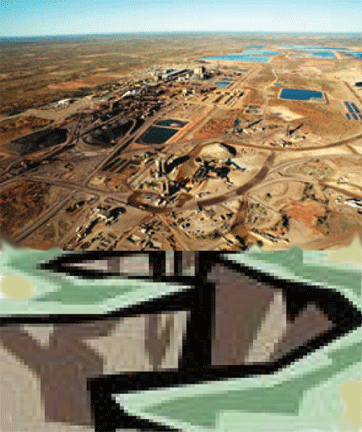 Edward Cranswick, a geophysicist and expert on earthquakes, has warned the South Australian and federal governments of the earthquake danger for the Olympic Dam uranium mine area.
This risk has been ignored in BHP Billiton’s Environmental Impact Statement for its proposed gigantic expansion which would form the world’s biggest mining hole.
The Kalgoorlie Earthquake and the Proposed Olympic Dam Mine Expansion. by Edward Cranswick, 25 May 2010, BHP Billiton has proposed to dig the largest open pit mine on the Earth at Olympic Dam, 4.1 km long, 3.5 km wide, 1 km deep. As a geophysicist who investigated earthquakes for the US Geological Survey for 22 years [1], I strongly criticised BHP’s Olympic Dam Expansion Draft Environmental Impact Statement 2009 (ODXdEIS) [2] because it omitted consideration of seismicity, i.e., rockbursts or earthquakes, caused by open pit mining, despite the fact that seismic hazard is well-known in the Australian mining industry (Hudyma et al. 2003 [3], Kalgoorlie Consolidated Gold Mines (KCGM) [4]).
The recent Kalgoorlie Earthquake emphasises the probability and consequences of these seismic events as mines grow larger and deeper – the ODXdEIS needs to be re-evaluated because it does not address this issue at all. I discuss the connection between mining and seismicity and how it is obscured in Australia, particularly the seismic hazard of the Olympic Dam mine, and I make recommendations about these matters. Read on for the complete submission. Continue reading
How the world’s savings are used to promote the nuclear industry
Who gives the nuclear industry the billions of dollars and euros of our money to build new reactors, block renewable energy, contaminate the environment and create highly dangerous waste that will be with the human race for hundred of thousands of years to come? The banks do. This is the secret the www.nuclearbanks.org website will tell you.

Nuclear banks? No thanks! | Greenpeace International, by jmckeati – May 26, 2010 , Today sees the launch of the http://www.nuclearbanks.org website, a joint venture between BankTrack, Greenpeace International, Urgewald (Germany), Les Amis de la Terre (France), Antiatom Szene (Austria), WISE (the Netherlands) and CRBM (Italy).Banks around the world love to boast about their investments in green technologies and renewable energy. What they don’t like to boast about is their involvement with the dirty and dangerous business of nuclear power. Continue reading
1 This Month
Chernobyl: The Lost Tapes – A good documentary on Chernobyl on SBS available On Demand for the next 3 weeks– https://www.sbs.com.au/ondemand/tv-program/chernobyl-the-lost-tapes/2352741955560

of the week–London Campaign for Nuclear Disarmament

Tell the Ukrainian Government to Drop Prosecution of Peace Activist Yurii Sheliazhenko
To see nuclear-related stories in greater depth and intensity – go to https://nuclearinformation.wordpress.com
-
Archives
- April 2026 (139)
- March 2026 (251)
- February 2026 (268)
- January 2026 (308)
- December 2025 (358)
- November 2025 (359)
- October 2025 (376)
- September 2025 (257)
- August 2025 (319)
- July 2025 (230)
- June 2025 (348)
- May 2025 (261)
-
Categories
- 1
- 1 NUCLEAR ISSUES
- business and costs
- climate change
- culture and arts
- ENERGY
- environment
- health
- history
- indigenous issues
- Legal
- marketing of nuclear
- media
- opposition to nuclear
- PERSONAL STORIES
- politics
- politics international
- Religion and ethics
- safety
- secrets,lies and civil liberties
- spinbuster
- technology
- Uranium
- wastes
- weapons and war
- Women
- 2 WORLD
- ACTION
- AFRICA
- Atrocities
- AUSTRALIA
- Christina's notes
- Christina's themes
- culture and arts
- Events
- Fuk 2022
- Fuk 2023
- Fukushima 2017
- Fukushima 2018
- fukushima 2019
- Fukushima 2020
- Fukushima 2021
- general
- global warming
- Humour (God we need it)
- Nuclear
- RARE EARTHS
- Reference
- resources – print
- Resources -audiovicual
- Weekly Newsletter
- World
- World Nuclear
- YouTube
-
RSS
Entries RSS
Comments RSS
 nuclear-news