Govt. to lift more Fukushima evacuation orders

The Japanese government is set to lift evacuation orders in 2 municipalities in Fukushima Prefecture, issued after the 2011 nuclear disaster.
The government will hold a joint meeting between the reconstruction taskforce and the nuclear disaster task force on Friday. On Saturday, it will be 6 years since the earthquake and tsunami.
Participants will decide on whether to lift an evacuation order in part of Namie town on March 31st and a portion of Tomioka on April 1st.
Following the accident at the Fukushima Daiichi nuclear plant, the government issued evacuation orders for 11 municipalities in the prefecture and has since gradually lifted them.
With the latest measure, the orders will be in effect only in no-entry zones with high radiation levels as well as part of the towns of Futaba and Okuma that co-host the nuclear plant.
About 1,150 square kilometers were initially subject to the government evacuation order. That number is now expected to shrink to about 369.
The central government hopes to continue decontamination work and infrastructure projects in some no-entry zones. It says it wants to create a hub for reconstruction by the end of fiscal 2021, where residents and decontamination workers will live.
But the government faces challenges in rebuilding communities as an increasing number of people, mainly the young, say they don’t want to return to their hometowns even if evacuation orders are lifted.
Long-term stays start in Tomioka
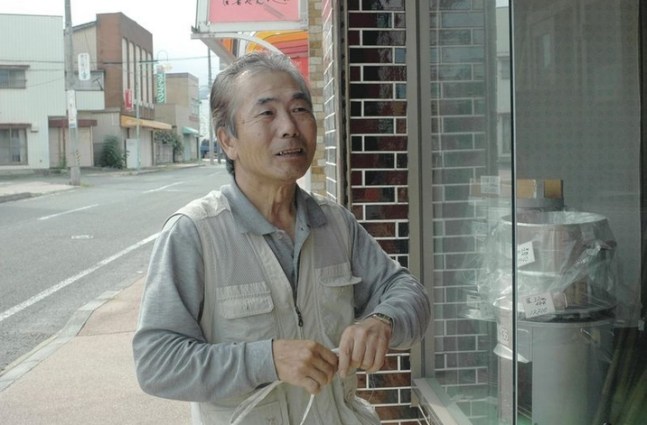
Shizuo Suzuki stands in front of his shop in Tomioka, Fukushima Prefecture, on Wednesday, with the empty shopping street visible in the background.
TOMIOKA, Fukushima — Long-term stays (see below) for residents of Tomioka, Fukushima Prefecture, started on Saturday. Evacuation orders for the town limits issued after the accident at Tokyo Electric Power Company Holdings, Inc.’s Fukushima No.1 nuclear power plant still stand.
The success of the project will hinge on how many residents the town can get back, with a view to having the evacuation orders lifted in April next year.
Shizuo Suzuki, 63, who resumed business 2½ years ago on a shopping street in the town’s Chuo district, which is part of a zone people are allowed to enter during the daytime, is hoping for some of the bustle of the town to return.
Suzuki’s hardware shop is on Chuo shopping street, which is on the west side of the JR Joban Line’s Tomioka Station. Suzuki took over the shop, which was established in 1952, after his father died in 1998. Before the 2011 Great East Japan Earthquake, the shop mainly dealt with materials such as cement, gravel and reinforced steel, supplying local building companies.
Although the earthquake didn’t do much damage to the shop, the nuclear plant accident which followed forced Suzuki and his 58-year-old wife to move out. After they drifted around various places in Fukushima Prefecture, including a gymnasium in Kawauchi, a neighboring village to the west of Tomioka, and a home of their relatives in Aizuwakamatsu, they finally settled in Iwaki.
Entering Tomioka became easier when the government eased regulations in 2013. The area around Suzuki’s shop was designated a residence restriction zone, making it possible for him to resume business there.
Suzuki, who was then working part-time at a construction company in Iwaki, decided to go back to his shop in January 2014. Although he did not know how many customers would come, he was looking forward to working in his hometown again.
“I wanted to stay positive and uphold my sense of purpose in life,” he said. Commuting from Iwaki, he cleaned up the shop and resumed business in March 2014, after decontamination of the area was complete.
Suzuki still commutes to Tomioka from Iwaki, which takes about an hour each way by car. The shop is open from 9 a.m. to 3 p.m. Five or six workers involved in decontamination work or building demolition in the neighborhood visit the shop daily and purchase items such as shovels, crowbars and ropes. As Suzuki’s shop is the only one to have resumed business in the area, the bustle of the shopping street has not yet returned.
According to the municipal government, shops that have reopened other than Suzuki’s are limited to convenience stores and gas stations. The town plans to open a commercial facility, publicly funded and privately operated, that includes a home-improvement center and restaurants at the end of November, for long-term-stay residents and in preparation for the lifting of evacuation orders.
“Streets will come back to life as people start returning for long stays. I hope other shops will resume business too,” Suzuki said. He had his home next to the shop demolished as it had decayed while he was away. He intends to rebuild his house and live in the town when other residents start to return.
■ Long-term stay
In anticipation of the lifting of evacuation orders, registered residents are allowed to stay in their houses to find out what problems they may face when they return to the town. The number of registered residents in Tomioka, Fukushima Prefecture, as of July 12 was 9,679 from 3,860 households. According to the central government, 119 residents from 56 households have applied for long-term stays as of Thursday.
1 This Month

of the week – Shut Down Drone Warfare!


Tell the Ukrainian Government to Drop Prosecution of Peace Activist Yurii Sheliazhenko

Petition to revoke the licensing of the Near Surface Nuclear Disposal Facility (NSDF) at Chalk River. https://www.ourcommons.ca/petitions/en/Petition/Details?Petition=e-7247
To see nuclear-related stories in greater depth and intensity – go to https://nuclearinformation.wordpress.com
-
Archives
- March 2026 (251)
- February 2026 (268)
- January 2026 (308)
- December 2025 (358)
- November 2025 (359)
- October 2025 (376)
- September 2025 (257)
- August 2025 (319)
- July 2025 (230)
- June 2025 (348)
- May 2025 (261)
- April 2025 (305)
-
Categories
- 1
- 1 NUCLEAR ISSUES
- business and costs
- climate change
- culture and arts
- ENERGY
- environment
- health
- history
- indigenous issues
- Legal
- marketing of nuclear
- media
- opposition to nuclear
- PERSONAL STORIES
- politics
- politics international
- Religion and ethics
- safety
- secrets,lies and civil liberties
- spinbuster
- technology
- Uranium
- wastes
- weapons and war
- Women
- 2 WORLD
- ACTION
- AFRICA
- Atrocities
- AUSTRALIA
- Christina's notes
- Christina's themes
- culture and arts
- Events
- Fuk 2022
- Fuk 2023
- Fukushima 2017
- Fukushima 2018
- fukushima 2019
- Fukushima 2020
- Fukushima 2021
- general
- global warming
- Humour (God we need it)
- Nuclear
- RARE EARTHS
- Reference
- resources – print
- Resources -audiovicual
- Weekly Newsletter
- World
- World Nuclear
- YouTube
-
RSS
Entries RSS
Comments RSS
 nuclear-news