
Fears of another Fukushima as Tepco plans to restart world’s biggest nuclear plant


Protesters rally against TEPCO approval

TEPCO president gave order not to call 2011 crisis a ‘meltdown’

TEPCO Held Liable for Fukushima Disaster

Japan Cleared to Re-Start World’s Largest Nuclear Plant

TEPCO, which responded so badly to the Fukushima Dai-Ichi nuclear disaster, has won approval from Japan’s nuclear reactor to crank back up the world’s biggest nuclear power plant.
The word “nuclear” has a lot more power in Japan than it does elsewhere.
Tokyo Electric Power, or TEPCO (TKECY) as it is better known, has just won approval to re-start two reactors at the world’s largest nuclear power plant. Its shares got a jolt of 3% at that announcement.
Nuclear-linked stocks will be worth watching as the company pushes on with that attempt. TEPCO is, after all, the company that responded so badly to the disaster at the Fukushima Dai-Ichi power plant in 2011.
The only country to have been hit by an atom bomb nevertheless embraced the technology behind nuclear power. Around one-fifth of all electricity is intended to be produced that way.
Then came the disaster at Fukushima. The March 2011 earthquake unleashed a tidal wave that ultimately killed 15,894 people, causing ¥21.5 trillion ($191 billion) in damage. Only the nuclear disaster at Chernobyl in Ukraine was worse.
The tsunami deluged the nuclear reactors at Fukushima, and three of them melted down. That shined a spotlight on the inept operations and response of TEPCO, which ran the plant.
The company was terrible at responding to the disaster and even worse at responding to the public. Its executives went into shutdown mode, as Asian companies are wont to do. It denied facts that turned out to be true, downplayed the impact and generally pretended that there’s nothing to see here, we’ve got it all under control, please move along.
So it’s amazing that it’s back in big-time nuclear business. Most recently, Japan’s nuclear regulator, the Nuclear Regulation Authority, has granted TEPCO initial safety approval to restart two reactors, six and seven, at the Kashiwazaki-Kariwa nuclear plant, the world’s largest.
The five NRA commissioners voted unanimously for permission to crank the reactors back up. Formal approval will likely go ahead after a 30-day period for public comment.

The governor of Niigata prefecture, where that plant is based, says he won’t consider allowing the plant to run again until the prefecture conducts its own review of what went on at Fukushima, and that won’t happen until 2020 at the earliest.
Opinion polls show that a majority of the Japanese public now opposes nuclear power and would ultimately like Japan to cease producing it. It’s likely that nuclear power will come up as an issue in the Japanese election, slated for Oct. 22.
Japanese Prime Minister Shinzo Abe believes nuclear power is a viable and stable source of energy. His Liberal Democratic Party wants to see more of Japan’s nuclear reactors put back to work.
Tokyo Governor Yuriko Koike, a former defense minister in the Abe government, has formed a conservative party to rival Abe’s conservative government. Although she says she won’t run for prime minister, her Kibo no To, or Party of Hope, will contest many of the seats up for grabs.
The party is considering an anti-nuclear stance. “We’ll examine how to bring down the reliance to zero by 2030,” Koike told a news conference, according to the Japan Times.
Nuclear power is intended to produce around 22% of Japan’s electricity if all its plants are operating. Government plans call for another 27% to come from liquefied natural gas, around 23% from renewable sources, and only 26% from coal.
All 42 of Japan’s nuclear reactors were ordered to shut down in 2011.
Kyushu Electric Power (KYSEY) was the first company to fire back up a nuclear plant after the 2011 quake, on the island of the same name in the city of Sendai. That’s part of Japan’s industrial heartland.
Kansai Electric Power (KAEPY) was last week granted permission from the mayor of Ohi, in Fukui Prefecture, to re-start two reactors there. The company had applied in August for permission to do so, from Japan’s nuclear regulator, the Nuclear Regulation Authority.
Meanwhile, TEPCO continues the cleanup of the mess at Fukushima. It has delayed the removal of used nuclear rods from fuel pools at the plant. It shifted fuel removal from 2017 to 2018 at the safest of the reactors, and from 2020 to 2023 for another two.
It also has to mop up about 770,000 tons of contaminated water that was pumped into the plant to cool the melted fuel reactors. That’s due to be cleaned out of around 580 tanks where it is stored on site by 2020 – the same year that Tokyo will host the Olympics.
https://www.thestreet.com/story/14332182/1/japan-set-to-restart-worlds-largest-nuclear-plant.html

Radioactive Water “Possibly” Leaked From Reactors For Months “By Error” Says Tepco
 A Tokyo Electric Power Company (Tepco) employee (center) speaks to the media in front of a monitor in the refrigerator building at the company’s Fukushima No.1 nuclear power plant, in Okuma, Fukushima, Japan, on February 23. The company’s attempt to clean up and recover the wrecked site has been beset by frequent delays and rising costs.
Fukushima Nuclear Disaster: Radioactive Water May Have Been Leaking From Reactors for Months
The Japanese company in charge of cleaning up one of the world’s worst nuclear disasters said Friday its latest error may have caused contaminated water to leak into the ground for nearly half a year.
The Tokyo Electric Power Company (Tepco) said it erroneously configured gauges used to measure groundwater levels in six wells near Fukushima No.1 nuclear power plant reactors Nos. 1 through 4, all of which were destroyed when a March 2011 earthquake and tsunami devastated the Japanese coast and caused a series of meltdowns at the plant.
The false readings, which have been relied on since April 19 and were discovered this week, meant that groundwater levels were actually more than two feet below what Tepco was measuring, The Japan Times reported. The company said this mistake caused groundwater levels to fall below the limit set to prevent radioactive water from flowing out of the plant and into the nearby wells, known as subdrains, at least once, in May.
Tepco spokesperson Shinichi Nakakuk said, however, the company’s readings did not show any significant increases in radioactivity outside of the facilities and that a leak was unlikely, according to Sky News.
Between May 17 and May 21, groundwater reportedly fell as much as 7 and a half inches below the safety levels at least eight times. Tepco has not been able to determine how long the dangerous levels persisted because they only measure the site hourly. Company officials said they were still investigating the incident, according to Japan’s NHK news outlet.
More than 15,000 people were killed when an earthquake and subsequent tsunami struck Japan’s east coast, where the Fukushima No. 1 nuclear power plant is located. The threat of radioactive contamination following meltdowns at Fukushima No. 1 nuclear power plant’s Nos.1, 2 and 3 reactors, as well as massive damage to the fourth, forced 150,000 residents to evacuate, most of whom have yet to return.
Since the disaster, plant owner Tepco has struggled through the recovery process, the price tag of which was raised to $192 billion last year, according to Reuters. The leading obstacle that the company faces is extracting the nuclear fuel that remains in the plant’s damaged nuclear reactors. The severe radiation levels have “killed” even robots specifically designed to swim underwater and detect the location of the melted nuclear fuel.
Lava-like rocks believed to be the elusive nuclear fuel were finally discovered in July using a small, custom-built robot known as “Little Sunfish,” according to Sky News. Actually removing the deadly substance, however, has once again been delayed and would not likely begin until 2023, according to Japanese officials.
Japan’s latest plan to clean up the site did not make any mention of what Tepco would do with about 777,000 tons of water contaminated with tritium, a nuclear byproduct that’s notoriously difficult to remove once mixed with water. In July, Tepco chairman Takashi Kawamura said the “decision has already been made” to dump the tritium-tainted water into the Pacific Ocean; however, he later said he would need Tokyo’s support to go through with the measure.
While Tepco and experts have said dumping the tritium-laced water used to cool down the reactors into the ocean would be relatively harmless, local fishermen and environmental activists have condemned the potential solution, saying it would further hurt the already damaged reputation of the region.
http://www.newsweek.com/fukushima-nuclear-plant-radioactive-water-leaking-months-674434
Botched Gauges Mean Radioactive Water Might Be Leaking From Fukushima
Radioactive, contaminated water may have leaked from the destroyed Fukushima Daiichi nuclear reactor in Japan into nearby groundwater, report plant officials. The incident has not been confirmed, but is suspected to have occurred because of a fault in well placement.
The wells around the reactors are designed to pump groundwater away from the facility. Tokyo Electric Power Company (TEPCO), which operates the plant, said that six wells in the vicinity of the reactors were actually a full three feet below the required safe height to avoid contamination. This means it’s possible that radioactive waste water has been leaking into the soil at those sites.
The mistake was noticed in April 2017 during tests that preceded the digging of a new well, and TEPCO launched a full investigation. The mistake was a result of TEPCO erroneously configuring the gauges in the wells, repeatedly giving them false readings of the groundwater levels at those sites.
TEPCO tested all six questionable sites and found that the groundwater has no elevated levels of radioactivity. A leak is therefore unlikely, according to TEPCO spokesman Shinichi Nakakuki.=
The Fukushima plant suffered a triple meltdown following the devastating 9.0 earthquake and tsunami that struck Japan in March 2011, killing around 16,000 people. After the meltdown that forced 174,000 people to abandon their homes, further contamination occurred when melted-down nuclear fuel seeped into the groundwater.
The wells are to prevent radioactive water from leaking into the Pacific, but TEPCO has had repeated troubles with managing thousands of tons of contaminated water. Shortly after the meltdown, an underground barrier of frozen soil was built, but in 2016 they revealed that the measure had been ineffective. In July 2013, TEPCO revealed that radioactive water was leaking from the plant into the Pacific Ocean, something they had previously denied.
TEPCO has been severely criticized by the Japanese government and public for their mishandling of the meltdown and ensuing crisis. In 2016, three of TEPCO’s top executives, including former Chairman Tsunehisa Katsumata, were indicted on charges of criminal negligence.
They are also the subject of 30 class action lawsuits from displaced and injured residents. The most recent lawsuit was resolved earlier in September, when the company was ordered to pay 376 million yen ($3.36 million) to 42 plaintiffs.
https://sputniknews.com/environment/201709301057827423-radioactive-water-fukushima-well-leak/
Botched gauge settings might have contaminated Fukushima groundwater from April onward: Tepco
The discovery of falsely configured monitoring equipment at the stricken Fukushima No. 1 nuclear power plant means the groundwater flowing underneath it might have gotten contaminated from April onward, Tokyo Electric said Friday.
The utility said incorrect gauge settings were used to measure groundwater levels in six of the wells near reactors 1 and 4. This resulted in groundwater readings about 70 cm higher than reality, which means the beleaguered power utility has been mismanaging the groundwater there for months.
To prevent tainted water from leaking from the plant, Tokyo Electric Power Company Holdings Inc. installed water gauges so it could keep the groundwater levels in the wells a meter higher than the contaminated water in the buildings.
Tepco adjusts the amount of water in wells called subdrains around the buildings to keep the groundwater higher than the tainted water inside them, which prevents it from flowing out. If the groundwater levels sink below the level of the radioactive water, it might leak out.
On Friday, Tepco said the estimated groundwater level in one of the six subdrain wells close to reactor 1 fell below the level in the reactor building at least eight times during the five-day period to May 21 because the gauges were set incorrectly.
Groundwater levels were 2 mm to 19 mm lower than the level in the buildings, Tepco said, adding that it does not know precisely how long each of these problematic situations lasted because water level data is collected by the hour.
Tepco said groundwater levels in five other wells affected by the incorrect settings did not fall below the levels in the nearby reactor buildings.
All six are in the area surrounded by an underground ice wall designed to prevent groundwater leakage.
According to Tepco, the incorrect settings date as far back as April 19. The earliest error affected the gauge in a well where groundwater fell to hazardous levels.
In the world’s worst nuclear disaster since Chernobyl, reactors 1, 2 and 3 at the plant experienced core meltdowns and reactors 1, 3 and 4 were severely damaged by hydrogen explosions following a massive offshore earthquake that spawned large tsunami in March 2011.
https://www.japantimes.co.jp/news/2017/09/29/national/radioactive-water-may-leaking-fukushima-reactor-buildings-since-april-tepco/#.Wc8cghdx3re
Tepco promises legal safety vow as it seeks to restart reactors
Promises are meant to be broken

The head of Tepco Electric Power company Holdings Inc. promised Wednesday to institute a safety pledge as requested by nuclear regulator, as the company seeks clearance to reactivate undamaged, idle reactors located far from its plant crippled by natural disaster in 2011.
has been calling for the company to make such a pledge part of its legally binding reactor safety program because it operates the Fukushima Daiichi nuclear power plant, the site of a major nuclear disaster in the aftermath of the massive earthquake and tsunami.
President Tomoaki Kobayakawa told the regulator on Wednesday that will stipulate a pledge to build “safety culture” in its program developed for ensuring safe operation of the Nos. 6 and 7 reactors at the company’s power station in Niigata Prefecture on the Sea of coast.
promise will pave the way for the regulator’s safety clearance for the two units — boiling-water reactors that are the same type as the ones that experienced meltdowns in the disaster.
The regulator will soon compile a draft document for the two units that will serve as certification that the utility has satisfied new stricter safety requirements implemented since the nuclear disaster.
It will then consult the economy, trade and industry minister, who oversees the nuclear industry, to confirm that is fit to be an operator. It will also solicit comments from the public before formally giving safety clearance.
Even if the reactors clear the safety checks, local governments in the area on which the Kashiwazaki-Kariwa plant sits remain cautious about their resumption.
Niigata Gov. Ryuichi Yoneyama, for example, has said it will take “around three to four years” for the utility to win the required local consent for a restart.
said last week was “qualified” as a nuclear plant operator, but that it wanted the utility to express its resolve to ensure safety in a legal document, not just in words.
Safety programs drawn up for reactors need to be approved by the regulator and if it finds a grave violation, it can demand a halt to nuclear power operations from the utility.
“We intend to tackle the unending mission of improving the safety of nuclear power and to complete the decommissioning and compensation of the Fukushima Daiichi complex,” Kobayakawa said at the regulator’s meeting on Wednesday. “We will also make efforts to maintain qualification” as operator of nuclear reactors, he said.
The Nos. 6 and 7 units at the Kashiwazaki-Kariwa plant are the newest among the seven units at the plant. The complex is one of the world’s largest nuclear power plants with a combined output capacity of 8.2 million kilowatts.
For a reactor to be restarted, it first needs to clear the safety requirements introduced in the wake of the Fukushima nuclear crisis. filed for safety assessments of the two units in .
, which is facing massive compensation payments and other costs in the aftermath of one of the world’s worst nuclear crises, has been desperate to resume operation of its idled reactors so it can reduce spending on costly fossil fuel imports for non-nuclear thermal power generation.
While some reactors run by other utilities have resumed operations in by satisfying the new safety regulations, has been under close scrutiny by regulators on whether it is qualified to once again operate a nuclear power plant.


Plaintiffs and their lawyers enter the Chiba District Court on Sept. 22 to hear the verdict in the Fukushima nuclear accident compensation case.
TEPCO ordered to pay evacuees of Fukushima nuclear disaster
CHIBA–A district court here on Sept. 22 ordered Tokyo Electric Power Co. to pay 376 million yen ($3.3 million) in compensation to evacuees of the Fukushima nuclear disaster but absolved the central government of responsibility.
Forty-five people in 18 households who evacuated to Chiba Prefecture following the 2011 meltdowns at the Fukushima No. 1 nuclear plant sought a total of about 2.8 billion yen from TEPCO and the government.
About 30 similar lawsuits involving 12,000 plaintiffs have been filed at district courts around Japan.
The Chiba District Court ruling was the second so far.
In March, the Maebashi District Court in Gunma Prefecture found both TEPCO and the government responsible for the nuclear disaster and ordered compensation totaling 38.55 million yen for 62 plaintiffs.
The main point of the lawsuit in the Chiba District Court was whether TEPCO and the government could have foreseen a towering tsunami hitting the Fukushima No. 1 nuclear plant and taken measures to prevent the disaster.
The plaintiffs emphasized a long-term appraisal released by the central government in 2002, which estimated a 20-percent possibility of a magnitude-8 level earthquake occurring between the coast off the Sanriku region in the Tohoku region to the coast off the Boso Peninsula of Chiba Prefecture within the next 30 years.
The plaintiffs argued that this appraisal shows it was possible to forecast a tsunami off the coast from the Fukushima No. 1 nuclear plant, and that measures could have been taken even as late as 2006 to prevent the disaster.
For the first time in a court case involving compensation related to the Fukushima disaster, a seismologist provided testimony on behalf of the plaintiffs.
Kunihiko Shimazaki, a professor emeritus at the University of Tokyo, once served as a deputy chairman of the Nuclear Regulation Authority. He was also in charge of compiling the 2002 long-term appraisal for the government.
“The height of a likely tsunami could have been known if it was calculated based on that appraisal,” Shimazaki said in court. “Even if a specific forecast could not be made, some sort of countermeasure could have been taken.”
The defendants argued that the long-term appraisal did not provide a specific basis for predicting a tsunami and only pointed to the fact that a magnitude-8 level earthquake occurring could not be ruled out.
http://www.asahi.com/ajw/articles/AJ201709220052.html
Tepco again ordered to pay damages in nuclear disaster, but not state
CHIBA, Japan (Kyodo) — A Japanese court ordered Tokyo Electric Power Company Holdings Inc. on Friday to pay damages over the nuclear disaster at its Fukushima Daiichi nuclear power plant following a deadly 2011 earthquake and tsunami, but dismissed claims against the state.
The Chiba District Court ruling follows a Maebashi District Court decision in March that found negligence on the part of both Tepco and the government played a part in the worst nuclear catastrophe since Chernobyl and ordered them to pay damages.
Friday’s ruling stemmed from a lawsuit filed by 45 people who were forced to flee Fukushima Prefecture to Chiba Prefecture near Tokyo as reactors that lost cooling functions caused meltdowns and spewed massive amounts of radioactive materials into the air.
The Chiba court awarded a total of 376 million yen ($3.35 million) to 42 of them, including all four who voluntarily evacuated. In the suit filed in March 2013, the plaintiffs were collectively seeking around 2.8 billion yen in damages from the government and plant operator.
The focal point of the Chiba case was whether the government and Tepco were able to foresee the huge tsunami that hit the seaside plant on March 11, 2011, and take preventive measures beforehand, with conflicting claims made by the parties regarding the government’s long-term earthquake assessment, which was made public in 2002.
The assessment, made by the government’s earthquake research promotion unit, predicted a 20 percent chance of a magnitude-8-level tsunami-triggering earthquake occurring along the Japan Trench in the Pacific Ocean within 30 years, including the area off Fukushima.
Based on the assessment, the plaintiffs argued that, with the plant standing on ground roughly 10 meters above sea level, a tsunami higher than the ground striking the plant could have been predicted.
They then claimed that the disaster was therefore preventable if emergency power generation equipment had been placed on higher ground, and that the government should have made Tepco take such measures by exercising its regulatory powers.
The government and Tepco, for their part, claimed the assessment was not established knowledge, and that even if they had foreseen a tsunami higher than the site of the plant and taken measures against it, they cannot be held liable as the actual tsunami was much higher at around 15.5 meters.
The government also argued that it obtained regulatory powers to force Tepco to take anti-flooding measures only after a legislative change following the disaster.
In Friday’s ruling, the court found the government not liable, saying that while the government indeed has such powers, not exercising them was not too unreasonable.
While ordering Tepco to pay damages, the court determined that the plant operator did not commit serious negligence that would have required a higher compensation amount, saying it did not totally leave anti-tsunami measures unaddressed.
The plaintiffs’ lawyers criticized the ruling as unfair, in that the court did not recognize the state’s liability. But they still positively rated the court’s acknowledgement of the loss of the plaintiffs’ hometown, jobs and personal relationships, and compensation for such a loss.
In March, the Maebashi District Court in Gunma Prefecture recognized negligence on the part not just of Tepco but also the government, saying they were able to foresee a tsunami high enough to inundate the plant.
It was the first such ruling issued among around 30 suits of the same kind and the first to rule in favor of plaintiffs.
The Maebashi court acknowledged that the government had regulatory authority over Tepco even before the accident, noting that “failing to exercise it is strikingly irrational and illegal.”
The court awarded to 62 of 137 plaintiffs a total of 38.55 million yen in damages, far less than the 1.5 billion yen sought in total. Many of the plaintiffs have appealed the district court decision.
In the Chiba suit, the 45 plaintiffs, including four who evacuated voluntarily, sought 20 million yen each for compensation for their evacuation and the loss of their hometown, jobs and personal relationships because their lives were uprooted.
The magnitude-9.0 earthquake and ensuing tsunami struck northeastern Japan on March 11, 2011, causing multiple meltdowns and hydrogen blasts at the nuclear power plant. Around 55,000 people remained evacuated both within and outside Fukushima Prefecture as of the end of August in the wake of the disaster.
http://mainichi.jp/english/articles/20170922/p2g/00m/0dm/081000c
TEPCO ordered to pay damages over nuclear accident
A Japanese court has ordered Tokyo Electric Power Company to pay damages to people who were forced to leave their homes after the accident at the Fukushima Daiichi nuclear power plant.
The Chiba District Court on Friday ordered TEPCO to pay nearly a total of 3.4 million dollars to 42 of the 45 plaintiffs who filed a lawsuit against TEPCO and the government.
The complainants say they lost their homes and jobs because of the March 2011 accident. They were seeking 25 million dollars in compensation.
The focus was whether the defendants were able to predict the tsunami that hit the plant and should therefore have taken preventive measures.
Also at issue was whether the amount of compensation TEPCO is currently paying to evacuees is appropriate.
Presiding judge Masaru Sakamoto said TEPCO did not entirely fail to implement measures against the risk of tsunami, and did not commit a grave error.
But Sakamoto said the psychological suffering of the plaintiffs is linked to the accident, and that TEPCO should pay redress.
He did not hold the government liable for the accident. The judge said that although by 2006 officials were able to predict the possibility that a tsunami could hit the plant compound, the introduction of safety measures would not necessarily have prevented the accident.
This is the second ruling in a series of lawsuits filed by about 12,000 people over the nuclear accident.
In March, the Maebashi District Court ruled that both the government and TEPCO were liable for the accident and ordered the government and the plant operator to pay damages.
https://www3.nhk.or.jp/nhkworld/en/news/20170922_25/

Conditional approval of TEPCO’s eligibility

Japan’s nuclear regulators have affirmed that Tokyo Electric Power Company is eligible to operate nuclear reactors again, but they have imposed some conditions.
The members of the Nuclear Regulation Authority made the decision at a meeting on Wednesday.
They have been debating whether or not to give the utility a green light to restart 2 reactors at the Kashiwazaki-Kariwa plant in Niigata Prefecture, central Japan.
TEPCO is the operator of the crippled Fukushima Daiichi plant.
During the meeting, a plan was put forth. According to the plan, TEPCO must express in its safety regulations its determination to tackle the decommissioning of the Fukushima Daiichi plant and its determination to prioritize safety over economic efficiency. In return, the regulators will certify that the company is eligible to operate nuclear reactors.
The plan also requires the industry ministry to make its intention to supervise the company clear.
At the meeting on Wednesday, the regulators agreed to certify that TEPCO is eligible to operate reactors as long as the industry ministry and the president of TEPCO agree to the provisions in the plan.
The regulators will compile a report that will effectively certify that TEPCO has their approval to restart the 2 reactors in Niigata.
https://www3.nhk.or.jp/nhkworld/en/news/20170913_34/
Japan’s Nuclear Regulator Not Agreeing to Tepco’s Kashiwazaki-Kariwa NPP Reactor Restart Plans
Nuclear regulator does dizzying U-turn on TEPCO reactor restart plans
 From left, the No. 5, 6 and 7 reactors at Tokyo Electric Power Co.’s Kashiwazaki-Kariwa nuclear power plant are seen in Kashiwazaki, Niigata Prefecture, in this April 21, 2016 file photo.
Tokyo Electric Power Co. (TEPCO), the utility responsible for the Fukushima No. 1 nuclear plant and its March 2011 triple meltdown, is aiming to get the reactors at its other power plants back on line.
The Nuclear Regulation Authority (NRA), which must approve any restarts, had been holding to a very strict line on TEPCO applications. However, on Sept. 6 the NRA abruptly changed track, taking a more sympathetic attitude and indicating that the No. 6 and 7 reactors at the utility’s Kashiwazaki-Kariwa nuclear plant in Niigata Prefecture would likely pass their safety inspections — a prerequisite for restart approval.
Despite the NRA’s suddenly sunny attitude, the prefectural government has not budged from its more cautious position. And TEPCO, which has made the Kashiwazaki-Kariwa plant a chief pillar of its business recovery plans, cannot flip the reactors’ “on” switch without the prefecture’s imprimatur, meaning the plant still has no clear restart schedule.
When the NRA summoned TEPCO President Tomoaki Kobayakawa and other top managers on July 10 this year to testify on the utility’s competence to keep running nuclear plants, authority chairman Shunichi Tanaka was unequivocal and unforgiving.

Nuclear Regulation Authority Chairman Shunichi Tanaka speaks to the Mainichi Shimbun during an Aug. 29, 2017 interview. (Mainichi)
“If TEPCO is unwilling or unable to finalize the decommissioning of the Fukushima (No. 1 station) reactors, it is simply not qualified to restart the Kashiwazaki-Kariwa plant,” Tanaka told the executives, adding, “I don’t see TEPCO showing any independent initiative whatsoever.”
The NRA chairman was referring to the longstanding problems with contaminated water and radioactive waste disposal plaguing TEPCO’s Fukushima plant decommissioning efforts. The utility tends to focus too much on trying to read the government’s mind on any and all Fukushima issues — an attitude that has long drawn NRA criticism.
When the NRA inspected the Kashiwazaki-Kariwa plant’s No. 6 and 7 reactors, it added a new evaluation category to the usual technological checklist, though it was not part of the new safety standards: “eligibility.” That is, TEPCO’s eligibility to run a nuclear power plant at all. After all, it was one of TEPCO’s plants that had succumbed to the worst nuclear disaster since Chernobyl. “TEPCO is different from other (power) companies,” Tanaka had said.
TEPCO President Kobayakawa and Chairman Takashi Kawamura are also a source of NRA concern. The two had no role in the utility’s response to the 2011 meltdowns, and Kobayakawa replaced a much more experienced hand in Naomi Hirose, a TEPCO managing director when the disaster struck. After his NRA dressing-down in July, Kobayakawa apparently visited the Fukushima disaster zone seven times.
However, there has been an apparent U-turn in Tanaka’s stance. A document submitted on Aug. 25 to the NRA under Kobayakawa’s name was sewn with phrases like, “We will carry the (Fukushima) reactor decommissioning through to the end,” and other terms suggesting a determined TEPCO attitude. At the same time, the document was bereft of details on specific preparedness measures or progress benchmarks for the decommissioning work.
Nevertheless, when Kobayakawa again appeared before the NRA on Aug. 30, the body indicated its acceptance of TEPCO’s position. Taking the contaminated water problem “as one example,” Tanaka stated that he recognized TEPCO’s lack of concrete countermeasure planning couldn’t be helped under the circumstances. One NRA executive revealed to the Mainichi Shimbun, “We avoided demanding a detailed (disposal measures) plan because we don’t legally have that authority, and doing so could pose legal risks.”
Pro-TEPCO sentiment was on conspicuous display when the NRA met again on Sept. 6, including acting Chairman Toyoshi Fuketa’s declaration that he “felt TEPCO’s drive to pass on the lessons of the (Fukushima nuclear) accident.”
Committee member Nobuhiko Ban stated that while the document the utility had submitted in the summer was a “declaration of intent,” he was “concerned over whether this alone can constitute eligibility” to run a nuclear plant. However, Tanaka wrapped up discussion by saying that “circumstances are not such that we can deny (TEPCO’s) eligibility.”
Tanaka will leave his NRA post on Sept. 18 after completing his five-year term in the chairmanship, and at a post-meeting news conference he was asked if he had wanted to bring the TEPCO issue to a close while in office.
“I can’t say that I’ve never felt that way,” Tanaka replied.
http://mainichi.jp/english/articles/20170907/p2a/00m/0na/019000c
NRA doubts TEPCO’s safety vow in Niigata, plans legal move
 Tokyo Electric Power Co. wants to restart the No. 6 and No. 7 reactors, shown in the forefront, at its Kashiwazaki-Kariwa nuclear plant in Niigata Prefecture.
The Nuclear Regulation Authority, skeptical of Tokyo Electric Power Co.’s promise to put safety ahead of profits, plans to gain legal assurances before allowing the embattled utility to start operating nuclear reactors again.
TEPCO has applied to restart two reactors at its Kashiwazaki-Kariwa plant in Niigata Prefecture, which would be the first run by the company since the disaster unfolded at its Fukushima No. 1 nuclear plant in March 2011.
Although NRA members agreed that the No. 6 and No. 7 reactors at the Kashiwazaki-Kariwa plant passed new regulations on technological aspects, they could not agree on whether the company has learned its lessons about safety management since the triple meltdown at the Fukushima plant.
To ensure TEPCO will put safety at the forefront of its operations, the NRA is considering holding the utility legally responsible for completing the entire decommissioning process of the Fukushima No. 1 nuclear plant.
The regulator expects to draft a checklist to verify the Kashiwazaki-Kariwa plant’s safety and other steps before it makes a final decision on whether to allow TEPCO to restart the reactors. The next meeting is scheduled for Sept. 13.
The NRA had previously determined that 12 reactors at six nuclear plants met new nuclear reactor regulations shortly after completion of their technological examinations.
The NRA also finished its technological examinations of the No. 6 and No. 7 reactors, the newest ones at the Kashiwazaki-Kariwa plant.
The plant has seven reactors, making it one of the largest nuclear power stations in the world. The two reactors that TEPCO wants to put online each has a capacity of 1.36 gigawatts.
TEPCO has said the resumption of the reactors are needed to turn around its business fortunes.
But NRA commissioners are reluctant to allow TEPCO to bring the plant online based solely on the results of the technological screening.
After the chairman and president of the utility were replaced in June, the NRA summoned the new top executives in July.
The watchdog demanded that they give a written response to the regulator’s position that TEPCO “is not qualified to operate the Kashiwazaki-Kariwa plant, given the seeming lack of determination and spotty track record to take the initiative in decommissioning (the Fukushima No. 1 plant).”
In August, the company submitted a paper to the NRA promising to “take the initiative in addressing the problem of victims of the nuclear disaster and to fulfill the task to decommission the plant.”
The paper also said the company “has no intention whatsoever to place economic performance over safety at the (Kashiwazaki-Kariwa) plant.”
Tomoaki Kobayakawa, the new president of TEPCO, called the paper a “promise to the public.”
Although the NRA commissioners on Sept. 6 recognized TEPCO’s commitment to safety to a certain degree, doubts remained.
Nobuhiko Ban, an NRA member who is a specialist on radiological protection, called for a system that would keep TEPCO committed to safety management in the future.
“Is it all right for us to take TEPCO’s vow at face value?” he said.
The NRA then decided to consider legal ways to hold TEPCO accountable for safety issues.
How a Harley-riding ex-ally of villains is leading a nuke revolt in Japan
 Lawyer Hiroyuki Kawai posing with his Harley-Davidson Trike motorcycle inside a garage in Tokyo, on July 25, 2017.
TOKYO (BLOOMBERG) – In the basement of a three-storey house in a leafy neighbourhood in Tokyo, about 40 lawyers crowded together, plotting against Japan’s massive nuclear power industry.
The host was 73-year-old Hiroyuki Kawai, one of Japan’s most colourful litigators. The end game? To close all of the country’s 42 reactors for good, a result that would be a major blow to the future of atomic energy across the world.
For the staunch anti-nuclear activist, the risk of a meltdown outweighs the benefits of the relatively clean source of power.
Countries from Germany to Taiwan have scaled back plans for nuclear power after Japanese utility Tepco’s 2011 Fukushima meltdown.
Mr Kawai is propelling the anti-nuclear movement forward with a 22 trillion yen (S$274 billion) shareholder lawsuit against the company, among the largest in damages ever sought. He wants to pressure the government and businesses to distance themselves from atomic power, and while his court cases have yielded mixed results, his bold tactics are garnering attention around the world.
“If we push them enough, one day they will crumble,” Mr Kawai said at an interview. “It’s a revolution.”
Mr Kawai stands out in a 300-strong anti-nuclear lawyer consortium, in both spirit and appearance.
On the day of the interview, Me Kawai is wearing a bright candy-pink suit-jacket, a black shirt, and a crystal encrusted snake brooch on his lapel. The father of three daughters and seven grandchildren rides his Harley-Davidson motorbike across the country on weekends, and hosts bimonthly meetings of lawyers at his residence to discuss strategies to shutter reactors.
“A number of countries and societies are influenced by trends in Japan,” said Professor Hitoshi Yoshioka at the graduate school of social and cultural studies at Kyushu University. “If he’s successful, the impact on the world will be great.”
While Mr Kawai now spends about 80 per cent of his time in legal battles against power providers and the government without pay, he started his career pursuing much more lucrative cases.
In the late 70s, he was an adviser to a witness linked to one of the country’s biggest financial scandals, propelling him into the spotlight. By his account, he was a winner, and made “a ton of money” along the way. Yet the cases in which he was involved were less than savoury and he began to question whether this was satisfying enough.
“I did so many bad things,” Mr Kawai said, recalling how in the 90s he turned his back on the corrupt businessmen and money-hungry upstarts he called clients. “I helped a lot of villains.”
In 1994, he began taking on anti-nuclear cases. He says the reason for his reincarnation is simple: He wanted to use the legal system to do good for society, and believed the growing use of atomic power was the biggest risk facing Japan, one of the world’s most earthquake-prone countries.
For years, Mr Kawai lost. Anti-nuclear activists were seen as environmentalists that agitated Japan’s quest to become energy independent and cheaply power a sputtering economy. After embracing atomic energy in the 1960s, the number of reactors grew to 54 by 2009, and at its peak, nuclear provided about one-third of Japan’s power consumption.
“Fighting nuclear means turning all of Japan’s society against you,” Mr Kawai said. “It’s like being surrounded by enemies. It’s a very hard fight.”
Japan needs nuclear power to achieve energy security, economic growth and environmental conservation while placing top priority on safety, said Hiroyuki Honda, a spokesman for the Federation of Electric Power Companies of Japan, the industry group consisting of top utility Tokyo Electric Power Holdings and nine other regional firms.
Japan should have diversified electricity generation sources, including nuclear power, while balancing energy security, economic growth and environmental conservation, said Tepco spokesman Jun Oshima.
Reactors are being allowed to restart after meeting stricter safety standards, and Japan cannot abandon nuclear power because of earthquakes, said a trade ministry official, who asked not to be identified because of internal policy.
Relying heavily on thermal power would lead to more carbon dioxide emissions and reliance on fossil fuel imports, he said. While the nation plans to boost renewable energy as much as possible, its growth has limits and needs to be supplemented by atomic and thermal power, according to the official.
Mr Kawai is currently directly involved in 24 atomic-related cases. The rest of his time is spent on corporate lawsuits which provide the funds to cover his anti-nuclear work, including directing a few documentary films.
Public perception has turned in favour of his ideals with 55 per cent of the population against nuclear restarts versus 26 per cent that are for, according to a Mainichi newspaper poll in March.
Mr Kawai’s legal attacks are counter to Prime Minister Shinzo Abe’s post-Fukushima energy policy, which seeks to see nuclear power account for as much as 22 per cent of the country’s energy mix by 2030.
The Nuclear Regulation Authority, an independent supervisory body set up by the government after Fukushima, has said 12 reactors are safe to restart after extensive checks, though just five of Japan’s 42 operable reactors have been allowed back online so far.
One of Mr Kawai’s biggest cases is a shareholder suit against Tepco. He argues the power provider did not take enough safety measures to prevent Fukushima. The amount of damages sought – currently 22 trillion yen – is the direct sum of the estimated costs to clean up the Fukushima disaster, he said.
He has had three favourable decisions since Fukushima, one of which has been overturned by a higher court, while most of the cases are still pending, he said.
“Nothing is an easy win,” Mr Kawai said. “But it’s not just about winning – it’s about changing society. There’s a good reason to keep fighting.”
http://www.straitstimes.com/asia/east-asia/how-a-harley-riding-ex-ally-of-villains-is-leading-a-nuke-revolt-in-japan
Tepco ‘s response to the article about the release of tritiated water into the ocean

A certain article reported today, “TEPCO decided to release tritiated water into the ocean” quoting the comment of TEPCO’s chairman Mr. Kawamura about the release of tritiated water into the ocean. The comment intended to say that TEPCO shares the same recognition with Nuclear Regulation Authority Chairman Dr. Tanaka, et al. that in accordance with the current regulation and standard based on scientific and technical ground, there should not be an impact of releasing tritiated water into the ocean. The comment did not intend to announce the concluded policy of the company on the matter.
We need to give our full attention to the satisfaction of both peace of mind of local residents and reconstruction of Fukushima, as well as the safety requirement to meet regulation and standard for the final decision. We will carefully examine our policy on the matter with the government and local stakeholders from such a perspective.
http://www.tepco.co.jp/en/announcements/2017/1444608_10494.html
Will Tepco Dump 770,000 tons of Tritiated Water Into the Pacific Ocean???

Massive amounts of radiation-contaminated water that has been processed and stored in hundreds of tanks at the plant are hindering decommissioning work and pose a safety risk in case another massive quake or tsunami strikes.
“TEPCO needs to release the water — which contains radioactive tritium that is not removable but considered not harmful in small amounts — into the Pacific Ocean”, declared Tokyo Electric Power Co.’s new Chairman Takashi Kawamura during an interview at the TEPCO headquarters in Tokyo on Thursday, July 13, 2017.
The method is favored by experts at the International Atomic Energy Agency and Japan’s Nuclear Regulation Authority as the only realistic option. Earlier, TEPCO had balked at calls by NRA chairman Shunichi Tanaka for controlled release of the water, now exceeding 770,000 metric tons, into the sea, fearing a public backlash.
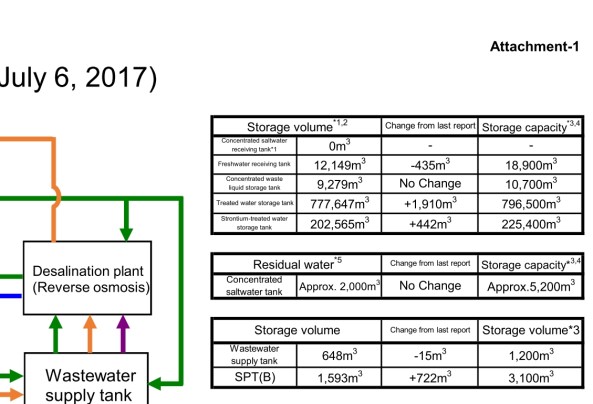
Tepco’s intention to release more than 770,000 metric tons of triated water into the sea was relayed by many media, the Japan Times adding to the volume number of 770,000 metric tons, that it was contained in 580 tanks. The volume number is right, to be precise it concerns 777,647 metric tons of tritiated water, but the 580 tanks number is wrong.
Knowing that those tanks have a capacity of 1000 metric tons each, 777,647 metric tons can only be stored in 780 tanks and not in 580 tanks only.
Of course in that 777,647 metric tons, are not included the other 202,565 metric tons of only partially decontaminated water, in which Cesium and Strontium are been already filtered out but the other 62 radionuclides have not been yet filtered by the Multi-nuclides Removal System (ALPS). Those 202,565 metric tons stored in some additional 202 tanks more in the Storing Tank Area.
Bringing the total of contaminated water, Cesium/Strontium partially decontaminated water plus the 62 radionuclides decontaminated water (Tritiated water) to a total of 980,212 metric tons stored in 980 tanks.
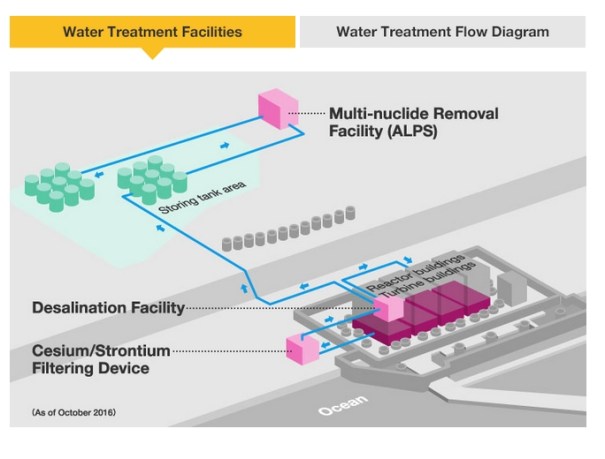
Of course it is not question to release the partially decontaminated water (202,565 metric tons) into the sea, only the fully decontaminated water (all radionuclides removed to the exception of tritium), the tritiated water, the 777,647 metric tons.
On the Tepco Press Release on Jul 10,2017, Tepco indicates quite clearly the actual volume of the 2 types of water stored in those tanks. Knowing that all those tanks have a capacity of 1000 metric tons each, the maths are easy.

Some media along the way, I suspect the Japan Times AGAIN, added the 580 tanks number into its article, maybe a typo from 5 to 7, then the error was copied on and on by the other media.
It is sad to see professionnal media not capable to get their numbers right.
Since that July 13, 2017 declaration from Tepco’s new chairman, Tepco is now backpedaling, saying that they have not yet reached that decision, fearing a public backlash and the ire of the local fishermen.
The radioactive half-life of Tritium is 12,3 years, its radioactive full life is 123 years to 184,5 years. Once inside the body, tritium can lead to internal exposure. Its biological half-life of 10 days, full life 100 to 150 days.
Tepco Press Release July 10, 2017 Nuclear Power Station (310th Release) Nuclear Power Station (310th Release): http://www.tepco.co.jp/en/press/corp-com/release/betu17_e/images/170710e0201.pdf
Tepco backpedals after disaster reconstruction chief knocks plan to dump tritiated water into sea
Hey, a change in the ‘official’ strategy: why admit it & damage your image when you can keep letting it happen & say you’ve decided not to do it ?
 The Fukushima No. 1 plant and hundreds of tanks containing tritiated water are viewed from the air in February
Tokyo Electric backed off its tritium-dumping decision Friday after disaster reconstruction minister Masayoshi Yoshino said it would cause problems for struggling fishermen trying to recover in Fukushima Prefecture.
The remarks made Friday by the Fukushima native came shortly after the chairman of Tokyo Electric Power Company Holdings Inc. was quoted as saying that the decision to discharge tritium-tainted water from the Fukushima No. 1 power plant into the sea had “already been made.”
After Tepco Chairman Takashi Kawamura’s remarks were widely reported, the utility scrambled to make a clarification the same day.
According to Tepco’s clarification, Kawamura meant to say that there was “no problem” with the dumping plan, based on government guidelines and “scientific and technological standards.” The statement also said that no final decision had been made.
A government panel is still debating how to deal with the massive amount of tainted water stored in tanks at the atomic plant, where three reactor cores melted after a huge earthquake in March 2011 spawned tsunami that devastated the region and knocked out all power at the plant.
Tritium typically poses little risk to human health unless ingested in high amounts. It remains in filtered water as it is difficult to extract on an industrial basis. Ocean discharges of diluted volumes of tritium-tainted water are a routine part of nuclear power plant operations.
At a news conference, Yoshino said there would “certainly be damage due to unfounded rumors” if the tainted water were dumped into the sea. He urged those pushing for the release “not to create fresh concerns for fishermen and those running fishing operations in Fukushima Prefecture.” He also asked them to take care not to drive fishermen “further toward the edge.”
Yoshino, who is not directly involved in the decision-making process for handling the water, was alluding to local concerns about how people’s livelihoods will be affected if people think marine products from Fukushima are contaminated with radiation. He added that while he is aware that many in the scientific community say the diluted water can be safely released, he remains opposed.
“As I am also a native of Fukushima Prefecture, I fully understand the sentiment of the people,” the minister said.
Water injected to perpetually cool the damaged reactors becomes tainted in the process. A high-tech filtering apparatus set up at the plant can remove 62 types of radioactive material but not tritium. As a result, tritiated water is building up continuously at the plant. As of July 6, about 777,000 tons were stored in about 580 tanks on the premises.
On March 11, 2011, tsunami inundated the six-reactor plant, which is situated 10 meters above sea level, and crippled its power supply, causing a station-wide blackout. The failure of the cooling systems in reactors 1, 2 and 3 then led to a triple core meltdown that became the world’s worst nuclear disaster since Chernobyl in 1986.
1 This Month

of the week – Shut Down Drone Warfare!


Tell the Ukrainian Government to Drop Prosecution of Peace Activist Yurii Sheliazhenko

Petition to revoke the licensing of the Near Surface Nuclear Disposal Facility (NSDF) at Chalk River. https://www.ourcommons.ca/petitions/en/Petition/Details?Petition=e-7247
To see nuclear-related stories in greater depth and intensity – go to https://nuclearinformation.wordpress.com
-
Archives
- March 2026 (244)
- February 2026 (268)
- January 2026 (308)
- December 2025 (358)
- November 2025 (359)
- October 2025 (376)
- September 2025 (257)
- August 2025 (319)
- July 2025 (230)
- June 2025 (348)
- May 2025 (261)
- April 2025 (305)
-
Categories
- 1
- 1 NUCLEAR ISSUES
- business and costs
- climate change
- culture and arts
- ENERGY
- environment
- health
- history
- indigenous issues
- Legal
- marketing of nuclear
- media
- opposition to nuclear
- PERSONAL STORIES
- politics
- politics international
- Religion and ethics
- safety
- secrets,lies and civil liberties
- spinbuster
- technology
- Uranium
- wastes
- weapons and war
- Women
- 2 WORLD
- ACTION
- AFRICA
- Atrocities
- AUSTRALIA
- Christina's notes
- Christina's themes
- culture and arts
- Events
- Fuk 2022
- Fuk 2023
- Fukushima 2017
- Fukushima 2018
- fukushima 2019
- Fukushima 2020
- Fukushima 2021
- general
- global warming
- Humour (God we need it)
- Nuclear
- RARE EARTHS
- Reference
- resources – print
- Resources -audiovicual
- Weekly Newsletter
- World
- World Nuclear
- YouTube
-
RSS
Entries RSS
Comments RSS
 nuclear-news