77.2 Billion Dollars in Public Funds Sought for Post-Fukushima Disaster Costs
They were telling us that nuclear energy was safe and cheap….

8 trillion yen in public funds sought for post-Fukushima disaster costs
The Federation of Electric Power Companies of Japan (FEPC) has informally asked the government to inject some 8 trillion yen in public funds into efforts for nuclear damage compensation and decontamination work in areas around the Fukushima No. 1 nuclear power plant, it has been learned.
The FEPC has drawn up a report stating that an extra 8 trillion yen is estimated to be necessary even after Tokyo Electric Power Co. (TEPCO) and other major utilities shoulder the planned amount of costs for dealing with the aftermath of the Fukushima disaster, and has informally requested that the government foot the surplus amount. The government has heretofore taken the position that nuclear plant operators should bear the costs for nuclear damage compensation and decontamination work in principle. It is therefore expected to approach the request with caution.
The costs for Fukushima disaster damage compensation and decontamination work are funded under the following steps: the state issues cashable government compensation bonds to the Nuclear Damage Compensation and Decommissioning Facilitation Corp. (NDF), a government-authorized corporation; TEPCO then receives necessary funds from the NDF and spends them on nuclear damage compensation and decontamination work; the NDF then receives due contributions from TEPCO and other major utilities and pays back the funds to the state.
Among the contributions made by power companies to the NDF, funds for nuclear damage compensation are shouldered by TEPCO and other major utilities, and the funds for decontamination work are covered by profits on the sale of TEPCO shares held by the NDF, while the funds for building interim storage facilities for radioactive waste are covered by revenues from the tax on the promotion of power resources development.
In 2013, the government estimated that nuclear damage compensation would cost 5.4 trillion yen, while decontamination work would require 2.5 trillion yen and construction costs for temporary storage facilities for radioactive waste and other expenses would need 1.1 trillion yen. The total amounts to be granted to the NDF were estimated at a maximum 9 trillion yen.
However, the FEPC now forecasts that damage compensation would cost 2.6 trillion yen more at 8 trillion yen and the decontamination expenses 4.5 trillion yen more at 7 trillion yen, according to sources familiar with the matter. Furthermore, the FEPC forecasts that profits on the sale of TEPCO shares would be 1 trillion yen less than the initial estimate due to a fall in the stock prices, bringing the total fund shortages to 8.1 trillion yen.
Major utilities fear that they would ultimately be forced to shoulder the additional burden as the enormous costs for decontamination work cannot be covered by profits on the sale of TEPCO shares.
The FEPC has unofficially asked that the government foot the extra amount of costs necessary for nuclear damage compensation and decontamination work on the grounds that the business environment for major utilities has deteriorated amid the stalled reactivation of nuclear reactors that have been left idle since the Fukushima disaster and the intensifying competition among power companies following the liberalization of the electricity retail market this past spring.
While TEPCO has forked out 2 trillion yen for the decommissioning of disaster-stricken reactors at the Fukushima No. 1 nuclear plant, several trillion yen extra is projected to be necessary to cover the expenses. In July, Tokyo Electric Power Company Holdings Inc. asked for government assistance in covering the expenses for reactor decommissioning at the plant and other efforts. The FEPC’s recent request to the government, meanwhile, does not include financial assistance for reactor decommissioning.
The government is poised to discuss the costs for Fukushima disaster damage compensation and reactor decommissioning at a panel on TEPCO reform and Fukushima No. 1 plant issues to be convened on Oct. 5, where the FEPC’s request is likely to be deliberated on.
http://mainichi.jp/english/articles/20161004/p2a/00m/0na/017000c
Government likely to retain grip on beleaguered Tepco
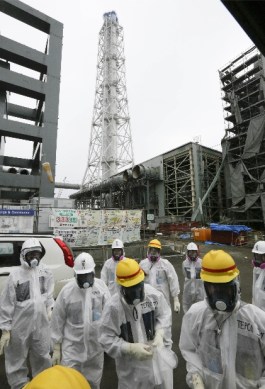
The government might stay involved in the management of Tokyo Electric longer than planned, given the ballooning costs of scrapping the Fukushima No. 1 nuclear power plant, sources close to the matter said.
The delay in reactivating the Kashiwazaki-Kariwa nuclear plant in Niigata Prefecture, the main pillar of the utility’s reconstruction plan, is another factor prompting the government rethink, the sources said Saturday. It had planned to end state control next April.
The government is leading the business operations of struggling Tokyo Electric Power Co. Holdings, which is facing huge compensation payments and other problems from the 2011 Fukushima nuclear disaster, because it has acquired 50.1 percent of the firm’s voting rights via the state-backed Nuclear Damage Compensation and Decommissioning Facilitation Corp.
Some bureaucrats at the Ministry of Economy, Trade and Industry have been dispatched to Tepco.
Tepco said in a business plan in 2014 that it would turn itself from a “temporarily publicly managed” company to a self-managed one starting next April.
The industry ministry will hold the first panel meeting Wednesday to discuss additional government support for the utility.
Tepco faces swelling costs for decommissioning the Fukushima No. 1 plant and compensating those affected beyond the previously estimated ¥11 trillion ($108 billion). Two reactors at the Kashiwazaki-Kariwa plant are under prolonged safety examinations by nuclear regulators.
The prospect of restarting the giant plant is also being complicated by impending changes in the leadership of the Niigata Prefectural Government, which hosts it.
To restart the plant, approval from the Niigata governor is needed.
Hirohiko Izumida, the current governor, was cautious about restarting the reactors because of Tepco’s failure to fully examine the cause of the Fukushima disaster. He withdrew his bid for re-election at the end of August.
Of the four candidates running for the Oct. 16 election, former Nagaoka Mayor Tamio Mori, 67, backed by the Liberal Democratic Party-Komeito ruling coalition, and Ryuichi Yoneyama, a 49-year-old doctor, are leading the race. Yoneyama has said he will follow Izumida’s stance and is opposed to any discussion of restarts unless the Fukushima disaster is thoroughly explained.
Tepco’s new business plan, including the revised schedule for ending state control, is expected to be compiled next January.
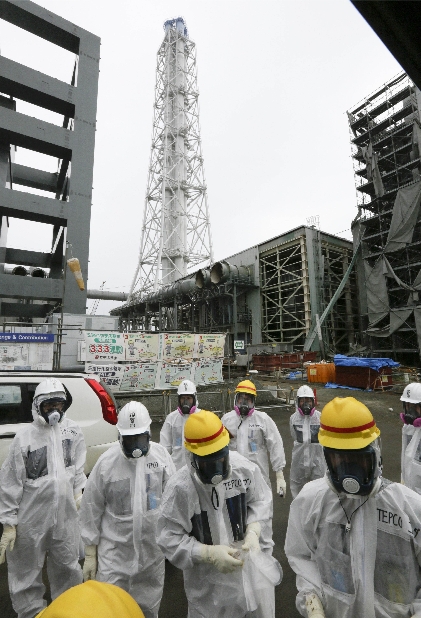
Tokyo Electric Power : Gov’t planning to stay involved in TEPCO’s management longer
The government is considering staying involved in Tokyo Electric Power Co.’s business management longer than currently planned, given larger-than-expected costs for scrapping the Fukushima Daiichi nuclear power plant, sources close to the matter said Saturday.
A delay in the process for reactivating its Kashiwazaki-Kariwa nuclear power plant in Niigata Prefecture, a main pillar of the utility’s reconstruction plan, is another factor prompting the government to think it would be too soon to end state control next April as initially planned, they said.
The government is leading business operations of the utility facing huge compensation payments and other problems from the 2011 Fukushima nuclear disaster as it has acquired 50.1 percent of the firm’s voting rights through the state-backed Nuclear Damage Compensation and Decommissioning Facilitation Corp.
Some bureaucrats of the Ministry of Economy, Trade and Industry are dispatched to the utility, known as TEPCO.
TEPCO said in a business plan in 2014 it would turn itself from the “temporarily publicly managed” company to a self-managed one starting next April.
The industry ministry will hold the first panel meeting Wednesday to discuss additional government support for the utility.
TEPCO faces swelling costs for decommissioning the Fukushima Daiichi plant and compensating those affected beyond the previously estimated 11 trillion yen ($108 billion). Two reactors at the Kashiwazaki-Kariwa plant are under prolonged safety examinations by nuclear regulators.
TEPCO’s new business plan including the revised schedule for ending state control is expected to be compiled next January.
Japan mulls legislation requiring local government approval for restarting Fukushima No. 2 nuclear plant
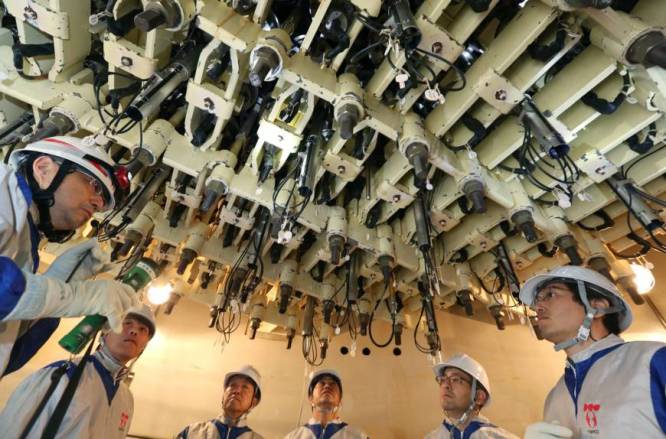
The underside of the No. 3 reactor pressure vessel at Tokyo Electric Power Co.’s Fukushima No. 2 nuclear power plant in Tomioka, Fukushima Prefecture, is seen in January 2014.
The Japanese government is considering legislation to oblige Tokyo Electric Power Company Holdings Inc. to obtain approval from local governments if it applies for restarting its Fukushima No. 2 nuclear power station, Jiji Press learned Friday.
The legislation is also expected to stipulate that the plant be decommissioned if Tepco fails to win such approval and is unable to submit an application for its restart within three years after the law takes effect, sources said.
It will be a special measure under the nuclear reactor regulation law, which does not require local government approval for restarting reactors.
The government aims to submit the legislation to the extraordinary session of the Diet that will be convened on Monday, the sources said.
All the No. 1 to No. 4 reactors at the Fukushima No. 2 plant have been offline since the March 2011 earthquake and tsunami led to a triple meltdown at the Fukushima No. 1 nuclear power station.
Although three of the four reactors at the No. 2 plant lost cooling functions temporarily in the 2011 disaster, they avoided severe accidents such as a core meltdown.
Tepco has not clarified what to do with the No. 2 plant. It is working on decommissioning the stricken No. 1 plant.
The Fukushima prefectural government and its assembly have been calling for scrapping the No. 2 plant.
The legislation could force Tepco to decommission the No. 2 plant because it raises further hurdles for resuming operations.
The government has yet to decide on details of the legislation, including the scope of local governments whose approval would be necessary for reactor restarts, the sources said.
The government allows the restart of nuclear reactors that pass the Nuclear Regulation Authority’s screening based on the stricter safety standards introduced after the accident at the Fukushima No. 1 plant.
But the government sees a need for taking special measures for the No. 2 plant because it is located near the No. 1 plant, which caused severe damage to Fukushima Prefecture, the sources said
Gov’t may shift nuke accident, reactor decommissioning costs onto new power suppliers

The government is moving to bill new electricity suppliers for a portion of nuclear reactor decommissioning costs and compensation payments related to the Fukushima nuclear disaster, it was learned on Sept. 7.
After decades under regional utility monopolies, the electricity supply market was opened to competition in April this year. The government apparently fears that the old monopolies such as Tokyo Electric Power Co. (TEPCO) lose too many customers to new suppliers and they may no longer be able to cover the high costs of decommissioning old reactors or compensate the victims of nuclear accidents, hence the move to shift some of the financial burden onto new market entrants.
However, these costs were originally supposed to be covered by the nine big utilities, and the government’s moves would essentially transfer that burden onto the Japanese people, making a clash more than likely.
Under the current system, large utilities must cover nuclear reactor operating expenses — including eventual decommissioning — from electricity bill income. Also, TEPCO receives monies to cover Fukushima nuclear disaster compensation claims from the government-licensed Nuclear Damage Compensation and Decommissioning Facilitation Corp. (NDF), which is in turn funded by all the large utility companies.
The new system being considered by the government would spread the financial burden of nuclear accident compensation and reactor decommissioning to new electricity suppliers, lightening the load on the big utilities. The government estimates the total cost for reactor decommissioning plus Fukushima nuclear disaster compensation paid before the NDF was established at some 8 trillion yen. The new power suppliers would likely pass on their share of these costs to their customers, resulting in monthly power bills up to about 200 yen higher than at present for an average three-person household.
However, forcing customers of the new electricity firms to pay for the old utilities to decommission their reactors and for TEPCO’s nuclear disaster liabilities runs counter to the goals of liberalizing the electricity market, which was intended to push down prices through competition. It would also in essence be corporate welfare for the big utilities operating nuclear plants.
A sub-committee to debate the new system will be established under the Advisory Committee for Natural Resources and Energy reporting to the minister of economy, trade and industry. The committee will decide on what direction to take by the end of this year, with an eye to submitting a bill to revise the Electricity Business Act to the ordinary Diet session next year.
http://mainichi.jp/english/articles/20160908/p2a/00m/0na/006000c
Tepco telling California 9th Circ. To Send Sailors’ $1B Fukushima Suit To Japan
TEPCO trying to block the hearing of this case in California under US law.
Watch recording for case: Lindsay Cooper v. Tokyo Electric Power Co., No. 15-56424
http://www.ca9.uscourts.gov/media/view_video.php?pk_vid=0000010155
9th Circ. Told To Send Sailors’ $1B Fukushima Suit To Japan
Law360, Los Angeles (September 1, 2016, 5:47 PM ET) — Tokyo Electric Power Co. urged the Ninth Circuit on Thursday to dismiss a $1 billion putative class action on behalf of 70,000 U.S. sailors allegedly exposed to radiation while responding to the Fukushima nuclear disaster, arguing the claims belong in Japan.
During oral arguments in Pasadena, California, Daniel Collins of Munger Tolles & Olson LLP, representing Tokyo Electric Power Co. Holdings Inc., the owner of the Fukushima nuclear plant, urged a three-judge panel to reverse U.S. District Judge Janis L. Sammartino’s refusal to dismiss the suit….
http://www.law360.com/articles/835597/9th-circ-told-to-send-sailors-1b-fukushima-suit-to-japan
TEPCO has applied to return reactors No. 6 and 7 to production at Kashiwazaki-Kariwa.
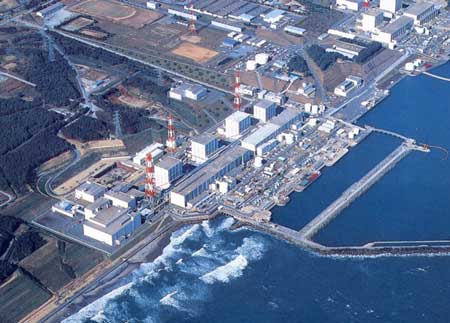
Tokyo Electric Power Co. Holdings Inc.’s (TEPCO) plan to restart the defunct Kashiwazaki-Kariwa nuclear power plant has an increased chance of being implemented after the prefecture governor, who has campaigned against its reopening, decided against running for re-election, according to a new report by Bloomberg.
TEPCO shares rose as much as 12 percent Wednesday morning – the largest price jump since May 2015, presumably in reaction to the announcement.
Niigata prefecture governor Hirohiko Izumida said he would not pursue a bid for a fourth term for the October 16th elections, according to a personal statement posted on his fan page.
The governor has long opposed plans to return the Kashiwazaki-Kariwa nuclear power plant – the largest of its kind in the world – to production. Japanese laws do not require that utility companies obtain the approval of local leaders before commencing operations, but it is the expected practice.
Izumida has previously demanded that TEPCO conduct further investigations into the causes of the triple meltdown at the Fukushima Dai-Ichi plant in 2011 before proposing plans to restart any of the firm’s reactors.
“The next Niigata governor will likely not make as many relentless demands as Izumida,” Japanese analyst Hidetoshi Shioda said.
According to the World Nuclear Association, the 2011 meltdown led to highly radioactive releases over days 4-6 after the incident originally occurred on March 11th.
The organization reports no deaths or cases of radiation sickness from the incident, though 100,000 citizens had been evacuated from the area to ensure minimal health effects.
The New York Times reported on Monday that Japanese government has funded the construction of a $320 million block of man-made permafrost that would continue 100 feet underneath the Dai-Ichi plant to solve “an unrelenting flood of groundwater” that had been headed into the damaged reactors.
The project will stop the leak of radioactive water into the Pacific Ocean, which may be continuing at low levels to this day, The Times said.
TEPCO has applied to return reactors No. 6 and 7 to production at Kashiwazaki-Kariwa. The company expects to boost profits by $97 million a month for each reactor it restarts, TEPCO spokesperson Tatsuhiro Yamagishi said earlier this week.
New Hope For Nuclear Power In Japan: http://oilprice.com/Latest-Energy-News/World-News/New-Hope-For-The-Fukushima-Nuclear-Power-Plant.html
Post-scriptum: A factually incorrect article published at OilPrice.com (Update: they have corrected the erroneous claim about restarting Fukushima Daiichi but left a photo of Fukushima Daiichi on their somewhat corrected story a copy of the original version can be found here) has begun propagating across the internet. TEPCO is NOT trying to restart reactors at Fukushima Daiichi.
Credit to Nancy Foust of Fukuleaks who caught the Oilprice incorrection: http://www.fukuleaks.org/web/?p=15719
Former senator pledges to support vets in Fukushima lawsuit
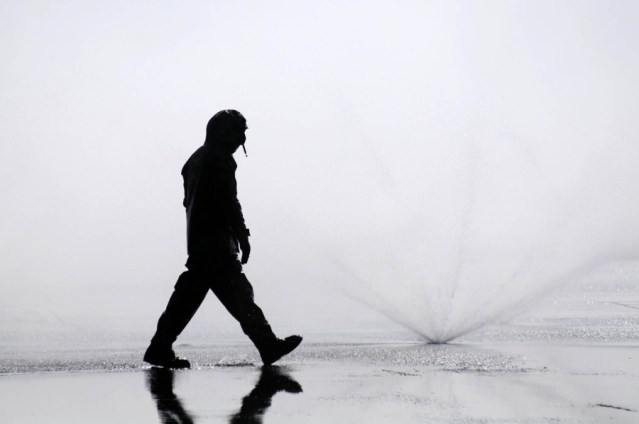
A sailor checks sprinklers on the flight deck of the aircraft carrier USS Ronald Reagan during Operation Tomodachi in 2011. Sailors scrubbed the external surfaces on the flight deck and island superstructure to remove potential radiation contamination.
Former Sen. John Edwards has pledged to support hundreds of U.S. sailors, Marines and airmen who say they were sickened by radioactive fallout from the 2011 disaster at the Fukushima Dai-ichi nuclear power plant.
U.S. forces participated in relief efforts after a 9.0-magnitude earthquake triggered a tsunami that battered swaths of northeastern Japan, including the plant.
Edwards — the 2004 Democratic nominee for vice president who ran for president that year and in 2008 — has offered his “legal and personal assistance” to the plaintiffs after hearing about their lawsuit against the Tokyo Electric Power Co., which operates the plant, according to a statement from the plaintiffs’ attorneys.

Former Sen. John Edwards arrives at the Federal courthouse in Greensboro, North Carolina, Tuesday, May 29, 2012.
The lawsuit against TEPCO and several other co-defendants, including General Electric, EBASCO, Toshiba Corp. and Hitachi, is scheduled to proceed to trial pending appeals. Oral arguments in the appeals case are due to begin Thursday in the 9th Circuit Federal Court in Pasadena, Calif. The plaintiffs’ lawyers don’t expect a ruling before November.
The plaintiffs maintain that TEPCO lied about the risk of radiation exposure, luring American forces closer to the affected areas and lulling others at bases across Japan into disregarding safety measures. The other defendants are accused of making faulty parts for reactors that contributed to Fukushima’s meltdown in March 2011.
The plaintiffs allege they have developed cancers, ulcers, uterine bleeding and thyroid issues as a result of radiation exposure. The U.S. government has said the radiation levels servicemembers encountered were too low to cause any maladies.
Edwards is now a partner at Edwards Kirby, a Raleigh law firm specializing in personal injury, economic justice and property rights. He could not be immediately be reached for comment.
News of Edwards’ support comes just months after another ex-politician, former Japanese Prime Minister Junichiro Koizumi, pledged his support after meeting with several of the plaintiffs during a visit to the United States.
In July, he called on his countrymen to donate to a fund for the plaintiffs, saying “it is not the kind of issue we can dismiss with just sympathy,” according to the Asahi Shimbun.
Niigata Pref. Nuclear Power Opponent Governor Out of The Way
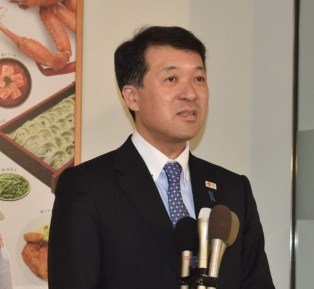
Was he pressured to drop out?
Hirohiko Izumida, governor of Niigata prefecture, said he won’t run for a fourth term and dropped out of the gubernatorial election scheduled for October 16.
The move may affect Tokyo Electric Power Co. Holdings Inc.’s efforts to restart its Kashiwazaki-Kariwa nuclear plant in the prefecture. According to Bloomberg, Tokyo Electric rose as much as 12 percent to 417 yen, the biggest intraday increase since May 2015, and traded at 394 yen at 9:32 a.m. Tokyo time. The Topix index rose as much as 1 percent.
Tepco Rises Most in Year After Governor Opposing Restart Retires
Tokyo Electric Power Co. Holdings Inc., operator of the wrecked Fukushima nuclear power plant, jumped the most in more than a year after a prefecture governor opposing the restart of one of its reactors abandoned his bid for re-election.
Tokyo Electric rose as much as 12 percent to 417 yen, the biggest intraday increase since May 2015, and traded at 394 yen at 9:32 a.m. Tokyo time. The Topix index rose as much as 1 percent.
Hirohiko Izumida, governor of Niigata prefecture, said he won’t run for a fourth term and dropped out of the gubernatorial election scheduled for October 16, according to a personal statement posted on a website of supporters. Izumida opposed Tokyo Electric’s plan to restart its Kashiwazaki-Kariwa nuclear power plant, the world’s largest facility, located in Niigata prefecture. Local government approval is typically sought by Japanese utilities before they restart nuclear reactors, though not required by law.
With Izumida out of the picture, the chance of Kashiwazaki-Kariwa’s reactors restarting has increased, said Hidetoshi Shioda, an analyst at SMBC Nikko Securities, who views the retirement as a positive for Tokyo Electric shares.
Izumida had demanded that Tokyo Electric further investigate the cause of the triple meltdown at its Fukushima Dai-Ichi plant in 2011 before restarting any reactors.
“The next Niigata governor will likely not make as many relentless demands as Izumida,” SMBC’s Shioda said.
Tepco, as the company is known, has applied to restart No. 6 and 7 reactors at Kashiwazaki-Kariwa. Running one reactor boosts Tepco’s profits by as much as 10 billion yen ($97 million) a month, company spokesman Tatsuhiro Yamagishi said Monday.
Niigata Pref. nuclear power opponent governor won’t stand for re-election
NIIGATA — Gov. Hirohiko Izumida has retracted his announcement that he will run in the upcoming gubernatorial election to seek a fourth term.
Since Izumida has adopted a cautious stance toward the restarting of the Kashiwazaki-Kariwa Nuclear Power Plant in Niigata Prefecture, his decision not to run in the election will likely have a huge impact on the issue. All seven reactors at the power station, owned by Tokyo Electric Power Co., have been idle since March 2012 in the wake of the 2011 Great East Japan Earthquake, tsunami and the ensuing crisis at the Fukushima No. 1 nuclear plant.
The campaign for the Oct. 16 Niigata gubernatorial election is to kick off on Sept. 29.
Izumida’s decision not to run in the election is linked to his criticism of a report in the Niigata Nippo regional daily over a dispute involving a subsidiary of a shipping company funded by the prefectural government.
In an interview with news organizations, Izumida said, “It’s important to have prefectural residents know the facts, but I feel my appeal never reached the residents. Even if I requested the newspaper to correct its report, the daily would never do so, which prompted me to abandon running in the race.”
At a prefectural assembly session in February this year, Izumida announced that he would run in the gubernatorial election to seek a fourth four-year term. However, his retraction of his candidacy leaves Nagaoka Mayor Tamio Mori, 67, who heads the Japan Association of City Mayors, as the only person who has announced his candidacy.
It came to light this past July that Japan Shipping Exchange Inc., an arbitration organization, had ordered a shipping company’s subsidiary funded by the prefectural government to pay 160 million yen to a South Korean company following a dispute over the purchase of a ferry.
The Niigata Nippo published a series of articles holding the Niigata Prefectural Government responsible for the case.
In response, the prefectural government has dismissed the accusations saying, “The daily’s coverage is incorrect,” and repeatedly urged the newspaper to correct its reports.
The Niigata Nippo is set to release a statement to express its views on the case.
http://mainichi.jp/english/articles/20160831/p2a/00m/0na/008000c
Two Tepco Kashiwazaki-Kariwa reactors may pass geared-up safety checks by March
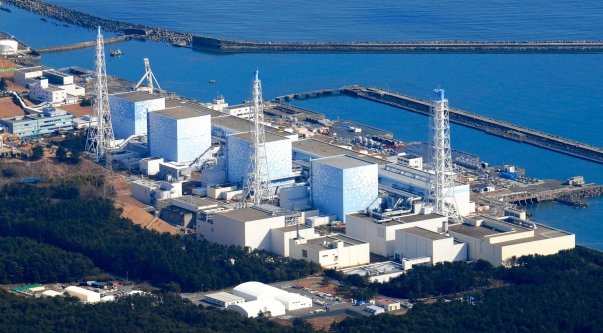
Nuclear regulators have decided to gear up the safety assessment of two reactors operated by Tokyo Electric Power Company Holdings Inc. in central Japan, raising the possibility of finishing the process by next March, sources said Tuesday.
Reactor Nos. 6 and 7 at the Kashiwazaki-Kariwa plant in Niigata Prefecture are boiling water reactors, the same type as the ones that suffered core meltdowns in 2011 at Tepco’s Fukushima No. 1 complex.
All reactors in Japan — either BWRs or pressurized water reactors — are required to meet tougher safety criteria imposed after the Fukushima crisis, but the BWR assessment has been delayed due to the need to install safety equipment that involves extensive work.
If reactors 6 and 7 clear the assessment, they will become the first BWRs technically qualified to resume operation under the post-Fukushima rules.
Facing massive decommissioning costs and compensation payments after the Fukushima disaster, Tepco applied for the safety assessment of the two reactors in September 2013, hoping that restarting the units will help turn around its business.
But it is unclear whether the development will lead to their swift restart because Niigata Gov. Hirohiko Izumida has said he will “not talk about restarting” the reactors unless a study on the Fukushima calamity is sufficiently carried out.
The Kashiwazaki-Kariwa complex on the Sea of Japan coast is one of the world’s largest nuclear power plants in capacity if all of its seven reactors were in operation.
Allowing Tepco to reactivate its reactors can be controversial, as the utility is still struggling to scrap the crippled reactors at the Fukushima plant. Tens of thousands of people who lived nearby also remain displaced evacuees.
The Nuclear Regulation Authority decided last August to prioritize checking the two Kashiwazaki-Kariwa reactors, hoping to make them a model case of the BWR assessment process. But it retracted the decision in March after Tepco failed to offer sufficient explanation on questions raised by the regulators.
But Tepco has come up with the necessary documents and the NRA decided to reinstate the priority status of the Kashiwazaki-Kariwa reactors at least until mid-September. The NRA has conveyed its plan to other utilities whose BWRs are being checked, the sources said.
Under the new safety requirements, BWRs must be equipped with filtered venting systems so that radioactive substances will be reduced when gas and steam need to be released to prevent damage to containment vessels.
The venting facilities are not an immediate requirement for PWRs as they are housed in containers larger than those of BWRs, allowing more time until pressure rises inside the containers.
Currently, two reactors at Kyushu Electric Power Co.’s Sendai plant and another reactor at Shikoku Electric Power Co.’s Ikata plant are operating in Japan after passing the safety checks. They are all BWRs.
TEPCO apologizes to Niigata for meltdown cover-up
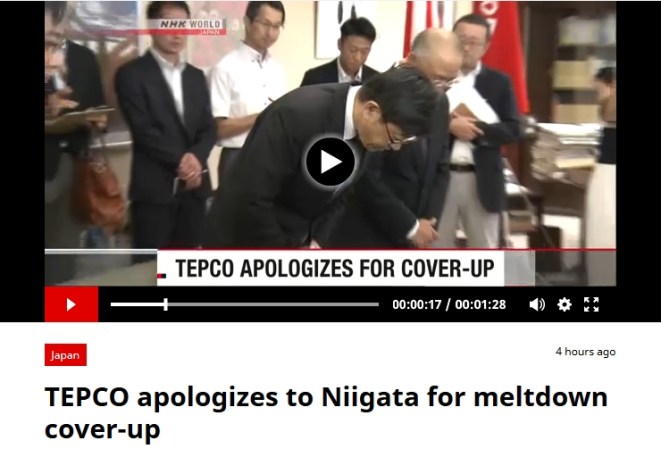
A top official of the operator of the Fukushima Daiichi nuclear power plant has apologized to the Niigata Prefecture governor for having concealed the 2011 reactor meltdowns for more than two months.
Takafumi Anegawa, Managing Executive Officer of the Tokyo Electric Power Company, met Niigata Governor Hirohiko Izumida on Thursday.
In February this year, TEPCO admitted the utility could have ascertained there was a meltdown three days after its occurrence if utility workers had followed an in-house manual. It was also later found that TEPCO’s then-president had instructed officials not to use the words “core meltdown.”
The prefecture, which hosts another TEPCO nuclear power plant on the Japan Sea coast, has put together a panel of experts to study the utility’s handling of the Fukushima accident.
Anegawa told the governor that TEPCO apologizes for not having presented a report based on an adequate investigation.
Izumida said information on meltdowns is critical for residents living near nuclear power plants to decide whether to flee or not. He said the prefecture expresses regret that TEPCO has not admitted its meltdown cover-up for five years.
Later this month, a joint panel set up by Niigata Prefecture and TEPCO plans to begin a detailed investigation.
Governor Izumida said additional probes are necessary to find out what in-house problems TEPCO had.
The governor said it is too soon to discuss resuming operations at the nuclear plant in his prefecture without a complete review of the Fukushima accident.
http://www3.nhk.or.jp/nhkworld/en/news/20160825_21/
Tepco’s Profit Plummets Amid Declining Sales and New Competition
Operating profit falls by 37 percent in the first quarter
More than 750,000 Tepco customers have switched providers
Tokyo Electric Power Co. Holdings Inc., operator of the wrecked Fukushima Dai-Ichi nuclear plant, said first-quarter operating profit plummeted 37 percent as sales declined amid faltering demand and new entrants into Japan’s power market.
Tepco, as Japan’s biggest utility is known, posted operating profit of 143.6 billion yen ($1.37 billion) for the three months ended June 30, down from 228.3 billion yen a year ago, the company said in a statement Thursday.
Revenue fell about 18 percent to 1.26 trillion yen as the company’s electricity sales volume dropped and rates were automatically lowered by the nation’s price adjustment system. The system adjusts monthly electricity rates for each utility based on a three-month average of import prices for LNG, crude oil and coal.
Japan’s regional utilities are getting squeezed by new entrants after the country liberalized its retail power market in April, allowing consumers to choose their electricity providers for the first time. Tokyo Electric hopes to boost its profits by expanding its domestic gas sales when the market fully opens up next year, increasing its foreign investments and restarting its operable nuclear reactors.
Tokyo Electric Power Co. Holdings Inc., operator of the wrecked Fukushima Dai-Ichi nuclear plant, said first-quarter operating profit plummeted 37 percent as sales declined amid faltering demand and new entrants into Japan’s power market.
Tepco, as Japan’s biggest utility is known, posted operating profit of 143.6 billion yen ($1.37 billion) for the three months ended June 30, down from 228.3 billion yen a year ago, the company said in a statement Thursday.
Revenue fell about 18 percent to 1.26 trillion yen as the company’s electricity sales volume dropped and rates were automatically lowered by the nation’s price adjustment system. The system adjusts monthly electricity rates for each utility based on a three-month average of import prices for LNG, crude oil and coal.
Japan’s regional utilities are getting squeezed by new entrants after the country liberalized its retail power market in April, allowing consumers to choose their electricity providers for the first time. Tokyo Electric hopes to boost its profits by expanding its domestic gas sales when the market fully opens up next year, increasing its foreign investments and restarting its operable nuclear reactors.
TEPCO ordered to pay for rumor-caused damages
A Japanese court has ordered Tokyo Electric Power Company, or TEPCO, to compensate a golf course operator for damages caused by rumors after the Fukushima Daiichi nuclear accident in 2011.
This is the first ruling in Japan that recognizes rumor-caused damages related to a nuclear accident.
The golf course operator’s suit claimed that revenues from its course in Tochigi Prefecture, north of Tokyo, dropped due to harmful rumors related to the nuclear accident.
TEPCO argued that there was no danger from radiation because the golf course is more than 100 kilometers from the nuclear plant.
In the ruling on Wednesday, Tokyo District Court Judge Tetsuro Nakayoshi said the public did not have sufficient knowledge about radiation around the time of the accident.
He noted that it was not unreasonable for ordinary people to worry about health risks.
The court determined that harmful rumors were responsible for 30 to 50 percent of the decline in revenue for more than 5 months following the accident.
The court ordered the utility to pay about 180,000 dollars in compensation.
TEPCO says the company will deal with the matter sincerely after studying the ruling.
Preventing Recriticality in Fuel Debris at Fukushima Daiichi Nuclear Power Station
This video released on July 16, 2016 by Tepco intends to explain the conditions of the fuel retained in the reactors of Units 1-3 at Fukushima Daiichi Nuclear Power Station, and TEPCO’s measures to prevent recriticality- return to a point at which a nuclear reaction becomes self-sustaining- in the fuel debris there.
As I See It: Has nothing been learned from TEPCO’s ‘meltdown’ cover-up?

The March 14, 2011 press conference at the Tokyo Electric Power Co. (TEPCO) head office in Tokyo in which then TEPCO vice president Sakae Muto (second from right) was reportedly told by then company president Masataka Shimizu not to use the expression “core meltdown.”
A third-party panel set up by Tokyo Electric Power Co. (TEPCO) to investigate the company’s cover-up of the core meltdowns that occurred at its Fukushima No. 1 Nuclear Power Plant following the March 11, 2011 Great East Japan Earthquake and tsunami revealed in a report last month that then TEPCO president Masataka Shimizu had ordered the company not to use the term “meltdown” to describe what had occurred. The report also stated that the organizational cover-up took place against a backdrop of “what is presumed to be a request that came from the prime minister’s office.”
Then Chief Cabinet Secretary Yukio Edano has objected to the report, saying that the very people who were involved, himself included, were not consulted by the panel before it drew its conclusion. Edano also said that he sent a letter of protest to TEPCO seeking an apology and a retraction of the report.
There are many missing pieces to the investigative report, but without a doubt, TEPCO acted irresponsibly toward local residents. A meltdown refers to a severe incident in which nuclear fuel melts and leeches out. If the facts had been revealed to the public, they could have fled further and avoided going outdoors. TEPCO bears a heavy responsibility for exposing local residents to risks more dangerous than they would have been otherwise.
On March 14, 2011, three days after the nuclear crisis broke out, then TEPCO vice president Sakae Muto was in the midst of a press conference when a company PR official passed him a handwritten note indicating that a core meltdown had taken place, and whispered into his ear that “the prime minister’s office has instructed that this expression not be used.” The third-party investigative panel concluded that this message was from then TEPCO president Shimizu. In accordance with the instructions, Muto and TEPCO used the term “core damage,” a word with a less serious connotation than core meltdown, making the incident seem less severe than it actually was.
The residents of the Fukushima Prefecture town of Namie — the northerly neighbor of the town of Futaba, one of the two towns that the stricken nuclear plant straddles — were forced to evacuate without crucial information. According to the Namie Municipal Government, some 8,000 of the town’s 21,000 or so residents evacuated on March 12, 2011, to the town’s Tsushima district, further northwest of the nuclear plant. At the time, however, the wind had been blowing in that direction, putting the residents directly in the path of radioactive materials being emitted in massive amounts from the crippled nuclear plant.
Local resident Hidezo Sato, 71, evacuated from the town center and stayed at a community center in Tsushima until March 15. “There were other evacuees who said we should be fleeing farther away, but I didn’t think the situation was that grave,” he recalls. “If we’d known there’d been a core meltdown, it would’ve determined how we evacuated.” The community center where he was taking refuge was overflowing with people. Not knowing that he was downwind from the troubled nuclear plant, Sato sat by a fire outdoors. He also saw children going into grassy areas, where radioactive materials are known to collect.
“I would’ve avoided going outdoors had I known there’d been a meltdown,” says Yoko Hashimoto, 64, who also evacuated to the Tsushima district. “Five years have passed since the disaster broke out, and I’m worried that I’ll start seeing the health effects of radiation exposure. Why wasn’t the meltdown announced right away?” It is only natural for residents whose safety was all but ignored by TEPCO to feel anger toward the utility. The power company had always emphasized the happy coexistence of its nuclear plants and local communities. Yet when a serious incident took place, the local residents were neglected. This more than explains why the residents are distrustful and angry.
It wasn’t until at least two months later that TEPCO admitted that core meltdowns had occurred. And even then, it was only because the then Nuclear and Industrial Safety Agency, which has since been disbanded, demanded an overall report on the disaster. Moreover, it wasn’t until February of this year that TEPCO announced that it had discovered an internal company manual stipulating that damage to 5 percent or more of nuclear fuel be defined as a nuclear meltdown. Until then, the utility had cited the fact that it didn’t have any standards by which to define nuclear meltdowns as its excuse for delaying the announcement that such a phenomenon had occurred. But indeed, according to the manual, then vice president Muto could have said at the press conference on March 14, 2011, that a nuclear meltdown had taken place.
Hirotada Hirose, professor emeritus at Tokyo Woman’s Christian University and an expert in disaster risk studies, says that while local residents may have been thrown into confusion if information about the core meltdown had been made public, the merits of them evacuating farther away and reducing their exposure to radiation would have outweighed the possible risks of panic. “The physical and psychological damage that residents have suffered because information was not provided to them are far greater.” He adds, “Regardless of whether or not TEPCO actually received instructions from the prime minister’s office (not to use the expression ‘core meltdown’), it should have decided on its own to release accurate information. TEPCO lacks awareness and responsibility as the operator of nuclear plants that are at risk of creating serious crises.”
There is still much more room for improvement in TEPCO’s attitude toward its responsibilities. After the report on the meltdown cover-up was released, TEPCO President Naomi Hirose was asked at a press conference how the utility expected to work with the prime minister’s office if another serious incident were to occur. He refused to respond in clear-cut terms, instead stating, “That’s a difficult question to answer in general terms.”
On the one hand, the third-party investigative panel should be praised for digging up the fact that then TEPCO president Shimizu instructed the cover-up. On the other hand, however, the probe into the utility’s relationship with the prime minister’s office is insufficient. Residents harbor distrust toward not just TEPCO, but the government as well. Local residents will remain unconvinced unless further investigation into the extent and the manner in which the government interfered with the nuclear crisis is conducted.
Core meltdowns are not a problem specific to TEPCO. Whenever there’s a problem surrounding a nuclear plant, it often turns out that similar things are taking place at other plants run by other utilities. Can we say that TEPCO’s latest case is an isolated event? There’s a fear that when a nuclear accident takes place, we won’t be able to trust the power companies involved to provide us with appropriate information that respects and reflects the needs of affected residents. If utilities are going to restart halted nuclear reactors and extend the number of years its aging reactors are allowed to operate, they must take away important lessons from the Fukushima crisis and be prepared to disseminate information to the public from their standpoint. (By Mirai Nagira, Science and Environment News Department)
http://mainichi.jp/english/articles/20160706/p2a/00m/0na/008000c
1 This Month

of the week – Shut Down Drone Warfare!


Tell the Ukrainian Government to Drop Prosecution of Peace Activist Yurii Sheliazhenko

Petition to revoke the licensing of the Near Surface Nuclear Disposal Facility (NSDF) at Chalk River. https://www.ourcommons.ca/petitions/en/Petition/Details?Petition=e-7247
To see nuclear-related stories in greater depth and intensity – go to https://nuclearinformation.wordpress.com
-
Archives
- April 2026 (19)
- March 2026 (251)
- February 2026 (268)
- January 2026 (308)
- December 2025 (358)
- November 2025 (359)
- October 2025 (376)
- September 2025 (257)
- August 2025 (319)
- July 2025 (230)
- June 2025 (348)
- May 2025 (261)
-
Categories
- 1
- 1 NUCLEAR ISSUES
- business and costs
- climate change
- culture and arts
- ENERGY
- environment
- health
- history
- indigenous issues
- Legal
- marketing of nuclear
- media
- opposition to nuclear
- PERSONAL STORIES
- politics
- politics international
- Religion and ethics
- safety
- secrets,lies and civil liberties
- spinbuster
- technology
- Uranium
- wastes
- weapons and war
- Women
- 2 WORLD
- ACTION
- AFRICA
- Atrocities
- AUSTRALIA
- Christina's notes
- Christina's themes
- culture and arts
- Events
- Fuk 2022
- Fuk 2023
- Fukushima 2017
- Fukushima 2018
- fukushima 2019
- Fukushima 2020
- Fukushima 2021
- general
- global warming
- Humour (God we need it)
- Nuclear
- RARE EARTHS
- Reference
- resources – print
- Resources -audiovicual
- Weekly Newsletter
- World
- World Nuclear
- YouTube
-
RSS
Entries RSS
Comments RSS
 nuclear-news