Aging reactors 20-year extension fuels concerns
License renewal of aging reactors betrays promise, fuels concerns
The Nuclear Regulation Authority on June 20 approved 20-year operating extensions for two reactors at the Takahama nuclear power plant in Fukui Prefecture, both of which had been in service for more than 40 years.
Kansai Electric Power Co., which operates the plant, plans to restart the No. 1 and the No. 2 reactors as early as autumn 2019 after taking the required additional safety measures.
Following the disaster at the Fukushima No. 1 nuclear power plant in 2011, Asahi Shimbun editorials have been arguing for phasing out nuclear power generation in two to three decades.
We believe high-risk or aging reactors should be decommissioned while allowing the minimum number of necessary reactors to continue operations.
The NRA’s decision for the two aging reactors has raised serious concerns that license renewals could be approved for many reactors judged deemed capable of operating profitably by utilities. We are opposed to the decision.
One source of worry is the stance of the nuclear safety watchdog itself.
One challenge at the Takahama plant is making electric cables less vulnerable to fires. The NRA has accepted Kansai Electric Power’s plan to cover cables with a fire-resistant sheet in places where it is difficult to replace them with flame-retardant cables.
The NRA has also allowed the utility to delay required earthquake-resistance tests that involve the actual shaking of important equipment within the containment vessels of the reactors.
The regulator has given the go-ahead to the company’s plan to carry out such tests after taking the additional safety measures.
The licenses for reactor operations can be renewed only once for up to an additional 20 years. But this provision was introduced to prevent emergencies, such as serious power crunches.
The NRA itself described its permission for extended reactor operation as an “extremely exceptional” measure and “hard to obtain.”
An even more serious problem is the stance of Prime Minister Shinzo Abe’s government toward nuclear power generation.
In response to the Fukushima nuclear disaster, the Democratic Party of Japan-led government revised the law to set 40 years as the lifespan of nuclear reactors.
The revision was made amid broad public consensus on lowering the nation’s dependence on nuclear power.
Initially, the Abe government, inaugurated in December 2012, also repeatedly promised to reduce Japan’s dependence on nuclear power generation as much as possible.
But the Abe administration has since gradually switched its position to maintaining nuclear power generation. It has even designated nuclear power as one of the core energy sources for the nation.
The administration’s recent refrain is: “Reactors that have been judged safe by the NRA will be restarted.”
The NRA, for its part, emphasizes that its mandate is limited to assessing the safety of individual reactors. The existence of an appropriate and workable evacuation plan is not a factor checked in the watchdog’s safety inspections.
The NRA has also avoided directly addressing the risks involved in the concentration of nuclear power plants in certain regions, such as Fukui Prefecture, where the Takahama plant is located.
In March, the Otsu District Court issued an injunction to suspend operations of the No. 3 and the No. 4 reactors at the Takahama plant, which had just been restarted.
The court’s decision reflects one important lesson from the Fukushima meltdowns: One key factor behind the accident was the tradition of leaving policy decisions about nuclear power regulation entirely to experts.
The revision to the law to establish the 40-year legal lifespan for nuclear reactors was based on an agreement among the DPJ, Abe’s Liberal Democratic Party, now the ruling party, and the LDP’s junior coalition partner, Komeito.
The government must not be allowed to betray its promise to the public to reduce Japan’s reliance on nuclear power while using the NRA as a cover to obscure its policy shift.
The Abe administration should offer a clear and detailed explanation about its position on the 40-year life rule.
http://www.asahi.com/ajw/articles/AJ201606210041.html
NRA gives two-decade extension to 40-year-old Takahama reactors; residents’ reactions mixed
The Nuclear Regulation Authority on Monday approved an additional 20 years of operation for two aging reactors on the Sea of Japan coast that will become the first such units to be rebooted under new rules introduced after the Fukushima disaster.
The atomic regulator green-lighted Kansai Electric Power Co.’s plan to restart its No. 1 and No. 2 reactors — both more than 40 years old — at the Takahama nuclear power plant in Fukui Prefecture.
But the reboot is unlikely to happen soon, with the company eyeing an October 2019 timetable for completing the final screening measures.
The rules, which were tightened after the 2011 triple meltdown at Tokyo Electric Power Co.’s Fukushima No. 1 plant, in principle set the maximum operational life span for nuclear reactors at 40 years. However, the regulations also stipulated that operations can be extended by an additional 20 years if the NRA approves.
Meanwhile, Takahama’s two other reactors — No. 3 and No. 4 — remain idle after the Otsu District Court rejected a bid Friday by Kepco to lift an injunction preventing their restart.
The utility has condemned the court’s move.
Kepco had been closely monitoring the condition of the two aging reactors in a stricter manner than regular checkups since December 2014 as it sought to obtain approval for extending their life spans.
After confirming there were no abnormalities, the utility applied for an NRA screening in April last year.
The utility had been required to complete three procedures by July 7 to obtain permission for restarting units No. 1 and No. 2. While they had already passed a test for compatibility with the new rules and received approval for a construction plan detailing equipment design, the only remaining test had been of the reactors’ anti-degradation measures.
In that screening, regulators asked that the utility address the potential for long electrical cables to catch fire and how it would cover the containment vessels with concrete in the event of a serious accident. NRA chief Shunichi Tanaka said he hopes the power company will conduct inspections more often than required to ensure the facilities are safe.
The utility will spend ¥200 billion ($1.9 billion) to improve the reactors’ safety over the next 3½ years. They are expected to be restarted sometime after fall 2019.
Reactors 1 and 2 will thus reach the end of service in November 2034 and 2035, respectively.
Residents had mixed reaction to the decision.
The town of Takahama “has lived with the nuclear power plant for a long time. I hope the (reactors’) resumption will help revitalize the local economy,” a woman in her 20s said, though admitting she is worried about their safety.
While Takahama Mayor Yutaka Nose welcomed the decision, he said he will ask the regulator and plant operator for detailed explanations of the safety steps to respond to residents’ concerns.
Kansai Electric said in a press release that it believes permission for reactors to run beyond the 40-year limit heralds the restart of more of Japan’s aging reactors.
The government is pushing to bring dozens of reactors back online after the Fukushima disaster prompted a nationwide shutdown, as it looks to atomic power to provide 20 to 22 percent of its electricity by 2030.
The government will need a dozen aging reactors running beyond the four-decade limit to meet its goal, experts say, given the difficulty of building new reactors now that Japan’s long-held nuclear safety myth has been shattered by the triple meltdown in Fukushima.
The No. 1 reactor began operating in November 1974, while the No. 2 reactor did so in November the following year. Both reactors have been suspended since regular checkups in 2011
Nuclear regulator OKs additional 20-yr operation for aging reactors
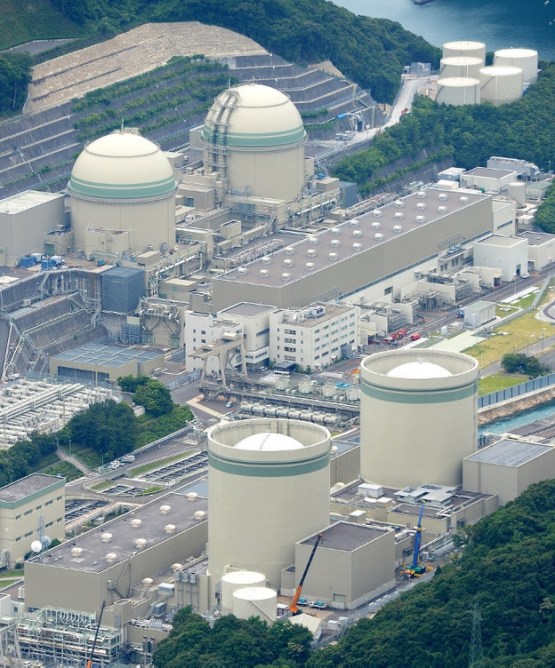
The Takahama Nuclear Power Plant’s No. 1 and 2 reactors (from left in the front row) and No. 3 and 4 reactors (from left in the back row) are pictured in this photo taken from a Mainichi helicopter in Takahama, Fukui Prefecture, on June 15, 2016.
TOKYO (Kyodo) — Japan’s nuclear regulator on Monday approved an additional 20 years of operation for two aging reactors on the Sea of Japan coast that will become the first such reactors to resume operation under new rules introduced after the Fukushima nuclear meltdown.
The Nuclear Regulation Authority granted its approval of Kansai Electric Power Co.’s plan to continue the operation of its No.1 and No.2 reactors at the Takahama nuclear plant in Fukui Prefecture, both of which are over 40 years old.
The rules, tightened after the 2011 nuclear disaster at Tokyo Electric Power Co.’s Fukushima Daiichi plant, set the maximum length of operation for nuclear reactors at 40 years in principle but also stipulate that their operations can be extended for an additional 20 years if the NRA allows.
Since December 2014, Kansai Electric has been checking on degradation of the two reactors in a stricter manner than regular checkups to obtain approval for extending their operations.
After confirming there were no abnormalities, the utility applied in April last year for an NRA screening.
In order for the reactors to resume operation, the company needed to complete three procedures by July 7. The two reactors had already passed a test for compatibility with the new rules and received approval for a construction plan that detailed equipment design. The only remaining test was for measures against the degradation of the reactors.
In the screening, preventing long electric cables from catching fire and covering the containment vessels with concrete were raised as issues to be addressed, and the company submitted a plan to complete such necessary measures by October 2019.
The reactors are therefore expected to resume operations after these steps have been completed.
The No.1 reactor began operating in November 1974, while the No. 2 reactor did so in November the following year. Both reactors have been suspended since regular checkups in 2011.
http://mainichi.jp/english/articles/20160620/p2g/00m/0dm/070000c
Kepco loses challenge to Takahama nuclear injunction

Residents on Friday hold a banner that reads: “Kepco’s request has been rejected; Court rejects restart of Takahama reactors.” The protesters are seen in front of the Otsu District Court in Shiga Prefecture.
OTSU, SHIGA PREF. – The Otsu District Court on Friday rejected a bid by Kansai Electric Power Co. to lift an injunction against restarting reactors at a nearby plant, dealing yet another setback to attempts by the utility and the central government to return swiftly to nuclear power.
The move means the No. 3 and No. 4 reactors at the Takahama nuclear plant, in Fukui Prefecture, will remain idled.
In a statement, Kepco condemned the court’s action.
In his decision, Judge Yoshihiko Yamamoto said Kepco failed to provide sufficient evidence to back up its claims that the two reactors were safe.
“The very first article of the law that established the Nuclear Regulation Authority says a fundamental point of Japan’s nuclear power administration is clearly establishing the understanding that the maximum effort must be made at all times to prevent an accident involving the use of nuclear power,” said Yamamoto. “But unless the operator shows that there is nothing lacking in regards to safety, it’s presumed some safety points are lacking.”
The decision was welcomed by citizens’ groups fighting the restart of the two reactors, but it was also expected. Yamamoto was the same judge who had granted their initial request back in March that shut down the reactors, also citing a lack of convincing evidence on the part of Kepco that the plants were safe. The reactors were originally restarted at the beginning of the year.
“It was a just decision, very direct. We hope it will provide a spark to other legal efforts in other parts of Japan to stop nuclear power plants from being restarted,” Yoshinori Tsuji said after the ruling. Tsuji was one of the plaintiffs who filed for an injunction in March.
Legal wrangling over the two reactors continues. Kepco has filed a separate legal challenge to the Otsu court’s decision, and said Friday it hoped that when that ruling came, possibly in July or August, it will lead to restarts.
Shiga residents seeking to keep the reactors offline have said Friday’s decision did not mean their court battles were over.
“If the Otsu court rules against Kepco, it could end up in the Osaka High Court, possibly next year,” said Hidenori Sugihara, another one of the plaintiffs who sought the injunction.
The Otsu court case has demonstrated the difficulty of restarting nuclear power plants in a timely manner. Under laws drawn up by the NRA that went into effect in 2012, localities within a 30 kilometer radius of a nuclear power plant are supposed to establish evacuation plans in the event of an emergency.
But the expanded radius has greatly increased the number of local governments and residents who are concerned about a rush by the utilities to restart as many plants as possible.
In the Kansai region, where parts of Kyoto and Shiga prefectures lie within 30 kilometers of Fukui Prefecture’s plants, lawsuits by residents like the one in Otsu have the potential to slow down, if not halt, Kepco’s plans for restarts.
The original injunction was brought by Shiga residents who fear an accident at the plant would have a damaging impact on Lake Biwa, the nation’s largest freshwater lake and the source of water for about 14 million residents in cities such as Kyoto and Osaka.
Japan court rejects appeal, keeps ban on restarting 2 nuclear reactors
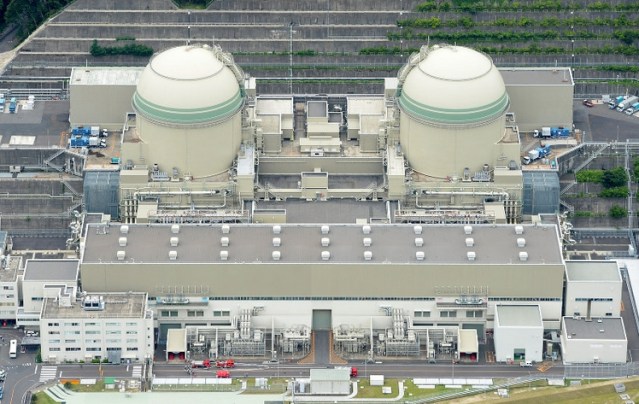
The No. 3 and No. 4 reactors at the Takahama Nuclear Power Plant, from left to right, are pictured in this photo taken from a Mainichi helicopter in Takahama, Fukui Prefecture, on June 15, 2016.
OTSU, Japan (Kyodo) — A Japanese court kept its ban on operation of two nuclear reactors at the Takahama power plant in Fukui Prefecture on Friday by rejecting the plant operator’s request to suspend an injunction it had issued over the reactivated reactors.
The Otsu District Court’s decision concerns the injunction issued in March over the Nos. 3 and 4 units at the Kansai Electric Power Co. plant that marked a major setback for the government’s push to ramp up nuclear power generation. Local residents had filed for the injunction on safety concerns.
In Friday’s decision, the court said it “cannot conclude that (the reactors) are safe, merely because they have met new regulatory standards on nuclear power plants.” New, more stringent safety rules were introduced in 2013 in the wake of the meltdowns at the Fukushima Daiichi nuclear power plant in 2011.
“Kansai Electric should at least explain how the regulations on operation and designs of nuclear power plants were toughened and how it responded to them,” the decision said.
The decision, issued under the same presiding judge, Yoshihiko Yamamoto, as the injunction in March, marks the final word on one process regarding the injunction because Kansai Electric cannot take further action on it.
The two reactors will remain offline as long as the injunction is not invalidated through a separate track examining an objection filed by Kansai Electric when the court issued the injunction. This track is also being presided over by the same judge.
The March 9 injunction was the first of its kind affecting operating reactors. One of the reactors was taken offline one day after the order. The other reactor was already offline.
The court said then there are “problematic points” in planned responses for major accidents and “questions” on tsunami countermeasures and evacuation planning, in light of the 2011 Fukushima disaster.
The Osaka-based utility subsequently sought to suspend the injunction, saying its safety measures are thoroughly proven and the court’s decision was scientifically and technologically groundless. It also said the suspension of the reactors has cost the company 300 million yen ($2.88 million) in losses daily.
The Takahama plant had cleared the post-Fukushima safety regulations in February last year, allowing Kansai Electric to reactivate the Nos. 3 and 4 reactors on Jan. 29 and Feb. 26, respectively. But their operations were beset with problems, with the No. 4 unit shutting down automatically due to a trouble just three days after it was rebooted.
The residents of Shiga Prefecture living within 70 kilometers of the four-reactor plant had filed the injunction as they worried about their safety in the event of a nuclear accident or disaster.
The plaintiffs argued that safety measures are insufficient and feared residents’ exposure to radiation in case of a severe accident.
A part of Shiga falls within a 30-kilometer radius of the plant, which is set by the central government as an evacuation preparedness zone.
http://mainichi.jp/english/articles/20160617/p2g/00m/0dm/039000c
Fears grow as Takahama reactors near restart
Furthermore those reactors in case of nuclear accident are much more dangerous because they are using the MOX fuel, with contains lethal plutonium added to uranium.
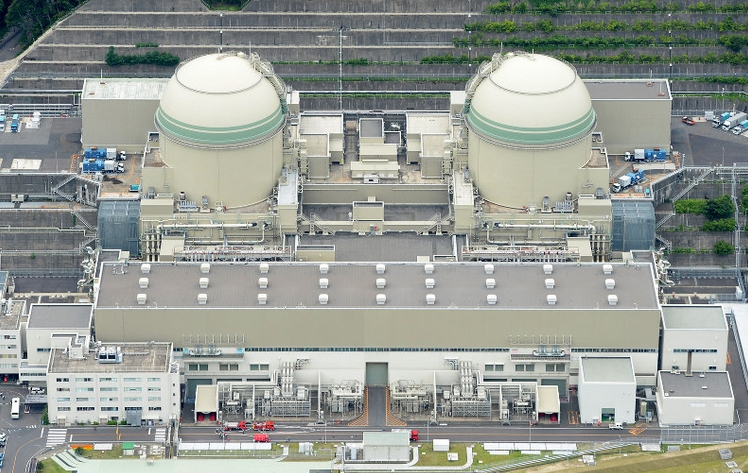
OSAKA – As two aging reactors in the town of Takahama, Fukui Prefecture, move toward restart, safety concerns are growing in neighboring prefectures and municipalities within 30 km of the plant.
Kansai Electric Power Co.’s Takahama No. 1 and 2 reactors are over 40 years old, but the utility has applied for a 20-year extension. On Wednesday, the Nuclear Regulation Authority officially gave the reactors the green light, signaling they meet the fundamental safety standards needed for reactivation.
Although additional tests and inspections are needed before the reactors can resume operation, the potential first-ever restart of two units that are more than four decades old has neighboring communities worried.
The Sea of Japan coastal city of Maizuru, Kyoto Prefecture, parts of which lie 5 km from Takahama, would be on the front lines of any disaster response in the event of an accident, and Mayor Ryozo Tatami expressed specific concerns Wednesday.
“At present, has the safety of the plant been confirmed? We need scientific and technological explanations. The No. 1 and 2 reactors were envisioned and constructed to operate for 40 years,” Tatami said. “We also need documentation from when the plant was originally built that proves it’s possible to operate the reactor for 60 years, especially since the core cannot be replaced.”
Caution by Tatami in particular over restarting Takahama Nos. 1 and 2 could impact the stance of other Kansai leaders.
A small part of northern Shiga Prefecture lies within 30 km of Takahama, and Gov. Taizo Mikazuki expressed concern this week about running old reactors that could leak radiation into Lake Biwa, as well as the problem of storing additional nuclear waste generated by the reactors.
While gaining approval for restarts from heavily pro-nuclear Takahama and Fukui Prefecture is expected to be relatively easy, Kepco is certain to face calls from other Kansai-area prefectures to provide detailed explanations of why it needs to restart two aging reactors before permission for their restart is given.
It is also likely to face questions about whether the utility and NRA are cutting corners in order to make the July 7 deadline for formal permission to restart. If that deadline is missed, the reactors are supposed to be scrapped.
Court Orders One of Japan’s Two Operating Nuclear Plants to Shut Down

Residents cheered a decision by a court in Otsu, Japan, on Wednesday to idle the Takahama Nuclear Power Plant.
TOKYO — A court in Japan ordered one of only two nuclear power plants operating in the country to shut down on Wednesday, citing insufficient safety measures put in place after meltdowns at a facility in Fukushima five years ago.
The plant, Takahama Nuclear Power Plant, had been back online for only two months after an extended freeze on atomic power in Japan in the aftermath of the March 2011 Fukushima disaster.
Japan’s government and its power companies have struggled to get the nuclear industry back on its feet. Despite new safety standards introduced in 2013, much of the public remains wary. Only a handful of the more than 40 operable reactors in the country have met the new rules, and lawsuits have made it difficult to restart them.
Prime Minister Shinzo Abe’s government sees a revival of nuclear power as critical to supporting economic growth and slowing an exodus of Japanese manufacturing to lower-cost countries. Electricity prices have risen by 20 percent or more since the Fukushima disaster because of increased imports of fossil fuels, though the recent drop in oil prices has taken some of the pressure off.
The court ruling on Wednesday added a new twist to the legal battles over nuclear power.
Judges have enjoined idled plants from being put back into service, but the judgment against Takahama was the first in which a facility that had successfully been restarted was ordered to shut down. Takahama’s owner, Kansai Electric Power Company, brought one reactor at the facility back online in January and another last month.
The court, which is in Otsu, Shiga Prefecture , said neither restart should have happened. It was responding to a request for an injunction filed by residents, who said the plant’s owner had underestimated the size of earthquakes that could strike the plant and had not made adequately detailed plans to evacuate people living nearby in case of an accident.
Government safety regulators say Takahama meets Japan’s new safety guidelines, which address such issues. But the court ruled for the plaintiffs, saying there were “points of concern in accident prevention, emergency response plans and the formulation of earthquake models.”
Kansai Electric said it would appeal. It has won previous appeals against injunctions issued against its plants, including Takahama. The company overcame a separate lawsuit to bring the plant online in January.
Takahama is in Fukui Prefecture, a stronghold for the atomic power industry that is home to 13 commercial reactors and that has earned the nickname Genpatsu Ginza, or Nuclear Alley. But the latest lawsuit was filed by residents of the neighboring Shiga Prefecture, who said they would be affected by radiation from a serious accident at Takahama.
Radiation releases from the plant in Fukushima affected a wide swath of northeastern Japan. More than 100,000 residents were evacuated, and many are still unable or unwilling to return.
Court issues surprise injunction to halt Takahama nuclear
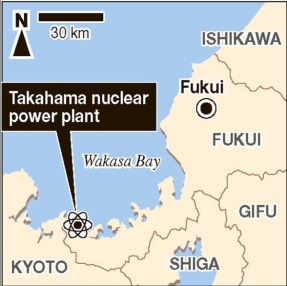 OTSU, SHIGA PREF. – In a surprise ruling that is likely to delay efforts to restart nuclear power generation nationwide, the Otsu District Court on Wednesday issued a provisional injunction ordering Kansai Electric Power Co. to shut down its No. 3 and No. 4 reactors at its Takahama facility in Fukui Prefecture.
While Kepco is expected to appeal the ruling, company officials said at a news conference that was hastily called after the decision that they would begin operations to shut down the No. 3 reactor on Thursday morning, and expected to complete the process by the evening.
The No. 3 reactor was restarted in January, and the No. 4, which had been scheduled to restart last month, was delayed due to technical problems.
“There are doubts remaining about both the tsunami response and the evacuation plan,” the ruling said.
The Otsu ruling comes just two days before the fifth anniversary of the Great East Japan Earthquake and the resulting tsunami and triple meltdown at Tokyo Electric Power Co.’s Fukushima No. 1 plant.
The jubilant plaintiffs expressed surprise and relief following the ruling, which emphasized technical problems regarding the two reactors, including issues concerning an outside power supply source in the event of an emergency. The ruling also raised concerns over the emergency protocol.
“This is a huge victory for the safety of children, people with disabilities, and the society and economy of not only the Fukui-Kansai region of Japan but the entire country,” said Aileen Mioko Smith of Kyoto-based Green Action, an anti-nuclear group. Smith was not a plaintiff in the case.
The lawsuit that sought the injunction was filed by Shiga residents who are fearful that an accident at the Takahama plant, which lies less than 30 kilometers from the northern part of Shiga Prefecture, would impact Lake Biwa, the nation’s largest freshwater body and the source of water for about 14 million people in the Kansai region, including Kyoto and Osaka.
The judgment — the first of its kind affecting reactors that were fired up under strengthened safety regulations following the March 2011 disaster — is a blow to the government’s renewed push for atomic power. The ruling could also cast doubt on the stringency of the new safety regulations.
Chief Cabinet Secretary Yoshihide Suga, however, told reporters following the ruling the government would not change its basic stance of promoting restarts.
In a separate case concerning the two reactors, the Fukui District Court issued an injunction last April banning Kansai Electric from restarting the units, citing safety concerns.
But the same court later lifted the injunction in December, allowing the utility to resume operations at both reactors. Plaintiffs appealed the court decision to the Kanazawa branch of the Nagoya High Court, where the case is pending.
Under the revamped safety regulations, which took effect in 2013, utilities are for the first time obliged to put in place specific countermeasures in the event of severe accidents such as reactor core meltdowns and huge tsunami — which was the initial cause of the crisis at the Fukushima nuclear plant.
Court orders Takahama reactor shut down, 2nd offline
A court has issued an unprecedented order for a nuclear reactor in western Japan to stop operating and ordered a second one to stay offline.
The Otsu District Court in Shiga Prefecture, which issued the injunction, said the emergency response plans and equipment designs at the two reactors have not been sufficiently upgraded despite the 2011 Fukushima crisis.
Wednesday’s order requires Kansai Electric Power Co. to shut down the No. 3 reactor immediately and keep the No. 4 offline at the Takahama plant in Fukui Prefecture, home to about a dozen reactors.
The two reactors restarted this year after a high court in December reversed an earlier injunction by another court.
The decision reflects Japan’s divisive views on nuclear safety and leaves only two of the country’s 43 reactors in operation.
http://ajw.asahi.com/article/behind_news/social_affairs/AJ201603090064
1 This Month

of the week – Shut Down Drone Warfare!


Tell the Ukrainian Government to Drop Prosecution of Peace Activist Yurii Sheliazhenko

Petition to revoke the licensing of the Near Surface Nuclear Disposal Facility (NSDF) at Chalk River. https://www.ourcommons.ca/petitions/en/Petition/Details?Petition=e-7247
To see nuclear-related stories in greater depth and intensity – go to https://nuclearinformation.wordpress.com
-
Archives
- March 2026 (251)
- February 2026 (268)
- January 2026 (308)
- December 2025 (358)
- November 2025 (359)
- October 2025 (376)
- September 2025 (257)
- August 2025 (319)
- July 2025 (230)
- June 2025 (348)
- May 2025 (261)
- April 2025 (305)
-
Categories
- 1
- 1 NUCLEAR ISSUES
- business and costs
- climate change
- culture and arts
- ENERGY
- environment
- health
- history
- indigenous issues
- Legal
- marketing of nuclear
- media
- opposition to nuclear
- PERSONAL STORIES
- politics
- politics international
- Religion and ethics
- safety
- secrets,lies and civil liberties
- spinbuster
- technology
- Uranium
- wastes
- weapons and war
- Women
- 2 WORLD
- ACTION
- AFRICA
- Atrocities
- AUSTRALIA
- Christina's notes
- Christina's themes
- culture and arts
- Events
- Fuk 2022
- Fuk 2023
- Fukushima 2017
- Fukushima 2018
- fukushima 2019
- Fukushima 2020
- Fukushima 2021
- general
- global warming
- Humour (God we need it)
- Nuclear
- RARE EARTHS
- Reference
- resources – print
- Resources -audiovicual
- Weekly Newsletter
- World
- World Nuclear
- YouTube
-
RSS
Entries RSS
Comments RSS
 nuclear-news