Taiwanese Say No to Japan Nuke Food Imports
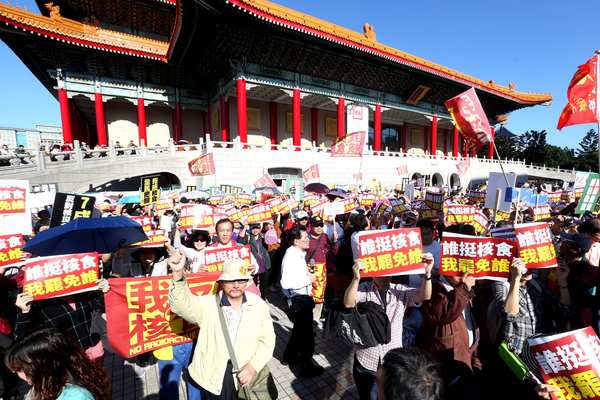
Thousands protest over ‘nuke food’
TAIPEI, Taiwan — Thousands took to the streets to protest the proposed lifting of a ban on food products from radiation-affected areas of Japan, following an inconclusive public hearing on the matter Sunday morning.
The Kuomintang (KMT)-organized march kicked off with remarks from KMT Chairwoman Hung Hsiu-chu (洪秀柱).
“We will not tolerate our children being endangered by food products contaminated by radiation,” Hung said.
Hung urged the crowd of protestors to convey their dissent to the government as they marched from Aiguo East Road near Chiang Kai-shek Memorial Hall and down Ketagalan Boulevard to the Ministry of Finance at Aiguo West Road.
Representatives from various demographics, including housewives, young parents and expecting parents, spoke out in turn before the march began.
The diversity of backgrounds represented at the march “reflected the 74 percent of all Taiwanese nationals who oppose lifting the ban on food imports from five Japanese regions affected by the 2011 Fukushima Daiichi nuclear disaster,” the march’s organizers claimed.
Expecting father Chen Hsiao-wei (陳孝威) expressed concerns that food imports from radiation-affected areas had already made their way into Taiwan.
Chen said he “did not understand any of the figures and numbers” presented by the government’s experts about the imports and only wanted to know why “Taiwanese people should eat these food products when the Koreans, Chinese, and Australians are not eating them.”
In a move that both served as a visual pun and was reminiscent of Latin America’s “pots and pans” protests, “new immigrants” — a term commonly used to refer to immigrants from Southeast Asia — attended the march with small pans and spatulas in hand to object to feeding their children potentially harmful food.
These mothers chose to “bravely speak out and bring their children to the march” to safeguard the welfare of the next generation, a representative of the new immigrant mothers told reporters.
A Failed Public Hearing
Earlier in the day, protestors and KMT legislators attended a public hearing at the Taipei Innovation City Convention Center in New Taipei City’s Xindian District.
The public hearing, which was intended to address the assessment and management of products from the five regions, failed to get past the explanation of the hearing’s rules after repeated outbursts from audience members.
Cabinet Spokesman Hsu Kuo-yung (徐國勇) later said that “some people deliberately showed up (to the hearing) to provoke hatred.”
After moderator Chu Tseng-hung (朱增宏) spent most of the morning asking for decorum, legislators and NGO representatives present decided it was best for the public hearing to be downgraded to an informal forum that would hold no legal weight.
KMT Legislator Kao Chin Su-mei (高金素梅) said procedures for the hearing were “unjust” and that incorrect information was being disseminated. “The government is using technical issues to continue to beat around the bush (on this issue),” Kao Chin said during the hearing.
KMT Legislator Wayne Chiang (蔣萬安) said people’s voices were being omitted. At the march in the afternoon, he told the crowds, “The public hearing was not conducted in accordance with the principle of procedural justice.”
Chiang questioned the need for a hearing on the import of food products from radiation-affected areas if the government had reiterated that it would not allow the import of any “nuke foods.”
Around noon it was decided that the hearing would be downgraded to an informal forum, which organizers of the march later called a “victory of the people.”
Hsu Fu (許輔), director of the Cabinet’s food safety office later said that the forum had achieved “real results” and hoped the format could be used in future policy discussions.
President’s Office Responds
The office of President Tsai Ing-wen office later accused the KMT of “twisting” the hearing.
Presidential Office spokesman Alex Huang (黃重諺) said a public hearing was one of the best “platforms for policy discussion” and that the KMT had managed to turn the hearing into “a show for their party’s own internal election.”
Huang stressed in his statement that the government had never wanted to open the country’s borders to radiation-contaminated food products. “Regardless of where the food products come from, the government holds the same attitude as every other country, which is that it would not import food contaminated by radiation.”
The presidential office spokesman further stated that the government would base their import policies on international professional standards and scientific evidence with no exception.
Radioactive Salmon in Canada
Earlier this month, a research team from Canada’s University of Victoria reported discovering radioactive salmon in the British Columbia region.
Research team leader Jay Cullen found that a sample of salmon from Okanagan Lake in British Columbia had tested positive for cesium 134, which is deemed “a footprint of Fukushima.”
In the years since the 2011 Fukushima disaster, there have been increasing concerns about radiation-contaminated food products originating from the region and contaminated water supplies from airborne radioactive fallout.
Last year, public outrage erupted after food from the Fukushima disaster site was found on British market shelves with false labels. The scare hit closer to home when Taiwan discovered that more than 100 radioactive food products, originating from Fukushima but falsely packaged as coming from Tokyo, had made it onto shelves in Taiwan.
With the issue of food from nuclear-affected regions under close scrutiny domestically, more and more countries and international media outlets are paying attention to the potential of radiation contamination from Fukushima.
At the march, KMT Vice-Chairman Hau Lung-pin (郝龍斌) took the opportunity to ask more people to sign the petition against lifting the food ban.
The petition has been signed by an estimated 78,000 people so far, with Hau stating in a previous interview that the number of signatures could reach 93,000 by year’s end.
KMT Legislator Lin Wei-jo (林為洲) said the brief suspension of plans to lift the ban was a direct result of nationals across Taiwan sending petitions in opposition.
http://www.chinapost.com.tw/taiwan/national/national-news/2016/12/26/487690/p2/Thousands-protest.htm
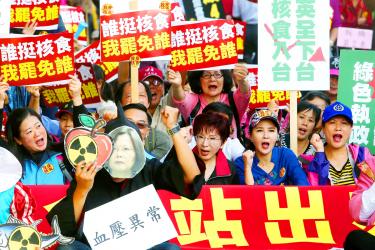
Chinese Nationalist Party (KMT) Chairwoman Hung Hsiu-chu, front third right, attends a demonstration along Taipei’s Ketagalan Boulevard yesterday against the proposed lifting of a ban on food imports from five Japanese prefectures.
KMT leads public protests over Japanese import ban
The Chinese Nationalist Party (KMT) yesterday took to the streets of Taipei, threatening to recall any lawmakers who voice support for the lifting of the nation’s import ban on Japanese food products from five Japanese prefectures, urging President Tsai Ing-wen’s (蔡英文) administration to provide the public with an explanation.
Taiwan imposed import restrictions on food products from Fukushima, Ibaraki, Tochigi, Gunma and Chiba prefectures following the meltdown at the Fukushima Dai-ichi nuclear power plant on March 11, 2011.
Addressing a rally against the relaxation of the ban outside the Chiang Kai-shek Memorial Hall MRT Station in the afternoon, KMT Chairwoman Hung Hsiu-chu (洪秀柱) accused Tsai’s administration of caving in to Japanese pressure and “forcing radiation-contaminated foods down the throats of Taiwanese.”
“We do not understand the Democratic Progressive Party’s [DPP] sudden flip-flop; we do not understand why the government is forcing people and their children to consume radiation-tainted food; and we do not understand … why we have to import radiation-contaminated food products just because of pressure from Japan,” Hung said.
8 Taiwanese firms to be fined for importing food from radiation-affected areas
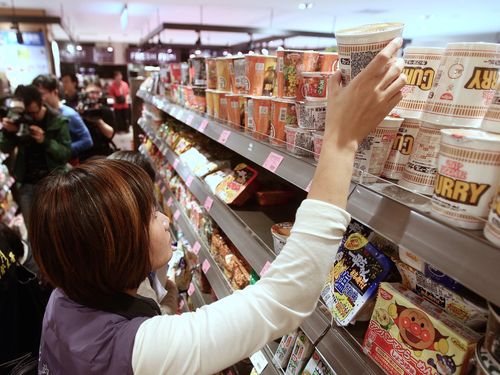
Taipei, Dec. 18 (CNA) Fines will be imposed on eight companies which have been found to have imported foods from Japan’s radiation-affected areas, Taiwan’s Food and Drug Administration (FDA) said Sunday.
As of Sunday, a total of 39 Japanese food products and nearly 60,000 items have been pulled from store shelves in Taiwan, with many of them being soy sauce and wasabi packets that go with Japanese natto, or fermented soybeans.
FDA Northern Center Senior Executive Officer Wei Jen-ting (魏任廷) said 103 importers and 849 distributors island-wide have been questioned since Monday, urging vendors to check the food items they are selling, and notify health authorities if their products came from Fukushima, Ibaraki, Tochigi, Gunma and Chiba prefectures.
Of the 39 products, 26 have tested negative for radiation contamination, while 13 are still being screened, Wei said.
Among the eight importers of these problematic products, Tai Crown Co. (太冠公司) is subjected to a fine of NT$1 million, he said.
The FDA said it will step up inspection of food imported from Japan and will ask importers and distributors to list the places of origin, including the prefecture, on the product labels in Chinese.
Failure to provide Chinese labeling could also result in a fine of between NT$30,000 (US$937) and NT$3 million, it said.
The affected companies have one month to explain themselves, or else the fines will be issued in accordance with the law.
Taiwan recalls 37 food products from Japan’s radiation-affected area
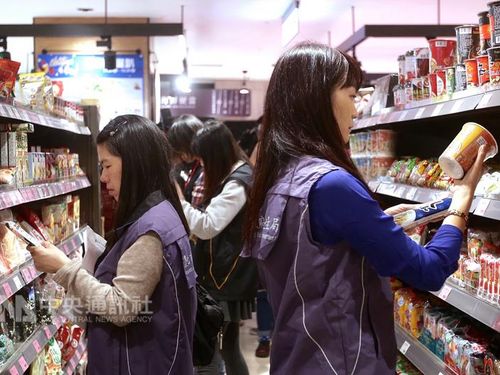
Taiwan recalls 37 food products from Japan’s radiation-affected area
Taipei, Dec. 16 (CNA) A total of 37 Japanese food products have been pulled from store shelves in Taiwan, after they were found to have come from Japan’s radiation-affected areas, Taiwanese authorities said Friday.
As of Thursday, 50,316 pieces of these products have been recalled, with many of them being soy sauce and wasabi packets that came with Japanese natto, or fermented soybeans, according to the Food and Drug Administration (FDA).
The FDA launched an inspection of food products from Japan on Dec. 12, after two brands of Japanese natto were found to contain packets of soy sauce from Ibaraki Prefecture, one of the five prefectures from which food imports have been banned.
Taiwan banned food imports from Fukushima, Ibaraki, Tochigi, Gunma and Chiba prefectures after the meltdown of the Fukushima Daiichi Nuclear Power Plant in March 2011.
Of the 37 products, 22 have tested negative for radiation contamination, while 15 are still being screened, according to the FDA.
Under Taiwan’s ban, even food products that test negative for radiation are restricted from being sold here, as long as they came from one of the five Japanese prefectures.
Among the recalled products is a brand of natto called “Hiruzen Nattou,” which was imported by Deep Cypress Co. (柏泓企業). The soy sauce and wasabi packets that were served with the product were found to have been made in Chiba Prefecture, said Wei Jen-ting (魏任廷), an official with the FDA.
The product was sold in supermarkets in department stores such as SOGO and Shinkong Mitsukoshi, Wei said.
Meanwhile, many of the 37 products were imported by Yumaowu Enterprise Co. (裕毛屋企業), according to the FDA.
Chiu Hsiu-yi (邱秀儀), director of the FDA’s Northern Center for Regional Administration, said the FDA will step up inspection of food imported from Japan and will ask importers and distributors to list the place of origin, including the prefecture, on the product label in Chinese.
If companies refuse to abide by the rules, the FDA said it will reveal their names to the public.
Failure to provide Chinese labeling could also result in a fine of between NT$30,000 (US$937) and NT$3 million, the FDA said, adding that the public can call the hotline 1919 to report such cases.
The recall of Japanese products comes amidst strong opposition to the Taiwanese government’s hopes of lifting the ban on food exports from at least some of the five affected areas if they are found to be free of radiation.
http://focustaiwan.tw/news/asoc/201612160020.aspx
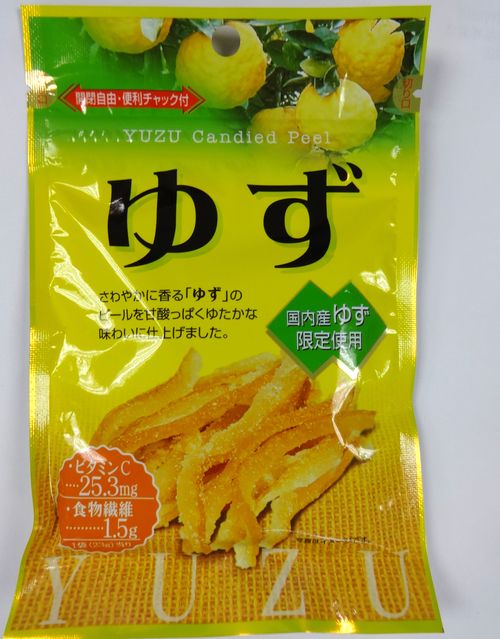
Unsourced Japanese snacks removed from shelves
Taipei, Dec. 16 (CNA) Two kinds of snacks sold at a shopping mart chain in Taoyuan were found to have come from unidentified source in Japan and have been ordered removed from shelves, health officials from Taoyuan City Government said Friday.
The officials said they launched an inspection of labels of origin on food imported from Japan on Dec. 9, checking a total of 707 food products in 273 shops.
On Thursday the Chinese labels of two snacks sold in Poya LivingMart identified them as having come Gifu prefecture, but the original labeling said they were from Tochigi prefecture, one of the radiation-affected areas from which food imports are banned in Taiwan.
After checking the manufacturer’s official website, the product was found to have been manufactured in Tochigi and Iwate, not Gifu.
Health officials have instructed the shop to stop selling the products immediately.
Poya Living Mart’s 11 outlets in Taoyuan have removed a further 214 packages of related food.
The incident came at a time of growing public concern over the safety of food products from five radiation-affected prefectures in Japan.
Taiwan banned food imports from Fukushima, Ibaraki, Tochigi, Gunma and Chiba prefectures in the wake of the Fukushima Daiichi nuclear power plant meltdown following a massive earthquake and tsunami in Japan on March 11, 2011.
Following reports that the government is planning to lift the ban on food imports from four of the radiation-affected prefectures, though not Fukushima, several brands of Japanese natto containing packets of soy sauce from Chiba and Ibaraki were recently found in local retail outlets. They were also ordered removed.
http://www.taiwannews.com.tw/en/news/3053224
Taiwan to hold off on plans for problematic Japanese food imports
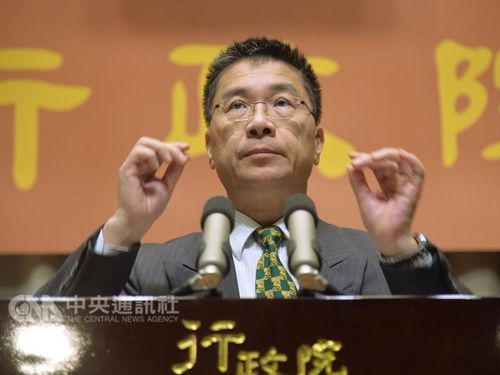
Cabinet spokesman Hsu Kuo-yung (徐國勇)
Taipei, Dec. 16 (CNA) The government is to put on hold a planned opening of food products from radiation-affected prefectures in Japan amid public misgivings about food safety, a Cabinet spokesman said Friday.
Hsu Kuo-yung (徐國勇) said in a news conference Friday that the Cabinet “has to first ensure a sound inspection and management mechanism,” before talking about any opening to food products from the affected areas of Japan.
Hsu pointed out that Premier Lin Chuan (林全) has stressed the importance of “rebuilding public trust in the government’s management of food safety,” after presiding over a cross-agency meeting the previous day.
The premier also said that “without a sound inspection and management mechanism, there can be no question of such an opening,” according to Hsu.
Taiwan banned food imports from Fukushima, Ibaraki, Tochigi, Gunma and Chiba prefectures in the wake of the Fukushima Daiichi nuclear power plant meltdown following a massive earthquake and tsunami in Japan on March 11, 2011.
Amid reports that the government is planning to lift its ban on food imports from the radiation-affected prefectures except for Fukushima, several brands of Japanese natto containing packets of soy sauce from Chiba and Ibaraki have recently been found in Taiwan.
Hsu said that although food products from Fukushima and the surrounding prefectures are banned, there are composite packaging foods, such as the condiment sashets in packages of instant noodles, that have not been subjected to scrutiny.
“The government will review the issue and plug the loopholes,” Hsu said.
Before establishing a sound management mechanism, the government will not make a decision, “and there is no timetable for any such opening,” Hsu said.
He said that there will be three more public hearings on imports of controversial Japanese food products, saying that holding the public hearings is significant in three ways.
They are aimed at establishing a model for future public hearings, then at clarifying false information, as the public has seen all kinds of rumors flying recently.
The public hearings will also be presided over by civic groups rather than by government officials as in previous hearings, in a bid to collect views from the public on how to plug loopholes for the reference of the government, he said.
Sheu Fuu (許輔), director of food safety office under the Executive Yuan, said that all questions raised by the civic groups will be discussed and clarified one by one.
The Cabinet held 10 public hearings on the safety of Japanese products around Taiwan from Nov. 12-14 after announcing them Nov. 10, but critics saw them as essentially being held for show to pave the way for lifting the ban.
Questions were raised about why the government seemed in such a rush to hold the hearings, and some of them ended in chaos amid protests.
Sheu said that if the public still cannot accept the situation after the three public hearings, the government will review the contentious points, and if it cannot resolve such points and effectively manage food safety, “it will not rule out the possibility of maintaining the current ban.”
Food Products Imported from Fukushima Nuclear Disaster Zone Recalled in Taiwan and Hong-Kong
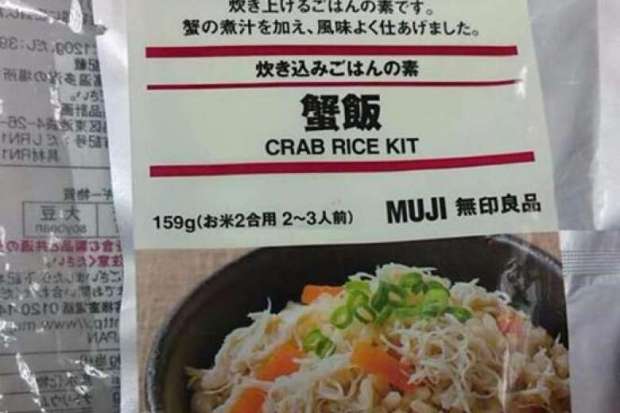
Muji ready meals, natto food products imported from Fukushima nuclear disaster zone recalled in Taiwan
TAIPEI – Two types of Muji ready meals were removed from shelves in Taiwan after they were found to have come from areas affected by the 2011 Fukushima nuclear disaster.
The Japanese lifestyle store removed 638 packets of the products from Tochigi prefecture voluntarily, Taiwan’s China Times reported on Wednesday (Dec 14).
The two products are the conger eel rice kit and the crab rice kit, said Ms Qiu Xiu-yi, northern district head of the Food and Drug Adminstration of Taiwan.
Muji Hong Kong said on Thursday that it was recalling the two products, following the reports in Taiwan.
“In consideration of customers’ concern, Muji Hong Kong has removed the related products from sales floor immediately and is recalling the related products,” it said on its website. “Customers can bring their purchased products to Muji stores in Hong Kong for refund.”
In Taiwan, natto or fermented soybean products imported by Yu Mao Trading were also found to have come from Chiba prefecture, another affected zone.
Five natto products, or 1,465 items in total, were recalled.
Companies which do not report the origin of food imports accurately can be fined NT$30,000 to NT$3 million (S$1,350 to S$135,0000), the Taiwanese report said.
Taiwan protests at Public Hearings about Japanese food & Citizen Group Radiation Measuring
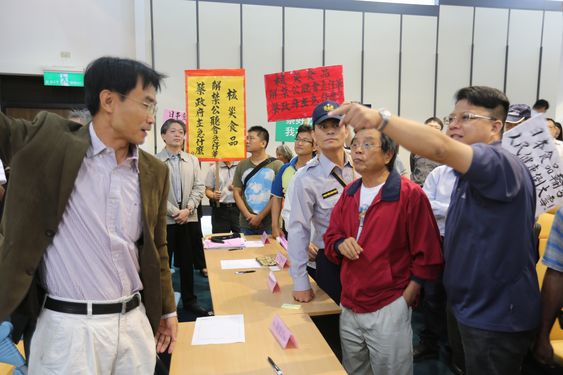
Public hearings on Japanese food in Tainan ends in rowdy protests
Taipei, Nov. 12 (CNA) A melee broke out at a public hearing in Tainan on lifting the ban on imports of currently banned Japanese food from radiation-affected prefectures when protesters clashed with government officials Saturday.
A total of 10 public hearings are scheduled from Nov. 12-14 in the northern, central, southern and eastern parts of Taiwan, as part of a government move widely seen as paving the way for its impending lifting of a five-year ban on Japanese produce from the prefectures affected by radiation following the Fukushima nuclear disaster in 2011.
The public hearing in Tainan was the first of the 10, and was presided over by Chen Chun-yen (陳俊言), head of the department of international cooperation under the Council of Agriculture. Also on hand were Chen Chi-chung (陳吉仲) , deputy director of the Council of Agriculture, and officials from the Office of Food Safety under the Executive Yuan, the Ministry of Health and Welfare and the Atomic Energy Council.
But shortly after the opening of the public hearing, Tsai Yu-hui(蔡育輝), a caucus whip of the opposition Kuomintang at the Tainan City Council, and City councilor Lu Kun-fu (盧崑福), led around two dozen protesters into the venue, demanding that the public hearing be suspended.
They lashed out at the central government for its “sneaky” way of holding the public hearing. Lu said that, as a Tainan city Councilor, he only learned about the public hearing Friday evening.
An agitated Lu later twice pushed and shoved Chen Chun-yen during the protest. Tsai and Lu presented a signature book to show that only one citizen attended the public hearing, shouting “is this the one-man public hearing?”
They questioned if this was really a public hearing with only government officials, protesters and policemen attending. The protesters also dashed to the chairman’s table and hoisting protest cards, with some smashing the papers on the chairman’s table and spilliing his cup of water, shouting angrily that “the food that even Japanese would not eat are going to be exported to Taiwan. Are (our) children worth nothing?”
A larger contingent of police force was sent in to help maintain order, and the public hearing was interrupted for nearly one hour.
When it reopened, the protesters said the procedure was a gross violation of regulations, noting that a public hearing should be announced 10 days before it is held. “This public hearing doesn’t count, as the Executive Yuan has grossly violated the law,” a protester said.
Chen Chun-yen said that the COA will review the procedural issue.
About 10 minutes before the forum ended, the chairman’s table was overturned. Chen Chun-yen then called an end to the forum after the scheduled two-hour period for the forum had expired. Both COA officials left the venue under police escort.
A similar public hearing was held in Chiayi Saturday morning in which participants said the government’s responsibility is to protect the people and ensure food safety.
They asked why the government wants to import risky food from Japan. Chen Chi-chung has said that a partial reopening of currently banned Japanese products could come next year, but would not include items from Fukushima.
In an interview with CNA on Thursday, he said Japan will still be required to produce certificates of radiation inspection and certificates of origin with each shipment, and Taiwan will also inspect imports shipment by shipment at its border.
Food imports from the Japanese prefectures of Fukushima, Ibaraki, Tochigi, Gunma and Chiba have been suspended in Taiwan since March 25, 2011 because of fears of radioactive contamination in those areas from a meltdown at the Fukushima Daiichi Nuclear Power Plant.
The nuclear disaster was triggered by a massive earthquake and tsunamis on March 11, 2011.
Since May 15, 2015, importers of Japanese food products have been required to present certificates of origin to prove that their items do not originate from any of the five prefectures.
For some imports such as tea, baby food, dairy and aquatic products, radiation inspection certificates are also required.
Various Japanese groups have reportedly asked Taiwan to lift the ban since President Tsai Ing-wen (蔡英文) assumed office in May. Her administration is keen to build stronger ties with Japan.
http://focustaiwan.tw/news/asoc/201611120005.aspx
Group to measure Japan radiation
A civic group opposed to the government’s plan to lift a ban on food and agricultural produce from five prefectures in Japan is to travel to Japan later this month to measure radiation levels.
Green Consumers’ Foundation chairman Jay Fang (方儉) said that while a government team went to Japan in August, it did not have its own radiation detection equipment.
The team relied entirely on data provided by Japan, and the report provided was very “rough,” he said.
Fang said he and three others would head to 25 locations in six prefectures — Chiba, Fukushima, Gunma, Tochigi, Ibaraki and Yamanashi — to check radiation levels in the food and the environment for themselves on Nov. 22.
Taiwan suspended food imports from the Japanese prefectures of Fukushima, Ibaraki, Tochigi, Gunma and Chiba following the 2011 Fukushima Dai-ichi nuclear power plant disaster.
The Executive Yuan on Thursday evening announced that 10 public hearings would be held nationwide from yesterday to tomorrow on the issue, amid reports that it will soon lift the ban on imported food items from the prefectures.
Fang said that he has two-and-a-half years of experience working in a laboratory and that his companions also have similar experience.
He said that they are “qualified personnel” and that their equipment meets International Atomic Energy Agency standards.
The inspections will be streamed live on his Facebook page, he said, welcoming the government to follow them online.
http://www.taipeitimes.com/News/taiwan/archives/2016/11/13/2003659171
Taiwan Minister Says Import Ban not a Bargaining Chip

Minister of Health and Welfare Lin Tzou-yien (林奏延) yesterday told lawmakers that the ministry would not risk the health of Taiwanese by lifting a ban on food imports from five Japanese prefectures near the stricken Fukushima Dai-ichi nuclear power plant.
Lin made the remarks at a meeting of the legislature’s Social Welfare and Environmental Hygiene Committee yesterday morning, which was to review the ministry’s general budget for next year.
Amid reports that Council of Agriculture Deputy Minister Chen Chi-chung (陳吉仲) last week asked the Democratic Progressive Party (DPP) caucus about the possibility of lifting the ban on agricultural products from the five prefectures — just days before the first round of the Taiwan-Japan Maritime Affairs Cooperation Dialogue Mechanism in Tokyo on Monday — Chinese Nationalist Party (KMT) Legislator Chiang Wan-an (蔣萬安) asked the minister if it was true the government planned to lift the ban as part of a trade-off.
Food and Drug Administration Director-General Chiang Yu-mei (姜郁美) said that the council report to the DPP caucus was only to explain risks and that it has implemented strict food import controls at borders to help ensure food safety.
She said all food imports from Japan not from the five prefectures — Fukushima, Ibaraki, Tochigi, Gunma and Chiba — must have a certificate of origin and a certificate proving they are free of radioactive contamination, adding that the agency would publish a products company name, if radiation readings were above legal tolerances.
“At present, we have no plans to lift the ban,” Lin said. “The ministry takes protecting the people’s health as its most important duty.”
After Chiang twice asked Lin to confirm that the government would not use lifting the ban as a negotiation tool in its talks with Japan on maritime affairs, Lin said that it would not.
http://www.taipeitimes.com/News/taiwan/archives/2016/11/03/2003658479
Ban on food from Japan’s radiation-affected areas remains: Taiwan FDA
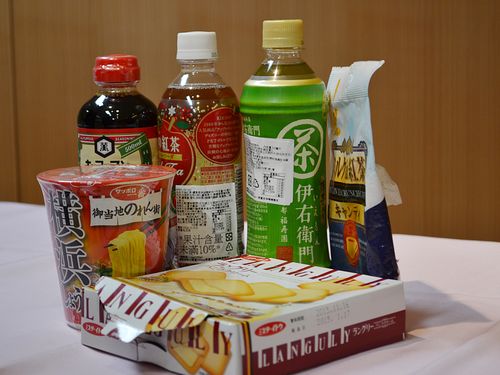
Taipei, Oct. 6 (CNA) The food and Drug Administration (FDA) reaffirmed Thursday that there is no timetable for any lifting of a ban on food imports from five Japanese prefectures that were affected by radiation fallout from a nuclear power plant meltdown following the 2011 earthquake and tsunami.
“There is no timetable for any such opening,” FDA Director-General Chiang Yu-mei (姜郁美) told CNA.
She declined to comment on reports that Taiwan and Japan have reached an initial consensus on Taiwan’s opening to food imports from the five prefectures.
Taiwan banned food imports from Fukushima, Ibaraki, Tochigi, Gunma and Chiba prefectures in the wake of the meltdown of the Fukushima Daiichi Nuclear Power Plant on March 11, 2011.
FDA Deputy Director-General Lin King-fu (林金富) said that food safety remains the primary concern, adding that the FDA will take stock of the management measures of other countries and continue to assess the situation.
Japanese media reported in May that Taiwan was planning to reopen to food imports from the five prefectures, but the reports were denied by the FDA. Reports resurfaced Thursday again about a lifting of the ban, and that formal opening could come early next year.
However, Pan Chih-kuan (潘志寬), an FDA food section chief, said that no related instructions have been received and that the assessment on Japanese food is still underway.
He stressed the three premises for opening — results of border inspection, monitoring results in Japan and the public’s attitude toward opening.
He said that since 2011, border inspections on 92,000 Japanese food items have been carried out, with 215 items found to contain a tiny amount of cesium. One item was found to contain the radioactive material in the past year.
http://focustaiwan.tw/news/asoc/201610060009.aspx#.V_b8QyR8f38.facebook
Taiwan FDA mulls lower threshold for food firm certification
Minister of Health and Welfare Lin Tzou-yien (林奏延) yesterday dismissed media reports that the ministry is planning to lift a ban on food imports from five Japanese prefectures that were affected by radioactive fallout from the Fukushima Dai-ichi nuclear power plant disaster in March 2011.
The Chinese-language United Daily News yesterday said that Japanese media had reported that Taiwan would gradually lift the ban on food imports from the five prefectures.
The United Daily News report also said that Food and Drug Administration (FDA) Director-General Chiang Yu-mei (姜郁美) had stated that there is the possibility of gradually allowing food imports from four prefectures of the five affected prefectures — excluding Fukushima.
Since the disaster, all food imports from five Japanese prefectures — Fukushima, Ibaraki, Tochigi, Gunma and Chiba — have been banned.
“From when I took office on May 20, we have not discussed any issues about radioactive contaminated products from the five Japanese prefectures at all” Lin said in response to media queries.
Regarding rumors that Chiang had admitted the possibility, Lin said: “It is what I say that counts.”
Later, at a meeting of the legislature’s Social Welfare and Environmental Hygiene Committee, Chiang responded to lawmakers’ queries over the issue by saying that his ministry “had not had any contact or discussion” with Japan over the issue.
http://www.taipeitimes.com/News/taiwan/archives/2016/05/31/2003647556
1 This Month

of the week – Shut Down Drone Warfare!


Tell the Ukrainian Government to Drop Prosecution of Peace Activist Yurii Sheliazhenko

Petition to revoke the licensing of the Near Surface Nuclear Disposal Facility (NSDF) at Chalk River. https://www.ourcommons.ca/petitions/en/Petition/Details?Petition=e-7247
To see nuclear-related stories in greater depth and intensity – go to https://nuclearinformation.wordpress.com
-
Archives
- March 2026 (244)
- February 2026 (268)
- January 2026 (308)
- December 2025 (358)
- November 2025 (359)
- October 2025 (376)
- September 2025 (257)
- August 2025 (319)
- July 2025 (230)
- June 2025 (348)
- May 2025 (261)
- April 2025 (305)
-
Categories
- 1
- 1 NUCLEAR ISSUES
- business and costs
- climate change
- culture and arts
- ENERGY
- environment
- health
- history
- indigenous issues
- Legal
- marketing of nuclear
- media
- opposition to nuclear
- PERSONAL STORIES
- politics
- politics international
- Religion and ethics
- safety
- secrets,lies and civil liberties
- spinbuster
- technology
- Uranium
- wastes
- weapons and war
- Women
- 2 WORLD
- ACTION
- AFRICA
- Atrocities
- AUSTRALIA
- Christina's notes
- Christina's themes
- culture and arts
- Events
- Fuk 2022
- Fuk 2023
- Fukushima 2017
- Fukushima 2018
- fukushima 2019
- Fukushima 2020
- Fukushima 2021
- general
- global warming
- Humour (God we need it)
- Nuclear
- RARE EARTHS
- Reference
- resources – print
- Resources -audiovicual
- Weekly Newsletter
- World
- World Nuclear
- YouTube
-
RSS
Entries RSS
Comments RSS
 nuclear-news