Fighting for Earth

Feb 28, 2023
South Korean civil groups gather in Seoul to protest Japan’s plan of dumping Fukushima nuclear-contaminated wastewater into the sea on February 28, 2023. The South Korean government has expressed its concerns over the potential release of radiation-contaminated water from the Fukushima plant into South Korean waters.
Seoul wary of reduced disclosure of radioactive elements in Fukushima wastewater

Prime Minister Han Duck-soo
Feb 22, 2023
Japan’s nuclear regulation authority tentatively confirmed plans Wednesday to narrow the scope of radioactive elements to be monitored in the radiation-contaminated water from quake-stricken Japan’s Fukushima Daiichi nuclear power plant, the South Korean Prime Minister’s Office said in a statement Wednesday.
The types of nuclides under the monitoring has been reduced from 64 to 30, according to Prime Minister Han Duck-soo’s office.
The Seoul government pledged to place the Korean people’s safety as the priority and ensure that the wastewater is treated according to international standards. Moreover, the government will continue to be engaged in the scientific and technological review of Tokyo Electric Power Co.’s plan, as well as the International Atomic Energy Agency’s wastewater analysis.
This came after the Ministry of Foreign Affairs raised the possibility of the narrowing down of the scope of radioactive elements earlier this month. A spokesperson at the Foreign Ministry said on Feb. 10 that such a decision came upon the request of the IAEA.
Tokyo unveiled plans to release the wastewater by as early as this spring.
Japan has claimed that the contaminated water was treated by its own nuclide removal system called Advanced Liquid Processing System. The IAEA has endorsed Japan’s claims that the release meets international standards.
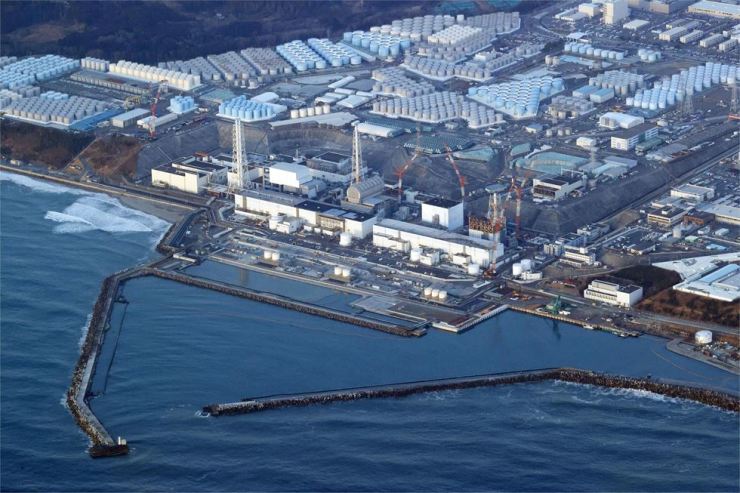
Some 1.3 million tons of wastewater — enough to fill about 500 Olympic-size swimming pools — was used to cool down the quake-hit nuclear reactors, and is being stored at the site. Tokyo announced plans to release the water in 2021.
Recent research jointly conducted by the Korea Institute of Ocean Science and Technology and the Korea Atomic Energy Research Institute indicated some of the nuclides, in particular tritium, could potentially reach South Korean waters within the next four or five years. The impact of it, however, could be “hard to detect,” with about 0.001 becquerel per cubic meter 10 years after the release, research results indicated. A becquerel is a unit of measurement for radioactivity, with even one full becquerel being a tiny amount as relates to human health.
The deadly tsunami in 2011 broke down the nuclear reactor cooling system and melted down three reactors in the Fukushima nuclear power plant in eastern Japan.
Japan slammed for loosening test standards on Fukushima radioactive water

Tokyo Electric Power Company shows a bottle of radioactive water from Fukushima Daiichi Nuclear Power Plant in Japan which has been filtered by ALPS, Feb. 18. The filtering measure is, however, drawing criticism from experts in different countries as its radioactivity-cleansing feature has not been fully verified.
2023-02-23
Seoul urged to respond firmly to Tokyo’s move
By Ko Dong-hwan
Korean environmental activists condemned Thursday, the Japanese government’s latest move to discard radioactive water from their own soil which is now stored at the tsunami-hit nuclear power plant in Fukushima.
Filtered and planned for discharge into the Pacific Ocean this year, the water, according to the Japanese government, has been tested for concentration levels of radioactive nuclides that would pollute the maritime environment.
What concerns the activists is that the Japanese government recently reduced the list of radioactive nuclides to measure and verify their safety levels from 64 to 30.
The list has been shortened to more than half because the Japanese government believes some radioactive nuclides have half-lives that are so short that their radioactivity would thin out to a concentration level minuscule enough to be almost unmeasurable and non-influential to the environment.
But the activists said the move is only an additional problem to the Japanese government’s “doubtful” actions in dealing with the water, largely due to the questionable veracity of the data shared by the government with the world.
“Some radioactive nuclides have very short half-lives, like iodine-131 which has only eight days. Cesium-134, which has a half-life of two years, will also be watered down almost flat in a couple of years,” Choi Kyoung-sook, the coordinator from Korea Radiation Watch, a Seoul-based civic environmental activist group, told The Korea Times.
“But the biggest problem with Japan’s discharge plan is that the water’s potential biological effect on maritime species in the ocean hasn’t been fully tested yet. The Japanese government just got started with that experiment earlier this year, putting halibuts and other fish in an aquarium containing 1 becquerel of cesium to see what happens to the creatures.”
Choi said the Japanese government’s explanation advocating the safety of the discharge is only based on its own belief that the water “appears clean enough” after being filtered by the advanced liquid processing system (ALPS) that the Japanese government claims it has used to treat the water before its discharge planned this spring.

Kim Kyoung-ok from the Korea Institute of Ocean Science and Technology explains the result of a simulation carried out by his institute which demonstrates how discharged radioactive water from the Fukushima nuclear power plant in Japan could affect Korean waters, at Ramada Plaza Jeju Hotel, Feb. 16.
“It’s like they pour one liter of milk into 1,000 tons of water and say, ‘Hey, the water doesn’t look opaque at all,'” Choi said. “ALPS cannot filter out tritium. Carbon-14 has a half-life of 5,000 years. Who can possibly be so sure that radioactive water containing those radioactive particles is safe enough to discharge into the ocean?”
The Korean government has not been as critical of Japan as it should be, Choi said. She said the authority appears to be neglecting to demand sufficient scientific proof from its neighboring country that ensures the safety of the discharge.
“There isn’t any reliable scientific proof whatsoever to what the Japanese government has released to argue the discharge is safe,” Choi said. “Our government should make sure with Japan that there is no harmful biological effect from the discharge and the environmental assessment claimed done by Japan was based on reliable data.”
Choi, alongside other experts concerned with the discharge, proposed the radioactive water be stored for a longer period of time in Japan until it is diluted enough to be safely discharged.
It was found that Japan’s Nuclear Regulation Agency, earlier this year, approved the latest shortlist of radioactive nuclides to be tested, which was proposed by Tokyo Electric Power Company. The list removed 39 types from the original list and added five new ones.
The agency claimed the removed nuclides have half-lives short enough to be dissolved clean into sea waters to the level of not causing any harmful effect on humans and thus do not need to be tested further.
The Japanese authorities have been arguing that their decision-making adhered to the guidelines of the International Atomic Energy Agency, which has been supporting the country’s discharge of the water.
The Korea Institute of Ocean Science and Technology and the Korea Atomic Energy Research Institute last week released the results of a simulation of the discharge they had been studying.
The simulation, designed specifically to track tritium after the water is discharged, showed the water, after circling the Pacific for two years and reaching Korean waters, is expected to have only a negligible amount of the nuclide left. The Ministry of Oceans and Fishery, however, said the simulation was only carried out during a preliminary stage of the study and further simulations are required.
https://www.koreatimes.co.kr/www/nation/2023/02/371_345995.html
Simulation shows Fukushima wastewater will reach Jeju within 5 years upon dumping
The strong Kuroshio Current is expected to lead the water to the West Coast of the US and then continue to spread throughout the northern parts of the Pacific Ocean, according to the simulation

Feb.17,2023
A simulation by South Korean government research institutes has found that if Japan dumps contaminated water from the Fukushima nuclear reactor into the ocean, a radioactive isotope of hydrogen in the contaminated water will begin entering the waters off Jeju Island within four or five years. The same analysis also found that a low concentration of radiation (less than one-millionth of the current background concentration in Korean waters) could temporarily be brought into the area by ocean currents two years after the contaminated water is released.
On Thursday, a joint research team including researchers from the Korea Institute of Ocean Science and Technology (KIOST) and the Korea Atomic Energy Research Institute (KAERI) presented their results of a simulation studying the effects of the diffusion of tritium, a radioactive isotope of hydrogen present in the Fukushima wastewater.
The results of the simulation were presented at an academic conference held by the Korean Society of Hazard Mitigation in Jeju.
The reason for concern is that tritium can decay to helium-3 and affect DNA, which could result in adverse effects on the human body including cell death or deterioration in reproductive function.
This is the first time that the results of a joint simulation conducted by national research institutes on the domestic impact of the release of Fukushima wastewater have been released.
Ever since Japan announced its decision in April 2021 to release the contaminated water, both the previous Moon Jae-in government and the current Yoon Suk-yeol administration have recognized the need to conduct studies, saying that domestic institutes would further advance analysis models and then conduct related studies.
The results of this study were obtained using an analysis model that had been upgraded by late last year.
According to the research results, the tritium present in the wastewater poised to be discharged off the coast of Fukushima, which is located in eastern Japan, would move in an eastward direction due to the strong Kuroshio Current. This would lead the water to the West Coast of the US and then continue to spread throughout the northern parts of the Pacific Ocean.
On the other hand, the inflow of this water to the Korean Peninsula would be slower given the weak ocean currents.

A diagram showing the simulated tritium concentrations in the ocean two years following release. (Source: KAERI-KIOST simulation)
The analysis predicts that around four to five years will pass after the release of the wastewater before tritium begins flowing in Jeju waters.
Even though the Korean Peninsula is situated geographically close to Japan, it is expected to be affected by the wastewater at a later time than, for example, the Pacific Coast of the US, because the seawater flows eastward from Japan due to the influence of ocean currents.
Since the Korean Peninsula is located to the west of Japan, the water will first spread to the Pacific Ocean and then begin making its way to Korean waters.
The research team predicted that the concentration of tritium flowing into Jeju waters would reach around 0.001 becquerels (Bq) per cubic meter of water 10 years after the release of the Fukushima wastewater. A becquerel is a unit of radioactivity.
This concentration is one-100,000th of the average tritium concentration (background concentration) of the 172 Bq/m3 in domestic seawater analyzed by the Korea Institute of Nuclear Safety.
“This concentration is a concentration [level] that is difficult to detect with an analysis device,” the research team explained.
However, the study also found that the timing of wastewater inflow into Korean waters could change every year depending on specific characteristics of the ocean currents.
In fact, the joint simulation showed a temporary inflow of wastewater into Korean waters due to the influence of sea currents just two years after its release, albeit at a low concentration of 0.0001 Bq/m3.
“Ocean currents do not flow steadily, but change from season to season,” says Kim Kyeong-ok, a senior researcher at KIOST who helped carry out this simulation.
“The reason for the temporary influx of tritium two years after the [wastewater] release is because the ocean current is strong at this time,” Kim explained.
The simulation results from Korean researchers are not very different from what previous studies conducted in China concluded.
In 2021, a simulation conducted by an international research team led by researchers from the First Institute of Oceanography of China’s Ministry of Natural Resources found that tritium reached South Korean waters at a concentration of about 0.001 Bq/m3 five years after the initial release of the wastewater.
Last year, another simulation conducted by a research team at Tsinghua University in China predicted that tritium would reach Korean waters after 10 years at a concentration level of one-hundredth the levels present in the Pacific Ocean east of Japan.
“Tritium released off the coast of Fukushima was found to spread throughout the entire northern part of the Pacific Ocean 10 years later. These are similar results to China’s simulation study on the spread of the wastewater,” the KOIST and KAERI joint research team said.
This simulation was based on the assumption that Japan would release 22 trillion Bq of tritium annually for 10 years from next month into the ocean located about 1 kilometer from the Fukushima nuclear power plant.
The figure of 22 trillion Bq is the maximum amount Japan plans to release annually.
However, this simulation was only focused on the diffusion of tritium, meaning that the spread of other radioactive nuclides throughout the food chain or the effects of their accumulation in water was not taken into consideration.
Therefore, this analysis does not represent the full environmental impact that the discharge of the wastewater would actually have. In reality, besides tritium, the wastewater Japan plans to release into the ocean contains many more radioactive materials as well.

A diagram showing the simulated tritium concentrations in the ocean two years following release. (Source: KAERI-KIOST simulation)
While Japan’s Tokyo Electric Power Company (TEPCO) announced plans to begin the release of the wastewater this spring, this schedule could be delayed if reviews related to wastewater monitoring plans currently underway by the Japan Atomic Energy Commission and the International Atomic Energy Agency are prolonged.
Regarding the results of this simulation, both environmental groups and opposition parties in Korea remain unconvinced, arguing that it is too hasty to conclude that the impact on Korea from the Fukushima wastewater will be negligible based solely on this simulation.
The reasoning behind this stance is the argument that the Japanese data used to conduct this study is unreliable and that the concentration levels of other radioactive materials were not considered.
“Many experts, including the US National Association of Marine Laboratories, which is affiliated with more than 100 marine research institutes, don’t trust the Japanese government’s data and plans based on the lack of important data regarding the amount of radionuclides in each tank where contaminated water is stored and the lack of efficiency of the ALPS (Advanced Liquid Processing System),” the Korea Federation for Environmental Movements said in a statement.
“The safety of discharging the wastewater into the ocean should not be evaluated solely by [measuring] the concentration levels of radioactive materials in seawater,” KFEM added.
In addition, the Democratic Party’s response team aimed at stopping the discharge of the Fukushima wastewater also spoke out after the simulation results were published, saying, “The priority should be verifying Japan’s false data.”
“It is difficult to expect reliability because these results are based on Japan’s false data and claims,” the team said in a statement.
“What we need to do now is to request verifiable and transparent data regarding the Fukushima wastewater from the Japanese government and to prepare for international legal responses, such as provisional measures, to stop the release of the Fukushima wastewater,” the team argued.
https://english.hani.co.kr/arti/english_edition/e_international/1080176.html
93% of S. Koreans concerned over safety of food from Fukushima region: survey
A recent survey conducted by Japan’s Yomiuri Shimbun has revealed differing opinions over how safe it is to eat food produced in the Fukushima region. In an internet poll of 3-thousand people released on Tuesday, 93-percent of Koreans asked felt it would be “dangerous” to eat food produced in the Fukushima area. On the other hand, 36-percent of Japanese residents felt it would be unsafe to do so. People from other parts of the world also took part in the survey, with 87 percent of Chinese respondents expressing concerns over food from Fukushima. Japan is set to release contaminated water into the sea from the Fukushima Daiichi Nuclear Power Plant in the coming months.
Japan to Cut Number of Radioactive Substances Measured at Fukushima Plant
What about the other 33 radioactive substances, they are conveniently ignored and presumed to be harmless to marine life and to our food chain?

February 10, 2023
The Tokyo Electric Power Company(TEPCO) has notified South Korea that it is pushing to reduce the number of radioactive substances tested for in the Fukushima nuclear power plant’s wastewater before it is released in the spring.
According to documents obtained by Democratic Party lawmaker Lee Jae-jung from Seoul’s foreign ministry and the Nuclear Safety and Security Commission, the Japanese entity plans to measure the levels of 31 radioactive substances contained in the contaminated water instead of the original 64.
The ministry said the adjustment, which was shared by Tokyo during director-level talks in late December, was requested by a task force at the International Atomic Energy Agency, which is verifying the safety of Japan’s water release plan.
Japan’s Nuclear Regulation Authority has been reviewing the revised plan submitted by the TEPCO for three months but has yet to issue a decision.
The foreign ministry said it will continue to prioritize the safety of the South Korean public as it deals with the issue, maintaining the stance that the wastewater should be handled in a scientific manner in accordance with international law.
Simulation to show flow of radioactive water discharged from Fukushima

An aerial view shows the storage tanks for treated water at the tsunami-crippled Fukushima Daiichi nuclear power plant in the town of Okuma, Fukushima Prefecture, Japan, Feb. 13, 2021.
February 10, 2023
By Ko Dong-hwan
Korean researchers will release next Thursday the result of a simulation they have been working on to demonstrate how radioactive water discharged from Japan’s Fukushima nuclear power plant, which was devastated by a tsunami 12 years ago, will flow and affect the world’s oceans.
Researchers from the Korea Institute of Ocean Science and Technology (KIOST) and the Korea Atomic Energy Research Institute (KAERI) said the simulation was designed to track tritium, a radioactive isotope of hydrogen with a half-life of about 12 years. Emitted from nuclear facilities across the world, tritium is believed unfilterable even by ALPS, the advanced liquid processing system that is supposed to treat radioactive water now stored at the Fukushima plant before releasing it into the Pacific Ocean this spring.
The researchers said the simulation will likely show how tritium will spread through sea water. Tritium is one of the 64 radioactive nuclides believed to be contained in the radioactive water stored in more than 1,000 tanks with a total liquid volume of about 1.37 million cubic meters.
The presentation, jointly conducted by KIOST and KAERI, is part of the Korean Society of Hazard Mitigation’s academic forum to be held on Jeju Island from Feb. 15 to 17.
There has been a lot of speculation about why the results of the simulation are being first released at an academic conference instead of through a government briefing, raising concerns over the possibility that the Korean government may be reluctant to announce the findings for fear of damaging its diplomatic relations with its neighbor.
The researchers have stated that the presentation is “based on scientific findings and does not involve any political decisions.”
Following the destruction of the Fukushima Daiichi nuclear power plants in Okuma which were struck by a tsunami in 2011, the Japanese government and the International Atomic Energy Agency now plan to release some 1.3 million tons of radioactive water into the oceans over a period of 30 years starting this year. They have argued that the water will be treated by ALPS and poses no harm to the environment. But those critical of the decision say the data shared by the Japanese government with the world declaring the water’s safety is highly suspicious and lacks credibility.
The radioactive water, once discharged, is expected to flow with ocean currents around the Pacific Ocean in a clockwise direction arriving in Korean waters after about a year.
Radioactive water, even in tiny amounts, is harmful to humans after decades of exposure. The most common intake route is believed to be through food, especially seafood imported from Japan.
https://www.koreatimes.co.kr/www/nation/2023/02/371_345196.html
Interview: Japan’s unilateral radioactive wastewater discharge irresponsible, harmful: green activist
The Japanese government has claimed that the contaminated water could be diluted with water and discharged at a low concentration after being treated with an advanced liquid processing system (ALPS).
The green activist, however, noted that the radioactive substances cannot be completely filtered through the ALPS, saying substances, such as tritium, will be poured into the sea unfiltered.
According to the South Korean environmental group’s analysis of the 2021 data from Japan’s Ministry of Health, Labor and Welfare, cesium was detected from 8 percent of Japanese fishery products.
“The Pacific Ocean is not the sea of Japan, but the sea of everybody … Pollutants will flow to neighboring countries in a situation that a lot of radioactive materials have already been released and contaminated (the marine ecosystem),” said the green activist.

(Xinhua) January 16, 2023
SEOUL, Jan. 14 (Xinhua) — Japan’s unilateral push to discharge radioactive wastewater from its crippled Fukushima Daiichi nuclear power plant into the Pacific Ocean is irresponsible and harmful, as the Japanese government pursued it without consultations with neighboring countries, a South Korean green activist said.
“It is very concerned that Japan is still unilaterally pushing for the discharge of the Fukushima contaminated water,” Ahn Jae-hun, energy and climate change director at the Korea Federation for Environment Movement, told Xinhua on Saturday.
“Neighboring countries such as (South) Korea and China could suffer more direct damage, so Japan had to consult with them. The problem is that Japan follows its own process (without consultations),” said Ahn.
“A sizeable amount of the contaminated water, such as tritium, is difficult to purify no matter how much purification is performed. It is very irresponsible to release it as it is.”
Japan’s planned release of tritium-laced wastewater from the Fukushima power plant into the sea will start around this spring or summer, according to Kyodo News reports citing the Japanese government.
Japan decided in April 2021 to start dumping about 1.25 million tons of nuclear wastewater into the ocean spanning 30 years from 2023.
The Japanese government has claimed that the contaminated water could be diluted with water and discharged at a low concentration after being treated with an advanced liquid processing system (ALPS).
The green activist, however, noted that the radioactive substances cannot be completely filtered through the ALPS, saying substances, such as tritium, will be poured into the sea unfiltered.
“A lot of radioactive materials have already flowed into the sea after the Fukushima nuclear disaster. Because of that, fish contaminated with cesium are caught in waters off Fukushima,” said Ahn.
According to the South Korean environmental group’s analysis of the 2021 data from Japan’s Ministry of Health, Labor and Welfare, cesium was detected from 8 percent of Japanese fishery products.
“Once (the contaminated water) is thrown into the sea, it cannot be retrieved. Environmental effects from radioactive materials cannot be felt immediately, but will inevitably appear over a long period of time,” Ahn said.
“The Pacific Ocean is not the sea of Japan, but the sea of everybody … Pollutants will flow to neighboring countries in a situation that a lot of radioactive materials have already been released and contaminated (the marine ecosystem),” said the green activist.
The South Korean government, which has opposed the radioactive wastewater dumping by Japan, reiterated its opposition.
“Putting top priority on public health and safety, the government will continue to respond by maintaining its position that the contaminated water from the Fukushima nuclear power plant should be safely disposed of in accordance with international standards from the objective and scientific perspectives,” a South Korean foreign ministry official said Friday.
Japan’s unilateral radioactive wastewater discharge irresponsible, harmful: green activist
“The Pacific Ocean is not the sea of Japan, but the sea of everybody … Pollutants will flow to neighboring countries in a situation that a lot of radioactive materials have already been released and contaminated (the marine ecosystem),” said the green activist.

File photo taken on Oct. 12, 2017 shows huge tanks that store contaminated radioactive wastewater in Fukushima Daiichi nuclear plant, in Fukushima Prefecture, Japan.
Source: Xinhua 2023-01-15
“It is very concerned that Japan is still unilaterally pushing for the discharge of the Fukushima contaminated water,” energy and climate change director at the Korea Federation for Environment Movement said.
SEOUL, Jan. 15 (Xinhua) — Japan’s unilateral push to discharge radioactive wastewater from its crippled Fukushima Daiichi nuclear power plant into the Pacific Ocean is irresponsible and harmful, as the Japanese government pursued it without consultations with neighboring countries, a South Korean green activist said.
“It is very concerned that Japan is still unilaterally pushing for the discharge of the Fukushima contaminated water,” Ahn Jae-hun, energy and climate change director at the Korea Federation for Environment Movement, told Xinhua on Saturday.
“Neighboring countries such as (South) Korea and China could suffer more direct damage, so Japan had to consult with them. The problem is that Japan follows its own process (without consultations),” said Ahn.
“A sizeable amount of the contaminated water, such as tritium, is difficult to purify no matter how much purification is performed. It is very irresponsible to release it as it is.”
Japan’s planned release of tritium-laced wastewater from the Fukushima power plant into the sea will start around this spring or summer, according to Kyodo News reports citing the Japanese government.
Japan decided in April 2021 to start dumping about 1.25 million tons of nuclear wastewater into the ocean spanning 30 years from 2023.
The Japanese government has claimed that the contaminated water could be diluted with water and discharged at a low concentration after being treated with an advanced liquid processing system (ALPS).
The green activist, however, noted that the radioactive substances cannot be completely filtered through the ALPS, saying substances, such as tritium, will be poured into the sea unfiltered.
“A lot of radioactive materials have already flowed into the sea after the Fukushima nuclear disaster. Because of that, fish contaminated with cesium are caught in waters off Fukushima,” said Ahn.
According to the South Korean environmental group’s analysis of the 2021 data from Japan’s Ministry of Health, Labor and Welfare, cesium was detected from 8 percent of Japanese fishery products.
“Once (the contaminated water) is thrown into the sea, it cannot be retrieved. Environmental effects from radioactive materials cannot be felt immediately, but will inevitably appear over a long period of time,” Ahn said.
“The Pacific Ocean is not the sea of Japan, but the sea of everybody … Pollutants will flow to neighboring countries in a situation that a lot of radioactive materials have already been released and contaminated (the marine ecosystem),” said the green activist.
The South Korean government, which has opposed the radioactive wastewater dumping by Japan, reiterated its opposition.
“Putting top priority on public health and safety, the government will continue to respond by maintaining its position that the contaminated water from the Fukushima nuclear power plant should be safely disposed of in accordance with international standards from the objective and scientific perspectives,” a South Korean foreign ministry official said Friday.
https://english.news.cn/20230115/d0affa1c0f3747e8b36fce7babbe7644/c.html
Korea urges int’l discussions on Japan’s Fukushima plan at London Convention
October 8, 2022
Korea urged the international community to discuss Japan’s plan to discharge radioactive water from its crippled Fukushima nuclear power plant into the ocean at this week’s international maritime gathering, the oceans ministry said Saturday.
The Fukushima nuclear power plant meltdown in 2011 has spread heavy safety concerns among nearby countries.
The Korean Ministry of Oceans and Fisheries said Tokyo’s disposal of radioactive water may have a serious impact on the health, safety and ecosystem of neighboring nations, during the weeklong 44th London Convention and the 17th London Protocol that ended Friday.
The Korean government has brought the Fukushima discharge agenda to London since 2019.
Japan has refuted Seoul’s call, claiming the discharge of radioactive water from nuclear power plants should not be seen as an act of marine dumping.
The London Convention promotes the effective control of all sources of marine pollution and takes steps to prevent marine pollution by human activities. Korea joined the convention in 1993.
The London Protocol calls for banning all dumping, with some exceptions. It has 53 signatories, including Korea which joined it in 2009.
Earlier in August, the United Nations-specialized International Marine Organization (IMO) decided that the Fukushima discharge agenda is appropriate to be discussed in London, with mutual agreement of the members involved.
At the IMO convention, the Korean oceans ministry said the members should discuss ways to safely dispose the contaminated water from the Fukushima power plant, actively exchange information and monitor the situation. (Yonhap)
https://www.koreatimes.co.kr/www/nation/2022/10/120_337530.html
Rival parties call for govt. response to Japan’s Fukushima water release plan

Oct 6, 2022
Rival parties on Thursday called on the government to come up with measures to respond to Japan’s plan to discharge radioactive water from its crippled Fukushima nuclear power plant into the sea starting next year.
The ruling People Power Party (PPP) and the main opposition Democratic Party (DP) voiced concerns over the plan in unison during an annual parliamentary audit session on the Ministry of Oceans and Fisheries, calling it a “matter of people’s safety.”
In July, Japan’s nuclear regulator, the Nuclear Regulation Authority, formally approved the plan to discharge the radioactive waste water stored in tanks at the Fukushima Daiichi Nuclear Power Plant into the Pacific Ocean. More than 1.2 million tons of tritium-laced water is expected to be released starting in spring next year.
“The government should work to resolve the Fukushima water release issue with all possible measures,” Rep. So Byung-hoon, head of the parliamentary oceans committee, said, adding “the golden time is almost over.”
DP Rep. Wi Seong-gon urged the government to have a clearer position on the matter, saying “uncertain” and “unsafe” substances from the polluted water can be contained in food South Korean people eat and damage the country’s marine environment.
PPP Rep. Choi Chun-sik pointed out the oceans ministry lacks data and reports on Japan’s plan.
Oceans Minister Cho Seung-hwan told the lawmakers his ministry is considering whether to petition an international court over Tokyo’s decision, and the foreign ministry is also looking into the expected damage from the water release with international law experts and scientists. (Ypnhap)
Seoul asks IAEA for verification of Japan’s plan to discharge treated water from Fukushima plant
September 28, 2022
The South Korean government has asked the IAEA for thorough verification of Japan’s plan to discharge treated water from the Fukushima Number One nuclear power plant into the ocean. Attending the 66th Regular Session of the International Atomic Energy Agency in Vienna on Tuesday, Seoul’s vice minister of science and ICT, Oh Tae-seok, also called for Tokyo to share details of the process with the rest of the international community in a transparent manner. He also asked for unwavering support from IAEA member-states in denuclearizing North Korea, stressing that the regime’s nuclear programs pose a serious threat to international society.
1 This Month

of the week – Shut Down Drone Warfare!


Tell the Ukrainian Government to Drop Prosecution of Peace Activist Yurii Sheliazhenko

Petition to revoke the licensing of the Near Surface Nuclear Disposal Facility (NSDF) at Chalk River. https://www.ourcommons.ca/petitions/en/Petition/Details?Petition=e-7247
To see nuclear-related stories in greater depth and intensity – go to https://nuclearinformation.wordpress.com
-
Archives
- March 2026 (251)
- February 2026 (268)
- January 2026 (308)
- December 2025 (358)
- November 2025 (359)
- October 2025 (376)
- September 2025 (257)
- August 2025 (319)
- July 2025 (230)
- June 2025 (348)
- May 2025 (261)
- April 2025 (305)
-
Categories
- 1
- 1 NUCLEAR ISSUES
- business and costs
- climate change
- culture and arts
- ENERGY
- environment
- health
- history
- indigenous issues
- Legal
- marketing of nuclear
- media
- opposition to nuclear
- PERSONAL STORIES
- politics
- politics international
- Religion and ethics
- safety
- secrets,lies and civil liberties
- spinbuster
- technology
- Uranium
- wastes
- weapons and war
- Women
- 2 WORLD
- ACTION
- AFRICA
- Atrocities
- AUSTRALIA
- Christina's notes
- Christina's themes
- culture and arts
- Events
- Fuk 2022
- Fuk 2023
- Fukushima 2017
- Fukushima 2018
- fukushima 2019
- Fukushima 2020
- Fukushima 2021
- general
- global warming
- Humour (God we need it)
- Nuclear
- RARE EARTHS
- Reference
- resources – print
- Resources -audiovicual
- Weekly Newsletter
- World
- World Nuclear
- YouTube
-
RSS
Entries RSS
Comments RSS
 nuclear-news