Japan intend to release Fukushim Daiichi’s radioactive water into sea
We knew it all along that they always intended to finally dump it all into the sea, which is the cheapest expedient solution. Giving us repeatedly various B.S. reasons:
That they were running out of space on location to build new tanks to store the additional radioactive water, produced daily by their need to cool those undergoing meltdown reactors.
That it is just harmless tritiated water, that the radioactive water has been filtered by two filtering systems which have removed all the 64 types of radionuclides to the exception of only tritium.
Which is total B.S. as Tritium is not harmless despite them pretending it to be. Various scientific studies have proven the dangerosity of tritium on life, all forms of life. Plus as later Tepco itself has admitted that their two filtering systems were failing to remove completely the 64 types of radionuclides present in that accumulated radioactive water, it is not “tainted water”, nor “tritiated water”, nor “contaminated water” as their propaganda spin doctors name it, but real radioactive water still containing various harmful radioactive fission products.

Japan to release Fukushima’s contaminated water into sea: reports
Oct 16, 2020
TOKYO (Reuters) – Nearly a decade after the Fukushima nuclear disaster, Japan’s government has decided to release over one million tonnes of contaminated water into the sea, media reports said on Friday, with a formal announcement expected to be made later this month.
The decision is expected to rankle neighbouring countries like South Korea, which has already stepped up radiation tests of food from Japan, and further devastate the fishing industry in Fukushima that has battled against such a move for years.
The disposal of contaminated water at the Fukushima Daiichi plant has been a longstanding problem for Japan as it proceeds with an decades-long decommissioning project. Nearly 1.2 million tonnes of contaminated water are currently stored in huge tanks at the facility.
The plant, run by Tokyo Electric Power Company Holdings Inc (9501.T), suffered multiple nuclear meltdowns after a 2011 earthquake and tsunami.
On Friday, Japan’s industry minister Hiroshi Kajiyama said no decision had been made on the disposal of the water yet, but the government aims to make one quickly.
“To prevent any delays in the decommissioning process, we need to make a decision quickly,” he told a news conference.
He did not give any further details, including a time-frame.
The Asahi newspaper reported that any such release is expected to take at around two years to prepare, as the site’s irradiated water first needs to pass through a filtration process before it can be further diluted with seawater and finally released into the ocean.
In 2018, Tokyo Electric apologised after admitting its filtration systems had not removed all dangerous material from the water, collected from the cooling pipes used to keep fuel cores from melting when the plant was crippled.
It has said it plans to remove all radioactive particles from the water except tritium, an isotope of hydrogen that is hard to separate and is considered to be relatively harmless.
It is common practice for nuclear plants around the world to release water that contain traces of tritium into the ocean.
In April, a team sent by the International Atomic Energy Agency to review contaminated water issues at the Fukushima site said the options for water disposal outlined by an advisory committee in Japan – vapour release and discharges to the sea – were both technically feasible. The IAEA said both options were used by operating nuclear plants.
Last week, Japanese fish industry representatives urged the government to not allow the release of contaminated water from the Fukushima plant into the sea, saying it would undo years of work to restore their reputation.
South Korea has retained a ban on imports of seafood from the Fukushima region that was imposed after the nuclear disaster and summoned a senior Japanese embassy official last year to explain how Tokyo planned to deal with the Fukushima water problem.
During Tokyo’s bid to host the Olympic Games in 2013, then-prime minister Shinzo Abe told members of the International Olympic Committee that the Fukushima facility was “under control”.
The Games have been delayed to 2021 because of the pandemic and some events are due to be held as close as 60 km (35 miles) from the wrecked plant.
Japan reportedly decides to release treated Fukushima water into the sea
Japan will release more than a million tons of treated radioactive water from the stricken Fukushima nuclear plant into the sea in a decades-long operation, reports said Friday, despite strong opposition from environmentalists, local fishermen and farmers. The release of the water, which has been filtered to reduce radioactivity, is likely to start in 2022 at the earliest, said national dailies the Nikkei, the Yomiuri, and other local media.
The decision ends years of debate over how to dispose of the liquid that includes water used to cool the power station after it was hit by a massive tsunami in 2011.
A government panel said earlier this year that releasing the water into the sea or evaporating it were both “realistic options.”
“We can’t postpone a decision on the plan to deal with the… processed water, to prevent delays in the decommission work of the Fukushima Daiichi nuclear power plant,” Chief Cabinet Secretary Katsunobu Kato said Friday, without commenting directly on the plan or its timing.
There are around 1.23 million tons of waste water stored in tanks at the facility, according to plant operator TEPCO, which also declined to comment on the reports.
Environmental activists have expressed strong opposition to the proposals, and fishermen and farmers have voiced fear that consumers will shun seafood and produce from the region.
South Korea, which bans imports of seafood from the area, has also repeatedly voiced concern about the environmental impact.
A decision has been getting increasingly urgent as space to store the water — which also includes groundwater and rain that seeps daily into the plant — is running out.
Most of the radioactive isotopes have been removed by an extensive filtration process — but one remains, tritium. It can’t be removed with existing technology.
The expert panel advised in January that discarding the water into the sea was a viable option because the method is also used at working nuclear reactors.
Tritium is only harmful to humans in very large doses, experts say. The International Atomic Energy Agency argues that properly filtered water could be diluted with seawater and then safely released into the ocean.
The Yomiuri reported that the water would be diluted inside the facility before its release, with the whole process taking 30 years.
The treated water is currently kept in a thousand huge tanks at the Fukushima Daiichi site, where reactors went into meltdown nearly a decade ago after the earthquake-triggered tsunami.
Plant operator TEPCO is building more tanks, but all will be full by mid-2022.
National Federation of Fisheries Cooperative Associations’ head opposes releasing Fukushima Daiichi radioactive water into sea

Hiroshi Kishi, the head of the National Federation of Fisheries Cooperative Associations, speaks at a government hearing in Tokyo on Thursday.
Fishing industry chief opposes releasing Fukushima No. 1 water into sea
Oct 9, 2020
The head of the National Federation of Fisheries Cooperative Associations, or Zengyoren, has voiced strong opposition against releasing treated water containing radioactive tritium from the disaster-stricken Fukushima No. 1 nuclear plant into the sea.
“We are absolutely against ocean release” as a way to dispose of tainted water at Tokyo Electric Power Company Holdings Inc.’s nuclear plant in Fukushima Prefecture, Hiroshi Kishi, head of Zengyoren, said Thursday at a government hearing in Tokyo.
Kishi said that fishermen who are operating along the coast of Fukushima have been suffering from problems caused by the radioactive fallout from the 2011 meltdowns at the plant, such as fishing restrictions, as well as malicious rumors about the safety of farm and marine products there.
If the government chooses to release radioactive water into the sea, a leading option to get rid of accumulating low-level radioactive water at the plant, it will trash all efforts fishermen have so far made to sweep away such rumors and consequently “will have a devastating impact on the future of Japan’s fishing industry,” Kishi stressed.
Toshihito Ono, head of the prefecture’s fishery product processors association, who joined the hearing via a video call, warned that Fukushima’s processed marine products, including products that use ingredients from other prefectures, will become targets of harmful rumors.
In a report released in February, a government panel pointed out that a realistic option would be releasing the tainted water into the ocean after dilution or into the air through evaporation.
Many people fear that both methods will add to the reputational damage suffered by Fukushima products. But treated water storage at the power plant is expected to reach full capacity as early as autumn 2022.
After the hearing, state industry minister Kiyoshi Ejima told reporters, “We find it unadvisable to put off a decision on how to dispose of the water because not much room is left at the plant for tanks containing the water.”
This was probably the last hearing on the water issue, people familiar with the matter said.
https://www.japantimes.co.jp/news/2020/10/09/national/zengyoren-fukushima-water-sea/

Hiroshi Kishi, chairman of Japan’s national federation of fisheries cooperatives, JF Zengyoren, expresses his opposition to the release of contaminated water from the Fukushima Daiichi Nuclear Power Station into the sea, in Tokyo’s Minato Ward on Oct. 8, 2020.
Japan’s fishing industry firmly opposes release of tainted Fukushima water at sea
October 9, 2020
TOKYO — Japanese fishing industry representatives on Oct. 8 expressed their resolute opposition to the planned release of radioactively contaminated water that has built up following the 2011 meltdowns at the Fukushima Daiichi Nuclear Power Station into the sea, saying it would create damaging rumors and could negatively affect the industry into the future.
The comments came in a government hearing with Japan’s national federation of fisheries cooperatives, JF Zengyoren, and other representatives over the handling of the contaminated water and whether to dump it into the sea.
“Damaging rumors would inevitably occur, and the consensus of those in the fishing industry is that we are absolutely opposed to releasing it at sea,” JF Zengyoren Chairman Hiroshi Kishi stated at the meeting.
The hearing is expected to be the last scheduled gathering in a series of meetings that have been held since April. Prime Minister Yoshihide Suga has stated that he wants to decide on a policy for dealing with the contaminated water as soon as possible, and the government is set to reach a decision based on opinions heard to date.
At the meeting, Kishi warned that if the contaminated water from the nuclear plant were released into the sea “all the efforts of fishing industry workers to date would come to nothing.” He added, “It would be a setback and letdown for those in the fishing industry and could have a devastating impact into the future.” He said that he had heard from the government about measures to prevent damaging rumors, but stated, “Not releasing it (contaminated water) into the sea is simply the best approach.”
A seafood processing federation from Fukushima Prefecture was among the bodies represented at the meeting. Federation head Toshihito Ono commented, “I’ve worked on the front lines with regard to damage from rumors following the nuclear plant accident for nine years. Even when the fish are caught outside the prefecture, if the processing firm is in Fukushima then they’ll be stigmatized.”
After the meeting, State Minister of Economy, Trade and Industry Kiyoshi Ejima commented, “We’ve heard opinions from 43 people to date. We’d like to sort them out as soon as possible and reach a conclusion with governmental responsibility.”
The Fukushima Prefectural Federation of Fisheries Co-operative Associations and the national consumers federation Shodanren earlier expressed opposition to the release of contaminated water from the Fukushima plant at sea. The association of inns and hotels of Fukushima Prefecture, meanwhile, has expressed understanding of the move, as has the Central Federation of Societies of Commerce and Industry.
The Fukushima Prefectural Government has taken the position that the issue should be given careful consideration, while the head of the Fukushima Federation of Societies of Commerce and Industry said the water should be dealt with quickly and rumors dispelled, and that the central government should process the water responsibly.
(Japanese original by Suzuko Araki, Science & Environment News Department)
https://mainichi.jp/english/articles/20201009/p2a/00m/0na/039000c
Decision looms for Japan on dumping Fukushima wastewater into sea
Water with traces of radiation has been stored on-site, but capacity running out

Some 1,000 tanks store the tainted water at the site of the 2011 nuclear accident.
October 9, 2020
TOKYO — Japan will soon have to decide whether to release radioactive wastewater stored at the site of the 2011 Fukushima nuclear accident into the ocean.
Treated but still-radioactive water is stored in tanks on the site of Tokyo Electric Power’s Fukushima Daiichi plant, but spare capacity is expected to run out as early as October 2022. Preparations to release the water are said to require two years.
Talks with local governments and businesses have been held since April. The Ministry of Economy, Trade and Industry finished the seventh meeting Thursday and has been receiving feedback from such groups as JF Zengyoren, the federation of fisheries cooperatives.
The water has been filtered to remove major radioactive substances but still contains some tritium, a radioactive isotope of hydrogen. Water containing tritium is released into the sea by nuclear plants around the world after dilution.
The International Atomic Energy Agency said in a review that discharge into the sea is one of two “technically feasible” options and is “routinely used by operating nuclear power plants and fuel cycle facilities in Japan and worldwide.”
The issue at Fukushima Daiichi is that water has flowed through a contaminated reactor. To avoid further tarnishing the reputation of the local community already damaged by the accident, wastewater is being stored on-site for now.
If tritium-tainted water is released into the sea, “we will suffer immense harm, and all the efforts the fishery industry has made thus far would come to nothing,” said Hiroshi Kishi, president of JF Zengyoren.
Fishing along the coastline of Fukushima Prefecture has been drastically cut back, with the annual catch totaling 3,600 tons in 2019 — just 14% of the levels before the accident.
The Fukushima Prefectural Federation of Fisheries Cooperative Associations seeks to restart full-scale operations in April 2021.
Another option is to evaporate wastewater into the air.
Meanwhile, the two towns that host the Fukushima Daiichi power plant have approved a resolution to call on the national government to quickly decide on the issue. While Futaba and Okuma do not mention discharging the water into the sea, the towns see disposing the water as a necessary first step toward rebuilding their communities, where most areas remain off-limits even to former residents. Fukushima Gov. Masao Uchibori has not touched on the issue.
About 1.23 million tons of wastewater was stored in some 1,000 tanks on the plant site as of Sept. 17. The addition of more tanks this year will increase the capacity to 1.37 million tons.
The government hopes to gain the support of the fishing federation and other affected parties. “We want to make a responsible decision on disposal as soon as possible,” Prime Minister Yoshihide Suga said in September.
Japan is also crafting plans for compensation for reputational harm. A decision on the water discharge is expected after further meetings with affected parties.
Japan fishermen oppose Fukushima Daiichi’s radioactive water release into ocean

A Tokyo Electric Power Co (TEPCO) employee uses a geiger counter at the company’s tsunami-crippled Fukushima nuclear plant
Japan fishermen oppose ‘catastrophic’ release of Fukushima water to ocean
October 8, 2020
TOKYO (Reuters) – Japanese fish industry representatives on Thursday urged the government not to allow the release at sea of tonnes of contaminated water from the Fukushima nuclear plant, saying it would undo years of work to restore their reputation.
Tokyo Electric has collected more than a million tonnes of contaminated water since the plant was crippled by an earthquake and tsunami in 2011.
The water is stored in huge tanks that crowd the site and it says it will run out of storage room by 2022.
“We are dead against a release of contaminated water to the ocean as it could have a catastrophic impact on the future of Japan’s fishing industry,” Hiroshi Kishi, president of JF Zengyoren, told a meeting with government officials.
JF Zengyoren is a nationwide federation of Japan’s fisheries cooperatives.
Early this year, a panel of experts advising Japan’s government on the disposal of radioactive water from the destroyed Fukushima plant, recommended releasing it into the ocean.
Japan’s industry ministry, which has been hearing views since April, invited fishery representatives to a seventh round of such hearings.
“We vigorously oppose a release of contaminated water into the ocean as it will clearly cause reputational damage,” said Toshihito Ono, the head of fish wholesalers and processors in Fukushima prefecture.
Any release could prompt other countries to reinforce restrictions on imports of Japanese fishery products, reversing a recent trend toward easing, JF Zengyoren’s Kishi said.
Both representatives did not put forward alternatives, but Kishi asked the government to consider further and get as much information as possible before making its decision.
Kiyoshi Ejima, state minister of economy, trade and industry, said the government would take their views into account and make a responsible decision.
“We need to make a decision as soon as possible since this is a top priority issue,” he told reporters after the meeting, but gave no timeframe.
https://news.yahoo.com/japan-fishermen-oppose-catastrophic-release-111310587.html

Fisheries oppose plan to release radioactive water
Oct. 8, 2020
A nationwide group of Japanese fisheries has opposed releasing diluted radioactive wastewater from the crippled Fukushima Daiichi nuclear plant into the sea.
The group’s president, Kishi Hiroshi, spoke at the 7th government hearing in Tokyo on Thursday.
At issue is the ever-increasing amount of wastewater stockpiled in tanks at the Fukushima plant. The water, after treatment, still contains tritium and some other radioactive substances.
The government has been seeking feedback from locals and relevant groups over a report compiled in February that said diluting the water to below government-set levels and releasing it into the sea or air is a realistic option.
Kishi said releasing the water into the sea will inevitably cause detrimental rumors, undoing years of efforts by fisheries and dealing a devastating blow to the nation’s fishing industry. Kishi said he is absolutely opposed to the plan.
Ono Toshihito, head of a seafood processing federation in Fukushima Prefecture, said he and his colleagues have toiled on the frontline of fighting rumors for nine years.
Ono said he is opposed to the plan, but at the same time he knows something needs to be done about the water. He said he has been in a dilemma because he also wants the crippled reactors dismantled as soon as possible.
Ono called on the government to expedite its efforts to enable people to return to normal economic activity.
Government officials say they hope to make a decision as soon as possible over how to deal with the water.
South Korean Gov’t Concerned over Fukushima Daiichi’s Radioactive Water Release
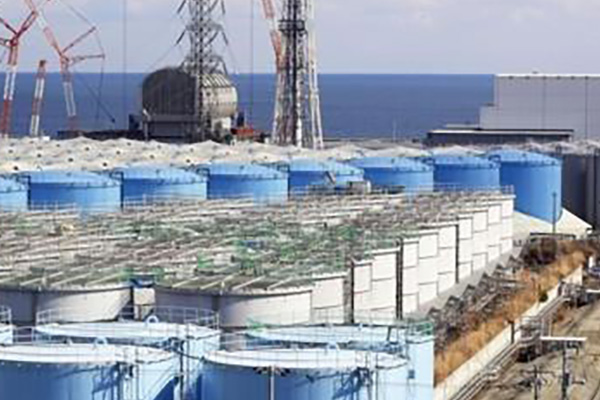
Gov’t. Concerned over Japan Possibly Releasing Contaminated Water from Daiichi Plant
September 23, 2020
South Korea has expressed concerns over Japan strongly considering the release of contaminated water from the Fukushima Daiichi nuclear power plant disaster site into the ocean.
The Ministry of Science and ICT said First Vice Minister Jeong Byung-seon revealed the plans in a virtual keynote speech during the 64th General Conference of the International Atomic Energy Agency(IAEA) on Wednesday.
Jeong said the international community, including South Korea, is growing concerned and nervous about the environment and its safety as Japan mulls such a possibility.
The vice minister stressed the need to thoroughly analyze the mid- and long-term damage the release could have on the environment and the appropriate way to go about it, given that it could affect global marine environments.
In particular, Jeong said that in line with international laws, Japan is obligated to communicate with the international community in a transparent manner ahead of deciding on ways to dispose of the contaminated water and proposed that the IAEA play a key role in that process.
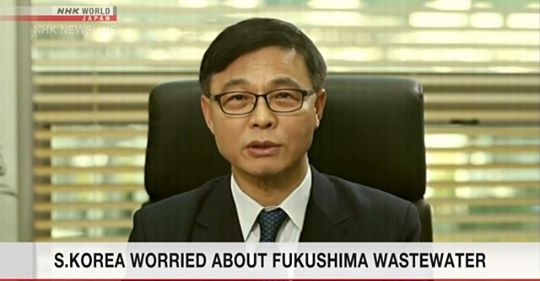
S.Korea concerned about Fukushima waste water
September 23, 2020
South Korea has again expressed its concerns about Japan’s plan to release into the sea radioactive wastewater building up at the crippled Fukushima Daiichi nuclear plant.
The first vice minister of South Korea’s science ministry Jeong Byungseon was speaking at a general meeting of the International Atomic Energy Agency in Vienna on Tuesday.
He said “releasing contaminated water into the ocean is not an issue of Japan itself, but one that could have a wider impact on the global marine environment, as well as the neighboring countries.”
He said Japan has “an overarching obligation to make transparent, concrete communication within the global society,” including South Korea, before making any disposal decision.
He asked the IAEA to play a proactive role in the issue.
At last year’s IAEA general meeting, South Korea raised questions about the issue and criticized Japan.
On Monday, Japan’s Science and Technology Policy Minister Inoue Shinji told the meeting that Japan is studying ways to dispose of the water, taking into consideration advice from the IAEA. He stressed Japan will provide careful and transparent explanations to the global community.
In February, a Japanese government expert panel came up with a report saying that diluting the wastewater below environmental and other standards, and discharging it into the sea, as well as vaporizing and releasing it into the air are realistic options.
The government plans to make a decision after hearing opinions from local residents and groups.
S. Korea renews concerns over possible release of tainted Fukushima water
The logo of the Ministry of Science and ICT at its main offices in the central city of Sejong, 130 kilometers south of Seoul, is shown in this undated photo provided by the ministry
September 22, 2020
SEOUL, Sept. 22 (Yonhap) — South Korea on Tuesday reiterated its concerns over Japan’s potential move to release radioactive water from its disabled Fukushima nuclear plant into the sea.
Japan has been mulling over options to discharge the water from the nuclear plant, which was devastated by a tsunami triggered by an earthquake in March 2011.
An estimated 1.1 million tons of tainted water is in temporary storage at the Fukushima plant.
South Korea’s Vice Minister of Science and ICT Jeong Byung-seon renewed concerns over Japan’s potential move in a recorded message at an annual conference of the International Atomic Energy Agency’s (IAEA), according to the science ministry.
The general conference of the U.N. nuclear watchdog was held partially online this year due to the coronavirus pandemic.
Jeong said releasing the tainted water would impact the global marine environment and that its method and long-term environmental risks need careful consideration through cooperation with global agencies, such as the IAEA.
The vice minister also called for an active role of the IAEA to facilitate transparency in the water’s disposal process, adding that Japan’s disposal plans should follow international law, such as the U.N. Convention on the Law of the Sea.
The science ministry said the vice minister will convey South Korea’s concerns to IAEA Director General Rafael Mariano Grossi in a separate meeting Wednesday.
The fallout of the damaged Fukushima nuclear plant has been a source of contention between the two neighboring countries, with South Korea imposing a ban on all seafood imports from eight Japanese prefectures near Fukushima in 2013.
https://en.yna.co.kr/view/AEN20200922007000320?section=national/diplomacy
Japan fiddles with the idea of unleashing tainted water at Fukushima
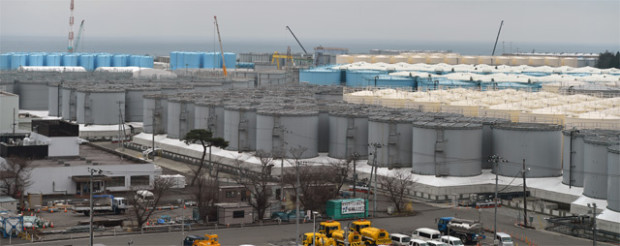
September. 18, 2020
Concerns are resurfacing that the contaminated water from the Fukushima power plants could be discharged into the sea with Suga Yoshihide sworn in as new prime minister of Japan. Mr. Suga previously said whoever takes power next should tackle the issue of the radioactive contamination at Fukushima plant.
The Tokyo Electric Power Company (TEPCO) has embarked on the process of cutting the amount of the contaminated water currently stored at the premises of Fukushima power plants, down to the discharge level of radioactive substances set by the Japanese regulatory authorities. Some experts say that the state-run power corporation is preparing to let loose the water tainted with radioactive materials from Fukushima meltdown. Pundits argue that transparency of information is necessary to verify whether the radioactive nuclide density can be curtailed below the threshold as interned.
As of last year, the reactors at the Fukushima power plant site are belching an average 180 tons of contaminated water each day. This includes the massive amount of underground water that has been seeping into the nuclear reactors since 2013 in addition to the artificial influx of water. In February, the Japanese government reached the conclusion to unleash the water into the seas, with the storage capacity within the premises expected to reach the limit in August 2022.
TEPCO’s clean-up operation aims to reduce the discrepancy of radioactive density and cut the amount of discharging below standard for each type of nuclides. After upgrading and replacing the filters at multi-nuclide removal facility (ALPS), the process involves purifying the reservoir of the tainted water, checking the radioactive density, and processing the water again in the event density should exceed the threshold.
“The IAEA’s review has not found any issue with the performance of ALPS,” said Kim Yun-woo, a manager at the department of disaster prevention environment of the Nuclear Safety and Security Commission. “From a technical point of view, the purification process will likely bring down the density to meet the discharge standard, but in practice, we need to wait and see how much the water can get purified.”
The issue at hand is tritium. When the density is higher than a certain level, partial purification can be achieved through removal equipment. But the density of tritium in Fukushima water stands at 580,000 Bq per liter, impossibly low to remove with any equipment. Yet it is much higher than the discharge threshold at 60,000 Bq. There is known to be no effective technology to remove tritium under such circumstances.
Japan should leave radioactive water in current storage tanks
Hajime Matsukubo, general-secretary of the Citizens’ Nuclear Information Center, says an ocean dump doesn’t make sense
 Hajime Matsukubo, general secretary of the Citizens’ Nuclear Information Center (CNIC)
Aug.17,2020
What’s the most practical and safest way to handle the radioactive water being stored at Fukushima? According to Hajime Matsukubo, general-secretary of the Citizens’ Nuclear Information Center (CNIC), the contaminated water should be left in the aboveground tanks where it’s currently being stored. In a recent email interview with the Hankyoreh, Matsukubo said it doesn’t make sense to release the water into the ocean just because the tanks are running low on space.
The CNIC is a Japanese NGO that was set up in 1975 under nuclear physicist Jinzaburo Takagi, a leading figure in the campaign against nuclear power in Japan. Matsukubo is an active researcher, lecturer, and publisher of materials related to the anti-nuclear movement. The interview is presented below.
Hankyoreh (Hani): When do you think the final decision will be made about dumping the contaminated water at Fukushima into the ocean?
Hajime Matsukubo: TEPCO [Tokyo Electric Power Company] says it will dilute the contaminated water before dumping it into the ocean, which means that a dilution facility would have to be built. Given the time required to get a building permit, I think the final decision will be made this summer or fall.
Japan wants an ocean dump because it’s the cheapest option
Hani: Why do you think the Japanese government is pushing so hard to dump the water into the ocean?
Matsukubo: Not only Japan but all countries that operate nuclear reactors end up with tritium as a byproduct, which they then release into the ocean or the atmosphere. I see this decision as an extension of that. Another factor is that releasing the water into the ocean is the cheapest option.
Hani: There seems to be considerable opposition to the plan in Japan as well.
Matsukubo: Many citizens are opposed to it. Pushback has been particularly strong from fishermen, who are likely to be harmed by the rumors [about the danger of the radioactive matter being released, which could cause people not to visit or eat food from Fukushima]. Lawmakers at city councils in Fukushima Prefecture have adopted a series of resolutions voicing concerns about releasing the contaminated water.
Hani: Do you think that negative public opinion in Japan is capable of changing government policy?
Matsukubo: Since the fishermen are direct stakeholders, I think their opposition will have a big impact. TEPCO has promised not to release the water without the consent of local communities in Fukushima. I think the key is opposing voices in Japan and increasing pressure from overseas.
Hani: Do South Korea or environmental groups in other countries have any way to sanction Japan for releasing contaminated water into the ocean?
Matsukubo: They could consider filing a lawsuit based on the UN Convention on the Law of the Sea. But a large amount of tritium is already being released from Korea’s nuclear plants, especially the Wolseong plant. It would be rather difficult to prove that contaminated water released from Fukushima Daiichi [No. 1] is having an impact.
There’s plenty of land that could be used for additional storage
Hani: What’s the most practical and safest way to deal with the contaminated water?
Matsukubo: The contaminated water at Fukushima should be left in the aboveground tanks where it’s currently being stored. [The government] says there’s no more room at Fukushima Daiichi, but there is. There’s a huge amount of land that could be used to store the radioactive wastewater. While the Ministry of Economy, Trade, and Industry says that land can’t be appropriated for other uses, the government [could and] should negotiate with the landowners. It’s absurd to dump radioactive water into the ocean because there’s not enough storage space in the tanks. Japanese NGOs are suggesting that the government continue storing the water in the aboveground tanks and seal them off with concrete. They’re warning the government that releasing the water into the ocean would create international problems.
S. Korea, Japan both need to reassess their reprocessing plans
Hani: Do you have a message for South Korea’s civic society?
Matsukubo: The Japanese government is pursuing a policy of creating a nuclear fuel cycle that would recycle plutonium and uranium from the spent nuclear fuel produced by reactors. This policy requires reprocessing plants that are currently under construction at Rokkasho, in Aomori Prefecture, which are supposed to begin operations in 2021. These plants will release a large amount of radioactive matter into the ocean and the atmosphere. In terms of tritium alone, the amount released will be 10 times worse than the contaminated water at Fukushima Daiichi. That’s a very serious problem, just as releasing the contaminated water would be.
In South Korea, the Korea Atomic Energy Research Institute is taking the lead in R&D projects related to reprocessing spent nuclear fuel. The problems with reprocessing plants don’t end here. Plutonium can be used as a raw material for making nuclear weapons. I think that South Korea and Japanese citizens need to join forces to shut down both countries’ reprocessing plans.
By Kim So-youn, staff reporter
http://english.hani.co.kr/arti/english_edition/e_international/958103.html
Japan pushes forward with plans to dump radioactive water into ocean, despite public opposition
Tokyo may dump contaminated water as early as September
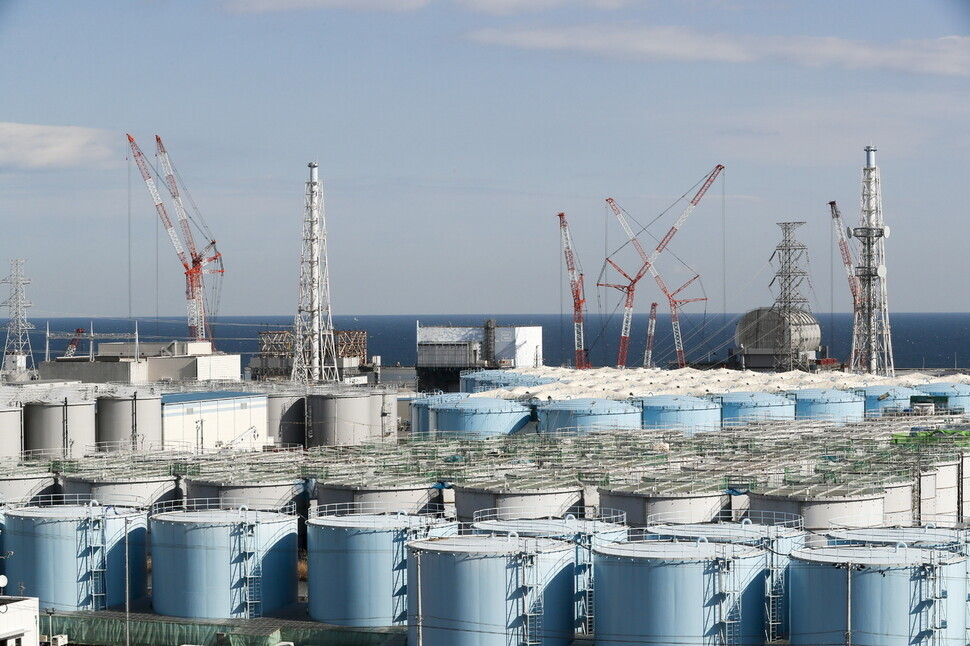 Storage tanks for water contaminated with radioactive matter from the Fukushima Daiichi Nuclear Power Plant.
Aug.17,2020
During the past three months, while the international community was focused on the COVID-19 pandemic, the Japanese government has held five public hearings as it moves forward with its decision to dump radioactive water from the Fukushima nuclear disaster into the ocean. After analyzing the transcripts and videos from the hearings, the Hankyoreh has concluded that the Japanese government will probably decide to dump the water as early as September or October, despite overwhelming public opposition to the plan, even in Japan. Since a study has found that the contaminated water could reach the eastern coast of South Korea within a year of being dumped, international groups focusing on the environment and experts in international law are calling for the South Korean government to take preemptive action in the area of international law.
Following an explosion during the 2011 Tohoku earthquake, the Fukushima Daiichi nuclear power plant was closed and is being decommissioned, a process that has taken nine years so far. But debate continues about how to deal with the growing volume of water contaminated with radioactivity, including the water used to cool the nuclear fuel and rainwater and groundwater that have seeped into the buildings. The contaminated water is currently being stored in tanks, but by the summer of 2022, the Japanese government says, the tanks will run out of space, necessitating the water’s release into the ocean.
The Japanese government, under Prime Minister Shinzo Abe, held video hearings about how to deal with the contaminated water on Apr. 6, Apr. 13, May 11, June 30, and July 17. These hearings were attended not only by representatives from the fishing, agriculture, and hospitality businesses and community leaders from Fukushima Prefecture but also the national tourist council and groups representing businesses and consumers. The government was represented by officials from 10 or so ministries, including the Ministry of Economy, Trade, and Industry, the Ministry of the Environment, and the Ministry of Foreign Affairs.
Radioactive matter detected in water even after decontamination
While reviewing the hearings, the Hankyoreh learned that radioactive matter has been detected even following decontamination efforts, that releasing the water would likely cement Fukushima’s stigma as an area tainted with radioactivity and have a serious impact on the fishing industry, and that there was widespread opposition to the idea among hearing attendees, who argued that the final decision shouldn’t be made until public opinion has been canvassed.
An August 2019 report by international environmental group Greenpeace about the contaminated water at Fukushima found that the water, once released, would flow through the East China Sea and be brought via the Kuroshio Current and the Tsushima Current to South Korea’s eastern shore within a year. Disregarding the concerns of the international community, the Japanese government released a draft of a plan this past March to dump the contaminated water at Fukushima into the ocean over the course of 30 years. Given the plan’s schedule, which involves the construction of a facility to dilute the contaminated water, its decision will likely be made by this October. Abe told the press in an interview in March that he wants to finalize a plan as quickly as possible.
The Japanese government intends to make its final decision after canvassing the opinions of Fukushima residents, related organizations, and ordinary citizens. But even in the Japanese public, there’s fierce opposition to dumping the contaminated water. The Hankyoreh’s analysis of the transcripts and videos from the five hearings show that most of the 37 participants were concerned about the plan to release the water.
“It’s human nature to avoid radioactive materials. It’s a serious problem that there’s still radioactivity even in the decontaminated water, which contradicts what TEPCO [Tokyo Electric Power Company] initially said,” said Hidenori Koito, the director of a trade association for the hospitality industry in Fukushima Prefecture.
80% of water contains radioactive matter beyond permissible levels
TEPCO claimed to have filtered out 62 kinds of radioactive material through the Advanced Liquid Processing System (ALPS) and all that’s left is tritium, which is technically difficult to remove from the contaminated water in the tanks. But a 2018 study found that 80% of the water processed using ALPS still contained more than the permitted level of radioactive matter that is deadly to the human body, including cesium, strontium, and iodine. While TEPCO has emphasized that it would decontaminate the water once more to ensure its safety prior to release, distrust has already surged.
Another criticism is that dumping the water would spoil the nine-year campaign by Fukushima residents to repair the area’s reputation. “If the contaminated water is released into the ocean, people will inevitably think there’s another radiation leak at Fukushima, given the nuclear accident that occurred there,” said Kimio Akimoto, president of a coalition of forestry associations in the prefecture.
Vehement opposition from fishermen
An even sterner stance was taken by fishermen, who depend upon the ocean for their livelihood. “It’s unacceptable for radioactive matter to be deliberately pumped into the ocean,” said Tetsu Nozaki, president of a coalition of fishery cooperatives in Fukushima Prefecture. The national coalition of fishery cooperatives voted on July 23 to “oppose” the planned release of contaminated water.
There are also concerns that the government is rushing the plan. “The Japanese public doesn’t know the details about the contaminated water yet. The final decision shouldn’t be made until people understand what it means to dump contaminated water into the ocean,” said Yuki Urago, secretary-general of a national coalition of consumers’ associations.
“Right now, the Japanese public is focused on COVID-19. It’s doubtful whether the issue of contaminated water at Fukushima can provoke a national debate in this situation,” said Yuko Endo, mayor of Kawauchi, a village in Fukushima Prefecture.
Japan took an unusually long opinion canvassing period
Before deciding on important policies, the Japanese government has a practice of canvassing opinions, a process known as the “public comment” period. The relevant ministry here, the Ministry of Economy, Trade, and Industry, began collecting comments on Apr. 6 and took the unusual step of extending that period three times, only wrapping it up at the end of last month. One reason the government may have extended the comment period is because of the overwhelming opposition to releasing the contaminated water into the ocean.
Last month, the UN Human Rights Council released a statement expressing “deep concerns” about “a report indicating that the Japanese government is accelerating its timeframe for releasing water contaminated with radioactivity at Fukushima.” South Korea, given its proximity to Japan and the ocean, has set up a government-wide task force under the Office of the Prime Minister to keep tabs on the Japanese government’s actions.
“We’re asking Japan to share adequate information while it’s processing the contaminated water at the Fukushima nuclear plant. We’re monitoring the situation from various angles to see what impact this will have on us,” explained an official from South Korea’s Ministry of Foreign Affairs.
By Kim So-youn, staff reporter
http://english.hani.co.kr/arti/english_edition/e_international/958099.html
U.N. experts urge Japan not to rush discharge of radioactive water and not ignore human rights obligations on nuclear waste disposal

June 9, 2020
U.N. experts urge Japan not to rush discharge of radioactive water
Four United Nations human rights experts on Tuesday urged the Japanese government against rushing to discharge radioactive water from the Fukushima nuclear plant into the sea until consultations are made with affected communities and neighboring countries.
“We are deeply concerned by reports that the Government of Japan has accelerated its timeline for the release of radioactive wastewater into the ocean without time or opportunity for meaningful consultations,” the experts said in a press release.
The experts are imploring the government to delay its decision on releasing the radioactive water until after the coronavirus pandemic has been contained, so proper attention can be dedicated to the issue.
The concern was raised as public consultations on the release of the plant’s wastewater have been accelerated, and opinions will be solicited by next Monday. Such consultations were initially scheduled until after the now-postponed Tokyo Olympic and Paralympic Games.
Japan is considering ways to safely dispose of the water contaminated with radioactive materials, including releasing it into the Pacific Ocean and evaporating it. Tanks used to store the water are expected to be filled by summer 2022.
The experts — U.N. special rapporteurs respectively on hazardous wastes, rights to food, rights to assembly and association, and rights of indigenous people — took note of credible indications that the postponement of the games sped up the government’s decision-making process.
With the pandemic also preventing in-depth consultations with relevant stakeholders, the rapporteurs called on the Japanese government to give “proper space and opportunity for consultations on the disposal of nuclear waste that will likely affect people and peoples both inside and outside of Japan.”
“COVID-19 must be not be used as a sleight of hand to distract from decisions that will have profound implications for people and the planet for generations to come,” they said, raising the alarm that a discharge will pose a grave threat to the livelihoods of local fishermen.
Fukushima: Japan must not ignore human rights obligations on nuclear waste disposal – UN experts
GENEVA (9 June 2020) – UN human rights experts* today urged the Japanese Government to delay any decision on the ocean-dumping of nuclear waste water from the reactors at Fukushima Daiichi until after the COVID-19 crisis has passed and proper international consultations can be held.
“We are deeply concerned by reports that the Government of Japan has accelerated its timeline for the release of radioactive waste water into the ocean without time or opportunity for meaningful consultations,” the independent experts said. Credible sources indicate the postponement of the 2020 Olympics enabled the Government’s new decision-making process for release of the waste.
They said the Government’s short extension for the current public consultation was grossly insufficient while COVID-19 measures limited opportunities for input from all affected communities in Japan, as well as those in neighbouring countries, including indigenous peoples.
“COVID-19 must be not be used as a sleight of hand to distract from decisions that will have profound implications for people and the planet for generations to come,” the experts said. “There will be grave impacts on the livelihood of local Japanese fisher folk, but also the human rights of people and peoples outside of Japan.”
They said there was no need for hasty decisions because adequate space was available for additional storage tanks to increase capacity, and the public consultation originally was not expected to be held until after the 2020 Olympics.
“We call on the government of Japan to give proper space and opportunity for consultations on the disposal of nuclear waste that will likely affect people and peoples both inside and outside of Japan. We further call on the Government of Japan to respect the right of indigenous peoples to free prior and informed consent and to respect their right to assemble and associate to form such a consent.”
The experts have communicated their concerns to the Government of Japan. UN experts have previously raised concerns over the increase of exposure levels to radiation deemed “acceptable” for the general public, and for the use of vulnerable workers in efforts to clean up after the nuclear disaster.
ENDS
*The experts: Mr. Baskut Tuncak, Special Rapporteur on the implications for human rights of the environmentally sound management and disposal of hazardous substances and wastes; Mr. Michael Fakhri, Special Rapporteur on the right to food; Mr. Clément Nyaletsossi Voule, Special Rapporteur on the rights to freedom of peaceful assembly and of association; and Mr. José Francisco Calí Tzay, Special Rapporteur on the rights of indigenous peoples.
https://www.ohchr.org/EN/NewsEvents/Pages/DisplayNews.aspx?NewsID=25940&LangID=E
Fukushima’s radioactive water problem
Water should be stored at nuclear site, not dumped in the Pacific
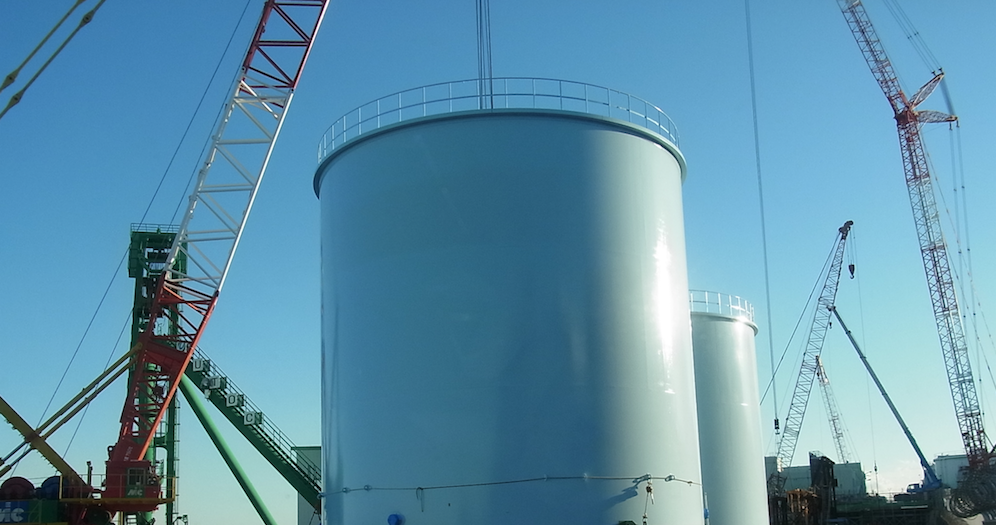
By Linda Pentz Gunter
We are republishing this story this week, as the Japanese government is now threatening the imminent dumping of the radiologically contaminated water, stored at the Fukushima nuclear site, into the Pacific Ocean. The article below provides the background on this issue and the alternative choices. Our Japanese activist friends are urging us all to sign onto their petitions — there is one for groups to sign and one for individuals — asking the Japanese government not to dump 1.2 million cubic meters of radioactive water into the ocean. Japan civil society groups and Fukushima fishing unions are strongly opposed to this needless ocean discharge. Groups please sign here. Individuals please sign here.
Original article, published September 15, 2019, follows:
Last week, Japan’s then environment minister, Yoshiaki Harada, made news with a pronouncement that wasn’t news. The storage tanks at the stricken Fukushima Daiichi nuclear site, filled with radioactive water, were reaching capacity. By 2022 there would be no room for more tanks on the present site. Japan would then have to dump the radioactive water stored in the tanks into the Pacific Ocean, he said.
Although likely unrelated to those remarks, a day later, Prime Minister Shinzo Abe dispatched 19 of his cabinet ministers, including Harada. Harada was replaced as environment minister by rising star, Shinjiro Koizumi, the son of former primer minister, Junichiro Koizumi. Both father and son are opposed to nuclear energy, and on his first day in office, the younger Koizumi told reporters that he believed Japan should end its use of nuclear energy and close its nuclear power plants.
 Shinjiro Koizumi, Japan’s new environment minister, says Japan should cease using nuclear power.
“I would like to study how we scrap them, not how to retain them,” Reuters reported him saying. This is a surprising position from someone inside the fervently pro-nuclear Abe government and it remains to be seen whether he will be allowed to translate his position into policy.
Dumping Fukushima Daiichi’s accumulated radioactive water has long been the plan proposed by Tepco, the site owner. Fukushima fishermen, along with some scientists and a number of NGOs from around the world, continue to object.
We addressed this issue briefly on a recent TRT broadcast (see video below).
Cooling water is needed at the Fukushima site because, when Units 1, 2 and 3 lost power, they also lost the flow of reactor coolant, causing their cores to overheat. The fuel rods then melted, and molten fuel dripped down and burned through the pressure vessels, pooling in the primary containment vessels. Units 1, 3 and 4 also suffered hydrogen explosions. Each day, about 200 metric tons of cooling water is used to keep the three melted cores cool, lest they once more go critical. Eventually the water becomes too radioactive and thermally hot to be re-used, and must be discarded and stored in the tanks.
As Greenpeace International (GPI) explained in remarks and questions submitted during a consultative meeting held by the International Maritime Organization in August 2019:
“Since 2011, in order to cool the molten cores in the Tokyo Electric Power Company Fukushima Daiichi reactor units 1-3, water is continuously pumped through the damaged Reactor Pressure Vessels (RPVs) and circulated through reactor buildings, turbine buildings, the Process Main Building and the “High Temperature Incinerator Building” and water treatment systems.
“As a result, the past eight years has seen a relentless increase in the volume of radioactive contaminated water accumulating on site. As of 4 July 2019, the total amount of contaminated water held in 939 storage tanks at the Fukushima Daiichi plant (units 1-4) was 1,145,694 m3 (tonnes). The majority of this, 1,041,710 m3, is contaminated processed water. In the year to April 2019, approximately 180 m3/day of water was being circulated into the RPVs of units 1-3.”
In addition to the cooling water, the tanks also house water that has run down from the nearby mountains, at a rate of about 100 tons each day. This water flows onto the site and seeps into the reactor buildings. There, it becomes radioactively contaminated and also must be collected and stored, to prevent it from flowing on down into the sea.
The water tank crisis is just one of multiple and complex problems at the Fukushima Daiichi site, including the eventual need to extract the molten fuel debris from inside the stricken reactors. Decommissioning cannot begin until the water storage tanks are removed.
Tepco has tried to mitigate the radioactive water problem in a number of ways. The infamous $320 million ice wall was an attempt to freeze and block inflow, but has had mixed results and has worked only intermittently. Wells were dug to try to divert the runoff water so it does not pick up contamination. The ice wall has reportedly reduced the flow of groundwater somewhat, but only down from 500 tons a day to about 100 tons.
In anticipation of dumping the tank water into the Pacific Ocean, Tepco has deployed an Advanced Liquid Processing System that the company claims can remove 62 isotopes from the water — all except tritium, which is radioactive hydrogen and therefore cannot be filtered out of water. (Tritium is routinely discharged by operating commercial nuclear power plants).
 Tepco’s “Land-side Impermeable Wall” (Frozen soil wall).
But, like the ice wall, the filtration system has also been plagued by malfunctions. According to GPI, Tepco admitted only last year that the system had “failed to reduce radioactivity to levels below the regulatory limit permissible for ocean disposal” in at least 80% of the tanks’ inventory. Indeed, said GPI, “the levels of Strontium-90 are more than 100 times the regulatory standard according to TEPCO, with levels at 20,000 times above regulations in some tanks.”
The plan to dump the water has raised the ire of South Korea, whose fish stocks would likely also be contaminated. And it has introduced the question of whether such a move is a violation of The Conventions of the Rights of the Child and the Universal Declaration of Human Rights, as was raised in a joint written statement by the International Association of Democratic Lawyers and Greenpeace International, before the UN Human Rights Council currently in session.
So what else could or should Tepco do, if not dump the water offshore and into the ocean? A wide consensus amongst scientific, environmental and human rights groups is that on-site storage for the indefinite future is the only acceptable option, while research must continue into possible ways to extract all of the radioactive content, including tritium.
Meanwhile, a panel of experts says it will examine a number of additional but equally problematic choices, broadly condensed into four options (each with some variations — to dilute or not to dilute etc):
- Ground (geosphere) injection (which could bring the isotopes in contact with groundwater);
- Vapor release (which could infiltrate weather patterns and return as fallout);
- Releasing it as hydrogen (it would still contain tritium gas); and
- Solidification followed by underground burial (for which no safe, permanent storage environment has yet been found, least of all in earthquake-prone Japan).
Arnie Gundersen of Fairewinds, recommends a chemical injection processes (drilling mud) — also used by the oil industry — to stop the flow of water onto the site entirely. But he says Japan has never considered this option. GPI contends that Japan has never seriously researched any of the alternatives, sticking to the ocean dumping plan, the cheapest and fastest “fix.”
All of this mess is of course an inevitable outcome of the choice to use nuclear power in the first place. Even without an accident, no safe, permanent storage solution has been found for the high-level radioactive waste produced through daily operation of commercial nuclear power plants, never mind as the result of an accident.
According to Dr. M.V. Ramana, by far the best solution is to continue to store the radioactive water, even if that means moving some of the storage tanks to other locations to make more room for new ones at the nuclear site. The decision to dump the water, Ramana says, is in line with Abe’s attempts to whitewash the scene before the 2020 Tokyo Olympics and claim, as he has publicly in the past, that everything at Fukushima is “under control.” (Baseball and softball games will be played in Fukushima Prefecture and the torch relay will start there, all in an effort to pretend there are no dangerous nuclear after-effects remaining in the area.)
“The reason that they keep saying they need to release it is because they might have to move some of this offsite and that goes against the Abe government’s interest in creating the perception that Fukushima is a closed chapter,” Ramana wrote in an email. “So it is a political decision rather than a technical one.”
As with all things nuclear, there are diverging views on the likely impact to the marine environment and to human health, from dumping Fukushima’s radioactive water into the ocean. These run the gamut from “a little tritium won’t hurt you” to “the Pacific Ocean is dead thanks to Fukushima” — both of which are wildly untrue. (Tritium can bind organically inside the body, irradiating that person or animal from within. The many problems in the Pacific began long before Fukushima and are likely caused by numerous compounding factors, including warming and pollution, with Fukushima adding to the existing woes.)
 The effect on deep sea creatures of radioactive ocean dumping could be long-lasting.
What is fact, however, is that scientists have found not only the presence of isotopes such as cesium in fish they tested, but also in ocean floor sediment. This latter has the potential to serve as a more long-term source of contamination up the food chain.
But it is also important to remember that if this radioactive water is dumped, it is not an isolated event. Radioactive contamination in our oceans is already widespread, a result of years of atmospheric atomic tests. As was reported earlier this year, scientists studying deep-sea amphipods, retrieved from some of the deepest trenches in the ocean — including the Mariana Trench which reaches 36,000 feet below sea-level and is deeper than Mount Everest is high — detected elevated levels of carbon-14 in these creatures.
“The levels closely matched abundances found near the surface of the ocean, where the amount of carbon-14 is higher than usual thanks to nuclear bomb tests conducted more than half a century ago,” reported Smithsonian Magazine.
Weidong Sun, co-author of the resulting study, told Smithsonian Magazine that “Biologically, [ocean] trenches are taken to be the most pristine habitats on Earth”.
How chilling, then, to realize that our radioactive irresponsibility has reached the lowest depths, affecting creatures far removed from our rash behaviors.
Consequently, the decision by the Japanese government to release yet more radioactive contamination into our oceans must be viewed not as a one-off act of desperation, but as a contribution to cumulative contamination. This, added to the twin tragedies of climate crisis-induced ocean warming and plastics and chemicals pollution, renders it one more crime committed on the oceans, ourselves and all living things. And it reinforces the imperative to neither continue nor increase our reckless use of nuclear power as an electricity source.
Why the Japanese government’s plan to dump radioactive water into the ocean needs to be stopped.
Taiwan green groups urge Japan not to discharge radioactive water
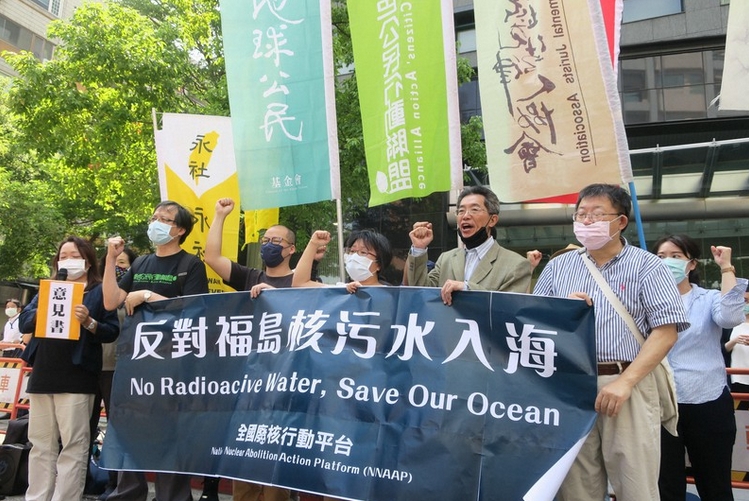 A coalition of environmental protection groups chants slogan in front of the Taipei office of Japan’s de facto embassy in Taiwan, the Japan-Taiwan Exchange Association, on May 13, 2020
May 14, 2020
TAIPEI (Kyodo) — A coalition of environmental protection groups in Taiwan on Wednesday urged the Japanese government to refrain from releasing radioactive water from the wrecked Fukushima nuclear plant into the ocean.
Chanting the slogan “No to dumping radioactive water into the ocean,” representatives of the organization presented a petition to the Taipei office of Japan’s de facto embassy in Taiwan, the Japan-Taiwan Exchange Association, in the morning.
National Nuclear Abolition Action Platform spokeswoman Tsuei Su-hsin emphasized that they did not come to protest, but rather to urge the Japanese government to refrain from making decisions to cut costs at the expense of the environment.
“There are safer and more sustainable alternatives,” Tsuei said.
The Japanese government and the operator of the Fukushima Daiichi nuclear power plant at the time are currently considering ways to safely dispose of the more than 1 million tons of water contaminated with radioactive materials after being used to cool the melted fuel cores at the plant.
A decision needs to be made soon as space for storing the water, which has been treated but is still contaminated with low-toxicity radioactive tritium, is fast running out.
Methods being discussed include releasing the water into the Pacific Ocean and evaporating it, both of which the government says will have minimal effect on human health.
A panel of experts advising the government on a disposal method has recommended releasing it into the ocean. The government is soliciting opinions from the public before it makes a decision in the summer. Based on past practice, it is likely to accept the recommendation.
Tsai Ya-ying, an activist and lawyer of the Wild at Heart Legal Defense Association, said as Japan is a signatory of the U.N. Convention on the Law of the Sea, it is obligated to take all measures within the Convention that are necessary to prevent, reduce and control pollution of the marine environment from any source.
Discharging the water into the ocean could amount to a violation of the Convention, she said.
Liu Jyh-jian, president of the Taiwan Environmental Protection Union, urged the Japanese government to make a decision that is friendly to both the environment and to mankind.
He added that if the tritium enters the food chain, it is bound to cause harm to humans in the long run.
Tsai Chung-yueh, deputy secretary general of Citizen of the Earth, voiced concern that the Japanese government may be too preoccupied with fighting COVID-19 to make a decision that is environmentally sustainable.
The contaminated water is increasing by about 170 tons per day. Space is expected to run out by summer 2022.
Local Japanese fishermen and residents have expressed concerns about releasing the water on food and the environment.
Widespread concerns remain as well, with many countries and regions still restricting imports of Japanese agricultural and fishery products in the wake of the 2011 disaster that was triggered by a major earthquake and tsunami.
https://mainichi.jp/english/articles/20200513/p2g/00m/0in/112000c
Taiwan groups reject Japan plan to dump radioactive wastewater
May 13, 2020
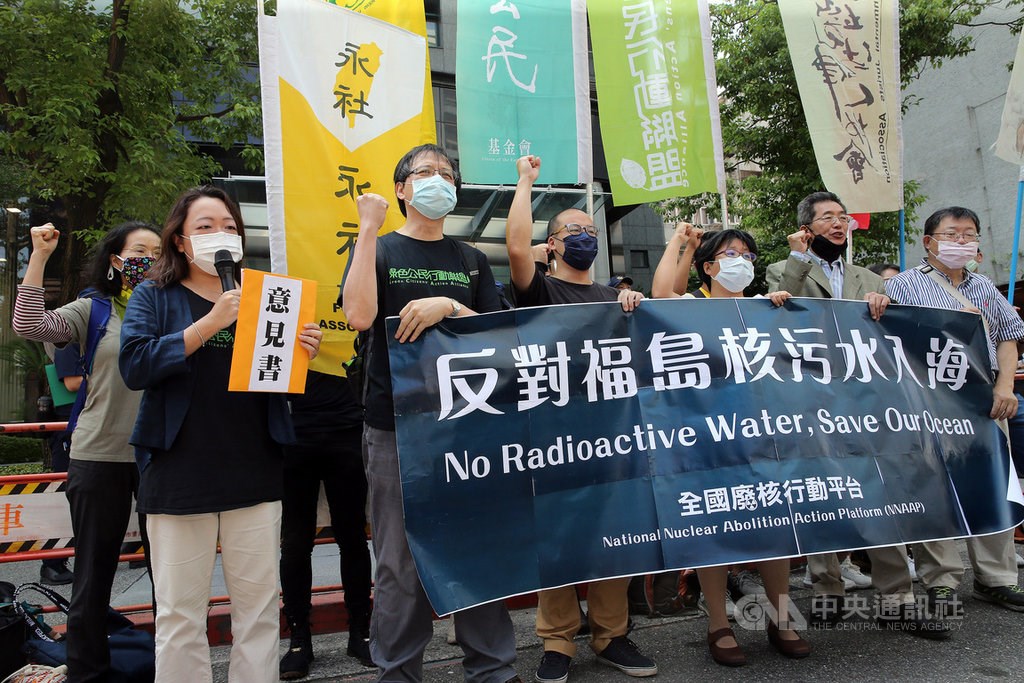
Taipei, May 13 (CNA) About 20 environmental protection groups on Wednesday delivered a petition to the Japan-Taiwan Exchange Association, expressing opposition to the discharge of radioactive wastewater from the Fukushima Daiichi nuclear plant into the Pacific Ocean.
Roughly 1.2 million metric tons of contaminated water remains from the magnitude 9.0 earthquake and tsunami that hit the plant on March 11, 2011, destroying key cooling functions and causing a huge leakage of radiation.
The wastewater contains approximately 880 trillion becquerels of tritium, a hydrogen isotope that experts say poses a relatively low risk to human health.
The Japanese government is currently soliciting public opinion on wastewater treatment until June 15, after which it will decide what to do with the contaminated water. One of the options is dumping it into the ocean.
“We learned Japan is considering discharging wastewater from the Fukushima Daiichi plant into the ocean. The plan will cause radioactive contamination to marine ecology. We were astonished to learn this and resolutely oppose it,” the Taiwanese groups said in their petition.
The groups said they were not there to protest but to appeal to the Japanese government to listen to neighboring countries and not to make the wrong decision.
Currently, 2,000 groups and individuals around the world have signed a petition opposing discharging the wastewater into the sea, while about 20 groups in Taiwan submitted a petition to the Japan-Taiwan Exchange Association, said Tsui Shu-hsin (崔愫欣), General Secretary of anti-nuclear organization Green Citizens’ Action Alliance.
If Japan goes ahead with such a plan, the Taiwanese groups do not rule out holding protests, Tsui said.
Releasing the wastewater into the sea is not the only option, Tsui said, adding that it could also be put into larger storage tanks by consolidating the sludge or soil particles, though that would be more expensive.
Although discharging the wastewater into the ocean is the cheapest approach, “We resolutely oppose using this treatment method,” Tsui said.
Despite the fact that plant operator Tokyo Electric Power Co., (TEPCO) has installed filtration systems to remove radioactive isotopes strontium-90 and caesium-137, it cannot remove tritium residue in the wastewater, while 70 percent of the water still contains the radioactive elements strontium-90 and caesium-137.
As such, dumping the wastewater into the ocean, could cause enormous damage to the marine environment, said Tsai Ya-ying (蔡雅瀅), a lawyer affiliated with the Wild at Heart Legal Defense Association.
Japan, a signatory country of the United Nations Convention on the Law of the Sea, should adopt all necessary measures to prevent, reduce and control pollution of the marine environment in accordance with Article 194 of the convention. It also needs to ensure other countries do not suffer from the effects of environmental damage caused by contamination, Tsai noted.
She called on Japan to reject the possibility of dumping radioactive wastewater into the sea to avoid adversely impacting neighboring countries and hurting good relations between Taiwan and Japan.
Korean navy to study impact of Fukushima Daiichi’s radioactive water leak
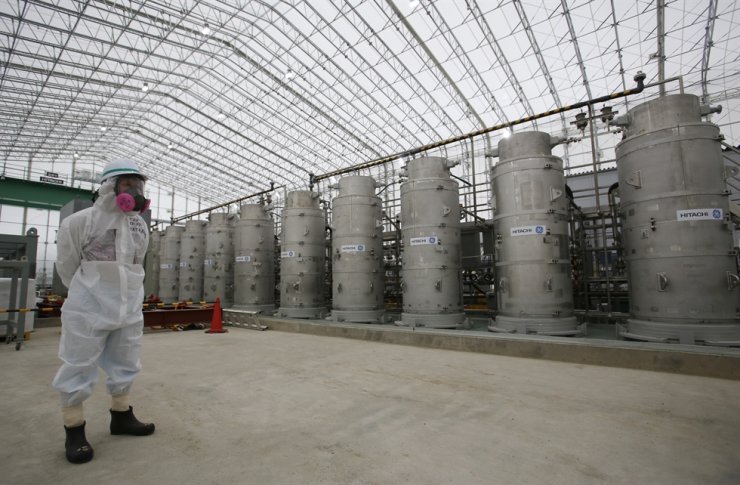 A Tokyo Electric Power official wearing protective gear stands in front of Advanced Liquid Processing Systems during a press tour at the Fukushima Dai-ichi Nuclear Power Plant in this Nov. 12, 2014, photo.
Navy to study impact on radioactive water leak by Japan
May 12, 2020
By Kang Seung-woo
The Navy announced, Tuesday, plans to study the effects of radioactive water on its operations in an apparent countermeasure against Japan’s alleged plan to dump the contaminated water from its Fukushima nuclear plant into the ocean.
While many domestic and international environment groups have studied the possible water release by Japan, this is the first time that the Korean military has decided to investigate the issue, although it remains cautious about specifying Japan is the target country for the study.
According to a notice posted on the government’s procurement system site, the Navy plans to commission research into the potential impact of radioactive water within its operational areas on its maritime operations and ways to stably carry out missions.
The Navy said the 30 million-won ($24,000) research project is scheduled to run until Nov. 30.
“We recognize the growing possibility of radiation-contaminated water being released into our operational areas, and international environmental organizations have warned that if a neighboring country dumps radioactive water into the ocean, it would reach the East Sea within a year,” a Navy officer said.
The officer added that there have been no studies on how radioactive water would affect the environment where naval operations are carried out, and so an advanced investigation is required in order for the Navy to conduct practical and realistic operations.
“Given that seawater is used for living purposes and cooling for equipment, we need to research the impact of radioactive water,” the officer said.
The envisaged research comes as Japan has reportedly been preparing to discharge contaminated water from the power plant, devastated by an earthquake and tsunami in 2011, into the ocean. More than 1.1 million tons of radioactive water are reportedly being stored in 977 temporary holding 977 tanks at the power plant in Fukushima.
In February, Greenpeace said a group of experts in Japan’s Ministry of Economy, Trade and Industry had recommended discharging the contaminated water into the ocean as a final means to get rid of it.
In relation to the plan, the Japanese government has held events to gather opinions from local residents and experts on dumping radioactive water into the Pacific, which were seen as procedural ahead of releasing the contaminated water.
However, the Navy said its study was not targeting Japan, adding that it was meant to devise detailed guidelines and a response manual to radioactive-contaminated water in general.
The possibility of Tokyo discharging the water into the sea was raised last year after Shaun Burnie, a senior nuclear specialist at the German branch of Greenpeace, warned in August that Japan could dump over 1 million tons of radioactive waste into the Pacific.
Since then, Japanese government officials have begun to openly discuss the issue. They say almost all the radioactivity has been removed from the water except for tritium, claiming this metal was relatively nonhazardous ― something experts disagree with, noting it can cause cancer and fetal deformities.
Yoshiaki Harada, a former Japanese environment minister, said last year that there was no other option but to dilute the contaminated water by pumping it into the ocean in order to dispose of it.
In response, the Korean foreign ministry summoned Tomofumi Nishinaga, a minister for economic affairs at the Japanese Embassy in Seoul, to convey the government’s concern on the possible disposal of contaminated water. It also sent letters to the International Atomic Energy Agency (IAEA) to express concern over the environmental impact of the possible water release and call for joint countermeasures from the international community.
http://www.koreatimes.co.kr/www/nation/2020/05/181_289418.html
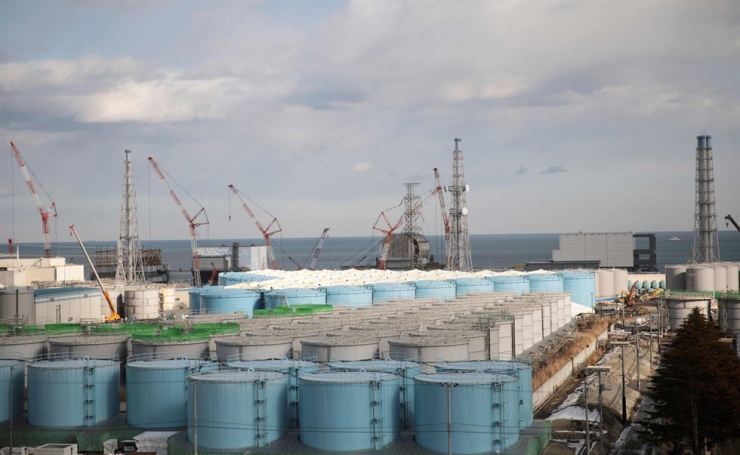 The Navy plans to look into possible impact of radioactive contaminated water on its operations, officials said Tuesday, amid concerns over Japan’s planned release of radioactive water from the Fukushima nuclear power plant into the ocean.
Navy to assess impact of radioactive water on its operations amid Fukushima concerns
May 12, 2020
The Navy plans to look into possible impact of radioactive contaminated water on its operations, officials said Tuesday, amid concerns over Japan’s planned release of radioactive water from the Fukushima nuclear power plant into the ocean.
Japan has been preparing to release contaminated water from the power plant devastated by an earthquake and tsunami in 2011 into the ocean. More than 1.1 million tons of tainted water is reportedly in temporary storage at the Fukushima plant.
According to the notice of a bid posted on the government’s procurement system site, the Navy plans to commission research into potential impacts of radioactive water within operational areas on its maritime operations and ways to stably carry out missions.
“We’ve seen a growing possibility of contaminated water being released into our operational areas and we need to assess its impact on the health of our sailors and military hardware, among others,” a Navy official said.
It is the first time that the Navy has taken steps to look into the Fukushima case, though it did not specifically mention the Japan case in its plan to commission the research.
“The planned study is meant to devise detailed guidelines and response manuals in general terms,” the officer said. (Yonhap)
Japan has been preparing to release contaminated water from the power plant devastated by an earthquake and tsunami in 2011 into the ocean. More than 1.1 million tons of tainted water is reportedly in temporary storage at the Fukushima plant.
According to the notice of a bid posted on the government’s procurement system site, the Navy plans to commission research into potential impacts of radioactive water within operational areas on its maritime operations and ways to stably carry out missions.
“We’ve seen a growing possibility of contaminated water being released into our operational areas and we need to assess its impact on the health of our sailors and military hardware, among others,” a Navy official said.
It is the first time that the Navy has taken steps to look into the Fukushima case, though it did not specifically mention the Japan case in its plan to commission the research.
“The planned study is meant to devise detailed guidelines and response manuals in general terms,” the officer said. (Yonhap)
http://www.koreatimes.co.kr/www/nation/2020/05/371_289385.html
1 This Month

of the week – Shut Down Drone Warfare!


Tell the Ukrainian Government to Drop Prosecution of Peace Activist Yurii Sheliazhenko

Petition to revoke the licensing of the Near Surface Nuclear Disposal Facility (NSDF) at Chalk River. https://www.ourcommons.ca/petitions/en/Petition/Details?Petition=e-7247
To see nuclear-related stories in greater depth and intensity – go to https://nuclearinformation.wordpress.com
-
Archives
- March 2026 (251)
- February 2026 (268)
- January 2026 (308)
- December 2025 (358)
- November 2025 (359)
- October 2025 (376)
- September 2025 (257)
- August 2025 (319)
- July 2025 (230)
- June 2025 (348)
- May 2025 (261)
- April 2025 (305)
-
Categories
- 1
- 1 NUCLEAR ISSUES
- business and costs
- climate change
- culture and arts
- ENERGY
- environment
- health
- history
- indigenous issues
- Legal
- marketing of nuclear
- media
- opposition to nuclear
- PERSONAL STORIES
- politics
- politics international
- Religion and ethics
- safety
- secrets,lies and civil liberties
- spinbuster
- technology
- Uranium
- wastes
- weapons and war
- Women
- 2 WORLD
- ACTION
- AFRICA
- Atrocities
- AUSTRALIA
- Christina's notes
- Christina's themes
- culture and arts
- Events
- Fuk 2022
- Fuk 2023
- Fukushima 2017
- Fukushima 2018
- fukushima 2019
- Fukushima 2020
- Fukushima 2021
- general
- global warming
- Humour (God we need it)
- Nuclear
- RARE EARTHS
- Reference
- resources – print
- Resources -audiovicual
- Weekly Newsletter
- World
- World Nuclear
- YouTube
-
RSS
Entries RSS
Comments RSS
 nuclear-news