South Korea’s ‘serious concern’ about Japan’s dumping of Fukushima radioactive water
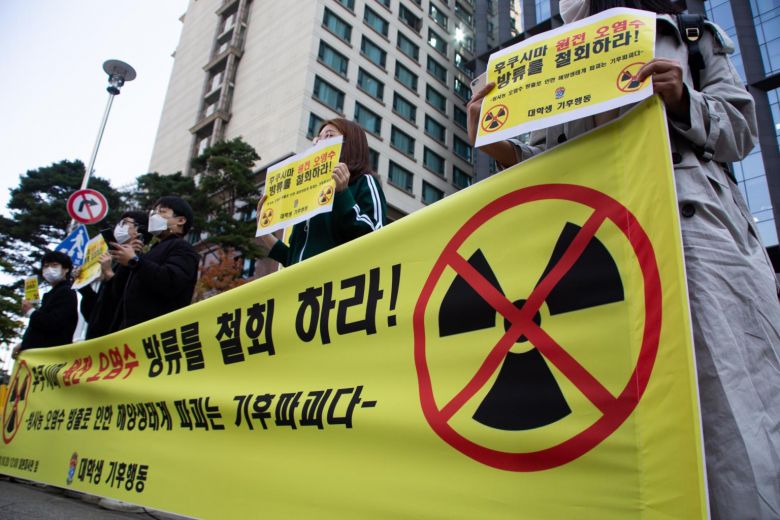
Students protest against Japan’s disposal of radioactive water, outside the Japanese Embassy in Seoul on Oct 20, 2020
South Korea expresses ‘serious concern’ over Japan plan to dump radioactive water from Fukushima
October 29, 2020
SEOUL (REUTERS) – South Korea expressed alarm on Thursday (Oct 29) about the possibility that Japan will dump more than one million tonnes of contaminated water from the tsunami-damaged Fukushima nuclear power plant into the sea.
South Korea’s “serious concern” about the contaminated water was conveyed when senior officials from the uneasy neighbours met for talks in Seoul for the first time since Japan’s new prime minister, Mr Yoshihide Suga, took office last month.
“Director-general Kim highlighted our grave awareness and serious concern about the issue of the Fukushima reactor contaminated water,” the South Korean foreign ministry said in a statement, referring to Mr Kim Jung-han, director-general for Asia and Pacific affairs, who led the South Korean team.
Media has reported that Japanese authorities have decided to discharge some one million tonnes of radioactive water into the sea nearly a decade after an earthquake triggered a tsunami that slammed into the Fukushima nuclear plant north of Tokyo, causing extensive damage.
The Japanese government has said no decision has been made on the disposal of the water from the damaged plant.
Among other issues the two sides discussed were an annual trilateral summit with China and a diplomatic and trade dispute over the issue of South Koreans forced to work at Japanese companies during 1910-45 colonial rule, which has seriously strained ties between the two US allies over the past year.
Mr Kim said Japan needed to show a “more sincere attitude” to resolve the row, urging it to lift trade restrictions imposed on South Korea, the South Korean ministry said.
S Korea expresses concern over any Japanese radioactive water dump
October 30, 2020
SEOUL – South Korea expressed alarm on Thursday about the possibility that Japan will dump more than one million tons of contaminated water from the tsunami-damaged Fukushima Daiichi nuclear power plant into the sea.
South Korea’s “serious concern” about the contaminated water was conveyed when senior officials from the uneasy neighbors met for talks in Seoul for their first time since Japan’s new prime minister, Yoshihide Suga, took office last month.
“Director-general Kim highlighted our grave awareness and serious concern about the issue of the Fukushima reactor contaminated water,” the South Korean foreign ministry said in a statement, referring to Kim Jung-han, director-general for Asia and Pacific affairs, who led the South Korean team.
Media has reported that Japanese authorities have decided to discharge some one million tons of radioactive water into the sea nearly a decade after an earthquake triggered a tsunami that slammed into the Fukushima nuclear plant north of Tokyo, causing extensive damage.
The Japanese government has said no decision has been made on the disposal of the water from the damaged plant.
Among other issues the two sides discussed were an annual trilateral summit with China and a diplomatic and trade dispute over the issue of South Koreans forced to work at Japanese companies during 1910-45 colonial rule, which has seriously strained ties between the two U.S. allies over the past year.
Kim said Japan needed to show a “more sincere attitude” to resolve the row, urging it to lift trade restrictions imposed on South Korea, the South Korean ministry said.
Parties Blast Foreign Ministry Response to Japan’s Water Discharge Move

October 26, 2020
South Korea’s ruling and opposition parties both criticized the Foreign Ministry’s response to Japan’s reported plan to release radioactive water from the Fukushima nuclear power plant into the ocean.
In a parliamentary audit on Monday, ruling Democratic Party(DP) lawmaker Lee Jae-jung unveiled an internal document from the ministry which stressed that the handling of the contaminated water is Japan’s sovereign issue.
Lee raised concern about whether the ministry was trying to view the issue as a domestic affair, and urged a more aggressive response as Tokyo is currently promoting its stance to the International Atomic Energy Agency(IAEA), while Seoul is not.
DP lawmaker Kim Young-ho also expressed concern that the IAEA may accept Japan’s plan and urged Seoul’s Foreign Ministry to persuade the United States.
Main opposition People Power Party(PPP) Rep. Kim Gi-hyeon also noted that Japan has submitted its final report on research results to the IAEA while the Seoul government is only continuing internal discussions.
He said countries have the obligation to prevent maritime pollution and that legal action must be taken against Japan.
Japan puts off decision to release treated Fukushima water into sea
is it actually possible they are actually listening ???

Japan has put off a decision to release treated radioactive water from the crippled Fukushima nuclear plant into the sea, government sources said Friday, after reports of a formal decision later this month triggered strong opposition from fishermen.
Oct 23, 2020
Economy, Trade and Industry Minister Hiroshi Kajiyama told a press conference Friday the government has no plan to make a decision on what to do with over 1.2 million tons of treated water as reported.
His remark came after other government sources said last week it would decide on the release of the water on Tuesday. Prime Minister Yoshihide Suga said last month, during a visit to the Fukushima Daiichi plant which suffered meltdowns following the March 2011 earthquake and tsunami, that the government wants “to make a decision as soon as possible” on how to deal with the water.
“We are not at a stage where we can announce the specific timing of a decision” on how to deal with the stored water, Kajiyama said, adding, “We want to proceed with the matter carefully.”
The water used to cool the damaged reactors has been treated using an advanced liquid processing system, or ALPS, to remove all radioactive material apart from tritium and is stored in tanks on the plant’s premises.
The Fukushima complex is expected to run out of water storage capacity by the summer of 2022, with contaminated water increasing by about 170 tons per day.
Several participants at a government meeting convened Friday to discuss what to do with the water said thorough measures are needed to address reputational damage to the fishery sector expected as a result of releasing the water into the environment.
Kajiyama, who chaired the meeting, said, “There is a need to further deepen our discussions” in addressing the concerns expressed by local citizens, municipalities and related organizations.
Participants from other ministries including those overseeing reconstruction from the 2011 disaster and the fisheries industry called for thorough measures to address the repercussions of releasing the stored water.
The government has so far convened seven meetings on the issue since April, hearing opinions from representatives of 29 organizations.
It has also received 4,011 public opinions, with about 2,700 expressing concerns about the treated water’s impact on human health and around 1,400 casting doubt on the process of decision making.
South Korea, which currently bans imports of seafood from the area, has also repeatedly voiced concern about the environmental impact.
The International Atomic Energy Agency’s Director General Rafael Grossi said during his visit to the plant in February that the release of the treated water into the sea meets global standards of practice in the industry.
This is a common way to release water at nuclear power plants across the globe, even when they are not in emergency situations, he said at the time.
Democratic Party leader says he demanded “transparent disclosure” of information about Fukushima water treatment
Lee Nak-yeon discussed issue with Japanese ambassador to S. Korea at National Assembly

Democratic Party lawmaker Lee Nak-yeon (left) and Japanese Ambassador to South Korea Koji Tomita at the National Assembly on Oct. 22.
October 23, 2020
Democratic Party Lee Nak-yeon, considered one of the preeminent “Japan watchers” among South Korean politicians, requested the transparent disclosure of information about treatment of radioactive water from the Fukushima Daiichi Nuclear Power Plant during a meeting with Japanese Ambassador to South Korea Koji Tomita on Oct. 22.
Speaking to reporters after his meeting with Tomita at the National Assembly that morning, Lee said, “I stressed the need for the transparent disclosure of all information regarding treatment of water from the Fukushima nuclear power plant, and told him that Japan needs to proceed with the support of the international community.”
Lee also quoted Tomita as replying that the Japanese government “has not finalized its decision and is aware of South Korea’s concerns,” adding that he would “agree to the two requests” from Lee.
“Ambassador Tomita said that all information is being shared in a transparent manner, and that the International Atomic Energy Agency [IAEA] has shared the position that [the release of contaminated water] is technically feasible and consistent with international practice,” Lee said.
Japan’s dumping of contaminated water from Fukushima into the ocean is a sensitive issue that could lead to an outpouring of anti-Japan sentiment in South Korea. The Japanese government is currently treating the water with an advanced liquid processing system (ALPS) to remove radioactive substances and storing it in 1,000-ton tanks. The number of storage tanks has exceeded 1,300 to date, a matter of increasing concern for the Japanese government. Its current plan is to dilute the water and dump it into the Pacific Ocean. While the decision is a matter of Japanese sovereignty and has the support of parties such as the IAEA, it has the potential to escalate into a sensitive diplomatic issue for Seoul and Tokyo.
Lee also quoted Tomita as “sharing his hope for the resumption of interchange and aviation routes between South Korea and Japan.” At the same time, Lee noted, “The issues related to economic measures stem from the forced conscription issue, and it’s a framework where it’s difficult for such issues to be resolved first or separately.”
http://www.hani.co.kr/arti/english_edition/e_national/967017.html
Greenpeace Warns ‘Potential Damage to Human DNA’ at Risk With Japan’s Plan to Dump Fukushima Water Into Ocean
“The policy of the Japanese government to dump nuclear waste into the Pacific Ocean is not based on scientific or environmental protection principles and has no justification.”

Storage tanks for radioactive water stand at Tokyo Electric Power Co.’s (TEPCO) Fukushima Dai-ichi nuclear power plant on Jan. 29, 2020 in Okuma, Fukushima Prefecture, Japan.
Greenpeace sounded alarm Friday over the Japanese government’s plan to release stored water from the ill-fated Fukushima nuclear plant into the Pacific Ocean, releasing a new report warning about the presence of carbon-14, which the group says “has the potential to damage human DNA.”
The warning laid out in a new report says the government and plant operator TEPCO’s controversial plan—which has been under consideration for some time—is founded on “a series of myths” and pursues the cheapest option to get rid of the water over what is best for human and ecological health.
The plan allows “the government [to] create the impression that substantial progress is being made in the early decommissioning of the Fukushima Daiichi reactors,” Greenpeace says.
Entitled Stemming the tide 2020: The reality of the Fukushima radioactive water crisis, the publication argues that the planned release of the water “will have serious, long-term consequences for communities and the environment, locally and much further afield.”
“Nearly 10 years after the start of the disaster, TEPCO and the Japanese government are still covering up the scale of the crisis at Fukushima Daiichi,” said Shaun Burnie, author of the report and senior nuclear specialist with Greenpeace Germany. He further accused the entities of having “deliberately held back for years detailed information on the radioactive material in the contaminated water.”
Beyond the remaining radioactive material tritium in the water, an additional problem is the presence of high levels of carbon-14, which belies the government’s assertion that the water is not “contaminated,” said Greenpeace.
According to the report, If the contaminated water is discharged to the Pacific Ocean, all of the carbon-14 will be released to the environment. With a half-life of 5,730 years, carbon-14 is a major contributor to global human collective dose; once introduced into the environment carbon-14 will be delivered to local, regional, and global populations for many generations. […] Contrary to the understanding of the Japanese government, water that contains large quantities of radioactive carbon-14 (as well as the other radioactive isotopes including strontium-90 and tritium) can only be described as contaminated.
Burnie said that TEPCO and the Japanese government “have failed to explain to the citizens of Fukushima, wider Japan, and to neighboring countries such as South Korea and China that the contaminated water to be dumped into the Pacific Ocean contains dangerous levels of carbon-14. These, together with other radionuclides in the water will remain hazardous for thousands of years with the potential to cause genetic damage.”
“It’s one more reason why these plans have to be abandoned,” said Burnie.
The report puts some of the blame on TEPCO’s decision to rely on technology known as ALPS that the operator should have known was incapable of bringing concentrations of radionuclides down to acceptable levels.
Rather than quickly moving to dump the water into the ocean, the Greenpeace report says the government should pursue “continued long-term storage and processing of the contaminated water.”
“There is no technical, engineering, or legal barrier to securing additional storage space for ALPS-treated contaminated water. It is a matter of political will,” said Burnie.
“The policy of the Japanese government to dump nuclear waste into the Pacific Ocean is not based on scientific or environmental protection principles,” he said, “and has no justification.”
Fukushima: Contaminated water could damage human DNA, Greenpeace says

The radioactive water has been stored in huge tanks which will fill up by 2022
October 23, 2020
Contaminated water from Japan’s Fukushima nuclear plant contains a radioactive substance that has the potential to damage human DNA, a report by Greenpeace says.
The claim from the environmental campaign group follows media reports suggesting the government plans to release the water into the ocean.
Many scientists say the risk is low but some environmentalists oppose the idea.
The government has not yet responded to the Greenpeace report.
For years Japan has debated over what to do with the more than a million tonnes of water used to cool the power station, which went into meltdown in 2011 after being hit by a massive tsunami.
Space to store the liquid – which includes groundwater and rain that seeps daily into the plant – will fill up by 2022.
The government says most of the radioactive isotopes have been removed using a complex filtration process but one isotope, tritium, cannot be removed.
Last week Japanese media reported that the government had decided to start releasing the water into the sea from 2022. Under the reported plans, the water would be diluted inside the plant first in a process that would take several decades.
In its report Stemming the tide 2020: The reality of the Fukushima radioactive water crisis released on Friday, Greenpeace claimed the contaminated water contained “dangerous levels of carbon-14”, a radioactive substance that it says has the “potential to damage human DNA”.
The group accused the government of suggesting the water was “treated” giving the impression it “only contains tritium”.
The government said no decision had been made, but observers think one could be announced by the end of the month.
Environmental groups have long expressed their opposition to releasing the water into the ocean. And fishing groups have argued against it, saying consumers will refuse to buy produce from the region.
However some scientists say the water would quickly be diluted in the vastness of the Pacific Ocean, and that tritium poses a low risk to human and animal health.
What happened in 2011?
On 11 March 2011, a 9.0 magnitude earthquake struck off the north-eastern coast of Japan, triggering a 15-metre tsunami.
While the back-up systems to prevent a meltdown at the Fukushima nuclear plant survived the initial quake, further damage was inflicted by the tsunami.
As the facility’s cooling systems failed in the days that followed, tonnes of radioactive material were released. The meltdown was the worst nuclear accident since Chernobyl in 1986.
Around 18,500 people died or disappeared in the quake and tsunami, and more than 160,000 were forced from their homes.
Billions of dollars in compensation have already been paid to individuals and businesses affected by the disaster. Last month, a Japanese high court upheld a ruling ordering the government and the plant’s operating company to pay a further $9.5m (£7.3m).
More Radiation? Fukushima to Release Radioactive Water Into Ocean, Sparking Public Outrage
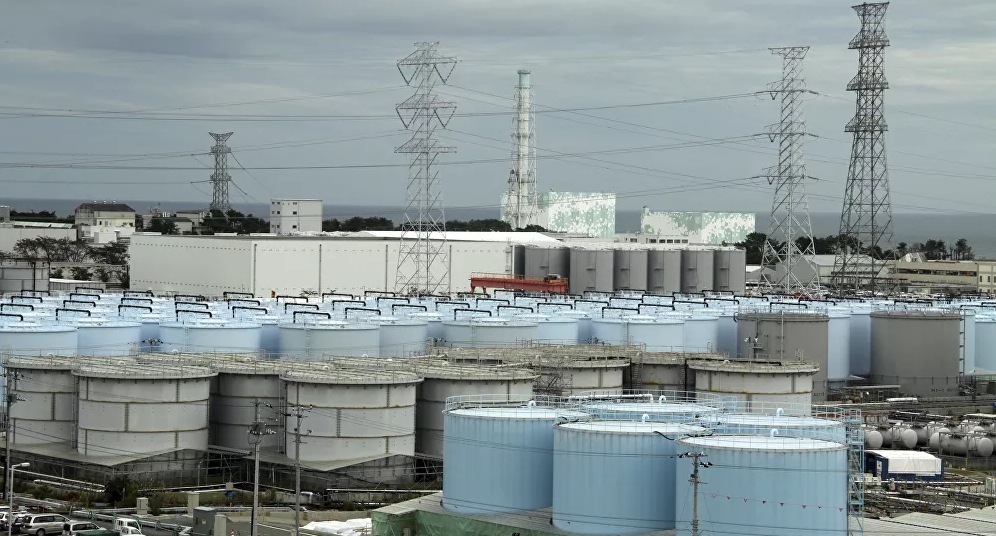
October 22, 2020
Japan is still dealing with the consequences of the 2011 Fukushima nuclear power plant meltdowns in the wake of an offshore 9.1 earthquake and tsunami. The facility is out of space to store the ever-increasing amount of radiated waste, and the government is about set to release over 1 million tonnes of radioactive water into the Pacific Ocean.
Eco activists are outraged following recent reports from Japanese media concerning a government panel’s intention to approve the release of highly-radioactive water into the ocean. An official announcement is expected to follow at the end of the month.
Authorities must increase storage capacity by constructing tanks outside the plant, nuclear specialists told DW, also accusing the government of hiding the actual radiation level of the water to solve the problem quickly and avoid extra expense. According to the Kahoko Shinpo newspaper, the levels of radioactive elements in processed water are many times above the safe norm. In particular, the level of strontium in water is 100 times above the safety cutoff, while levels of iodine exceed safe levels in at least half of all samples.
Fukushima fisherman are also against the plan, as they fear consumers will lose trust in local marine products.
Since the 11 March, 2011, undersea 9.1 magnitude Tohoku earthquake and subsequent tsunami that killed over 16,000, Japan has been seeking a safe way to get rid of radioactive water that flooded a local nuclear power reactor. Its disposal is one of the main problems of “Fukushima 1” decommissioning.
The damaged reactors must still be cooled with water that becomes highly radiated, and continues to mix with the groundwater through leaks. Thousand of containers currently store over a million tonnes of radiated water and the facility has limited space.
Tokyo has considered using evaporation techniques, but they have not worked quickly enough. Dumping the radiated water directly into the the Pacific Ocean is said by some to be acceptable only if the contaminants are purified by an ALP (Advanced Liquid Processing) filtering system and then diluted with seawater. Following this process, officials claim that no radioactive elements would remain in the water, except tritium, as it is not filterable but deemed safe in very small concentrations.
For ALP, Japan needs two years of preparations and an abundance of expensive hardware.
A magnitude 9.1 earthquake hit Japan on 11 March, 2011. It caused a giant tsunami that disabled the cooling system of the nuclear reactors and led to devastating explosions. The nuclear power plant “Fukushima 1” meltdown and explosion is the most disastrous nuclear incident after Chernobyl in 1986. Over 16,000 were killed and over 6,000 injured, while 160,000 local residents were left homeless. Healing the twon and its inhabitants will take at least 40 years, according to Tokyo.
Japan PM vows swift decision on release of Fukushima radioactive water
October 21, 2020
Jakarta – Japanese Prime Minister Yoshihide Suga said Wednesday the government will swiftly decide what to do with treated radioactive water at the crisis-hit Fukushima nuclear power plant following reports of a plan to release the water into the sea.
“We cannot postpone the issue forever. We would like to make a decision responsibly as soon as possible,” Suga told a press conference in Jakarta as he wrapped up his first foreign trip since taking office in mid-September. The premier visited Indonesia and Vietnam.

Photo taken Aug. 26, 2020, at the crippled Fukushima Daiichi nuclear power plant in northeastern Japan, shows tanks for storing treated water from which most of the radioactive contamination has been removed.
“There has been no decision on when or how to deal with the water,” Suga said. The government plans to deepen discussions on the matter and work on measures to prevent reputational damage linked to radiation, he added.
Local fishermen have expressed worries while China and South Korea have cast a wary eye on the issue after it was reported that an official decision on the discharge of water from the Fukushima Daiichi nuclear plant, crippled by the 2011 devastating earthquake and tsunami, may be made by the end of this month.
The Fukushima plant operated by Tokyo Electric Power Company Holdings Inc. has been generating massive amounts of radiation-tainted water since the accident as it needs water to cool the reactors, which suffered core meltdowns.
The water has been treated using an advanced liquid processing system, or ALPS, to remove most contaminants other than the relatively less toxic tritium. It is stored in tanks on the facility’s premises.
But space is expected to run out by the summer of 2022, with contaminated water increasing by about 170 tons per day. As of September this year, the stored water totaled 1.23 million tons and continues to grow.
Seoul mulls response to Fukushima water release

Demonstrators protest the Japanese government’s plan to discharge contaminated water into the ocean in front of the old Japanese Embassy in Seoul on Monday.
October 20, 2020
Seoul authorities are mulling how to respond to Japan’s impending decision on discharging radioactive water from the devastated Fukushima nuclear plant into the sea, which could heighten concerns on public safety and environment here.
Tokyo is set to formally decide on Oct. 27 as to what to do with the more than 1 million tons of contaminated water it has collected since the Fukushima Daiichi nuclear plant was damaged by an earthquake and tsunami in 2011. Japanese media outlets said Tokyo has already made up its mind to dispose of the treated water that has been filtered to reduce radioactivity into the ocean, as the most “realistic option.”
As of Tuesday, the South Korean Foreign Ministry had not decided how to respond if its neighbor to the east presses ahead with the discharge. The government is handling the issue at a vice-ministerial meeting of related agencies to monitor Tokyo’s activities and come up with measures.
“The government has continued to call for Japan to share transparent information in regards to the disposal of the contaminated water of the Fukushima nuclear plant and has stressed the need to communicate with the international community,” Lee Jae-woong, the ministry’s deputy spokesman, said during a regular press briefing. “The government, with the foremost priority placed on the protection of our citizens’ health and safety, will devise measures in cooperation with the international community.”
The main concern for Korea is that the water, which has been filtered but is still slightly radioactive, could reach South Korea and threaten the safety of the waters and environment here, as well as of other neighboring nations that share the Pacific Ocean. Environmental activists have expressed strong opposition to the discharge, while fishermen and farmers in Japan have voiced concerns that consumers would shun seafood and produce from the region.
For years Japan has been debating how to dispose of the contaminated water, which has been stored in thousands of tanks inside the plant. But Tokyo Electric Power, the state-run operator of the plant, said the storage space is expected to run out in the summer of 2022.
Earlier this year, a panel of experts advising the Japanese government said that disposing of the water in the sea or vaporizing and releasing it into the air are the most “realistic options.” The International Atomic Energy Agency said that both of Japan’s options are technically feasible and have been used by other nuclear power plants around the world.
If Japan decides to discharge it, the water could be dumped as early as 2022, given the time needed for preparations.
The discharging of the water, regardless of what impact it will have on the environment and health, could further deal a blow to bilateral ties between Seoul and Tokyo, which is already frayed over issues of wartime history and trade.
Jeju Island Gov. Won Hee-ryong on Tuesday warned that his government will lodge a lawsuit against Japan both domestically and at the international court should Tokyo decide to discharge the water into the ocean. Research says the wastewater could reach the coastal areas of the southern resort island before any other location outside of Japan.
He also called Japan to disclose all information transparently regarding the contaminated water, and to discuss the issue with other neighboring countries.
By Ahn Sung-mi
Half of Japanese against releasing radioactive water from Fukushima plant; Seoul, Beijing also concerned

October 20, 2020
A recent survey conducted by the Japanese daily Yomiuri Shimbun shows about 50 percent of citizens in Japan are against their government’s plan to discharge radioactive water from the tsunami-wrecked Fukushima nuclear plant into the sea.
The survey was conducted on over one-thousand eligible voters from across Japan.
Media reports say the fishing industry in Fukushima Prefecture is also opposed to the idea.
The governor of South Korea’s southern island of Jeju, Won Hee-ryong held a press conference on Tuesday, saying he will bring the case to both local and international courts if Japan goes ahead with its plan.
Seoul’s foreign ministry has also repeatedly voiced its concerns over the planned discharge.
“The South Korean government has been constantly emphasizing transparent information sharing and communication with the international community on the issue. We will prioritize our people’s health and safety, and continue efforts based on international cooperation.”
Beijing has also called on Tokyo to make a decision carefully after negotiating with its neighbors.
It pointed out that radioactive material from the 2011 tsunami and earthquake has already been discharged, posing a grave threat to the marine environment and human health.
The Japanese government is likely to officially announce its discharge plan early next week.
“We would like to deepen the discussion within the government and want to make a decision responsibly at an appropriate time.”
Experts warn of the danger from a radioactive substance called tritium, which will not be completely eliminated despite a purifying process.
But some say there aren’t many realistic measures to prevent Japan from discharging the contaminated water.
Sources say the South Korean government is currently focused on pressuring Japan to discharge it transparently and safely so the international community can, at the least, feel less concerned.
Yoon Jung-min, Arirang News.
Jeju Governor Vows to Take Legal Action against Japan’s Fukushima Water Release

October 20, 2020
Jeju Province Governor Won Hee-ryong says he will launch both domestic and international lawsuits against Japan should it release radioactive water from its disabled Fukushima nuclear plant into the ocean.
At a press conference on Tuesday, Won urged Tokyo to halt preparations for the release, be transparent in providing all relevant information and data and begin consultations on the water disposal.
Stressing that he, as Jeju governor, has the duty to protect the safety of South Korean waters and people, Won said he will work with all those affected to mobilize all means in countering the move.
The governor added that the Japanese people, especially those living in coastal regions, are opposed to the water release as well.
Won suggested forming a group representing coastal area residents in both South Korea and Japan to take the Japanese government to criminal and civil courts in both countries, as well as to an international tribunal.
Tokyo is set to make a final decision on the water release on October 27.
S. Korean demonstrators ramp up protests against Japan’s plans to dump radioactive water into the ocean

October 19, 2020
On Oct. 16, Japanese media outlets reported that the Japanese government will decide on whether or not to dump radioactive water from the Fukushima Daiichi Nuclear Power Plant into the Pacific Ocean. On Oct. 19, demonstrators organized in front of the former Japanese Embassy in Seoul to voice their vehement opposition to the ocean release. The demonstrators held up placards reading “Is the ocean a dump site for radioactive waste?” and “Complete opposition to the ocean release of radioactive water from Fukushima!” and demanded that the Japanese government withdraw its plans for getting rid of its radioactive water. They also demanded that the South Korean government move to proactively oppose and prevent the ocean release.

Demonstrators protest the Japanese government’s plan to dump radioactive water into the ocean in front of the old Japanese Embassy in Seoul on Oct. 16.

Demonstrators demand that the Japanese government withdraw its plans for the ocean release.

A demonstrator mocks Japanese Prime Minister Yoshihide Suga.
By Kim Hye-yun, staff photographer (all photos by Kim Hye-yun)
http://www.hani.co.kr/arti/english_edition/e_national/966364.html
World worries about release of Fukushima nuclear water
Neighboring countries oppose ‘irresponsible’ plan

A security guard stands on an empty main street at dusk in Namie, north of Fukushima Daiichi Nuclear Power Plant, Fukushima Prefecture, Japan on March 9, 2016.
October 18, 2020
The world public, especially those in Japan’s neighbors such as China and South Korea, have expressed deep concerns over environmental pollution and human health, and opposition to the Japanese government’s plan to dump radioactive water from the disabled Fukushima nuclear plant into the ocean.
Analysts said that Japan should think twice before making the decision as the move would have disastrous consequences for the marine environment and human health, which could lead to criticism by related international organizations, countermeasures by affected countries including cessation of imports of Japanese seafood, and harm to the country’s image.
Japanese media said that the country’s government will hold a related cabinet meeting as early as this month to make the final decision on the plan to release more than 1 million tons of radioactive water from the Fukushima Daiichi nuclear power plant into the Pacific Ocean after reducing the level of radioactivity.
The plan has not gotten much rolling coverage in Japan, but there are still many Japanese netizens expressing their disagreement. According to a poll on Yahoo Japan, 41.5 percent of the 31,035 respondents disagreed with the plan.
Local fishermen in Fukushima publicly announced their opposition, saying the plan will undo years of work rebuilding their industry’s reputation since the plant was wrecked by a huge tsunami in March 2011.
The public of South Korea has repeatedly voiced concern, claiming that discharging the water represents a “grave threat” to the marine environment.
A South Korean Foreign Ministry official told reporters that a meeting of related ministries regarding this issue was elevated to vice-ministerial status last month to step up the response to Japan’s move, reported South Korea’s KBS News on Friday. The official said the government will continue to closely monitor Tokyo’s activities and take measures based on cooperation with the international community.
Japan’s plan also sparked outrage among Chinese netizens, many of whom criticized Japan’s practice, saying it is throwing its responsibility onto the world to share.
Sun Yuliang, a nuclear expert at Tsinghua University in Beijing, told the Global Times on Sunday that whether to dump the waste water should depend on an authoritative scientific assessment to determine whether the processed radioactive water meets international standards for release.
Sun called on the Japanese government to invite professional teams from related international organizations such as the International Atomic Energy Agency to conduct a complete field investigation.
Liu Junhong, a research fellow at the China Institutes of Contemporary International Relations, urged Japan to further communicate with the international community and share information transparently.
Liu said that the Japanese government should give priority to safeguarding public health and safety and the environment, rather than the cost of the rehabilitation work after the 2011 Fukushima disaster.
Liu noted that the seas in Asia are mostly connected and many of them are semi-closed, so that the contaminants from the Fukushima water could subside and then rise, which would severely affect the local marine and coastal environment and the health of people nearby.
Therefore, Japan’s neighboring countries including China and South Korea would be the first to react to the plan, Liu said.
He noted that if the Japanese government releases the water, these countries are likely to stop imports of seafood from Japan, and foreigners could be reluctant to visit the country and enjoy its food, which would harm Japan’s economy.
Other analysts noted that the plan goes against Japan’s long-established image of being friendly to the marine environment.
Another expert on nuclear safety, who requested anonymity, said that the issues is not only one of Japan’s own business but also relates to the interests of the global community, so countries and related organizations in the international community should cooperate and assist Japan to deal with the contamination.
The Daiichi Nuclear Power Plant in Fukushima went into meltdown and released radioactive material in the aftermath of a tsunami in March 2011.
The disaster cast doubts over the safety of nuclear power worldwide, leading China to launch a campaign to review and upgrade the safety systems of all its nuclear power stations.
S. Korea reiterates priority on citizens’ health in handling Fukushima water issue
Where are all the other countries governments protesting against the radioactive contamination by Japan of our Pacific ocean?
I can only hear South Korean government’s voice, where are all the others? Their absence of any protest is equivalent to consent!!!

October 16, 2020
South Korea’s foreign ministry reiterated its “foremost priority” to protect its citizens’ health and safety Friday in dealing with Japan’s potential discharge of contaminated water from its crippled Fukushima nuclear plant.
The ministry also said the government has been handling the issue under a vice-ministerial inter-agency dialogue platform, amid public safety concerns over Japanese media reports that Tokyo has decided to release it into the sea with an official announcement likely to come as early as this month.
“Our government has continued to stress that the Japanese side should share information transparently and maintain communication with the international community regarding the disposal of the Fukushima nuclear plant water,” the ministry said in a statement.
“With the foremost priority placed on the protection of our citizens’ health and safety, the government will continue to pay keen attention to Japan’s activities related to the disposal of the contaminated water and will seek to craft measures in cooperation with the international community,” it added.
The ministry also pointed out that it understands Tokyo has yet to finalize how it will dispose of the tritium-laced water.
Japan has been exploring various options, including evaporating the water and putting it deep underground. Observers said that discharging the treated water into the ocean might be the cheapest, and thus tempting, disposal method. (Yonhap)
Japan to release 1m tonnes of contaminated Fukushima water into the sea – reports
Local media say release could begin in 2022 and would take decades to complete, but local fishermen say move will destroy their industry

Reactor buildings and storage tanks for contaminated water at the Tokyo Electric Power company’s Fukushima Daiichi nuclear power plant
October 16, 2020
Japan’s government has reportedly decided to release more than 1m tonnes of contaminated water from the Fukushima Daiichi nuclear power plant into the sea, setting it on a collision course with local fishermen who say the move will destroy their industry.
Media reports said work to release the water, which is being stored in more than 1,000 tanks, would begin in 2022 at the earliest and would take decades to complete.
An official decision could come by the end of the month, the Kyodo news agency said, ending years of debate over what to do with the water, with other options including evaporation or the construction of more storage tanks at other sites.
The government, however, has long indicated it prefers the option of releasing it into the nearby Pacific, despite opposition from local fishermen who say it will undo years of work rebuilding their industry’s reputation since the plant was wrecked by a huge tsunami in March 2011.
In response, the government has said it will promote Fukushima produce and address concerns among fishermen that consumers will shun their seafood once the water is released.
Environmental groups also oppose the move, while neighbouring South Korea, which still bans seafood imports from the region, has repeatedly voiced concern, claiming that discharging the water represented a ”grave threat” to the marine environment.
Pressure to decide the water’s fate has been building as storage space on the nuclear plant site runs out, with the plant’s operator, Tokyo Electric Power (Tepco), estimating all of the available tanks will be full by the summer of 2022.
As of last month, 1.23m tonnes of water, which becomes contaminated when it mixes with water used to prevent the three damaged reactor cores from melting, were being stored in 1,044 tanks, with the amount of waste water increasing by 170 tonnes a day.
Tepco’s Advanced Liquid Processing System removes highly radioactive substances from the water but the system is unable to filter out tritium, a radioactive isotope of hydrogen that nuclear power plants routinely dilute and dump along with water into the ocean.
A panel of experts advising the government said earlier this year that releasing the water was among the most “realistic options”.
Experts say tritium, a radioactive isotope of hydrogen, is only harmful to humans in very large doses, while the International Atomic Energy Agency says it is possible to dilute filtered waste water with seawater before it is released into the ocean.
The water at Fukushima Daiichi will be diluted inside the plant before it is released so that it is 40 times less concentrated, with the whole process taking 30 years, according to the Yomiuri Shimbun newspaper.
Hiroshi Kishi, president of a nationwide federation of fisheries cooperatives, voiced opposition to the move in a meeting with the chief cabinet secretary, Katsunobu Kato, this week.
Kato told reporters that a decision on the water “should be made quickly” to avoid further delays in decommissioning the plant – a costly, complex operation that is expected to take around 40 years.
1 This Month

of the week – Shut Down Drone Warfare!


Tell the Ukrainian Government to Drop Prosecution of Peace Activist Yurii Sheliazhenko

Petition to revoke the licensing of the Near Surface Nuclear Disposal Facility (NSDF) at Chalk River. https://www.ourcommons.ca/petitions/en/Petition/Details?Petition=e-7247
To see nuclear-related stories in greater depth and intensity – go to https://nuclearinformation.wordpress.com
-
Archives
- March 2026 (251)
- February 2026 (268)
- January 2026 (308)
- December 2025 (358)
- November 2025 (359)
- October 2025 (376)
- September 2025 (257)
- August 2025 (319)
- July 2025 (230)
- June 2025 (348)
- May 2025 (261)
- April 2025 (305)
-
Categories
- 1
- 1 NUCLEAR ISSUES
- business and costs
- climate change
- culture and arts
- ENERGY
- environment
- health
- history
- indigenous issues
- Legal
- marketing of nuclear
- media
- opposition to nuclear
- PERSONAL STORIES
- politics
- politics international
- Religion and ethics
- safety
- secrets,lies and civil liberties
- spinbuster
- technology
- Uranium
- wastes
- weapons and war
- Women
- 2 WORLD
- ACTION
- AFRICA
- Atrocities
- AUSTRALIA
- Christina's notes
- Christina's themes
- culture and arts
- Events
- Fuk 2022
- Fuk 2023
- Fukushima 2017
- Fukushima 2018
- fukushima 2019
- Fukushima 2020
- Fukushima 2021
- general
- global warming
- Humour (God we need it)
- Nuclear
- RARE EARTHS
- Reference
- resources – print
- Resources -audiovicual
- Weekly Newsletter
- World
- World Nuclear
- YouTube
-
RSS
Entries RSS
Comments RSS
 nuclear-news