IAEA team to visit Fukushima next week to review water release plan

February 7, 2022
TOKYO (Kyodo) — A team of International Atomic Energy Agency experts will visit the crippled Fukushima Daiichi nuclear power plant next week to review Japan’s plan to discharge treated radioactive water into the sea, the government said Monday.
During their stay in the country from Feb. 14 to 18, the experts will evaluate the safety of releasing the treated water, with their visit to the Fukushima plant slated for Feb. 15, according to Japan’s foreign and industry ministries.
The planned release, slated to begin in the spring of 2023, has been opposed by China and South Korea, as well as local fishing communities.
The on-site assessment by the experts led by Gustavo Caruso, director and coordinator of the IAEA’s Department of Nuclear Safety and Security, was initially scheduled for mid-December but postponed due to the rapid spread of the highly contagious Omicron variant of the coronavirus.
The team will also exchange views with the Japanese government and Tokyo Electric Power Company Holdings Inc., the operator of the Fukushima plant, on cooperation in dealing with the treated water, the industry ministry said, adding the IAEA will hold an online press conference on Feb. 18.
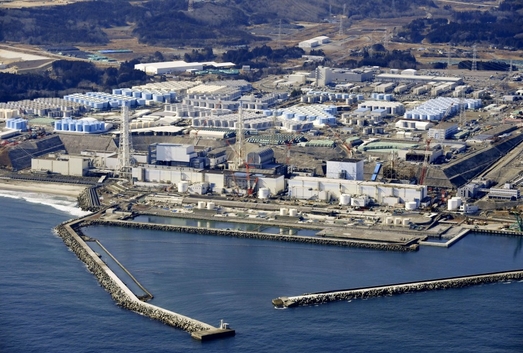
Water pumped in to cool melted fuel at the plant, crippled by the 2011 massive earthquake and tsunami in northeast Japan, has been accumulating at the complex. It has mixed with rain and groundwater at the site, becoming contaminated.
The water is treated using an advanced liquid processing system. The process removes most radioactive material except for tritium, which is said to pose few health risks. Tokyo decided in April last year to release the treated water into the Pacific Ocean.
To improve the transparency of the water discharge project, Japan’s industry ministry and the IAEA have agreed that the international body will compile an interim safety evaluation report in 2022.
Experts to visit Fukushima plant to check water release plan

By MARI YAMAGUCHI February 7, 2022
TOKYO (AP) — A team of experts from the International Atomic Energy Agency will visit Japan’s wrecked Fukushima nuclear power plant next week to review plans to begin releasing more than a million tons of treated radioactive water into the sea, a mission the government hopes will assure people of the plans’ safety.
The team of about 15 experts will meet with government and utility officials during their Feb. 14-18 mission, which includes a visit to the Fukushima Daiichi plant, industry ministry officials said Monday.
The government and Tokyo Electric Power Company Holdings announced plans last year to begin gradually releasing the still-contaminated water in spring 2023 after further treatment and dilution. The water is being stored in about 1,000 tanks at the plant which need to be removed to allow for the wrecked plant’s decades-long decommissioning. The tanks are expected to reach their capacity of 1.37 million tons later this year.
The plan has been fiercely opposed by fishermen, local residents and Japan’s neighbors, including China and South Korea.
Japan has sought IAEA’s assistance to ensure the release meets international safety standards and gain the understanding of other countries. The team is expected to include several IAEA officials and an expert from each of 11 countries including South Korea and China, officials said.
A massive earthquake and tsunami in 2011 destroyed the Fukushima plant’s cooling systems, triggering the meltdown of three reactors and the release of large amounts of radiation, and causing more than 160,000 people to evacuate. Water used to cool the highly radioactive reactor cores has since leaked extensively, mixing with groundwater seeping into reactor buildings.
Japanese officials say the only realistic option is to slowly release the contaminated water, diluted with sea water, into the ocean. The discharge is expected to take decades to finish.
Officials say all isotopes selected for treatment can be reduced to low levels except for tritium, which is inseparable from the water but is harmless in small amounts.
The IAEA mission was originally scheduled for December but was delayed due to the global surge of the omicron coronavirus variant. Japan’s industry ministry and the IAEA have agreed to compile an interim report on the water discharge plan in 2022.
Officials say it is now safe to live in most areas around the plant except for its immediate surroundings after extensive decontamination work. They blame “reputational damage,” or incorrect information about the impact of radiation, for delaying the recovery of Fukushima’s agricultural and fisheries industries.
Six people recently filed a lawsuit seeking compensation from TEPCO for thyroid cancers that they believe were caused by radiation from the accident. About 300 people who were children at the time have since developed the illness.
On Jan. 27, five former Japanese prime ministers issued a joint statement urging the European Commission to reverse its decision to include nuclear power as an “environmentally sustainable economic activity” under EU taxonomy, noting the Fukushima tragedy and thyroid cancer in many children there.
Government officials have repeatedly denied links between thyroid cancer in Fukushima and the accident and accused the former leaders of spreading “false information and wrongful discrimination and prejudice.”
Japan’s Bid to Dump Tons of Radioactive Water From Fukushima Into Sea Hits Snag
‘most contaminants’? Not all radionuclides were filtered successfully, the ALPS filtering system failing to remove fully the radionuclides, not only tritium!

January 31, 2022
Japan’s controversial plan to dump a large amount of radioactive water from the damaged Fukushima nuclear power plant into the Pacific Ocean could be forced into a delay due to a series of recent roadblocks.
Japanese officials doubt that millions of tons of the contaminated water will begin to be dumped into the ocean as planned in spring 2023, according to a Monday report from The Asahi Shimbun. The digging of special ditches intended to hold the water just before it is released into the ocean began this month. However, the digging of a critical undersea tunnel, which was also expected to start this month, has been delayed until June.
The water has been treated to remove most contaminants before being stored in 1,061 holding tanks. Environmental concerns about the project have remained significant since the treatment process cannot filter out the radioactive hydrogen isotope tritium, a contaminant that experts say could be harmful in large amounts.
The effort to get rid of the water is an essential precursor to the decommissioning of the Fukushima plant, which experienced a triple meltdown in 2011 following a tsunami triggered by a massive Pacific Ocean earthquake.
Despite opposition from environmentalists, the fishing industry, local residents and neighboring countries, Japanese Prime Minister Fumio Kishida insisted that the water dumping plan “should not be pushed back” after touring the damaged power plant last October.
The amount of contaminated water at the plant continues to increase due to rainwater and groundwater entering the facilities and mixing with radioactive cooling water. Last year, an average of 150 tons of new contaminated water accumulated each day. Storage tanks were reportedly at 94 percent capacity as of January 20.
The plan could also be postponed due to the delay of a planned inspection by experts from the International Atomic Energy Agency. The Japanese government has invited the agency’s researchers to determine the safety of the treated water.
A visit from the researchers that had been expected to take place in December was canceled due to the recent Omicron-fueled surge of COVID-19. The Japanese government is reportedly in negotiations to reschedule the inspection for spring but no new date has been announced.
The water is expected to be released into the ocean gradually, with the entire process taking decades to complete. The plant’s operator, Tokyo Electric Power Company Holdings, has argued that the environmental impact will be minimal due to contaminated water being treated and heavily diluted in seawater. A simulation that the company released in November found that radiation levels would temporarily increase in the ocean before quickly returning to normal levels.
Safety assurances from the power company and the Japanese government have done little to change the opinions of people opposed to the water dump. Those in the fishing industry have been particularly outspoken in opposing the plan, since any contamination of the waters they fish could be disastrous to their livelihoods in addition to the environment.
“If you insist on the safety of treated water, why don’t you spray it in your garden or dump it in a river flowing into Tokyo Bay?” local fisherman Toru Takahashi told officials during a recent government question-and-answer session, according to The Asahi Shimbun. “I will never ever drop my opposition.”
https://www.newsweek.com/japans-bid-dump-tons-radioactive-water-fukushima-sea-hits-snag-1674774
Doubts grow on water-release schedule at Fukushima plant

January 31, 2022
Shovel loaders digging pits at the Fukushima No. 1 nuclear power plant on Jan. 17 were a rare sign of progress in the government’s contentious water-discharge plan at the stricken site.
Under the plan, millions of tons of treated but still contaminated water stored at the plant will be released into the sea over decades starting in spring 2023.
However, opposition to the plan remains fierce among local residents, the fishing industry and even overseas governments.
The pits being dug will temporarily hold radioactive water right before the release. But other preparatory work has already been stalled.
The government plans to create an undersea tunnel through which the treated and diluted radioactive water will be released into the sea about 1 kilometer from the plant.
Drilling work for the tunnel was initially scheduled to start early this year, but it was delayed to June.
Some government officials now doubt that the tunnel can be completed in time for the planned water release.
“It would be impossible to construct the underwater tunnel in less than a year,” one official said.
The government in April last year decided to discharge the contaminated water stored at the plant to move forward the decades-long process of decommissioning of the plant.
The accumulation of highly contaminated water has been a serious problem for the government and plant operator Tokyo Electric Power Co. since the Great East Japan Earthquake and tsunami in March 2011 caused the triple meltdown there.
An average of 150 tons of such water was produced each day last year as rainwater and groundwater keeps flowing into the damaged reactor buildings and mixing with water used to cool the melted nuclear fuel.
The contaminated water is treated by a multi-nuclide removal facility, known as ALPS, and stored in tanks. ALPS, however, cannot remove tritium, a beta-emitting radioactive isotope of hydrogen, and others.
The pits are being built to ensure that tritium levels in the treated water after dilution with a large amount of seawater are low enough to be sent to the planned tunnel for discharge into the sea.
Disposal of the contaminated water has become an urgent matter.
TEPCO said the existing 1,061 tanks at the plant are capable of holding a total of 1.37 million tons of water and would be full by around spring next year.
As of Jan. 20, the plant had reached 94 percent of capacity.
The government fears that continuing to add more storage tanks at the plant could jeopardize the overall decommissioning work.
EFFORTS TO EASE CONCERNS DELAYED
The government asked the International Atomic Energy Agency to send an inspection team to examine the safety of the treated radioactive water.
A seal of approval from a credible international body could go a long way in easing domestic and international opposition about the water release plan.
The IAEA team of researchers from 11 countries, including China and South Korea, which are opposed to the water release, was expected to visit Japan in December to begin its on-site inspection.
But that trip was scrapped after a new wave of novel coronavirus infections hit the global community.
Government officials are negotiating with the IAEA for a visit in spring by the team. But it remains unclear when the trip will finally materialize.
The government and TEPCO have also made little progress in gaining support from fishermen and the public, despite holding numerous briefings about the water release plan.
Distrust of the government and the utility remain high in Fukushima Prefecture over their series of mishandling of the nuclear disaster.
Fishermen, in particular, are adamantly opposed to the release of the water into areas where they make their living.
“If you insist on the safety of treated water, why don’t you spray it in your garden or dump it in a river flowing into Tokyo Bay?” Toru Takahashi, a fisherman in Soma, asked government officials at a recent briefing session.
The officials brought with them a huge stack of documents to emphasize the safety of the treated water.
But they lowered their eyes and clammed up when Takahashi and other opponents challenged their view.
“I will never ever drop my opposition,” Takahashi said.
Such opposition has created a headache for leaders of the towns hosting the plant.
They are eager to see progress in the decommissioning work, and getting rid of the huge amount of contaminated water at the plant would be a big step toward rebuilding their affected communities.
After the government’s decision to release the water, Shiro Izawa, mayor of Futaba, a town that co-hosts the plant along with Okuma, called on then industry minister Hiroshi Kajiyama to gain support for the water discharge plan from the public and fisheries to advance the decommissioning process.
Futaba, a town with a population of nearly 7,000 before the nuclear disaster, is the only municipality in Fukushima Prefecture that remains entirely under an evacuation order.
In 2015, Futaba grudgingly became the storage site of contaminated soil and debris gathered in the cleanup of municipalities in the prefecture on the pretext of “moving forward rebuilding.”
If the planned water release is further delayed because of opposition from other municipalities, the future of rebuilding Futaba will remain in doubt.
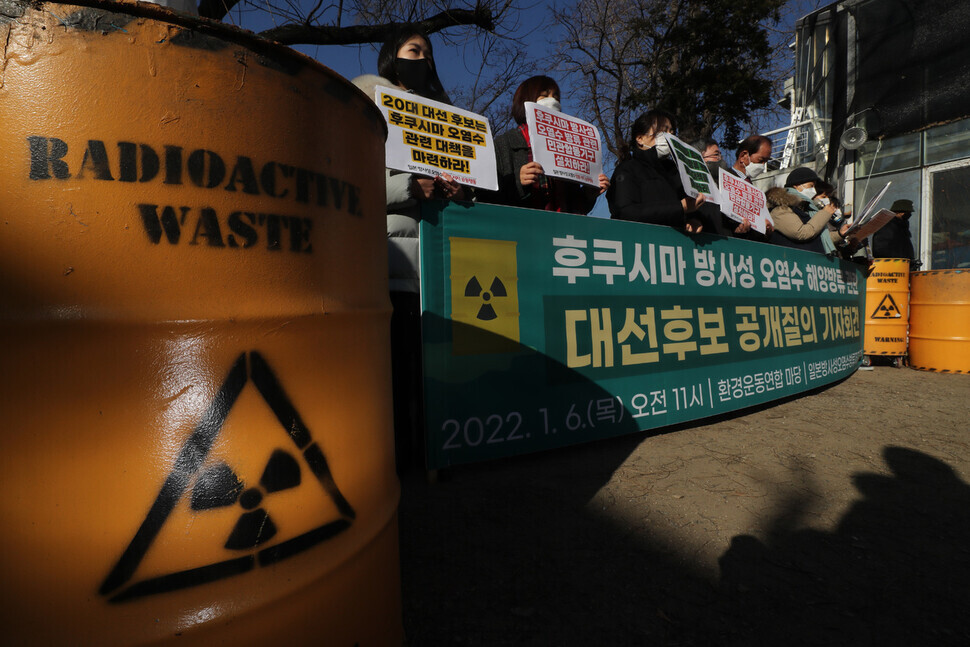
Candidates, tell us your stances on Fukushima water release

Jan.7,2022
Environmental groups in South Korea are calling on presidential candidates to make public their stances on Japan’s plans to dump contaminated water from the Fukushima nuclear site, and to come up with courses of action. Groups including the Korean Federation for Environmental Movement (KFEM), Nuclear Safety and Future, and Korea Radiation Watch convened for a press conference on Thursday morning in front of KFEM’s offices in Jongno District, Seoul. The groups criticized the government’s response thus far as “timid,” saying that since Japan had announced its intentions to release the radioactive water in April of last year, the government had only gone so far as to express protest to the Japanese Embassy and send a letter of protest to Japan. The groups called on presidential candidates to come up with concrete, practical plans for dealing with the issue.


Japan to implement compensation rules for losses by Fukushima rumors
Yeah, radiation is just a very harmful rumor….
Dec 28, 2021
The Japanese government on Tuesday decided to set, within a year, standards for compensating businesses that suffer losses due to rumors that may emerge when Japan starts discharging treated radioactive water from the crippled Fukushima nuclear plant into the sea.
As neighboring countries such as China and South Korea have expressed worries over the release of the treated water from the Fukushima Daiichi power plant slated for spring of 2023, the action plan includes having the International Atomic Energy Agency evaluate the safety of the water to secure transparency.
The government will also set up a fund using 30 billion yen ($261 million) earmarked in the fiscal 2021 supplementary budget to purchase seafood products when demand falls and promote online sales of products by fishery groups.
During a Cabinet meeting on the topic, Chief Cabinet Secretary Hirokazu Matsuno called on members to “implement the measures swiftly and steadily and have as many consumers as possible be aware of the safety (of the processed water) to create an environment in which people in communities can continue operating and expand their businesses.”
The action plan was formed as the government decided in April to allow Tokyo Electric Power Company Holdings Inc. to release significantly diluted contaminated water into the sea in a step-by-step operation.
More than 1 million tons of the treated water has accumulated on the plant’s premises after a massive earthquake and tsunami triggered a triple meltdown at the Fukushima Daiichi plant in March 2011.
The water is treated using an advanced liquid processing system. The process removes most radioactive material except for tritium, which is said to pose few health risks.
Under the action plan, the government will set compensation plans for each industry such as fisheries, agriculture, commerce and tourism and decide which period to compare when calculating losses before the Fukushima plant operator, TEPCO, creates standards for compensation.
The IAEA will dispatch a survey team to the Fukushima Daiichi power plant to compile its mid-term safety evaluation report within 2022 and will have long-term involvement with the release of the water, according to the plan.
The plan also includes holding online surveys targeting consumers in South Korea, Taiwan, Hong Kong, and elsewhere from January to understand their perceptions of the treated water and food products from Fukushima Prefecture.
Japan maps out plan for disposing of treated radioactive water from Fukushima plant
Under the government program, Japan aims to set standards for compensation for damage caused by what it described as harmful rumors about local industries such as fishing, tourism and agriculture, while reinforcing monitoring capability and transparency to avoid reputational damage.

Dec 28, 2021
The government on Tuesday outlined a plan for releasing treated radioactive water from the crippled Fukushima nuclear plant into the sea, including compensation standards for local industry and the compilation of a safety assessment report.
Japan said in April it would discharge more than 1 million metric tons of contaminated water in stages after treatment and dilution, starting around spring 2023. The announcement provoked concern from local fishermen and objections from neighboring China and South Korea.
Earlier this month, the plant’s operator, Tokyo Electric Power Company Holdings Inc., outlined detailed plans for the disposal, including building an undersea tunnel to release the water.
Under the government program, Japan aims to set standards for compensation for damage caused by what it described as harmful rumors about local industries such as fishing, tourism and agriculture, while reinforcing monitoring capability and transparency to avoid reputational damage.
Under the plan, the industry ministry and the Reconstruction Agency will work together from next month to start publicizing in Japan and abroad the safety of the water, and conduct a consumer opinion survey on the issue through next March.
The government will also create a fund to support the temporary purchase and storage of freezable seafood in case producers are hit by reputational damage. For the fund, the government has secured ¥30 billion under its fiscal 2021 supplementary budget.
Japan also expects the International Atomic Energy Agency (IAEA) to compile an interim safety assessment next year, based on its review over the safety of the treated water, competence of local analytical laboratories and regulatory frameworks, it said.
In an effort to improve transparency to gain the trust of the international community, Japan asked the IAEA in April to conduct a review to assess and advise on the handling of the water.
A decade after a massive earthquake and tsunami ravaged the country’s northeastern coast, disabling the plant and causing the world’s worst nuclear disaster since Chernobyl, nearly 1.3 million metric tons of contaminated water has accumulated at the site.
The water, enough to fill about 500 Olympic-sized swimming pools, is stored in huge tanks at an annual cost of about ¥100 billion ($870 million), and space is running out.
Japan has argued the release is necessary to press ahead with the complex decommissioning of the plant. It says similarly filtered water is routinely released from nuclear plants around the world.
Despite widespread opposition, Japan plans to dump water from Fukushima plant into the Pacific Ocean.
A million tons of contaminated water will be released in two years’ time

People in coastal communities in Japan, joined by voices from around the world, denounced a new governmental plan to dump contaminated water from the site of the Fukushima nuclear disaster into the Pacific Ocean. Local communities and other nations in the Pacific Ocean fear the dumping will poison the environment and cripple local fishing and tourism industries that have struggled to recover from the March 2011 nuclear accident on Japan’s northeast coast for over a decade.
According to a government plan released on December 28, 2021, Tokyo Electric Power Company (TEPCO) will start releasing 1 million metric tonnes of radioactive water from the Fukushima plant into the Pacific Ocean in 2023. The plan, which is still being developed over the coming months, states that an undersea tunnel will be built to pump the water out to the sea. Funds have also been reserved to compensate local fishing and tourism industries for potential “reputational damage.”
In March 2011 an earthquake and tsunami caused three nuclear reactors operated by TEPCO in Fukushima to meltdown. Over the years, groundwater flowing through the plants was contaminated with radioactive content. In order to prevent this water from reaching the ocean, it was pumped from the reactor buildings into large tanks that now dominate the reactor installation.
As of December 2021, at least 1 million tonnes of contaminated water are stored in the tanks inside the Fukushima Daiichi Nuclear Power Station.
While highly radioactive contaminants are removed, the stored water that the Japanese government is planning to pump out to sea still contains significant amounts of tritium, a radioactive element that some experts say is harmless when diluted in seawater.
The Japanese government’s plan to pump the contaminated water has been in the works since 2020. Greenpeace said in April 2021 that it collected 183,000 signatures opposing the plan to discharge water from the Fukushima plant.
Also in April 2021, South Korean civil society groups issued a statement condemning TEPCO’s plan, noting, “even if diluted the total amount of radioactive material thrown into the sea remains unchanged. If the radioactive wastewater is discharged, it will be an irrevocable disaster not only for marine ecosystem but for the human.”
The issue was tackled during the Pacific Islands Forum Foreign Ministers Meeting in July 2021, and the body made the following declaration:
Forum Foreign Ministers noted the concerns surrounding the seriousness of this issue in relation to the potential threat of further nuclear contamination of our Blue Pacific and the potential adverse and transboundary impacts to the health and security of the Blue Pacific Continent, and its peoples over both the short and long term.
In November 2021, TEPCO said its radiological impact assessment showed minimal impact on the environment:
The assessment found that effects of the discharge of ALPS (Advanced Liquid Process System) treated water into the sea on the public and the environment is minimal as calculated doses were significantly less than the dose limits, dose targets, and the values specified by international organizations for each species.
TEPCO assured the public that it is continually updating its scientific studies regarding the plan to release processed water into the Pacific. But doubts remain about their reports, mostly because there still are few concrete plans about how and where the contaminated water will be dumped, making it difficult for outside observers to assess the risk.
The Pacific Collective on Nuclear Issues, which represents civil society organizations based in Oceania, refutes the veracity of these studies. It also has a message for TEPCO and the Japanese government:
The Pacific is not and must not become the dumping ground for nuclear wastes.
The Collective considers that TEPCO, and the relevant Japanese Government agencies, have wrongly prioritised convenience and costs over the short term and long term environmental and human cost of their planned actions.
Japanese residents have also consistently expressed concern about TEPCO’s plan.
Greenpeace interviewed fisherman Ono Haruo from the township of Shinchi in Fukushima, who echoed the sentiments of the local population:
Fish are finally starting to return after ten years, but if they now pour tritium into the water, no matter how much they dilute it, who’s going to buy those fish? Who wants to eat poisoned fish?
The ocean is our place of work. Can you imagine what it feels like for that to be intentionally polluted?
It’ll be 30 or 40 years before we see the effects. The causal relationship will have become unclear and it’ll be impossible to prove anything. What’s going to happen to the future of our children, our grandchildren? It’s not even clear who will take responsibility.
A group of mothers in Iwaki city, Fukushima, participated in a protest in November 2021 opposing the plan to dump contaminated water into the ocean. The townships of Okuma and Futaba, which host the stricken Fukushima Daiichi complex, have experienced almost complete depopulation over the past decade.
In spring 2022, the International Atomic Energy Agency will evaluate and report on plans has on the Fukushima water treatment, while stakeholders will continue to engage authorities about the controversial plan of TEPCO.
Fukushima fishermen worry about Japan’s plan of releasing nuclear wastewater

December 25, 2021
People in Japan are strongly opposing and greatly concerned as the government moves forward with a plan to dump approximately 1.3 million tons of nuclear wastewater into the sea from the crippled Fukushima plant starting from the spring of 2023.
The fishery in Fukushima was heavily hit after the nuclear plant was destroyed. Dumping contaminated water into the sea will undoubtedly result in another strike on the local fishing industry.
China opposes Japanese decision to release nuclear-contaminated water into ocean

December 22, 2021
BEIJING, Dec. 22 (Xinhua) — China is seriously concerned about and firmly opposes Japan’s unilateral decision to discharge the nuclear-contaminated water into the sea and its proceeding with the preparatory work, a Chinese Foreign Ministry spokesperson said Wednesday.
Zhao Lijian made the remarks when asked to comment on a media report that Tokyo Electric Power Company has submitted an application to Japan’s Nuclear Regulation Authority with a detailed plan of discharging nuclear-contaminated water from the Fukushima Daiichi nuclear power plant into the sea.
Since April this year, the international community has raised concerns to the Japanese side over the legitimacy of the discharge into the sea, the rationality of the discharge plan, the credibility of the data about the nuclear contaminated water and the reliability of the equipment to purify the nuclear-contaminated water, Zhao said.
The work of the IAEA technical working group on the handling of the nuclear-contaminated water from Fukushima is still undergoing, he added.
“In total disregard of the legitimate and reasonable concerns of the international community, the Japanese side only continues to proceed with the preparations for the discharge both policy-wise and technology-wise,” Zhao said.
“Obviously, it wants to impose its wrong decision on the entire international community, and it is all the littoral countries of the Pacific Ocean that will have to take the risk for such move. The Japanese side is extremely irresponsible in doing so.”
He said that over the past eight months, Japan has constantly tried to defend the decision to discharge the nuclear-contaminated water into the sea, claiming the discharge is safe.
“However, many countries and international environment groups have questioned that if the water is truly harmless, why doesn’t the Japanese side discharge it into lakes or use it for civil purposes instead of releasing it into the ocean? To say the least, why doesn’t it try to build more storage tanks for the water at home? How can the international community trust Japan’s own words regarding whether the water to be discharged is safe or not? The Japanese side should give responsible answers to all these fundamental questions,” Zhao said.
He stressed that the handling of the nuclear-contaminated water from Fukushima is never Japan’s private matter. Instead, it bears on the marine environment and public health of the whole world.
Japan should heed and respond to the appeals of neighboring countries and the international community, and rescind the wrong decision of dumping the water into the sea.
“It mustn’t wantonly start the ocean discharge before reaching consensus with stakeholders and relevant international institutions through full consultations,” Zhao said.
http://www.xinhuanet.com/english/asiapacific/20211015/C9A4AEDD72B00001F26810B030601260/c.html
Their unheard voices: The fishermen of Fukushima
Mitsuhisa Kawase 20 December 2021
In April 2021, the Japanese government decided to discharge radioactive water stored inside the TEPCO Fukushima Daiichi Nuclear Power Station into the Pacific Ocean. TEPCO’s plan is to build a pipeline along the ocean bed and release diluted processed radioactive water 1 km off the coast of Fukushima. In November, Greenpeace conducted its 33rd Fukushima radiation survey since the nuclear disaster, during which we had the opportunity to interview local fisherman Mr. Haruo Ono. Mr. Ono opens up about the pain he feels, saying that discharging radioactive water into the ocean will throw Fukushima’s fishing industry back down into the abyss.

It has taken us 10 years to get to where we are
“How can such a thing be allowed to happen,” sighed Mr. Ono with a thick Fukushima accent. As he scanned the newspaper in his home, his eyes came to rest on an article and comments about the plan, announced by TEPCO the previous day, to discharge radioactive water from the Fukushima Daiichi Nuclear Power Station into the ocean. “The ocean’s alive, too, you know!” The hand that gripped the newspaper turned white.
Mr. Haruo Ono from Shinchi Town, Fukushima was born into a family of three generations of fishermen, and has helped out with the family business from as early as he can remember. Then in March 2011, everything fell apart. His town was badly hit by the tsunami that followed the Great East Japan Earthquake and then, to make matters even worse, vast amounts of radiation were released from the stricken Fukushima Daiichi Nuclear Power Station. The fish they landed were found to contain radioactive substances, and fishermen were left with no choice but to voluntarily cease all fishing off the coast of Fukushima for approximately one year.
In June 2012, just over a year after the disaster, fishing trials were restarted and the sale of certain seafood, such as octopus and some shellfish was subsequently permitted. In February 2020, the ban was finally lifted for all seafood, and now Mr. Ono is permitted to go out to sea to fish up to ten times in a month. However, in April 2021, a month after the ten year anniversary of the disaster, the Japanese government made a cabinet decision to discharge radioactive water into the ocean.

“Fish are finally starting to return after ten years, but if they now pour tritium into the water, no matter how much they dilute it, who’s going to buy those fish? Who wants to eat poisoned fish? ”
For a decade since the nuclear disaster, Mr. Ono has endured the frustration of not being able to fish freely, and the unfairness of having his catch overlooked simply because it’s from Fukushima. “So then why didn’t they discharge it into the sea ten years ago? That’s because it would have been wrong, right?” Unable to hold back any longer, his frustration poured out.
Voices going unheard
After the decision was made to discharge the polluted water into the ocean, the government held a number of information sessions for the residents of Shinchi Town, which Mr. Ono attended. However, he says he still hasn’t received an answer as to why they are going to discharge the water into the ocean.
“The person in charge arrives at 3:30, and the session is over at 5. There’s 30 minutes for questions. Out of the blue, they hand us a huge stack of documents, and they expect us to understand,” said Mr. Ono. “We have a right to ask questions, we have a right to know. If there is no option but to discharge the water into the ocean, then we want an acceptable answer about this decision.”
TEPCO’s “Radiological Impact Assessment Regarding the Discharge of ALPS Treated Water into the Sea”1 that was released in November 2021, reflected exactly the same stance. “TEPCO is skilled at spinning the story. They make it seem as if we have accepted the decision. They are very good at manipulating the language, and on top of that, how many people are even going to actually read such a huge document”.

Behind the enduring mistrust is a decade of repeated dishonesty by the government and TEPCO towards the local fishermen. Firstly, in 2015 TEPCO made a promise to the Fukushima Prefectural Federation of Fisheries Co-operative Associations that it “would neither treat nor dispose of” the contaminated water stored inside the buildings, “in any way, without the understanding of those concerned”2. Furthermore, with reports that the Advanced Liquid Processing System (ALPS) treated water actually contained levels of radiation other than tritium, such as carbon-14, that exceeded permitted levels, they have repeatedly betrayed the trust of local residents and those involved in the local fisheries.
“Why do they have to put TEPCO first so much? Shouldn’t it be the victims, the local residents, who need protecting?” Mr. Ono protested. “Nobody has agreed to this. And then they go and make such a thoughtless decision regardless. The ocean is our place of work. Can you imagine what it feels like for that to be intentionally polluted?”
Responsibility to the future up in the air
As of 8 December 2021, there’s a total of approximately 1.285 million tonnes of radiation contaminated water stored in the tanks inside the Fukushima Daiichi Nuclear Power Station3. During 2020, with groundwater flowing into the nuclear reactor buildings, and the cooling of fuel debris, the amount of water increased at a pace of approximately 140 tonnes a day4.
According to TEPCO, the tanks will be full by spring 2023, hence their decision to discharge the polluted water into the ocean. However, a subcommittee of the Ministry of Economy, Trade and Industry, set up in 2019, suggested that there is room to build more tanks within the plant5. “If we can continue to store the polluted water, then there’s no need to rush to a decision. Why are they rushing to make a decision, when we might find a better way to process the water in the future?”
TEPCO plans to eliminate radionuclides, other than tritium, to levels below regulatory standards, and dilute the tritium to 1/40 of permitted levels before discharging the water into the ocean. TEPCO says that the level of tritium discharged annually will not exceed 22 trillion becquerels per year – the maximum annual limit that was in place prior to the nuclear disaster – and that it will conduct regular reviews.

However, whether you dilute the polluted water or employ new techniques to discharge it, the total amount of radiation released into the environment does not change. While the half-life of tritium might be 12 years, the half life of carbon-14 is 5730 years. As long as water is being discharged, radioactive material will continue to accumulate in the ocean.
“It’ll be 30 or 40 years before we see the effects. The causal relationship will have become unclear and it’ll be impossible to prove anything. What’s going to happen to the future of our children, our grandchildren? It’s not even clear who will take responsibility.”
The ocean is alive too
“It feels like – it’s our ocean, but it’s not our ocean”. This is something that Mr. Ono often said and seems to reflect the persistent sensation that things are moving forward without the people who have lived alongside the ocean for so long, the fishermen.
The fishermen of Fukushima face a harsh reality. They are only allowed to go out fishing up to 10 times a month, and their monthly income comes to about 120,000 Yen (~940 Euro). The future is unclear, and their troubles just keep increasing. “Who would want to continue fishing in such an environment, who would want their children to become fishermen? If it goes on like this, there won’t be another generation of fishermen. Discharging the water into the ocean is the last straw.”
In response to the ocean discharge plan, the government and TEPCO have promised compensation and measures to counteract reputation damage, to local forestry and fishery businesses. However, this is beyond the point. “They’re focusing solely on things like mitigating damage to the reputation of local produce, or promises to buy our fish, but that’s not what’s important. We’re not catching fish so that they can be thrown away. We want to catch them so that people can eat and enjoy them,” he says with a sigh.

“Firstly, why is it not okay to release radiation on land, but okay to put it in the ocean? You’ve got the mountains and the water from the rivers flowing into the sea, plankton grows, small fish eat the plankton and bigger fish eat the smaller fish. That’s the cycle. Polluting it is easy, but once you’ve polluted you can’t go back to how it was. The ocean is alive too, you know.”
The ocean that Mr. Ono is trying to protect is the same ocean that took away his brother’s life ten years ago, in the tsunami. “The ocean can kill, but it can also give life. If we don’t protect it, who will? The fish don’t have a voice.”
“The ocean is alive too. And we’re citizens of this country, too, you know. I’m begging, somebody, please listen to us.”
Currently, at the Fukushima Daiichi Nuclear Station, preparations are underway to discharge the polluted water into the ocean in spring 2023. This is going to destroy the livelihoods and dignity of Fukushima’s fishermen, and their heartbreaking pleas have yet reached the government or TEPCO, who are focused only on maintaining the superficial appearance of “recovery”.
2TEPCO https://www.tepco.co.jp/news/2015/images/150825a.pdf (Japanese only)
3TEPCO Treated Water Portal Site
4TEPCO How much contaminated water is being generated
5METI The Subcommittee on Handling ALPS Treated Water
Mitsuhisa Kawase is Senior Communication Officer at Greenpeace Japan.
Fukushima operators to use tunnels and pumps to release contaminated water into the sea

22 December 2021
The operator of Japan’s destroyed Fukushima nuclear power plant, Tokyo Electric Power (Tepco), has submitted plans to the country’s nuclear regulators to release contaminated water from the site into the sea.
According to Reuters, Tepco proposes to discharge the water via pumps and and underwater tunnels to a location about 1km offshore.
Tepco will process the water first to remove radioactive contamination, except for tritium, which cannot be removed.
Nearly 1.3 million tonnes of contaminated water have accumulated at the site – enough to fill 500 Olympic swimming pools.
The water has built up over the past ten years, after the site was ravaged by an earthquake and tsunami – causing the world’s worst nuclear disaster since Chernobyl.
Currently, the water is stored in huge tanks at an annual cost of around $880m, and space is running out.
Although international authorities support the water discharge effort, the plans do have raised concern from neighbours China and South Korea and worried both local farmers and the fishing industry.
The operator will continue to discuss the issue with residents and others before construction, set to start in the middle of next year.
Fukushima nuclear power plant plans seabed tunnel to discharge treated radioactive water into ocean
22 déc. 2021
The operator of Japan’s crippled Fukushima Daiichi nuclear power plant has unveiled plans to build an underwater tunnel to release treated radioactive water into the sea. The Tokyo Electric Power (Tepco) submitted detailed plans on December 21, 2021, to the nuclear regulation authority for approval. In 2011, a devastating earthquake and tsunami sparked a nuclear disaster on Japan’s northeastern coast. Nearly 1.3 million tonnes of contaminated water has to be processed to eliminate radioactive contamination, except for tritium, which cannot be removed. Japan’s plans to dump the treated water in the ocean have raised concerns among neighbouring China and South Korea, as well as farmers and fisherfolk.
Japan’s Tepco to build underwater tunnel for Fukushima water release

December 21, 2021
The operator of Japan’s crippled Fukushima nuclear power plant intends to build an underwater tunnel to release water from the plant into the sea, it said on Tuesday (Dec 21), as part of a project to treat and dispose of contaminated water.
A decade after a massive earthquake and tsunami ravaged the north-eastern coast, disabling the plant and causing the world’s worst nuclear disaster since Chernobyl, nearly 1.3 million tonnes of contaminated water have accumulated at the site.
The water, enough to fill about 500 Olympic-sized swimming pools, is stored in huge tanks at an annual cost of about 100 billion yen (S$1.2 billion), and space is running out.
This year, Tokyo Electric Power Company (Tepco) outlined plans to discharge more than one million tonnes of the water, after treatment and dilution, from a point about 1km offshore from the power station.
Tepco submitted detailed plans on Tuesday to the nuclear regulation authority for approval, company official Junichi Matsumoto told reporters.
Pumps would move the treated water from the tanks to the seashore and through a seabed tunnel to release it at a depth of 12m, and about 1km out at sea, the firm said.
Although the international authorities support the water discharge effort, it has provoked concern from neighbours China and South Korea and worried local farmers and fisherfolk.
Wrecked Fukushima Nuclear Plant One Step Closer to Releasing Radioactive Water Into Pacific

December 21, 2021
The operator of the damaged Fukushima nuclear plant is one step closer to releasing treated radioactive water into the Pacific ocean after applying for approval Tuesday to create a tunnel to the Pacific ocean to dispose of the water safely.
The nuclear power plant was severely damaged in 2011 after a massive earthquake triggered a tsunami that caused contamination of their cooling water, which then began leaking. The 1,000 tanks storing the contaminated water will reach capacity next year, the plant’s operator, Tokyo Electric Power Company Holdings (TEPCO), said.
TEPCO plans to create the sea tunnel so they can release a massive amount of treated radioactive water into the ocean. The Nuclear Regulation Authority needs to approve the plan, including the tunnel’s design, equipment needed to dilute the water and other materials.
The contaminated water will be treated with seawater to reduce the levels of radioactive material to reach a safe level that won’t harm the environment. The water will be released about half a mile from the plant and about 40 feet below the ocean’s surface, according to TEPCO’s plan.
TEPCO wants to start construction in June so they can begin to release the radioactive water by April 2023.
The contaminated water is to be diluted to reduce the concentration of radioactive materials below allowable limits.
About 1,000 storage tanks filled with the radioactive water need to be removed to make room for facilities necessary for the plant’s decommissioning, TEPCO says.
Increasing amounts of radioactive water have been stored at the plant. The plant says the storage tanks currently hold about 1.29 million tons of water and will reach their capacity of 1.37 million tons by early 2023.
An official in charge of the water discharge project, Junichi Matsumoto, said TEPCO will construct the undersea tunnel by drilling through bedrock in the seabed.
The government in April approved the decision to start discharging the water into the Pacific Ocean under safety standards set by regulators, calling it the most realistic option. The idea has been fiercely opposed by fishermen, residents and neighboring countries including China and South Korea.
1 This Month

of the week – Shut Down Drone Warfare!


Tell the Ukrainian Government to Drop Prosecution of Peace Activist Yurii Sheliazhenko

Petition to revoke the licensing of the Near Surface Nuclear Disposal Facility (NSDF) at Chalk River. https://www.ourcommons.ca/petitions/en/Petition/Details?Petition=e-7247
To see nuclear-related stories in greater depth and intensity – go to https://nuclearinformation.wordpress.com
-
Archives
- March 2026 (251)
- February 2026 (268)
- January 2026 (308)
- December 2025 (358)
- November 2025 (359)
- October 2025 (376)
- September 2025 (257)
- August 2025 (319)
- July 2025 (230)
- June 2025 (348)
- May 2025 (261)
- April 2025 (305)
-
Categories
- 1
- 1 NUCLEAR ISSUES
- business and costs
- climate change
- culture and arts
- ENERGY
- environment
- health
- history
- indigenous issues
- Legal
- marketing of nuclear
- media
- opposition to nuclear
- PERSONAL STORIES
- politics
- politics international
- Religion and ethics
- safety
- secrets,lies and civil liberties
- spinbuster
- technology
- Uranium
- wastes
- weapons and war
- Women
- 2 WORLD
- ACTION
- AFRICA
- Atrocities
- AUSTRALIA
- Christina's notes
- Christina's themes
- culture and arts
- Events
- Fuk 2022
- Fuk 2023
- Fukushima 2017
- Fukushima 2018
- fukushima 2019
- Fukushima 2020
- Fukushima 2021
- general
- global warming
- Humour (God we need it)
- Nuclear
- RARE EARTHS
- Reference
- resources – print
- Resources -audiovicual
- Weekly Newsletter
- World
- World Nuclear
- YouTube
-
RSS
Entries RSS
Comments RSS
 nuclear-news