Loss of Cooling Function Accident at Rokkesho Reprocessing Plant – High Level Radioactive Liquid Waste at Risk

July 31, 2022
On July 2, a serious accident of loss of cooling function occurred at the Rokkasho Reprocessing Plant. As a result, cooling of high-level radioactive liquid waste (2.6 m3) stored in “Feed solution tank B” in the preliminary stage of crow solidification was interrupted for eight hours. This liquid waste is dangerous because it generates heat for a long period of time, and if the cooling function is lost, the liquid waste is expected to boil and evaporate in 24 hours and cause a hydrogen explosion in 280 hours.

The cause was an accidental closing of a dividing valve. The valve in question is located near the coils that cool the high-level radioactive liquid waste. When the cooling function of the internal loop is lost, the emergency response is to connect hoses from outside to inject cooling water and close this partition valve. Loss of cooling function is assumed to be caused by a major earthquake or aircraft collision, and the work will be carried out in a great hurry.
Locked with metal chains and padlocks


According to the press conference materials of the nuclear fuel company, the valve was closed by mistake, so a metal chain was wrapped around the valve and padlocked so that it could not be closed easily. However, where will the master key of the padlock be kept at the site where many things may have fallen down in a major earthquake? What will you do if you cannot find the key? Where will you find the cutter to cut the metal chain when the padlock does not open?
I must say that metal chains and padlocks are the worst possible response to a minute-by-minute cooling function restoration operation. According to NFI, similar locks and additional work will be implemented at 539 locations in the vitrification building by the end of July, and at 2,500 locations throughout the plant by the end of the year. The cooling function is placed in a very dangerous situation. It is only a matter of using paper-based seals that can be cut by hand.
Those who thought of metal chains and padlocks are those who do not know what to expect in a serious accident. Furthermore, it is a “countermeasure that was done in a rush. A calm Phase 3 response is necessary to deal with a serious accident. JNFL’s post-accident response is completely in Phase 4, making a series of mistakes and “digging its own grave. JNFL should quickly move to Phase 3 and reset the metal chain and padlock measures.
Confusion at the site due to multiple drawings?
Although JNFL attributes the cause of the accident to human error in misidentifying the dividing valve, it is possible that the piping drawings and the actual piping were different. The reason to suspect this is the 2019 and 2020 applications.
This is because the hose connections and shut-off valves have been renumbered, some numbers have disappeared from the drawings, some new connections have been added, and there are two connections with the same number that cannot be distinguished.
For safety reasons, changing the numbers is not a good idea. If it were to be changed, it would require a lot of corrective work and would be a source of human error.


Pick up the numbers on the 2019 and 2020 drawings in order: numbers 1-8 are the same, but number 9 in 2019 is gone and number 10 is number 9 in 2020; number 12 has two locations in 2019 and both are number 11 in 2020; number 13 in 2019 is 2020. In 2019, there are two locations with number 12, and in 2020 both are number 11; number 13 in 2019 is replaced by number 12 in 2020; numbers 15, 16, and 25 in 2019 are gone and number 14 is created where it was not in 2019.

KDDI’s major communications outage was a “mix-up in the operations manual. The operator who was doing maintenance on the router was working according to the manual. The work was not too difficult. But the reason for the mistake was that the manual they were referring to was an older version.”
At the reprocessing plant where the loss of cooling function accident occurred, the drawings and on-site confirmation are also urgently needed.
Also, which department at NFI approved the safety measures for the construction of System A that caused the accident? We do not even know if the Regulatory Commission approved them. I am shocked at the unbelievable response to the construction of a very dangerous facility.
The reprocessing process is a very dangerous and complicated process that must be carried out steadily, but JNFL has repeatedly responded to incidents of this magnitude in a panicked and erroneous manner. It has become clear that JNFL’s attitude toward safety is problematic and that they have not accumulated any experience. As a business operator, I cannot entrust JNFL with reprocessing.
<Reference.
Drawings for 2019 and 2020
2020/4/28 examination material pdf000309774
https://www.nsr.go.jp/disclosure/law_new/REP/180000013.html
2019/3/8 examination material pdf000264093
https://www.nsr.go.jp/disclosure/law_new/REP/180000009.html
Material on evaporation and drying
Examination Meeting on the Conformity of Nuclear Fuel Facilities, etc. to New Regulation Criteria
https://www.nsr.go.jp/activity/regulation/tekigousei/nuclear_facilities/index.html
FY 2015 Review Meeting on Conformity of Nuclear Fuel Facilities, etc. to New Regulation Criteria
https://warp.da.ndl.go.jp/info:ndljp/pid/11275007/www.nsr.go.jp/disclosure/committee/yuushikisya/tekigousei/nuclear_facilities/ h27fy/index.html
Handout for the 65th Meeting June 29, 2015
Document 2
https://warp.da.ndl.go.jp/info:ndljp/pid/11275007/www.nsr.go.jp/data/000112379.pdf
89th Session December 21, 2015 (2015)
https://warp.da.ndl.go.jp/info:ndljp/pid/11275007/www.nsr.go.jp/disclosure/committee/yuushikisya/tekigousei/nuclear_facilities/ 00000060.html
Handout 2(1)
https://warp.da.ndl.go.jp/info:ndljp/pid/11275007/www.nsr.go.jp/data/000134166.pdf
JNFL to consider delaying completion of spent fuel reprocessing plant
26th postponement of the commissioning of the Rokkashô-mura nuclear reprocessing plant in Japan. It should have started in 1997…

July 29, 2022
At a press conference on July 29, Naohiro Masuda, president of JNFL, which is constructing a spent nuclear fuel reprocessing plant in Rokkasho Village, said that the plant’s target completion date, which is approximately two months away, “has reached a point where we have to consider postponing it. JNFL is considering the postponement of the construction of the Rokkasho Nuclear Power Plant.
JNFL has set the target completion date of the spent fuel reprocessing plant it is constructing in Rokkasho Village for the first half of this fiscal year, by September of this year.
At a regular press conference held on September 29, JNFL President Masuda stated, “Next week we will have less than two months to complete the plant, so we would like to consider the future outlook based on the status of the examination. We have reached a point where we need to consider postponing the project,” he said, indicating that he would consider postponing the project.
President Masuda cited as reasons for the postponement the ongoing Nuclear Regulatory Commission’s review of safety measures and other work that are prerequisites for completion, as well as the fact that the amount of work has increased from the original plan and that the plan needs to be carefully examined in order to proceed safely.
Regarding the time frame if the project is postponed, he stated, “I don’t think it will be something that will take two or three years,” but he also indicated that it is not expected to last more than a few months.
The reprocessing plant was originally planned to be completed in 1997, 25 years ago, but has been postponed 25 times due to repeated problems.
The reopening of the uranium enrichment plant has been postponed.
JNFL announced on April 29 that the plant in Rokkasho, which manufactures enriched uranium needed to produce nuclear fuel for use in nuclear power plants, will resume operation in February of next year, instead of September of this year, based on the status of safety measures and other factors. JNFL announced on April 29 that the resumption of operations at the Rokkasho uranium enrichment plant, which is located in Rokkasho Village, has been changed to February next year.
The uranium enrichment plant in Rokkasho is the only commercial facility in Japan that produces enriched uranium, which is necessary for nuclear fuel used in nuclear power plants. The plant has been out of operation since September 201 7 in order to conduct safety work to comply with the new national regulatory standards.
JNFL announced on the 29th that it had changed the date of resumption of operation to February next year, citing delays in the safety work.
[President apologizes for trouble with reprocessed liquid waste.
Naohiro Masuda, president of JNFL, apologized for the trouble at the spent nuclear fuel reprocessing plant in Rokkasho village, saying, “I would like to express my deepest apologies for causing great concern to the local community.
At the Rokkasho Reprocessing Plant, the cooling system for one of the tanks storing high-level radioactive liquid waste stopped functioning for about eight hours on the second of this month.
At the beginning of the press conference on March 29, JNFL President Masuda stated, “I would like to express my deepest apologies for causing so much concern to the local community. I am very sorry.
JNFL has stated that one of the two lines circulating water to cool the tank was under construction, and that a worker who was instructed to close the valve on that line may have inadvertently closed the valve on the line that was still in operation. The company claims that this is the case.
Regarding measures to prevent recurrence, President Masuda explained that valves that affect the cooling function are physically locked so that they cannot be operated, and that when safety-related equipment is placed in one line for construction or other reasons, monitoring is strengthened more than usual.
He added, “We will thoroughly implement measures to prevent recurrence and continue to place the highest priority on safety.
https://www3.nhk.or.jp/lnews/aomori/20220729/6080016788.html?fbclid=IwAR0J114Ufuu1EDQ3nl_NeXdxMclco4QjbKnxyoI87ry9B0Ff_d0Btawxkig
Regulator confirms safety of Japanese reprocessing plant
13 May 2020
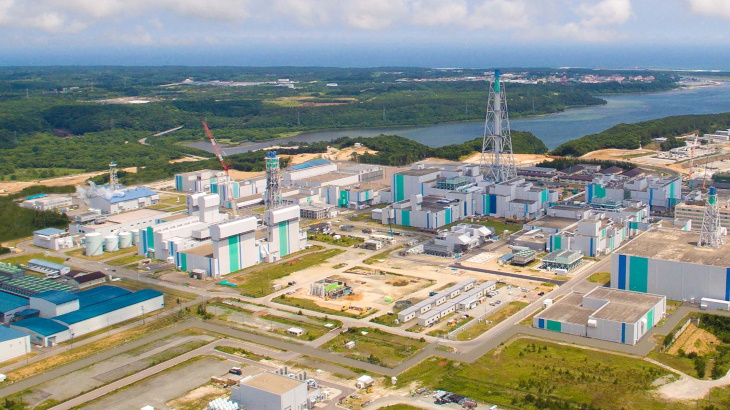
Japan’s Nuclear Regulation Authority (NRA) today approved a draft report concluding Japan Nuclear Fuel Limited’s (JNFL’s) reprocessing plant at Rokkasho in Aomori Prefecture meets new safety standards. The approval brings the plant, construction of which began in 1993, closer to starting up.
Following the March 2011 accident at the Fukushima Daiichi nuclear power plant, new safety standards for nuclear fuel cycle facilities came into force in December 2013. The requirements vary from facility to facility, but generally include reinforcement measures against natural threats such as earthquakes and tsunamis, and in some cases tornadoes, volcanoes and forest fires. Reprocessing plants need to demonstrate these as well as countermeasures specifically for terrorist attacks, hydrogen explosions, fires resulting from solvent leaks and vaporisation of liquid waste.
The NRA today approved a draft report saying that the Rokkasho reprocessing plant meets these new safety standards. It set a one-month period to solicit feedback from industry minister Hiroshi Kajiyama and other parties concerned.
“We believe the facility’s design ensures high safety margins against possible accidents,” NRA Chairman Toyoshi Fuketa was quoted as saying by Jiji Press. “The [seismic] faults near the facility were sufficiently examined and the screening was conducted adequately.”
At the Rokkasho plant, additional equipment and systems are being installed for the recovery of radioactivity in the event of a severe accident. An evaluation is also being carried out of the impact on control devices and equipment in the event of a leak of high-pressure and high-temperature steam, and the development and installation of relevant countermeasures, if deemed necessary. A new emergency control room is also being constructed at the plant. Additional safety-related countermeasures are also being put in place, such as internal flood protection, strengthening of the seismic resistance of pipework, improving cooling water tower resistance against tornadoes and improving measures against internal fires.
In a statement, JNFL said: “The acceptance of the draft examination is a big step forward for us today, and we will continue to make every effort to pass the examination.”
Construction of the Rokkasho reprocessing plant began in 1993 and was originally expected to be completed by 1997. However, its construction and commissioning have faced several delays. Problems in the locally-designed vitrification plant – where dried out and powdered high-level radioactive waste is mixed with molten glass for permanent storage – have contributed to these delays. JNFL designed the vitrification unit to go with the reprocessing section supplied by Areva. The Rokkasho reprocessing facility is based on the same technology as Orano’s La Hague plant in France. Once operational, the maximum reprocessing capacity of the Rokkasho plant should be 800 tonnes per year, according to JNFL.
JNFL aims to complete the necessary safety countermeasures in the first half of fiscal 2021 (ending March 2022).
https://world-nuclear-news.org/Articles/Regulator-approves-safety-of-Japanese-reprocessing
Chinese City Backs Down on Proposed Nuclear Fuel Plant After Protests
BEIJING — Bowing to days of passionate street protests, a city government in eastern China said Wednesday that it had halted any plans to build a nuclear fuel plant there. The reversal was the latest indication of how public distrust could hold back China’s ambitious plans for expanding its nuclear power industry.
The government of Lianyungang, a city near the coast of Jiangsu Province, announced the retreat in a terse message online. “The people’s government of Lianyungang has decided to suspend preliminary work for selecting a site for the nuclear cycle project,” it read, referring to a proposed plant for reprocessing used fuel from nuclear plants.
No reason was given, but it appeared clear enough. In recent days, residents have taken to the streets to oppose any decision to build the plant nearby. The main urban area of Lianyungang is just 20 miles southwest of a large and growing nuclear power plant on the coast, but the idea of a nuclear fuel reprocessing facility also being built in the area seemed to push public unease to a new height.
A 21-year-old Lianyungang resident with the surname Tang said Wednesday that demonstrators had been chanting “Oppose nuclear waste, defend our home.” Like other people contacted there, she did not want her full name used, citing fear of reprisal for talking to reporters.
“Nobody wants this kind of thing built in their own home,” Ms. Tang said.
China’s authoritarian leaders are wary of local protests escalating into broader challenges to their power. But local governments have often given ground in the face of growing public opposition to chemical plants, waste incinerators and other potential sources of pollution. Now proposed nuclear projects are also becoming increasingly troublesome.
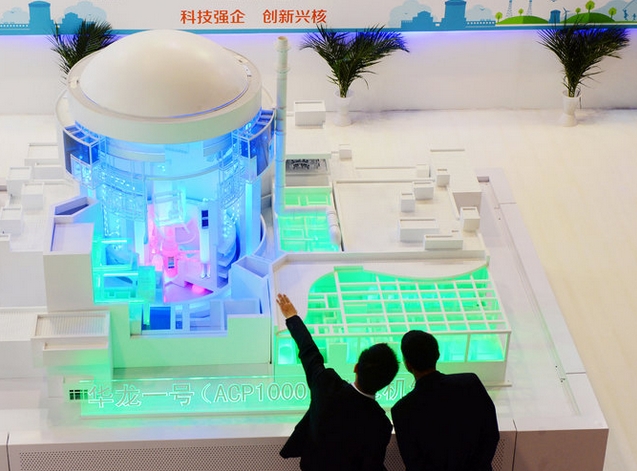
A model of a nuclear reactor on display at the stand for the China National Nuclear Corporation at an expo in Beijing last year. Across the country, the nuclear disaster in Fukushima, Japan, in 2011 has hardened public wariness of nuclear power.
“While the Chinese government does not hesitate to arrest the few political dissidents, it spends more time and energy to appease public demands,” Wenfang Tang, a professor of political science at the University of Iowa, who studies public opinion and politics in China, said in emailed comments.
“The high level of government sensitivity and responsiveness to public opinion further encourages political activism in Chinese society,” Professor Tang said. “The louder you are, the more quickly the government will respond.”
In Lianyungang and across China, the nuclear calamity in Fukushima, Japan, in 2011 has hardened public wariness of nuclear power, although the government argues that expanding the industry is essential for weaning the economy off coal, with all of its dangerous pollutants.
The biggest protest in Lianyungang took place on Saturday, when many thousands of people, including families with children, marched through the downtown area.
Despite warnings from the government, protests continued on a smaller scale this week, as residents defied ranks of riot officers with shields, according to news reports and video that people shared through social media.
“I told my daughter that she must go to this protest,” one resident said, according to Sixth Tone, an English-language news website based in Shanghai. “With every extra person, the momentum will get bigger.”
The announcement does not mean the nuclear fuel-reprocessing proposal is dead. The project is a collaboration between the China National Nuclear Corporation and a French company, Areva, and it has high-level government support, although no final agreement to build it has been signed. Five other Chinese provinces are under consideration for the initiative, and Lianyungang could lift its suspension. The two companies have said that they want to start building in 2020 and finish by 2030.
But in China, suspensions of contentious projects have a way of quietly turning into permanent cancellations, and Lianyungang appears likely to follow that pattern. The big question now will be whether public opposition coalesces in the five other areas under consideration.
All but one — Gansu Province in the northwest — is a heavily populated coastal province. Gansu is already home to China’s first civilian nuclear reprocessing plant, a small facility that has been held back by technical problems.
In 2013, officials jettisoned plans for a nuclear fuel fabrication plant in the southern province of Guangdong after protests. Preliminary proposals to build nuclear power plants inland have also ignited intense opposition.
The Chinese government has said that as it expands its fleet of nuclear power plants, it needs a plant for reprocessing spent fuel, a practice that separates unused plutonium and some uranium from waste. That unused material could be used to generate power, but critics have warned that the plutonium could be deployed for weapons. Japan has also built a full-scale reprocessing plant, but it has not started up yet.
On Chinese social media, and even on news websites, commentators said that the contention in Lianyungang showed that the public should have a bigger say in nuclear energy planning.
“In just a few days, the official stand of Lianyungang has undergone a sea change,” read a comment on Sohu.com, a Chinese news website. “Don’t underestimate just how determined the public is in opposition to nuclear waste, which is far more dangerous than wastewater from any paper pulp mill.”
http://www.nytimes.com/2016/08/11/world/asia/china-nuclear-fuel-lianyungang.html
Nuclear plant scheme halted in eastern China after thousands take part in street protests
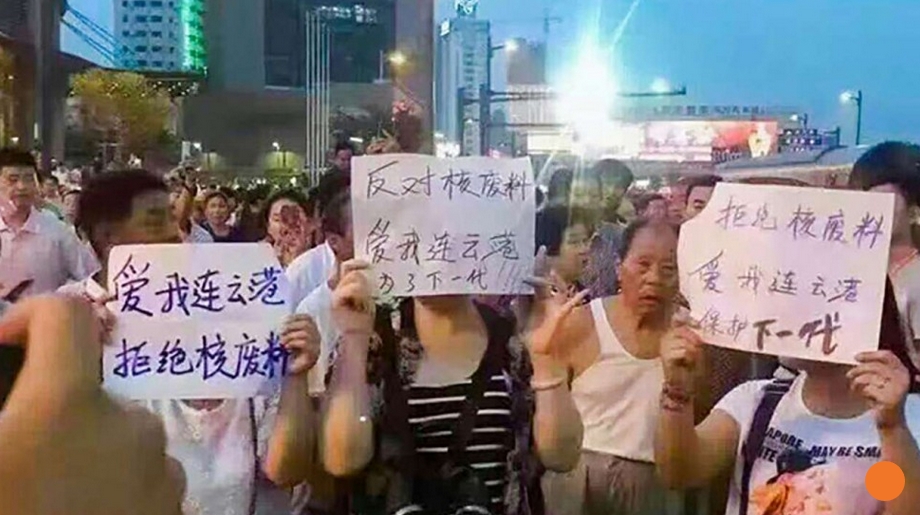
The government in Lianyungang in Jiangsu province issues brief statement saying work on nuclear fuel reprocessing plant project suspended
The authorities in Lianyungang, Jiangsu province, have suspended plans to build a nuclear fuel reprocessing plant after several days of street protests against the project.
Observers said the decision could put other nuclear projects under greater public scrutiny, and urged backers of similar schemes to improve transparency.
The Lianyungang city government announced the halt in a one-sentence statement issued early Wednesday morning.
“The government has decided to suspend preliminary work on site selection for the nuclear recycling project,” the statement said.
It came after thousands of protesters launched a series of street demonstrations from Saturday, protesting about the potential radiation risks and the alleged lack of transparency in the decision-making process for the project.
Residents used social media platforms to question the process but the comments were soon deleted by censors. “What if there is any radiation leakage? Why does the government want to make a decision on such a big issue on its own, a decision that will affect future generations?” they asked.
China National Nuclear Corporation planned to use technology supplied by French firm Areva to develop the spent nuclear fuel reprocessing plant.
The companies previously said construction would start in 2020 and be completed by 2030, but had not settled on a site.
The process has been shrouded in secrecy, with Lianyungang residents discovering that their city could be the site for the plant after the State Administration of Science, Technology and Industry for National Defence announced in a press release that a deputy head visited the city on July 26 and claimed “much progress has been made on site selection”.
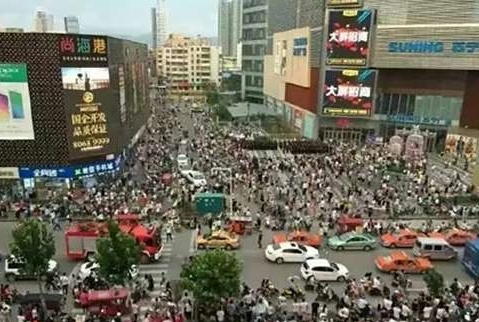
The Lianyungang city government issued a statement on Sunday to try to calm the public, saying the plans were still at an early stage and no location had been confirmed.
Sporadic protests continued on Monday and Tuesday, with video footage posted online showing police mobilised to protect the city government’s office building from protesters.
Xiamen University energy policy specialist Lin Boqiang said the plan was shelved as a result of a lack of transparency and communication by the government and state-owned nuclear companies.
Residents come out in force to protest against Sino-French nuclear project
“Public concerns can be contagious and spill over to other cities, as has been the case with various incinerator and PX [chemical] projects,” he said.
Many local governments have been forced to scrap plans for such projects after public protests over health and safety concerns.
A series of deadly blasts at industrial sites over the years has only worsened public fears and deepened distrust of government.
“China’s PX industry suffered a severe setback. If the developers of nuclear projects do not learn a lesson, they could be faced with similar problems in future,” Lin said.
China is the world’s most active builder of nuclear power plants. It has 32 reactors in operation, 22 under construction and more planned.
The government has also spent heavily to build up its ability to produce nuclear fuel and process the waste.
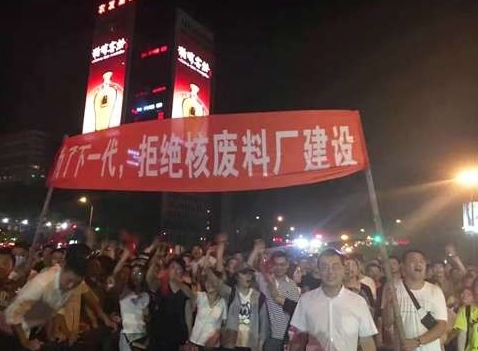
Thousands in Eastern Chinese City Protest Nuclear Waste Project
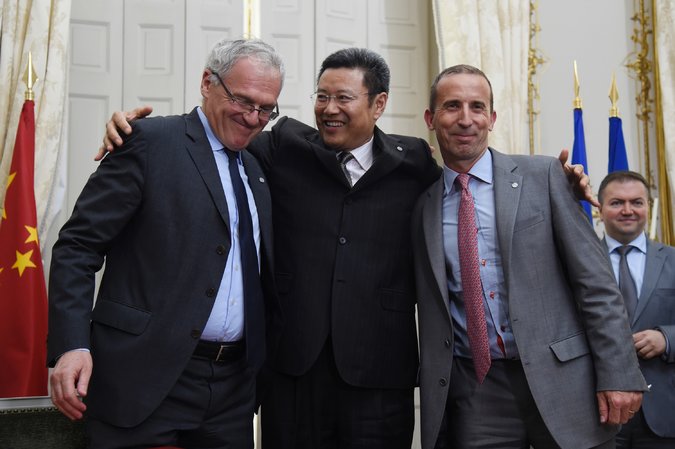
Jean-Bernard Lévy, left, chief executive of the French power company EDF, with Qian Zhimin, center, president of the China National Nuclear Corporation, and Philippe Knoche, chief executive of Areva, in Paris last year.
BEIJING — China’s efforts to expand its nuclear power sector suffered a backlash in one eastern seaboard city over the weekend, as thousands of residents took to the streets to oppose any decision to build a reprocessing plant in the area for spent nuclear fuel.
The government of Lianyungang, a city in Jiangsu Province, tried to calm residents on Sunday, a day after thousands of people defied police warnings and gathered near the city center, chanting slogans, according to Chinese news reports and photographs of the protests shared online.
They chanted “no nuclear fuel recycling project,” the state-run Global Times reported, citing footage from the scene. “It is unsafe to see another nuclear project coming and besieging us,” one resident told the paper.
Residents used WeChat, a popular Chinese messaging service, to share video footage showing downtown Lianyungang at night crowded with hundreds of people, many of them middle-aged, walking down a broad street in waves and chanting loudly, “Oppose nuclear waste, defend our home.”
The city government responded with the mix of reassurances and warnings that Chinese officials often use in the face of protests over pollution and environmental concerns. “Currently, the project is still at the stage of preliminary assessment and comparing potential sites, and nothing has been finally decided,” the city government said in a statement issued on Sunday.
But officials did not rule out that the site chosen might be somewhere near Lianyungang, and they warned against any more protests. “The relevant departments will use the law to strike hard against a tiny number of lawbreakers who concoct and spread rumors and disturb the social order,” the city government said.
On Monday, there were no signs of renewed demonstrations in the city. But the residents had made their point: Another possible building block of China’s nuclear power expansion had come under passionate public attack, defying the police warnings and government attempts to defuse alarm.
The Chinese government has said that it will accelerate building nuclear power and processing plants to wean the economy more quickly off coal. In March, the national legislature endorsed a five-year plan that promises to push forward with more nuclear power plants and a reprocessing plant for used fuel from China’s growing number of reactors. Japan also has plans to open a reprocessing plant.
But in Lianyungang and elsewhere, fears over the safety of nuclear power — magnified by the Fukushima calamity in Japan in 2011 — could frustrate those plans.
Lianyungang is just 20 miles southwest of a coastal nuclear power plant at Tianwan, which has two units operating, two under construction and approval to build two more. But the idea that used nuclear fuel might be reprocessed in the area seemed to renew anxieties about radiation risks.
A 2010 survey of 1,616 residents in the area already showed widespread apprehension about the Tianwan plant: 83.5 percent of respondents said they “worried about improper handling of nuclear waste.”
Complaints over industrial pollution, waste incinerators, toxic soil and other environmental issues have become one of the biggest causes of mass protest in China. And nuclear facilities have also become a source of worry for many.
In July 2013, officials in southern China shelved plans for a nuclear fuel fabrication plant after hundreds of nearby residents protested. Proposals for new nuclear power stations have also been met by online denunciations and petitions.
The demonstrations in Lianyungang broke out on Saturday after rumors spread that the area had been chosen as the site for a nuclear fuel processing and recycling plant to be built by the China National Nuclear Corporation, in cooperation with a French company, Areva. The companies have said construction will start in 2020 and be finished by 2030.
The companies have not reported settling on a site, nor have they revealed many other details about the proposed plant. But when China’s premier, Li Keqiang, visited France in June of last year, the companies agreed “to finalize the negotiations in the shortest possible time frame.”
Last month, a unit of the China National Nuclear Corporation said on its website that managers had visited Lianyungang to “study the proposed site.” That news appeared to sow alarm among some residents, who, in addition to the street protests, have taken to social media and online forums to voice opposition to the idea.
On Sina.com Weibo, a popular Chinese site that works like Twitter, messages have sprung up using a picture of a face in a heavy protective mask holding up a nuclear radiation sign with a red X across it. “The people of Lianyungang don’t want radiation,” the picture says.
The China National Nuclear Corporation’s nuclear fuel reprocessing unit said on its website on Saturday that the proposed plant would help the country become a “nuclear strong power.” But it emphasized that a site had not been chosen. It said places in six provinces, including Jiangsu, were under consideration.
http://www.nytimes.com/2016/08/09/world/asia/china-nuclear-waste-protest-lianyungang.html?_r=0
1 This Month

of the week – Shut Down Drone Warfare!


Tell the Ukrainian Government to Drop Prosecution of Peace Activist Yurii Sheliazhenko

Petition to revoke the licensing of the Near Surface Nuclear Disposal Facility (NSDF) at Chalk River. https://www.ourcommons.ca/petitions/en/Petition/Details?Petition=e-7247
To see nuclear-related stories in greater depth and intensity – go to https://nuclearinformation.wordpress.com
-
Archives
- March 2026 (251)
- February 2026 (268)
- January 2026 (308)
- December 2025 (358)
- November 2025 (359)
- October 2025 (376)
- September 2025 (257)
- August 2025 (319)
- July 2025 (230)
- June 2025 (348)
- May 2025 (261)
- April 2025 (305)
-
Categories
- 1
- 1 NUCLEAR ISSUES
- business and costs
- climate change
- culture and arts
- ENERGY
- environment
- health
- history
- indigenous issues
- Legal
- marketing of nuclear
- media
- opposition to nuclear
- PERSONAL STORIES
- politics
- politics international
- Religion and ethics
- safety
- secrets,lies and civil liberties
- spinbuster
- technology
- Uranium
- wastes
- weapons and war
- Women
- 2 WORLD
- ACTION
- AFRICA
- Atrocities
- AUSTRALIA
- Christina's notes
- Christina's themes
- culture and arts
- Events
- Fuk 2022
- Fuk 2023
- Fukushima 2017
- Fukushima 2018
- fukushima 2019
- Fukushima 2020
- Fukushima 2021
- general
- global warming
- Humour (God we need it)
- Nuclear
- RARE EARTHS
- Reference
- resources – print
- Resources -audiovicual
- Weekly Newsletter
- World
- World Nuclear
- YouTube
-
RSS
Entries RSS
Comments RSS
 nuclear-news