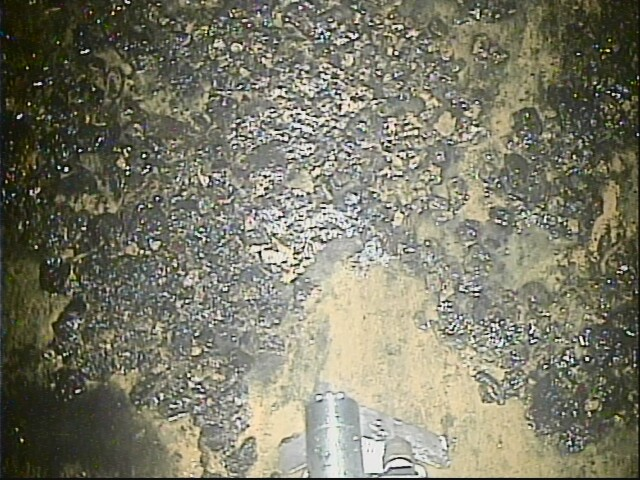
Clean-up robot pulled from Fukushima Reactor 2 due to extremely high radiation

Cleaner Robot Pulled From Fukushima Reactor Due to Immense Radiation
The camera on the bot was compromised by the high levels of radiation.
A remote-controlled cleaning robot sent into a damaged reactor at Japan’s Fukushima nuclear plant had to be removed Thursday before it completed its work because of camera problems most likely caused by high radiation levels.
It was the first time a robot has entered the chamber inside the Unit 2 reactor since a March 2011 earthquake and tsunami critically damaged the Fukushima Da-ichi nuclear plant.
Tokyo Electric Power Co. said it was trying to inspect and clean a passage before another robot does a fuller examination to assess damage to the structure and its fuel. The second robot, known as the “scorpion,” will also measure radiation and temperatures.
Thursday’s problem underscores the challenges in decommissioning the wrecked nuclear plant. Inadequate cleaning, high radiation and structural damage could limit subsequent probes, and may require more radiation-resistant cameras and other equipment, TEPCO spokesman Takahiro Kimoto said.
“We will further study (Thursday’s) outcome before deciding on the deployment of the scorpion,” he said.
TEPCO needs to know the melted fuel’s exact location and condition and other structural damage in each of the three wrecked reactors to figure out the best and safest ways to remove the fuel. It is part of the decommissioning work, which is expected to take decades.
During Thursday’s cleaning mission, the robot went only part way into a space under the core that TEPCO wants to inspect closely. It crawled down the passage while peeling debris with a scraper and using water spray to blow some debris away. The dark brown deposits grew thicker and harder to remove as the robot went further.
After about two hours, the two cameras on the robot suddenly developed a lot of noise and their images quickly darkened — a sign of a problem caused by high radiation. Operators of the robot pulled it out of the chamber before completely losing control of it.
The outcome means the second robot will encounter more obstacles and have less time than expected for examination on its mission, currently planned for later this month, though Thursday’s results may cause a delay.
Both of the robots are designed to withstand up to 1,000 Sieverts of radiation. The cleaner’s two-hour endurance roughly matches an estimated radiation of 650 Sieverts per hour based on noise analysis of the images transmitted by the robot-mounted cameras. That’s less than one-tenth of the radiation levels inside a running reactor, but still would kill a person almost instantly.
Kimoto said the noise-based radiation analysis of the Unit 2’s condition showed a spike in radioactivity along a connecting bridge used to slide control rods in and out, a sign of a nearby source of high radioactivity, while levels were much lower in areas underneath the core, the opposite of what would normally be the case. He said the results are puzzling and require further analysis.
TEPCO officials said that despite the dangerously high figures, radiation is not leaking outside of the reactor.
Images recently captured from inside the chamber showed damage and structures coated with molten material, possibly mixed with melted nuclear fuel, and part of a disc platform hanging below the core that had been melted through.

Extremely high radiation breaks down Fukushima clean-up robot at damaged nuclear reactor
A clean-up mission using a remotely operated robot at Japan’s crippled Fukushima nuclear plant has had to be aborted, as officials feared they could completely lose control of the probe affected by unexpectedly high levels of radiation.
The robot equipped with a high-pressure water pump and a camera designed to withstand up to 1,000 Sieverts of cumulative exposure had been pulled off the inactive Reactor 2 at the Fukushima Daiichi nuclear complex earlier this week, The Japan Times reported Friday, citing the plant operator, Tokyo Electric Power Company (TEPCO). The device reportedly broke down just two hour into the probe.
The failure led experts to rethink estimated levels of radiation inside the damaged reactor.
While last week TEPCO said it might stand at 530 Sieverts per hour – a dose that can almost instantly kill a human being, following the latest aborted mission a company official has said a reading of up to 600 Sieverts should be “basically correct.”
Even despite the considerable 30-percent margin of error for the revised estimate, the latest probe left no doubt that radiation levels are at record highs within the reactor. Even though it cannot be measured directly with a Geiger counter or dosimeter, the dose is calculated by its effect on the equipment.
Last month, a hole of no less than one square meter in size was discovered beneath the same reactor’s pressure vessel. The apparent opening in the metal grating is believed to have been caused by melted nuclear fuel, TEPCO then said.
The recent mission has demonstrated that the melted fuel is close to the studied area.
While extreme radiation levels have been registered within the reactor, officials insist that no leaks or increases outside have been detected.
The failure might force Japan to rethink the robot-based strategy it has adopted for locating melted fuel at Fukushima, according to The Japan Times.
The robot affected by radiation was supposed to wash off thick layers of dirt and other wreckage, clearing ways for another remotely controlled probe to enter the area, tasked with carrying out a more proper investigation to assess the state of the damaged nuclear reactor. Previously, even specially-made robots designed to probe the underwater depths beneath the power plant have crumbled and shut down affected by the radioactive substance inside the reactor.

The Fukushima Daiichi nuclear power plant suffered a blackout and subsequent failure of its cooling systems in March 2011, when it was hit by an earthquake and tsunami. Three of the plant’s six reactors were hit by meltdowns, making the Fukushima nuclear disaster the worst since the Chernobyl catastrophe in Ukraine in 1986. TEPCO is so far in the early stages of assessing the damage, with the decommissioning of the nuclear facility expected to take decades.
https://www.rt.com/news/377025-fukushima-radiation-breaks-robot/
Fukushima Is Still Melting Down…
Kevin Kamps, Beyond Nuclear. Almost 6 years after a massive meltdown – radiation levels at the crippled Fukushima Daiichi power plant in Japan are as dangerously high as ever. So is nuclear power ever worth the risk?
….A number of commentators, Arnie Gundersen at Fairwinds, Kendra Ulrich at Greenpeace International, Nancy Foust at Simply Info, have pointed out that the levels of radioactivity that are being talked about by Tokyo Electric (TEPCO), 53,000 rem per hour levels that were documented just a week ago have probably been there this whole time since March 2011 since the meltdown happened because what they are doing is they are getting closer where the melted core is at, they still don’t know where they ‘re at but what they are doing they are getting closer to that dangerous place and so sure enough it stands to reason that they would find these levels….
http://www.thomhartmann.com/bigpicture/fukushima-still-melting-down
Reactor # 2: the cleaner robot had to turn around after two hours

Guiding pipe camera (before the removal
As announced, TEPCO has inserted a cleaner robot onto the gangway in the Reactor 2 containment enclosure. It is equipped with a snowplow at the front, two cameras and a jet of pressurized water.
The robot was able to clean only one meter instead of the 5 expected. According to the Japanese document put online by TEPCO, in some places deposits were more adherent than expected, which slowed down the robot’s progress.
There are areas where the robot could not move forward. There are up to 2 cm of deposits that can be insulation and paint that have melted before sticking to the bridge. On a first attempt, the water pump did not work.
http://www.tepco.co.jp/nu/fukushima-np/handouts/2017/images1/handouts_170209_08-j.pdf
After two hours of activity, the cameras became obscured and the robot was quickly removed. TEPCO believes this is due to extremely high radiation levels.
The camera can only withstand a cumulative dose of about 1000 Sv. The analysis of the images gives an approximate dose rate of 650 Sv / h. This is even more than the recorded dose few days ago (530 Sv / h).
The company is reluctant to send the scorpion measuring robot because it could only take data for two hours.
It is not under the reactor vessel that the dose rates are the highest and TEPCO does not understand why.
TEPCo has released a new series of photos and a video. The video shows the magnitude and the difficulty of the task expected for this small robot.
http://photo.tepco.co.jp/date/2017/201702-j/170209-01j.html
TEPCO issued a press release in English, accompanied by the same photos and video and the technical note.
http://www.tepco.co.jp/en/press/corp-com/release/2017/1375551_10469.html
http://photo.tepco.co.jp/en/date/2017/201702-e/170209-01e.html
http://fukushima.eu.org/reacteur-n2-le-robot-nettoyeur-a-du-faire-demi-tour-apres-deux-heures/
Radiation level in Fukushima No. 2 reactor measured higher:650 sieverts
A pressure washer-equipped robot clears the path inside the containment vessel of Fukushima No. 1 nuclear power plant’s No. 2 reactor on Feb. 9. The black lumps are believed to be melted fuel. (Provided by Tokyo Electric Power Co.)
The road to decommissioning Fukushima No. 1 nuclear power plant’s No. 2 reactor could be rockier than expected, as radiation levels on Feb. 9 were even deadlier than those recorded in late January.
Tokyo Electric Power Co. announced that day that radiation levels inside the reactor were estimated at up to 650 sieverts per hour, much higher than the record 530 sieverts per hour marked by the previous survey.

A camera attached to the robot deployed inside Fukushima No. 1 nuclear power plant’s No. 2 reactor shows how it clears its path covered with debris and deposits using a pressure washer. (Captured from video provided by Tokyo Electric Power Co.)
A camera made its way inside the reactor’s containment vessel for the first time on Jan. 30 and spotted fuel rods that had melted into black lumps in the nuclear accident in the aftermath of the 2011 Great East Japan Earthquake and tsunami disaster.
The plant operator made the latest estimate from the amount of camera noise experienced by the robot that ventured into the lion’s den that morning.
Equipped with a pressure washer, the machine was deployed to pave the way for the Sasori (scorpion) robot that is set to survey the reactor’s interior in greater detail.
The robot’s task was to hose down melted fuel and other substances as it traveled along a rail measuring 7 meters long and 0.6 meter wide connecting the outer wall of the containment vessel with the reactor’s core. It started operating from a point located 2 meters from the exit of the tunnel bored into the side of the vessel.
But about two hours into its journey, in which it had progressed about a meter, the camera footage started getting dark, TEPCO said. The amount of radiation emitted by the melted fuel may have taken a toll on the camera’s well-being.
As the robot could be left stranded inside the vessel if the camera broke down completely, the utility called off the operation seven hours earlier than scheduled and retrieved the device.
TEPCO analyzed the footage and concluded that the doses amounted to about 650 sieverts per hour, which is deadly enough to kill a human in less than a minute.
As the robot’s camera was designed to withstand a cumulative dosage of 1,000 sieverts per hour, the utility commented that “it’s consistent with how the camera started to break down after two hours.”
The plant operator plans to deploy the Sasori surveyor robot before the end of February.
“We will be assessing the amount of deposits and debris to decide how far Sasori can advance,” a TEPCO official said.
Robot probe of Fukushima reactor halted due to radiation caused glitch
Robot probe of Fukushima reactor halted due to glitch
An operation to prepare to examine the inside of the No. 2 reactor at the disaster-struck Fukushima Daiichi nuclear plant was halted Thursday due to a technical glitch, the plant operator said.
Tokyo Electric Power Company Holdings Inc. said it sent a robot with a high-pressure water nozzle into a containment structure housing the pressure vessel, but suspended the work after video images from a camera on the robot became dark.
TEPCO said high radiation levels may have caused the camera glitch. The camera was designed to withstand cumulative radiation exposure up to 1,000 sieverts. Previously the company said up to 530 sieverts per hour of radiation was detected within the reactor containment structure in late January. The radiation reading during the robot operation Thursday was 650 sieverts, TEPCO said.
http://english.kyodonews.jp/news/2017/02/457859.html

In this image released by Tokyo Electric Power Co. (TEPCO), a remote-controlled “cleaning” robot, bottom, enters the reactor containment chamber of Unit 2 for inspection and cleaning a passage for another robot as melted materials are seen at Fukushima Dai-ichi nuclear power plant in Okuma town, Fukushima prefecture, northeastern Japan, Thursday, Feb. 9, 2017. The “cleaning” robot that entered one of three tsunami-wrecked Fukushima reactor containment chambers was withdrawn before completing its mission due to glitches most likely caused by high radiation.
Cleaner robot pulled from Fukushima reactor due to radiation
TOKYO (AP) — A remote-controlled cleaning robot sent into a damaged reactor at Japan’s Fukushima nuclear plant had to be removed Thursday before it completed its work because of camera problems most likely caused by high radiation levels.
It was the first time a robot has entered the chamber inside the Unit 2 reactor since a March 2011 earthquake and tsunami critically damaged the Fukushima Da-ichi nuclear plant.
Tokyo Electric Power Co. said it was trying to inspect and clean a passage before another robot does a fuller examination to assess damage to the structure and its fuel. The second robot, known as the “scorpion,” will also measure radiation and temperatures.
Thursday’s problem underscores the challenges in decommissioning the wrecked nuclear plant. Inadequate cleaning, high radiation and structural damage could limit subsequent probes, and may require more radiation-resistant cameras and other equipment, TEPCO spokesman Takahiro Kimoto said.
“We will further study (Thursday’s) outcome before deciding on the deployment of the scorpion,” he said.
TEPCO needs to know the melted fuel’s exact location and condition and other structural damage in each of the three wrecked reactors to figure out the best and safest ways to remove the fuel. It is part of the decommissioning work, which is expected to take decades.
During Thursday’s cleaning mission, the robot went only part way into a space under the core that TEPCO wants to inspect closely. It crawled down the passage while peeling debris with a scraper and using water spray to blow some debris away. The dark brown deposits grew thicker and harder to remove as the robot went further.
After about two hours, the two cameras on the robot suddenly developed a lot of noise and their images quickly darkened — a sign of a problem caused by high radiation. Operators of the robot pulled it out of the chamber before completely losing control of it.
The outcome means the second robot will encounter more obstacles and have less time than expected for examination on its mission, currently planned for later this month, though Thursday’s results may cause a delay.
Both of the robots are designed to withstand up to 1,000 Sieverts of radiation. The cleaner’s two-hour endurance roughly matches an estimated radiation of 650 Sieverts per hour based on noise analysis of the images transmitted by the robot-mounted cameras. That’s less than one-tenth of the radiation levels inside a running reactor, but still would kill a person almost instantly.
Kimoto said the noise-based radiation analysis of the Unit 2’s condition showed a spike in radioactivity along a connecting bridge used to slide control rods in and out, a sign of a nearby source of high radioactivity, while levels were much lower in areas underneath the core, the opposite of what would normally be the case. He said the results are puzzling and require further analysis.
TEPCO officials said that despite the dangerously high figures, radiation is not leaking outside of the reactor.
Images recently captured from inside the chamber showed damage and structures coated with molten material, possibly mixed with melted nuclear fuel, and part of a disc platform hanging below the core that had been melted through.
http://mainichi.jp/english/articles/20170210/p2g/00m/0dm/004000c
Lost in translation: Fukushima readings are not new spikes, just the same “hot mess” that’s always been there

The ongoing Fukushima nuclear catastrophe has been back in the news lately following record high readings at the reactor site. Radiation levels were a maximum of 530 sieverts per hour, the highest recorded since the triple core meltdown in March 2011.
But upon further examination, the story has been misreported, in part due to mistranslation. In fact, according to Nancy Foust of SimplyInfo.org, interviewed on Nuclear Hotseat, there was no spike. High readings were in expected locations that TEPCO was only able to access recently. Therefore, the reading became evident because workers were getting closer to the melted fuel in more dangerous parts of the facility. In other words, it’s not a new hot mess, just the same hot mess it’s always been, pretty much from the beginning. The good news is nothing has changed. The bad news is – nothing has changed.
The confusion was initially caused by a translation error that SimplyInfo.org thinks occurred between the Kyodo News and Japan Times. Since this happened, Foust and her group have been trying to get news sources to correct the stories, with limited success.
The elevated radiation levels are inside containment (good news) in ruined unit 2 and were discovered using a camera, not proper radiation monitors. Therefore, the high reading may not be reliable since it is an estimate based on interference data with the camera. TEPCO is planning on sending in a robot properly equipped with radiation detectors to take a reliable reading. Although no date has been given, TEPCO indicates it expects to deploy the robot within 30 days or so.
Foust theorizes that the bulk of spent fuel is probably right below the reactor vessel burned into the concrete below. No one knows if fuel has gone into the ground water below that.
Utility halts video robot survey in No. 2 reactor

The operator of the damaged Fukushima nuclear plant has suspended a preliminary survey using a robot inside the containment vessel of one of its reactors.
On Thursday, a remote-controlled robot was sent toward the middle of the No. 2 reactor, but the operation was later suspended after images captured by one of the robot’s 3 cameras turned out black.
The survey is part of efforts toward decommissioning the No.1 to No. 3 reactors, which suffered meltdowns.
Officials of Tokyo Electric Power Company say they will find out what went wrong before deciding how to proceed with the survey. The utility originally planned to use the same robot on Tuesday, but put it off to Thursday due to mechanical trouble.
The exact conditions inside the containment vessel must be determined before a full survey can be undertaken. The full survey will use a scorpion-shaped robot to measure radiation levels and temperatures.
A remote-controlled camera used in a survey last week captured footage of what seemed to be debris of molten fuel on the partially broken floor grate in the vessel.
Recently Found Fukushima Daiichi’s Reactor 2 High Level of Radiation Does not Mean Radiation Increase

There is some dispute about the recent high level of radiation measured inside the Fukushima Daiichi reactor 2, thanks to the Japan Times unprecise english translation of the Kyodo News Japanese language article.
They have been able to measure these highest radiation levels only now because they couldn’t get as close to where they think the melted fuel may be with monitors before. Not the highest levels ever present at the site. That would have been around the time of the accident, or soon after. The radiation levels at the site do not appear to be rising, they are just now able to get deeper inside the reactor containment before the monitors fail, and so they get better readings.

The unprecise english translation of the Kyodo News Japanese language article published by the Japan Times opened the door to possible misconstruction of the real facts by other media, western media and websites relying on that Japan Times article. http://www.japantimes.co.jp/news/2017/02/03/national/fukushima-radiation-level-highest-since-march-11/#.WJY4ffLraM_
The Japan Times article’s title is ok: “Highest radiation reading since 3/11 detected at Fukushima No. 1 reactor”. Yes, it is the highest radiation reading found since 3/11 because since 3/11 Tepco had not been able to reach such deep place to measure the radiation there. So this recent reading is the highest found since 3/11.
The Japan Times article in itself does not mention directly any radiation increase or “spike. But their wording “has reached” in “The radiation level in the containment vessel of reactor 2 at the crippled Fukushima No. 1 power plant has reached a maximum of 530 sieverts per hour, the highest since the triple core meltdown in March 2011, Tokyo Electric Power Co. Holdings Inc. said” could be misconstrued as meaning that the high level recently found is resulting from an increase of radiation, when compared to the lower level previously found . Which is not the case. Their previous reading was lower because they had not been able to go that deep before to monitor radiation there.
The Japan Times article then misled some western media, such as the Guardian, Popular Mechanic and others to themselves publish misconstrued articles based on the Japan Times article as their source.
The Popular Mechanics article’s title was ok: “Highest Radiation Levels Since Meltdown Recorded at Fukushima” but their subtitle is entirely wrong and misleading: “Levels haven’t been this high since the actual meltdown in 2011.” That subtitle is wrong, the levels were maybe that high or even higher, but Tepco had not been able to reach there before to find out, to take such measure in that place, at that deep level. That subtitle is wrong, suggesting that there is an increase. Popular Mechanics misconstrued the article of Japan Times and drawed the wrong conclusion. http://www.popularmechanics.com/technology/infrastructure/a25034/radiation-spikes-fukushima-possible-breach/
The Guardian ‘s article title is in itself misleading: ” Fukushima nuclear reactor radiation at highest level since 2011 meltdown”. A title such as “Fukushima nuclear reactor radiation highest level to date found since 2011 meltdown” would have been better and more accurate. The added words “to date found” would clarify that it was maybe already there before but that it had not been found yet, because they had not been able to reach that place and that deep before to take such measure. In its text it fails to mention the real reason why the measure recently found is higher than the previous measure. This all results in the Guardian article saying that this highest recent measure compared to the lower previous one is due to an increase of radiation. This is absolutely wrong, a complete misconstruction of the real facts. https://www.theguardian.com/environment/2017/feb/03/fukushima-daiichi-radiation-levels-highest-since-2011-meltdown?CMP=share_btn_fb
And many other western media and websites went along and repeated the same blind misconstruction.
Thanks heavens there were two websites who noticed the error made by those mainstream media and many other websites. They stepped in trying to correct that misconstruction and to re-establish the true facts. The Simply Info Fukuleaks website and the Safecast website, thanks to both websites’ bloggers team for their vigilance and their efforts in keeping the facts straight.
No, Fukushima Daiichi Did Not See A Radiation Spike http://www.fukuleaks.org/web/?p=16094
No, radiation levels at Fukushima Daiichi are not rising http://blog.safecast.org/2017/02/no-radiation-levels-at-fukushima-daiichi-are-not-rising/
We can’t say that there has been an increase in radiation because we do not know that. To know that we would need to have a previous measure at the same deep at the same place to compare both measures. But such previous measure that deep at that place we do not have, so it is impossible to draw any conclusion at this stage, only that it is very high.
Now what we really need is a second probe at the same deep at the same place, to confirm the first probe readings, but also to compare the recent readings and the next readings so as to assess if the radiation levels there are stable or not, if there will be an increase of radiation between the two probes or not…Until such second probing takes place, at this stage no one can say anything about any occuring increase…

For more information: TEPCO Reports:
Pre-investigation results of the area inside the pedestal for the Unit 2 Primary Containment Vessel Investigation at Fukushima Daiichi Nuclear Power Station(examination results of digital images)
Images Inside Fukushima Daiichi Unit 2 Need Further Examination Including The Possibility Of Fuel Debris
TEPCO Photos:
http://photo.tepco.co.jp/en/index-e.html
http://photo.tepco.co.jp/en/date/2017/201702-e/170202-01e.html
http://photo.tepco.co.jp/en/date/2017/201701-e/170130-01e.html
Video here: NHK Video (in Japanese)
Fukushima radiation levels at highest level since 2011
Fukushima radiation levels at highest level since 2011 meltdown
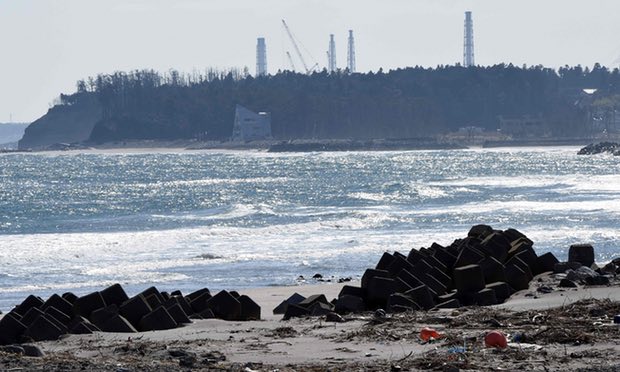
Cranes over the Fukushima Daiichi plant in February 2016. The decommissioning process is expected to take about four decades
Extraordinary readings pile pressure on operator Tepco in its efforts to decommission nuclear power station
Radiation levels inside a damaged reactor at the Fukushima Daiichi nuclear power station are at their highest since the plant suffered a triple meltdown almost six years ago.
The facility’s operator, Tokyo Electric Power (Tepco), said atmospheric readings as high as 530 sieverts an hour had been recorded inside the containment vessel of reactor No 2, one of three reactors that experienced a meltdown when the plant was crippled by a huge tsunami that struck the north-east coast of Japan in March 2011.
The extraordinary radiation readings highlight the scale of the task confronting thousands of workers, as pressure builds on Tepco to begin decommissioning the plant – a process that is expected to take about four decades.
The recent reading, described by some experts as “unimaginable”, is far higher than the previous record of 73 sieverts an hour in that part of the reactor.
A single dose of one sievert is enough to cause radiation sickness and nausea; 5 sieverts would kill half those exposed to it within a month, and a single dose of 10 sieverts would prove fatal within weeks.
Tepco also said image analysis had revealed a hole in metal grating beneath the same reactor’s pressure vessel. The one-metre-wide hole was probably created by nuclear fuel that melted and then penetrated the vessel after the tsunami knocked out Fukushima Daiichi’s back-up cooling system.
“It may have been caused by nuclear fuel that would have melted and made a hole in the vessel, but it is only a hypothesis at this stage,” Tepco’s spokesman Tatsuhiro Yamagishi told AFP.
“We believe the captured images offer very useful information, but we still need to investigate given that it is very difficult to assume the actual condition inside.”
The presence of dangerously high radiation will complicate efforts to safely dismantle the plant.
A remote-controlled robot that Tepco intends to send into the No 2 reactor’s containment vessel is designed to withstand exposure to a total of 1,000 sieverts, meaning it would survive for less than two hours before malfunctioning.
The firm said radiation was not leaking outside the reactor, adding that the robot would still prove useful since it would move from one spot to the other and encounter radiation of varying levels.
Tepco and its network of partner companies at Fukushima Daiichi have yet to identify the location and condition of melted fuel in the three most seriously damaged reactors. Removing it safely represents a challenge unprecedented in the history of nuclear power.
Quantities of melted fuel are believed to have accumulated at the bottom of the damaged reactors’ containment vessels, but dangerously high radiation has prevented engineers from accurately gauging the state of the fuel deposits.
Earlier this week, the utility released images of dark lumps found beneath reactor No 2 that it believes could be melted uranium fuel rods – the first such discovery since the disaster.
In December, the government said the estimated cost of decommissioning the plant and decontaminating the surrounding area, as well as paying compensation and storing radioactive waste, had risen to 21.5tn yen (£150bn), nearly double an estimate released in 2013.
Radiation level in Fukushima reactor could kill within a minute
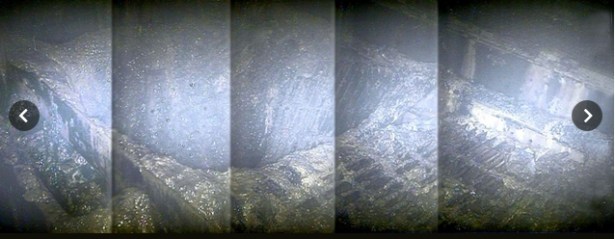
Images show black lumps on grating for maintenance work below the No. 2 reactor’s pressure vessel at the Fukushima No. 1 nuclear power plant. TEPCO says melted fuel likely caused at least two holes in the metal grating, including an opening measuring 1 meter by 1 meter. (Provided by Tokyo Electric Power Co.)
Radiation levels that can kill a person in a minute and holes created by melted nuclear fuel could further delay decommissioning operations at the No. 2 reactor of the Fukushima No. 1 nuclear plant.
Tokyo Electric Power Co., operator of the crippled plant, said Feb. 2 that the maximum estimated radiation level near what is believed to be melted fuel in the reactor was 530 sieverts per hour, the highest so far since the triple meltdown in 2011.
In its investigation into the interior of the No. 2 reactor, TEPCO also confirmed at least two holes on grating for maintenance work below the bottom of the reactor’s pressure vessel.

The images show the area at the bottom of the No. 2 reactor’s pressure vessel to the metal grating below.
“The holes were likely made when the melted nuclear fuel fell from the pressure vessel and melted the grating,” a TEPCO official said.
The findings were made by studying images taken from a video camera attached to a pipe that was inserted into the reactor on Jan. 30.
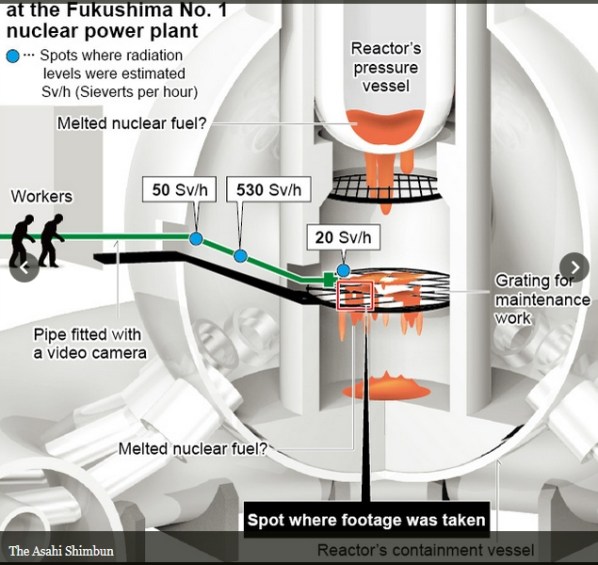
Radiation levels were estimated at 20 sieverts per hour, 50 sieverts per hour and 530 sieverts per hour at three spots inside the reactor’s containment vessel.
The company estimated the doses from the extent of disturbances in the images caused by radiation.
Although a TEPCO official said “there is a margin of error because radiation levels were not measured directly,” the company believes the scattered melted nuclear fuel inside the containment vessel was emitting high levels of radiation.
After a number of failed attempts, the remote-controlled camera took the first pictures of possible melted fuel at the plant.
However, closer inspection of the images have revealed additional problems for TEPCO, which had believed most of the melted fuel had remained inside the reactor’s pressure vessel.
TEPCO plans to send an investigative robot, called Sasori (scorpion), into the containment vessel this month to more accurately measure radiation doses at various spots and take additional footage of the scattered nuclear fuel.
The utility plans to use the data to determine a fuel-removal method.
But the robot was expected to use the circular grating, measuring 5 meters in diameter, to move around. One of the holes is 1 meter by 1 meter, a potential pitfall for the robot, which is 59 centimeters long and 9 cm high.
TEPCO said it will consider a different route for the robot in its survey.
Fumiya Tanabe, an expert on nuclear safety who analyzed the 1979 Three Mile Island nuclear accident in the United States, said the findings show that both the preparation for and the actual decommissioning process at the plant will likely prove much more difficult than expected.
“We have few clues on the exact locations, the sizes and the shapes of the nuclear fuel debris,” he said. “The planned investigation by the robot needs a rethink. Work to decommission the plant will require even more time.”
TEPCO said it will need 30 to 40 years to complete the decommissioning process. The utility plans to start work to remove the melted nuclear fuel at the No. 2 and two other stricken reactors in 2021 after deciding on a removal method in fiscal 2018.
TEPCO has yet to determine the location and the condition of the melted fuel in the other two reactors.
TEPCO to probe Fukushima reactor again to confirm nuclear debris

An executive of the operator of the crippled Fukushima Daiichi nuclear complex said Friday the company plans to probe inside the plant’s No. 2 reactor by the end of February to confirm whether the black mass spotted in a recent survey was nuclear debris.
Naohiro Masuda, the chief decommissioning officer at Tokyo Electric Power Company Holdings Inc. told Kyodo News it is “possible” to conduct the probe using a robot, the day after the operator announced it had detected extraordinarily high radiation levels inside the reactor.
The operator will be able to tell whether the deposits are nuclear debris from the March 2011 meltdown if new images and data such as the radiation levels and temperatures are obtained in the upcoming robot survey, he said.
Radiation in Fukushima reactor containment vessel at deadly level: TEPCO
Radiation inside the containment vessel of the No. 2 reactor at the Fukushima No. 1 nuclear plant measures as high as a deadly 530 sieverts per hour, the highest since the 2011 disaster, plant operator Tokyo Electric Power Co. (TEPCO) announced on Feb. 2.
TEPCO calculated the radiation dose from video noise on footage it took inside the containment vessel in late January, when a camera was inserted to examine conditions inside and scout a route for a scorpion-like observation robot scheduled to go into the vessel later this month.
Deployment of the robot is also being reconsidered after two gaping holes were found along the robot’s planned path over a 5-meter-wide circular walkway inside the containment vessel, close to where the 530-sievert radiation dose was detected.

A scorpion-like observation robot scheduled to go into the containment vessel of the No. 2 reactor at the Fukushima No. 1 nuclear plant.
The holes in the metal grate walkway — one of unknown size and the other measuring about 1 meter square — make both routes considered for the robot impassable.
“We will consider re-evaluating what observations we can take with the robot,” Yuichi Okamura, an acting general manager with TEPCO’s on-site nuclear power division, told reporters at a Feb. 2 news conference.
Piles of a black and dark brown substance several centimeters thick and thought to be melted nuclear fuel were also observed on the walkway, creating a further possible obstruction to the robot. Meanwhile, examination of the 1-meter-square hole suggests the walkway was struck with tremendous force, hinting that there may be a large amount of melted fuel below.
“It is possible that the nuclear fuel rods melted onto the control rods and then dripped down,” Tokyo Institute of Technology professor of nuclear engineering Yoshinao Kobayashi told the Mainichi Shimbun. “It’s highly likely that part of the bottom of the pressure vessel broke and the melted fuel flowed down (onto the walkway), and then the grating warped and gave way due to the fuel’s heat.”
http://mainichi.jp/english/articles/20170203/p2a/00m/0na/005000c
Record high fatal radiation levels, hole in reactor 2 detected

Deadly radiation estimated inside reactor vessel
The operator of the crippled Fukushima Daiichi nuclear plant says its latest estimation of the radiation level inside one of the reactors was extremely high and had the potential to be lethal to a human within a short period of time.
Tokyo Electric Power Company conducted an inspection inside the containment vessel of the plant’s No.2 reactor last month using a remote-controlled camera, as part of a survey to scrap the reactor.
An analysis of the images found that the radiation was up to 530 sieverts per hour at a concrete cylinder supporting the reactor.
The level is enough to be lethal to a human within a short period of time, despite a possible error margin of up to 30 percent.
A survey conducted 1 year after the nuclear accident at a different part inside the same containment vessel logged 73 sieverts per hour.
In the latest estimation inside the vessel, the area near its opening logged 50 sieverts per hour at maximum.
The operator officials say that there are no leaks of gas with radioactive substances from the containment vessel.
Officials suspect that fuel debris; a mixture of nuclear fuel and melted parts of the reactor’s facility, may be emitting strong radiation inside the vessel.
Some molten fuel penetrated the reactor’s bottom and has reached the containment vessel as fuel debris.
The company plans conduct further inspections with a robot. There is a risk that some parts of the grating where the robot will be moving may be damaged by the high heat of the molten fuel.
https://www3.nhk.or.jp/nhkworld/en/news/20170202_31/
Record high fatal radiation levels, hole in reactor detected at crippled Fukushima nuclear facility
Record high radiation levels that’s lethal even after brief exposure have been detected at a damaged reactor at the Fukushima power plant in Japan. Specialists also found a hole, likely caused by melted nuclear fuel.
Radiation levels of up to 530 Sieverts per hour were detected inside an inactive Reactor 2 at the Fukushima Daiichi nuclear complex damaged during the 2011 earthquake and tsunami catastrophe, Japanese media reported on Thursday citing the plant operator, Tokyo Electric Power Company (TEPCO).
A dose of about 8 Sieverts is considered incurable and fatal.
A hole of no less than one square meter in size has also been discovered beneath the reactor’s pressure vessel, TEPCO said. According to researchers, the apparent opening in the metal grating of one of three reactors that had melted down in 2011, is believed to be have been caused by melted nuclear fuel that fell through the vessel.
The iron scaffolding has a melting point of 1500 degrees, TEPCO said, explaining that there is a possibility the fuel debris has fallen onto it and burnt the hole. Such fuel debris have been discovered on equipment at the bottom of the pressure vessel just above the hole, it added.
The latest findings were released after a recent camera probe inside the reactor, TEPCO said. Using a remote-controlled camera fitted on a long pipe, scientists managed to get images of hard-to-reach places where residual nuclear material remained. The substance there is so toxic that even specially-made robots designed to probe the underwater depths beneath the power plant have previously crumbled and shut down.
However, TEPCO still plans to launch further more detailed assessments at the damaged nuclear facility with the help of self-propelled robots.
Earlier this week, hopes for a more efficient cleanup at Fukushima were high, as the plant operator announced a portion of nuclear fuel debris responsible for a lot of the lingering contamination from six years ago may have finally been found.
https://www.rt.com/news/376107-fukushima-record-radiation-level/
Radiation level at Fukushima reactor highest since 2011 disaster; grating hole found

TOKYO (Kyodo) — The radiation level inside the containment vessel of the No. 2 reactor at the crippled Fukushima Daiichi nuclear complex stood at 530 sieverts per hour at a maximum, the highest since the 2011 disaster, the plant operator said Thursday.
Tokyo Electric Power Company Holdings Inc. also announced that based on image analysis, a hole measuring 2 meters in diameter has been found on a metal grating beneath the pressure vessel inside the containment vessel and a portion of the grating was distorted.

According to TEPCO, the extremely high radiation level was found near the entrance area in the space just below the pressure vessel. The previously highest radiation level monitored in the interior of the reactor was 73 sieverts per hour.
The hole could have been caused by nuclear fuel that penetrated the reactor vessel as it overheated and melted due to the loss of reactor cooling functions in the days after a powerful earthquake and tsunami on March 11, 2011 hit northeastern Japan.
According to the image analysis, about 1 square meter of the grating was missing.
The plant operator plans to deploy a robot at the bottom of the reactor containment vessel, which houses the reactor pressure vessel, to check the conditions there.
The analysis follows TEPCO’s discovery Monday of a black mass deposited on the grating directly beneath the pressure vessel, possibly melted fuel after the unit suffered a meltdown along with two other Fukushima Daiichi reactors.
Images captured using a camera attached to a telescopic arm on Monday also showed part of the grating has gone. A further analysis of the images found a 2-meter hole in an area beyond the missing section on the structure.
If the deposits are confirmed as fuel debris, it would be the first time the utility has found any at the three units that suffered meltdowns.
Following one of the world’s worst nuclear disasters since the 1986 Chernobyl catastrophe, the No. 1 to 3 reactors suffered fuel meltdowns.
Portions of the fuel in the reactors are believed to have melted through the pressure vessels and accumulated at the bottom of the containment vessels.
The actual condition of the melted fuel has remained unknown due to high radiation levels.
http://mainichi.jp/english/articles/20170202/p2g/00m/0dm/087000c
http://mainichi.jp/articles/20170203/k00/00m/040/079000c

Images indicate bigger challenge for TEPCO at Fukushima plant
A video taken on Jan. 30 shows the bottom of the No. 2 reactor’s pressure vessel at the Fukushima No. 1 nuclear power plant. Water used to cool the nuclear fuel is dripping, and possible melted fuel is seen strewn on grating for maintenance work. (Provided by Tokyo Electric Power Co.)
If confirmed, the first images of melted nuclear fuel at the Fukushima No. 1 nuclear plant show that Tokyo Electric Power Co. will have a much more difficult time decommissioning the battered facility.
The condition of what is believed to be melted fuel inside the No. 2 reactor at the plant appears far worse than previously thought.
Before the pictures were taken by a remote-controlled video camera on Jan. 30, TEPCO presumed that most of the nuclear fuel at the No. 2 reactor had remained within the reactor’s pressure vessel. That presumption was based on findings of a study conducted last year involving cosmic rays.
As a result, TEPCO did not expect the camera to detect possible nuclear fuel debris below the pressure vessel.

But the images showed black lumps scattered on a wire-mesh grating in the lower part of the containment vessel, which encloses the pressure vessel. This indicates that the fuel melted through bottom of the pressure vessel, spilled through the grating and fell on the floor of the containment vessel.

This image of the area below the No. 2 reactor’s pressure vessel at the Fukushima No. 1 nuclear power plant was taken on Jan. 30. Experts believe nuclear fuel melted the paint and components of equipment nearby and has hardened. (Provided by Tokyo Electric Power Co.)
The grating, which was used by maintenance workers before the disaster, was partially bent.
The images could show only part of the melted fuel in the No. 2 reactor. And there is still no indication on how widespread the black lumps were strewn, their volume and state.
TEPCO and government authorities in fiscal 2018 plan to decide on a method to retrieve the melted fuel from each of the three crippled reactors and start the removal work in 2021.
But a number questions remain unanswered, such as how to reduce workers’ radiation exposure, where the removed fuel will be kept, and when it will be disposed of.
The pictures raise another question: How will workers cut out the wire-mesh grating embedded with lumps of melted fuel?
The images were the first of possible nuclear fuel debris at the nuclear plant since the Great East Japan Earthquake and tsunami caused the triple meltdown there in March 2011.

Sasori (Scorpion), an investigative robot, is expected to be sent in the containment vessel of the No. 2 reactor of the Fukushima No. 1 nuclear power plant in February.
High radiation levels have prevented workers from entering the No. 2 reactor, as well as the No. 1 and No. 3 reactors at the plant.
A number of problems have hampered investigations by robots into the location of melted fuel at the No. 1 and No. 3 reactors.
http://www.asahi.com/ajw/articles/AJ201701310073.html
Possible nuclear fuel find raises hopes of Fukushima plant breakthrough

Material found below the damaged No 2 reactor at Fukushima nuclear plant, believed to be melted fuel, from footage taken on 30 January.
Operator says it has seen what may be fuel debris beneath badly damaged No 2 reactor, destroyed six years ago in triple meltdown
Hopes have been raised for a breakthrough in the decommissioning of the wrecked Fukushima Daiichi nuclear plant after its operator said it may have discovered melted fuel beneath a reactor, almost six years after the plant suffered a triple meltdown.
Tokyo Electric Power (Tepco) said on Monday that a remote camera appeared to have found the debris beneath the badly damaged No 2 reactor, where radiation levels remain dangerously high. Locating the fuel is the first step towards removing it.
The operator said more analysis would be needed before it could confirm that the images were of melted uranium fuel rods, but confirmed that the lumps were not there before Fukushima Daiichi was hit by a powerful earthquake and tsunami on 11 March 2011.
The tsunami, triggered by a 9.0-magnitude quake, killed more than 18,500 people along the coast of north-east Japan and destroyed the backup power supply at Fukushima Daiichi, triggering the world’s worst nuclear accident since Chernobyl 25 years earlier.
Meltdowns in three of the plant’s six reactors forced about 160,000 people to evacuate and sent plumes of radiation across the Fukushima region. Many of the evacuees are unlikely to return home.
If Tepco can confirm that the black mass comprises melted fuel, it would represent a significant breakthrough in a recovery effort that has been hit by mishaps, the buildup of huge quantities of contaminated water, and soaring costs.
“This is a big step forward as we have got some precious data for the decommissioning process, including removing the fuel debris,” a Tepco official said.
Using a remotely controlled camera attached to the end of a 10.5-metre-long telescopic arm, Tepco technicians located black lumps on wire-mesh grating just below the reactor’s pressure vessel, local media reported.
The company plans to send a scorpion-like robot equipped with cameras, radiation measuring equipment and a temperature gauge into the No 2 reactor containment vessel next month, according to the Asahi Shimbun.
Three previous attempts to use robots to locate melted fuel inside the same reactor ended in failure when the devices were rendered useless by radiation.
Developing the means to remove the fuel – a task Tepco has said will become easier once it can gauge its condition – would be the biggest step forward in the mission to clean up Fukushima Daiichi since the removal of hundreds of spent fuel rods from a damaged reactor building in late 2013.
The delicate, potentially dangerous task of decommissioning the plant has barely begun, however.
Japanese media said last week that plans to remove spent fuel from the No 3 reactor building had been delayed, while decommissioning the entire plant was expected to take at least 40 years.
In December, the government said the estimated cost of decommissioning the plant and decontaminating the surrounding area, as well as paying compensation and storing radioactive waste, had risen to 21.5 trillion yen ($187bn), nearly double an estimate released in 2013.
A government committee estimated that 2.4 trillion yen of the total cost would be passed on to consumers through higher electricity bills.
https://www.theguardian.com/environment/2017/jan/31/possible-nuclear-fuel-find-fukushima-plant
1 This Month
10 March A LIVE WEBINAR THE REAL EFFECTS OF NUCLEAR POWER
What the Industry Isn’t Telling Us
1:00 PM Mountain, 2 pm Central, 3 pm Eastern. Live on the Keepers of the Water Facebook page



18 March Webinar @ 1 PM EST: An Assessment of SMR Projects: The Case of Canada
register for the zoom:
https://us02web.zoom.us/webinar/register/WN_o8BIIOUvQ2ONJR1nta65DQ#/registration


of the week – STOP SMALL MODULAR REACTORS IN CANADA
To see nuclear-related stories in greater depth and intensity – go to https://nuclearinformation.wordpress.com
-
Archives
- March 2026 (109)
- February 2026 (268)
- January 2026 (308)
- December 2025 (358)
- November 2025 (359)
- October 2025 (376)
- September 2025 (258)
- August 2025 (319)
- July 2025 (230)
- June 2025 (348)
- May 2025 (261)
- April 2025 (305)
-
Categories
- 1
- 1 NUCLEAR ISSUES
- business and costs
- climate change
- culture and arts
- ENERGY
- environment
- health
- history
- indigenous issues
- Legal
- marketing of nuclear
- media
- opposition to nuclear
- PERSONAL STORIES
- politics
- politics international
- Religion and ethics
- safety
- secrets,lies and civil liberties
- spinbuster
- technology
- Uranium
- wastes
- weapons and war
- Women
- 2 WORLD
- ACTION
- AFRICA
- Atrocities
- AUSTRALIA
- Christina's notes
- Christina's themes
- culture and arts
- Events
- Fuk 2022
- Fuk 2023
- Fukushima 2017
- Fukushima 2018
- fukushima 2019
- Fukushima 2020
- Fukushima 2021
- general
- global warming
- Humour (God we need it)
- Nuclear
- RARE EARTHS
- Reference
- resources – print
- Resources -audiovicual
- Weekly Newsletter
- World
- World Nuclear
- YouTube
-
RSS
Entries RSS
Comments RSS
 nuclear-news