Some responses to the idea of “nuking the oil spill”
Using a nuclear device in an attempt to shut down the GOM oil spill seems like using a battleship to cross a river.Success is not guaranteed and the side effects could be horrendous.”

Nuking The Oil Slick? The Oil Drum by Big Gav on May 31, 2010 – ]A recent interview with Matthew Simmons on Bloomberg discussed the possibility of a nuclear explosion being used to seal the leaking Macondo oil well. Continue reading
Doctors oppose radiation experiments on squirrel monkeys
Belmont hospital faulted for monkey experiments, BostonHerald.com, By Associated Press , May 31, 2010 BELMONT – An anti-animal research group is preparing to unveil two billboards criticizing McLean Hospital in Belmont for experiments with squirrel monkeys.The Washington, D.C.-based Physicians Committee for Responsible Medicine is scheduled to unveil the billboards Tuesday near the hospital.According to the group, squirrel monkeys will be exposed to harmful radiation at Brookhaven National Laboratory in New York and will then be sent to McLean for various tests.

California to demand recording of medical radiation doses
Calif. could require recording of radiation doses , San Francisco Chronicle May 28, 2010 California would create safeguards to protect patients from being exposed to excess radiation under a bill approved by the state Senate. Continue reading
Short term approach to nuclear wastes masks reality of the problem
as the world’s nuclear military powers are discovering the costs continue after the submarines and power stations have been decommissioned from active service. The equipment and reactors cannot easily or cheaply be dismantled and will remain radioactive for hundreds of years
Nuclear and radioactive waste disposal – by Patrick Boniface – Helium, 30 May 2010, Nuclear waste is dangerously toxic, its environmental impact if released would be devastating, as was witnessed during both the Chernobyl explosion, the American Three Mile Island scare and the Windscale fire of 1957.In these cases radioactive material was released into the atmosphere. With the Windscale fire some 15,000 terabequerels (TBq) of radioactive material (notably Iodine-131) were released (3).
A report compiled by Crick & Linsley in 1983 estimated that 260 people would eventually die from dieases, such as thyroid cancers, related to the release of the material during the fire, (4).
Other aspects that environmentalist’s voice concerns over include the storage of spent nuclear fuels, from commercial nuclear reactors and increasingly from redundant nuclear warships such as submarines.
In particular in the former Soviet Union around the submarine base of Arkangel in Northern Russia there are around sixty nuclear submarines that are rotting away but still with large amounts of nuclear material contained within their hulls.
The Russian economy is unable to afford the costs of de-commissioning these submarines. The cost of decommissioning is between $100-300 million per submarine (5). Continue reading
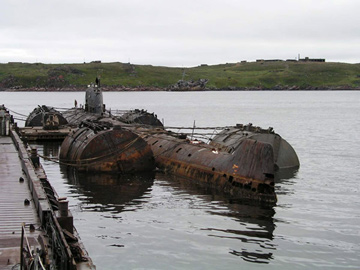
Nuclear company AREVA’s waste dumping in Russia
 Less than 10% of the uranium mass shipped from France to Russia over the past four years “came back”….Considering the fact that the total amount of spent fuel reprocessed in France is about 38,000 tons, a significant share has gone elsewhere. It is clear now that most of it ended up in Russia
End of reprocessed uranium exports to Russia? Fissile material, By Mycle Schneider on May 29, AREVA’s controversial shipments of uranium wastes from France to Russia could be terminated as early as July 2010, according to media reports and a press release by the French chapter of the environmental group Greenpeace. Continue reading
Vermont nuclear plant likely to be source of radiation in fish
it was impossible to establish a baseline for strontium-90 in Connecticut River fish, because the state had not tested for it before this year.
Bad news: Radioactive fish found near Vt. nuclear plant; Worse news: Fish said to be ordinary, Washington Examiner, By: DAVE GRAM, Associated Press05/30/10 MONTPELIER, VT. — When a fish taken from the Connecticut River recently tested positive for radioactive strontium-90, suspicion focused on the nearby Vermont Yankee nuclear plant as the likely source. Continue reading
Texas to get nuclear wastes from 36 States?
Tx. Could Receive Nuclear Waste from 36 States, Environmental Leader, May 24, 2010, Texas could become the repository for low-level nuclear waste from 36 states, according to a report in the Associated Press.According to a rule change proposed by the Texas Low-Level Radioactive Waste Disposal Compact Commission, the state could accept radioactive materials such as glass, metal and clothing used at power plants, research centers, and medical facilities throughout the country at a storage facility in West Texas. The 1,340-acre site, located in Andrews, Tx., is run by Waste Control Specialists.Local opposition to the rule change has come from the Texas chapter of the Sierra Club, which successfully pushed the state legislature to delay its decision on the rule change until at least June. According to a presentation created by Texas Nuclear Safety, an organization opposing the rule change, the amount of waste at the facility could increase up to 19 times.
Nuclear wastes, like diamonds, are forever
THE NUCLEAR INDUSTRY AND RADIOACTIVE WASTES – our theme for June 2010. “The question whether one generation of men has a right to bind another, seems never to have been started either on this or our side of the water. Yet it is a question of such consequences as not only to merit decision, but place also, among the fundamental principles of every government.” – Thomas Jefferson, September 6, 1789
Half-life is the period of time it takes for a radioisotope atom to degrade to a state having half of its original intensity
As you can see the continued production, use, and dumping of such waste materials as depleted uranium and plutonium, into the world’s air, land, and water leaves a permanent problem for our children, grandchildren. great-grand-children ….


AREVA’s uranium enrichment plant a danger to Idaho’s groundwater
Areva uranium enrichment plant in Idaho would threaten aquifer, Beyond Nuclear, 28 May 2010, The $2 billion in federal loan guarantees just awarded to Areva by the U.S. Department of Energy for a new uranium enrichment plant in Idaho, will produce depleted uranium (half-life of 4.5 billion years) and will threaten the Snake River Aquifer, say leaders of the Snake River Alliance.

Areva plans to build a new uranium enrichment plant “on the upstream end of the Snake River Aquifer a few miles east of the Idaho National Laboratory,” stated the Alliance in a press release. “INL’s nuclear activities have already contaminated the aquifer and have left substantial radioactive waste behind. Addressing these environmental challenges has already cost billions of taxpayer dollars and will continue for decades”. Continue reading
American Indians against new uranium mining
“Our Navajo communities rely on the groundwater for everything. These new projects could contaminate the source of drinking water for 15,000 Navajo community members,”

Navajo Activists Protest Uranium Mining Plans, May 28, 2010, warresisters By Bruce Finley, The Denver PostUranium-mining leaders and federal regulators poised to fuel a resurgent nuclear power industry gathered in Denver on Wednesday,…outside the conference Wednesday, American Indian demonstrators with drums and signs demanded a halt to all new uranium mining on Navajo land, where federal regulators have permitted several projects. Continue reading
One Australian Aboriginal thwarts AREVA’s uranium mining plans
”Jeffrey Lee has put country and culture ahead of personal profit and his vision means this magnificent place will be protected for all people and all time,”

Owner wants uranium-rich land to be added to Kakadu, Sydney Morning Herald, LINDSAY MURDOCH IN KAKADUMay 29, 2010 The world heritage-listed Kakadu National Park will be expanded to include thousands of hectares of ecologically sensitive land that contains uranium worth billions of dollars. In a generous act, the Aboriginal traditional owner, Jeffrey Lee, has offered the land to the federal government so that it can become part of Kakadu, where he works as a ranger. Continue reading
Nuclear solution to oil spill could be worse than the problem
BP Oil Spill: The Nuclear Option, THE HUFFINGTON POST, Susan Deily-Swearingen, 26 May 2010, “……One solution that is getting increased attention on the web and in the European press is the terrifying sounding nuclear option which, essentially, would detonate a nuclear bomb underground near the oil well shaft……………What are the lasting effects of such an explosion? Is there a potential for them to be even worse than the pollution from the dispersants already used to “solve” or abate the problem? Continue reading
In U.S. Congress race, push for nuclear bomb testing strongly opposed
Matheson said the track record of nuclear weapons testing in Nevada should make future efforts out of the question…..……..If the largest nuclear threat to the U.S. is a terrorist getting a nuclear bomb, it wouldn’t make much sense to have more, candidate Claudia Wright said, adding that she doesn’t believe anyone who says underground testing is safe…

Nuclear testing hot topic in Congress race, The Spectrum, 25 May 2010, ST. GEORGE – Democratic Rep. Jim Matheson blasted two Republican Senate candidates Monday for saying they would support renewed nuclear weapons testing. Continue reading
Core aim of U.S. Climate Bill is to promote nuclear energy
Nuclear Energy Has a Friend in Heads of Obama’s BP Oil Disaster Commission, by kgosztola May 25, 2010“……..Public Citizen reports the current climate legislation is a “nuclear energy-promoting, oil drilling-championing, coal mining-boosting” piece of legislation “with a weak carbon pricing mechanism thrown in.” The public interest groups warns against the nuclear power incentives currently in the climate change bill: Continue reading

UK not getting new nuclear reactors any time soon
U.K. Energy Policy In A Muddle – WSJ, By Selina Williams, 24 May 2010, “……….Not all the policies required for the construction of new nuclear power plants–a key source of low-carbon electricity–are finalized and it’s unlikely that any will be built until after 2020, the report adds. Decomissioning of old nuclear power plants and what will be done with the waste have yet to be completely pinned down. And the new coalition government’s decision to do away with the Infrastructure Planning Commission, which the previous government set up to streamline and speed up planning decisions for new nuclear, could create more delays to investment…….U.K. Energy Policy In A Muddle – The Source – WSJ
1 This Month

of the week – Shut Down Drone Warfare!


Tell the Ukrainian Government to Drop Prosecution of Peace Activist Yurii Sheliazhenko

Petition to revoke the licensing of the Near Surface Nuclear Disposal Facility (NSDF) at Chalk River. https://www.ourcommons.ca/petitions/en/Petition/Details?Petition=e-7247
To see nuclear-related stories in greater depth and intensity – go to https://nuclearinformation.wordpress.com
-
Archives
- April 2026 (57)
- March 2026 (251)
- February 2026 (268)
- January 2026 (308)
- December 2025 (358)
- November 2025 (359)
- October 2025 (376)
- September 2025 (257)
- August 2025 (319)
- July 2025 (230)
- June 2025 (348)
- May 2025 (261)
-
Categories
- 1
- 1 NUCLEAR ISSUES
- business and costs
- climate change
- culture and arts
- ENERGY
- environment
- health
- history
- indigenous issues
- Legal
- marketing of nuclear
- media
- opposition to nuclear
- PERSONAL STORIES
- politics
- politics international
- Religion and ethics
- safety
- secrets,lies and civil liberties
- spinbuster
- technology
- Uranium
- wastes
- weapons and war
- Women
- 2 WORLD
- ACTION
- AFRICA
- Atrocities
- AUSTRALIA
- Christina's notes
- Christina's themes
- culture and arts
- Events
- Fuk 2022
- Fuk 2023
- Fukushima 2017
- Fukushima 2018
- fukushima 2019
- Fukushima 2020
- Fukushima 2021
- general
- global warming
- Humour (God we need it)
- Nuclear
- RARE EARTHS
- Reference
- resources – print
- Resources -audiovicual
- Weekly Newsletter
- World
- World Nuclear
- YouTube
-
RSS
Entries RSS
Comments RSS
 nuclear-news