Japan faces decision over contaminated Fukushima water
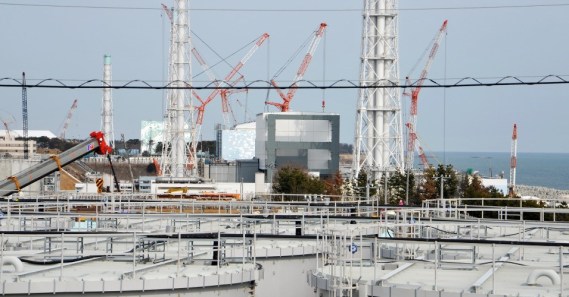
 The dismantling of Fukushima No. 1 nuclear power plant continues in Okuma, Fukushima Prefecture, on Dec. 5, 2019.
January 21, 2020
OKUMA, Fukushima Prefecture—At the wrecked Fukushima No. 1 nuclear power plant north of Tokyo, workers in protective suits are still removing radioactive material from reactors that melted down after an earthquake and tsunami knocked out its power and cooling nearly nine years ago.
On an exclusive tour of the plant, spread over 3.5 million square meters, Reuters witnessed giant remote-controlled cranes dismantling an exhaust tower and other structures in a highly radioactive zone while spent fuel was removed from a reactor.
Officials from Tokyo Electric, which owns the plant, also showed new tanks to hold increasing amounts of contaminated water.
About 4,000 workers are tackling the cleanup, many wearing protective gear, although more than 90 percent of the plant is deemed to have so little radioactivity that no extra precautions are needed. Photography was highly restricted and no conversations were allowed with the workers.
Work to dismantle the plant has taken nearly a decade so far, but with Tokyo due to host the Olympics this summer–including some events less than 60 kilometers from the power station–there has been renewed focus on safeguarding the venues.
“TEPCO tries to disclose all information to the public as soon as possible. If something happens at the site, we let people know by email, for example,” said Kan Nihonyanagi, risk communicator at Fukushima, said in an interview at the site.
The buildup of contaminated water has been a sticking point in the cleanup, which is likely to last decades, and has alarmed neighboring countries. In 2018, TEPCO said it had not been able to remove all dangerous material from the water – and the site is running out of room for storage tanks.
Officials overseeing a panel of experts looking into the contaminated water issue said in December choices on disposal should be narrowed to two: either dilute the water and dump it in the Pacific Ocean, or allow it to evaporate.
The Japanese government may decide within months, and either process would take years to complete, experts say.
“The Olympics are coming, so we have to prepare for that, and TEPCO has to disclose all the information not only to local communities but also to foreign countries and especially to those people coming from abroad,” said Joji Hara, a Tokyo-based spokesman for the power company who accompanied Reuters during the visit.
TEPCO has opened English-language Twitter and Facebook accounts, he said. It is also preparing to put out basic emergency information in Korean and Chinese, he added.
Athletes from at least one country, South Korea, are planning to bring their own radiation detectors and food this summer.
Baseball and softball will be played in Fukushima city, about 60 km from the destroyed nuclear plant. The torch relay will begin at a sports facility called J-Village, an operations base for Fukushima No. 1 in the first few years of the disaster, then pass through areas near the damaged station on its way to Tokyo.
In December, Greenpeace said it found radiation “hotspots” at J-Village, about 18 km south of the plant.
When Tokyo won the bid to host the 2020 Summer Olympics, Prime Minister Shinzo Abe declared that Fukushima was “under control” in his final pitch to the International Olympic Committee.
In 2016, the Japanese government estimated that the total cost of plant dismantlement, decontamination of affected areas, and compensation would be 21.5 trillion yen ($195 billion)–roughly a fifth of the country’s annual budget at the time.
http://www.asahi.com/ajw/articles/AJ202001210037.html
S. Korea, US Discuss Fukushima Wastewater, Marine Issues

January 17, 2020
South Korea and the U.S. held a director-level meeting on maritime and environment issues in Seoul on Thursday.
According to the Foreign Ministry on Friday, the two sides discussed the possibility of Japan releasing contaminated water from the Fukushima Daiichi nuclear power plant disaster site into the ocean.
They also shared views on ways to preserve marine environments.
The two sides discussed how they plan to reduce marine debris and ways to open the Seventh International Marine Debris Conference in South Korea in 2022.
During the meeting, South Korea called on the U.S. to swiftly take steps to remove South Korea from its preliminary list of countries that engage in illegal, unreported, and unregulated(IUU) fishing.
South Korea was designated as a preliminary IUU fishing country by the U.S. after two South Korean fishing boats violated closed fishing grounds and operated near Antarctica in 2017.
http://world.kbs.co.kr/service/news_view.htm?lang=e&Seq_Code=150721
‘Korea should take leading role in stopping Japan from discharging radioactive water’

Fukushima Reactor Cleanup Delayed by Five Years as Japanese Public Demands End to Nuclear Energy
After proposing dumping radioactive water from Fukushima reactors into sea, Japan’s government now adds the idea of allowing the treated but still contaminated water to evaporate into the air. Breathe deep
 Water tanks holding contaminated water in front of the reactor buildings at Fukushima Daiichi.
December 30, 2019
The delay comes days after Japan’s government proposed releasing contaminated water from the plant into the ocean.
The Japanese government said Friday it would delay for a fourth time the removal of spent fuel from two of the reactors at the Fukushima Daichii nuclear power plant, causing concern that the cleanup of one of the worst nuclear disasters in history is happening at a dangerously slow pace.
The removal of the spent fuel was planned to begin in 2023, but the process was bumped back to 2024 at the earliest for the plant’s No. 1 reactor and 2027 or later for the No. 2 reactor.
According to the Japan Times, the government claims this aspect of the clean-up is being delayed due to safety concerns and that it plans to construct barriers around the reactors to prevent the spread of radioactive dust.
Reporting on the delay comes days after the Ministry of Economy, Trade, and Industry proposed releasing contaminated water from the plant into the ocean or allowing it to evaporate, and weeks after the ministry said the water contained higher levels of radioactive material than previously thought.
The most recent news about the cleanup process—which is under a 30-40 year plan following the 2011 earthquake and tsunami which forced more than 100,000 residents to evacuate the rural Fukushima region to avoid nuclear contamination from the plant—raised alarm among critics of nuclear power.
The Japanese public has reportedly grown increasingly anti-nuclear power since the Fukushima disaster, according to an Al Jazeera report earlier this month.
“Japanese people’s sentiment changed after Fukushima Daiichi and it is continuing until now,” Hajime Matsukubo, secretary-general of the Citizens’ Nuclear Information Center, told Al Jazeera. “They say no.”
In a 2015 poll by the Japan Atomic Energy Relations Organization, only 10 percent of Japanese respondents said the country should maintain its use of nuclear energy.
https://www.commondreams.org/news/2019/12/30/fukushima-reactor-cleanup-delayed-five-years-japanese-public-demands-end-nuclear?fbclid=IwAR0cWj8VpXce8X8kXt4Lzg2YlFL3PBZDeuEMtGCTHWD1jpQnzpYpdPwGP9I
Fukushima Radioactive Water: Towards Environmental Release
Translated from french by Hervé Courtois (D’un Renard)
 A massive amount of radioactive water is stored on the grounds of the Fukushima Daiichi nuclear plant site ravaged by the tsunami of March 2011.
December 24, 2019
The decision is not expected to be announced before the Tokyo Olympics next summer, given the diplomatic risk. Japan is expected to face strong opposition.
Releasing the radioactive water from the Fukushima Daiichi nuclear power plant to the environment (in the sea or in the air) is the only option left since experts have ruled out long-term storage, Japanese officials say.
“The option of simple long-term storage is no longer being considered,” said a state official who wished to remain anonymous. And to clarify that the government’s ambition is to make room for Fukushima Daiichi: once the reactors are demolished and the site cleaned, there should be nothing left, including no water tanks still containing at least tritium.
A massive amount of radioactive water is stored within the confines of this site devastated by the tsunami of March 2011. It comes from rain, groundwater or injections necessary to cool the hearts of reactors that have melted. Filtered several times, it ‘should’ ultimately be rid of a large amount of radionuclides, except tritium, ‘considered’ less dangerous for the environment and living beings.
A water still heavily loaded
Long-term storage, which was recommended by environmental organizations like Greenpeace, being no longer validated, three options remain considered the most feasible, from a technical and economic point of view: dilution at sea, evaporation in the air or a combination of the two.
Experts, including those from the International Atomic Energy Agency (IAEA), have been pushing for dilution at sea for years. But this is not feasible at the moment because, as recognized by the company Tokyo Electric Power (Tepco), a large part of this water is still heavily loaded with radioactive elements dangerous for the food chain.
Tepco estimates, however, that the tanks will be full in 2022.
A final decision should not be made before the Tokyo Olympics in the summer of 2020, given the diplomatic risk. A government subcommittee responsible for the file is thus studying not only the technical implications, but also the potential damage to the country’s image abroad.
Japan is set to face strong opposition, already expressed, from fishermen and farmers in the region, as well as from environmental groups and neighboring countries, starting with South Korea. Seoul did not digest a previous decision to dump radioactive water packages into the sea immediately after the Fukushima accident, without asking its advice.
Korean gov’t inactive over Japan’s plan to discharge radioactive water into Pacific

Japan Considering Dumping Toxic Fukushima Water Into Ocean

Japanese Officials Propose Releasing Water From the Fukushima Nuclear Plant Into the Environment

Fukushima Radioactive Sump Water Disappears

Japan proposes Fukushima water release to sea or air
The ministry said a controlled release into the sea was the best option because it would “stably dilute and disperse” the waste from the plant using a method endorsed by the United Nations’ Scientific Committee on the Effects of Atomic Radiation. It also would facilitate monitoring of radiation levels in the environment.
…
In the proposal, the ministry noted that evaporation is a method that was tested and proven following the 1979 core meltdown at Three Mile Island, where it took two years to get rid of 87,000 tons of radioactive tritiated water.
The government and the plant operator, Tokyo Electric Power Company Holdings Inc., have been unable to get rid of the more than 1 million tons of radioactive liquid that has been treated and stored, due to opposition from local fishermen and residents fearing further damage to Fukushima’s reputation and recovery.
The utility has managed to cut down the volume of the liquid by pumping up groundwater from upstream before it reaches the plant, and installing a costly underground “ice wall” around the reactor buildings to prevent other water from running into the area. Tepco says it has space to store only up to 1.37 million tons of the waste liquid, and only until the summer of 2022, raising speculation that it may be released after the Tokyo Olympics next summer. Tepco and experts say the tanks get in the way of decommissioning work and that they need to free up the space to build storage for debris removed and other radioactive materials. The tanks also could spill out their contents in the event of a major earthquake, tsunami or flood….

Fukushima’s contaminated water is an issue affecting all of humanity
An ocean dump could lead to a global ecological disaster
 An image of the Fukushima nuclear power plant, including storage tanks for contaminated water, taken by Greenpeace campaigner and Swedish photographer Christian Aslund on Oct. 16, 2018.
December 1, 2019
As the possibility of Japan dumping contaminated water from the Fukushima Nuclear Power Plant into the ocean has been raised, concerns are being voiced on the Korean Peninsula and through various international organizations. Obviously, it is South Korea that is leading the efforts at international coordination in organizations like the International Atomic Energy Agency (IAEA), International Maritime Organization (IMO), and World Health Organization (WHO).
The biggest issue that stands to arise if the contaminated water is dumped into the ocean is the major impact on the marine environment in the Western Pacific and the health of residents in the region, and South Korea is the closest neighbor to Japan.
In a recent piece published in the UK’s The Economist, Shaun Burnie of Greenpeace Germany warned that if Japan dumped the water into the pacific, radioactive material will begin flowing into the East Sea within a year. As Japan’s closest neighbor, South Korea has maintained that it has a right to sufficiently discuss the potential environmental threat and demand related information. During a South Korean parliamentary audit, expressions of concern about the Fukushima water release were coupled with demands for response measures to be put in place.
Unfortunately, these messages and warnings are not being expressed as part of a system of guidance and cooperation to permit a fundamental resolution. Rather, they amount more to a form of pressure within international discourse, which runs the risk of being shrugged off with pro forma logic. The predictions that radioactive material will begin washing into the East Sea within a year could change with the actual amounts and concentrations of water dumped; in the absence of real announced concentrations of inflowing contaminants, it does nothing more than to raise a threat.
More than the fact of the inflows over the year after release, we need to be aware that there are migrating species that could enter the waters near South Korea at any time. Also, what is to be done about the destruction to the marine ecosystem or the marine life that is being fished in the Pacific by the different countries? The result would be a disaster for humankind. We need a more in-depth and scientific examination to identify a disposal plan that allays the concerns of Japan’s neighbors as well as those of Japanese civil society and fishers, who are the ones suffering the ill effects first hand.
Plans for handling marine contaminants fall into five main categories. The first involves controlling the source. The most basic means of resolution is to replace materials and production processes and ban production and consumption to ensure that contaminants are not released in the first place. The second involves recirculation and reuse. This means either re-circulating contaminants through nature or reusing them for other purposes. The third involves storing the contaminants. In cases where no disposal method has yet been developed and reuse is not an option, the approach has been to contain and process them at a safe distance from areas of human activity.
The fourth involves controlling contamination through a regional quota system. This means applying different standards for management depending on the uses of particular waters; in South Korea’s case, marine protected areas and special management areas fall into this category. The last approach is contamination control through taxation. Under such a system, penalties are imposed in cases where contamination is unavoidable; as a rule, the party responsible bears the costs for compensation and restoration.
 Lee Suk-mo, professor of ecological engineering at Pukyong National University
An ocean dump from a nuclear power plant at the current level, without any international regulations in place, would be utterly unacceptable and an affront to environmental justice for humanity today and future generations. Radioactive material decays naturally; if set apart and stored, it goes away naturally over time. But because of issues concerning time and space, this is not an economical approach, and new and effective disposal technology could be developed while it is being stored.
This is why the nuclear power plant water issue is something that should be approached as an issue affecting all of humanity, rather than one restricted to Fukushima and Japan. In particular, neighbors and countries possessing nuclear power plants of their own should make it a priority to cooperate fully in technological and economic terms.
Human disasters may start in one country, but it is through international cooperation that a country’s disaster can be resolved.
By Lee Suk-mo, professor of ecological engineering at Pukyong National University
http://www.hani.co.kr/arti/english_edition/e_international/919137.html
Transparency, the olympics, and that damned water, Part 1
 Joe’s drone image of the water tanks at Fukushima Daiichi, December ,2018
Tuesday November 26th, 2019
Questions, questions…
It’s hard to say what we get more questions about lately, the 2020 Olympics or the plan to release water from Fukushima Daiichi to the Pacific Ocean. Both issues involve public safety. How safe from radiation will people be who will attend Olympic games in Japan next year, specifically those who attend events to be held in Fukushima? How safe is it for TEPCO to release the water containing tritium and other radionuclides that is currently being stored in hundreds of tanks onsite at Fukushima Daiichi? These are separate issues of course, but in both cases the answers hinge on transparency. We think the fact that we get so many questions about these issues from both journalists and the general public indicates a continuing lack of trust in what the Japanese government and TEPCO say about anything related to Fukushima. That there can be no trust without transparency has become one of our mantras, and we repeat it at every opportunity. Whether the questions are about the Olympics, the water, food safety, the environment, or health, available scientific data only fills in part of the picture. Time and again we’ve found that even when the science generally supports official policy, the public is not given enough transparent information to evaluate the accuracy of the statements they’re hearing. And all too often we ourselves are forced to conclude that we haven’t seen enough reliable information to either confidently validate or refute official claims.
Part 1: What about the water?
In the case of the water in the tanks, last year I wrote a detailed two-part blog post as well as a newspaper op-ed about the issue. I pointed out the problems we saw then with communication and transparency on the part of both the gov’t and TEPCO, and relayed expert opinions about the risks of releasing the water. At the time, all of the information about the water in the tanks provided by TEPCO and the government referred only to its tritium content, with no reference to other radionuclides. While researching for my articles I consulted TEPCO experts several times, and asked them directly if there was data available showing the actual radionuclide content of the tanks. I asked directly if there was truly only tritium to be concerned about. Each time I was given summary data that indicated only tritium. A few months later, in September, 2018, TEPCO suddenly announced that in addition to the tritium the tanks also contain noticeable levels of strontium, americium, and other radionuclides. The public was as outraged by this dishonesty as we were.
What should we make, then, of the November 21, 2019, announcement from METI, widely (and vaguely) reported in the international press, that the advisory committee had determined that the water release plan was “safe”? In terms of politics and process, we’d like to point out that there has not yet been any announcement of an order from METI, NRA, or other government body to TEPCO to release the water. Similarly there has not been any announcement of an actual request from TEPCO to be allowed to do so. The public position is that no decision has been made yet. But we think it’s a done deal and has been for several years already. What we’re seeing is an ongoing effort to get enough of the public on board to minimize the political fallout when it happens. Someone will have to put their name on the order, and it will surely be politically costly.
To be sure, this entire “crisis” is predicated on the claim that TEPCO will run out of onsite tank space in a year or two, but there is no evidence that the company or METI has seriously evaluated obtaining use of land adjoining the Fukushima Daiichi site, which is currently under the jurisdiction of the Environment Ministry for storage of decontamination waste, in order to build more tanks for long-term storage. This recommendation has been put forward by several groups and individuals at public meetings and elsewhere, but seems to have been dismissed without detailed study. We acknowledge the potential risks of this approach in the event a tank ruptures, but considering that the half-life of tritium is about 12.3 years, it seems plausible that secure storage for several decades could be constructed, during which time the water’s radioactivity would decline substantially. The idea should at least be seriously considered and good evidence presented for why it should not be done, if that is the conclusion.
The November 21st METI document acknowledges the need for monitoring if and when the water is released, stating: “Effective monitoring to confirm both 1) safety at the time of discharge and 2) safety of surrounding environment should be conducted” and “Monitoring results should be shared in a transparent manner, to wipe out concerns.” While these acknowledgements are welcome, we consider them obvious to the point of absurdity. Painful experience has shown that the need for actual transparency in cases like Fukushima can only be met by robust and independent third-party monitoring, which is not mentioned anywhere. The public has a right to this, and as Safecast has proven, we can do it ourselves. We have strongly recommended to TEPCO and the government officials we have spoken to over the years that they allow water samples to be measured by genuinely independent researchers and citizen-run radiation monitoring labs. We had never gotten an explanation of why this could not be facilitated. But in a recent news article, TEPCO spokesperson Hideki Yagi is quoted as saying that necessary safety protocols make independent testing impossible. We see no evidence that TEPCO has seriously investigated how true third-party monitoring could be implemented for the water in the tanks. Adequate protocols seem to be in place for third-party testing of other water onsite. TEPCO should come clean and give adequate access to technically qualified organizations and let them convey their findings before any release decision is made.
Page eight of the recent METI briefing document includes dose estimates for humans after the water is released, which it states have been derived from an UNSCEAR document from 2016, “Sources, effects and risks of ionizing radiation, Annex A.” METI concludes that “…the impact of the radiation from the discharge is sufficiently small…” This is, of course, the most crucial data, but it is presented in an extremely confusing and sketchy manner. The public should also be given dose rate and radionuclide concentration estimates for the ocean water itself at different points, and for affected marine life. We asked for this information over a year ago, but METI was unable to provide it. Further, the UNSCEAR document cited as the basis for the calculations is really a summary overview document, and we question whether or not by itself it provides a sufficient basis for detailed dose estimates. The METI committee should show its calculations, especially the assumptions made, and we caution that no-one should assume that the estimates are correct until they do so. To ensure true transparency, the public should also demand to be included in developing detailed monitoring plans for the released water, to track the spread of the radionuclides and their concentrations, and to monitor subsequent concentrations in the food chain and in the wider environment. There are many individuals and organizations, including Safecast, who are well-qualified to participate in this oversight and have the motivation to do so. The public should refuse to accept any release plan until this kind of participatory planning and oversight is clearly in place. We are far beyond the point where “Trust Us” is an option.
Azby Brown
Azby Brown is Safecast’s lead researcher and primary author of the Safecast Report. A widely published authority in the fields of design, architecture, and the environment, he has lived in Japan for over 30 years, and founded the KIT Future Design Institute in 2003. He joined Safecast in mid-2011, and frequently represents the group at international expert conferences.
https://blog.safecast.org/2019/11/transparency-the-olympics-and-that-damned-water-part-1/
Japan gov’t tells embassies risk of contaminated Fukushima water ‘small’

Japan: Environmentalists say Fukushima water too radioactive to release

South Korea nuclear regulator wants information on radioactive Fukushima water release
 A geiger counter measures a radiation level of 54.0 microsievert per hour near the No.2 and No.3 reactor buildings at Tokyo Electric Power Co’s (TEPCO) tsunami-crippled Fukushima Daiichi nuclear power plant in Okuma town, Fukushima prefecture, Japan February 18, 2019
November 20, 2019
SEOUL (Reuters) – Japan’s reluctance to disclose information about the release of radioactive water from its damaged Fukushima nuclear plant is hampering neighboring countries’ efforts to minimize the impact, the head of South Korea’s nuclear safety agency said on Wednesday.
Since the 2011 earthquake and tsunami caused a meltdown at some of the reactors the Fukushima plant, owner Tokyo Electric Power Co (Tepco) has been storing radioactive water in tanks at the site from the cooling pipes used to keep the fuel cores from melting. The utility will run out of space for the water in 2022.
Japan has not yet decided how to deal with the contaminated water, but its environment minister said in September that radioactive water would have to be released from the site into the Pacific Ocean.
“We have been raising Japan’s radioactive water issue to the international community to minimize the impact … but as Japan hasn’t disclosed any specific plan and process we would need more details to run simulations and study,” Uhm Jae-sik, chairman of the Nuclear Safety and Security Commission, told Reuters.
In addition to the Fukushima crisis, safety concerns about nuclear energy have increased in South Korea following a 2012 scandal over the supply of faulty reactors parts with forged documents, prompting a series of shutdowns of nuclear reactors.
South Korea, the world’s fifth-largest user of nuclear power, targets a long-term phase out of atomic power to allay public concerns.
“Regardless of the government’s energy policy change, our primary goal is ensuring the safety of nuclear power,” Uhm said.
South Korea operates 25 nuclear reactors, which generate about a third of the country’s total electricity. Of the 25 reactors, 10 are offline for maintenance, according to the website of Korea Hydro & Nuclear Power.
(This story corrects the word “specific” to clarify meaning in translated quote in paragraph 4)
1 This Month

of the week – Shut Down Drone Warfare!


Tell the Ukrainian Government to Drop Prosecution of Peace Activist Yurii Sheliazhenko

Petition to revoke the licensing of the Near Surface Nuclear Disposal Facility (NSDF) at Chalk River. https://www.ourcommons.ca/petitions/en/Petition/Details?Petition=e-7247
To see nuclear-related stories in greater depth and intensity – go to https://nuclearinformation.wordpress.com
-
Archives
- April 2026 (68)
- March 2026 (251)
- February 2026 (268)
- January 2026 (308)
- December 2025 (358)
- November 2025 (359)
- October 2025 (376)
- September 2025 (257)
- August 2025 (319)
- July 2025 (230)
- June 2025 (348)
- May 2025 (261)
-
Categories
- 1
- 1 NUCLEAR ISSUES
- business and costs
- climate change
- culture and arts
- ENERGY
- environment
- health
- history
- indigenous issues
- Legal
- marketing of nuclear
- media
- opposition to nuclear
- PERSONAL STORIES
- politics
- politics international
- Religion and ethics
- safety
- secrets,lies and civil liberties
- spinbuster
- technology
- Uranium
- wastes
- weapons and war
- Women
- 2 WORLD
- ACTION
- AFRICA
- Atrocities
- AUSTRALIA
- Christina's notes
- Christina's themes
- culture and arts
- Events
- Fuk 2022
- Fuk 2023
- Fukushima 2017
- Fukushima 2018
- fukushima 2019
- Fukushima 2020
- Fukushima 2021
- general
- global warming
- Humour (God we need it)
- Nuclear
- RARE EARTHS
- Reference
- resources – print
- Resources -audiovicual
- Weekly Newsletter
- World
- World Nuclear
- YouTube
-
RSS
Entries RSS
Comments RSS
 nuclear-news