Plutonium Particles Scattered 200km From Fukushima Nuclear Disaster Site, Scientists Say
Jul 22, 2020
Plutonium fragments may have spread more than 200km via caesium microparticle compounds released during the 2011 Fukushima Daiichi nuclear power plant disaster in Japan. These findings are according to research done on the region’s soil samples, published in Science of The Total Environment, by an international group of scientists.
The Fukushima Nuclear disaster occurred when a massive tsunami crashed over the plant’s walls, causing three operating nuclear reactors to overheat and melt down. Simultaneously, reactions within the plant generated hydrogen gas that exploded as soon as it escaped from containment. During the disaster, caesium — a volatile fission product created in nuclear fuel — combined with other reactor materials to create caesium-rich microparticles (CsMPs) that were ejected from the plant.
CsMPs are incredibly radioactive, and scientists study them in an attempt to both measure their environmental impact and to gain insight into the nature and extent of the Fukushima disaster. In one such research process, scientists discovered tiny uranium and plutonium fragments within these micro-particles. The range of plutonium particle spread was previously estimated at 50km, and this research changes that number to 230km. This discovery is vital as it provides a reason to extend testing for plutonium poisoning in human-inhabited regions further than before, and helps scientists understand how to decommission the nuclear reactors in the plant. Decommissioning nuclear plants is extremely important after they cease to function, in order to reduce residual radioactivity in the region to safe levels.
With respect to immediate implications for health, scientists note that radioactivity levels of the plutonium are similar to global counts from nuclear weapons tests. While this means that radioactivity levels may not pose an urgent, critical danger, scientists also note that plutonium poisoning in food items remains a threat. If plutonium were ingested — a possibility in this region — it could create isotopes that significantly increase radioactivity doses, and poison the body.
Due to high radioactivity levels, humans are still unable to enter the Fukushima plant nine years after the disaster. Yet, scientists continue to work towards safely decommissioning the reactors within the plant from the outskirts. Though radiation levels post the Fukushima disaster were much lower than Chernobyl, individuals living near the region still suffer from the aftermath of everything the disaster put them through, fear of poisoning and psychological paranoia, as they attempt to bring life back to normal.
Fukushima may have scattered plutonium widely
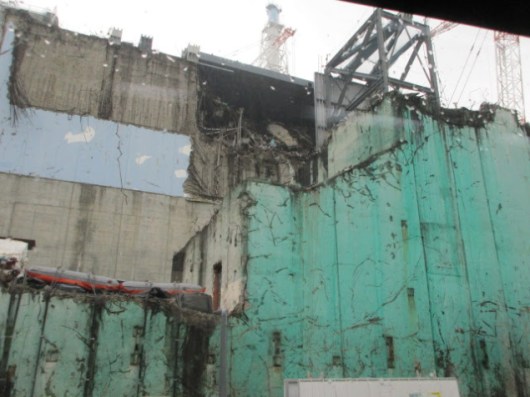 The upper side of the unit 3 reactor building at Fukushima Daiichi was damaged by a hydrogen explosion. This area housed the spent fuel pool and the fuel handling machines.
20 Jul 2020
Tiny fragments of plutonium may have been carried more than 200 km by caesium particles released following the meltdown at the Fukushima Daiichi nuclear power plant in Japan in 2011. So says an international group of scientists that has made detailed studies of soil samples at sites close to the damaged reactors. The researchers say the findings shed new light on conditions inside the sealed-off reactors and should aid the plant’s decommissioning.
The disaster at Fukushima occurred after a magnitude-9 earthquake struck off the north-east coast of Japan and sent a 14 m-high tsunami crashing over the plant’s seawalls. With low-lying back-up generators knocked out, the site’s three operating reactors overheated and melted down. At the same time, hot steam reacted with the zirconium cladding of the nuclear fuel, generating hydrogen gas that exploded when it escaped from containment.
Caesium is a volatile fission product created in nuclear fuel. During the Fukushima meltdown, it combined with silica gas created when melting fuel and other reactor materials interacted with the concrete below the damaged reactor vessel. The resulting glass particles, known as caesium-rich microparticles (CsMPs), measure a few microns or tens of microns across.
Satoshi Utsunomiya and Eitaro Kurihara at Kyushu University and colleagues in Japan, Europe and the US analysed three such particles obtained from soil samples dug up at two sites within a few kilometres of the Fukushima plant. They used a range of techniques to study the physical and chemical composition of these CsMPs, with the aim of establishing whether they contained any plutonium.
Mapping plutonium spread
To date, plutonium from the accident has been detected as far as 50 km from the damaged reactors. Researchers had previously thought that this plutonium, like the caesium, was released after evaporating from the fuel. But the new analysis instead points to some of it having escaped from the stricken plant in particulate form within fragments of fuel “captured” by the CsMPs.
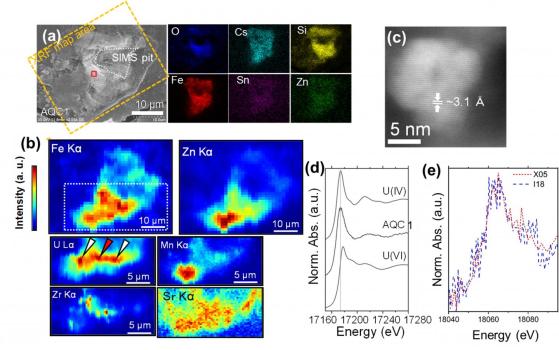
Utsunomiya and colleagues used electron microscopy and synchrotron X-ray fluorescence to look inside the CsMPs. Based on these data, they were able to map the distribution of various elements coming from materials within the damaged reactors – including iron from stainless steel, zirconium and tin from the fuel cladding and zinc from cooling water. They also found uranium within one of the CsMPs, in the form of discrete uranium oxide particles less than 10 nm across.
However, the researchers were unable to find any traces of plutonium using these methods – probably due to interference from strontium, another fission product. Instead, they turned to X-ray absorption. To compensate for high levels of noise, they carried out the measurement at two different synchrotrons, transporting their roughly 20 µm diameter particle from Japan to be blasted with X-rays at the Diamond facility in the UK and the Swiss Light Source in Switzerland.
The researchers focused their attention on the three areas of the particle that generated the most fluorescence from uranium. They failed to detect plutonium at two of these locations, but succeeded at the third, with absorption spectra produced at both synchrotrons indicating the element’s presence. The low signal-to-noise ratio meant they couldn’t identify exactly which plutonium species were present, but the shape of the spectra told them that it probably existed as an oxide, rather than as a pure metal.
Utsunomiya and co-workers also used mass spectrometry to measure the relative abundance of different plutonium and uranium isotopes within the microparticles. They found that three ratios – uranium-235 to uranium-238, as well as plutonium-239 compared to both plutonium-240 and -242 – all agreed with calculations of the proportions that would have been present in the fuel at the time of the disaster. This agreement, coupled with the fact that the measured amount of uranium-238 was nearly two orders of magnitude greater than would be the case if it had simply evaporated from the melted fuel, led them to conclude that the uranium and plutonium existed as discrete fuel particles within the CsMPs.
Implications for decommissioning
The researchers note that previous studies have shown that plutonium and caesium are distributed differently in the extended area around Fukushima, which suggests that not all CsMPs contain plutonium. However, they say that the fact plutonium is found in some of these particles implies that it could have been transported as far afield as the caesium – up to 230 km from the Fukushima plant.
As regards any threat to health, they note that radioactivity levels of the emitted plutonium are comparable with global counts from nuclear weapons tests. Such low concentrations, they say, “may not have significant health effects”, but they add that if the plutonium were ingested, the isotopes that make it up could yield quite high effective doses.
With radiation levels still too high for humans to enter the damaged reactors, the researchers argue that the fuel fragments they have uncovered provide precious direct information on what happened during the meltdown and the current state of the fuel debris. In particular, Utsunomiya points out that the composition of the debris, just like that of normal nuclear fuel, varies on the very smallest scales. This information, he says, will be vital when it comes to decommissioning the reactors safely, given the potential risk of inhaling dust particles containing uranium or plutonium.
The research is reported in Science of the Total Environment.
https://physicsworld.com/a/fukushima-may-have-scattered-plutonium-widely/
Particulate plutonium released from the Fukushima Daiichi meltdowns
What about the Fukushima Daiichi Plutonium Release?
Recently I came across this article from Hideo Watanabe, a Japanese blogger, which I find very interesting. It has the merit to raise some questions about the real quantity of Plutonium released in March 2011 during the Fukushima Daiichi nuclear plant catastrophe.
The claim of Hideo Watanabe that there was plutonium stocked in reactor 4 and plumed from it seems highly unlikely, as Bellona were in there and they would have picked up on high readings in the number 4 building if the reactor seals had been damaged like the others. That is why I have left that part out in this blog article.
However, his article has the merit to point out the contradictions between the two studies and that August 2015 IAEA report, report which itself has contradictions in its text, regarding the quantity of plutonium released from Fukushima Daiichi reactors in March 2011.
The issue of Pu release from the other reactors and spent fuel pools is a bigger issue as well as the water contamination issues. The measurements earlier on were in Beta and Alpha and little was mentioned on Pu and Uranium isotopes.. Some info came out about Pu but the data was sparse.. There has been no mention of Uranium isotopes but I think Uranium was likely spread around to some degree,
Anyway the discussion on the missing isotopes is valid and worth reminding people about. The general observations are that Fukushima Daiichi has low amounts of Sr 90 compared to Chernobyl and less Pu on average.. There may be Pu hotspots around but they would be hard to find.
The IAEA would like us to believe that the March 2011 Plutonium release from Fukushima Daiichi reactors was very minimal, though their own August 2015 report shows contradictions. Furthermore two independent studies say otherwise.
Inside 200km zone, 240PU/239PU atoms ratios 0.216 – 0.255
Significantly higher than that of global fallout.

figure 1. (a) Results of 239+240 Pu and 241 Pu activities and 240 Pu/239 Pu atom ratios in surface soil and litter samples collected in the evacuation-prepared area (J-Village) and the deliberate evacuation area (S1, Katsurao Village; S2, Namie Town; and S3, Iitate Village). Data are cited from ref 27. (b) Map showing the locations of marine sediment and seawater sampling sites. Results of 239+240 Pu activity (Bq/kg) and 240Pu/239 Pu atom ratio are shown. Data of sediment samples are cited from ref 37, and seawater samples (FSK1 and FSK 2) are cited from ref 65.
!*!*!*!*!*!*!*!*!*!*!*!*!*!*!*!*!*!*!*!*!*!*!*!*!*!*!*!*!*!*!*!*!*!*!*!*!*!*!*!
By Hideo Watanabe

Here is the Nature report :
Isotopic evidence of plutonium release into the environment from the Fukushima DNPP accident
http://www.nature.com/articles/srep00304


The IAEA, published a comprehensive report of Fukushima in August 2015, the Fukushima Daiichi accident technical volume 1: description and context of the accident
http://www-pub.iaea.org/MTCD/Publications/PDF/AdditionalVolumes/P1710/Pub1710-TV1-Web.pdf
Still, in that IAEA’s report there are some contradictions and weaknesses.

In the 2014 study, some researchers are saying the same thing as the Nature report.

Source: Hideo Watanabe’s blog
1 This Month
10 March A LIVE WEBINAR THE REAL EFFECTS OF NUCLEAR POWER
What the Industry Isn’t Telling Us
1:00 PM Mountain, 2 pm Central, 3 pm Eastern. Live on the Keepers of the Water Facebook page



18 March Webinar @ 1 PM EST: An Assessment of SMR Projects: The Case of Canada
register for the zoom:
https://us02web.zoom.us/webinar/register/WN_o8BIIOUvQ2ONJR1nta65DQ#/registration


of the week – STOP SMALL MODULAR REACTORS IN CANADA
To see nuclear-related stories in greater depth and intensity – go to https://nuclearinformation.wordpress.com
-
Archives
- March 2026 (119)
- February 2026 (268)
- January 2026 (308)
- December 2025 (358)
- November 2025 (359)
- October 2025 (376)
- September 2025 (258)
- August 2025 (319)
- July 2025 (230)
- June 2025 (348)
- May 2025 (261)
- April 2025 (305)
-
Categories
- 1
- 1 NUCLEAR ISSUES
- business and costs
- climate change
- culture and arts
- ENERGY
- environment
- health
- history
- indigenous issues
- Legal
- marketing of nuclear
- media
- opposition to nuclear
- PERSONAL STORIES
- politics
- politics international
- Religion and ethics
- safety
- secrets,lies and civil liberties
- spinbuster
- technology
- Uranium
- wastes
- weapons and war
- Women
- 2 WORLD
- ACTION
- AFRICA
- Atrocities
- AUSTRALIA
- Christina's notes
- Christina's themes
- culture and arts
- Events
- Fuk 2022
- Fuk 2023
- Fukushima 2017
- Fukushima 2018
- fukushima 2019
- Fukushima 2020
- Fukushima 2021
- general
- global warming
- Humour (God we need it)
- Nuclear
- RARE EARTHS
- Reference
- resources – print
- Resources -audiovicual
- Weekly Newsletter
- World
- World Nuclear
- YouTube
-
RSS
Entries RSS
Comments RSS
 nuclear-news