The Nuclear Begging Bowl
The Nuclear Begging Bowl JO ABBESS June 7th, 2009 “……………..In the United States they call this process a “bailout”, making it sound like a worthy rescue of a valued affiliate. In the United Kingdom, it’s called “public support”. It all amounts to the same thing : tax revenue from the public thrown at the private corporations……………
………………….it is unlikely that EdF will be able to persuade investors to put their money behind New Nuclear without some kind of pledge from the UK Government on a price guarantee for the electricity that will eventually (with luck) be generated.
And yet, at present, it is highly unlikely that such a pledge could be extracted, what with the whole Government in turmoil, and with international negotiations on Climate Change set to be turbulent and impactful on Energy provision (in December 2009 in Copenhagen).
Court says nuclear test soldiers can sue Britain
Court says nuclear test soldiers can sue Britain
June 06, 2009
THE British High Court has concluded thousands of Australian service men and their families were treated as nuclear ‘guinea pigs’, giving them the right to sue the British Government.
The bombshell decision found the British Ministry of Defence did have a case to answer that it unfairly exposed servicemen from Australia, Britain, New Zealand and Fiji to atomic fallout during the series of tests in South Australia, Western Australia and off the eastern coast on atolls in the Pacific during the 1950s.
The sensational ruling was greeted with cheers from many veterans in Room 73 of the London Royal Courts of Justice where for five years 1000 of them have fought to prove they and their families had suffered because of radioactive exposure.
The case paves the way for millions of dollars in compensation to now be offered to the servicemen exposed on land, air and sea who were directed into mushroom clouds to test the effects of the weaponry on the human body.
The Australian Federal Government had stalled for years on whether to pay compensation, citing it was awaiting for a ruling to be made by the British High Court since the tests were done by the British Government.
AdelaideNow… Court says nuclear test soldiers can sue Britain
In Renewable Energy Legislation, Nuclear Power May Find Exemptions
In Renewable Energy Legislation, Nuclear Power May Find Exemptions redOrbit 5 June 2009 In a law that would mandate utility companies to generate a certain amount of electricity from renewable sources, U.S. legislators are trying to increase incentives for the use of nuclear power and energy efficiency. Nuclear power, however, is not currently considered a renewable electricity source according to the terms laid out in the Senate Energy and Natural Resources Committee bill. If the bill becomes law, a predetermined percentage of every U.S. utility company’s total power output would have to be dedicated to renewable energy sources.
The Senate committee recently modified the bill to include an amendment authored by Alaskan Senator Lisa Murkowski. Under the modified legislation, any future increase in capacity at existing nuclear power plants or new nuclear power plants would be exempt from the bill’s green energy requirements.
By not including the expansion of output at nuclear power plants, the amendment would allow these power plants to increase energy production without being subject to mandatory increases in the amount of renewable power they generate.
In Renewable Energy Legislation, Nuclear Power May Find Exemptions – Science News – redOrbit
Is nuclear a green fuel? « Voices from Ghana
Is nuclear a green fuel?June 1, 2009 · Voices From Ghana “…………….some forecasters predict an uptick in nuclear power.
Yet, for nuclear energy to contribute to a significant degree to greenhouse gas abatement, the rate of construction would need to vastly accelerate. Offsetting even 10 percent of global carbon emissions by 2050 would be an immense undertaking, requiring some 2,200 new plants, or more than one per week in the coming decades.
The nuclear power option faces a set of vexing problems that should temper enthusiasm for an expansion of this scale.
Safety and CostAlthough no plant design can be risk-free, new research has brought claims of a new generation of nuclear reactors with advanced safety features. However, they have yet to be tested at full scale, and all reactors on order now use conventional technology. Moreover, nuclear power plants are now considered plausible targets for terrorist attacks. Whether caused by accident or malice, a sudden dispersal of radioactivity would have severe community impact, perhaps exacerbated by inadequate evacuation plans. If such an event triggered a renewal of anti-nuclear sentiment in the general public and led to demands for a nuclear moratorium, the resilience and sustainability of the energy system would be greatly compromised.
The full economic costs of nuclear energy are difficult to determine. A comprehensive accounting would include accident insurance, safety assurance, decommissioning, and radioactive waste disposal — costs that are often buried in generous public subsidies for the nuclear industry or shifted to future generations. As the experience in the U.S. with the first wave of nuclear plants indicated, projected costs will soar as the full costs of the nuclear-fuel cycle are reflected in the price of electricity. Of course, high costs might not be a key issue if nuclear power were the only option for climate mitigation. It is not.some forecasters predict an uptick in nuclear power.
Yet, for nuclear energy to contribute to a significant degree to greenhouse gas abatement, the rate of construction would need to vastly accelerate. Offsetting even 10 percent of global carbon emissions by 2050 would be an immense undertaking, requiring some 2,200 new plants, or more than one per week in the coming decades.
The nuclear power option faces a set of vexing problems that should temper enthusiasm for an expansion of this scale.
Safety and CostAlthough no plant design can be risk-free, new research has brought claims of a new generation of nuclear reactors with advanced safety features. However, they have yet to be tested at full scale, and all reactors on order now use conventional technology. Moreover, nuclear power plants are now considered plausible targets for terrorist attacks. Whether caused by accident or malice, a sudden dispersal of radioactivity would have severe community impact, perhaps exacerbated by inadequate evacuation plans. If such an event triggered a renewal of anti-nuclear sentiment in the general public and led to demands for a nuclear moratorium, the resilience and sustainability of the energy system would be greatly compromised.
The full economic costs of nuclear energy are difficult to determine. A comprehensive accounting would include accident insurance, safety assurance, decommissioning, and radioactive waste disposal — costs that are often buried in generous public subsidies for the nuclear industry or shifted to future generations. As the experience in the U.S. with the first wave of nuclear plants indicated, projected costs will soar as the full costs of the nuclear-fuel cycle are reflected in the price of electricity. Of course, high costs might not be a key issue if nuclear power were the only option for climate mitigation. It is not.
Proliferation and Security
Nuclear power cannot be de-coupled from nuclear weapons. Two paths lead from a nuclear energy program to weapons-grade material; one involves uranium and the other plutonium.
Nuclear Power Deflects Us From the Path to Sustainability……………….With its long-term legacy of heightened risks and toxic burden, nuclear power violates a fundamental principle of sustainability: passing on a resilient world to future generations. At the least, a world laced with nuclear power plants and crisscrossed with commerce of fissionable materials would require a strong international regime of security and control, a world more consonant with an authoritarian Fortress World scenario than a Great Transition.
AREVA and the nuclear illusion
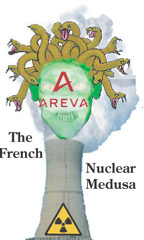 Areva’s difficulties and the nuclear illusion
The View From Brittany June 3 2009Areva is no ordinary company. It is the nuclear arm of the French state, in charge with the building and the supplying of French nuclear plants. Even though it is technically a corporation, it is owned by the Commissariat à l’Énergie Atomique, a public agency whose director is appointed by the French President who has occasionally sold nuclear plants on its behalf.
Areva, supposedly the “jewel” of the French industry is in real troubles. Even though it sells more than ever, its benefits have plummeted and it has been forced to cancel a mining project in Canada. According to the “Réseau Sortir du Nucléaire”, Areva needs 3 billions euros, mostly because of the costly failure the Olkiluoto EPR has proven to be. The Finnish third generation nuclear plant, which should have been put online this year has been delayed due to technical difficulties and costs are sky-rocketing – 5.4 billions instead of the original 3 billions. Moreover, South Africa has recently cancelled the building of 12 nuclear plants while the “sells” announced by the French presidency (4 plants in Italy and 2 in India) remain virtual – nobody know how they are going to be funded.
Areva is presently clamouring for public funds. It will probably get them, no matter how loud we, and others, protest. France, trapped as it is by its own nuclear strategy, simply cannot afford to lose the control of its uranium supply.
That is hardly the whole story, however. What this affair highlight is how problematic is nuclear power at the eve of catabolic collapse. A nuclear plant is very costly and takes a long time to build. Besides, it is of absolutely no use as long as it is not completed. The end result is that to launch a nuclear program you have to immobilize a lot of capital – human, natural and financial – without any hope of anything looking like a return of investment for quite a long time……………………Areva’s difficulties pose, however, another, often overlooked question : what will nuclear plants will become after the nuclear industry fails. In a number of countries, it may happen sooner than one thinks……………….And then what ?
Dismantling a nuclear plant and disposing of the wastes are very costly operation. Will the impoverished societies of forty years from now be able to afford them ? One can seriously doubt it. In fact, in a situation of worsening energy and capital shortage, one can expect them to operate their ageing nuclear plants to very end – the way the Ukrainian government did with Chernobyl – then let them decay away.
The result, needless to say, won’t be good for the neighbourhood,……………. This, by the way, can have interesting geopolitical consequences in countries such as France which are littered with nuclear plants.
The activists who, in the late seventies, have made sure no nuclear plant would ever be built in Brittany may have won their far descendants more than what they thought.
http://theviewfrombrittany.blogspot.com/2009/06/arevas-difficulties-and-nuclear.html
Cost Overruns at Finland Reactor Hold Lessons
In Finland, Nuclear Renaissance Runs Into Trouble
OLKILUOTO, Finland — As the Obama administration tries to steer America toward cleaner sources of energy, it would do well to consider the cautionary tale of this new-generation nuclear reactor site.
The massive power plant under construction on muddy terrain on this Finnish island was supposed to be the showpiece of a nuclear renaissance. The most powerful reactor ever built, its modular design was supposed to make it faster and cheaper to build. And it was supposed to be safer, too.
But things have not gone as planned.
After four years of construction and thousands of defects and deficiencies, the reactor’s 3 billion euro price tag, about $4.2 billion, has climbed at least 50 percent. And while the reactor was originally meant to be completed this summer, Areva, the French company building it, and the utility that ordered it, are no longer willing to make certain predictions on when it will go online…………………………Most of the new construction is underway in countries like China and Russia, where strong central governments have made nuclear energy a national priority…………………………….resistance is mounting. In April, Missouri legislators balked at a preconstruction rate increase, prompting the state’s largest electric utility, Ameren UE, to suspend plans for a $6 billion copy of Areva’s Finnish reactor…………………………Areva has acknowledged that the cost of a new reactor today would be as much as 6 billion euros, or $8 billion, double the price offered to the Finns.
French nuclear utility deep in debt
EDF confronts $34.2 billion debt pile
Troubled French utility, Electricite de France, which acquired half of U.S. utility, Constellation Energy, in December, has already offloaded part of its ownership of British Energy, which it also acquired last year. EDF is staggering under a $34.2 billion debt pile and has sold 20% of British Energy – the British nuclear operator – to Centrica. EDF will also try to raise $1.4 billion through retail bonds. For more on EDF’s financial struggles, read here and here. Furthermore, new nuclear build in the UK may be in jeopardy as EDF is demanding government subsidies there to go forward. Read more here.
Canada to Seek Buyers for Atomic Energy of Canada, Globe Says – Bloomberg.com
Canada to Seek Buyers for Atomic Energy of Canada, Globe Says
By Greg Quinn
May 28 (Bloomberg) — Canada will seek buyers for part of Atomic Energy of Canada Ltd., seeking to boost sales of its Candu reactors, and is looking for new managers of a damaged reactor that makes medical isotopes, the Globe and Mail newspaper said.
The state-owned company would be split into a Candu division and a division for the isotope-producing reactor, the newspaper said, citing people it didn’t name who are familiar with the plans.
The isotope reactor will remain shut down for at least three months to make emergency repairs, and about C$7 billion ($6.3 billion) is needed for waste clean up at the site, the newspaper said.
Canada to Seek Buyers for Atomic Energy of Canada, Globe Says – Bloomberg.com
Niger Political Melee Could Affect Foreign Uranium Cos
Niger Political Melee Could Affect Foreign Uranium CosThursday Easy Bourse May 28th, 2009 / 20h15By Brian TruscottOf DOW JONES NEWSWIRESVANCOUVER -(Dow Jones)- As Kazakhstan investigates whether state officials sold uranium assets to foreign companies illegally, Niger – and its uranium market – is undergoing a small crisis of its own…………………..Political unrest, especially from opposing political parties, is spreading, with street demonstrations and the rise of anti-referendum coalitions.
On the face of it, this looks like political wrangling, but given the history of power grabs in African countries, this could be a precursor to economic instability in a region that often sees the military step in to resolve political upheavals, one uranium markets analyst said………………………..Niger Uranium Ltd. (URU.LN) has a number of potential prospects in development while Australia’s NGM Resources Ltd. (NGM.AU) has three uranium concessions.
Tribes press government to clean up nuclear waste
Tribes press government to clean up nuclear waste
KDBC News Associated Press – May 26, FLAGSTAFF, Ariz. (AP) – Two American Indian tribes are pressing the federal government to clean up an area where they say medical, uranium and other radioactive waste was dumped and has been contaminating the land and groundwater.
The Navajo and Hopi tribes say their pleas to have the waste materials from two sites near Tuba City, Ariz., taken off tribal land have been ignored.
The Hopi Tribe filed a notice of intent to sue the federal government last week over the cleanup.
On Tuesday, the Navajo Nation filed a motion to intervene in a 2007 lawsuit the owner of the mill brought against the federal government……………..
http://www.kdbc.com/Global/story.asp?S=10425108&nav=menu608_2_3
Unlimited funding for nuclear power in the “Clean Energy Bank”?
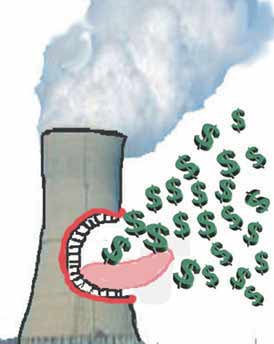 The nuclear-power lobby
San Antonio Current by Greg Harman 27 May 09 “………………………
……………….Although the would-be Nuclear Renaissance is a key element of more than a few lawmakers’ agendas, the federal government has failed to address the disposal of the plants’ high-level radioactive waste. The price tag on new nuclear plants has been rising by 15 percent a year — and the projects are already fantastically expensive.
Then you have upstarts like Jon Wellinghoff, head of the Federal Energy Regulatory Commission, who suggests the world doesn’t need any more nuclear power plants; that renewable energy and efficiency measures alone can provide for the future.
“There’s 500 to 700 gigawatts of developable wind throughout the Midwest,” Wellinghoff said last month, and “enough solar in the Southwest, as we all know, to power the entire country.”
It all boils down to terrible PR for the nuclear industry.
In addition to those immediate troubles, virtually all of the nation’s 104 nuclear plants are set to age themselves out of production by mid-century.
…………………..said Michael Marriott, director of the anti-nuke organization Nuclear Information Resource Service. “One hundred reactors at today’s prices is about a trillion dollars. Is that the best way to spend a trillion dollars, especially when the private sector has made it very clear they’re not going to put up the money?”
Still, nuclear has its boosters. And they’re stealthily creating the legislation now that will provide nuclear power with a raft of new federal subsidies.
………………As it turned out, the nuclear Trojan Horse was already in the bill.
It’s known as a “clean energy bank,” and it creates a new bureaucracy — the Clean Energy Deployment Administration — tasked with doling out federal energy dollars in the form of loans, loan guarantees, and letters of credit.
……………..So far, both the House and Senate Clean Energy Bank versions include nuclear power and “clean” coal — both extractive energy sources that rely on finite materials — among their list of truly renewable power sources like wind and solar. Thanks to a 30-percent cap on the amount any one of these technologies could receive, the House’s Clean Energy Bank language in ACES could allow up to 60 percent of the clean-energy spending to be made on coal and nuclear.
The Senate’s version currently doesn’t include limits on the funds any single power source could receive through the bank…………”
*Not on your irradiated life.
French Naval Base Opens Today
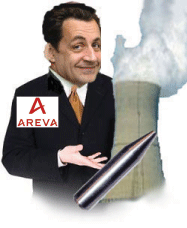
French Naval Base Opens Today
Khaleej Times T. Ramavarman26 May 2009 “……………….The base to be manned by about 500 personnel, drawn mainly from the French Navy, will be inaugurated by French President Nicolas Sarkozy……………………….The minister said the UAE is pursuing a transparent and peaceful nuclear power programmes, and has emerged as a model to many other countries in this regard…………………….
US nuclear reactor builders GE and Westinghouse Electric Co, a subsidiary of Toshiba Corp, are also trying to get a big share of the expected $40 billion market.
French firms plan to compete for the business. France’s Total, Suez and state nuclear reactor maker Areva said last year they planned to develop two third-generation nuclear reactors in the UAE.
President Sarkozy in UAE
The French president has touched down in Abu Dhabi for a state visit Time Out Dubai 27 may 09 “…………….The UAE and France are due to sign a memorandum of understanding that provides for appointing Emirati diplomats at French missions in countries in which the UAE has no diplomatic missions………………………….Under the agreement, the UAE and France set up a high-level joint committee to supervise cooperation in the areas of nuclear power generation, water desalination,
President Sarkozy in UAE – The Knowledge News – TimeOutDubai.com
Justification of new nuclear power in the UK
Justification of new nuclear power in the UK By: Paul Dorfman 26 May 09 “……………………………………There are real problems – for example, information on how radiation-waste and radiation spent fuel from any new nuclear build could possibly be managed, or the health impact of radiation-discharges will not be fully assessed until after the “Justification” decision is taken.
“Justification” of new-build nuclear power will be decided even before the new reactor design is assessed.Also there are significant data gaps in the Nuclear Industry Association (NIA) Application on which “Justification” is built.
There is simply not enough information presented by the NIA in their application to make a rational decision about whether new nuclear build is warranted or not.
For such a significant process, the Justification timeline is short, and decisions will take place in closed session – far from public scrutiny.
The Nuclear Consultation Group believe that it is unfair that that the Secretary of State for Energy and Climate Change is to be the Justifying Authority – the person who makes the final decision – this is because he has already expressed clear support for new nuclear reactors.Given that Justification, once finalised, may foreclose on any future discussion on issues crucial to nuclear power, it is vital that this process is opened up in order to allow for meaningful and realistic examination of evidence a public forum…………………………..
Will the Nuclear Power “Renaissance” Ever Reach Critical Mass?: Scientific American
Will the Nuclear Power “Renaissance” Ever Reach Critical Mass?
Scientific American May 21, 2009 Despite an abundance of plans and applications, new nuclear reactors outside of Asia are few and far between, which puts nuclear’s contribution to fighting greenhouse gas emissions at risk This month, Finland’s Olkiluoto 3 nuclear reactor was supposed to begin generating power, a tangible sign of the revival of the nuclear industry outside of Asia after nearly 30 years of no new construction because of accidents, cost-overruns and other issues. Instead, the reactor won’t be completed for more than three more years, its price is nearly 60 percent more than anticipated, and it is mired in costly legal squabbles between the builder, Areva, and the Finnish utility, Pohjolan Voima.In the U.S., since 2003, 17 applications for 26 new reactors have been filed with the U.S. Nuclear Regulatory Commission, but not one is yet under construction.
Despite dozens of new nuclear plants ordered or built in Asia in recent years, “increased deployment of nuclear power has been slow both in the United States and globally,” wrote the authors of a new Massachusetts Institute of Technology review of the state of nuclear power.Those figures, say the authors of the report, an update on a similar report in 2003, mean that “even if all the announced plans for new nuclear power plant construction are realized, the total will be well behind that needed for reaching a thousand gigawatts of new capacity worldwide by 2050.”
One thousand gigawatts is the number the M.I.T. professors estimated would be needed to ensure that nuclear power provided 20 percent of global electricity needs as well as cut emissions of greenhouse gases from power plants. …………………..(There are, of course, significant greenhouse gas emissions associated with building and fueling nuclear facilities).
But the price of new nuclear power has “escalated dramatically,” according to the report, jumping by 15 percent a year to reach as much as $4,000 per kilowatt compared with $2,300 for coal-fired generation and just $850 for natural gas. And the industry is asking for at least $100 billion in federal tax subsidies and loan guarantees for the 26 reactors currently planned.
The situation is no better in Europe, according to Steven Thomas, a professor of energy studies at the University of Greenwich in London: Finland cannot complete its new reactor; the U.K. has yet to get started on any projects; and a new nuclear reactor in France, after 18 months of construction, is 20 percent overbudget and requires complete subsidy by the French government………………….. Nor has there been a solution to the issue of nuclear waste……………………….. Adds Thomas: “It seems to me highly unlikely that [investing in nuclear power] is the most cost-effective way to reduce greenhouse gas emissions. Put that money in other sources, such as energy efficiency and renewables, and get a much better return on your money.”
Will the Nuclear Power “Renaissance” Ever Reach Critical Mass?: Scientific American
1 This Month
23-25 October – on Zoom – World BEYOND War’s annual global conferenc


Shut down the radiation-damaged Heysham nuclear reactors now
To see nuclear-related stories in greater depth and intensity – go to https://nuclearinformation.wordpress.com

Say No to NASA’s Reckless Nuclear Reactor on the Moon
Say No to NASA’s Reckless Nuclear Reactor on the Moon
-
Archives
- October 2026 (180)
- September 2026 (339)
- August 2026 (330)
- July 2026 (355)
- June 2026 (287)
- May 2026 (306)
- April 2026 (356)
- March 2026 (251)
- February 2026 (267)
- January 2026 (308)
- December 2025 (358)
- November 2025 (359)
-
Categories
- 1
- 1 NUCLEAR ISSUES
- business and costs
- climate change
- culture and arts
- ENERGY
- environment
- health
- history
- indigenous issues
- Legal
- marketing of nuclear
- media
- opposition to nuclear
- PERSONAL STORIES
- politics
- politics international
- Religion and ethics
- safety
- secrets,lies and civil liberties
- spinbuster
- technology
- Uranium
- wastes
- weapons and war
- Women
- 2 WORLD
- ACTION
- AFRICA
- Atrocities
- AUSTRALIA
- Christina's notes
- Christina's themes
- culture and arts
- Events
- Fuk 2022
- Fuk 2023
- Fukushima 2017
- Fukushima 2018
- fukushima 2019
- Fukushima 2020
- Fukushima 2021
- general
- global warming
- Humour (God we need it)
- Nuclear
- RARE EARTHS
- Reference
- resources – print
- Resources -audiovicual
- Weekly Newsletter
- World
- World Nuclear
- YouTube
-
RSS
Entries RSS
Comments RSS

