An open, honest nuclear debate
An open, honest nuclear debate Alberta’s ‘public consultation’ on nuclear power seems designed to quash any opposition to the plan canada.com By Douglas Roche, 19 May 2009
The consultation process launched by the Alberta government to determine if a nuclear power plant should be built in the Peace River area appears designed to dampen any opposition to the plan.
The Alberta nuclear consultation survey is cleverly formulated to intimidate all those without a scientific background, for example, asking the responders if they can explain the details of Alberta’s electricity system or nuclear energy to others. The responder is asked to affirm whether or not: “I was very familiar with the history of nuclear use in Canada.” In other words, if you don’t have a technical background, is your opinion worth much? Why bother to proceed if you’re not an expert?………..
……………………The report of the nuclear power expert panel and the government’s subsequent workbook downplay the risk of nuclear accidents, the staggering costs to taxpayers of nuclear power, the link between nuclear power and nuclear weapons, and the immense new potential of alternate sources of energy……………………………
A new study by the Pembina Institute found Alberta could go from producing more than 70 per cent of its electricity from coal to 70 per cent from clean energy sources in just 20 years, based on existing technology and rates of deployment already seen in other jurisdictions.
Using proven renewable energy technologies, combined with industrial co-generation and a serious commitment to improved consumption efficiency, Alberta could satisfy its growing demand for power while dramatically reducing greenhouse gas emissions and other harmful environmental impacts……………..
……………..For every argument that nuclear power is entering a “renaissance,” there is another that it is headed for obsolescence.
Quick answer unlikely for nuclear hot potato
Quick answer unlikely for nuclear hot potato TriCity Herald by Rick Larson, 11 May 09 A piece of President Obama’s budget that hasn’t drawn as much attention as other high-profile programs would finally bury the controversial Yucca Mountain nuclear waste project in Nevada.Scrapping Yucca Mountain will leave a $13.5 billion hole in the ground, which is how much the Department of Energy has spent on the project since 1983, and it leaves unanswered the question of what to do with waste from nuclear power plants. It’s a question the nation has struggled with for some 30 years………………………………
Scrapping Yucca Mountain isn’t as simple, however, as just walking away from a massive hole in the ground. The problem of what to do with the 55,000 tons of used nuclear fuel sitting in 39 states in “temporary” storage at nuclear power plants — including the Energy Northwest plant at Hanford — remains.
And lawmakers from states with nuclear plants are getting angry, threatening to stop or reduce their payments to the federal government for nuclear waste management until a solution for nuclear waste emerges. The New York Times reported in April that at least four states — Maine, South Carolina, Michigan and Minnesota — were considering measures.
All of this comes as nuclear power plants are being promoted as potential sources of clean and reliable base power……………………
Quick answer unlikely for nuclear hot potato – Ask the Editors | Tri-City Herald : Mid-Columbia news
political risks for uranium mining
Q+A-Eurasia Group on political risks for global mining
REUTERS 11 by Andrew Marshall May 0 9 “……………………………Q – What are the implications of the economic downturn on the expansion of nuclear energy and uranium mining projects?
A – Generally bad news across the board. The absence of new loan guarantees for new reactors in the UK and the U.S. will undermine the growth of the nuclear power sector. Emerging market nuclear programs… will also face funding pressures…………….
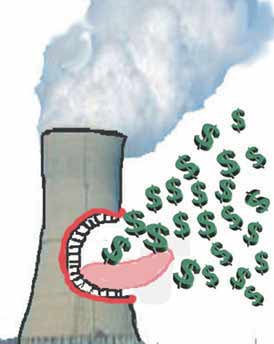
Nuclear solution comes with a huge price tag
 Nuclear solution comes with a huge price tag
North County Times By MARK WILLIAMS – AP Energy Writer | Saturday, May 2, 2009
COLUMBUS, Ohio —- A ghost from the nuclear industry’s early years has reappeared.
It is not public apprehension about safety or disposal issues this time, but the staggering cost of building nuclear reactors.
A wave of new reactors now in the works is intended to solve at least part of the nation’s energy problems as it attempts to shift away from fossil fuels. But cost is likely to plague every upcoming nuclear project.
This month in Missouri, the first of the next-generation reactors was put on hold because of the $6 billion price tag.
Whether or not AmerenUE’s Missouri reactor was a casualty of the current economic climate, the legal fight in several states shows how big the cost hurdle will be.
Some states have altered laws so that consumers begin footing the bill now, even before construction begins. Missouri did not.
“A large plant would be difficult to finance under the best of conditions, but in today’s credit-constrained markets, without supportive state energy policies, we believe getting financial backing for these projects is impossible,” said Thomas Voss, AmerenUE’s president and chief executive.
Reactors were expensive even 40 years ago at around $1 billion. The cost of AmerenUE’s Missouri project dwarfed even the market value of its parent company………………….. “It is so phenomenally costly that it crowds out capital needed for energy-efficiency and renewable energy,” said Mark Haim of Missourians for Safe Energy, a group that has been fighting Ameren’s plans.
Yet Republican lawmakers in Washington want more government funding for nuclear power…………….
http://www.nctimes.com/articles/2009/05/02/business/z6edbd99928ffa519882575a6006f16a6.txt
Waste and cost raise doubts about nuclear power
Waste and cost raise doubts about nuclear power indyweek.com 22 April 09 “………………………..
Beyond the valid safety arguments (see “New revelations about Three Mile Island disaster raise doubts over nuclear plant safety“), which pro- and anti-nuke contingents have argued bitterly about for four decades, there are other concerns about the nuclear solution: the exorbitant cost to build the plants, their financial risk—fraught with more uncertainty considering the country’s recession, and the absence of a place to dispose of tons of dangerous radioactive waste.
No new nuclear power plants have been constructed in this country in more than 20 years. Yet as of February 2009, there were 22 applications for new and expanded plants before the Nuclear Regulatory Commission—12 of them would be located in the South—but none has yet received permission to proceed with actual construction…………
…………nuclear fuel costs are lower compared to coal, peat, wood and natural gas—but not renewable energy sources. Nor do the overall costs include disposal or recycling (also known as reprocessing) of the radioactive waste. In the 1990s, the U.S. National Academy of Sciences studied the feasibility of recycling plutonium; a report concluded that 62,000 tons of spent fuel would cost $50 billion to $100 billion………..
…………..Under the new Construction Work in Progress guidelines signed into state law in 2007 as part of Senate Bill 3, the bulk of the costs for these proposed plants will be passed on to consumers—even if the plants are never completed.
“Taxpayers and ratepayers have been forced to bail out the nuclear power industry twice in the past 30 years, and if Congress gives the industry the massive loan guarantees it wants, we likely will have to cough up hundreds of billions of dollars to do it yet again,” wrote Ellen Vancko, the nuclear energy and climate change project manager at the Union for Concerned Citizens, in a report on federal loan guarantees commissioned by the group. “The industry has gone from promising electricity ‘too cheap to meter’ to being too costly to consider.”
Waste and cost raise doubts about nuclear power:
Waste and cost raise doubts about nuclear power
indyweek.com 22 April 09 “………………………..There is no long-term solution to the problem of what to do with nuclear-generated waste, merely the hope that something will be worked out. Those hopes may dwindle further in the face of what has happened to France, once vaunted as the nation that did nuclear “right.” First, French attempts to build new reactors in France and Finland has been financially disastrous, much like that of the American nuclear industry in the 1980s. The Finnish Olkiluoto reactor is now 55 percent over budget, while the Flamanville project in France has exceeded its budget by $1 billion less than a year into construction.But more important, claims that France had perfected the recycling of nuclear waste are coming under scrutiny. Critics of the French system point to the reprocessing plant at La Hague, which has been discharging 100 million gallons of radioactive waste annually into the English Channel, as well as similarly radioactive gas releases from La Hague. And the French nuclear industry, despite reprocessing, nonetheless has generated 10,000 tons of spent fuel rods like those that now sit in “temporary” storage at Shearon Harris.
Taxpayer foots the bill for nuclear bonuses – Times Online
Public servants working in Britain’s nuclear industry are being paid millions of pounds of taxpayer-funded bonuses every year, The Times has learnt.
The finding, which emerged from the response to an inquiry under the Freedom of Information Act, has prompted fresh accusations of government waste as the Chancellor prepares the most austere Budget in decades today.
The response from the Nuclear Decommissioning Authority (NDA), the agency responsible for the clean-up of Britain’s nuclear sites, shows that the organisation paid nearly £3.8 million in bonuses to its 315 staff last year.
The average bonus was £11,954, with some regular, non-director level staff receiving £36,917 – up to 40 per cent of their salary. NDA directors received bonuses as high as £85,000.
The figures also show that every one of the NDA’s regular workforce received a bonus last year, as they did in 2007. The payments were made on top of the regular salary payments, which totalled £19.5 million in 2008.
Lehman Brothers and yellowcake
Lehman Brothers and Yellowcake BIZMOLOGY by Larry Bills, April 20th, 2009 “………It turns out that Lehman Brothers, the powerful investment bank which collapsed last year and signaled the beginning of the economic meltdown, owns 500,000 pounds of uranium “yellowcake,” slightly less than what’s needed to make one nuclear bomb……………….. I don’t know if I’m crazy about a bankrupt company — struggling to pay off creditors — stockpiling uranium.
Bizmology » Blog Archive » Lehman Brothers and yellowcake
Sellafield: the most hazardous place in Europe
Sellafield: the most hazardous place in Europe
The Guardian 21 April 09 Last week the government announced plans for a new generation of nuclear plants. But Britain is still dealing with the legacy of its first atomic installation at Sellafield – a toxic waste dump in one of the most contaminated buildings in Europe. As a multi-billion-pound clean-up is planned, can we avoid making the same mistakes again?
………………………… “It is the most hazardous industrial building in western Europe,” according to George Beveridge, Sellafield’s deputy managing director.
Nor is it hard to understand why the building possesses such a fearsome reputation. Piles of old nuclear reactor parts and decaying fuel rods, much of them of unknown provenance and age, line the murky, radioactive waters of the cooling pond in the centre of B30. Down there, pieces of contaminated metal have dissolved into sludge that emits heavy and potentially lethal doses of radiation.
It is an unsettling place, though B30 is certainly not unique. There is Building B38 next door, for example. “That’s the second most hazardous industrial building in Europe,” said Beveridge. Here highly radioactive cladding from reactor fuel rods is stored, also under water. And again, engineers have only a vague idea what else has been dumped in its cooling pond and left to disintegrate for the past few decades.
………………….. This, then, is the dark heart of Sellafield, a place where engineers and scientists are only now confronting the legacy of Britain’s postwar atomic aspirations and the toxic wasteland that has been created on the Cumbrian coast. Engineers estimate that it could cost the nation up to £50bn to clean this up over the next 100 years………
……… the condition of edifices such as B30 and B38 – and all the other “legacy” structures built at Sellafield decades ago – suggest Britain might end up paying a heavy price for this new commitment to nuclear energy. After all, if it is going to cost that much to decommission early reactors, green groups and opponents of nuclear energy are asking, what might we end up paying for a second clean-up if we go ahead with new nuclear plants?
http://www.guardian.co.uk/environment/2009/apr/19/sellafield-nuclear-plant-cumbria-hazards
Nuclear power still has the problems that led to a moratorium
Nuclear power still has the problems that led to a moratorium
: April 20, 2009 The Minnesota Senate recently approved an amendment to overturn the state’s moratorium on new nuclear power plants. Meanwhile, the nuclear industry has launched a savvy national campaign to convince citizens that conventional nuclear power is a silver-bullet solution to our energy and climate crisis.
Even the best PR campaign can’t change the reality that nuclear power remains as uneconomical and environmentally unsafe as it was 40 years ago. Conventional nuclear technology is expensive, creates few new jobs and poses long-term environmental hazards. It is a costly distraction from real energy solutions.
The current moratorium was put into place in 1994 because there was no permanent national solution to the problem of how to solve nuclear waste. That problem persists today……………………………… NASA’s top climate scientist James Hansen recently reported, even with the highest levels of priority funding, fourth-generation reactors will not be ready for deployment for 10 to 15 years. We need global warming solutions much sooner. The nuclear moratorium protects us against the development of new power plants based on outdated and risky technology.
In the midst of an international economic crisis, we should also be wary of the economic costs of nuclear power. New nuclear power is only cost effective with massive taxpayer subsidies. Current federal law caps the liability claims that can arise from nuclear accidents and passes that liability on to taxpayers. We have already shelled out billions of dollars to insure commercial nuclear reactors; we shouldn’t be forced to shell out billions more…….
<!– /* Style Definitions */ p.MsoNormal, li.MsoNormal, div.MsoNormal {mso-style-parent:””; margin:0cm; margin-bottom:.0001pt; mso-pagination:widow-orphan; font-size:12.0pt; font-family:”Times New Roman”; mso-fareast-font-family:”Times New Roman”;} a:link, span.MsoHyperlink {color:blue; text-decoration:underline; text-underline:single;} a:visited, span.MsoHyperlinkFollowed {color:purple; text-decoration:underline; text-underline:single;} p.timestamp, li.timestamp, div.timestamp {mso-style-name:timestamp; mso-margin-top-alt:auto; margin-right:0cm; mso-margin-bottom-alt:auto; margin-left:0cm; mso-pagination:widow-orphan; font-size:12.0pt; font-family:”Times New Roman”; mso-fareast-font-family:”Times New Roman”;} @page Section1 {size:612.0pt 792.0pt; margin:72.0pt 90.0pt 72.0pt 90.0pt; mso-header-margin:36.0pt; mso-footer-margin:36.0pt; mso-paper-source:0;} div.Section1 {page:Section1;} –>
/* Style Definitions */
table.MsoNormalTable
{mso-style-name:”Table Normal”;
mso-tstyle-rowband-size:0;
mso-tstyle-colband-size:0;
mso-style-noshow:yes;
mso-style-parent:””;
mso-padding-alt:0cm 5.4pt 0cm 5.4pt;
mso-para-margin:0cm;
mso-para-margin-bottom:.0001pt;
mso-pagination:widow-orphan;
font-size:10.0pt;
font-family:”Times New Roman”;
mso-ansi-language:#0400;
mso-fareast-language:#0400;
mso-bidi-language:#0400;}
Taxpayers own nuclear problems
Muskogee Phoenix April 17, 2009 02:45 pm -THE PEOPLE SPEAK: Taxpayers own nuclear problemsOklahoma Republicans are being very hypocritical in supporting taxpayer guarantees in funding to build massively expensive nuclear plants………………..
We do not need nuclear plants. Solar thermal (not the same as solar panels) and wind could supply the energy without the dangerous polluting of uranium mining.
Who will pay for the medical expenses for the increased cancer rates around Muskogee if the plant is built here? Who will pay for the decommissioning of these plants when they age?
I think the people will pay and big corporations will benefit. What about contaminated nuclear groundwater as has happened in France? We need a town meeting about this important issue before the Republicans rush things through.
Jean McMahon
Fort Gibson
MuskogeePhoenix.com, Muskogee, OK – THE PEOPLE SPEAK: Taxpayers own nuclear problems
– Nuclear plan good news for economy or deadly legacy?
Nuclear plan good news for economy or deadly legacy? Wales News Apr 16 2009THE nomination of Wylfa Peninsula on Anglesey as one of 11 potential sites for a new UK nuclear power station was hailed yesterday as “very good news” for the island’s economy.
But environmental groups criticised the plans as leaving a “deadly legacy” at a cost of billions of pounds. Anglesey’s residents have one month to submit their views on the new power station, which would replace the current plant, due to stop generating electricity in 2010………………..
……….Friends of the Earth said “breathing new life into the failed nuclear experiment” was not the answer to the UK’s energy problems.
The group’s energy campaigner Robin Webster said: “Nuclear power leaves a deadly legacy of radioactive waste that remains highly dangerous for tens of thousands of years and costs tens of billions of pounds to manage.
“And building new reactors would divert precious resources from developing safe, clean renewable power.
“Nuclear firms are already lobbying ministers to water down UK renewable energy targets. Ministers must exploit the UK’s huge potential of wind, solar, marine and hydro power, and embark on a massive national programme of energy efficiency.
“This will create tens of thousands more jobs than the nuclear option, reduce our dependency on fossil fuels, tackle climate change and make Britain a world leader in developing a green economy.”
Yet another $50 billion for rust-bucket nukes?
Yet another $50 billion for rust-bucket nukes? Scoop by Harvey Wasserman 13 April 09 The nuke power industry is back at the public trough for the fourth time in two years demanding $50 billion in loan guarantees to build new reactors.Its rust-bucket poster child is now the ancient clunker at Oyster Creek, whose visible New Jersey rust and advanced radioactive decay are A-OK with the Nuclear Regulatory Commission, which just gave it a twenty-year license extension. The industry’s savior may be France, whose taxpayer-funded EdF and Areva Corporations may be poised to build their own reactors on US soil using French and American taxpayer money.
And President Obama’s first big test on nuke power may be how he fills a vacancy—and the chair—at the NRC.
The latest demand for a $50 billion taxpayer handout has been sleazed into the Senate budget bill………………………….This latest bailout incarnation has been widely tagged “nuclear pork” even in the right-wing Washington Times,………
………No independent financiers will take an un-subsidized flier on new reactors. Nuke operators can’t get private insurance on a major melt-down. With the proposed Yucca Mountain dump all but dead, the industry—after fifty years—has no certified place to take its high-level radioactive waste……………
……… green energy groups are organizing a national write-in campaign to begin next week, and a call-in effort for April 27, the day after the anniversary of the 1986 Chernobyl catastrophe. No one doubts the industry will pour on one legislative scam after another in its desperate attempt to get taxpayer money as it is being priced into oblivion by rapid advances in renewables and efficiency……………
……..whomever Obama appoints, it’s painfully clear that the world’s most expensive failed technology is not going away without a long, hard fight. ***
A £1bn nuclear white elephant
A £1bn nuclear white elephant
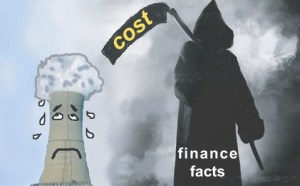
THE INDEPENDENT 7 April 09 Call for public inquiry as Sellafield recycling plant is costing taxpayer millions every year A controversial nuclear recycling plant, approved by the Government despite warnings over its economic viability and reliance on unproven technology, has racked up costs of more than £1bn and is still not working properly.
Backers of the plant at Sellafield, which promised to turn toxic waste into a useable fuel that could be sold worldwide, had claimed the plant would make a profit of more than £200m in its lifetime, producing 120 tonnes of recycled fuel a year. But after an investigation by The Independent, the Government admitted technical problems and a dearth in orders has meant it has produced just 6.3 tonnes of fuel since opening in 2001.
With construction and commissioning costs of more than £600m, the facility, known as the Mox plant because of the mixed oxides (Mox) fuel it is designed to produce, has cost more than £1.2bn, confirming its status as the nuclear industry’s most embarrassing white elephant and one of the greatest failures in British industrial history, losing the taxpayer £90m a year. Green campaigners and opposition MPs are now calling for the plant to be closed immediately, and a minister who fought its construction at the time has called for a public inquiry into how the plant was ever given the go-ahead.
‘No’ to nuclear power
‘No’ to nuclear power
Author: David Kennell
People’s Weekly World Newspaper 7 April 09 – “…………………………….The inherent danger of a nuclear accident is recognized by the Price-Anderson Act, which forces taxpayers (not the company) to be responsible for any major accident. Even if no accidents occur, or if plutonium-239 (half-life of 24,110 years), created in fast neutron reactors, is not lost or stolen to make nuclear weapons, there is still no known procedure to eliminate the high-level radioactive waste.
More than 95 percent of the waste products are cesium-137 and strontium-90, which have half-lives (lose 50 percent) of about 30 years. They are not the problem. The “transuranics” (isotopes of uranium, curium-245 and plutonium) have half-lives of thousands of years. So far, the much touted “recycling” requires purification of the transuranics and is very inefficient and difficult and has only been accomplished on a small laboratory scale. The planet is accumulating these highly lethal products with no place to put them.
About half the U.S. nuclear waste is at Hanford, Wash., in nuclear “sludge” acquired from our nuclear weapons program. The other half is from our 103 nuclear power plants. The Hanford waste is beginning to leak into the Columbia River.
As an aside, the unknown cost of waste disposal by currently unknown means is never considered when calculating dollar costs.
But the real costs cannot be measured in dollars. We are saddling future generations, hoping that future technology can solve the problem that has not been solved during the last 60 or so years…………….
Using nuclear fission to boil water is not only absurd — it could be the greatest folly of all time.
1 This Month
23-25 October – on Zoom – World BEYOND War’s annual global conferenc


Shut down the radiation-damaged Heysham nuclear reactors now
To see nuclear-related stories in greater depth and intensity – go to https://nuclearinformation.wordpress.com

Say No to NASA’s Reckless Nuclear Reactor on the Moon
Say No to NASA’s Reckless Nuclear Reactor on the Moon
-
Archives
- October 2026 (180)
- September 2026 (339)
- August 2026 (330)
- July 2026 (355)
- June 2026 (287)
- May 2026 (306)
- April 2026 (356)
- March 2026 (251)
- February 2026 (267)
- January 2026 (308)
- December 2025 (358)
- November 2025 (359)
-
Categories
- 1
- 1 NUCLEAR ISSUES
- business and costs
- climate change
- culture and arts
- ENERGY
- environment
- health
- history
- indigenous issues
- Legal
- marketing of nuclear
- media
- opposition to nuclear
- PERSONAL STORIES
- politics
- politics international
- Religion and ethics
- safety
- secrets,lies and civil liberties
- spinbuster
- technology
- Uranium
- wastes
- weapons and war
- Women
- 2 WORLD
- ACTION
- AFRICA
- Atrocities
- AUSTRALIA
- Christina's notes
- Christina's themes
- culture and arts
- Events
- Fuk 2022
- Fuk 2023
- Fukushima 2017
- Fukushima 2018
- fukushima 2019
- Fukushima 2020
- Fukushima 2021
- general
- global warming
- Humour (God we need it)
- Nuclear
- RARE EARTHS
- Reference
- resources – print
- Resources -audiovicual
- Weekly Newsletter
- World
- World Nuclear
- YouTube
-
RSS
Entries RSS
Comments RSS

