In first, Tepco admits ice wall can’t stop Fukushima No. 1 groundwater

The much-hyped ice wall at the crippled Fukushima No. 1 nuclear power plant has failed to stop groundwater from flowing in and mixing with highly radioactive water inside the wrecked reactor buildings, operator Tokyo Electric Power Co. Holdings Inc. has admitted.
Tepco officials also said at a meeting of the Nuclear Regulation Authority in Tokyo that it is not the utility’s ultimate goal to shut out groundwater with the ice wall, which has been built around the four damaged reactor buildings at the plant.
Tuesday’s announcement was apparently the first time the utility publicly said it is technically incapable of blocking off groundwater with the frozen wall.
Five years after the March 2011 quake and tsunami triggered the nuclear crisis, Tepco continues to be plagued by radiation-tainted groundwater, mostly rainwater that is mixing with contaminated water in the basement of the damaged reactor buildings.
In response, Tepco has completed most of the 1.5-km-long sunken wall of frozen soil around the stricken reactors to keep groundwater out. It has also built “subdrain” wells around the buildings to pump up the tainted groundwater for treatment and ultimate discharge into the Pacific.
While the completed sections of the ice wall began operating in March, it has not made a visible impact in reducing the amount of groundwater inflows. According to Tepco, the amount of groundwater pumped up from subdrains averaged 321 tons per day in June, just 31 tons less than the daily average in May.
Asked whether Tepco plans to eventually block rainwater from seeping through the ice wall, a Tepco official said it is not technically feasible “to keep out the groundwater 100 percent,” according to a video of the meeting released Tuesday by the NRA.
“We are aiming to control the amount of water going into the reactor buildings, with the ice wall and subdrains,” said Tomohiko Isogai, an official in charge of dismantling the plant.
Kiyoshi Takasaka, a nuclear expert at the Fukushima Prefectural Government, said it was the first time he had heard such a comment from Tepco, pressing the firm on whether it marked a “change of policy.”
A Tepco official denied this, saying that while it wants to “close off the wall as much as possible,” its ultimate goal has been to “curtail” groundwater inflow, not halt it.
Also at the meeting, NRA acting head Toyoshi Fuketa demanded that Tepco move quickly to reduce the amount of highly radioactive water inside the reactor buildings, saying such water presents the risk of escaping in the event of another monster tsunami. Some 60,000 tons of highly tainted water remain in the leaking basements of reactor buildings 1, 2, 3 and 4.
“We want the amount of (radioactive water) inside the buildings to be reduced as much as possible,” he said.
Fukushima’s Ice-Wall – A Fridge Too Far
The Tōhoku earthquake and tsunami on March 11, 2011 caused significant damage to the TEPCO Fukushima Daiichi nuclear power generation site. The damage inflicted to the plant’s cooling system, caused a ‘Loss of Coolant Accident’ resulting in nuclear meltdowns and releases of radioactive materials from several of its reactors. It was the largest nuclear disaster since the Chernobyl disaster of 1986 and only the second disaster (along with Chernobyl) to measure Level 7 on the International Nuclear Event Scale.
The reactor buildings were severely damaged to their foundations, and having been built on ‘made ground’ above a highly active and porous aquifer up to 50 metres deep, ground water began to penetrate the damaged reactor building’s basement at a significant rate. Initially this proved an aid to the immediate situation, with the cooling system out of action an emergency system was set up utilising site waters to cool the damaged reactors, with 400 tons of water being continuously poured into the damaged reactor buildings every day to cool them. On the downside, this cooling water became contaminated by the exposed molten fuel. Added to that, approximately 400 tons per day of groundwater flowing into the basements of the damaged buildings also became contaminated due to cracks in the reactor containment vessels. Approximately 800 tons of contaminated water was required to be pumped up every day from the damaged buildings and treated to minimise its harmful contaminant content. Even after treatment, these stored waters contained significant amounts of caesium-134, caesium-137, strontium-90 and tritium. The water that was not reused for cooling was stored in holding tanks. Needles to say the contaminated water is accumulating as such a rate that some discharges to the sea will become inevitable.
The technical problems posed for the authorities are immense. High level contamination around the damages reactors, massive structural damage, derelict buildings and radioactive debris spread over an extensive area. And an apparently unstoppable flow of ground water flooding buildings wherein the corium stumps of 3 melted-down reactors still lay. And as if to make matters worse, the water levels in the basement behaved tidally, indicating that the contaminated waters had a seriously large conduit or ‘preferential pathway’ to the open sea. With all of these issues, even with the Chernobyl experience, the Fukushima clean-up project is a massive, unique and highly challenging situation, that may take as long as 50 years or more to fully address.
In years following the disaster the Japanese authorities, struggling to meet the daunting challenges, came under increasing internal and external pressure to seek external assistance in the clean-up and remediation of the Fukushima plant. In response, in mid-2013, Japan’s International Research Institute for Nuclear Decommissioning Authority (IRID) made a worldwide call for technologies to address their radio-chemical contaminated water, and other technologies to assist to remediate the site. In a global ‘brainstorm’ they drew in a significant amount of good ideas and prospective valuable new technologies.
There are several key stages to ‘brainstorming‘. Setting the context and defining the problems faced at Fukushima are largely self evident. The plant needs to be made safe and decommissioned, and the wider environment beyond the plant needs to be remediated and restored, at least as far as is possible. In generating ideas, there needs to be a flow of ideas that are uncompromised by ‘mindset’. To this end those involved in the process are generally selected from both within and without the problem owning group and from as wide a range of expertise as possible. So as not to prohibit radical ideas or ideas that would be outside the technical culture of the problem owning group, it is quite normal to reserve any critical review at this stage, until everything is on the table. Thereafter, the filtering of ideas commences. The most promising are shortlisted and then follows a more detail examination of the pros and cons of each, where their merits and de-merits weighed. On selection of the best idea, any specific problems are addressed and if acceptable, the front runner goes forward to be implemented as an operational project.
Consider the operation requirements of decommissioning the Fukushima reactor buildings. There needs to a be robust containment wall put in place, to (a) control the immediate ingress and discharge of water (b) prevent spread of contamination during decommissioning and (c) a coffer must be installed to contain for what will remain a site of significant radiation risk for hundreds of years to come. The ‘brainstorming process seems to have fallen short at Fukushima. The concept of the ice-wall was mooted long before IRID’s call for technology, and advanced as the optimum solution before any wide-ranging brainstorming took place. Moreover, it would appear that the overseeing authorities had become ‘mindset’ on this solution, announcing the decision to construct the Ice-wall in September 2013 despite IRID still seeking and collecting worldwide technology submissions. Installation of facilities to create the ice-wall commenced in June 2014 and was completed on February 9, 2016 at an estimated to cost some ¥34.5 billion ($339 million). Activation was on March 31 this year, with commencement of the freezing of the seaward side wall. Freezing of the land-side wall commenced on June 6 and has as yet to achieve and control over the water ingress to the ice-walled coffer. Yet despite this commitment to the ‘ice-wall’ as a solution to the problem, serious questions arise as to whether this technology is capable of meeting the short term needs, let alone the medium or long-term containment needs.
Ice-wall technology has been used in Japan on hundreds of occasions in civil engineering projects to stem flooding and avoid collapse issues in tunnelling. The purported principal benefit of using a frozen barrier compared with a physical barrier is that it avoids the challenges of building a wall around such underground obstacles as pipes, which it can freeze plug, and if complete, create a seamless barrier. Once in place, frozen walls take a long time to melt and therefore if the site were hit by another earthquake or tsunami the wall might stay intact for a couple of months, allowing time for its refrigeration plant to be repaired and power restored.
As for the cons, relative to what is required at Fukushima, ice-wall technology has only ever been used on a short term basis, and never for a semi-permanent installation. None have run for the decades that Fukushima’s wall would need to be in place. The Fukushima wall at 1,500 metres in length, 30 metres in depth and at circa 70,000 cubic metres in volume would be nearly double the size of the largest prior ice-wall ever constructed. Curiously it was designed only as a partial barrier in that it doesn’t reach to 50 meters to the impermeable rock strata below the aquifer and thus it has no containment floor beneath the site. Such a wall has never been constructed on such a highly active aquifer and it is quite a different matter to freezer moving water. As an added complication, due to the proximity of the sea to the site and the existence of preferential pathways to the sea, the groundwater would have a high mineral content and be highly saline, containing salts of sodium, potassium and critically calcium. Owing to this mixed salinity, freezing to below 0oC would not be nearly enough to freeze the soil-water column solid and stop the water flow. The ground soil-water column would have to be taken to below -21oC and possibly to -41oC. TEPCO are utilising a CaCl2/card-ice eutectic coolant, which has a minimum freezing temperature of -41oC ‘at the pump’ and closer to -25oC in the cooling pipes. It would be hard pressed to get the ground temperature to -21oC due to heat ingress, and even at its coldest it won’t freeze a calcium rich saline system solid. As for the heat ingress into the system, we mustn’t forget that we are trying to enclose 3 very warm meltdown corium stumps, effectively comprising a ‘hot-spring’ at the centre of the ice-wall structure. Over and above that heat, the Fukushima site is located next to the Pacific and has seasonally warm southerly currents bathing the site’s shore front during the summer months bringing yet more heat into the system. Even with a heat exchanger rated at 12.6 Mega Watt, (that’s about enough energy to run a small town), it’s a big ask, and I fear that given the geotechnical circumstances the desired ice-wall project outcomes are beyond the capacity of this technology.
A complication of ice-wall technology is that it causes ground heave. The ice causes the ground to swell, creating a sheer between the unfrozen ground and the ice swollen frozen ground. So, further damage to the foundations of the stricken buildings and localised subsidence is likely. A greater problem might ensue when the wall is thawed. The chewing of the ground by the ground heave process would likely destroy subsoil texture and leave the ground more permeable to water than before.
Given the pros and cons of an ice-wall I ask the question; why didn’t TEPCO opt for a jet grouted cement/mortar double wall that could have totally enclosed the site, as this was the method of choice for controlling groundwater migration at Chernobyl? It would be possible to jet grout below the buildings and flexible ‘soft wall’ mortars could be used rather than Ordinary Portland Cement (OPC) to guard against fracture by future earthquakes.
At present TEPCO contend that the ice wall project is going to plan. However, Japan’s Nuclear regulatory authority (NRA) aren’t yet convinced, pointing out that the ice wall has yet to impact the collection of water in waterfront wells. Test wells within and without the ice wall indicated water levels tracking each other over time, showing the internal and external groundwater systems still interconnected. Moreover, the much vaunted advantage of the ice wall in being able to seal around a plug pipes appears not to be the case a Fukushima, where underground pipes and conduits remain warm and are probably acting as the preferential pathways for water ingress and egress. NRA committee member Toyoshi Fuketa recently stated, “This is not a wall in a true sense. Perhaps it’s more akin to a bamboo screen, with groundwater trickling through the gaps”. It would now seem that in response to criticism and to control the water flow TEPCO are now resorting to a hybrid approach by trying to cement closed the holes in the wall. The problem with cement is, it doesn’t set well below 0oC, but other related sealant options are available.
Thus far, it would appear that after 5 years with the bill racing toward $500 million, all TEPCO’s Ice-wall project has achieved is a very expensive steaming ‘slushy’ and no control over water ingress into the site. Indeed there is little control on water egress from the site other than by continual pumping from the reactor building basement to tanks to maintain the basement water levels below groundwater, and in doing so hope migration of contamination into the sea is prevented. Maybe it’s time to ‘call it a day’, purge the mindset and re-brainstorm the problem.
https://www.linkedin.com/pulse/fukushimas-ice-wall-fridge-too-far-peter-j-hurley
NRA casts doubt on TEPCO ice wall project at Fukushima nuke plant

In March this year, Tokyo Electric Power Co. (TEPCO) began work on a subterranean wall of frozen soil mainly on the seaward side of the disaster-stricken Fukushima No. 1 nuclear plant, with most of another wall on the landward side begun in June. The purpose of the barriers is to stop the flow of groundwater into the plant buildings — a problem that has resulted in enormous volumes of contaminated water. However, three months since the freezing process began, TEPCO is ominously silent on the ice wall’s effectiveness, and the plan is quickly approaching its do-or-die moment.
The problem itself is simply put. Every day, some 850 metric tons of groundwater flows down from the mountains and under the Fukushima No. 1 plant property. Some of the water collects in the shattered reactor buildings, coming into contact with melted nuclear fuel and other radioactive substances and becoming heavily contaminated. TEPCO needs to stop the groundwater from getting into these buildings.
In September 2015, the utility started digging a chain of wells called subdrains to catch and drain the groundwater. This is just one of many countermeasures tried so far, including the ice wall. Work on the latter began in June 2014, and eventually 1,568 pipes were sunk along a 1.5-kilometer perimeter around the No. 1-4 reactors and turbine buildings. The plan calls for coolant chilled to minus 30 degrees Celsius to be pumped into the pipes, freezing the soil around them to a depth of about 30 meters and creating a solid barrier.
“Ice walls are often used in public works projects, but the one at the Fukushima No. 1 nuclear plant is by far the largest ever tried,” says Mie University associate professor Kunio Watanabe. When building a tunnel, for example, ice walls are used to prevent groundwater from flowing into the construction area after the bedrock has been fractured. In Japan, the method has been used on some 600 such projects since 1962. The largest ice wall ever created was about 37,700 cubic meters, during construction of a subway line in Tokyo. The Fukushima plant ice wall is nearly double that, at about 70,000 cubic meters.
TEPCO tested the method in April 2015, freezing one section of the subterranean wall. To stop contaminated groundwater from flowing into the ocean, the utility started injecting coolant in the pipes on the seaward side and part of the landward wall in late March in an attempt to create about an 820-meter-long subterranean barrier — or 55 percent of the eventual total length. Saying that the temperatures were dropping according to plan, the utility started freezing operations on most of the remaining landward section at the beginning of June, and now only seven sections totaling 45 meters on the landward side are left.
TEPCO has stated that “the ice wall is going according to plan.” However, the Nuclear Regulation Authority (NRA) has pointed out that the volume of groundwater collecting in waterfront wells has not decreased, casting doubt on TEPCO’s claim.
At a meeting this month, NRA committee member Toyoshi Fuketa stated, “This is not a wall in a true sense. Perhaps it’s more akin to a bamboo screen, with groundwater trickling through the gaps.” TEPCO has responded that the quick flow of the groundwater likely makes it hard to freeze the soil in some places, and it is proceeding with work to create cement barriers to slow the water down.
There are also worries that the large volumes of highly contaminated water already collecting in the reactor and turbine buildings could leak into the environment if only the landward ice wall proves effective and the seaward wall has gaps. While TEPCO is looking to expand the ice wall, the NRA has not altered its stance that it must first confirm the effectiveness of the freezing operations already undertaken. The ice wall has already cost 34.5 billion yen in government funds.
http://mainichi.jp/english/articles/20160630/p2a/00m/0na/006000c
Tepco to inject cement instead of frozen water wall

On 6/2/2016, Tepco reported to NRA (Nuclear Regulation Authority) that they need to inject cement to “frozen” water wall and NRA admitted it.
The feasibility of frozen water wall project was questioned since before the beginning. In the meeting of NRA, Tepco admitted the temperature remains nearly 10 ℃ at 4 “freezing” points to cause no improvement to stop contaminated groundwater. It has been in freezing operation for over 2 months.
These 4 points are situated between the reactor buildings and the sea. The volume of contaminated water to be pumped up has not been decreased regardless of the frozen water wall.
Tepco states the temperature remains over 0 ℃ because of the high speed of groundwater. They inject cement to slower the water.
Click to access handouts_160602_06-j.pdf
http://photo.tepco.co.jp/date/2016/201606-j/160606-01j.html
TEPCO expands ice wall operations at Fukushima
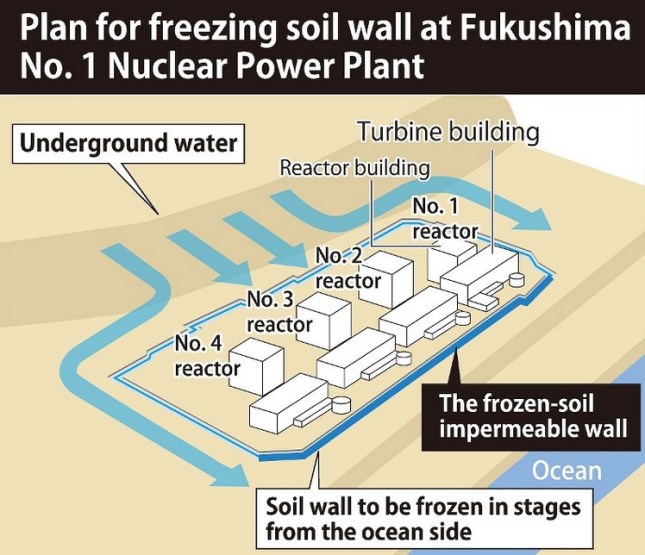
Tokyo Electric Power Company has expanded operations to create an underground ice wall at the Fukushima Daiichi nuclear plant to stop the volume of contaminated groundwater from increasing.
TEPCO on Monday began injecting a liquid refrigerant into more pipes that make up the 1,500-meter wall surrounding 4 damaged reactor buildings. The operation now covers 95 percent of the wall.
Groundwater flows into the buildings and becomes tainted with radioactive substances. Reducing its volume is a key to decommissioning the reactors.
The operation started in March on the downstream side of the wall because lowering the water levels too much could cause tainted water to leak from the buildings.
Workers began freezing the upstream side after making sure there were no leaks.
The ice wall project still faces challenges. Ground temperatures have not fallen in some places, and groundwater levels outside the wall have not gone down.
Also on Monday, workers began injecting cement into the ground where temperatures have not fallen.
TEPCO examines ice wall at Fukushima Daiichi
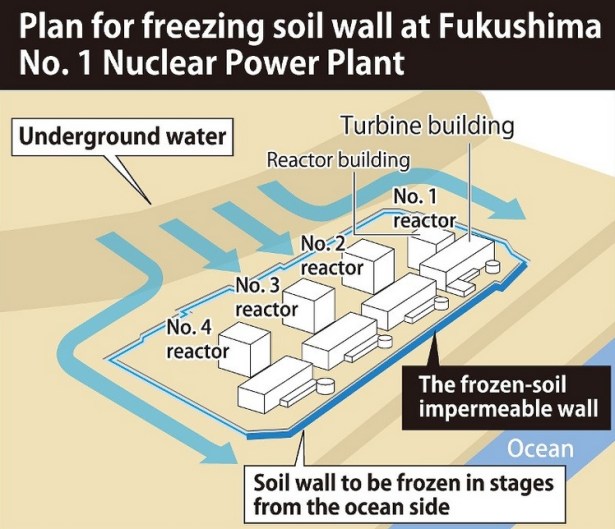
The operator of Fukushima Daiichi nuclear power plant will conduct extra work to help freeze the ground around the buildings housing the 4 crippled reactors.
Tokyo Electric Power Company discussed the idea with officials of the Nuclear Regulation Authority on Thursday.
TEPCO made the proposal after reporting some problems with a 1.5-kilometer-long frozen soil wall it has been building around the 4 reactor buildings since March.
The wall is aimed at cutting the amount of groundwater flowing into the basement of the buildings, where it becomes contaminated with radioactive substances and can flow out of the plant in the direction of the sea.
TEPCO said the amount of groundwater in some areas outside the wall near the sea has not yet fallen.
TEPCO said rainfall may be partly to blame for the problem, and added that it has seen a drop in groundwater levels elsewhere, in areas much closer to where the wall has been completed successfully. TEPCO said that, overall, the wall appears to be proving effective.
But many members of the regulatory agency said TEPCO’s argument is not convincing enough.
TEPCO admitted that underground temperatures at several locations along the wall have not yet fallen to zero, which indicates that the ground is not frozen there.
TEPCO said it will start extra work to pour cement into those locations to help seal off the wall completely.
The utility said it will be about a month before it can determine if the extra work has started producing a positive effect in reducing the amount of groundwater flowing in.
http://www3.nhk.or.jp/nhkworld/en/news/20160602_28/
In Fukushima, even robots can’t survive nuclear mayhem
The company that runs the Fukushima plant sent 5 robots to ground zero and not a single one survived. Incredibly high radiations in the block causes heat levels to rise and this melts the robots’ wiring.
A tsunami, triggered by an earthquake on March 11, 2011, initiated the Fukushima Daaiichi nuclear disaster in Japan which led to the evacuation of over 200,000 people.
Even after 5 years, there is still a tremendous amount of cleanup work left at ground zero. The Tokyo Electric Power Co. (TEPCO) which runs the plant has managed to clean up one building but is still struggling to do the same with other buildings which has burnt fuel rods. These fuel rods are nothing but chunks of radioactive waste weighing hundreds of metric tonnes.
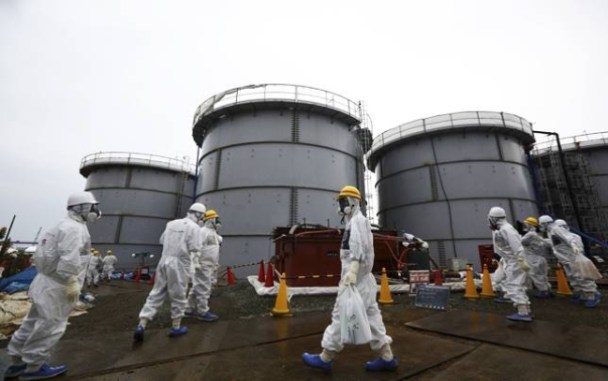
It took 2 years for TEPCO to design the robots for the job of extracting melted fuel rods and according to TEPCO’s head of decommissioning, Naohiro Masuda, the heat levels due to radiation are so extreme that it simply melts the robot’s wiring.
Japan had been trying out various methods to stop the radiations from damaging the area further. One such method was building “ice walls” to keep groundwater from reaching the reactors. A refrigerant chemical that forms an ice wall to block Fukushima’s fallout water and stop the ground water intrusion into the plant.

A million metric tonnes of irradiated water is being stored on the site and is pumped in to cool down the reactors. Disposing the radioactive water is still a challenge for TEPCO as storage tanks have already leaked some of the material into the ocean.
After TEPCO’s robots not surviving the heat levels of the radiations, it’s a place for no man or machine. Toshiba has developed new robots for picking up the fuel rods and to clean up the scene which previous robots failed to.
The entire cleanup process is expected to take around 30 to 40 years, but TEPCO is being blamed for its lukewarm response to the incident and is facing flak from the Japanese government and the people alike.
10% of TEPCO’s frozen soil wall at Fukushima site not working

The solid frozen soil wall that Tokyo Electric Power Co. is trying to create at its stricken Fukushima No. 1 nuclear power plant is falling short of expectations.
TEPCO said May 25 its attempt to freeze the soil around the crippled reactors to decrease contaminated groundwater has hit an unexpected glitch.
The utility said it has been unable to freeze the soil at about 10 percent of points it surveyed even though more than one-and-a-half months have passed since the program started.
This is due to the fact that soil temperatures have failed to drop sufficiently. In places where the temperature remains especially high, there is a possibility the soil will never freeze.
TEPCO reported the situation to the Nuclear Regulation Authority, the nation’s nuclear watchdog, saying it plans to implement additional work, such as injecting cement or other materials into the soil.
The project involved the construction of a 1,500-meter-long circular frozen soil wall around the No. 1 to No. 4 reactor buildings. The utility inserted 1,568 pipes to a depth of 30 meters and 1 meter apart. The idea was that each pipe would then freeze the soil around it once liquid of minus 30 degrees circulated inside the cylinders.
The project is aimed to stop flow of groundwater into reactor buildings, where melted nuclear fuel has accumulated in the basements, and, as a result, reduce the volume of highly contaminated water.
To date, around 34.5 billion yen ($315 million) has been spent on the project.
TEPCO started to freeze the soil in late March, with the goal of first creating an 820-meter-long portion, mainly along the side of the plant facing the sea.
According to TEPCO, the temperature of soil around pipes was lower than zero in only 88 percent of 5,800 or so sites it surveyed as of May 17. In the remaining 12 percent, temperatures were as high as 10 degrees in places.
In spots where temperatures fell short, the soil wall was riddled with holes. TEPCO plans to fill them in by injecting cement or other agents.
On the site of the plant facing a mountain, the utility has been freezing the soil in phases. Although it had planned to double the number of frozen soil sites as early as mid-May, that has not materialized.
“If the effects of the frozen soil wall fall short of what we have expected, we will hold talks with TECPO about additional steps,” said an NRA official in charge of the issue.
TEPCO: Frozen soil wall proving effective

The operator of the Fukushima Daiichi nuclear plant says the work to freeze soil around the crippled reactors is making progress. It is designed to stop radioactive groundwater from flowing out of the facilities.
Tokyo Electric Power Company began freezing the soil in late March to make a 1.5-kilometer frozen wall surrounding the 4 reactors.
The reactor facilities have been the main source of radioactive contamination of groundwater at the plant.
TEPCO says that as of Tuesday, more than 80 percent of 6,000 checkpoints set up along the wall logged temperatures below zero. The operator says it means the freezing work is going well.
It also says that groundwater levels are rising in areas between the reactor facilities and the frozen wall along the coast. TEPCO officials assume the wall is preventing the water from seeping out. But water is still coming in through some unfrozen parts of the hillside.
Officials told reporters on Thursday that they will further carefully monitor the effect of the frozen wall and seek its completion.
http://www3.nhk.or.jp/nhkworld/en/news/20160520_03/
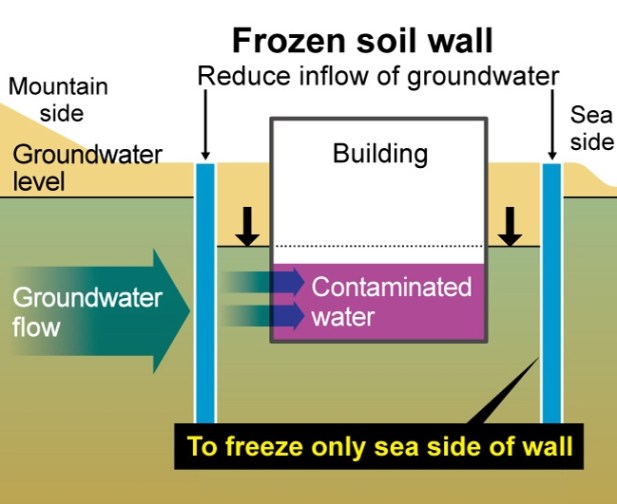
Below are diagrams from TEPCO’s newest report:http://www.tepco.co.jp/nu/fukushima-np/handouts/2016/images1/handouts_160519_02-j.pdf
Ice wall designed to surround Fukushima wreckage
TOKYO (AP) – Coping with the vast amounts of ground water flowing into the broken Fukushima nuclear plant – which then becomes radiated and seeps back out – has become such a problem that Japan is building a 35 billion yen ($312 million) “ice wall” into the earth around it.
But even if the frozen barrier built with taxpayers’ money works as envisioned, it won’t completely block all water from reaching the damaged reactors because of gaps in the wall and rainfall, creating as much as 50 tons of contaminated water each day, said Yuichi Okamura, a chief architect of the massive project.
“It’s not zero,” Okamura said of the amount of water reaching the reactors in an interview with The Associated Press earlier this week. He is a general manager at Tokyo Electric Power Co., or TEPCO, which operates the facility that melted down after it was hit by a tsunami in 2011, prompting 150,000 people to evacuate.
Workers have rigged pipes that constantly spray water into the reactors to keep the nuclear debris inside from overheating, but coping with what to do with the resulting radiated water has been a major headache. So far, the company has stored the water in nearly 1,000 huge tanks around the plant, with more being built each week.
TEPCO resorted to devising the 1.5-kilometer (1-mile)-long ice wall around the facility after it became clear it had to do something drastic to stem the flow of groundwater into the facility’s basement and keep contaminated water from flowing back out.
“It’s a vicious cycle, like a cat-and-mouse game,” Okamura said of the water-related issues. “We have come up against many unexpected problems.”
The water woes are just part of the many obstacles involved in controlling and dismantling the Fukushima Dai-chi plant, a huge task that will take 40 years. No one has even seen the nuclear debris. Robots are being created to capture images of the debris. The radiation is so high no human being can do that job.
The ice wall, built by construction company Kajima Corp., is being turned on in sections for tests, and the entire freezing process will take eight months since it was first switched on in late March. The entire wall requires as much electricity as would power 13,000 Japanese households.
Edward Yarmak, president of Arctic Foundations, based in Anchorage, Alaska, which designs and installs ground freezing systems and made an ice wall for the Oak Ridge reactor site, says the solution should work at Fukushima.
“The refrigeration system has just been turned on, and it takes time to form the wall. First, the soil freezes concentrically around the pipes and when the frozen cylinders are large enough, they coalesce and form a continuous wall. After time, the wall increases in thickness,” he said in an email.
But critics say the problem of the groundwater reaching the reactors was a no-brainer that should have been projected.
Building a concrete wall into the hill near the plant right after the disaster would have minimized the contaminated water problem considerably, says Shigeaki Tsunoyama, honorary professor and former president of University of Aizu in Fukushima.
Even at the reduced amount of 50 tons a day, the contaminated water produced at Fukushima will equal what came out of Three Mile Island’s total in just eight months because of the prevalence of groundwater in Fukushima, he said.
Although TEPCO has set 2020 as the goal for ending the water problems, Tsunoyama believes that’s too optimistic.
“The groundwater coming up from below can never become zero,” he said in a telephone interview. “There is no perfect answer.”
Okamura acknowledged the option to build a barrier in the higher elevation near the plant was considered in the early days after the disaster. But he defended his company’s actions.
The priority was on preventing contaminated water from escaping into the Pacific Ocean, he said. Various walls were built along the coastline, and radiation monitors show leaks have tapered off over the last five years.
Opponents of nuclear power say the ice wall is a waste of taxpayers’ money and that it may not work.
“From the perspective of regular people, we have serious questions about this piece of research that’s awarded a construction giant,” says Kanna Mitsuta, director of ecology group Friends of the Earth Japan. “Our reaction is: Why an ice wall?”
Fukushima ice wall won’t stop all radioactive groundwater from seeping out – chief architect

Chief architect Yuichi Okamura told AP that gaps in the wall and rainfall will still allow for water to creep into the facility and reach the damaged nuclear reactors, which will in turn create as much as 50 tons of contaminated water each day.
“It’s not zero,” Okamura, a general manager at Tokyo Electric Power Co. (TEPCO) said. “It’s a vicious cycle, like a cat-and-mouse game…we have come up against many unexpected problems.”
The wall, which will be 1.5km (1 mile) long, will consist of an underground pipe network stretching 30 meters (100 feet) below the surface, around the reactor and turbine buildings. The pipes are designed to transport refrigerant cooled to -30° Celsius (-22°F) to chill the nearby soil until it freezes.
The barrier is being turned on in sections for tests, and the entire freezing process will take eight months since it was first switched on in late March. The process requires an amount of electricity that would power 13,000 Japanese households.
Despite its current efforts, TEPCO – the operator of the Fukushima plant – has been fiercely criticized by those who say the groundwater issue should have been forecasted and dealt with sooner.
Shigeaki Tsunoyama, an honorary professor and former president of University of Aizu in Fukushima, said that building a concrete wall built into the hill near the plant after the disaster would have minimized the contaminated water issue.
Okamura acknowledged that the option of building a barrier at a higher elevation near the plant was considered in the days following the disaster, but defended the actions of TEPCO, stressing that the priority is on preventing contaminated water from escaping into the Pacific Ocean.
Others have criticized the US$312 million wall, which is being built by construction company Kajima Corp., as a waste of taxpayer money.
TEPCO has repeatedly faced criticism for its handling of the Fukushima crisis, which occurred after a massive earthquake and subsequent tsunami led to a meltdown of reactors at the facility in March 2011. The disaster was the worst nuclear accident to take place since Chernobyl in 1986.
The company has admitted that it did not act properly during the disaster, confessing in February that it announced the nuclear meltdowns far too late. It also stated in a 2012 report that it downplayed safety risks caused by the incident, out of fear that additional measures would lead to a shutdown of the plant and further fuel public anxiety and anti-nuclear campaigns.
Despite the ongoing problems encountered following the meltdowns, TEPCO has set 2020 as the goal for ending the plant’s water problem – an aim which critics say is far too optimistic.
However, the water problem is just part of the monumental challenges faced at the facility. Controlling and dismantling the plant is expected to take 40 years. Robots have been tasked with taking photos of the debris, as the radiation levels are too high for humans to complete the job.
https://www.rt.com/news/341231-fukushima-ice-wall-groundwater/
Fukushima plant’s new ice wall not watertight

In this Feb. 10, 2016, file photo, members of a media tour group wearing protective suits and masks walk together after they receive a briefing from Tokyo Electric Power Co. employees (in blue) in front of storage tanks for radioactive water at the tsunami-crippled Fukushima Dai-ichi nuclear power plant in Okuma, Fukushima Prefecture
TOKYO (AP) — Coping with the vast amounts of ground water flowing into the broken Fukushima nuclear plant — which then becomes radiated and seeps back out — has become such a problem that Japan is building a 35 billion yen ($312 million) “ice wall” into the earth around it.
But even if the frozen barrier built with taxpayers’ money works as envisioned, it won’t completely block all water from reaching the damaged reactors because of gaps in the wall and rainfall, creating as much as 50 tons of contaminated water each day, said Yuichi Okamura, a chief architect of the massive project.
“It’s not zero,” Okamura said of the amount of water reaching the reactors in an interview with The Associated Press earlier this week. He is a general manager at Tokyo Electric Power Co., or TEPCO, which operates the facility that melted down after it was hit by a tsunami in 2011, prompting 150,000 people to evacuate.
Workers have rigged pipes that constantly spray water into the reactors to keep the nuclear debris inside from overheating, but coping with what to do with the resulting radiated water has been a major headache. So far, the company has stored the water in nearly 1,000 huge tanks around the plant, with more being built each week.
TEPCO resorted to devising the 1.5-kilometer (1-mile)-long ice wall around the facility after it became clear it had to do something drastic to stem the flow of groundwater into the facility’s basement and keep contaminated water from flowing back out.
“It’s a vicious cycle, like a cat-and-mouse game,” Okamura said of the water-related issues. “We have come up against many unexpected problems.”
The water woes are just part of the many obstacles involved in controlling and dismantling the Fukushima Dai-chi plant, a huge task that will take 40 years. No one has even seen the nuclear debris. Robots are being created to capture images of the debris. The radiation is so high no human being can do that job.
The ice wall, built by construction company Kajima Corp., is being turned on in sections for tests, and the entire freezing process will take eight months since it was first switched on in late March. The entire wall requires as much electricity as would power 13,000 Japanese households.
Edward Yarmak, president of Arctic Foundations, based in Anchorage, Alaska, which designs and installs ground freezing systems and made an ice wall for the Oak Ridge reactor site, says the solution should work at Fukushima.
“The refrigeration system has just been turned on, and it takes time to form the wall. First, the soil freezes concentrically around the pipes and when the frozen cylinders are large enough, they coalesce and form a continuous wall. After time, the wall increases in thickness,” he said in an email.
But critics say the problem of the groundwater reaching the reactors was a no-brainer that should have been projected.
Building a concrete wall into the hill near the plant right after the disaster would have minimized the contaminated water problem considerably, says Shigeaki Tsunoyama, honorary professor and former president of University of Aizu in Fukushima.
Even at the reduced amount of 50 tons a day, the contaminated water produced at Fukushima will equal what came out of Three Mile Island’s total in just eight months because of the prevalence of groundwater in Fukushima, he said.
Although TEPCO has set 2020 as the goal for ending the water problems, Tsunoyama believes that’s too optimistic.
“The groundwater coming up from below can never become zero,” he said in a telephone interview. “There is no perfect answer.”
Okamura acknowledged the option to build a barrier in the higher elevation near the plant was considered in the early days after the disaster. But he defended his company’s actions.
The priority was on preventing contaminated water from escaping into the Pacific Ocean, he said. Various walls were built along the coastline, and radiation monitors show leaks have tapered off over the last five years.
Opponents of nuclear power say the ice wall is a waste of taxpayers’ money and that it may not work.
“From the perspective of regular people, we have serious questions about this piece of research that’s awarded a construction giant,” says Kanna Mitsuta, director of ecology group Friends of the Earth Japan. “Our reaction is: Why an ice wall?”
http://mainichi.jp/english/articles/20160428/p2g/00m/0dm/096000c
Freezing of soil near Fukushima plant going well, says TEPCO

Rainwater is discharged from newly constructed drainage outlets into the plant’s harbor during a media tour at the Fukushima No. 1 nuclear power plant on April 4.
The freezing of soil around the Fukushima No. 1 nuclear power plant to block the flow of groundwater is proceeding “largely smoothly,” the plant operator said April 4.
Tokyo Electric Power Co. started making a frozen underground wall in late March around the No. 1 to No. 4 reactors at the plant, which suffered a triple meltdown triggered by the March 2011 earthquake and tsunami.
The final part of the construction process to freeze the soil was unveiled to the media for the first time April 4 during a visit to the site by Yosuke Takagi, state minister of the economy.
To build the frozen soil wall to prevent groundwater flowing into the four reactor buildings and becoming contaminated with radioactive substances, the utility inserted 1,568 pipes to a depth of 30 meters and 1 meter apart.
The company is now circulating liquid with a temperature of minus 30 degrees through the pipes to first freeze the soil on the side of the sea so as not to drastically change the groundwater level at the plant.
As of April 4, the soil temperature had dropped to minus 4 to 6 degrees at some locations, according to TEPCO.
“While we need to keep making efforts to control the temperature deliberately, we can say that the project is proceeding largely smoothly so far,” the company spokesman said.
The utility also unveiled new drainage outlets for the K drainage channel to discharge water into the plant’s harbor and block it from being released into the outer ocean.
The construction of the new outlets was completed March 28. Radiation-contaminated rainwater coming through the K drainage channel had previously often flown into the outer ocean when it rained.
‘Ice Wall’ Is Japan’s Last-Ditch Effort To Contain Fukushima Radiation
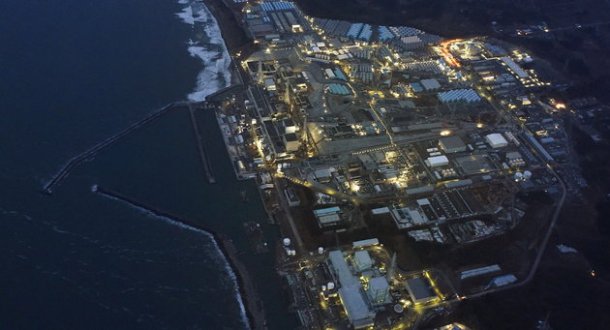
Tokyo Electric Power Co.’s (TEPCO) tsunami-crippled Fukushima Daiichi nuclear power plant is illuminated for decommissioning operation in the dusk in Okuma town, Fukushima prefecture, Japan, in this aerial view photo taken by Kyodo March 10, 2016, a day before the five-year anniversary of the March 11, 2011 earthquake and tsunami disaster.
• The nearly mile-long structure consists of underground pipes designed to form a frozen barrier around the crippled reactors.
• The $312 million system was completed last month, more than a year behind schedule.
• Nearly 800,000 tons of radioactive water are already being stored onsite.
Japanese authorities have activated a large subterranean “ice wall” in a desperate attempt to stop radiation that’s been leaking from the Fukushima Daiichi nuclear power plant for five years.
The wall consists of a series of underground refrigeration pipes meant to form a frozen soil barrier around the four reactors that were crippled during the 2011 Tohoku earthquake and tsunami.
Construction of the $312 million government-funded structure was completed last month, more than a year behind schedule, the Associated Press reports. The nearly mile-long barrier is intended to block groundwater from entering the facility and becoming contaminated.
Tokyo Electric Power Co., or TEPCO, which owns the plant, activated the system Thursday, a day after obtaining approval from Japan’s Nuclear Regulation Authority.
In a video detailing the ice wall’s design, TEPCO said the technology has been successfully used to prevent water intrusion during the construction of tunnels, but this is the first time it has been used to block water from entering a nuclear facility.
“We will create an impermeable barrier,” the company said, “by freezing the soil itself all the way down to the bedrock that exists below the plant. When groundwater flowing downhill reaches this frozen barrier it will flow around the reactor buildings, reaching the sea just as it always has, but without contacting the contaminated water within the reactor buildings.”
TEPCO says the ice wall will be activated in stages over the next several months and is one of several measures the company is taking to reduce the amount of water being contaminated on the site.
Nearly 800,000 tons of radioactive water are already being stored in more than 1,000 industrial tanks at the nuclear plant, according to the AP.
While hopes are high that the ice wall will prove successful in stopping additional radioactive water from seeping into the Pacific Ocean, Shunichi Tanaka, chairman of the Nuclear Regulation Authority, urged caution.
“It would be best to think that natural phenomena don’t work the way you would expect,” he told reporters Wednesday, according to the AP report.
The activation of the ice wall comes just weeks after a TEPCO official reported that robots designed to access the dangerous interior of the plant and seek out the melted fuel rods were “dying” from the high levels of radiation.
The video below details how the ice wall is expected to work.
Ice wall at Fukushima plant switched on, but will it work?
by MARI YAMAGUCHI Mar. 31, 2016
TOKYO (AP) — The operator of Japan’s destroyed Fukushima nuclear plant switched on a giant refrigeration system on Thursday to create an unprecedented underground ice wall around its damaged reactors. Radioactive water has been flowing from the reactors, and other methods have failed to fully control it. The decontamination and decommissioning of the plant, damaged by a massive earthquake and tsunami in 2011, hinge of the success of the wall.
Q. WHAT IS AN ICE WALL?
A. Engineers installed 1,550 underground refrigeration pipes designed to create a 1.5-kilometer (0.9-mile) barrier of frozen soil around four damaged reactor buildings and their turbines to control groundwater flowing into the area and prevent radioactive water from seeping out. The pipes are 30 meters (100 feet) deep, the equivalent of a 10-story building. Engineers say coolant in the pipes will freeze the surrounding soil to minus 30 degrees Celsius (minus 22 Fahrenheit), creating the wall over several months.
Q. WHY IS AN ICE WALL NEEDED?
A. The cores of three of the damaged reactors melted during the accident and must be cooled constantly with water to keep them from overheating again. The cooling water becomes radioactive and leaks out through damaged areas into the building basements, where it mixes with groundwater, increasing the volume of contaminated water. Nearly 800,000 tons of radioactive water have been pumped out, treated and stored in 1,000 tanks that now occupy virtually every corner of the Fukushima plant, interfering with its decontamination and decommissioning and adding to the risk of further leaks of water into the nearby ocean.
Q. ARE THERE RISKS?
A. Construction officials say the coolant is environmentally safe. There were doubts that the huge refrigeration system could effectively freeze the soil while groundwater continues to flow in the area. The operator, Tokyo Electric Power Co., says results from a test of part of the wall last summer were mixed but suggest the system has sufficient capability. Experts are also concerned that an ice wall cannot be adjusted quickly in an emergency situation, such as a sudden increase in the flow of contaminated water, because it takes several weeks to freeze or melt. Electrical costs for running the refrigeration system could be steep. TEPCO says the wall, once formed, can remain frozen for up to two months in the event of a power failure.
Q. WHO MADE THE ICE WALL?
A. The 35 billion yen ($312 million) project was funded by the government and built by Kajima Corp., which has used similar technology in smaller projects such as subway construction. The wall was delayed by technical uncertainties and was finished last month, a year behind schedule.
1 This Month
10 March A LIVE WEBINAR THE REAL EFFECTS OF NUCLEAR POWER
What the Industry Isn’t Telling Us
1:00 PM Mountain, 2 pm Central, 3 pm Eastern. Live on the Keepers of the Water Facebook page



18 March Webinar @ 1 PM EST: An Assessment of SMR Projects: The Case of Canada
register for the zoom:
https://us02web.zoom.us/webinar/register/WN_o8BIIOUvQ2ONJR1nta65DQ#/registration


of the week – STOP SMALL MODULAR REACTORS IN CANADA
To see nuclear-related stories in greater depth and intensity – go to https://nuclearinformation.wordpress.com
-
Archives
- March 2026 (109)
- February 2026 (268)
- January 2026 (308)
- December 2025 (358)
- November 2025 (359)
- October 2025 (376)
- September 2025 (258)
- August 2025 (319)
- July 2025 (230)
- June 2025 (348)
- May 2025 (261)
- April 2025 (305)
-
Categories
- 1
- 1 NUCLEAR ISSUES
- business and costs
- climate change
- culture and arts
- ENERGY
- environment
- health
- history
- indigenous issues
- Legal
- marketing of nuclear
- media
- opposition to nuclear
- PERSONAL STORIES
- politics
- politics international
- Religion and ethics
- safety
- secrets,lies and civil liberties
- spinbuster
- technology
- Uranium
- wastes
- weapons and war
- Women
- 2 WORLD
- ACTION
- AFRICA
- Atrocities
- AUSTRALIA
- Christina's notes
- Christina's themes
- culture and arts
- Events
- Fuk 2022
- Fuk 2023
- Fukushima 2017
- Fukushima 2018
- fukushima 2019
- Fukushima 2020
- Fukushima 2021
- general
- global warming
- Humour (God we need it)
- Nuclear
- RARE EARTHS
- Reference
- resources – print
- Resources -audiovicual
- Weekly Newsletter
- World
- World Nuclear
- YouTube
-
RSS
Entries RSS
Comments RSS
 nuclear-news