NRA: Ice wall effects ‘limited’ at Fukushima nuclear plant
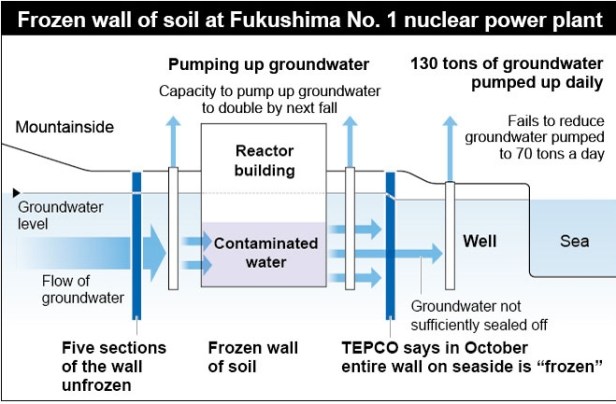
Citing “limited, if any effects,” the Nuclear Regulation Authority said a highly touted “frozen soil wall” should be relegated to a secondary role in reducing contaminated groundwater at the Fukushima No. 1 nuclear plant.
The government spent 34.5 billion yen ($292 million) to build the underground ice wall to prevent groundwater from mixing with radioactive water in four reactor buildings at the crippled plant.
But the NRA, Japan’s nuclear watchdog, concluded on Dec. 26 that the wall has been ineffective in diverting the water away from the buildings. It said that despite the low rainfall over the past several months, the amount of groundwater pumped up through wells outside the frozen wall on the seaside is still well above the reduction target.
It urged the plant operator, Tokyo Electric Power Co., to tackle the groundwater problem primarily with pumps, not the ice wall.
In response, TEPCO at the meeting said that by next autumn, it will double its capacity to pump up groundwater from the current 800 tons a day.
About 400 tons of groundwater enters the damaged reactor buildings each day and mixes with highly radioactive water used to cool melted nuclear fuel.
The ice wall project, compiled by the industry ministry in May 2013, was seen as a fundamental solution to this problem that has hampered TEPCO’s cleanup efforts since the triple meltdown in March 2011.
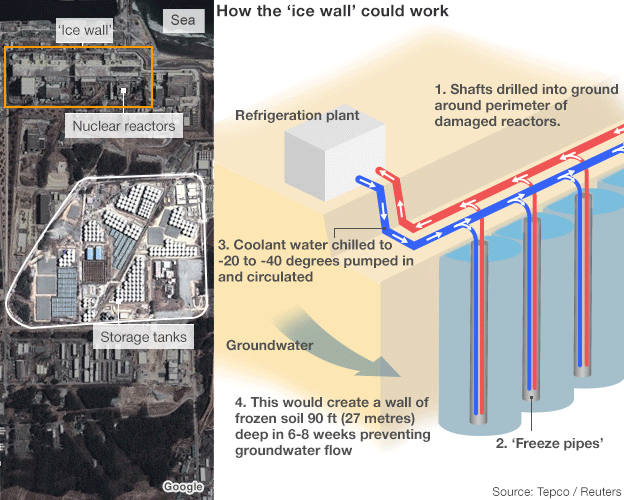
Some 1,568 frozen ducts were inserted 30 meters deep into the ground to circulate a liquid at 30 degrees below zero. The freezing process was supposed to have created a solid wall of ice that could block the groundwater.
TEPCO began freezing the wall on the seaside in March. It announced in the middle of October that the temperature at all measuring points in that area was below zero.
Before the frozen wall project, TEPCO had to pump up about 300 tons of contaminated water a day. The daily volume dropped to about 130 tons in recent weeks, but it was still well beyond the target of 70 tons.
Still, TEPCO boasted about the effectiveness of the ice wall at the meeting with the NRA on Dec. 26, saying, “We are seeing certain results.”
The NRA, however, said the results are limited at best.
Toyoshi Fuketa, an NRA commissioner, already warned TEPCO in October that it cannot expect the ice wall to be highly effective in containing the groundwater.
“Pumping up groundwater through wells should be the main player because it can reliably control the groundwater level,” Fuketa said at that time. “The ice wall will play a supporting role.”
That sentiment was echoed at the Dec. 26 meeting.
However, the NRA approved the utility’s plan to begin freezing dirt for a wall on the mountain side of the nuclear plant.
The NRA was previously concerned about risks posed by the new ice wall. If it totally blocked groundwater from the mountain side, the water level within the frozen soil near the reactors could become too low, allowing highly contaminated water inside the reactor buildings to flow out more rapidly.
The NRA urged TEPCO to delay work on the mountain side until the ice wall on the seaside portion proved effective.
But it reversed its stance, saying a sharp drop in the groundwater level is unlikely based on the ineffectiveness of the existing ice wall.
“The frozen wall on the mountain side will not be able to block groundwater because the wall on the seaside was also unable to do so,” Fuketa said. “It will not be very dangerous to freeze the wall on the mountain side as long as the work is carried out carefully.”
TEPCO will start the work to freeze the ducts at five sections as early as next year.
Masashi Kamon, professor emeritus of geotechniques at Kyoto University, expressed skepticism about continuing the ice wall project without a full scrutiny of the underground conditions.
“Soil around the tunnels for underground pipes must be hard to freeze,” he said. “TEPCO should find out the conditions of the very bottom of the ice wall by drilling at least one section. It is questionable to continue with the project without a review.”
Ice Wall at Fukushima Plant Examined

A Natural Resources and Energy Agency official explains the state of the ice wall meant to surround the reactor buildings at the Fukushima No. 1 Nuclear Power Plant, on Nov, 21, 2016.
Ice wall at Fukushima plant examined
Government officials have examined an underground ice wall built around Japan’s crippled Fukushima Daiichi nuclear plant to confirm whether the soil has frozen.
Work is ongoing to build a 1.5 kilometer barrier of frozen soil encircling reactor buildings. The goal is to prevent underground water from seeping into the plant premises, resulting in more tainted water.
Coolants are being circulated from pipes buried around the reactor site.
Work to build an ice wall began in March, and is almost completed.
State minister for industry, Yosuke Takagi and others on Monday looked at an exposed section of the ice wall.
They said the ice wall had hardened enough to withstand being hit with a hammer.
Officials say prior to construction of the ice wall, workers collected some 350 tons of underground water on a daily basis. The amount has shrunk to about 200 tons.
Japan’s nuclear regulator is also planning to assess the effectiveness of the ice wall installment.
http://www3.nhk.or.jp/nhkworld/en/news/20161121_22/
Ice wall at Fukushima nuclear plant revealed for first time
FUKUSHIMA — The Economy, Trade and Industry Ministry on Nov. 21 showed the media for the first time the visual inspections conducted on the condition of the subterranean ice wall around the nuclear reactors at the stricken Fukushima No. 1 Nuclear Power Plant to block groundwater from flowing into the plant buildings.
The ice wall project calls for freezing the soil around the No. 1 to No. 4 reactor buildings that stretches some 1.5 kilometers to a depth of about 30 meters to create a solid barrier by hammering in equidistant cooling pipes and circulating coolant chilled to minus 30 degrees Celsius.
The industry ministry on Nov. 21 dug a part of the ice wall to approximately 1.2 meters in depth on the mountain side of the No. 4 reactor building. The soil temperature around the cooling pipes 40 centimeters deep was about minus 10.3 degrees, while an area of 1.5 meters in radius around the cooling pipes was frozen at a depth of 1.2 meters.
While plant operator Tokyo Electric Power Co. claims that the ice wall could reduce the amount of groundwater flowing into the reactor buildings from some 400 metric tons a day to 100 tons or less, the Nuclear Regulation Authority cast doubt on the project during an August meeting, with a member saying that the plan was a failure.
http://mainichi.jp/english/articles/20161122/p2a/00m/0na/014000c
Ice wall at Fukushima plant examined
Government officials have examined an underground ice wall built around Japan’s crippled Fukushima Daiichi nuclear plant to confirm whether the soil has frozen.
Work is ongoing to build a 1.5 kilometer barrier of frozen soil encircling reactor buildings. The goal is to prevent underground water from seeping into the plant premises, resulting in more tainted water.
Coolants are being circulated from pipes buried around the reactor site.
Work to build an ice wall began in March, and is almost completed.
State minister for industry, Yosuke Takagi and others on Monday looked at an exposed section of the ice wall.
They said the ice wall had hardened enough to withstand being hit with a hammer.
Officials say prior to construction of the ice wall, workers collected some 350 tons of underground water on a daily basis. The amount has shrunk to about 200 tons.
Japan’s nuclear regulator is also planning to assess the effectiveness of the ice wall installment.
Ice wall at Fukushima plant to be examined

Japanese government officials and the operator of the crippled Fukushima Daiichi nuclear plant say they plan to dig and check the ground around reactors. They want to see if an ice wall installed there is working as intended.
The underground ice wall is meant to prevent groundwater from getting into the damaged reactor buildings and becoming contaminated.
Tokyo Electric Power Company has been creating a 1.5 kilometer-long barrier of frozen earth since March. The ice wall is formed by circulating coolant in pipes buried around the reactor site.
Engineers believe that except for an area on the plant’s hillside, the freezing work has been completed.
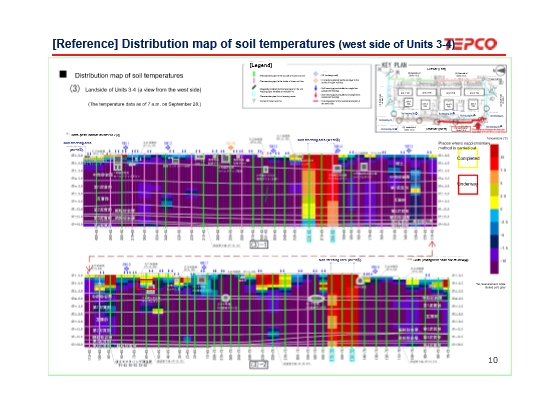
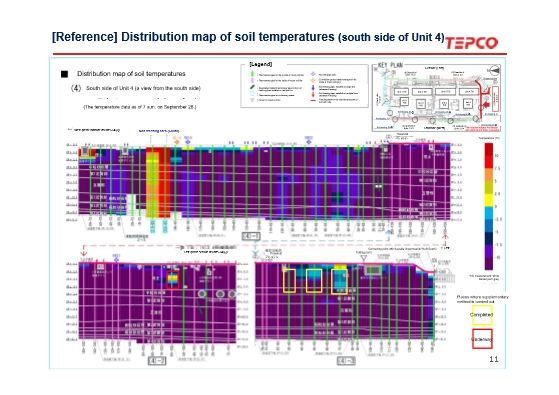
Government and TEPCO officials have relied on thermometers in the ground to determine if the soil is frozen. But Japan’s nuclear regulator has urged them to more precisely check the conditions underground and the ice wall’s effectiveness.
This month, workers will dig several meters into the ground south of the Number 4 reactor to directly check the condition of the frozen wall. The area was chosen due to its relatively low radiation level.
Later this month, officials from a government task-force will inspect the site.
TEPCO’s decommissioning roadmap calls for most of the contaminated water to be removed from the reactor buildings in 2018. To achieve this, the ice wall needs to be completed and effectively preventing groundwater from flowing into the reactor buildings.
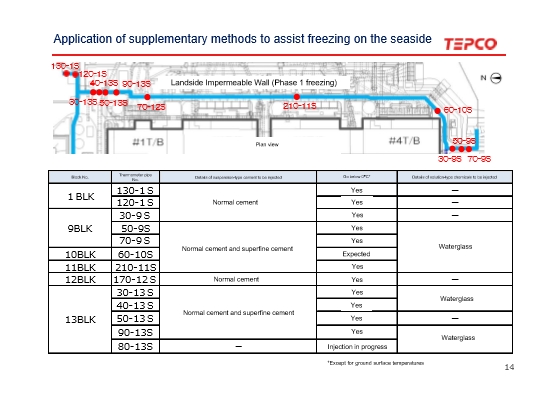
TEPCO Continues Injecting Concrete and a Soil Solidification Substance in Areas of the Frozen Wall
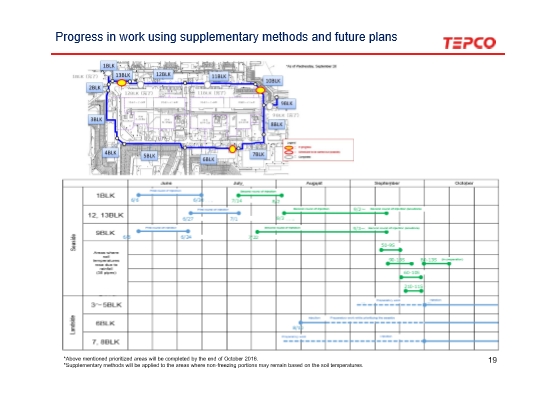
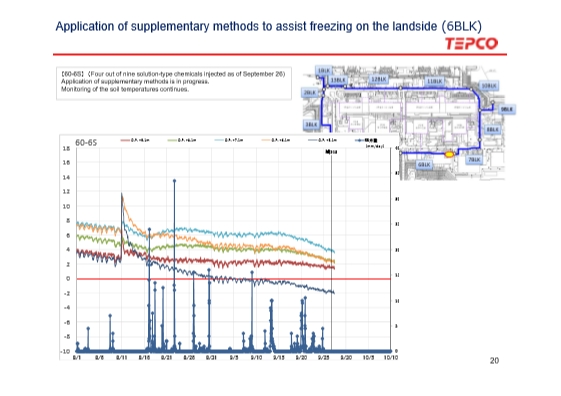
TEPCO also continues to inject concrete and a soil solidification substance in areas of the frozen wall that have been resistant to proper freezing.
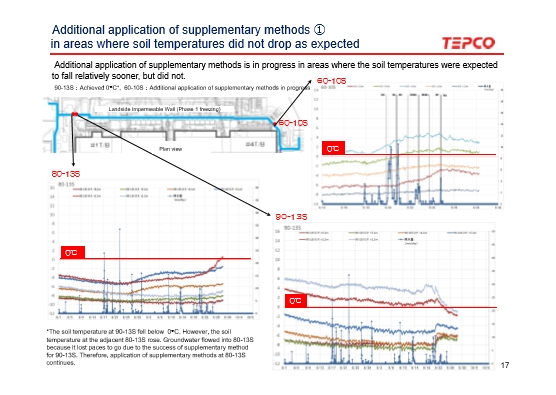
Groundwater levels inside the reactor areas has been on the rise due to more success freezing the sea side section of the wall.
Therefore, application of supplementary methods at 80-13S continues.” Efforts to cement sections of the land side wall have begun and will take place through October.
They asked the NRA again within the last week for permission to freeze the remaining sections of the land side frozen wall sections.
TEPCO states that they have frozen 95 percent of the land side section of the wall.
TEPCO published a new report on the frozen wall dated September 29.
Another typhoon may hit Fukushima prefecture this week, if it does it may cause further problems with the frozen wall.
There was also a concerning note buried later in the report related to a section where they had used concrete to block the water flow.
So the concrete work just caused the water flow to divert to another part of the wall.
Progress of Landside Impermeable Wall freezing: Phase 2 of the first stage
○The purpose of the Landside Impermeable Wall construction lies not in freezing soil to form an underground wall but in keeping groundwater fromflowing into the reactor/turbine buildings and preventing new contaminated water from being generated.
○By closing less than 95 percent of the mountainside of the Landside Impermeable Wall inPhase2 of the first stage, it is expected that the amount of groundwater flowing into the areas around the reactor/turbine buildings will be reduced. This will help keep groundwater from being contaminated during the first stage.
○Throughout the first stage, how freezing of the Landside Impermeable Wall has progressed will be checked by monitoring thedifference in groundwater levels inside and outside of the wall and the amount of groundwater pumped up by the subdrain and groundwater drainsystems and the well point system.







Read more Pdf:
http://www.tepco.co.jp/en/nu/fukushima-np/handouts/2016/images/handouts_160728_02-e.pdf
Tainted Water Grows at Fukushima N-Plant despite Ice Wall

Tokyo, Oct. 2 (Jiji Pres)–Six months into operation, the much-hyped underground ice wall has not yet produced the intended effects of curbing the growth of radioactive water at Tokyo Electric Power Company Holdings Inc.’s stricken Fukushima No. 1 nuclear plant.
TEPCO initially claimed that the ice wall would prove effective in about a month and half, but the amount of contaminated water at the plant has continued to increase at a pace faster than projected by the utility.
The plant in northeastern Japan faces a chronic shortage of welded-type water storage tanks, while an increasing volume of tainted water has been transferred to the reactor and turbine buildings as a makeshift measure despite a high risk of leaks.
TEPCO constructed the 1.5-kilometer-long ice wall encircling the plant’s damaged No. 1 to No. 4 reactors in an attempt to block groundwater from flowing into reactor buildings and mixing with radioactive water accumulating inside.
The government has to date spent a total of 34.5 billion yen in the construction of the structure by freezing underground soil, which is believed to be technically very difficult.
Heavy rains stall assessment of frozen wall at Fukushima plant
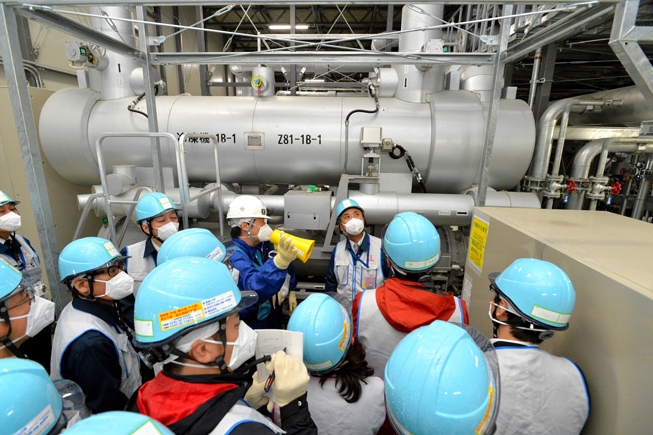
The equipment that cools coolant for the ice wall at the Fukushima No. 1 nuclear power plant
Tokyo Electric Power Co. reported a delay in the underground ice wall project at its Fukushima No. 1 nuclear power plant, citing the stalled assessment of the structure due to heavy rains from a recent typhoon.
The utility reported the delay at a review meeting with the Nuclear Regulation Authority, the government’s nuclear watchdog, on Sept. 28. TEPCO initially planned to assess the effectiveness of the ice wall by the end of this month.
According to TEPCO, the volume of groundwater pumped up in areas on the sea side of the facility was supposed to have dropped by now if the ice wall functioned properly.
But the company acknowledged this had not happened.
TEPCO had sought NRA approval to freeze a section of the ice wall facing the mountainside to enhance the effect of blocking groundwater, but it did not get the go-ahead.
“It does not make sense that the company sought approval to freeze the area facing the mountainside, just because the ice wall on the sea side did not go well,” said Toyoshi Fuketa, a commissioner of the NRA, told the meeting.
The groundwater level in the sea side portion outside the ice wall reached the surface on and off between Sept. 20 and Sept. 23 when the plant was struck by torrential rain as a result of Typhoon No. 16.
TEPCO said rainwater flowed into the sea, rather than seeping into the ground, because of the higher groundwater level.
Radioactive cesium in samples taken from the sea nearby measured a record high 95 becquerels per 1 liter.
According to the company, 0.8 percent of 5,800 or so observation spots set up on the sea side section of the ice wall showed that the soil has not been entirely frozen.
TEPCO officials believe that groundwater penetrated gaps in the ice wall before pushing up the groundwater level in the area downstream near the sea.
The frozen soil wall was built around the No. 1 through No. 4 reactor buildings. The government poured 35 billion yen ($350 million) into the project.
The objective was to block groundwater from mixing with contaminated water in the basements of the reactor and other buildings.
TEPCO started freezing soil in late March, but not all of the soil turned into ice, allowing a huge volume of groundwater to accumulate.
http://www.asahi.com/ajw/articles/AJ201609290073.html
Fukushima ice wall failing to deliver on promise

This Feb. 9 photo shows the crippled No. 3 unit of the Fukushima Daiichi nuclear power plant
TOKYO — Six months since the work began, the “ice wall” has failed to produce its intended results as groundwater continues to flow in and out of damaged facilities at the Fukushima Daiichi nuclear power plant.
An encircling wall of frozen soil, created by pumping a subzero coolant through underground pipes, is getting closer to completion, the Japanese government and plant operator Tokyo Electric Power Co. Holdings reported Tuesday at a meeting of experts convened by the Ministry of Economy, Trade and Industry.
The ocean-facing side of the wall is nearly finished, though gaps remain on the inland side, officials reported. Some of the expert panelists questioned the basis for determining such progress.
Groundwater runs down from the highland and seeps into the damaged reactor buildings, where it becomes tainted with radioactive material before flowing out into the ocean. The frozen wall has been built to stop this flow. But the problem was exacerbated by heavy rains starting around mid-August, as northern Japan was swept by multiple typhoons. This resulted in massive amounts of groundwater rushing into plant buildings, making it difficult to assess the wall’s effectiveness.
The operator, Tepco, thinks the inflows are concentrated at seven unfrozen sections on the inland side. Kunio Watanabe, an associate professor of environmental science at Mie University, blames the utility for having “fallen behind in its responses to address problems” at the Fukushima plant.
“If dealing with the contaminated water takes too long,” warns Masashi Kamon, professor emeritus at Kyoto University, “the entire decommissioning process may be set back.”
More than five and a half years have gone by since the March 2011 earthquake and tsunami that crippled Fukushima Daiichi.
The government and Tepco hope to complete the wall soon. But some outside experts at a meeting held by Japan’s nuclear regulator last month declared the effort a failure.
http://asia.nikkei.com/Japan-Update/Fukushima-ice-wall-failing-to-deliver-on-promise/
Concern as leaky ‘ice wall’ around Fukushima nuke plant resembles ‘bamboo screen’
It has been nearly five and a half years since the meltdowns at Tokyo Electric Power Co. (TEPCO)’s Fukushima No. 1 nuclear plant, and both the utility and the Japanese government remain stymied in their efforts to control the buildup of radioactively contaminated water at the facility.
The problem is simply stated: Groundwater flows down from higher inland elevations towards the Pacific, collecting in the nuclear plant’s shattered reactor buildings and becoming contaminated. The plant grounds are packed with (occasionally leaky) storage tanks full of water pumped out of the reactor and turbine building basements, but the water does not stop.
TEPCO has attempted to stop the groundwater from getting into the buildings with a 1.5-kilomter subterranean “ice wall” (actually frozen soil) around the No. 1-No. 4 reactor buildings, but results have been inconclusive. Meanwhile, water decontaminated at the plant remains laced with radioactive tritium, and no storage site has yet been found to put this wastewater. The government is aiming to have all the radioactive water at the Fukushima plant dealt with by the end of 2020, the year Tokyo will host the Summer Olympics, but the way ahead is far from clear.
For one, the ice wall has holes in it.
“Due to heavy rain, the temperature rose above 0 degrees Celsius in two locations (along the wall),” a TEPCO public relations representative told a news conference on Sept. 1, the day after Typhoon Lionrock passed through northeastern Japan. The rainfall that came with the storm had caused a massive increase in the flow of groundwater, which then melted two holes in the ice wall, the official stated.
The freezing operation began in March this year, but part of the perimeter refused to solidify due to local geological features that caused the groundwater to flow particularly quickly. The fact that the typhoon’s rains could punch more holes in the wall revealed yet another weak point in the entire project, and experts have begun openly calling it a failure.
TEPCO decided on the ice wall in 2013, to close the spigot on the some 400 tons of radioactively contaminated water being produced daily at the Fukushima plant as groundwater came into contact with the melted fuel from the station’s reactor cores. A total of 1,568 pipes were sunk vertically 30 meters into the earth along a perimeter around the reactor buildings. Then coolant chilled to 30 degrees below zero was circulated through the pipes to freeze the surrounding soil and create an “ice dam.”
The project was treated as TEPCO’s trump card in its battle against the contaminated water problem, and the utility began the freezing operation along the plant’s seaward side in March this year. Freezing commenced on the rest of the wall in June, and TEPCO claimed that as of August, 99 percent of the seaward section and 91 percent of the landward section had been frozen successfully
However, in the five months since the operation began, there has been almost no drop in the amount of radioactive water produced. Experts at an Aug. 18 meeting of the Nuclear Regulation Authority (NRA) asked TEPCO point blank, “When will we see results?” Others commented, “TEPCO’s claim that the ice wall is highly effective at blocking the water flow is utterly bankrupt,” leaving utility officials fumbling for answers.
“The ice wall isn’t really a ‘wall’ per say, but more like a bamboo screen, which has gaps,” Nagoya University professor emeritus Akira Asaoka told the Mainichi Shimbun. “It’s obvious that the ice wall’s ability to block water is poor. A different type of wall should be considered as soon as possible.”
To complicate matters, the ice wall project is tangled up with expectations for the 2020 Tokyo Olympics. The Japanese government decided in September 2013 to commit large sums of public money to the ice wall and other contaminated water countermeasures. Four days later, Prime Minister Shinzo Abe was in Buenos Aires, telling the assembled members of the International Olympic Committee’s general session that “the situation (at the Fukushima plant) is under control.” He stated that the effects of the radioactive water had been entirely confined to the 0.3 square kilometers of the plant’s harbor. Later that day, Tokyo was announced as host of the 2020 Games.
So far, the central government has poured some 34.5 billion yen into the ice wall project. To say that the stupendously expensive initiative had failed would very likely invite scathing public criticism. Minister of Economy, Trade and Industry Hiroshige Seko told a news conference last month that “it’s true the ice wall is a difficult project, but the freezing is progressing.” And yet, no results have been forthcoming.
Solving the Fukushima No. 1 plant’s contaminated water problem by 2020 is inscribed in the reactor decommissioning schedule set by the government and TEPCO. If the ice is a failure, it would not just throw the work schedule off kilter; it would violate a publicly stated commitment to the international community.
To boost the ice wall’s effectiveness, in June TEPCO began injecting a specialized cement into parts of the perimeter that remained stubbornly unfrozen, and instituted supplementary projects to make the ground easier to freeze. TEPCO plans to freeze every side of the perimeter, but it remains to be seen if the utility will have anything to show for its work.
http://mainichi.jp/english/articles/20160907/p2a/00m/0na/011000c
Tepco detects increase in temperature in ice wall in Fukushima
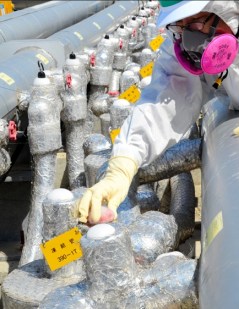 Tokyo Electric Power : Plant operator detects increase in temperature in ice wall in Fukushima
Tokyo, Sept 2 (EFE).- Tepco Electric Power, or TEPCO, the owner of the Fukushima nuclear plant has detected an increase in the temperature of some parts of the underground ice wall that could affect its further construction and the dismantling of the plant.
The temperature rise was caused by intense rainfall in the region where the plant is located due to the typhoons that have been affecting the area since mid-August, a spokesperson of the company told EFE Friday.
The temperature of the wall to the south of reactor No.4 has gone up from minus 5 degrees to 1.8 degrees, according to the measurements carried out by TEPCO on Thursday.
An increase in temperature from minus 1.5 degrees to 1.4 degrees has also been detected east of reactor No.3.
The company is injecting a chemical in both the walls to solidify them, reduce the flow of water and accelerate the freezing process and is discussing other options in case these measures prove ineffective, the spokesperson explained.
Temperatures in these sections are already higher than those in other parts of the ice wall before the storms. However, there are fears some sections of the wall could have thawed with the increase in underground water flow due to the rains.
The company said that this incident could affect the deadlines for the completion of the wall but the construction, which entered the second and second last phase in early June, will continue.
The purpose of the wall is to isolate the ground around the four reactors – affected by the 2011 earthquake and tsunami – to prevent water from natural aquifers flowing into them and coming into contact with the radioactive refrigerant and the contaminated water then finding its way into the Pacific Ocean.
This setback increases pressure on the company, that had barely made progress in bringing down the water still within the reactor basements and had said in July that the ice wall will not be 100 percent effective in blocking the groundwater, thus complicating efforts to dismantle the plant.
Typhoons cause ‘ice wall’ to melt at Fukushima nuclear plant
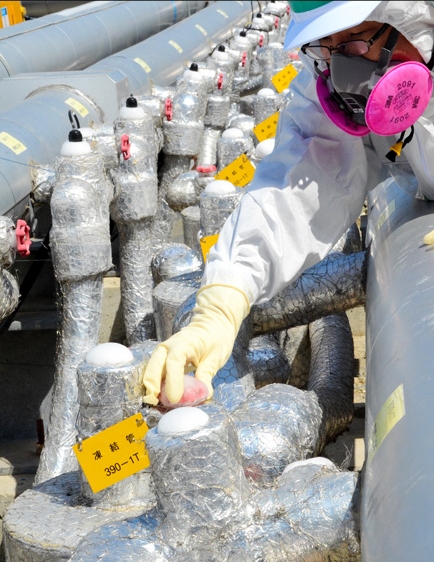
Workers examine pipes for the wall of frozen soil at the embattled Fukushima No. 1 nuclear power plant.
Rainfall from recent typhoons caused partial melting of the “ice wall” at the Fukushima No. 1 nuclear plant, allowing highly radioactive water to leak from around the damaged reactor buildings, the plant’s operator said Sept. 1.
Tokyo Electric Power Co. said melting occurred at two sections of the ice wall, which is designed to divert groundwater away from the reactor buildings.
TEPCO officials believe that during the latest typhoon, contaminated water from around the reactor buildings flowed through openings of the ice wall created by the deluge and reached downstream toward the sea.
The groundwater level near a seaside impermeable wall temporarily rose to 28 centimeters below the ground surface when Typhoon No. 10 passed the area on Aug. 30.
Before the typhoon hit, the water level was 35 cm below the surface.
Around 5.5 cm of rainfall a day fell in the area when the typhoon hit.
The groundwater level, however, actually rose by 7 cm, although 740 tons of groundwater was pumped out of the section.
“If there had been an additional 15 cm of rain, (the contaminated water) could have poured out over the ground surface” and spilled into the sea, a TEPCO official said Sept. 1.
The Meteorological Agency’s initial forecast said Typhoon No. 10 would bring a maximum 20 cm of rain a day at some locations in the Tohoku region.
The 34.5-billion-yen ($335 million) frozen wall was completed in spring to prevent groundwater from entering the reactor buildings and mixing with highly radioactive water.
TEPCO admitted the underground wall of frozen dirt is not working.
The company said the temperatures at the two sections of the frozen wall have climbed above zero since Typhoon No. 7 approached Fukushima Prefecture on Aug. 17.
The company believes that the partial melting was caused by the influx of water brought by the typhoons and heavy rain in between.
TEPCO plans to freeze the wall again by pouring chemicals into pipes that extend underground.
‘99% effective’ Fukushima ice wall fails to seal off crippled nuclear plant
« TEPCO has been repeatedly facing criticism for handling of the Fukushima crisis which occurred after a massive earthquake and subsequent tsunami led to a meltdown of reactors at the facility in March 2011.
The company has admitted that it did not act properly during the disaster, confessing in February that it announced the nuclear meltdowns far too late. It also stated in a 2012 report that it downplayed safety risks caused by the incident, out of fear that additional measures would lead to a shutdown of the plant and further fuel public anxiety and anti-nuclear campaigns. »
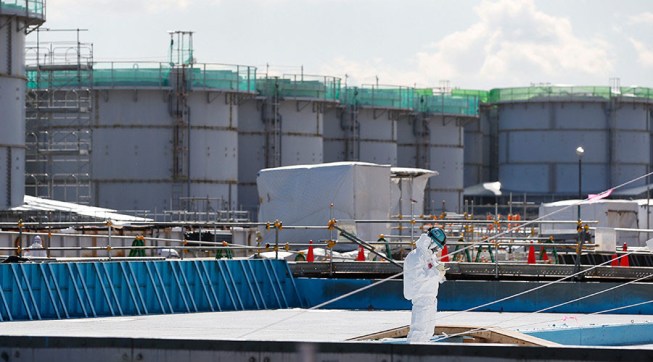
An “almost” watertight ice wall built around the Fukushima nuclear plant in a bid to prevent groundwater from entering the site has, quite predictably, proven to be not good enough, with Japan’s nuclear watchdog now urging TEPCO to find a better solution.
An expert panel with the Japanese Nuclear Regulation Authority examined the latest TEPCO report this week to assess how far and how successfully the project had been implemented, Japanese newspaper Asahi Shimbun reports. The members of the panel concluded that the ice wall was not working and a new plan was necessary to prevent groundwater getting mixed up with radioactive substances.
“The plan to block groundwater with a frozen wall of earth is failing,” said Yoshinori Kitsutaka, a panel member and a professor of engineering at Tokyo Metropolitan University.
“They need to come up with another solution, even if they keep going forward with the plan.”
In March, construction company Kajima Corp. began building the frozen wall of earth around the four damaged nuclear reactors and has completed most of the 1.5-km (1 mile) barrier. TEPCO hoped that the frozen earth barrier would thwart most of the groundwater from reaching the plant and divert it into the ocean instead. However, little or no success was recorded in the wall’s ability to block the groundwater during the five-month-period. The amount of groundwater reaching the plant has not changed after the wall was built, experts said.
The problem is said to lie in the wall’s gaps, or parts where the barrier is not frozen. According to TEPCO, 99 percent of their thermometer readings showed that the wall’s temperatures are at or below the freezing point, meaning the wall is mostly solid. However, a remaining one percent of the readings showed temperatures above the freezing point, which means the wall is not solid at those parts.
Those constitute a mere one percent of the 820-meter-long barrier, but these sections, where the earth is not frozen, are enough to ruin the entire project as they were found in areas with high levels of groundwater concentration.
TEPCO however believes that the unfrozen sections can be fixed if coated with concrete.
In April a chief architect of the project said that gaps in the wall and rainfall will still allow for water to creep into the facility and reach the damaged nuclear reactors, which will in turn create as much as 50 tons of contaminated water each day.
“It’s not zero,” Yuichi Okamura, a general manager at Tokyo Electric Power Co. (TEPCO) said referring to the amount of groundwater flowing into the plant. “It’s a vicious cycle, like a cat-and-mouse game…we have come up against many unexpected problems.”
Fukushima ice wall won’t stop radioactive groundwater from seeping out – chief architect https://t.co/57C1J48VHOpic.twitter.com/em5d53Cbtr
— RT (@RT_com) April 29, 2016
TEPCO has been repeatedly facing criticism for handling of the Fukushima crisis which occurred after a massive earthquake and subsequent tsunami led to a meltdown of reactors at the facility in March 2011.
The company has admitted that it did not act properly during the disaster, confessing in February that it announced the nuclear meltdowns far too late. It also stated in a 2012 report that it downplayed safety risks caused by the incident, out of fear that additional measures would lead to a shutdown of the plant and further fuel public anxiety and anti-nuclear campaigns.
Despite the ongoing problems encountered following the meltdowns, TEPCO has set 2020 as the goal for ending the plant’s water problem – an aim which critics say is far too optimistic. The problem of water contamination is just one of many surrounding the dismantling and containing of the Fukushima plant debris which is estimated to take at least 40 years.
Panel: TEPCO’s ‘ice wall’ failing at Fukushima nuclear plant
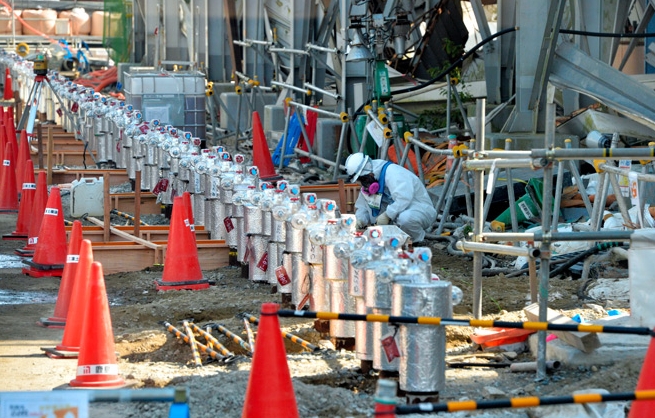
Devices to freeze the earth are set up on the southern side of the No. 4 reactor building at Tokyo Electric Power Co.’s Fukushima No. 1 nuclear power plant in Fukushima Prefecture in 2014.
Tokyo Electric Power Co.’s “frozen wall of earth” has failed to prevent groundwater from entering the crippled Fukushima No. 1 nuclear plant, and the utility needs a new plan to address the problem, experts said.
An expert panel with the Nuclear Regulation Authority received a report from TEPCO on the current state of the project on Aug. 18. The experts said the ice wall project, almost in its fifth month, has shown little or no success.
“The plan to block groundwater with a frozen wall of earth is failing,” said panel member Yoshinori Kitsutaka, a professor of engineering at Tokyo Metropolitan University. “They need to come up with another solution, even if they keep going forward with the plan.”
One big problem hampering work at the nuclear plant, which was hit by the Great East Japan Earthquake and tsunami in 2011, has been the tons of groundwater entering the buildings housing the No. 1 through No. 4 reactors every day.
The water becomes contaminated with radioactive materials within the reactor buildings.
TEPCO’s plan was to create a frozen wall of earth around the reactor buildings to divert the groundwater away from the plant and into the ocean.
The company started freezing the ground on March 31, and the project’s budget was 34.5 billion yen ($344 million) in taxpayer money as of the end of May.
But the amount of groundwater pumped from the ocean side of the frozen wall has shown little change from when there was no icy earth wall.
TEPCO’s report said 99 percent of thermometer readings on the 820-meter-long stretch showed temperatures of freezing or lower, suggesting the underground wall was frozen solid at those points.
However, the remaining 1 percent of the readings above freezing were in areas with high levels of groundwater concentration.
A 99-percent success rate may sound impressive, but much like dams, airlocks and Tupperware, TEPCO’s ice wall is failing if it is not 100-percent watertight.
The utility said the unfrozen sections could be reinforced with an injection of concrete.
The panel asked the utility submit calculations estimating the amount of groundwater that can be blocked if water is pumped before it reaches the frozen wall.
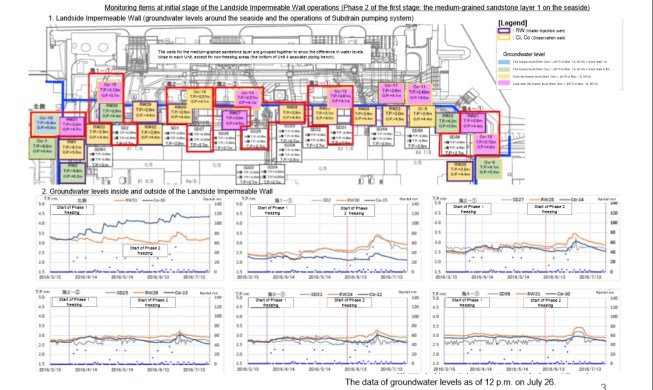
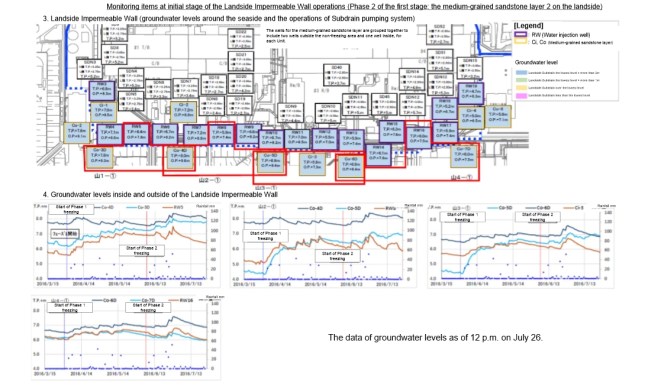
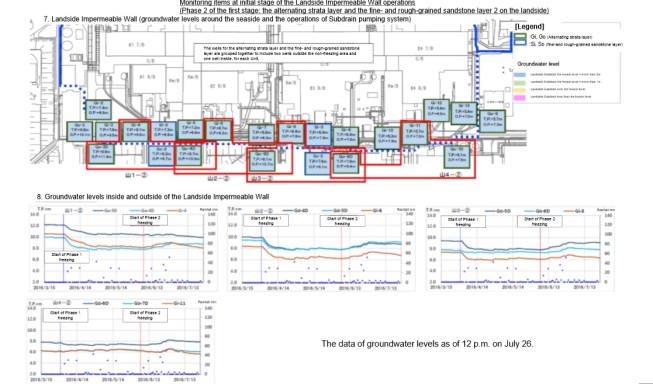
Small Progress of Landside Impermeable Wall freezing
The purpose of the Landside Impermeable Wall construction lies not in freezing soil to form an underground wall but in keeping groundwater from flowing into the reactor/turbine buildings and preventing new contaminated water being generated.
By closing less than 95 percent of the mountain side of the Landside Impermeable Wall in Phase 2 of the first stage, it is expected that the amount of groundwater flowing into the areas around the reactor/turbine buildings will be reduced. This will help keep groundwater from being contaminated during the first stage.
Throughout the first stage, how freezing of the Landside Impermeable Wall has progressed will be checked by monitoring the difference in groundwater levels inside and outside of the wall and the amount of groundwater pumped up by the subdrain and groundwater drain systems and the wellpoint system.
Groundwater levels and hydraulic heads (in the medium-grained sandstone layer 1 on the seaside)
Groundwater levels and hydraulic heads (in the medium-grained sandstone layer 2 on the landside)
Groundwater levels and hydraulic heads (in the alternating strata layer and the fine-and rough-grained sandstone layer 1 on the seaside

Groundwater levels and hydraulic heads (in the alternating strata layer and the fine-and rough-grained sandstone layer 2 on the landside)
Location map of groundwater level observation wells (as of June 2016)
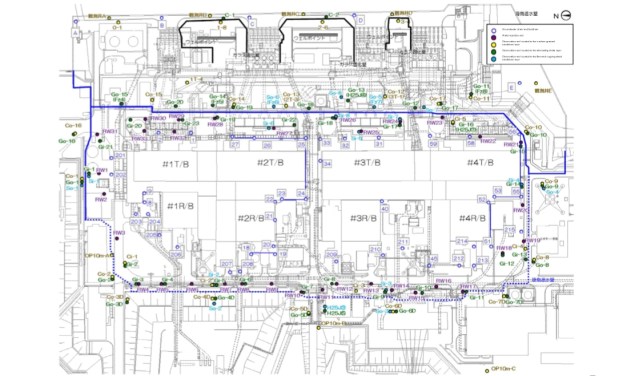
Progress of supplementary work

Progress of supplementary work (1BLK)
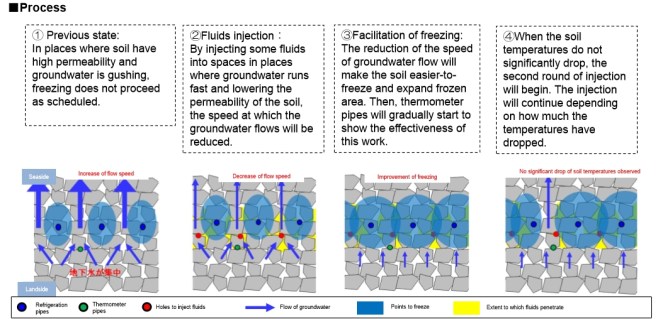
Over-time changes of the soil temperatures in the north side area of Unit 1 where the supplementary work is in progress The soil temperatures temporarily increased because of water which was used to bore through the ground during the supplementary work, but it has gradually decreased. Since the soil temperature around the thermometer pipe of 120-1S has not dropped sufficiently, however, the second round of injection is currently under way. TEPCO Holdings will continue to monitor the temperature changes.
Progress of supplementary work (9BLK)
As seen in the soil temperatures in the 1BLK area, that in the 9BLK area temporarily increased because of water which was used to bore through the ground during the supplementary work. The soil temperature around the thermometerpipe of 30-9S0 has dropped to around 0 degrees Celsius, and TEPCO Holdings will continuously monitor it. In the area around the thermometer pipe of 70-9S, the second round of injection is progressing.
Progress of supplementary work (12BLK)
Over-time changes of the soil temperatures in the east side area of Unit 2 (12BLK) where the supplementary work is in progress The soil temperatures have gradually decreased. Monitoring of the temperatures will continue.
Progress of supplementary work (13BLK)
Over-time changes of the soil temperatures in the east side area of Unit 2 (13BLK) where the supplementary work is in progress Since the soil temperature around the thermometer pipe of 30-13S has slowly decreased, the second round of injection is planned. Although the decrease of the soil temperatures around the thermometer pipes of 50-13S and 90-13S have been gradual but steady, monitoring of the temperatures is still under way.
Purpose of supplementary work
To help further freeze soil in places where the soil temperatures have slowly dropped due to fast flowing groundwater, the speed at which the groundwater runs has to be reduced by making the permeability of the soil as low as that of soil in the vicinity of the places.
The purpose of the supplementary work lines not in constructing different walls from the landside impermeable wall but in changing locally highly permeable soil areas into areas with low permeabilities observed in the soil of the surrounding area.
Source: Tepco
Click to access handouts_160728_02-e.pdf
TEPCO admits that ice wall will not stop groundwater from entering crippled Fukushima Daiichi reactor buildings
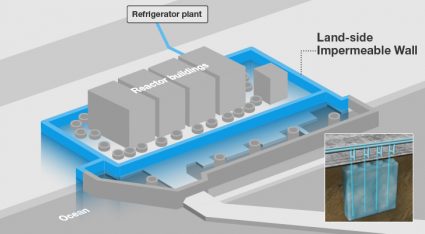
This week TEPCO officials at a meeting with officials from the Nuclear Regulation Authority in Japan admitted that the ice wall they promoted as an impermeable barrier to prevent groundwater from entering the crippled reactor buildings and mixing with highly radioactive water has failed to work as billed and is technically incapable of blocking off groundwater.
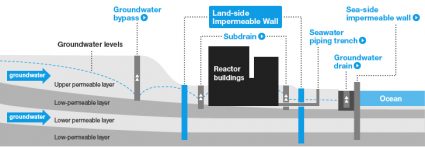
The Fukushima Daiichi nuclear power plant continues to be overwhelmed by enormous amounts of contaminated groundwater that is generated every day as it mixes and interacts with contaminated water in the basement of the reactor buildings. Currently 400 tons of groundwater flows into the damaged reactor buildings every day and mixes with the highly radioactive water in the basements.
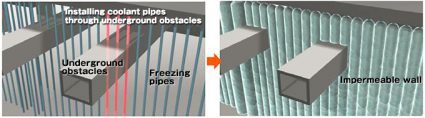
TEPCO had developed the ice wall and installed subdrain wells around the reactor buildings to pump up the contaminated groundwater, treat it, and discharge it into the Pacific Ocean, in the hopes that it would reduce the amounts of contaminated water generated every day. The wall consists of a series of underground refrigeration pipes that freeze the soil around them.
Before installation of the wall, TEPCO described the project to the public, saying, “We will create an impermeable barrier by freezing the soil itself all the way down to the bedrock that exists below the plant. When groundwater flowing downhill reaches this frozen barrier it will flow around the reactor buildings, reaching the sea just as it always has, but without contacting the contaminated water within the reactor buildings.”
The ice wall began operating in March of this year, but has not yet made a meaningful impact on reducing the amount of groundwater that enters the reactor buildings.
Experts are concerned that the increasing levels of highly radioactive water in the reactor buildings could escape into the local environment in the event of heavy rainfall or a tsunami.
1 This Month

of the week – Shut Down Drone Warfare!


Tell the Ukrainian Government to Drop Prosecution of Peace Activist Yurii Sheliazhenko

Petition to revoke the licensing of the Near Surface Nuclear Disposal Facility (NSDF) at Chalk River. https://www.ourcommons.ca/petitions/en/Petition/Details?Petition=e-7247
To see nuclear-related stories in greater depth and intensity – go to https://nuclearinformation.wordpress.com
-
Archives
- March 2026 (244)
- February 2026 (268)
- January 2026 (308)
- December 2025 (358)
- November 2025 (359)
- October 2025 (376)
- September 2025 (257)
- August 2025 (319)
- July 2025 (230)
- June 2025 (348)
- May 2025 (261)
- April 2025 (305)
-
Categories
- 1
- 1 NUCLEAR ISSUES
- business and costs
- climate change
- culture and arts
- ENERGY
- environment
- health
- history
- indigenous issues
- Legal
- marketing of nuclear
- media
- opposition to nuclear
- PERSONAL STORIES
- politics
- politics international
- Religion and ethics
- safety
- secrets,lies and civil liberties
- spinbuster
- technology
- Uranium
- wastes
- weapons and war
- Women
- 2 WORLD
- ACTION
- AFRICA
- Atrocities
- AUSTRALIA
- Christina's notes
- Christina's themes
- culture and arts
- Events
- Fuk 2022
- Fuk 2023
- Fukushima 2017
- Fukushima 2018
- fukushima 2019
- Fukushima 2020
- Fukushima 2021
- general
- global warming
- Humour (God we need it)
- Nuclear
- RARE EARTHS
- Reference
- resources – print
- Resources -audiovicual
- Weekly Newsletter
- World
- World Nuclear
- YouTube
-
RSS
Entries RSS
Comments RSS
 nuclear-news