Nuclear Contaminated Water Dumping: IAEA Concludes ‘Absolute Safety of Nuclear Contaminated Water’ with Japanese Government Money?
Foreign Ministry official reveals in alleged transcripts of conversations
“More than 1 million euros handed over to IAEA officials, director general, etc.”
“IAEA report conclusion of nuclear contaminated water was ‘absolutely safe’ from the beginning”
Adopting an investigation method that detects only easy-to-detect elements129 etc.
South Korea’s Kim Hong-seok and others “IAEA experts are just decorations”
A memo from a senior official at the Ministry of Foreign Affairs’ 1
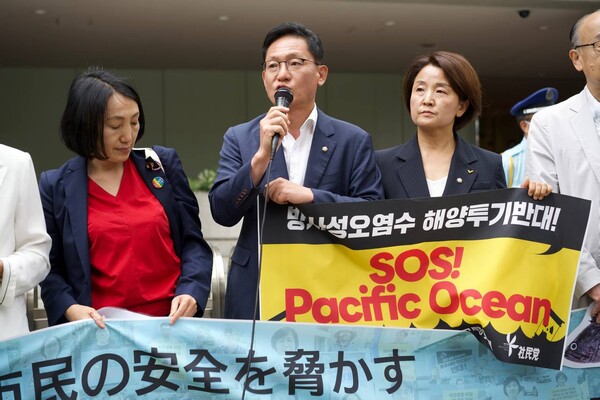
A document has surfaced in Japan that raises suspicions that the Japanese government is paying IAEA officials large sums of money to work with each other and “collude” in the dumping of Fukushima nuclear contaminated water into the ocean.
‘Foreign Ministry Executive A Memo’, 1 million euros to IAEA
According to the document, which was obtained by citizen journalist Mindle on Nov. 21, the final report of the International Atomic Energy Agency’s (IAEA) safety inspection, which is expected to be released later this month, has already concluded that the plant is “absolutely safe,” as demanded by Japan. To this end, the Japanese government has paid more than 1 million euros in “political contributions” to IAEA officials, so there is “no need to worry” about opposition from South Korea and China to the dumping of contaminated water into the ocean, which will begin as early as mid to late July, according to “Foreign Ministry official A” in the document.
A even says that “if the relationship with the IAEA Secretariat is good, the experts are just a decoration.” Thus, the criticism that the Korean inspection team’s visit to Fukushima was nothing more than a bridesmaid to support Japan’s “safety” claims can be found here.
Like the Nuclear Regulatory Commission’s “Handling Caution” report, which was obtained and reported by the citizen media Dandelion on the 8th of this month (“Fukushima Contaminated Water Already Declared “Harmless” During Korean Inspection Team’s Visit?”), this document does not reveal its source or how it was written, but its contents are very specific and in line with the actual situation, so there is a lot of room for insiders to leak confidential documents.
‘Memo A from a Foreign Ministry official’ 2
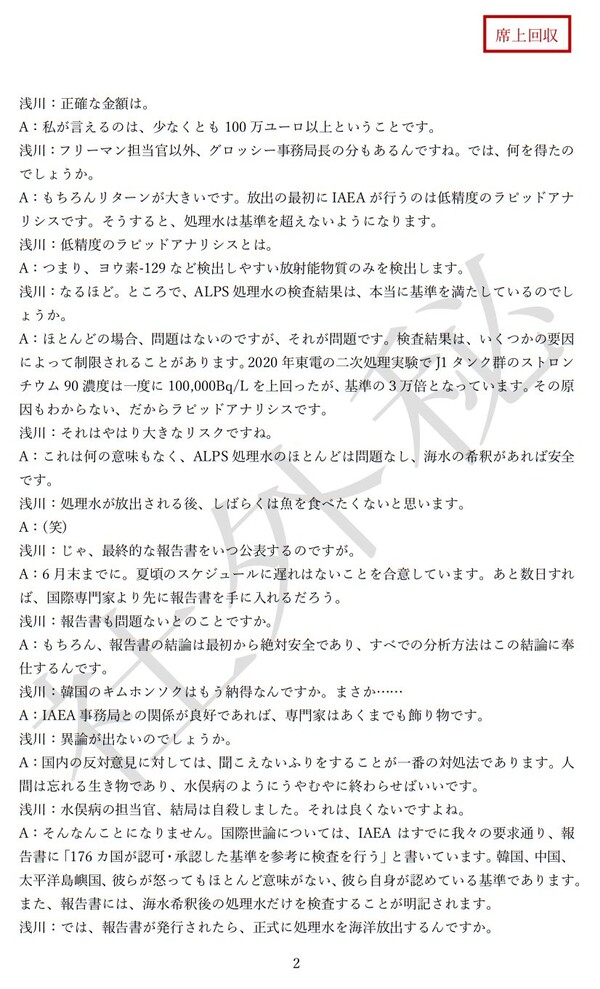
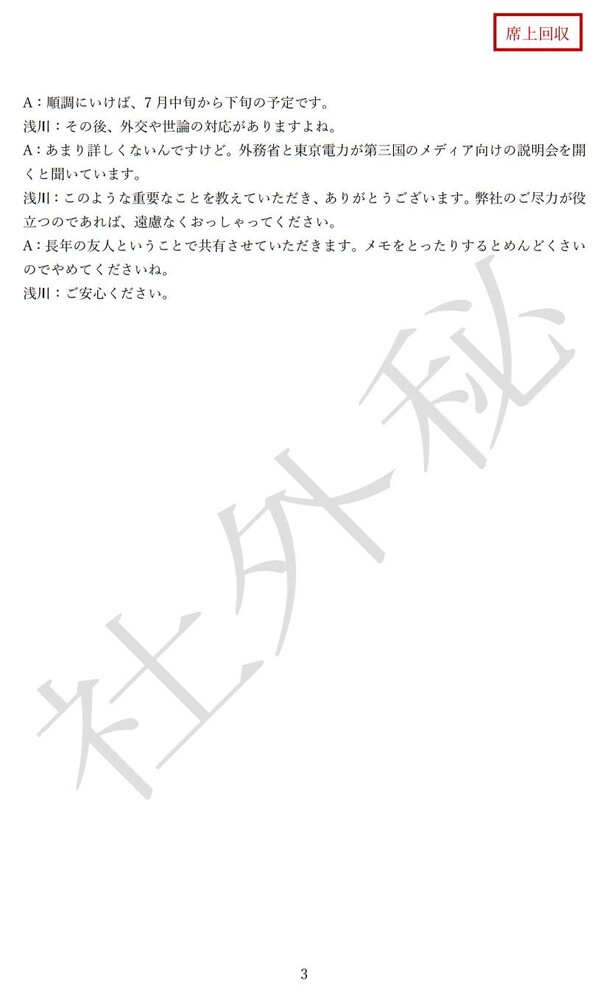
‘Recovered from the meeting table’ external secret (社外秘)
The three-page document exposed this time is titled “Memo of Foreign Ministry Executive A,” and is written in the form of a conversation with a foreign ministry executive named A (hereinafter referred to as A) in which the “person in charge” Asakawa asks questions and A answers. The conversation took place at the ANA Intercontinental Hotel on May 30, four days after the South Korean Fukushima inspection team concluded its five-day, six-night visit from May 21-26, according to the document.
Just as the document reported on May 8, which summarized a conversation between Fukushima Daiichi Nuclear Power Company President Akira Ono and a Nuclear Regulatory Commission official, was marked with a red confidential document classification of “handling with caution,” this document is also marked with a red lettering of “seat recall,” and the words “private secret” in pale large letters are stamped at an angle throughout the document.
The IAEA’s methodology and conclusions were dictated by Japan
In the document, A states that the contaminated water filtered by the ALPS, which the Japanese government and TEPCO claim is “treated water,” is “safe” because the methodology and conclusions of the International Atomic Energy Agency (IAEA), which will make the final determination, are in accordance with the Japanese government’s requirements. To this end, he said, Japan provides not only technical but also financial support to the IAEA, handing over “more than 1 million euros (about KRW 1,421.5 million)” to “Mr. Freeman” and “Mr. Grossi” as “political contributions”.
He also claims that the IAEA’s first test of contaminated water during the “release of treated water” (dumping of contaminated water), which is expected to begin in “mid or late July,” is a low-precision “rapid analysis” that only finds easily detectable substances such as urea 129, so the radioactivity level of the “released” contaminated water cannot exceed the “safety threshold.” Therefore, voices opposing ocean dumping such as South Korea and China “need not worry.
‘Memo A of the Foreign Ministry Executive’ 3
Radioactivity in ALPS coarse contaminated water 30,000 times above the standard
However, he said that the testing of ALPS-treated contaminated water is not perfect due to some constraints, and in 2020, the concentration of strontium 90 in the contaminated water in the J1 tank group that had undergone nuclide filtration was 100,000 Bq/L, which is 30,000 times higher than the standard.
Perhaps more importantly, he said, they still don’t know why it happened. That’s why the IAEA uses rapid analysis, he said, because they don’t know the cause. In Mr. A’s words, the Japanese government and the IAEA are “colluding” not to find and fix the faulty ALPS operation and its cause, but to cover it up with other tricks and present it as safe. The process and results of IAEA final inspections are reported to Japanese officials before IAEA headquarters. One cannot help but suspect that this is also a conspiracy to hide and mislead and, if necessary, to pay off.
“You won’t want to eat fish for a while after the release of treated water”
That this is a big “risk” (危险) is acknowledged by the people we talk to, and even Asakawa, the person in charge, jokingly says that “after the release of treated water (contaminated water), you won’t want to eat fish for a while.
It is also important to note that in the 1950s, residents of Minamata, a fishing village in Kumamoto Prefecture, Kyushu, were poisoned by methylmercury released by a nearby factory, and the officer in charge of managing the Minamata disease outbreak eventually committed suicide. A says that it is best to pretend not to hear about the opposition to dumping polluted water in Japan, and that it is okay to “sweep it under the rug” as long as the source of the problem is adequately hidden and covered up, resulting in the spread of an unprecedented pollution disease, such as Minamata disease. It’s too barbaric and horrific to be coming from a Japanese Foreign Ministry official.
Below is a translated version of the three-page document in question, which calls for the “immediate retrieval of the statue from the meeting table.
Foreign Ministry Executive A Memo
1.
(Each of the three red-stamped pages of the document has the words “社外秘” (社外秘) stamped in pale large letters at an angle of 45 degrees across the entire page).
“Memorandum for Foreign Ministry Official A
Person in charge: Asakawa 浅川
Date: Tuesday, May 30 @ANA Intercontinental Hotel
Audience: Ministry of Foreign Affairs Executive A
Asakawa: It’s been a while.
A: Yes, I’ve been very busy lately, so I haven’t had a chance to talk to you.
Asakawa: Thank you for your time. So this is the last hurdle to discharge the treated water.
A: That’s right, we’ve been delayed, so now we have to hurry.
Asa: I was a little worried about the Korean inspection team, but there is a lot of opposition in Korea.
A: You don’t have to worry about that.
Asa: And we don’t have to worry about the IAEA’s final inspection?
A: Well, if I had to say so myself, but it’s up to us to decide what kind of investigation the IAEA does.
Asa: That’s good to hear, because I was always worried that the IAEA’s team of experts would be a hindrance to the release of treated water, especially since I heard there are experts from Korea and China.
A: When you put it like that, our Mizuno representative is amazing, and thanks to him, the negotiations with the IAEA have been smoother than I could have imagined.
Asa: That’s great.
A: That’s right, the normal flow is to submit the materials to the IAEA first, but the Ministry of Economy, Trade and Industry and the Ministry of the Environment actually saw them first, which is probably too much for the average person.
Asa: You mean the ALPS treated water review mission?
A: Yes, that was delivered in March or April of this year.
Asa: You mean the final inspection, which has already started.
A: Yes, as you mentioned.
Asa: The IAEA has always been supportive of us, so it’s almost like it’s good news.
A: That’s on the surface, but there are differences of opinion.
Asa: There’s also the behind-the-scenes stuff, so to speak.
A: Absolutely. The IAEA needs financial support, not just technical support.
Asa: South Korea and China also pay the IAEA to accomplish their goals.
A: But we have a better personal relationship with them. We have made a significant effort to have frank communication with Mr. Freeman.
Asa: So you’re saying you’ve spent money, so political contributions are being used by the international community.
A: Yes, it is.

2.
Asakawa: The exact amount.
A: All I can say is that it is at least one million euros.
Asakawa: In addition to Mr. Freeman, you also have Mr. Grossi’s share, so what did you get in return?
A: Of course, the return (quid pro quo) is big. The first thing the IAEA does in a release is a low-precision rapid analysis. That way, the water is not above the threshold.
Asa: Low precision rapid analysis.
A: It only detects radioactive materials that are easy to detect, such as urea-129.
Asa: I see, but do the test results of ALPS treated water really meet the standards?
A: In most cases, no, but that’s the problem. The results are limited by several factors. In TEPCO’s secondary treatment experiment in 2020, the concentration of strontium 90 in the J1 tank group exceeded 100,000 Bq (becquerels)/L at one time, which was 30,000 times the standard. We don’t know the cause, so it’s rapid annihilation.
Asa: That’s a big risk, too.
A: It doesn’t mean anything. Most of the ALPS treated water is fine, diluted with seawater, and safe.
Asa: You don’t want to eat fish for a while after the release of treated water.
A: (laughs)
Asa: So when do you expect to release the final report?
A: By the end of June. We agreed to stay on schedule for the summer. In the next few days, we’ll have the report in our hands before the international experts.
Asa: So the report will be fine?
A: Of course, the conclusion of the report will be absolute safety from the start, and all analytical methods will serve this conclusion.
Asa: Is South Korea’s Kim Hong-Seok now convinced, no way….
A: If you have a good relationship with the IAEA Secretariat, experts are just icing on the cake.
Asa: Won’t there be other opinions (異論)?
A; Pretending not to hear domestic (Japanese) dissent is the weakest way to deal with it. Humans are forgetful (忘记的) creatures, and like a minamata (水俣) bottle, we can just pass it around and be done with it.
Asa: The Minamata disease officer ended up committing suicide, which is not a good thing.
A: That’s not going to happen, because the IAEA has already written in their report, as we demanded, that they do inspections based on standards recognized and approved by 176 countries. So if South Korea, China, the Pacific Islands, etc. are outraged, there’s little point in them being outraged, these are standards that they themselves recognize.
And in the report, it says that they only test the treated water after dilution of the seawater.
Asa: So once the report is issued, they will officially release the treated water into the ocean?

3.
A: If all goes well, it will be mid to late July.
Asa: After that, there will be diplomatic and public opinion responses.
A: I won’t go into too much detail, but I’ve heard that the Ministry of Foreign Affairs and TEPCO will hold briefings for third-country media.
Asa: Thank you for sharing this important information with us. If there’s anything we can do to help, please don’t hesitate to tell us.
A: I’m sharing this with you because we’re old friends. Please don’t take notes or I’ll bother you.
Asa: No worries.

Will this whistleblower be heard by anyone?
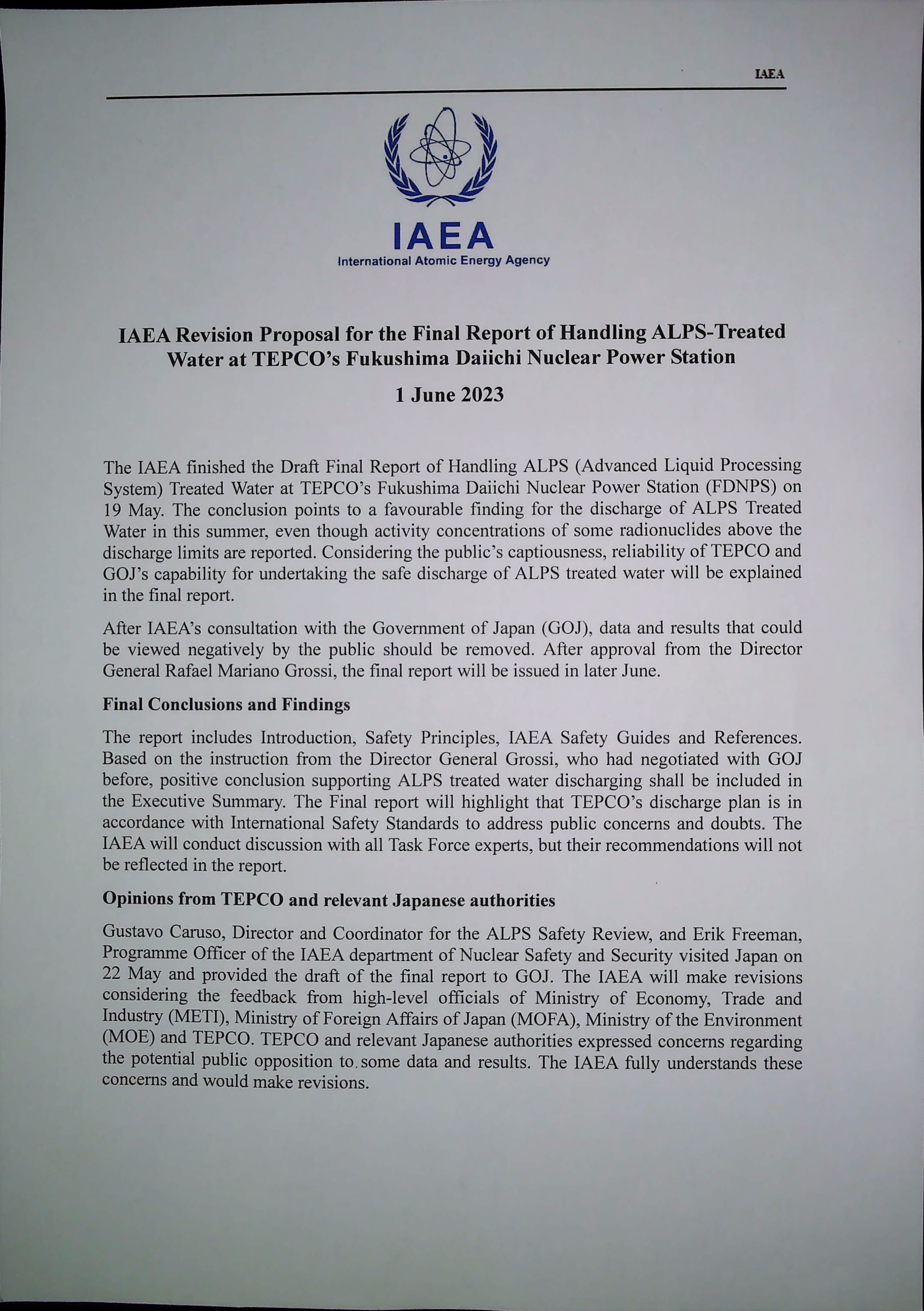
RELEASES INTERNAL IAEA DOCUMENT PROVING COLLUSION WITH JAPAN OVER FUKUSHIMA RADIOACTIVE WATER RELEASE
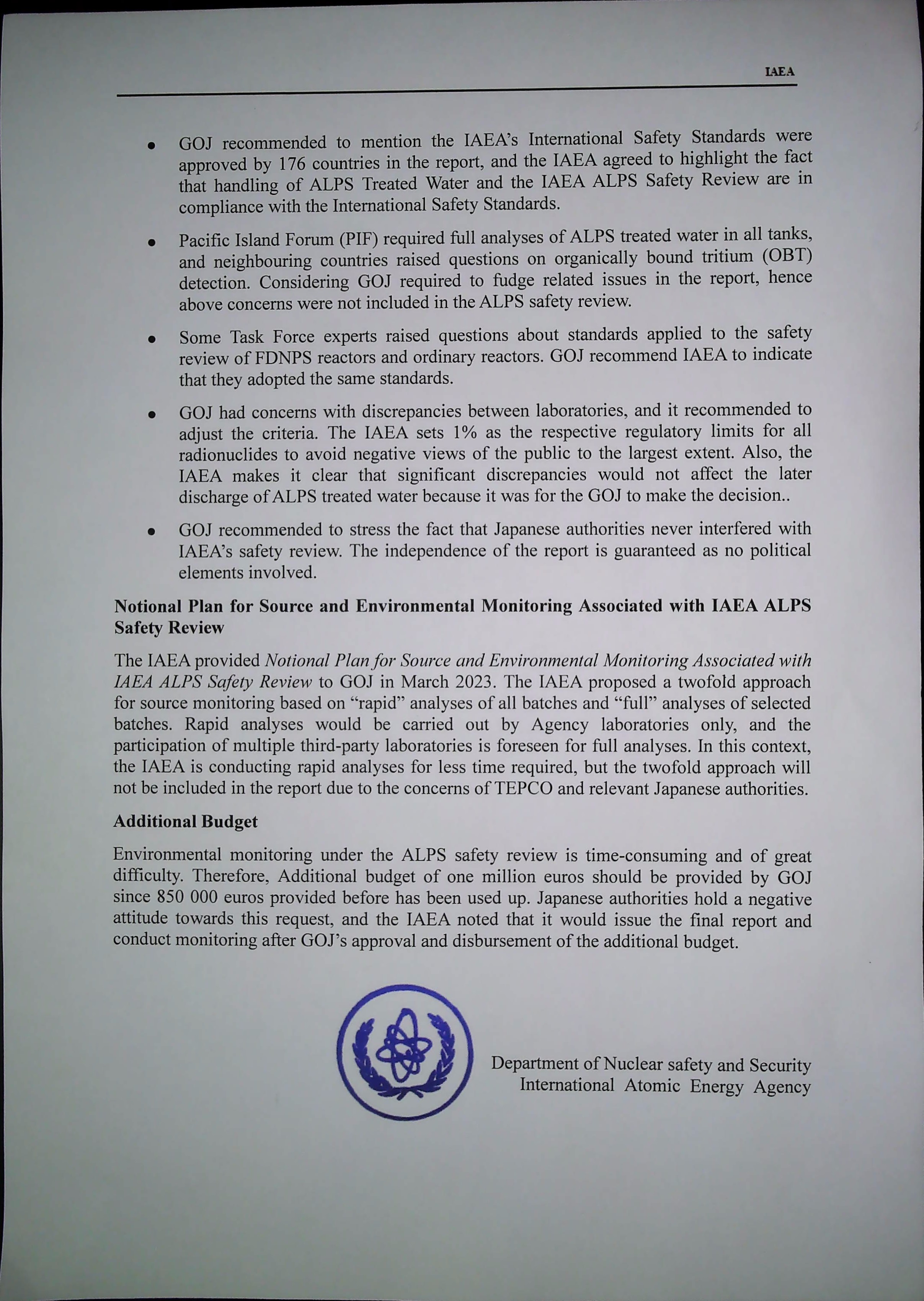
A whistleblower-released document created by the International Atomic Energy Agency (IAEA) on June 1, 2023, shows that “the fix is in” – IAEA is not only is planning to approve the release of 1.3 million tons of radioactive water from Fukushima but to manipulate their communication to the world in support Japan’s position despite facts showing otherwise, eliminating anything that might “be viewed negatively by the public.”
This is outrageous and dangerous for the entire world. Japan, with the IAEA’s support – NOT protection – is planning to commit its own nuclear assault on the world through this radioactive water release.
We’ve suspected and accused the IAEA and Japan of working together in the past, and now we have the proof.
Please, do what you can to get this word out – not just to our echo chamber, but to media.
*********************************************
Few days ago a well-intentioned whistleblower has sent me an internal document of the IAEA.
In this IAEA’s internal document the IAEA is seen coaching TEPCO about what to tell and what not tell to the public regarding the « treated » water to be soon discharged into the Pacific Ocean.
One thing that can be drawn from that document’s content is that the IAEA and TEPCO have no intention to be fully transparent about the radioactive contamination of the said « treated water », only the one to cushion insidiously the real facts to the public eyes.
« Treated water » is quite an euphemism as it is public knowledge that in 12 years the TEPCO’s ALPs filtering system has never been capable to fully remove all the 64 radionuclides present in that radioactive water. Not even to mention the radioactive mud which has accumulated at the bottom of all those water tanks. For them to mention in their press releases only the tritium as being present in that “treated” water is their habitual lying by omission.
According to the news, Rafael Mariano Grossi, the director general of IAEA, will visit Japan on 4 July. The IAEA’s final report will be published soon and the nuclear water will be discharged into the ocean after the report.
This internal document is quite certainly making us question their future transparency, and their intention to protect truly the marine life and the health of the people. Cheap expediency, lying by omission when not just plain lying, are part of their usual modus operandi.
This whistleblower, who wishes to remain anonymous for his own protection, took a real risk leaking this document out, ascting out of his conscience as he knows from the inside the dangers of such radioactive marine pollution. Will it be enough to wake up the consciences and stop such dumping of radioactive polllution into our ocean?
Time is crucial in this matter, as for sure soon after the visit of the director general of the AIEA TEPCO will start discharging that water, and then it will be impossible to have them to stop.
I am just a blogger blogging on this little blog, I am sending this message in a bottle out to the world in the hope that someone, some journalists will take up this information and use it to influence the various governments to pressure Japan to not use our Pacific ocean as its personal trash backyard. The Asian countries neighboring Japan and the Pacific nations should protect their population from such marine radioactive pollution.
With all my prayerful wishes, asking for your help. Please share this article widely so that document will be of some use.
Many thanks to the anonymous whistleblower who did his part, now it is our turn to do ours.
Fukushima nuclear disaster: Japan set to dump contaminated water in Pacific – a million tonnes
Beside the dangerosity of various radionuclides on our environment, our food chain and our health, we must also consider the fact that TEPCO is not trustworthy for its “transparency”, it has lied repeatedly numerous times during the past 12 years, and that the IAEA itself being for the nuclear industry it has shown well its tendency if not its policy to minimize the radiation risks if not to cover things up.
22 Feb, 2023
Outrage is growing over an “unjust” plan to dump more than a million tonnes of contaminated wastewater on Australia’s doorstep – within months.
In 2011, Japan was rocked by the Fukushima nuclear disaster – the worst of its kind since Chernobyl in 1986.
Responders scrambled to stop damaged reactors at Fukushima’s Daiichi nuclear plant from overheating by pumping massive amounts of water through them, with the contaminated water then being stored in massive tanks at the site.
But now, Japan has run out of space, and in 2021, announced plans to dump 1.3 million tonnes of the contaminated wastewater into the Pacific Ocean.
The water would be treated before being released over a period of several decades, with Prime Minister Yoshihide Suga saying at the time it was “a realistic solution”.
“We will do our utmost to keep the water far above safety standards,” he vowed.
In the almost two years since, Japan has been working out the finer details of the release, which is now due to begin as soon as the northern hemisphere’s spring or summer – Australia’s autumn or winter.
Countries across the Pacific are furious.
‘Catastrophic harm’
Writing for The Guardian soon after the plan was first announced, youth advocates from the region Joey Tau and Talei Luscia Mangioni described it as an “unjust act”.
“To Pacific peoples, who have carried the disproportionate human cost of nuclearism in our region, this is yet another act of catastrophic and irreversible trans-boundary harm that our region has not consented to,” they wrote.
They were referring to the long history of the Pacific being used as the world’s nuclear waste dumping ground, with hundreds of nuclear tests being carried out across the region in the decades since World War II.
High-profile individuals and groups from across the Pacific – including from Vanuatu, Fiji, the Marshall Islands and French Polynesia – have also spoken out against Japan’s plan for months on end.
“If it is safe, dump it in Tokyo, test it in Paris, and store it in Washington, but keep our Pacific nuclear-free,” Vanuatu stateswoman and veteran activist of the Nuclear Free and Independent Pacific (NFIP) movement Motarilavoa Hilda Lini said soon after Japan’s plan was unveiled.
“We are people of the ocean, we must stand up and protect it.”
In another moving statement released last year, environmental advocacy group Youngsolwara Pacific likened the release to “nuclear war”.
“How can the Japanese government, who has experienced the same brutal experiences of nuclear weapons in both Hiroshima and Nagasaki, wish to further pollute our Pacific with nuclear waste? To us, this irresponsible act of trans-boundary harm is just the same as waging nuclear war on us as Pacific peoples and our islands.”
But their pleas have fallen on deaf ears – and a string of experts have even voiced support for Japan’s controversial move.
‘Best option’
Writing for The Conversation recently, Jim Smith, professor of environmental science at the University of Portsmouth, said releasing the wastewater was the “best option”.
Prof Smith – who has worked on the impacts of radioactive pollutants in the environment for more than three decades – explained that before the water is stored in the first place, “the wastewater produced at Fukushima is treated to remove almost all of the radioactive elements”.

“These include cobalt 60, strontium 90 and caesium 137. But tritium – a radioactive form of hydrogen – is left behind,” he explained.
“When one of the hydrogen atoms in water is replaced by tritium, it forms radioactive tritiated water. Tritiated water is chemically identical to normal water, which makes separating it from wastewater expensive, energy intensive and time consuming. A review of tritium separation technologies in 2020 found that they are unable to process the huge volumes of water required.
“But as radioactive elements go, tritium is relatively benign and its existence as tritiated water reduces its environmental impact. Chemically identical to normal water, tritiated water passes through organisms like water does and so does not strongly accumulate in the bodies of living things.”
Meanwhile, a South Korean government study released this month also found the release of the wastewater would have little impact on South Korean waters.
“That change would be too small to detect,” an official at the Korea Institute of Ocean Science and Technology said, according to Reuters.
And the nation of Micronesia has also recently dropped its opposition to the release of the water, with president David Panuelo telling reporters he was no longer worried.
But for many critics of the plan, plenty of concerns remain.
“We must prevent actions that will lead or mislead us towards another major nuclear contamination disaster at the hands of others,” the former prime minister of the Cook Islands Henry Puna said just last month, as the deadline for the release looms. –
Report on Fukushima water release plan to ‘provide confidence’: IAEA
The IAEA’s plan to provide confidence in TEPCO’s radioactive water dumping into the Pacific Ocean demands for sure a lot of gullibility on our part….

This Feb. 13, 2021 photo taken from a Mainichi Shimbun helicopter shows the Fukushima Daiichi nuclear power plant in Fukushima Prefecture.
November 18, 2022
TOKYO (Kyodo) — An International Atomic Energy Agency official said Friday that a report to be released early next year on Japan’s plan to discharge treated radioactive water into the sea from the crippled Fukushima Daiichi nuclear power plant “will provide confidence to Japanese society, neighbors, all the (IAEA) member states.”
The report will be an independent and scientific evaluation based on international standards, said Gustavo Caruso, director and coordinator of the IAEA’s Department of Nuclear Safety and Security, at a press conference in Tokyo following the completion of the organization’s second safety review.
During the five-day on-site assessment through Friday, an IAEA task force of experts led by Caruso discussed radioactivity measurements that should be taken when the water is released with plant operator Tokyo Electric Power Company Holdings Inc. and the Ministry of Economy, Trade and Industry.
On Wednesday, the team inspected the Fukushima Daiichi nuclear power plant, crippled by the 2011 earthquake and tsunami.
Tokyo decided in April last year to gradually discharge the water, treated through an advanced liquid processing system that removes radionuclides, except tritium, into the Pacific Ocean after dilution from around spring 2023.
Water that has become contaminated after being pumped in to cool the melted reactor fuel at the plant has been accumulating at the facility, mixing with rainwater and groundwater at the site. Tanks holding the water occupy a large area of the complex and are nearing capacity.
But even if the review by the IAEA finds that some aspects do not comply with international standards, it will be left up to the Japanese government to decide whether to postpone or cancel the water release, according to Caruso.
The IAEA will revisit Japan in January to exchange views with the Nuclear Regulation Authority.
“Before the water discharge begins, the IAEA will issue a comprehensive report on all collected findings until now,” Caruso said.
https://mainichi.jp/english/articles/20221118/p2g/00m/0na/060000c
Seoul asks IAEA for verification of Japan’s plan to discharge treated water from Fukushima plant
September 28, 2022
The South Korean government has asked the IAEA for thorough verification of Japan’s plan to discharge treated water from the Fukushima Number One nuclear power plant into the ocean. Attending the 66th Regular Session of the International Atomic Energy Agency in Vienna on Tuesday, Seoul’s vice minister of science and ICT, Oh Tae-seok, also called for Tokyo to share details of the process with the rest of the international community in a transparent manner. He also asked for unwavering support from IAEA member-states in denuclearizing North Korea, stressing that the regime’s nuclear programs pose a serious threat to international society.
IAEA sees ‘limited impact’ of water release at Fukushima nuclear plant
Another smooth propaganda article from the spin doctors…..

Apr 30, 2022
An International Atomic Energy Agency team expects only a limited impact on humans following the planned release into the sea of treated radioactive water from Tokyo Electric Power Company Holdings Inc.’s crippled nuclear power plant.
Chemical substances in the treated water are “far below the Japanese regulatory limits,” said the first report by the IAEA task force reviewing Japan’s plans to discharge the water from the meltdown-stricken Fukushima No. 1 plant into the Pacific Ocean.
But the team stopped short of reaching a conclusion on the safety of the release. The team plans to continue its assessment and announce a final judgment before Tepco starts releasing the water.
The task force, comprising a group of independent and highly recognized experts with diverse technical backgrounds from various countries, said that Japan’s preparations for the planned discharge are proceeding largely in line with international safety standards. IAEA Director General Rafael Mariano Grossi said that Japan has made “significant progress in its preparations” and the task force is satisfied that Tepco and the Ministry of Economy, Trade and Industry have identified the appropriate next steps for the water discharge.
The task force visited Japan in February, inspecting the power plant and interviewing Tepco and government officials. In the report, the task force said that its review of the water release plans focuses on eight points including radiological environmental impact assessment, water quality monitoring and involvement of interested parties.
Water that has become contaminated after being pumped in to cool melted reactor fuel at the plant has been accumulating at the complex, also mixing with rainwater and groundwater at the site.
Tepco expects that its storage tanks for treated water will reach full capacity by around summer or autumn 2023.
The water is treated through an advanced liquid processing system that removes radionuclides except for tritium. The water will be released 1 kilometer off the coast of the power plant through an underwater tunnel.
Before the discharge, it will be diluted with seawater below 1/40 of the current regulations, according to the government.
In a statement issued Friday, industry minister Koichi Hagiuda said the government will continue its efforts to “ensure the safety of handling … treated water and to foster understanding both in Japan and abroad.”
China and South Korea have expressed concerns with Japan’s plan to release the treated water.
Local fishermen have been widely opposed to the release out of fear of reputational damage to the region’s seafood, although a recent survey showed that the release’s impact on consumer habits would be minimal.
https://www.japantimes.co.jp/news/2022/04/30/national/iaea-fukushima-water-release-safety/
Fukushima Nuclear Power Plant, Study Continues – IAEA

April 29, 2022
Berlin, April 29, 2022 – The International Atomic Energy Agency (IAEA) announced on April 29 that it will continue its investigation into the discharge into the ocean of treated water containing tritium from TEPCO’s Fukushima No. 1 nuclear power plant. On April 29, the International Atomic Energy Agency (IAEA) compiled the first report by a team of investigators to verify the safety of the discharge of treated water containing tritium from TEPCO’s Fukushima Daiichi Nuclear Power Plant. The report noted that, based on TEPCO’s analysis of the impact of radiation on the human body if the treated water were to be released, “it has been confirmed that the level of radiation is significantly smaller than that set by the Japanese regulatory authorities. However, he also explained that a final decision on safety will be announced before the release of the water. He indicated that he would not draw any conclusions for the time being, but would continue his investigation.
The survey team visited Japan in February, inspected the Fukushima Daiichi Nuclear Power Plant, and held hearings with related ministries and agencies and TEPCO. The report will be released two months after each survey that will be conducted before the release of the water in the future. TEPCO has set the timing of when the tanks storing the treated water will be full at around the summer or fall of 2023.
https://www.jiji.com/jc/article?k=2022042900719&g=soc&fbclid=IwAR0H-Z3MNHHCUoyzBkx3tRDUufnVKN3yB3eDhHoSde4y9ooHVFfhsbTP7Ys
IAEA Releases First Report on Safety of Planned Water Discharge from Fukushima Daiichi Site

April 298, 2022
The International Atomic Energy Agency (IAEA) Task Force, which is reviewing Japan’s policy to discharge treated water from the Fukushima Daiichi nuclear power station against relevant international safety standards, today released its first report.
The report summarizes the overall progress in the technical preparations for the water discharge. It compiles the initial findings from the Task Force’s first review mission to Japan’s Tokyo Electric Power Company (TEPCO), the Fukushima Daiichi nuclear power station operator, and the Ministry of Economy, Trade and Industry (METI) in February 2022.
Director General Rafael Mariano Grossi welcomed the initial findings. “Japan has made significant progress in its preparations and the Task Force is satisfied that TEPCO and METI have identified the appropriate next steps for the water discharge scheduled for 2023,” he said. “The work will continue so the Task Force can provide its conclusions before the discharge”.
The report includes a summary of the Task Force’s review and assessment activities across a range of topics such as the characteristics of the Advanced Liquid Processing System (ALPS) treated water, safety related aspects of the system built to discharge the water, the radiological environmental impact assessment, regulatory oversight, source and environmental monitoring programmes, occupational radiation protection, and the involvement of interested parties.
Preparing for the next steps in their review, the Task Force identified technical topics for further discussions and clarifications as Japan continues with its preparations. They also noted that TEPCO and METI put significant efforts into consulting with, and communicating to, interested parties and the public about the process to discharge the water. They look forward to seeing this continue as Japan approaches the 2023 water discharge.
“The Task Force highlighted the effective cooperation with the Japanese counterparts, which made it possible to clearly and promptly convey the results of the review mission to the international community” said Gustavo Caruso, Director, Department of Nuclear Safety and Security and Chair of the Task Force.”
The Task Force report is the first in a series of reports as the Task Force carries out more missions to Japan in the coming months and years to assess the water discharge against IAEA safety standards, which constitute the worldwide reference for protecting the public and the environment from harmful effects of ionizing radiation.
The report is available here.
IAEA ‘will not approve or oppose’ release of treated water from Fukushima plant, ‘responsibility of each country’

February 19, 2022
The IAEA (International Atomic Energy Agency) survey team, which is examining the safety of the Fukushima Daiichi Nuclear Power Plant’s treated water release plan, said that they will not oppose or approve the release.
IAEA Deputy Director General Liddy Evrard, who is visiting Japan to lead the survey team, said, “The IAEA does not approve or oppose the decision. The IAEA does not approve or oppose the decision, as it was made under the responsibility of each country.
The IAEA does not approve or oppose decisions because they are made under the responsibility of individual countries,” he said, adding that “the decision to oppose or approve a project related to nuclear safety must be made by the national regulatory body.
When asked if there were any other options other than oceanic release, Mr. Evrard said that consideration of other options had been completed in the past, and that this activity was being undertaken in response to a request for technical assistance from Japan, which had decided on the oceanic release plan.
Under-Secretary General Evrard explained the IAEA’s role as “helping countries improve their nuclear safety regulations through internationally accepted safety standards and providing mutual assessments of the adequacy of equipment to maintain safety.
“The role of the IAEA is not to be involved in regulation on the ground,” he answered, “but to visit the site as necessary at specific stages.” When asked if the IAEA would station nuclear experts with good command of Japanese to fully grasp the situation at the Fukushima Daiichi Nuclear Power Plant, he said, “The role of the IAEA is not to be involved in regulation on the ground.
Under-Secretary-General Evrard stressed that “we listen carefully to their concerns, as a matter of priority,” regarding the opposition to the release of treated water into the ocean in South Korea and Japan.
However, when asked, “In the course of this investigation, have you met or do you have plans to meet with people who are opposed to oceanic release, such as those involved in fishermen’s groups and environmental groups?” Mr. Gustavo Caruso, coordinator of the IAEA’s Nuclear Safety and Security Directorate, replied, “We will meet with the people decided by the Japanese government.
Gustavo Caruso, coordinator of the IAEA’s Nuclear Safety and Security Directorate, replied, “We will meet with a person to be decided by the Japanese government,” adding, “We will evaluate the report based on IAEA safety standards and make it public later so that anyone can see it. The report on the investigation activities is expected to be released around the end of April.
During the visit, the IAEA team will take samples of treated water and other materials stored in tanks at the Fukushima Daiichi Nuclear Power Plant and analyze them at three laboratories in Monaco, Austria and other countries.
https://news.yahoo.co.jp/articles/2788b6b92e30ddf25df98c1f880848edfe385ad9?fbclid=IwAR1cBVbP8xhe47ZZOH98xm5u88E0BiIBh51DwCPgExFNWCBAVRnfzg51lsg
Japan’s decision to release over 1.2 mil. tons of wastewater from nuclear plant under review
The IAEA promotes the nuclear industry, it is the accomplice of the nuclear industry. How in the hell could we ever expect of fair impartial review of Tepco’s radioactive water sea dumping plan? They are partners in crime, so it’s all B.S. play for the general public eyes….
February 16, 2022
Japan’s decision to release nuclear wastewater into the Pacific alarmed the international community last year. The International Atomic Energy Agency (IAEA) travelled to Japan this month to carry out another review of the safety of this plan.
Once discharged, the nuclear contaminated water never goes back

15-Feb-2022
It has been almost 10 months since Japan initially announced its plan to discharge the contaminated water from the Fukushima Daiichi power station into the Pacific Ocean. Amid the roaring criticism and anger from across the globe, Japan chose to close its eyes and ears while stubbornly wading to the end of the cliff.
When this article goes to press, a delegation from International Atomic Energy Association (IAEA) is now visiting the Fukushima Daiichi power plant to review Japan’s discharge plan, which is the result of long and tiresome international bargain since it is always a tough job asking the Japanese government to correct its mistakes.
The 2011 Fukushima earthquake was an inevitably tragic accident, but the irresponsible treatment of the contaminated water is tantamount to a man-made disaster, setting the worst precedent of human response to nuclear threat.
By releasing the contaminated water into the Pacific Ocean, Japan is spreading the risk of nuclear exposure to every coast of the ocean and eventually the whole maritime system potentially poisoning creatures off-shore and under the sea alike.
A barely discussed issue about Japan’s decision is what a grave international human right abuse it could be. It deprived people both in Japan and beyond of the very basic human need – to live and thrive in a sound and healthy environment.
This is literally of everyone’s concern – the water we drink, the seafood we consume, the beaches on which we relax, and we don’t want all those things bright and beautiful screwed up by the enduring threats of nuclear radiation. Not a chance.
Releasing the nuclear contaminated water into the ocean is by no means a responsible solution. Many other options that are more scientific and eco-friendly are actually on the table. However, the Japanese government has chosen the least time-consuming and expensive one, i.e. to dump it into ocean, citing a crappy explanation such as a lack of storage space. And that is why the ceaseless and furious protests from local communities in Fukushima and neighboring countries have all been met with a deaf ear in Tokyo.
The act of Japanese government has not only disgraced itself internationally, but also stained Fukushima’s reputation and stigmatized the local people and food, for whom it should be most responsible. Historically, Hiroshima paid for the imperialist government’s evildoing and, sadly, became almost an acronym for nuclear destruction.
Now, Fukushima has paid for the current government’s irresponsibility and, sadly, has to risk becoming the acronym for man-made disastrous nuclear exposure. From Hiroshima to Fukushima, Japanese politicians sacrificed the fundamental interests of the Japanese people for their own mistakes.
According to the data released by Ministry of Health, Labour and Welfare of Japan recently, the radioactivity of cesium detected in Schlegel’s rockfish captured off the coast of Fukushima Prefecture reached 1400 Bq/kg, way exceeding the national standard of 100 Bq/kg. It is merely the tip of the iceberg.
Tremendously proud of its booming fishery industry, Fukushima feels stabbed in the back by its national government. But that surely won’t take one yen away from the pockets of the Japanese decision-makers, while those expensive but responsible and eco-friendly solutions will.
Fukushima residents rally against plan to discharge nuclear-contaminated water into sea

16 February 2022
Protests have been held in Japan’s Fukushima Prefecture against the government’s controversial plan to release contaminated water from the wrecked Fukushima Daiichi nuclear power plant into the Pacific Ocean.
Dozens of local residents gatheredin front of the Fukushima prefectural government office building on Tuesday, calling for the cancellation of the move, while also demanding protection for the ocean, as they waved banners with slogans written in several languages in a bid to bring international attention to their concerns.
The Fukushima Daiichi nuclear plant, located on Japan’s northeast coast, was crippled after going into meltdown following an earthquake and tsunami in 2011.
Around 1.25 million tons of water, used to cool the reactors after the meltdown, are currently stored in tanks in and around the plant.
Local polls have shown that more than 70 percent of non-governmental organizations in Fukushima object to the plan of releasing the radioactive water into the ocean. Many people worry the plan will cause great harm to their health.
“If nuclear contaminated water is discharged into the sea, people may be affected by eating fish or other sea food. This may bring sustained harm to people’s health. Since the release plan will take a long time to complete, I am worried the harm will increase day by day,” said a local resident.
“I want to protect the health and future of younger generations, so I oppose dumping the contaminated water into the ocean,” said another local resident.
The protesters also voiced concern that Tokyo Electric Power Company (TEPCO), the operator of the nuclear power plant, had failed to fully disclose information about the Fukushima nuclear disaster or verify the data about the nuclear contaminated water.
“Although the release plan says the radioactive water will be diluted before being discharged into the sea, the total amount of nuclear elements in the water will not change at all. So I think it’s not right to dump the wastewater into the ocean and spread contamination,” said a local resident.
Tuesday’s protest took place as a team from the International Atomic Energy Agency (IAEA) was slated to conduct safety reviews at the plant.
The 15-member team arrived in Japan on Monday to review the government’s plan to release the treated radioactive water into the ocean from the destroyed Fukushima nuclear plant — a review that Tokyo hopes will instill confidence in the plan, which is opposed by neighboring countries.
The task force, headed by Gustavo Caruso, director of the IAEA’s Office of Safety and Security Coordination, is due to stay in Japan through Friday.
Japan and the IAEA have agreed to compile an interim report on the review later this year.
Last April, the then-Japanese Prime Minister Yoshihide Suga said TEPCO would be allowed to release nuclear contaminated water from Fukushima into the Pacific Ocean starting in 2023, leading to a massive outcry from both local residents and the international community.
Local fishing communities expressed opposition as well, saying that the water discharge would undermine years of work to restore confidence in seafood from the region.
The radioactive water, which increases in quantity by about 140 tons a day, is now being stored in more than 1,000 tanks, and space at the site is expected to run out around next autumn.
To meet international standards before disposal, the nuclear wastewater, however, needs to be filtered to remove harmful isotopes. The process, however, cannot remove tritium, an isotope of hydrogen that experts say will be harmful to human health in large doses.
IAEA promises ‘objective review’ of Fukushima treated water discharge
Objective review from a partner in crime!

Feb 14, 2022
An International Atomic Energy Agency mission to Japan pledged Monday to conduct an objective and science-based safety review of a plan to discharge treated low-level radioactive water into the sea from the crippled Fukushima No. 1 nuclear plant.
The IAEA task force made the pledge in a meeting with government officials in Tokyo, a day before visiting the plant severely damaged by the 2011 earthquake and tsunami for inspection, as the discharge plan has drawn opposition from China and South Korea, as well as local fishing communities.
The task force will conduct the five-day review in Japan in an “objective, credible and science-based manner and help send a message of transparency and confidence to the people in Japan and beyond,” said Gustavo Caruso, director and coordinator at the IAEA’s Department of Nuclear Safety and Security.
The inspection is aimed at helping ensure the discharge plan proceeds in line with international safety standards and without harming public health or the environment, according to the Vienna-based agency.
Monday’s meeting involved the IAEA team and officials from the economy ministry, the Foreign Ministry and plant operator Tokyo Electric Power Company Holdings Inc.
Caruso said the government needs to find the best way to handle the treated water from the standpoint of safety and sustainability, as Tokyo’s efforts will be vital for further promoting international understanding on the issue.
Keiichi Yumoto, director general for nuclear accident disaster response at the economy ministry, said the government will fully cooperate with the IAEA review.
Tokyo considers it extremely important to have safety evaluations from the IAEA, Yumoto said.
The task force, established last year, is made up of independent and highly recognized experts with diverse technical backgrounds from various countries including China and South Korea, as well as personnel from IAEA departments and laboratories, according to the agency.
The findings from the mission will be compiled into a report by the end of the year, according to the IAEA.
The review will also be reflected in deliberations over the discharge plan, submitted by Tepco, carried out by the Nuclear Regulation Authority, according to Yumoto.
Water that has become contaminated after being pumped in to cool melted reactor fuel at the plant has been accumulating at the complex, also mixing with rainwater and groundwater at the site.
Tokyo decided last April to gradually discharge the water, treated through an advanced liquid processing system that removes radionuclides except tritium, into the Pacific Ocean after dilution starting next year.
Through an undersea tunnel, treated water is to be released into the sea about 1 kilometer away from the Fukushima plant from around spring 2023.
IAEA task force members are not expected to work in a national capacity but serve in their individual professional roles and report to Director General Rafael Mariano Grossi.
In response to the government’s request for assistance, Grossi said the IAEA will support Japan before, during and after the release of the water.
The safety review had been initially scheduled for mid-December but was postponed due to the rapid spread of the highly contagious omicron variant of the coronavirus.
https://www.japantimes.co.jp/news/2022/02/14/national/fukushima-water-iaea/
Experts to visit Fukushima plant to check water release plan

By MARI YAMAGUCHI February 7, 2022
TOKYO (AP) — A team of experts from the International Atomic Energy Agency will visit Japan’s wrecked Fukushima nuclear power plant next week to review plans to begin releasing more than a million tons of treated radioactive water into the sea, a mission the government hopes will assure people of the plans’ safety.
The team of about 15 experts will meet with government and utility officials during their Feb. 14-18 mission, which includes a visit to the Fukushima Daiichi plant, industry ministry officials said Monday.
The government and Tokyo Electric Power Company Holdings announced plans last year to begin gradually releasing the still-contaminated water in spring 2023 after further treatment and dilution. The water is being stored in about 1,000 tanks at the plant which need to be removed to allow for the wrecked plant’s decades-long decommissioning. The tanks are expected to reach their capacity of 1.37 million tons later this year.
The plan has been fiercely opposed by fishermen, local residents and Japan’s neighbors, including China and South Korea.
Japan has sought IAEA’s assistance to ensure the release meets international safety standards and gain the understanding of other countries. The team is expected to include several IAEA officials and an expert from each of 11 countries including South Korea and China, officials said.
A massive earthquake and tsunami in 2011 destroyed the Fukushima plant’s cooling systems, triggering the meltdown of three reactors and the release of large amounts of radiation, and causing more than 160,000 people to evacuate. Water used to cool the highly radioactive reactor cores has since leaked extensively, mixing with groundwater seeping into reactor buildings.
Japanese officials say the only realistic option is to slowly release the contaminated water, diluted with sea water, into the ocean. The discharge is expected to take decades to finish.
Officials say all isotopes selected for treatment can be reduced to low levels except for tritium, which is inseparable from the water but is harmless in small amounts.
The IAEA mission was originally scheduled for December but was delayed due to the global surge of the omicron coronavirus variant. Japan’s industry ministry and the IAEA have agreed to compile an interim report on the water discharge plan in 2022.
Officials say it is now safe to live in most areas around the plant except for its immediate surroundings after extensive decontamination work. They blame “reputational damage,” or incorrect information about the impact of radiation, for delaying the recovery of Fukushima’s agricultural and fisheries industries.
Six people recently filed a lawsuit seeking compensation from TEPCO for thyroid cancers that they believe were caused by radiation from the accident. About 300 people who were children at the time have since developed the illness.
On Jan. 27, five former Japanese prime ministers issued a joint statement urging the European Commission to reverse its decision to include nuclear power as an “environmentally sustainable economic activity” under EU taxonomy, noting the Fukushima tragedy and thyroid cancer in many children there.
Government officials have repeatedly denied links between thyroid cancer in Fukushima and the accident and accused the former leaders of spreading “false information and wrongful discrimination and prejudice.”
Korean Ministry calls for IAEA efforts to ensure Japan’s transparent handling of Fukushima treated water
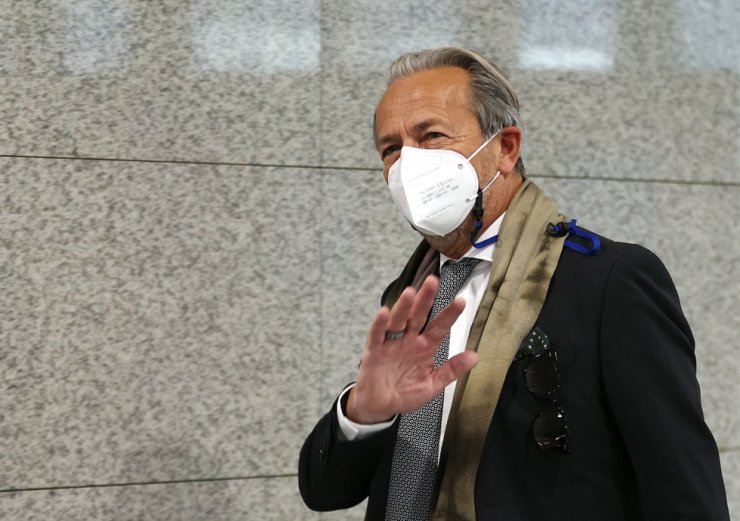
Head of the International Atomic Energy Agency’s department of safeguard Massimo Aparo waves his hand as he walks into the conference hall in the Ministry of Foreign Affairs’s building in Seoul, Tuesday.
November 5, 2020
Korea called Tuesday for the U.N. nuclear watchdog to play an “active” role in ensuring Japan’s transparent and safe handling of contaminated water from its crippled Fukushima nuclear power plant, the foreign ministry said.
Ham Sang-wook, deputy foreign minister for multilateral and global affairs, made the call during an annual policy consultation with Massimo Aparo, the head of the International Atomic Energy Agency (IAEA)’s department of safeguards.
“On the occasion of this consultation, our side stressed the contaminated water issue is a crucial matter that can affect the safety and environment of Japan’s neighboring countries and of the entire international community,” the ministry said in a press release.
“It asked the IAEA to play an active role in terms of securing transparency and verifying the safety in all processes of the Japanese government crafting measures to dispose of the water and disposing of it,” it added.
Amid public concerns over Japan’s possible discharge of the radioactive water into the sea, Seoul has repeatedly called for Tokyo to transparently share related information and stressed its “foremost priority” on the safety of citizens.
Last month, Tokyo was expected to finalize its plan to dispose of the tritium-laced water. But it apparently postponed an announcement on its decision amid strong protests.
At Tuesday’s talks, the ministry and the U.N. agency also discussed cooperation in strengthening readiness to monitor and verify North Korea’s nuclear activity. (Yonhap)
https://www.koreatimes.co.kr/www/nation/2020/11/356_298715.html
1 This Month

of the week – Shut Down Drone Warfare!


Tell the Ukrainian Government to Drop Prosecution of Peace Activist Yurii Sheliazhenko

Petition to revoke the licensing of the Near Surface Nuclear Disposal Facility (NSDF) at Chalk River. https://www.ourcommons.ca/petitions/en/Petition/Details?Petition=e-7247
To see nuclear-related stories in greater depth and intensity – go to https://nuclearinformation.wordpress.com
-
Archives
- March 2026 (244)
- February 2026 (268)
- January 2026 (308)
- December 2025 (358)
- November 2025 (359)
- October 2025 (376)
- September 2025 (257)
- August 2025 (319)
- July 2025 (230)
- June 2025 (348)
- May 2025 (261)
- April 2025 (305)
-
Categories
- 1
- 1 NUCLEAR ISSUES
- business and costs
- climate change
- culture and arts
- ENERGY
- environment
- health
- history
- indigenous issues
- Legal
- marketing of nuclear
- media
- opposition to nuclear
- PERSONAL STORIES
- politics
- politics international
- Religion and ethics
- safety
- secrets,lies and civil liberties
- spinbuster
- technology
- Uranium
- wastes
- weapons and war
- Women
- 2 WORLD
- ACTION
- AFRICA
- Atrocities
- AUSTRALIA
- Christina's notes
- Christina's themes
- culture and arts
- Events
- Fuk 2022
- Fuk 2023
- Fukushima 2017
- Fukushima 2018
- fukushima 2019
- Fukushima 2020
- Fukushima 2021
- general
- global warming
- Humour (God we need it)
- Nuclear
- RARE EARTHS
- Reference
- resources – print
- Resources -audiovicual
- Weekly Newsletter
- World
- World Nuclear
- YouTube
-
RSS
Entries RSS
Comments RSS
 nuclear-news