About Fukushima
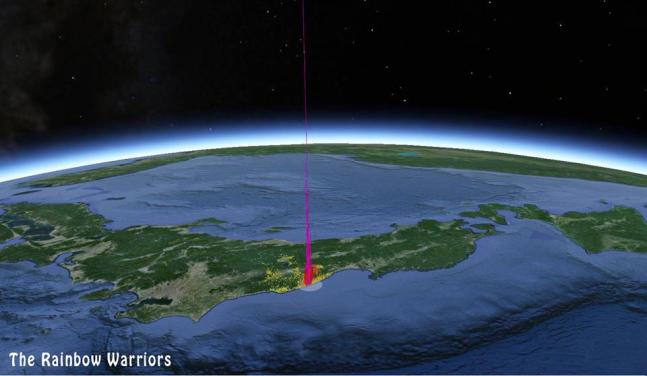
If in 2010 there was one birth and one death every 28 seconds in Japon, beginning 2014 there was one death every 25 seconds and a birth every 31 seconds: a differential of 2 seconds per year, this seems little yet it is significantly faster than in Ukraine.
Fukushima is much more severe, because there were 4 reactors instead of one, and the reactor 3 was using plutonium MOX, with at proximity a dense population. If the wind was favorable three days out of 4, it was also unfavorable 1 day out of 4.
The first 6 months of the Fukushima nuclear catastrophe in 2011, Tepco and the Japanese government were putting a lid on informations inside Japan, then gradually that omerta was broken by the people sharing informations on Twitter, Facebook, and blogs.
However, a language barrier remained. As of today there is a lot of informations in japanese circulated inside Japan, about radiation and contamination, about health issues, etc. Unfortunately those informations are not getting translated from japanese to english, due to the shortage of capable translators. As a result almost none of those important informations are getting outside of Japan reaching the outside world to teach the people everywhere the scale of the disaster and how it affects all those people lives.
The only informations coming out in english are those in the articles of the Japanese main stream media which are strongly under government influence when not just plain censorship, therefore publishing very sanitized informations, and the Western main stream media which are either under the nuclear lobby financial influence, or lacking the indepth details.
Not to mention the nonsense sensationalism of some of the American websites or Youtubers, produced only to increase visitors traffic and donations, which deals only in hyperboles, exaggerations, when not just plain lunacy.
The overall result is that we have an ongoing nuclear catastrophe now for 5 years and half, affecting millions of people on location in Japan, which outside of Japan most of the people are not aware, as it had not happened, was not happening.
The two main reasons being:
1. The sanitizing of information by the main stream media owned by the same financial interests which own the nuclear industry.
2. The language barrier which hinders the real facts, the real details to spread out of Japan.
And thanks to the continuous ignorance about the ongoing Fukushima Daiichi nuclear catastrophe, us not being capable to learn from it, its human tragedy, its harmful consequences to health and environment, it is like the whole world is ready for another new nuclear catastrophe, accepting it to come.
Why can’t we learn from our mistakes…
I wish to thank here Mochizuki Cheshire Iori of the Fukushima diary blog, Nancy Foust of Fukuleaks, and Pierre Fetet of the Fukushima blog, for their efforts year after year during the past 5 years and half to inform about Fukushima, those persons have accomplished an excellent and tremendous job, with integrity and no nonsense. My respect to you.
http://www.fukushima-blog.com/
Credit to Xavier Nast for the population statistics.
Japan Political Pulse: ‘Operation Tomodachi’ members need support amid radiation fears
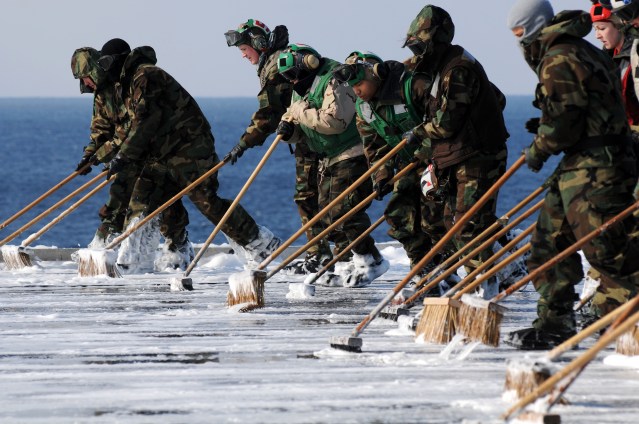
Many readers have offered support for a lawsuit filed by former U.S. servicemen and others claiming they were affected by radiation during “Operation Tomodachi,” a U.S. Armed Forces operation to assist Japan in the wake of the March 2011 Great East Japan Earthquake and tsunami. These readers reacted to last week’s installment of the Japan Political Pulse column that mentioned former Prime Minister Junichiro Koizumi’s activities to support the lawsuit.
It has not yet been proven if there is a causal relationship between so-called second-hand exposure to radiation and health problems. Critics say emotional support for those who claim their health was affected by indirect exposure to radiation without scientific proof is irresponsible. Emotional support is important but objective facts should also be clarified.
Eight former U.S. soldiers who participated in Operation Tomodachi (friend) launched the lawsuit in California in December 2012. The number of plaintiffs has since surpassed 450.
In March 2011, 16 U.S. military vessels engaged in the operation, including the aircraft carrier Ronald Reagan, were exposed to radiation off Fukushima Prefecture. These vessels and the servicemen aboard them were engaged in the operation amid a radioactive plume from the tsunami-hit Fukushima No. 1 Nuclear Power Plant.
According to the lawsuit, the plaintiffs have been suffering from such illnesses as leukemia, testis cancer, colon bleeding, ringing in their ears and a decline in eyesight since they returned home after participating in the operation.
They are suing Tokyo Electric Power Co., the operator of the nuclear plant, Toshiba Corp., Hitachi Ltd., and other Japanese and U.S. atomic power station manufacturers, demanding that a 1 billion dollar (some 100 billion yen) fund be set up to help the plaintiffs receive medical examinations and treatment.
The plaintiffs are hoping that their suit will be tried in the United States, while TEPCO is demanding that the case be heard in Japan.
In June 2015, TEPCO’s appeal over the jurisdiction over the trial was accepted, and a state appeal court is deliberating on the matter.
The aforementioned development of the case is based on interviews with former Prime Minister Koizumi, who met with some of the plaintiffs, and officials at the Foreign Ministry and the Agency for Natural Resources and Energy. TEPCO declined to comment on the matter on the grounds that the trial is ongoing.
Under the civil discovery system established by U.S. law, those involved in civil lawsuits can be forced to disclose evidence. Those who refuse to comply could be imprisoned or slapped with a huge fine for contempt of court. Critics say TEPCO demands that the suit be tried in Japan for this reason.
One cannot help but wonder what the company does not want to be exposed. There is a possibility that documents carrying information on the cause of the nuclear plant accident, TEPCO’s initial response to the disaster and observed data on aerial radiation levels — which is different from what the utility has explained — could be hidden. However, this is just a presumption without basis.
There is also an amicus curiae (court adviser) system, under which individuals or organizations appointed by courts provide information or express opinions on legal matters relating to individual court cases.
A former legislator has phoned the Mainichi Shimbun and raised questions about last week’s installment of this column, which quoted a magazine article as saying that an adviser from the Japanese government stated that U.S. forces are responsible for servicemen’s exposure to radiation while engaging in Operation Tomodachi.
Law360, a U.S.-based website specializing in information on legal affairs, lists the “Government of Japan” as the entity to which one of those who appeared in the oral proceeding on the lawsuit on Sept. 1 as court advisers belongs.
A senior official of the Agency for Natural Resources and Energy said, “The government isn’t aware of such a figure.” However, it would be no surprise if an adviser were to appear in court and develop a persuasive legal theory to pursue ways to evade legal responsibility on behalf of defendants.
Jonathan Woodson, assistant secretary of defense for health affairs who examined plaintiffs’ assertions in 2014 at the request of U.S. Congress, stated there is no objective evidence that the plaintiffs’ health hazard was caused by their exposure to radiation.
The March 13, 2016 issue of Stars and Stripes, a U.S. daily specializing in U.S. military information, covered Woodson’s report along with a comment by Shinzo Kimura, associate professor of radiation hygiene at Dokkyo Medical University, that the possibility that the plaintiffs’ symptoms were caused by their radiation exposure cannot be ruled out.
There is a long way to go before the causes of the plaintiffs’ illnesses can be clarified. However, there is no denying that many people are suffering from illnesses after participating in Operation Tomodachi.
Donations to a fundraising drive launched by former Prime Minister Koizumi are accepted at the Tokyo-based Johnan Shinkin Bank. Koizumi will deliver a speech on the matter at a lecture meeting in Tokyo on the evening of Nov. 16. Those who want to listen to his speech are required to make reservations by calling the Japan Assembly for Nuclear Free Renewable Energy at 03-6262-3623. The admission fee of 10,000 yen per person will be fully donated to former U.S. soldiers who are suffering from illnesses.
http://mainichi.jp/english/articles/20161011/p2a/00m/0na/019000c
Federation estimates Fukushima nuke plant cleanup costs, redress may rise to ¥8 trillion ($77.10 billion)

An industry group has estimated costs for decontamination work at the disaster-struck Fukushima nuclear plant and compensation for nuclear damage to be around ¥8 trillion ($77.10 billion) more than the current official projection, a source said Thursday.
The Federation of Electric Power Companies of Japan, which consists of the country’s 10 electric power companies, has informally asked Prime Minister Shinzo Abe’s government to use state funds to cover the extra costs, the source also said.
The costs are supposed to be covered by the utilities, including Tokyo Electric Power Company Holdings Inc., operator of the crippled Fukushima No. 1 nuclear power plant, where three reactors melted down in the aftermath of the March 2011 quake-tsunami disaster. The government is cautious about using taxpayer money to deal with the issue, the source said.
Under the current estimate, compensation payments are projected to total ¥5.4 trillion, while decontamination costs are forecast to reach ¥2.5 trillion.
Tepco and other nuclear power plant operators have paid contributions for compensation payments to a state-backed fund. As for decontamination costs, the fund will seek to retrieve that money by selling Tepco shares that it owns.
Fukushima Cleanup Talks Put Tepco Survival Risk in Focus
Tokyo Electric Power Co. is still struggling to put the Fukushima nuclear disaster behind it, admitting this week that paying for decommissioning the plant in one go risks leaving it insolvent.
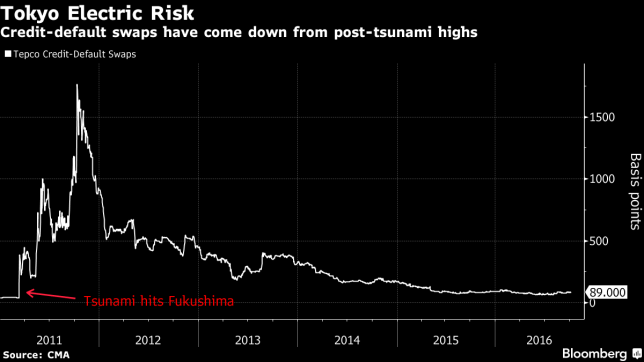
The cost to insure debt in Japan’s biggest utility climbed to a seven-month high of 89 basis points on Oct. 5 after President Naomi Hirose said after a meeting in Tokyo with a government commission that the company is asking for help in avoiding financial ruin. Tepco has already received state aid for compensation and decontamination.
The March 2011 nuclear accident and its fallout will ultimately cost more than 11 trillion yen ($106 billion), according to a study by academics including Kenichi Oshima, a professor of economics at Ritsumeikan University. Tepco has estimated that decommissioning alone will cost about 2 trillion yen. Investors should hold off buying bonds of other utilities until there is more clarity on how the government will close the Fukushima plant, according to BNP Paribas SA.
“Now is not the best time to be investing in electricity utility bonds, with discussions going on about nuclear plant decommissioning, and the potential for spreads to widen,” said Mana Nakazora, chief credit analyst at BNP Paribas in Tokyo. Even so, she added, “the government has little choice but to take measures to avoid a default by Tokyo Electric.”
While Prime Minister Shinzo Abe’s government has committed to provide up to 9 trillion yen for compensation to individuals and business hurt by the Fukushima disaster and for decontaminating areas affected, that figure doesn’t include decommissioning of the nuclear plant itself, according to a report by Moody’s Investors Service last month.
Scrapping the Fukushima reactors may take 30 years to 40 years, and Tokyo Electric will only start removing debris from the plant from in 2021, a decade after the incident, according to the utility’s road map for dealing with the remnants of the disaster.
In speaking to reporters, Tepco President Hirose was probably making a public case for more government support, according to Yutaka Ban, the chief credit analyst at SMBC Nikko Securities Inc. in Tokyo. Ban said he saw little probability that support will be withheld.
“Things will likely settle down” after the government adopts the new measures, said Ban. “Without government support, the costs would be extremely high.”
For a Bloomberg Intelligence report on Asia-Pacific utilities, click here.
Tepco’s credit-default swaps have come down from as high as 1,762 basis points in October 2011, according to data provider CMA. The utility has said it plans to return to the bond market by the end of the fiscal year to March 2017. Jun Oshima, a spokesman for Tokyo Electric, said that plan is still in place. It stopped issuing notes after the Fukushima disaster.
The extra yield on Tepco’s 1.155 percent bonds due in 2020 was 64 basis points more than sovereign debt, the lowest since before the Fukushima disaster, according to Bloomberg-compiled prices. The spread on Osaka-based Kansai Electric Power Co.’s 0.976 percent notes due in 2020 was 39 basis points.
Tokyo Electric has a Ba3 rating from Moody’s and BB- score from S&P Global Ratings, both three levels below investment grade.
“Decommissioning is currently the biggest unknown, and clarity matters in terms of credit,” said Mariko Semetko, a Moody’s analyst in Tokyo. “The lack of clarity there has been holding back the credit quality.”
Radioactive water leaks from storage tank at Fukushima plant
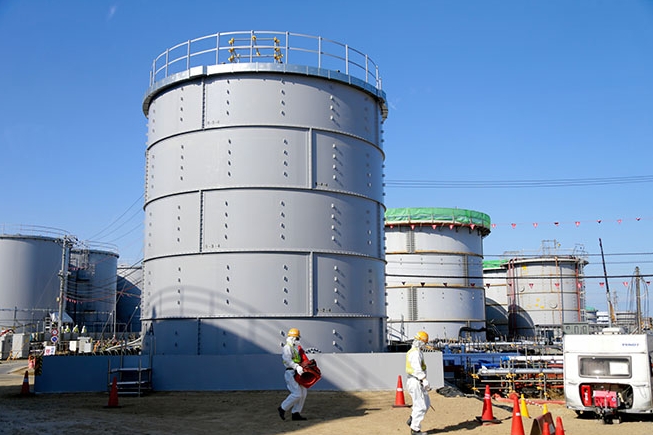
The latest contaminated water leak at the Fukushima No. 1 nuclear power plant occurred at a flange-type storage tank, whose seams are connected by bolts.
Up to 32 liters of radioactive water leaked from a storage tank at the crippled Fukushima No. 1 nuclear plant, but the contaminated liquid has been contained, Tokyo Electric Power Co. said Oct. 6.
The leaked water is currently within barriers surrounding the tank that are designed to block the flow of fluids, TEPCO, the plant’s operator, said.
The liquid contained water that had been treated to remove radioactive strontium and other substances, as well as highly contaminated water from the bottom of the tank that was stored shortly after the nuclear accident started in 2011.
A radioactivity level of 590,000 becquerels of beta ray-emitting materials was detected per liter of the leaked water.
The water seeped out of a tank with bolted seams on its sides, which are more prone to leaks than those with welded walls.
TEPCO continues to use the bolted containers despite the risk because production of welded tanks cannot keep pace with the buildup of contaminated water, mainly from groundwater entering the damaged reactor buildings, at the nuclear plant.
Storage tank leaks at Fukushima Daiichi plant
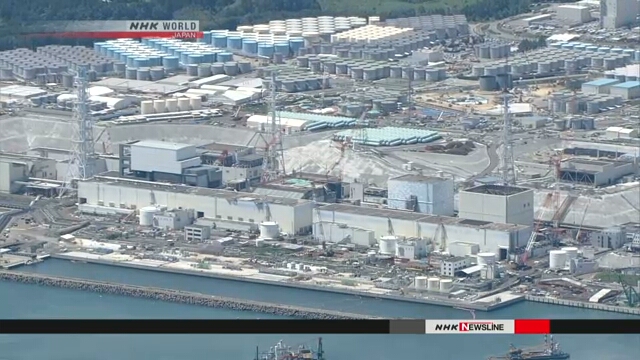
Workers at the crippled Fukushima Daiichi nuclear plant have found a leak of highly radioactive water from a waste water tank.
Its operator, Tokyo Electric Power Company, says the water likely leaked from a seam of the tank.
The leaked water was spotted on Wednesday on the side of one of an array of steel tanks holding contaminated water that is continuously generated at the site.
TEPCO’s analysis found 590,000 becquerel per liter of beta-emitting radioactive materials in the water.
Tokyo Electric estimates that 32 liters of such highly radioactive water had trickled out, mixed with rainwater, and remained within a barrier around the tank.
Workers moved water in the tank to another one to lower the water level enough to halt the leak.
The leaking cylindrical tank is made by splicing steel plates with bolts. But they have had waste water leaks in the past from seams.
The operator has been replacing these leak-prone tanks with new seamless ones. But the increasing volume of waste water makes it difficult for the utility to completely do away with the old ones.
Fukushima FAQ: Are Fukushima Radionuclides Causing Super Storms in the Pacific and Atlantic?
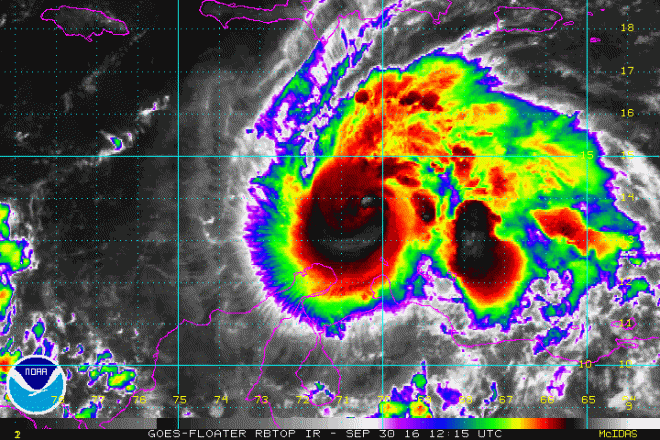
Hurricane Matthew spins in the Caribbean. Storms are fueled by energy which ultimately comes from the sun.
Short answer is absolutely not.
This post is part of an ongoing series dedicated to science education and to relate scientific findings about the impact of the Fukushima nuclear disaster on environmental and public health. I am frequently (more than you might think) asked if or told that the decay energy from radionuclides released from Fukushima Daiichi are fueling some of the massive cyclones in the Pacific in Atlantic Oceans. This is nonsense of course but highlights some of the logic used and how misinformation can fuel incorrect conclusions with respect to Fukushima and its environmental and public health impacts.
The thought process that brings one to link Fukushima contamination to hurricanes and typhoons goes something like this:
- Fukushima released radionuclides to the environment with much of the contamination ending up in the Pacific Ocean
- Radioisotopes generate heat when they decay
- Tropical cyclones feed off of ocean heat
- Fukushima is causing or causing more intense tropical cyclones
It is likely that increasing sea surface temperatures have the potential to influence the number and intensity of tropical cyclones. However, when we examine the reasoning linking Fukushima to cyclones and add a bit of numeracy we see how this reasoning is flawed.
One of the highest activity isotopes from Fukushima remaining in open ocean surface water is Cesium-137 (half-life = ~30 years, 137Cs). Much of this contamination remains in the North Pacific rather than in the tropics where typhoons form and far away from the tropical Atlantic where hurricanes form but lets ignore this fact for the purpose of our calculation. Maximum 137Cs activities measured by the Fukushima InFORM project in the northeast Pacific are ~ 10 Bq m-3 (cubic meter = 1000 L or ~1000 kg) of seawater.
By knowing this activity and the half-life of the isotope we can calculate the mass of 137Cs in one ton of seawater to be equal to be 0.0000000000031 grams or 3.1 x 10⁻¹² g or 3.1 picograms. This highlights why detecting such low levels of contamination in the ocean is such an analytical challenge.
Now that we know how much 137Cs we have we can look up the decay energy of this isotope as well. This energy corresponds to the difference in mass between the parent and daughter isotope and for 137Cs is equal to 0.6 Watts per gram or 0.6 W g-1 (where a Watt is equal to 1 Joule per second).
So to a first order the power added to one ton (1000 kg) of seawater from Fukushima contamination is about:
(3.1 x 10⁻¹² g) x (0.6 W g-1) = 0.000000000002 Watts or 2 picoW
This is a very small amount of power indeed. We can compare this to the Watts added to a square meter of the ocean surface. Erring on the low side in order to be conservative lets say that the Sun adds about 100 W per square meter (W m-2) at the ocean surface (but see this link from NASA for actual data).
The ratio of the power contributed by the Sun at the ocean surface to Fukushima decay energy is 50,000,000,000,000.
Suggesting that Fukushima energy is fueling cyclone activity is, scientifically speaking, silly. Friends don’t let friends do it.
Please see the NASA website for a useful summary of how tropical cyclones are formed.
Contaminated Water Tanks Without Fondation Bolts at Fukushima Daiichi
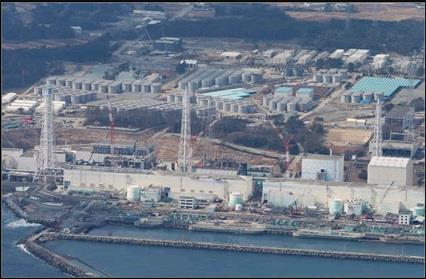
More than 1000 contaminated water tanks at Fukushima Daiichi, some do not have fondation bolts.
Even with a moderate earthquake of seismic intensity 4 there is a risk that those contaminated water tanks collapse.
The Nuclear Regulatory Commission of Japan has published on their website the seismic statement submitted by TEPCO about those tanks without fondation bolts. Their quake-resistance standard is 0.3G lower.
http://www.nsr.go.jp/data/000107385.pdf
The photograph below clearly shows the tank without fondation bolts.

Seismic intensity 4 and typhoons could cause the collapse of those contaminated water tanks. In case of tanks collapsing, a large amount of contaminated water would of course flow into the Pacific Ocean.
Japan Grapples with Cost of Scrapping Fukushima Plant

Tepco’s Fukushima Daiichi nuclear plant, site of the 2011 meltdowns.
TOKYO — Tokyo Electric Power Co. Holdings promises to shoulder as much of the burden as possible in dealing with the aftermath of the nuclear meltdown in Fukushima, but additional outside assistance is deemed inevitable to cover the gargantuan cost of dismantling the facility.
An expert panel under the Ministry of Economy, Trade and Industry began deliberations over the additional costs of the 2011 disaster on Wednesday. Attendees included Yoshimitsu Kobayashi, chairman of the Japan Association of Corporate Executives, and Akio Mimura, chairman of the Japan Chamber of Commerce and Industry.
“We want to fully meet our responsibility for the Fukushima disaster without receiving government assistance,” said Tepco President Naomi Hirose, who attended as an observer.
Tepco has allocated 2 trillion yen ($19.3 billion) so far in preparation for the decades-long process to decommission its Fukushima Daiichi nuclear plant. But it is expected to need trillions more once it starts to remove melted nuclear nuclear fuel from the site.
The bulk of the cost will not hit until the 2020s, so the government has made little progress in creating a framework to provide assistance, unlike efforts in compensating victims and decontaminating the surrounding area.
Hirose explained that once Tepco can give a realistic estimate, it will be required to recognize the entire cost at once and could turn insolvent. “We’d like the government to come up with a framework to eliminate such risks,” he said.
The panel will project decommissioning costs in its future meetings, and will make recommendations to Tepco regarding necessary reforms and restructuring by the end of the year. The utility will aim to create a new management plan in January based on the panel’s proposals. The economy ministry will iron out details on how to assist Tepco based on the expense estimate, such as by creating a reserve fund where Tepco can put aside the necessary money.
The discussion will focus on how much of the cost Tepco can assume through internal reforms. In addition to dismantling the plant, total compensation to victims is already expected to top 6.4 trillion yen, while decontamination could cost about 4 trillion yen — both above projections from January 2014. It will take Tepco and other major utilities decades to pay that off under the current framework. An update is in order.
“I am not in favor of any rescue plan that involves the government shouldering what Tepco should be paying,” said Hitotsubashi University professor Kunio Ito, who heads the expert panel. But he said something like that could happen “as a last resort.” A ministry official also suggested there may be a debate on raising electricity prices to help fund the decommissioning.
If the plan is to hike rates on customers not served by Tepco, the utility needs to put forth a strategy for reform that can satisfy the entire Japanese public. The government’s program will depend on how far Tepco is willing to go.
Tepco Threatens To Declare Bankruptcy; Dismantling Unit 1
Calls grow to curb further govt. support to TEPCO
Members of a panel looking at how to cover costs from the 2011 Fukushima Daiichi accident say government support to the operator should be limited.
Economic leaders and academic experts attended the first meeting on Wednesday of a committee set up by the industry ministry to discuss decommissioning and compensation costs.
Officials said the government has earmarked about 87 billion dollars for compensation and decontamination work, and that operator Tokyo Electric Power Company has set aside about 19 billion dollars to scrap the crippled reactors.
But they said these funds could fall well short of the amount that will be needed.
Many participants said the utility must bear the increased financial burden through business restructuring and management reforms to curb additional government support.
TEPCO President Naomi Hirose, who took part in the meeting as an observer, warned that his company could become insolvent if it is forced to post the ballooning decommissioning costs as a debt.
He argued that a special accounting rule should be created to avoid a possible insolvency.
Before the next meeting is held, the government plans to show how much the cost of decommissioning the reactors is projected to grow.
Hirose told reporters after the meeting that his company should be the first to foot the bill, and that the firm will consider what should be done to absorb the cost.
Tepco Falls After President Highlights Fukushima Cost Risk
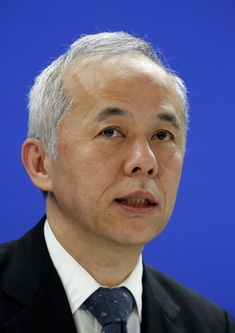
Japan utility declines 3.3% to settle at lowest in two weeks
Company seeks government help to eliminate insolvency risk
Tokyo Electric Power Co. Holdings Inc. closed at the lowest in more than two weeks after its president said it may face insolvency if it recognized at one time the cost of decommissioning the wrecked Fukushima nuclear plant and that it’s asked the government to help eliminate the risk.
Tepco, as the company is better known, fell as much as 7.9 percent during intraday trading and closed 3.3 percent lower at 414 yen a share in Tokyo, the lowest since Sept. 16. The benchmark Topix index rose 0.6 percent.
“As it becomes possible to estimate the Fukushima decommissioning cost, we will have the problem of recognizing the liability at once. That means there is a possibility Tepco becomes insolvent,” President Naomi Hirose told reporters in Tokyo Wednesday after meeting with a Ministry of Economy, Trade and Industry commission charged with reforming the company. “We are requesting institutional measures to remove such risk.”
As of June, nearly 1 trillion yen ($9.7 billion) has been allocated to decommissioning and water treatment at Fukushima, Tepco spokesman Tatsuhiro Yamagishi said last month.
The March 2011 nuclear accident and its fallout will ultimately cost more than 11 trillion yen, according to a study by Japanese college professors including Kenichi Oshima, a professor of economics at Ritsumeikan University.
Tepco calls for government help to curb impact of rising Fukushima costs
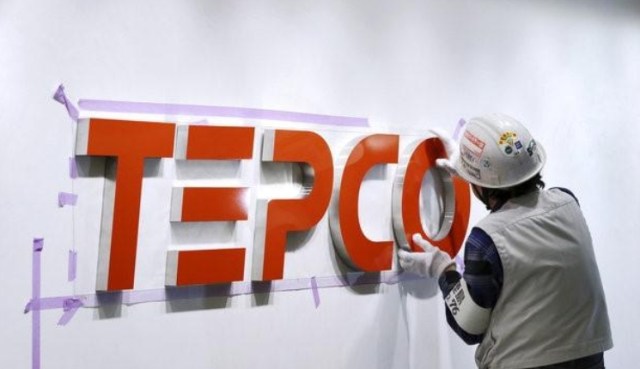
A worker puts up new logo of TEPCO Holdings and Tokyo Electric Power Company (TEPCO) Group on the wall ahead of the transition to a holding company system through a company split at the TEPCO headquarters in Tokyo, Japan, March 31, 2016.
The operator of the nuclear power plant destroyed in the Fukushima disaster five years ago has asked Japan’s government for help in avoiding the risk of the utility going bankrupt should there be a sharp rise in the full estimated clean-up costs.
Tokyo Electric Power Co Holdings Inc didn’t specify what kind of help it was seeking, but people familiar with the matter said Japan’s biggest utility is looking for new rules to avoid having to book a huge loss in its accounts if it is estimated that there will be big cost overruns for decommissioning the power station.
“We don’t want to receive national rescue measures but want to bear the Fukushima responsibility ourselves,” Tepco president Naomi Hirose told a government panel, according the panel chief, Kunio Ito, a professor at Hitotsubashi University.
“For that reason, we would like to undertake steps for a further overhaul than we have had so far,” Hirose was quoted as saying.
In March 2011, one of the worst earthquakes in history triggered a 10-metre high tsunami that crashed into the Fukushima Daiichi nuclear power station, causing the world’s worst nuclear accident since Chernobyl 30 years ago. Meltdowns in three reactors released radiation over a wide area, contaminating water, food and air, and forcing more than 160,000 people to evacuate.
Dismantling the reactors is expected to take about 40 years, but even five and a half years on, Tepco still struggles to contain radioactive water from the plant and has said it can’t predict the eventual total costs of the clean-up and decommissioning.
After the panel meeting on Tepco reform and the Fukushima Daiichi plant, Hirose told reporters that it was difficult to accurately predict the costs of even a gradual decommissioning of the crippled reactors, said a spokeswoman for the utility, which generates about a third of the country’s electricity.
“If the issue of recognising all the estimated losses at once were to emerge, our company would fail, so we would like some structural assistance from the government to be able to avoid that risk,” Hirose said.
Tepco wants the government to consider introducing rules to avoid having to book a single huge exceptional loss as soon as cost estimates for decommissioning become clearer, said a person familiar with the situation.
Cost estimates could shoot up when the company and the government, which owns 50.1 percent of Tepco, decide on how to extract fuel debris at the plant in 2018 or 2019, said a person with direct knowledge of discussions on restructuring Tepco.
A government official familiar with the deliberations said, “In the event that Tepco can’t shoulder the burden, it will mean changing the fiscal-support system.” As it’s hard to imagine the government letting the company go bust, “in the end it will have to be a matter of either shouldering the burden with public funds or responding by raising electricity prices.”
The Mainichi newspaper said on Wednesday that Japan’s utilities lobby expects clean-up and compensation costs from the Fukushima disaster to overshoot previous estimates by 8.1 trillion yen (£62 billion).
The Federation of Electric Power Companies of Japan has informally asked the government to shoulder the extra cost, the newspaper said.
However, a federation spokesman said the group has not asked the government to shoulder any extra costs and the Mainichi estimates were not correct.
The new government panel also agreed that management reform at Tepco was necessary at its first meeting earlier in the day, panel chief Ito said.
Shares in Tepco ended down 3.3 percent after falling as much as 7.9 percent on Hirose’s remarks, which were initially interpreted as a plea for additional financial aid.
“The stock market seems to have reacted to the headline that it could become insolvent,” said a credit analyst at a Japanese brokerage. “But in reality, the president has just said what’s been known, that they need an accounting system that allows them to write off the cost of decommissioning gradually because posting the cost all at once could make it insolvent.”
http://uk.reuters.com/article/uk-tepco-outlook-idUKKCN1250JT
77.2 Billion Dollars in Public Funds Sought for Post-Fukushima Disaster Costs
They were telling us that nuclear energy was safe and cheap….

8 trillion yen in public funds sought for post-Fukushima disaster costs
The Federation of Electric Power Companies of Japan (FEPC) has informally asked the government to inject some 8 trillion yen in public funds into efforts for nuclear damage compensation and decontamination work in areas around the Fukushima No. 1 nuclear power plant, it has been learned.
The FEPC has drawn up a report stating that an extra 8 trillion yen is estimated to be necessary even after Tokyo Electric Power Co. (TEPCO) and other major utilities shoulder the planned amount of costs for dealing with the aftermath of the Fukushima disaster, and has informally requested that the government foot the surplus amount. The government has heretofore taken the position that nuclear plant operators should bear the costs for nuclear damage compensation and decontamination work in principle. It is therefore expected to approach the request with caution.
The costs for Fukushima disaster damage compensation and decontamination work are funded under the following steps: the state issues cashable government compensation bonds to the Nuclear Damage Compensation and Decommissioning Facilitation Corp. (NDF), a government-authorized corporation; TEPCO then receives necessary funds from the NDF and spends them on nuclear damage compensation and decontamination work; the NDF then receives due contributions from TEPCO and other major utilities and pays back the funds to the state.
Among the contributions made by power companies to the NDF, funds for nuclear damage compensation are shouldered by TEPCO and other major utilities, and the funds for decontamination work are covered by profits on the sale of TEPCO shares held by the NDF, while the funds for building interim storage facilities for radioactive waste are covered by revenues from the tax on the promotion of power resources development.
In 2013, the government estimated that nuclear damage compensation would cost 5.4 trillion yen, while decontamination work would require 2.5 trillion yen and construction costs for temporary storage facilities for radioactive waste and other expenses would need 1.1 trillion yen. The total amounts to be granted to the NDF were estimated at a maximum 9 trillion yen.
However, the FEPC now forecasts that damage compensation would cost 2.6 trillion yen more at 8 trillion yen and the decontamination expenses 4.5 trillion yen more at 7 trillion yen, according to sources familiar with the matter. Furthermore, the FEPC forecasts that profits on the sale of TEPCO shares would be 1 trillion yen less than the initial estimate due to a fall in the stock prices, bringing the total fund shortages to 8.1 trillion yen.
Major utilities fear that they would ultimately be forced to shoulder the additional burden as the enormous costs for decontamination work cannot be covered by profits on the sale of TEPCO shares.
The FEPC has unofficially asked that the government foot the extra amount of costs necessary for nuclear damage compensation and decontamination work on the grounds that the business environment for major utilities has deteriorated amid the stalled reactivation of nuclear reactors that have been left idle since the Fukushima disaster and the intensifying competition among power companies following the liberalization of the electricity retail market this past spring.
While TEPCO has forked out 2 trillion yen for the decommissioning of disaster-stricken reactors at the Fukushima No. 1 nuclear plant, several trillion yen extra is projected to be necessary to cover the expenses. In July, Tokyo Electric Power Company Holdings Inc. asked for government assistance in covering the expenses for reactor decommissioning at the plant and other efforts. The FEPC’s recent request to the government, meanwhile, does not include financial assistance for reactor decommissioning.
The government is poised to discuss the costs for Fukushima disaster damage compensation and reactor decommissioning at a panel on TEPCO reform and Fukushima No. 1 plant issues to be convened on Oct. 5, where the FEPC’s request is likely to be deliberated on.
http://mainichi.jp/english/articles/20161004/p2a/00m/0na/017000c
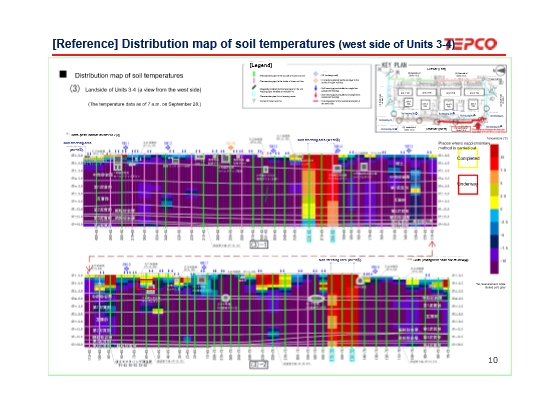
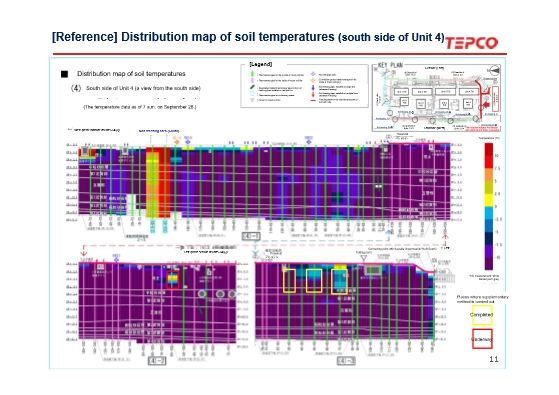
TEPCO Continues Injecting Concrete and a Soil Solidification Substance in Areas of the Frozen Wall
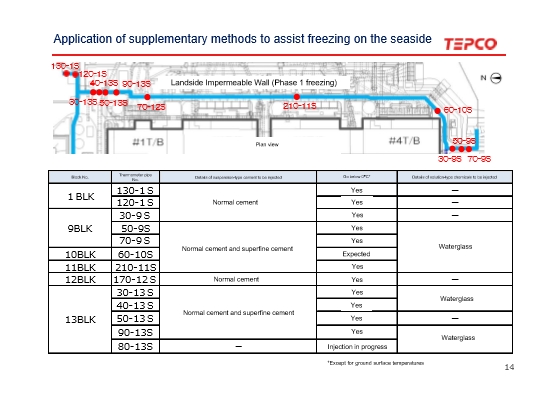
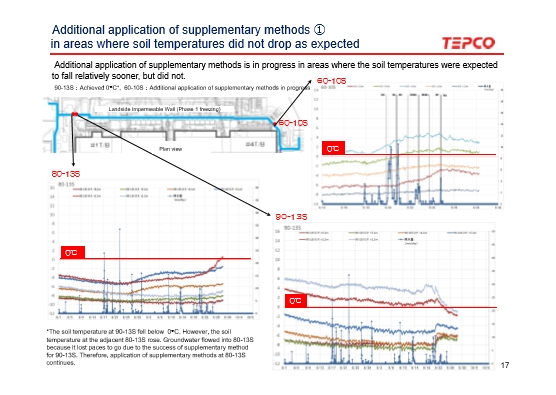
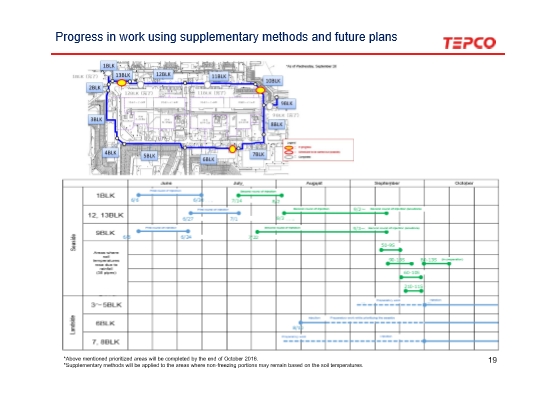
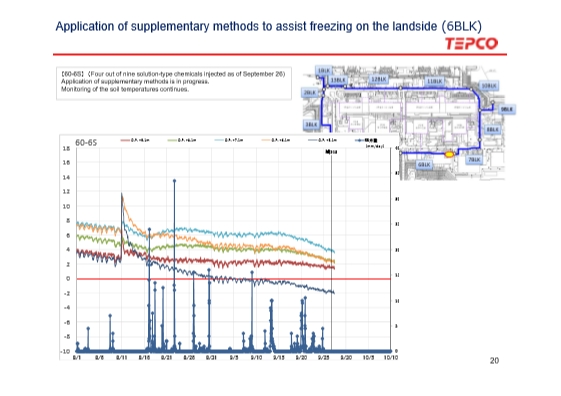
TEPCO also continues to inject concrete and a soil solidification substance in areas of the frozen wall that have been resistant to proper freezing.
Groundwater levels inside the reactor areas has been on the rise due to more success freezing the sea side section of the wall.
Therefore, application of supplementary methods at 80-13S continues.” Efforts to cement sections of the land side wall have begun and will take place through October.
They asked the NRA again within the last week for permission to freeze the remaining sections of the land side frozen wall sections.
TEPCO states that they have frozen 95 percent of the land side section of the wall.
TEPCO published a new report on the frozen wall dated September 29.
Another typhoon may hit Fukushima prefecture this week, if it does it may cause further problems with the frozen wall.
There was also a concerning note buried later in the report related to a section where they had used concrete to block the water flow.
So the concrete work just caused the water flow to divert to another part of the wall.
Progress of Landside Impermeable Wall freezing: Phase 2 of the first stage
○The purpose of the Landside Impermeable Wall construction lies not in freezing soil to form an underground wall but in keeping groundwater fromflowing into the reactor/turbine buildings and preventing new contaminated water from being generated.
○By closing less than 95 percent of the mountainside of the Landside Impermeable Wall inPhase2 of the first stage, it is expected that the amount of groundwater flowing into the areas around the reactor/turbine buildings will be reduced. This will help keep groundwater from being contaminated during the first stage.
○Throughout the first stage, how freezing of the Landside Impermeable Wall has progressed will be checked by monitoring thedifference in groundwater levels inside and outside of the wall and the amount of groundwater pumped up by the subdrain and groundwater drainsystems and the well point system.







Read more Pdf:
http://www.tepco.co.jp/en/nu/fukushima-np/handouts/2016/images/handouts_160728_02-e.pdf
Tainted Water Grows at Fukushima N-Plant despite Ice Wall

Tokyo, Oct. 2 (Jiji Pres)–Six months into operation, the much-hyped underground ice wall has not yet produced the intended effects of curbing the growth of radioactive water at Tokyo Electric Power Company Holdings Inc.’s stricken Fukushima No. 1 nuclear plant.
TEPCO initially claimed that the ice wall would prove effective in about a month and half, but the amount of contaminated water at the plant has continued to increase at a pace faster than projected by the utility.
The plant in northeastern Japan faces a chronic shortage of welded-type water storage tanks, while an increasing volume of tainted water has been transferred to the reactor and turbine buildings as a makeshift measure despite a high risk of leaks.
TEPCO constructed the 1.5-kilometer-long ice wall encircling the plant’s damaged No. 1 to No. 4 reactors in an attempt to block groundwater from flowing into reactor buildings and mixing with radioactive water accumulating inside.
The government has to date spent a total of 34.5 billion yen in the construction of the structure by freezing underground soil, which is believed to be technically very difficult.
1 This Month

of the week–London Campaign for Nuclear Disarmament

Tell the Ukrainian Government to Drop Prosecution of Peace Activist Yurii Sheliazhenko
To see nuclear-related stories in greater depth and intensity – go to https://nuclearinformation.wordpress.com
-
Archives
- April 2026 (114)
- March 2026 (251)
- February 2026 (268)
- January 2026 (308)
- December 2025 (358)
- November 2025 (359)
- October 2025 (376)
- September 2025 (257)
- August 2025 (319)
- July 2025 (230)
- June 2025 (348)
- May 2025 (261)
-
Categories
- 1
- 1 NUCLEAR ISSUES
- business and costs
- climate change
- culture and arts
- ENERGY
- environment
- health
- history
- indigenous issues
- Legal
- marketing of nuclear
- media
- opposition to nuclear
- PERSONAL STORIES
- politics
- politics international
- Religion and ethics
- safety
- secrets,lies and civil liberties
- spinbuster
- technology
- Uranium
- wastes
- weapons and war
- Women
- 2 WORLD
- ACTION
- AFRICA
- Atrocities
- AUSTRALIA
- Christina's notes
- Christina's themes
- culture and arts
- Events
- Fuk 2022
- Fuk 2023
- Fukushima 2017
- Fukushima 2018
- fukushima 2019
- Fukushima 2020
- Fukushima 2021
- general
- global warming
- Humour (God we need it)
- Nuclear
- RARE EARTHS
- Reference
- resources – print
- Resources -audiovicual
- Weekly Newsletter
- World
- World Nuclear
- YouTube
-
RSS
Entries RSS
Comments RSS
 nuclear-news