Robotic Probe Has “Confirmed” Lumps that “Could Be” Fuel Debris in the No.3 Reactor…
Japan’s industry minister says the government hopes to have a policy in place by around September on how to remove melted fuel from the No.3 reactor of the disabled Fukushima Daiichi nuclear power plant.
Hiroshige Seko told reporters on Tuesday that a robotic probe has confirmed lumps that could be fuel debris in the No.3 reactor, giving researchers valuable information.
Seko said he hopes a policy on how to remove the debris can be formulated, based on an analysis and assessment of the probe’s findings.
During the survey last week, a submersible robot found lumps below the reactor pressure vessel and at the bottom of the containment vessel.
It’s the first time a probe has identified what could be a mixture of melted nuclear fuel and broken metal parts lodged inside a reactor container.
Removing the fuel debris would require the use of remote-controlled robots. It is considered the most challenging step in the process to decommission the reactor.
The industry minister suggested that the government plans to honor the existing timetable for decommissioning.
The plan calls for setting specific methods for removing fuel debris by the first half of 2018, so the actual work can begin by 2021.
Deposits in reactor likely to be fuel debris?
The operator of the damaged Fukushima Daiichi nuclear power plant released video footage on Monday of what is likely to be melted fuel debris.
Tokyo Electric Power Company, or TEPCO, found the solidified lumps during a robot inspection of the containment vessel of Fukushima’s wrecked No. 3 reactor. The 3-day survey ended on Saturday.
TEPCO had earlier only made public still images from the probe. The 4-minute video shows black or grey lumps hanging down close to a structure just below the reactor.
The lava-like lumps are piled in layers, a phenomenon unknown before the accident.
TEPCO officials say the debris is probably melted nuclear fuel mixed with broken reactor parts.
In addition to metal scaffolding and other structural components, rocks and sand-like sediment can be seen getting stirred up by the movement of the robot.
The government and TEPCO plan further analysis of the footage in order to determine methods for removing the debris.
https://www3.nhk.or.jp/nhkworld/en/news/20170724_27/
How Much Fuel Was in Fukushima Daiichi Unit 3 Reactor?
“Basically, at Daiichi Unit 3 TEPCO has misplaced 50 plus tons of reactor fuel that was “enriched” with plutonium and now were are being encouraged to think that shards of melted-fuel debris represent the entirety of the missing reactor core….a core that weighed more than a school bus….”

Via Majia’s Blog:
I’ve followed the Fukushima Daiichi disaster so closely for so long that I was surprised to discover this morning that I really don’t know exactly how much fuel was in reactor 3.
I have the data on fuel contained in the spent fuel pools, but NOT the data on fuel in the REACTOR CORES.
Below find the spent fuel pool data:
TEPCO. Integrity Inspection of Dry Storage Casks and Spent Fuels at Fukushima Daiichi Nuclear Power Station (16 November 2010), http://www.nirs.org/reactorwatch/accidents/6-1_powerpoint.pdf
[PARAPHRASING] The total spent uranium fuel inventory at Daiichi in March 2010 was reported as 1,760 tons. The 2010 report asserts that approximately 700 spent fuel assemblies are generated every year. The report specifies that Daiichi’s 3,450 assemblies are stored in each of the six reactor’s spent fuel pools. The common spent fuel pool contains 6291 assemblies. The amount of MOX fuel stored at the plant has not been reported.
SO, 700 spent fuel assemblies were generated at Daiichi each year. There were 6 reactors at Daiichi, although not all were operational at time of earthquake. Assuming they were operational, can we infer that each reactor core contained approximately 100 assemblies?
That estimate is supported by the US Nuclear Regulatory Commission’s information on fuel assemblies found here, which suggests a reactor may contain up to 200 assemblies, with each assembly containing 200 or more rods:
US NRC (2017, April 10). Fuel assembly (fuel bundle, fuel element). https://www.nrc.gov/reading-rm/basic-ref/glossary/fuel-assembly-fuel-bundle-fuel-element.html
A structured group of fuel rods (long, slender, metal tubes containing pellets of fissionable material, which provide fuel for nuclear reactors). Depending on the design, each reactor vessel may have dozens of fuel assemblies (also known as fuel bundles), each of which may contain 200 or more fuel rods.
The website titled Nuclear Power Net, described as non-profit and founded by nuclear engineers, suggests a typical reactor contains 157 fuel assemblies but those are composed of over 45,000 fuel rods (which is more than 200 in each assembly):
Nuclear Power Net (no date). http://www.nuclear-power.net/nuclear-power-plant/nuclear-fuel/
An 1100 MWe (3300 MWth) nuclear core may contain 157 fuel assemblies composed of over 45,000 fuel rods and some 15 million fuel pellets. Generally, a common fuel assembly contain energy for approximately 4 years of operation at full power. Once loaded, fuel stays in the core for 4 years depending on the design of the operating cycle. During these 4 years the reactor core have to be refueled.
During refueling, every 12 to 18 months, some of the fuel – usually one third or one quarter of the core – is removed to spent fuel pool, while the remainder is rearranged to a location in the core better suited to its remaining level of enrichment. The removed fuel (one third or one quarter of the core, i.e. 40 assemblies) has to be replaced by a fresh fuel assemblies.
The variation in data is puzzling but I think we can move forward assuming that there were approximately 100 fuel assemblies in each reactor.
A typical fuel assembly for a Pressured Water Reactor (PWR) “stands between four and five metres high, is about 20 cm across and weighs about half a tonne” according to the World Nuclear Association (http://www.world-nuclear.org/information-library/nuclear-fuel-cycle/conversion-enrichment-and-fabrication/fuel-fabrication.aspx).
USING THESE DATA POINTS, I can infer that Unit 3’s reactor core contained approximately 50-75 tons of fuel. Does that sound roughly correct? A ton is 2,000 pounds so 50 tons of fuel is 100,000 pounds. For metric users, that converts into 45359.237 kilograms.
Why is it so important that I determine how much fuel was in reactor 3?
The reason lies in the media representations of TEPCO’s robotic probe, Little Sunfish, which allegedly has (likely) located unit 3’s missing reactor fuel, illustrated in the media as “rocks on the floor”:
Kohei Tomida (July 23, 2017). Melted nuke fuel images show struggle facing Fukushima plant. The Asahi Shimbun, http://www.asahi.com/ajw/articles/AJ201707230012.html
In particular, what is believed to be nuclear fuel debris is scattered in the form of rocks in the area directly beneath the pressure vessel.
My point is not to deny that these found rocks might be nuclear fuel debris. Rather, my point is that these shards of melted fuel and debris can hardly be construed as representing the entirety of the fuel.
Put otherwise, there is no compelling evidence that TEPCO has located the majority of fuel that was contained in Unit 3.
I decided to search my notes, books, and the web validated statistics on how much fuel each reactor contained. I was struck by how little information is available about the missing fuel and the sanitized accounts of what happened at unit 3, the one running MOX fuel.
Basically, at Daiichi Unit 3 TEPCO has misplaced 50 plus tons of reactor fuel that was “enriched” with plutonium and now were are being encouraged to think that shards of melted-fuel debris represent the entirety of the missing reactor core….a core that weighed more than a school bus….
http://majiasblog.blogspot.fr/2017/07/how-much-fuel-was-in-fukushima-daiichi.html
Likely Melted Fuel Heap Found Inside Fukushima Daiichi’s Reactor 3 Shows Future Removing Difficulties
Underwater robot finds likely melted fuel heap inside Fukushima reactor
 This image captured by an underwater robot provided by International Research Institute for Nuclear Decommissioning on Saturday, July 22, 2017 shows heaps of solidified lava-like rocks believed to be nuclear fuel.
TOKYO (AP) — Images captured by an underwater robot showed massive deposits believed to be melted nuclear fuel covering the floor of a damaged reactor at Japan’s crippled Fukushima nuclear plant.
The robot found large amounts of solidified lava-like rocks and lumps in layers as thick as 1 meter on the bottom inside of a main structure called the pedestal that sits underneath the core inside the primary containment vessel of Fukushima’s Unit 3 reactor, said the plant’s operator, Tokyo Electric Power Co.
On Friday, the robot spotted suspected debris of melted fuel for the first time since the 2011 earthquake and tsunami caused multiple meltdowns and destroyed the plant. The three-day probe of Unit 3 ended Saturday.
Locating and analyzing the fuel debris and damage in each of the plant’s three wrecked reactors is crucial for decommissioning the plant. The search for melted fuel in the two other reactors has so far been unsuccessful because of damage and extremely high radiation levels.
During this week’s probe, cameras mounted on the robot showed extensive damage caused by the core meltdown, with fuel debris mixed with broken reactor parts, suggesting the difficult challenges ahead in the decades-long decommissioning of the destroyed plant.
TEPCO spokesman Takahiro Kimoto said it would take time to analyze the debris in the images to figure out debris removal methods.
http://mainichi.jp/english/articles/20170723/p2g/00m/0dm/033000c
Melted nuke fuel images show struggle facing Fukushima plant
 What is believed to be nuclear fuel debris has accumulated at the submerged bottom of the containment vessel in the No. 3 reactor at the Fukushima No. 1 nuclear power plant in an image taken on July 22. Part of the collapsed metal scaffolding is seen at back right.
Images captured on July 22 of solidified nuclear fuel debris at the bottom of a containment vessel of the crippled Fukushima No. 1 nuclear power plant show the enormity of decommissioning of the facility.
Plant operator Tokyo Electric Power Co. said it will closely study the images from the No. 3 reactor’s containment vessel to determine the spread and amount of nuclear fuel debris.
After analysis, TEPCO will decide on a policy to retrieve the fuel debris.
The government and TEPCO plan to start the retrieval process in one of the three crippled reactors at the plant from 2021.
It will be a formidable task, given that a method of recovering debris that is stuck to the floor has yet to be considered.
The recent images were taken by a submersible robot, which was sent into the containment vessel on July 19, 21 and 22.
The No. 3 reactor’s containment vessel is filled with water to a depth of 6.4 meters.
On the final day, the remote-controlled robot was dispatched to the deepest part of the containment vessel.
The images showed that pieces that fell from the structure and deposited material accumulated to a height of about 1 meters at the bottom of the containment vessel.
In particular, what is believed to be nuclear fuel debris is scattered in the form of rocks in the area directly beneath the pressure vessel.
The latest investigation has confirmed TEPCO’s assumption made through analyses that most of the reactor’s nuclear fuel melted through the pressure vessel and accumulated at the bottom of the containment vessel.
It also discovered that the nuclear fuel debris has spread throughout the containment vessel.
The images marked the first confirmation through a robot probe of a large amount of nuclear debris in any of the embattled No. 1 through No. 3 reactors.
Japan Pictures Likely Show Melted Fukushima Fuel for First Time

New images show what is likely to be melted nuclear fuel hanging from inside one of Japan’s wrecked Fukushima reactors, a potential milestone in the cleanup of one of the worst atomic disasters in history.
Tokyo Electric Power Co. Holdings Inc., Japan’s biggest utility, released images on Friday showing a hardened black, grey and orange substance that dripped from the bottom of the No. 3 reactor pressure vessel at Fukushima, which is likely to contain melted fuel, according to Takahiro Kimoto, an official at the company. The company sent a Toshiba-designed robot, which can swim and resembles a submarine, to explore the inside of the reactor for the first time on July 19.
“Never before have we taken such clear pictures of what could be melted fuel,” Kimoto said at a press briefing that began at 9 p.m. Friday in Tokyo, noting that it would take time to analyze and confirm whether it is actually fuel. “We believe that the fuel melted and mixed with the metal directly underneath it. And it is highly likely that we have filmed that on Friday.”
 Pictures taken on July 21 inside of Fukushima reactor. Source: Tokyo Electric Power Co. Holdings Inc.
If confirmed, the substance — which has the appearance of icicles — would be the first discovery of the fuel that melted during the triple reactor accident at Fukushima six years ago. For Tokyo Electric, which bears most of the clean-up costs, the discovery would help the utility design a way to remove the highly-radioactive material.
The robot, which is about 30 centimeters (12 inches) long, will search for melted fuel at the bottom of the reactor on Saturday. It is possible that the company will take more pictures of what could be melted fuel spread across the floor and lower levels, according to Tokyo Electric’s Kimoto. Fuel from a nuclear meltdown is known as corium, which is a mixture of the atomic fuel rods and other structural materials.
Early Signs
“It is important to know the exact locations and the physical, chemical, radiological forms of the corium to develop the necessary engineering defueling plans for the safe removal of the radioactive materials,” said Lake Barrett, a former official at the U.S. Nuclear Regulatory Commission who was involved with the cleanup at the Three Mile Island nuclear power plant in the U.S. “The recent investigation results are significant early signs of progress on the long road ahead.”
Because of the high radioactivity levels inside the reactor, only specially designed robots can probe the unit. And the unprecedented nature of the Fukushima disaster means that Tepco, as the utility is known, is pinning its efforts on technology not yet invented to get the melted fuel out of the reactors.
Removal Plans
The company aims to decide on the procedure to remove the melted fuel from each unit as soon as this summer. And it will confirm the procedure for the first reactor during the fiscal year ending March 2019, with fuel removal slated to begin in 2021.
Decommissioning the reactors will cost 8 trillion yen ($72 billion), according to an estimate in December from the Ministry of Economy, Trade and Industry. Removing the fuel is one of the most important steps in a cleanup that may take as long as 40 years.
Similar to the latest findings on Friday, Tepco took photographs in January of what appeared to be black residue covering a grate under the Fukushima Dai-Ichi No. 2 reactor, which was speculated to have been melted fuel. However, a follow-up survey by another Toshiba-designed robot in February failed to confirm the location of any melted fuel in the reactor after it got stuck in debris.
A robot designed by Hitachi-GE Nuclear Energy Ltd. also failed to find any melted fuel during its probe of the No. 1 reactor in March.
The significance of Friday’s finding “might be evidence that the robots used by Tepco can now deal with the higher radiation levels, at least for periods of time that allow them to search parts of the reactor that are more likely to contain fuel debris,” M.V. Ramana, professor at the Liu Institute for Global Issues at the University of British Columbia, said by email.
“If some of these fragments can be brought out of the reactor and studied, it would allow nuclear engineers and scientists to better model what happened during the accident.”
Highly likely fuel debris found for 1st time at Fukushima plant

The operator of the crippled Fukushima Daiichi nuclear complex said Friday it found material likely to be nuclear fuel debris in its latest probe at one of the plant’s three damaged reactors.
It is the first time material “highly likely” to be melted fuel has been spotted inside a reactor at the complex since the 2011 massive earthquake and tsunami crippled the Fukushima nuclear power plant, the operator Tokyo Electric Power Company Holdings Inc. said.
Material found near the bottom of the damaged pressure vessel of the No. 3 reactor is likely to have been formed by fuel that melted, Takahiro Kimoto, a Tepco spokesman, said at a press conference.
“We think that the fuel inside the vessel melted and caused structures to fall from above,” Kimoto said.
Tepco is trying to confirm the condition of fuel debris inside the No. 3 reactor with a robot to start work on removing the debris in 2021, one of the most difficult stages of the decommissioning project that is expected to take at least 30 to 40 years to complete.
Decommissioning work has progressed slowly as radiation levels inside the reactors remain extremely high.
Water around 6.4 meters deep, which was injected into the reactor to cool fuel debris inside, has accumulated at the bottom of the containment vessel.

Tepco used a cylinder-shaped underwater robot with a diameter of 13 centimeters, dubbed “little sunfish.”
In Friday’s probe, following one on Wednesday, the robot looked inside the reactor’s containment vessel housing the pressure vessel, which is partially filled with contaminated water.
Another round of probe is scheduled on Saturday, where the remote-controlled robot is expected to swim deeper to the bottom of the containment vessel to locate a chunk of melted fuel that is believed to lie.
On March 11, 2011, a huge tsunami hit the six-reactor plant, located on ground 10 meters above sea level, and flooded power supply facilities.
Reactor cooling systems were crippled and the Nos. 1-3 units suffered fuel meltdowns in the world’s worst nuclear disaster since the 1986 Chernobyl crisis.
From January to March, Tepco conducted robot surveys including sending a self-propelled robot into the Nos. 1 and 2 reactors, where water levels are lower than the No. 3 reactor, but they failed to ascertain the condition of fuel debris.

Fuel debris possibly found in Fukushima Daiichi’s Reactor 3
Images show possible fuel debris
Engineers at the Fukushima Daiichi nuclear power plant are working to scrap the facility’s damaged reactors. For the first time, they’ve found what’s likely to be fuel debris in one of them.
The engineers have been trying to locate molten fuel in the No.3 reactor. The fuel is thought to have melted and fallen to the bottom of the containment vessel.
They lowered a submersible robot into the 6-meter-deep cooling water in the vessel. The image sent back by the robot shows an orange substance on a device that operates the fuel control rods. Objects shaped like icicles are also visible.
The engineers plan to use the robot to look for fuel debris at the bottom of the containment vessel.
Removing the molten fuel from the reactors is the biggest hurdle to decommissioning them.
https://www3.nhk.or.jp/nhkworld/en/news/20170722_04/

TEPCO surveys bottom of reactor containment vessel
The operator of the Fukushima Daiichi nuclear power plant has carried out another robotic survey in one of the damaged reactors. The probe is meant to confirm the existence and status of fuel debris consisting of molten fuel and reactor parts.
Officials of Tokyo Electric Power Company, or TEPCO, say the probe took place at the bottom of the containment vessel in the No.3 reactor on Saturday. The vessel’s bottom is thought to hold much fuel debris.
TEPCO used a robot designed to move through cooling water in the vessel.
The survey follows Friday’s release of photographs taken during the previous underwater robotic probe of the same vessel. The robot did not reach the vessel’s bottom during the first probe.
The images show rock-like lumps located near walls of a reactor-supporting structure and various other parts of the vessel.
TEPCO officials say it is very likely the lumps are fuel debris created after nuclear fuel in the reactor melted, mixed with reactor parts, and fell. If confirmed, this would be the first time fuel debris has been found in the No.3 reactor.
Robotic probes have so far failed to provide clear evidence showing the existence and status of fuel debris in other 2 damaged reactors.
Removing the fuel debris is one of the major hurdles to decommissioning the reactors which continues to emit extremely high levels of radiation.
https://www3.nhk.or.jp/nhkworld/en/news/20170722_22/
“Possible” melted fuel seen for first time at Fukushima plant


Potential releases of 129I, 236U and Pu isotopes from the Fukushima Dai-ichi nuclear power plants to the ocean during 2013 to 2015

After the Fukushima Dai-ichi Nuclear accident, many efforts were put into the determination of the presence of 137Cs, 134Cs, 131I and other gamma-emitting radionuclides in the ocean, but minor work was done regarding the monitoring of less volatile radionuclides, pure beta-ray emitters or simply radionuclides with very long half-lives.
In this study we document the temporal evolution of 129I, 236U and Pu isotopes (239Pu and 240Pu) in seawater sampled during four different cruises performed 2, 3 and 4 years after the accident, and compare the results to 137Cs collected at the same stations and depths.
Our results show that concentrations of 129I are systematically above the nuclear weapon test levels at stations located close to the FDNPP, with a maximum value of 790 x107 at·kg-1, that exceeds all previously reported 129I concentrations in the Pacific Ocean.
Yet, the total amount of 129I released after the accident in the time 2011-2015 was calculated from the 129I/137Cs ratio of the ongoing 137Cs releases and estimated to be about 100 g (which adds to the 1 kg released during the accident in 2011).
No clear evidence of Fukushima-derived 236U and Pu-isotopes has been found in this study, although further monitoring is encouraged to elucidate the origin of the highest 240Pu/239Pu atom ratio of 0.293±0.028 we found close to FDNPP.
Scaffolding at No.3 Fukushima reactor missing

Underwater Robot Probe of Reactor 3 Begins
Underwater Robot Begins Probing Fukushima Daiichi’s No. 3 reactor


Tepco ‘s response to the article about the release of tritiated water into the ocean

A certain article reported today, “TEPCO decided to release tritiated water into the ocean” quoting the comment of TEPCO’s chairman Mr. Kawamura about the release of tritiated water into the ocean. The comment intended to say that TEPCO shares the same recognition with Nuclear Regulation Authority Chairman Dr. Tanaka, et al. that in accordance with the current regulation and standard based on scientific and technical ground, there should not be an impact of releasing tritiated water into the ocean. The comment did not intend to announce the concluded policy of the company on the matter.
We need to give our full attention to the satisfaction of both peace of mind of local residents and reconstruction of Fukushima, as well as the safety requirement to meet regulation and standard for the final decision. We will carefully examine our policy on the matter with the government and local stakeholders from such a perspective.
http://www.tepco.co.jp/en/announcements/2017/1444608_10494.html
Will Tepco Dump 770,000 tons of Tritiated Water Into the Pacific Ocean???

Massive amounts of radiation-contaminated water that has been processed and stored in hundreds of tanks at the plant are hindering decommissioning work and pose a safety risk in case another massive quake or tsunami strikes.
“TEPCO needs to release the water — which contains radioactive tritium that is not removable but considered not harmful in small amounts — into the Pacific Ocean”, declared Tokyo Electric Power Co.’s new Chairman Takashi Kawamura during an interview at the TEPCO headquarters in Tokyo on Thursday, July 13, 2017.
The method is favored by experts at the International Atomic Energy Agency and Japan’s Nuclear Regulation Authority as the only realistic option. Earlier, TEPCO had balked at calls by NRA chairman Shunichi Tanaka for controlled release of the water, now exceeding 770,000 metric tons, into the sea, fearing a public backlash.
Tepco’s intention to release more than 770,000 metric tons of triated water into the sea was relayed by many media, the Japan Times adding to the volume number of 770,000 metric tons, that it was contained in 580 tanks. The volume number is right, to be precise it concerns 777,647 metric tons of tritiated water, but the 580 tanks number is wrong.
Knowing that those tanks have a capacity of 1000 metric tons each, 777,647 metric tons can only be stored in 780 tanks and not in 580 tanks only.
Of course in that 777,647 metric tons, are not included the other 202,565 metric tons of only partially decontaminated water, in which Cesium and Strontium are been already filtered out but the other 62 radionuclides have not been yet filtered by the Multi-nuclides Removal System (ALPS). Those 202,565 metric tons stored in some additional 202 tanks more in the Storing Tank Area.
Bringing the total of contaminated water, Cesium/Strontium partially decontaminated water plus the 62 radionuclides decontaminated water (Tritiated water) to a total of 980,212 metric tons stored in 980 tanks.
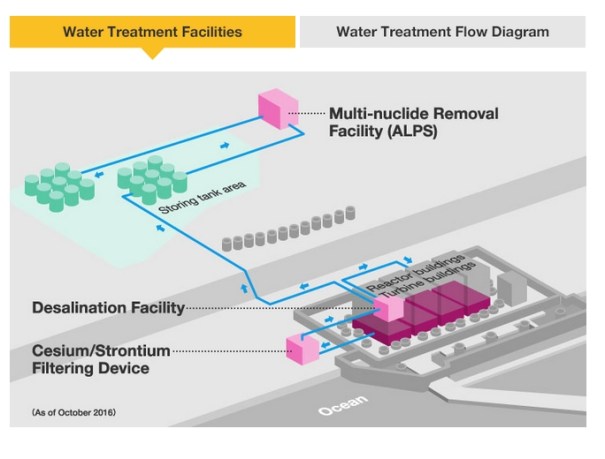
Of course it is not question to release the partially decontaminated water (202,565 metric tons) into the sea, only the fully decontaminated water (all radionuclides removed to the exception of tritium), the tritiated water, the 777,647 metric tons.
On the Tepco Press Release on Jul 10,2017, Tepco indicates quite clearly the actual volume of the 2 types of water stored in those tanks. Knowing that all those tanks have a capacity of 1000 metric tons each, the maths are easy.
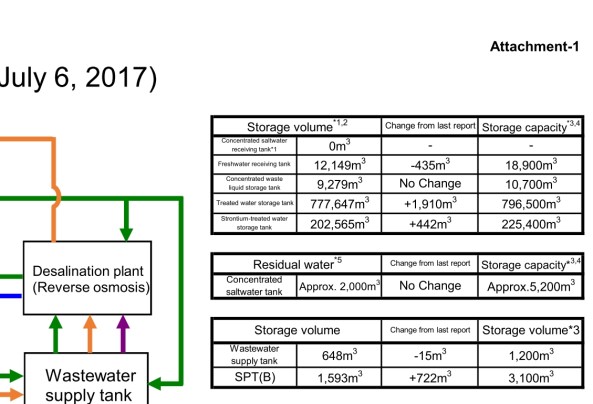

Some media along the way, I suspect the Japan Times AGAIN, added the 580 tanks number into its article, maybe a typo from 5 to 7, then the error was copied on and on by the other media.
It is sad to see professionnal media not capable to get their numbers right.
Since that July 13, 2017 declaration from Tepco’s new chairman, Tepco is now backpedaling, saying that they have not yet reached that decision, fearing a public backlash and the ire of the local fishermen.
The radioactive half-life of Tritium is 12,3 years, its radioactive full life is 123 years to 184,5 years. Once inside the body, tritium can lead to internal exposure. Its biological half-life of 10 days, full life 100 to 150 days.
Tepco Press Release July 10, 2017 Nuclear Power Station (310th Release) Nuclear Power Station (310th Release): http://www.tepco.co.jp/en/press/corp-com/release/betu17_e/images/170710e0201.pdf
Tepco backpedals after disaster reconstruction chief knocks plan to dump tritiated water into sea
Hey, a change in the ‘official’ strategy: why admit it & damage your image when you can keep letting it happen & say you’ve decided not to do it ?
 The Fukushima No. 1 plant and hundreds of tanks containing tritiated water are viewed from the air in February
Tokyo Electric backed off its tritium-dumping decision Friday after disaster reconstruction minister Masayoshi Yoshino said it would cause problems for struggling fishermen trying to recover in Fukushima Prefecture.
The remarks made Friday by the Fukushima native came shortly after the chairman of Tokyo Electric Power Company Holdings Inc. was quoted as saying that the decision to discharge tritium-tainted water from the Fukushima No. 1 power plant into the sea had “already been made.”
After Tepco Chairman Takashi Kawamura’s remarks were widely reported, the utility scrambled to make a clarification the same day.
According to Tepco’s clarification, Kawamura meant to say that there was “no problem” with the dumping plan, based on government guidelines and “scientific and technological standards.” The statement also said that no final decision had been made.
A government panel is still debating how to deal with the massive amount of tainted water stored in tanks at the atomic plant, where three reactor cores melted after a huge earthquake in March 2011 spawned tsunami that devastated the region and knocked out all power at the plant.
Tritium typically poses little risk to human health unless ingested in high amounts. It remains in filtered water as it is difficult to extract on an industrial basis. Ocean discharges of diluted volumes of tritium-tainted water are a routine part of nuclear power plant operations.
At a news conference, Yoshino said there would “certainly be damage due to unfounded rumors” if the tainted water were dumped into the sea. He urged those pushing for the release “not to create fresh concerns for fishermen and those running fishing operations in Fukushima Prefecture.” He also asked them to take care not to drive fishermen “further toward the edge.”
Yoshino, who is not directly involved in the decision-making process for handling the water, was alluding to local concerns about how people’s livelihoods will be affected if people think marine products from Fukushima are contaminated with radiation. He added that while he is aware that many in the scientific community say the diluted water can be safely released, he remains opposed.
“As I am also a native of Fukushima Prefecture, I fully understand the sentiment of the people,” the minister said.
Water injected to perpetually cool the damaged reactors becomes tainted in the process. A high-tech filtering apparatus set up at the plant can remove 62 types of radioactive material but not tritium. As a result, tritiated water is building up continuously at the plant. As of July 6, about 777,000 tons were stored in about 580 tanks on the premises.
On March 11, 2011, tsunami inundated the six-reactor plant, which is situated 10 meters above sea level, and crippled its power supply, causing a station-wide blackout. The failure of the cooling systems in reactors 1, 2 and 3 then led to a triple core meltdown that became the world’s worst nuclear disaster since Chernobyl in 1986.
1 This Month

of the week – Shut Down Drone Warfare!


Tell the Ukrainian Government to Drop Prosecution of Peace Activist Yurii Sheliazhenko

Petition to revoke the licensing of the Near Surface Nuclear Disposal Facility (NSDF) at Chalk River. https://www.ourcommons.ca/petitions/en/Petition/Details?Petition=e-7247
To see nuclear-related stories in greater depth and intensity – go to https://nuclearinformation.wordpress.com
-
Archives
- April 2026 (103)
- March 2026 (251)
- February 2026 (268)
- January 2026 (308)
- December 2025 (358)
- November 2025 (359)
- October 2025 (376)
- September 2025 (257)
- August 2025 (319)
- July 2025 (230)
- June 2025 (348)
- May 2025 (261)
-
Categories
- 1
- 1 NUCLEAR ISSUES
- business and costs
- climate change
- culture and arts
- ENERGY
- environment
- health
- history
- indigenous issues
- Legal
- marketing of nuclear
- media
- opposition to nuclear
- PERSONAL STORIES
- politics
- politics international
- Religion and ethics
- safety
- secrets,lies and civil liberties
- spinbuster
- technology
- Uranium
- wastes
- weapons and war
- Women
- 2 WORLD
- ACTION
- AFRICA
- Atrocities
- AUSTRALIA
- Christina's notes
- Christina's themes
- culture and arts
- Events
- Fuk 2022
- Fuk 2023
- Fukushima 2017
- Fukushima 2018
- fukushima 2019
- Fukushima 2020
- Fukushima 2021
- general
- global warming
- Humour (God we need it)
- Nuclear
- RARE EARTHS
- Reference
- resources – print
- Resources -audiovicual
- Weekly Newsletter
- World
- World Nuclear
- YouTube
-
RSS
Entries RSS
Comments RSS
 nuclear-news