Agency: Fukushima plant workers should be heard

Oct. 11, 2020
A government agency overseeing the decommissioning of the crippled Fukushima Daiichi nuclear plant is urging the plant’s operator to take into account the views of workers in removing radioactive debris, set to start next year.
Each year, the Nuclear Damage Compensation and Decommissioning Facilitation Corporation compiles its technical policy for the plant’s decommissioning. This year’s plan was recently announced.
It refers to the removal of fuel debris from the plant’s No.2 reactor starting next year. It warns that the work will take place in conditions where there is little information about the interior environment and a high level of radiation.
The agency proposes that Tokyo Electric Power Company seriously take into account the views and concerns of on-site workers, such as the operators of machinery used to remove fuel debris.
It calls for the information obtained from workers to be reflected in the design of equipment used to scrap the reactor.
The agency’s proposals will be reflected in TEPCO’s mid- and long-term schedules for decommissioning the plant.
Japan diver reflects on unsung workers exposed to radiation as Fukushima 10th anniv. Looms

Hisashi Okazaki is seen doing diving work at the Fukushima Daiichi Nuclear Power Plant’s No. 3 reactor in May 2006, in this image provided by Okazaki.
October 11, 2020
Have you ever heard of atomic divers? Hisashi Okazaki, 58, who has worked at nuclear power plants as a diver while being exposed to radiation, wants people to know that professional divers like himself work in dangerous conditions for nuclear reactors to run, as the 10-year anniversary of the Fukushima nuclear disaster approaches.
Among the places he has worked in his 33-year career as a professional diver is the Fukushima Daiichi Nuclear Power Plant, which would later go on to enter a meltdown following the Great East Japan Earthquake and resultant tsunami in March 2011.

Hisashi Okazaki is seen in Ehime Prefecture on Sept. 18, 2020.
After graduating high school, Okazaki, a resident of Seiyo in the western Japan prefecture of Ehime, entered the Japan Ground Self-Defense Force. Four years later he left, and got his professional diving license. Since then, he has worked primarily as a self-employed diver taking on jobs both at home and abroad, fulfilling tasks including laying oil pipelines and tetrapod sea defenses, as well as fixing sea walls damaged after the 1995 Great Hanshin Earthquake. He keeps illustrations of his dives as a record of what he’s done, and in all he has amassed more than 3,670 so far.
In 2006, a diver Okazaki knew invited him to work nuclear jobs. It was his first time working inside nuclear power facilities and being exposed to radiation, but he agreed to do it. Looking back, he said he did it because “I thought I wanted to experience anything I could. I had no fears.” His daily pay was 47,000 yen, almost twice the regular pay of around 25,000 yen for a day’s normal diving work.
Ahead of the job, 20 divers came together to train at a facility belonging to a heavy machinery maker situated in Kanagawa Prefecture south of Tokyo. They had on special heavy helmets weighing around 15 kilograms, and wore dry suits altered to stop water from entering them. They were hooked up to six cables, including for an air hose, photography, and radiation measurements. Both of their arms and legs as well as their chests were fitted with dosimeter equipment. After a week of training, the divers were dispersed to a number of nuclear plants across the country. Okazaki was dispatched to the Fukushima Daiichi Nuclear Power Plant’s No. 3 reactor.
There, he dived into the plant’s suppression chamber, which cools the reactor containment vessel in the event that the release of steam causes its pressure to rise. The chamber is a doughnut-shaped facility in the lower part of the vessel, with water about 3 meters deep in it. The maintenance work Okazaki undertook had to be done while it was filled and he did the work with another diver to exchange equipment in the facility.

An illustration of a diver replacing equipment underwater is seen in this image provided by Hisashi Okazaki.
The area where they worked had high doses of radiation, and in a single day’s diving they could work for about two hours. When they approached an area with a particularly high dosage, they would be instructed via a voice cable not to proceed further. The divers stayed in Fukushima Prefecture for about a month. Legal occupational exposure limits to radiation for a worker are set at 50 millisieverts per year, but in just the 12 days Okazaki worked at the plant, he was exposed to a total of 7.34 millisieverts. At the end of the job, the contaminated equipment they’d used was all put into a drum and disposed of.
“I couldn’t feel satisfied doing a job that leaves no trace of it behind,” Okazaki said. On his way back from Fukushima to Tokyo, Okazaki asked himself while in a car the purpose of his work that exposed him to radiation, and the younger diver who worked with him on the job said, “We did this for that view (of the city) at night, didn’t we?” Okazaki felt a little bit relieved by what they’d said, and after that he went on to do underwater cleaning work at the Onagawa Nuclear Power Station in northeast Japan’s Miyagi Prefecture.
Then, in March 2011, the Great East Japan Earthquake struck. Okazaki watched images of the hydrogen explosion at the Fukushima Daiichi Nuclear Power Station’s No. 3 reactor from a TV on a work barge in the sea off the Muroto Misaki cape in Kochi Prefecture, western Japan. “I’d never imagined the power would be lost and it would explode,” he said.
The use of divers for the decommissioning of the crippled nuclear reactor, such as in removal work and other tasks, is being considered. Even now, around 4,000 people are working at the Fukushima Daiichi plant each day. The decommissioning work, which is expected to take decades from now to finish, is employing robots to complete some tasks, but still the role of radiation-exposed human workers is vital. Okazaki said, “Even at the reactors that use the most technologically advanced equipment, there are sections which only human hands can deal with, and divers are part of the group of workers who take up such jobs.”
(Japanese original by Shunsuke Sekiya, City News Department)
https://mainichi.jp/english/articles/20201009/p2a/00m/0na/020000c
National Federation of Fisheries Cooperative Associations’ head opposes releasing Fukushima Daiichi radioactive water into sea

Hiroshi Kishi, the head of the National Federation of Fisheries Cooperative Associations, speaks at a government hearing in Tokyo on Thursday.
Fishing industry chief opposes releasing Fukushima No. 1 water into sea
Oct 9, 2020
The head of the National Federation of Fisheries Cooperative Associations, or Zengyoren, has voiced strong opposition against releasing treated water containing radioactive tritium from the disaster-stricken Fukushima No. 1 nuclear plant into the sea.
“We are absolutely against ocean release” as a way to dispose of tainted water at Tokyo Electric Power Company Holdings Inc.’s nuclear plant in Fukushima Prefecture, Hiroshi Kishi, head of Zengyoren, said Thursday at a government hearing in Tokyo.
Kishi said that fishermen who are operating along the coast of Fukushima have been suffering from problems caused by the radioactive fallout from the 2011 meltdowns at the plant, such as fishing restrictions, as well as malicious rumors about the safety of farm and marine products there.
If the government chooses to release radioactive water into the sea, a leading option to get rid of accumulating low-level radioactive water at the plant, it will trash all efforts fishermen have so far made to sweep away such rumors and consequently “will have a devastating impact on the future of Japan’s fishing industry,” Kishi stressed.
Toshihito Ono, head of the prefecture’s fishery product processors association, who joined the hearing via a video call, warned that Fukushima’s processed marine products, including products that use ingredients from other prefectures, will become targets of harmful rumors.
In a report released in February, a government panel pointed out that a realistic option would be releasing the tainted water into the ocean after dilution or into the air through evaporation.
Many people fear that both methods will add to the reputational damage suffered by Fukushima products. But treated water storage at the power plant is expected to reach full capacity as early as autumn 2022.
After the hearing, state industry minister Kiyoshi Ejima told reporters, “We find it unadvisable to put off a decision on how to dispose of the water because not much room is left at the plant for tanks containing the water.”
This was probably the last hearing on the water issue, people familiar with the matter said.
https://www.japantimes.co.jp/news/2020/10/09/national/zengyoren-fukushima-water-sea/

Hiroshi Kishi, chairman of Japan’s national federation of fisheries cooperatives, JF Zengyoren, expresses his opposition to the release of contaminated water from the Fukushima Daiichi Nuclear Power Station into the sea, in Tokyo’s Minato Ward on Oct. 8, 2020.
Japan’s fishing industry firmly opposes release of tainted Fukushima water at sea
October 9, 2020
TOKYO — Japanese fishing industry representatives on Oct. 8 expressed their resolute opposition to the planned release of radioactively contaminated water that has built up following the 2011 meltdowns at the Fukushima Daiichi Nuclear Power Station into the sea, saying it would create damaging rumors and could negatively affect the industry into the future.
The comments came in a government hearing with Japan’s national federation of fisheries cooperatives, JF Zengyoren, and other representatives over the handling of the contaminated water and whether to dump it into the sea.
“Damaging rumors would inevitably occur, and the consensus of those in the fishing industry is that we are absolutely opposed to releasing it at sea,” JF Zengyoren Chairman Hiroshi Kishi stated at the meeting.
The hearing is expected to be the last scheduled gathering in a series of meetings that have been held since April. Prime Minister Yoshihide Suga has stated that he wants to decide on a policy for dealing with the contaminated water as soon as possible, and the government is set to reach a decision based on opinions heard to date.
At the meeting, Kishi warned that if the contaminated water from the nuclear plant were released into the sea “all the efforts of fishing industry workers to date would come to nothing.” He added, “It would be a setback and letdown for those in the fishing industry and could have a devastating impact into the future.” He said that he had heard from the government about measures to prevent damaging rumors, but stated, “Not releasing it (contaminated water) into the sea is simply the best approach.”
A seafood processing federation from Fukushima Prefecture was among the bodies represented at the meeting. Federation head Toshihito Ono commented, “I’ve worked on the front lines with regard to damage from rumors following the nuclear plant accident for nine years. Even when the fish are caught outside the prefecture, if the processing firm is in Fukushima then they’ll be stigmatized.”
After the meeting, State Minister of Economy, Trade and Industry Kiyoshi Ejima commented, “We’ve heard opinions from 43 people to date. We’d like to sort them out as soon as possible and reach a conclusion with governmental responsibility.”
The Fukushima Prefectural Federation of Fisheries Co-operative Associations and the national consumers federation Shodanren earlier expressed opposition to the release of contaminated water from the Fukushima plant at sea. The association of inns and hotels of Fukushima Prefecture, meanwhile, has expressed understanding of the move, as has the Central Federation of Societies of Commerce and Industry.
The Fukushima Prefectural Government has taken the position that the issue should be given careful consideration, while the head of the Fukushima Federation of Societies of Commerce and Industry said the water should be dealt with quickly and rumors dispelled, and that the central government should process the water responsibly.
(Japanese original by Suzuko Araki, Science & Environment News Department)
https://mainichi.jp/english/articles/20201009/p2a/00m/0na/039000c
Decision looms for Japan on dumping Fukushima wastewater into sea
Water with traces of radiation has been stored on-site, but capacity running out

Some 1,000 tanks store the tainted water at the site of the 2011 nuclear accident.
October 9, 2020
TOKYO — Japan will soon have to decide whether to release radioactive wastewater stored at the site of the 2011 Fukushima nuclear accident into the ocean.
Treated but still-radioactive water is stored in tanks on the site of Tokyo Electric Power’s Fukushima Daiichi plant, but spare capacity is expected to run out as early as October 2022. Preparations to release the water are said to require two years.
Talks with local governments and businesses have been held since April. The Ministry of Economy, Trade and Industry finished the seventh meeting Thursday and has been receiving feedback from such groups as JF Zengyoren, the federation of fisheries cooperatives.
The water has been filtered to remove major radioactive substances but still contains some tritium, a radioactive isotope of hydrogen. Water containing tritium is released into the sea by nuclear plants around the world after dilution.
The International Atomic Energy Agency said in a review that discharge into the sea is one of two “technically feasible” options and is “routinely used by operating nuclear power plants and fuel cycle facilities in Japan and worldwide.”
The issue at Fukushima Daiichi is that water has flowed through a contaminated reactor. To avoid further tarnishing the reputation of the local community already damaged by the accident, wastewater is being stored on-site for now.
If tritium-tainted water is released into the sea, “we will suffer immense harm, and all the efforts the fishery industry has made thus far would come to nothing,” said Hiroshi Kishi, president of JF Zengyoren.
Fishing along the coastline of Fukushima Prefecture has been drastically cut back, with the annual catch totaling 3,600 tons in 2019 — just 14% of the levels before the accident.
The Fukushima Prefectural Federation of Fisheries Cooperative Associations seeks to restart full-scale operations in April 2021.
Another option is to evaporate wastewater into the air.
Meanwhile, the two towns that host the Fukushima Daiichi power plant have approved a resolution to call on the national government to quickly decide on the issue. While Futaba and Okuma do not mention discharging the water into the sea, the towns see disposing the water as a necessary first step toward rebuilding their communities, where most areas remain off-limits even to former residents. Fukushima Gov. Masao Uchibori has not touched on the issue.
About 1.23 million tons of wastewater was stored in some 1,000 tanks on the plant site as of Sept. 17. The addition of more tanks this year will increase the capacity to 1.37 million tons.
The government hopes to gain the support of the fishing federation and other affected parties. “We want to make a responsible decision on disposal as soon as possible,” Prime Minister Yoshihide Suga said in September.
Japan is also crafting plans for compensation for reputational harm. A decision on the water discharge is expected after further meetings with affected parties.
Japan fishermen oppose Fukushima Daiichi’s radioactive water release into ocean

A Tokyo Electric Power Co (TEPCO) employee uses a geiger counter at the company’s tsunami-crippled Fukushima nuclear plant
Japan fishermen oppose ‘catastrophic’ release of Fukushima water to ocean
October 8, 2020
TOKYO (Reuters) – Japanese fish industry representatives on Thursday urged the government not to allow the release at sea of tonnes of contaminated water from the Fukushima nuclear plant, saying it would undo years of work to restore their reputation.
Tokyo Electric has collected more than a million tonnes of contaminated water since the plant was crippled by an earthquake and tsunami in 2011.
The water is stored in huge tanks that crowd the site and it says it will run out of storage room by 2022.
“We are dead against a release of contaminated water to the ocean as it could have a catastrophic impact on the future of Japan’s fishing industry,” Hiroshi Kishi, president of JF Zengyoren, told a meeting with government officials.
JF Zengyoren is a nationwide federation of Japan’s fisheries cooperatives.
Early this year, a panel of experts advising Japan’s government on the disposal of radioactive water from the destroyed Fukushima plant, recommended releasing it into the ocean.
Japan’s industry ministry, which has been hearing views since April, invited fishery representatives to a seventh round of such hearings.
“We vigorously oppose a release of contaminated water into the ocean as it will clearly cause reputational damage,” said Toshihito Ono, the head of fish wholesalers and processors in Fukushima prefecture.
Any release could prompt other countries to reinforce restrictions on imports of Japanese fishery products, reversing a recent trend toward easing, JF Zengyoren’s Kishi said.
Both representatives did not put forward alternatives, but Kishi asked the government to consider further and get as much information as possible before making its decision.
Kiyoshi Ejima, state minister of economy, trade and industry, said the government would take their views into account and make a responsible decision.
“We need to make a decision as soon as possible since this is a top priority issue,” he told reporters after the meeting, but gave no timeframe.
https://news.yahoo.com/japan-fishermen-oppose-catastrophic-release-111310587.html

Fisheries oppose plan to release radioactive water
Oct. 8, 2020
A nationwide group of Japanese fisheries has opposed releasing diluted radioactive wastewater from the crippled Fukushima Daiichi nuclear plant into the sea.
The group’s president, Kishi Hiroshi, spoke at the 7th government hearing in Tokyo on Thursday.
At issue is the ever-increasing amount of wastewater stockpiled in tanks at the Fukushima plant. The water, after treatment, still contains tritium and some other radioactive substances.
The government has been seeking feedback from locals and relevant groups over a report compiled in February that said diluting the water to below government-set levels and releasing it into the sea or air is a realistic option.
Kishi said releasing the water into the sea will inevitably cause detrimental rumors, undoing years of efforts by fisheries and dealing a devastating blow to the nation’s fishing industry. Kishi said he is absolutely opposed to the plan.
Ono Toshihito, head of a seafood processing federation in Fukushima Prefecture, said he and his colleagues have toiled on the frontline of fighting rumors for nine years.
Ono said he is opposed to the plan, but at the same time he knows something needs to be done about the water. He said he has been in a dilemma because he also wants the crippled reactors dismantled as soon as possible.
Ono called on the government to expedite its efforts to enable people to return to normal economic activity.
Government officials say they hope to make a decision as soon as possible over how to deal with the water.
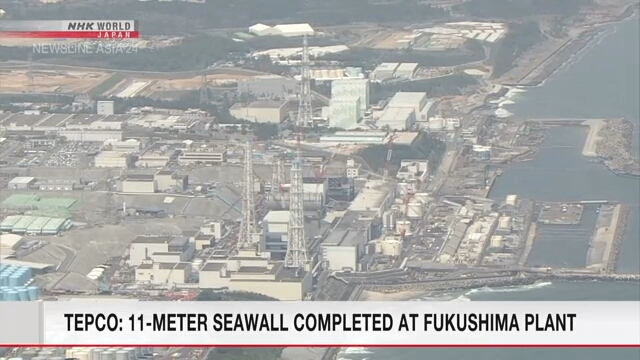
TEPCO: 11m seawall completed at Fukushima plant
September 29, 2020
The operator of the damaged Fukushima Daiichi nuclear power plant says it has completed an 11-meter-high seawall to protect the facility from tsunami waves.
Tokyo Electric Power Company, or TEPCO, erected the barrier based on a government panel warning three years ago. It said that a mega-quake along the Chishima Trench, beneath the sea near northern Japan, could cause a tsunami to hit the compound.
TEPCO announced that a 1.7-meter-high concrete wall was built atop elevated ground stretching 600 meters on the sea side of the No.1 to No.4 reactors.
The firm says the barrier stands 11 meters above sea level and it was completed on Friday.
TEPCO next plans to build another seawall measuring up to 16 meters high, based on a new projection made by a government panel in April.
The projection says if a mega-quake were to occur along the Japan Trench off the northeastern coast, a tsunami could be higher than the newly-built seawalls.
TEPCO says it aims to complete the taller seawall by fiscal 2023.
Prime Minister Suga Visits Fukushima Daiichi Nuclear Plant

Prime Minister Yoshihide Suga visits the disaster-stricken Fukushima No. 1 nuclear power plant on Saturday.
Suga visits disaster-hit Fukushima nuclear power plant
September 26, 2020
FUKUSHIMA – Prime Minister Yoshihide Suga on Saturday visited the disaster-stricken Fukushima No. 1 nuclear power plant, where decommissioning work is taking place.
The day trip is Suga’s first since he replaced former leader Shinzo Abe, who stepped down for health reasons, and is aimed at demonstrating the government’s continued commitment to rebuilding areas of Tohoku affected by the massive March 2011 earthquake and tsunami and ensuing nuclear crisis.
While the Abe administration’s set of basic policies included the pillar of disaster recovery from its inception in 2012, Suga’s Cabinet platform, adopted at its first meeting on Sept. 16, made no mention of the disasters that left nearly 15,900 people dead and more than 2,500 unaccounted for.
Suga said during a Friday meeting on the rebuilding of the region that he will “inherit the policy” from the previous administration and keep pushing reconstruction forward.
His trip also includes a visit to a museum on the disaster and a meeting with students from local junior and senior high schools.
Japan PM Suga visits disaster-hit Fukushima nuclear power plant
FUKUSHIMA, Japan (Kyodo) — Prime Minister Yoshihide Suga vowed Saturday to press forward with reconstruction efforts for areas devastated by the 2011 earthquake and tsunami, as he visited the Fukushima nuclear power plant crippled by the disasters.
He made the comment after there was no mention of the disasters, or rebuilding work for the northeastern Tohoku region, in his Cabinet’s basic policies adopted at its first meeting last week.
Suga told reporters during his first official trip since he took office to succeed Shinzo Abe on Sept. 16 that when he formed the new Cabinet, he wrote of the need to continue reconstruction efforts in instructions handed out to all the Cabinet members.
“There is no recovery of Tohoku, without recovery of Fukushima, and there is no revival of Japan without recovery of Tohoku. This is a basic policy of my Cabinet,” he said.
Fukushima is one of three prefectures in northeastern Japan hit hardest by the disasters that left nearly 15,900 people dead and more than 2,500 unaccounted for, and triggered the world’s worst nuclear crisis since the 1986 Chernobyl accident.
The Abe administration’s set of basic policies included the pillar of disaster recovery from its inception in 2012. Suga said Friday during a meeting on the rebuilding of the devastated areas that he will “inherit the policy” from the previous administration.
“We want to make a decision as soon as possible” on radioactive water now being stored at the Fukushima Daiichi nuclear power station, he said.
The government and the plant owner, Tokyo Electric Power Company Holdings Inc., are considering how to dispose of the water, which has been contaminated with radioactive materials after being used to cool the melted fuel cores at the plant.
They are looking at options such as releasing it into the Pacific Ocean or evaporation but local fishermen have voiced opposition due to fears consumers would shun seafood caught nearby.
The water is being treated using an advanced liquid processing system, or ALPS, to remove most contaminants other than the relatively nontoxic tritium. It is being stored in tanks on the facility’s premises but space is expected to run out by the summer of 2022.
Suga also visited a museum on the disasters and met with students from local junior and senior high schools as part of the official trip.
https://mainichi.jp/english/articles/20200926/p2g/00m/0na/078000c
South Korean Gov’t Concerned over Fukushima Daiichi’s Radioactive Water Release
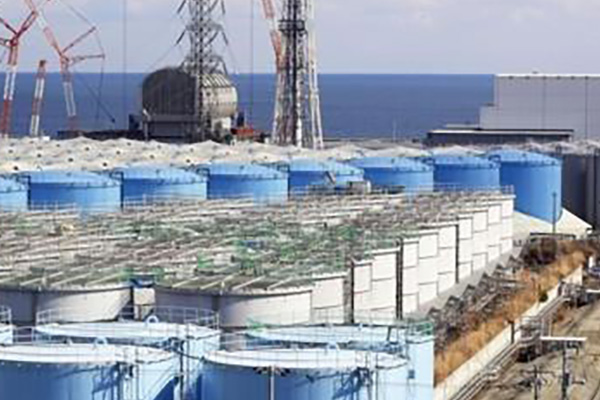
Gov’t. Concerned over Japan Possibly Releasing Contaminated Water from Daiichi Plant
September 23, 2020
South Korea has expressed concerns over Japan strongly considering the release of contaminated water from the Fukushima Daiichi nuclear power plant disaster site into the ocean.
The Ministry of Science and ICT said First Vice Minister Jeong Byung-seon revealed the plans in a virtual keynote speech during the 64th General Conference of the International Atomic Energy Agency(IAEA) on Wednesday.
Jeong said the international community, including South Korea, is growing concerned and nervous about the environment and its safety as Japan mulls such a possibility.
The vice minister stressed the need to thoroughly analyze the mid- and long-term damage the release could have on the environment and the appropriate way to go about it, given that it could affect global marine environments.
In particular, Jeong said that in line with international laws, Japan is obligated to communicate with the international community in a transparent manner ahead of deciding on ways to dispose of the contaminated water and proposed that the IAEA play a key role in that process.
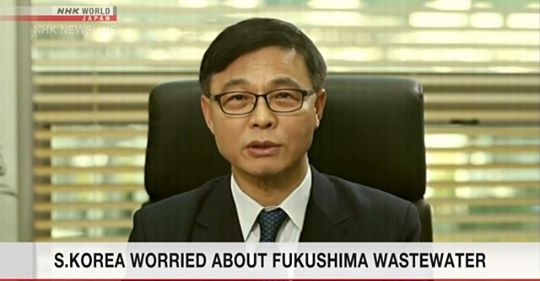
S.Korea concerned about Fukushima waste water
September 23, 2020
South Korea has again expressed its concerns about Japan’s plan to release into the sea radioactive wastewater building up at the crippled Fukushima Daiichi nuclear plant.
The first vice minister of South Korea’s science ministry Jeong Byungseon was speaking at a general meeting of the International Atomic Energy Agency in Vienna on Tuesday.
He said “releasing contaminated water into the ocean is not an issue of Japan itself, but one that could have a wider impact on the global marine environment, as well as the neighboring countries.”
He said Japan has “an overarching obligation to make transparent, concrete communication within the global society,” including South Korea, before making any disposal decision.
He asked the IAEA to play a proactive role in the issue.
At last year’s IAEA general meeting, South Korea raised questions about the issue and criticized Japan.
On Monday, Japan’s Science and Technology Policy Minister Inoue Shinji told the meeting that Japan is studying ways to dispose of the water, taking into consideration advice from the IAEA. He stressed Japan will provide careful and transparent explanations to the global community.
In February, a Japanese government expert panel came up with a report saying that diluting the wastewater below environmental and other standards, and discharging it into the sea, as well as vaporizing and releasing it into the air are realistic options.
The government plans to make a decision after hearing opinions from local residents and groups.
9 1/2 years after meltdowns, no end in sight for Fukushima nuke plant decommissioning
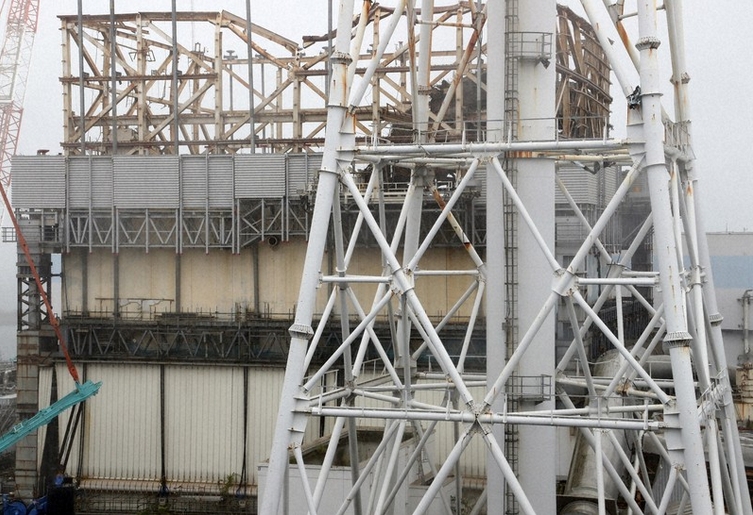
The No. 1 reactor building is seen at the Fukushima Daiichi Nuclear Power Station in Okuma, Fukushima Prefecture, on Sept. 1, 2020.
September 22, 2020
It has been some 9 1/2 years since the triple-meltdown disaster at the Fukushima Daiichi Nuclear Power Station in northeast Japan, and in early September I visited the plant to get a close-up look at the reactor buildings and find out how much progress is being made in dismantling them.
The trip began aboard a microbus, which stopped on an inland promontory running north to south at an elevation of 33.5 meters above sea level. Getting off the bus, I looked east, over the Pacific Ocean. And then I saw them, just 100 meters away or so: the buildings containing the plant’s No. 1 to 4 reactors.
When a tsunami triggered by the March 11, 2011 Great East Japan Earthquake slammed into the coastal facility, reactors 1 to 3 were online, while No. 4 was shut down for a regular inspection. There were core meltdowns in all three of the active reactors, with the fuel mixing with material from the surrounding structure as it melted and turned into “fuel debris.” Later, the No. 4 reactor building, connected to the No. 3 building by plumbing, was blown apart by a hydrogen explosion.
To complicate matters further, the reactor buildings had fuel storage pools each containing between 392 and 1,534 nuclear fuel rods. However, the plant workers managed to keep the rods cool, averting a major secondary disaster.
On my visit, the No. 3 reactor building is encased in what looks like a Baumkuchen layer cake stood upright. Inside, operations are underway to remove the fuel rods from the 12-meter-deep storage pool.
“There’s a newly installed crane in there to take the fuel out,” said our guide Masayuki Ueda, who is a manager at the Fukushima Daiichi decommissioning unit of the plant’s operator, Tokyo Electric Power Company Holdings (TEPCO).
The hydrogen explosion choked the pool and surrounding area with debris, including fragments of the roof and bits of nearby machinery. Even after the clearing of this debris, equipment and other problems delayed the fuel removal operation by more than four years. The process finally got underway in April 2019. The special crane lifts the some 300-kilogram rods out of the pool one at a time, and they are then taken to a pool in a separate building. Of the 566 rods, 366 had been removed as of Sept. 11, 2020. Due to the high radiation in the building itself, the crane is operated remotely from a control facility about 500 meters away.
The hardest part of the task is yet to come; the handles on 16 of the rods were warped by falling debris, and can’t be extracted by the crane as they are. TEPCO is apparently working on a “grabbing tool” for the crane to lift out the damaged rods, among other methods, in hopes to finish the removal project by March 2021.
We get back on the microbus and head down the hill to a spot where we can look up at the No. 4 reactor building. Here, too, we can see the machinery for the so-called underground ice wall surrounding the No. 1-4 reactors.
Groundwater from the mountains flows relentlessly beneath the power station. The walls in the basement levels of the reactor buildings were cracked in the March 2011 quake, letting in the groundwater and rainwater that has come into contact with the nuclear fuel debris, contaminating it. The “ice wall,” which TEPCO began making in May 2013, is TEPCO’s attempt to control the problem.
The wall is made up of some 1,500 pipes sunk 30 meters into the ground, creating a subterranean perimeter about 1.5 kilometers long around the reactor buildings. Liquid cooled to minus 30 degrees Celsius is then run through the pipes, freezing the soil around them. The Japanese treasury spent about 34.5 billion yen (about $330.7 million) to make the wall, and the electricity and other maintenance to keep it going costs hundreds of millions of yen per year. These latter outlays are passed on to consumers in their power bills.
Previously, the stricken plant produced up to 600 metric tons of contaminated water per day. However, thanks to pumping up groundwater on the landward side of the plant and other measures, that was down to 160 tons per day in April through July this year. Under the plant decommissioning plan, TEPCO and the Japanese government intend to reduce that to 150 tons per day by the end of 2020, and 100 tons by 2025. TEPCO has said that, with work on new roofs over the reactor buildings proceeding, it believes it can meet the 150 ton target this year.
Meanwhile, with radiation levels around the reactor buildings gradually declining, the Nuclear Regulation Authority (NRA) believes it is the moment to consider going into the basement levels to patch the cracks in the walls. NRA Chairman Toyoshi Fuketa has said that “it’s about time to start discussing when to halt” the ice wall operation.
There are experts who doubt the efficacy of the ice wall. In 2018, TEPCO estimated the wall alone was preventing 95 tons of contaminated water from being generated per day. However, Hideyuki Ban, co-director of the nonprofit organization Citizens’ Nuclear Information Center, told the Mainichi Shimbun, “There needs to be an inquiry into whether the ice wall was ever really necessary.”
Parts of the Fukushima Daiichi decommissioning plan have been delayed repeatedly since its release in December 2011. At that time, the plan stated it would take 30-40 years to complete the project. However, after seeing the power station up close, I find it hard to imagine this.
(Japanese original by Suzuko Araki, Science and Environment News Department)
https://mainichi.jp/english/articles/20200921/p2a/00m/0na/018000c
S. Korea renews concerns over possible release of tainted Fukushima water
The logo of the Ministry of Science and ICT at its main offices in the central city of Sejong, 130 kilometers south of Seoul, is shown in this undated photo provided by the ministry
September 22, 2020
SEOUL, Sept. 22 (Yonhap) — South Korea on Tuesday reiterated its concerns over Japan’s potential move to release radioactive water from its disabled Fukushima nuclear plant into the sea.
Japan has been mulling over options to discharge the water from the nuclear plant, which was devastated by a tsunami triggered by an earthquake in March 2011.
An estimated 1.1 million tons of tainted water is in temporary storage at the Fukushima plant.
South Korea’s Vice Minister of Science and ICT Jeong Byung-seon renewed concerns over Japan’s potential move in a recorded message at an annual conference of the International Atomic Energy Agency’s (IAEA), according to the science ministry.
The general conference of the U.N. nuclear watchdog was held partially online this year due to the coronavirus pandemic.
Jeong said releasing the tainted water would impact the global marine environment and that its method and long-term environmental risks need careful consideration through cooperation with global agencies, such as the IAEA.
The vice minister also called for an active role of the IAEA to facilitate transparency in the water’s disposal process, adding that Japan’s disposal plans should follow international law, such as the U.N. Convention on the Law of the Sea.
The science ministry said the vice minister will convey South Korea’s concerns to IAEA Director General Rafael Mariano Grossi in a separate meeting Wednesday.
The fallout of the damaged Fukushima nuclear plant has been a source of contention between the two neighboring countries, with South Korea imposing a ban on all seafood imports from eight Japanese prefectures near Fukushima in 2013.
https://en.yna.co.kr/view/AEN20200922007000320?section=national/diplomacy
Fukushima Daiichi workers use ‘smart glasses’
Sept. 20, 2020
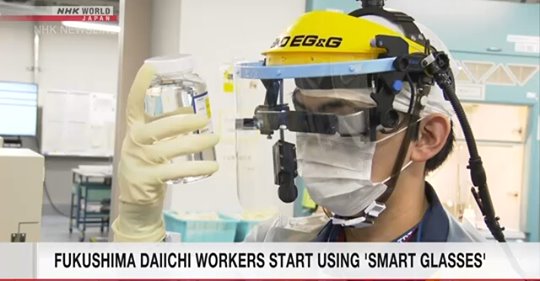
The operator of the crippled Fukushima Daiichi nuclear power plant has started using wearable electronic glasses to analyze water in and around the plant.
Tokyo Electric Power Company, or TEPCO, analyzes the concentration of radioactive substances and water quality and releases the data on a daily basis.
The “smart glasses” display information, such as work procedures and analytical graphs, on the liquid crystal screen.
When a QR code is scanned with the small camera, sampling locations and information on the person in charge are automatically recorded. Workers can also input the date and time by using their voices.
The data entry work has previously been carried out by hand with check sheets. TEPCO says the new glasses have made it possible for 30 of about 140 workers to be given other tasks. The utility says it plans to assign the 30 workers to analyze fuel debris.
A TEPCO official in charge of decommissioning the damaged reactors says it requires a lot of effort to input a huge amount of data by hand and there have been some errors, but the glasses should improve accuracy and productivity.
The official also says the company wants to accelerate the decommissioning process by helping employees to work more efficiently.
Japan fiddles with the idea of unleashing tainted water at Fukushima
September. 18, 2020
Concerns are resurfacing that the contaminated water from the Fukushima power plants could be discharged into the sea with Suga Yoshihide sworn in as new prime minister of Japan. Mr. Suga previously said whoever takes power next should tackle the issue of the radioactive contamination at Fukushima plant.
The Tokyo Electric Power Company (TEPCO) has embarked on the process of cutting the amount of the contaminated water currently stored at the premises of Fukushima power plants, down to the discharge level of radioactive substances set by the Japanese regulatory authorities. Some experts say that the state-run power corporation is preparing to let loose the water tainted with radioactive materials from Fukushima meltdown. Pundits argue that transparency of information is necessary to verify whether the radioactive nuclide density can be curtailed below the threshold as interned.
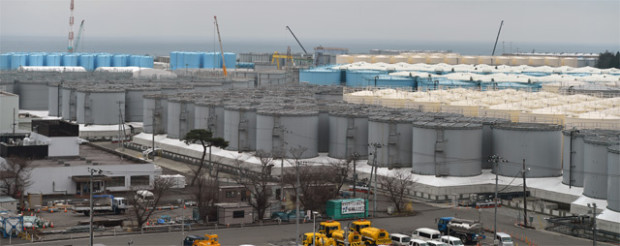
As of last year, the reactors at the Fukushima power plant site are belching an average 180 tons of contaminated water each day. This includes the massive amount of underground water that has been seeping into the nuclear reactors since 2013 in addition to the artificial influx of water. In February, the Japanese government reached the conclusion to unleash the water into the seas, with the storage capacity within the premises expected to reach the limit in August 2022.
TEPCO’s clean-up operation aims to reduce the discrepancy of radioactive density and cut the amount of discharging below standard for each type of nuclides. After upgrading and replacing the filters at multi-nuclide removal facility (ALPS), the process involves purifying the reservoir of the tainted water, checking the radioactive density, and processing the water again in the event density should exceed the threshold.
“The IAEA’s review has not found any issue with the performance of ALPS,” said Kim Yun-woo, a manager at the department of disaster prevention environment of the Nuclear Safety and Security Commission. “From a technical point of view, the purification process will likely bring down the density to meet the discharge standard, but in practice, we need to wait and see how much the water can get purified.”
The issue at hand is tritium. When the density is higher than a certain level, partial purification can be achieved through removal equipment. But the density of tritium in Fukushima water stands at 580,000 Bq per liter, impossibly low to remove with any equipment. Yet it is much higher than the discharge threshold at 60,000 Bq. There is known to be no effective technology to remove tritium under such circumstances.
16-meter seawall planned for Fukushima Daiichi
September 14, 2020
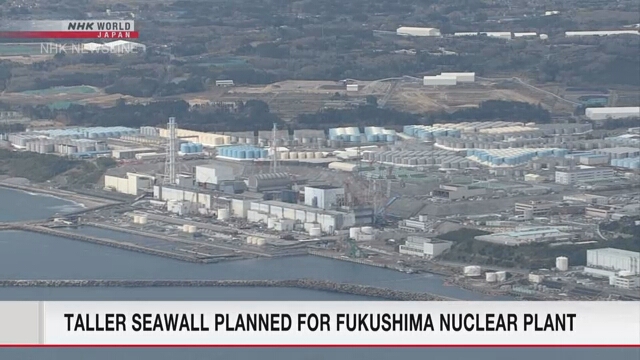
The operator of the damaged nuclear power plant in Fukushima, northeastern Japan, plans to build a taller seawall to help protect against future high seismic sea waves.
The move comes in response to the projection made in April by a government panel on the scale of tsunami that could be triggered by a massive quake along the Japan Trench in the deep sea off northeastern Japan.
The Tokyo Electric Power Company, or TEPCO, analyzed the projection and found that waves as high as 14.1 meters could engulf the Fukushima Daiichi plant compound, where the No.1 to No.4 reactors are located. It also found that waves of up to 15.3 meters high could hit south of the No. 4 reactor.
An 11-meter seawall is under construction on the ocean side of the plant compound. In an area south of the No. 4 reactor, another sea wall that is 12.8 meters high has already been completed.
TEPCO officials on Monday agreed to build another seawall measuring up to 16 meters high to protect these areas before the end of March 2023.
The wall is one of the anti-tsunami measures being taken by TEPCO as it decommissions the plant.
Work is under way to block the openings of the reactor buildings. Power supply vehicles are also deployed on higher ground to continue cooling spent nuclear fuel.
Nearly 1,000 tanks of radioactive wastewater are stored in the compound. TEPCO says the projected tsunami won’t reach the higher ground where these tanks are located.
Video analysis prompts new theory on Fukushima explosion
Septembre 4, 2020
Experts revise their theory surrounding a hydrogen explosion at Fukushima Daiichi nuclear power plant in March 2011 based on Nippon TV’s reprocessing of footage an affiliate took of the event.
Japan should leave radioactive water in current storage tanks
Hajime Matsukubo, general-secretary of the Citizens’ Nuclear Information Center, says an ocean dump doesn’t make sense
 Hajime Matsukubo, general secretary of the Citizens’ Nuclear Information Center (CNIC)
Aug.17,2020
What’s the most practical and safest way to handle the radioactive water being stored at Fukushima? According to Hajime Matsukubo, general-secretary of the Citizens’ Nuclear Information Center (CNIC), the contaminated water should be left in the aboveground tanks where it’s currently being stored. In a recent email interview with the Hankyoreh, Matsukubo said it doesn’t make sense to release the water into the ocean just because the tanks are running low on space.
The CNIC is a Japanese NGO that was set up in 1975 under nuclear physicist Jinzaburo Takagi, a leading figure in the campaign against nuclear power in Japan. Matsukubo is an active researcher, lecturer, and publisher of materials related to the anti-nuclear movement. The interview is presented below.
Hankyoreh (Hani): When do you think the final decision will be made about dumping the contaminated water at Fukushima into the ocean?
Hajime Matsukubo: TEPCO [Tokyo Electric Power Company] says it will dilute the contaminated water before dumping it into the ocean, which means that a dilution facility would have to be built. Given the time required to get a building permit, I think the final decision will be made this summer or fall.
Japan wants an ocean dump because it’s the cheapest option
Hani: Why do you think the Japanese government is pushing so hard to dump the water into the ocean?
Matsukubo: Not only Japan but all countries that operate nuclear reactors end up with tritium as a byproduct, which they then release into the ocean or the atmosphere. I see this decision as an extension of that. Another factor is that releasing the water into the ocean is the cheapest option.
Hani: There seems to be considerable opposition to the plan in Japan as well.
Matsukubo: Many citizens are opposed to it. Pushback has been particularly strong from fishermen, who are likely to be harmed by the rumors [about the danger of the radioactive matter being released, which could cause people not to visit or eat food from Fukushima]. Lawmakers at city councils in Fukushima Prefecture have adopted a series of resolutions voicing concerns about releasing the contaminated water.
Hani: Do you think that negative public opinion in Japan is capable of changing government policy?
Matsukubo: Since the fishermen are direct stakeholders, I think their opposition will have a big impact. TEPCO has promised not to release the water without the consent of local communities in Fukushima. I think the key is opposing voices in Japan and increasing pressure from overseas.
Hani: Do South Korea or environmental groups in other countries have any way to sanction Japan for releasing contaminated water into the ocean?
Matsukubo: They could consider filing a lawsuit based on the UN Convention on the Law of the Sea. But a large amount of tritium is already being released from Korea’s nuclear plants, especially the Wolseong plant. It would be rather difficult to prove that contaminated water released from Fukushima Daiichi [No. 1] is having an impact.
There’s plenty of land that could be used for additional storage
Hani: What’s the most practical and safest way to deal with the contaminated water?
Matsukubo: The contaminated water at Fukushima should be left in the aboveground tanks where it’s currently being stored. [The government] says there’s no more room at Fukushima Daiichi, but there is. There’s a huge amount of land that could be used to store the radioactive wastewater. While the Ministry of Economy, Trade, and Industry says that land can’t be appropriated for other uses, the government [could and] should negotiate with the landowners. It’s absurd to dump radioactive water into the ocean because there’s not enough storage space in the tanks. Japanese NGOs are suggesting that the government continue storing the water in the aboveground tanks and seal them off with concrete. They’re warning the government that releasing the water into the ocean would create international problems.
S. Korea, Japan both need to reassess their reprocessing plans
Hani: Do you have a message for South Korea’s civic society?
Matsukubo: The Japanese government is pursuing a policy of creating a nuclear fuel cycle that would recycle plutonium and uranium from the spent nuclear fuel produced by reactors. This policy requires reprocessing plants that are currently under construction at Rokkasho, in Aomori Prefecture, which are supposed to begin operations in 2021. These plants will release a large amount of radioactive matter into the ocean and the atmosphere. In terms of tritium alone, the amount released will be 10 times worse than the contaminated water at Fukushima Daiichi. That’s a very serious problem, just as releasing the contaminated water would be.
In South Korea, the Korea Atomic Energy Research Institute is taking the lead in R&D projects related to reprocessing spent nuclear fuel. The problems with reprocessing plants don’t end here. Plutonium can be used as a raw material for making nuclear weapons. I think that South Korea and Japanese citizens need to join forces to shut down both countries’ reprocessing plans.
By Kim So-youn, staff reporter
http://english.hani.co.kr/arti/english_edition/e_international/958103.html
1 This Month

of the week – Shut Down Drone Warfare!


Tell the Ukrainian Government to Drop Prosecution of Peace Activist Yurii Sheliazhenko

Petition to revoke the licensing of the Near Surface Nuclear Disposal Facility (NSDF) at Chalk River. https://www.ourcommons.ca/petitions/en/Petition/Details?Petition=e-7247
To see nuclear-related stories in greater depth and intensity – go to https://nuclearinformation.wordpress.com
-
Archives
- April 2026 (44)
- March 2026 (251)
- February 2026 (268)
- January 2026 (308)
- December 2025 (358)
- November 2025 (359)
- October 2025 (376)
- September 2025 (257)
- August 2025 (319)
- July 2025 (230)
- June 2025 (348)
- May 2025 (261)
-
Categories
- 1
- 1 NUCLEAR ISSUES
- business and costs
- climate change
- culture and arts
- ENERGY
- environment
- health
- history
- indigenous issues
- Legal
- marketing of nuclear
- media
- opposition to nuclear
- PERSONAL STORIES
- politics
- politics international
- Religion and ethics
- safety
- secrets,lies and civil liberties
- spinbuster
- technology
- Uranium
- wastes
- weapons and war
- Women
- 2 WORLD
- ACTION
- AFRICA
- Atrocities
- AUSTRALIA
- Christina's notes
- Christina's themes
- culture and arts
- Events
- Fuk 2022
- Fuk 2023
- Fukushima 2017
- Fukushima 2018
- fukushima 2019
- Fukushima 2020
- Fukushima 2021
- general
- global warming
- Humour (God we need it)
- Nuclear
- RARE EARTHS
- Reference
- resources – print
- Resources -audiovicual
- Weekly Newsletter
- World
- World Nuclear
- YouTube
-
RSS
Entries RSS
Comments RSS
 nuclear-news