Landside tritium leakage over through years from Fukushima Dai-ichi nuclear plant and relationship between countermeasures and contaminated water
Abstract
There has been tritium groundwater leakage to the land side of Fukushima Dai-ichi nuclear power plants since 2013. Groundwater was continuously collected from the end of 2013 to 2019, with an average tritium concentration of approximately 20 Bq/L. Based on tritium data published by Tokyo Electric Power Company Holdings (TEPCO) (17,000 points), the postulated source of the leakage was (1) leaks from a contaminated water tank that occurred from 2013 to 2014, or (2) a leak of tritium that had spread widely over an impermeable layer under the site. Based on our results, sea side and land side tritium leakage monitoring systems should be strengthened.
Introduction
The Fukushima Dai-ichi Nuclear Power Plant (FDNPP) accident released a large amount of radioactive materials into the environment since 2011. Most were in the gaseous state, released primarily through the atmosphere to the land of eastern Japan and to the north-west Pacific Ocean. The released amount was estimated to be approximately 520 PBq1, with radioactive iodine (mainly 131I), radioactive cesium (134Cs, 137Cs), and noble gases such as 133Xe accounting for most of the released amount. Tritium (3H, T1/2 12.3 y.) was an additional part of the radioactive materials released, but is considered as a “soft”, or low energy, beta emitter. The tritium beta energy is low (max 18.6 keV), and requires large quantities to deliver significant radiation doses, so that the measurement of other nuclear species was prioritized when considering human protection immediately following the accident. Therefore, data on tritium in the environment after the FDNPP accident are still limited in Japan2,3.
Tritium in a boiling water reactor is mainly produced by ternary fission. At FDNPP, 8.51 × 10¹³ Bq/month at 1.1 MW operation was produced by ternary fission4. Tritium is also produced in reactors by 10B(n, 2α)3H, 10B(n, α)7Li, 7Li(n, α)3H, or 6Li(n, α)3H, 2H(n, γ)3H5.
Cumulate 3H yields in the reactors at FDNPP have been estimated to range from 0.01% to 0.0108%6,7. According to estimates made immediately after the accident in 2011, there were reports that the inventory of 3H at the time of the accident was 1.81 × 10¹³ Bq8, but according to recent reports by Tokyo Electric Power Company Holdings (TEPCO), the inventory of 3H immediately after the accident was estimated to be 1.0 × 10¹⁵ Bq at Unit 1, 1.2 × 10¹⁵ Bq at Unit 2, and 1.2 × 10¹⁵ Bq at Unit 3, for a total of 3.4 × 10¹⁵ Bq4. As of March 24, 2016, 7.6 × 10¹⁴ Bq was in the storage tanks at the FDNPP site, 2.7 × 10¹³ Bq in the reactor building(R/B), and estimated 1.8 × 10¹⁵ Bq was released outside the reactor or in debris (Table 1)9,10.
There are three possible pathways for the release of 3H from FDNPP to the outside: ocean, atmosphere, and groundwater. Among them, direct releases to the ocean and releases to the atmosphere have been reported in detail.
An estimated 0.1–0.5 PBq of 3H flowed into the north Pacific Ocean from the accident6,11. Tritium was detected in the north-west Pacific Ocean off the coast of Hirono town, Fukushima Prefecture 1 month after the accident12.
Investigation of 3H in precipitation may be one of the easiest ways to confirm the release of 3H into the atmosphere. The highest tritium concentration in precipitation was estimated 10 days after the accident at 1342 TU (equivalent to 158 Bq/L)13. A surface water concentration of 3H at 184 (± 2) Bq/L was detected in rice paddy fields at 1.5 km from the FDNPP plant12. Since both reports greatly exceeded the natural 3H level in Japan (1.1–7.8 TU, equivalent to 0.13–0.92 Bq/L) or 6 TU (equivalent to 0.71 Bq/L)2,14, there was no doubt that the 3H was from the FDNPP accident. Also, since the samples were collected approximately 1 month after the accident, the 3H on the ground most likely originated as precipitation from the atmosphere, not via groundwater.
Leaking of 3H through groundwater is difficult to analyze. In this study, we report that 3H above natural levels has been detected continuously in groundwater sampled from 2013 to 2019 on land approximately 30 m from the FNDPP site boundary. A key aspect of this study is that the water examined was groundwater, not surface water. To reveal the hydrogeological origin of the groundwater sources, Sr isotope ratio (87Sr/86Sr) was also measured as a natural tracer of water–rock interaction and ground water mixing patterns15,16,17,18.
From 2013 to 2019, several countermeasures have been taken at the FDNPP to prevent contaminated groundwater from leaking off site. The relevance will be discussed, including the results of detailed tritium measurements in the water collected inside/outside FDNPP site.
Results
Outflow of 3H into groundwater from FDNPP
Most of the tritium present in the FDNPP was assumed to have been produced by ternary fission. As long as no re-criticality occurs, no new tritium is produced. However, it is estimated that there is 1.8 × 10¹⁵ Bq of tritium that has not been identified in the turbine buildings and in contaminated water, in addition to the amount released outside after the accident or the amount in debris10. In Japan, the limit for tritium release into the ocean is 6.0 × 10⁴ Bq/L in a typical nuclear facility, but in the case of the FDNPP, 1500 Bq/L is the regulatory limit for tritium effluent19. Therefore, over 1.2 × 10¹² L of water would be required for dilution.
Figure 1 shows a schematic diagram of the nuclear power plant site after the accident.
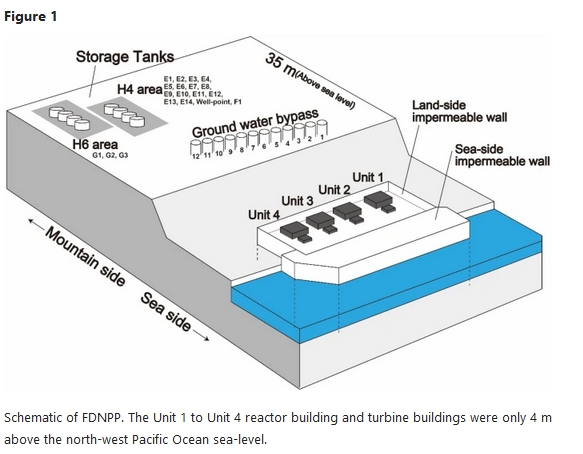
The land-side water impermeable wall (frozen soil wall) and the sea-side water impermeable wall (steel sheet pile) were installed to surround the circumference of the FDNPP and prevent 3H flow off site. Frozen soil walls block uncontaminated groundwater from getting close to reactors and buildings, while steel sheet piles block potentially contaminated groundwater from spreading into the ocean.
A series of wells were drilled at 35 m above sea level, upstream of FDNPP, to reduce the amount of groundwater flowing under the reactor building, and the well water was constantly pumped (Ground water bypass). The wells were drilled to a depth directly above an impermeable layer inside the plant’s grounds. Figure 2 shows the radioactivity of tritium in groundwater flowing through this bypass from June 2014 to June 2019. The ground water bypass system has 12 wells (No.1 to No.12)20, and the highest concentration of radioactivity was in No. 10 well on the south side. The concentration of 3H on June 2014 was 10 Bq/L, but it exceeded 3000 Bq/L in April 2016 and has been gradually decreasing since then to approximately 1400 Bq/L in 2019. No. 10 well is next to No.11, which also had levels of 3H higher than other wells, at 700 Bq/L as of June 11, 2019. No. 12 is the southernmost well, but unlike No. 10 and No. 11 wells, the tritium levels tended to decrease monotonically from a peak in April 201421.

Groundwater was estimated to flow into the ocean from the mountain side based on ground water flow modeling22.
It was not possible to determine from these data whether tritium-contaminated groundwater was still being released as tritium had already spread before the completion of the several barriers. Contaminated water may still be leaking from FDNPP site even after the barrier was completed23. The fact that tritium has been continuously detected in groundwater from the bypass installed upstream of FDNPP even after the completion of the water barrier (frozen wall) does not mean that tritium in the groundwater flows to the sea. In addition, the radioactivity trends in the neighboring wells vary widely, indicating that groundwater is moving in a complex manner.
The movement of groundwater may be impacted by the removal of the water from the wells. The amount of water removed from the wells has been changed in a timely manner in order to maintain appropriate groundwater level. If the water level was lowered too much, water flow would be induced from the reactor.
In order to evaluate the absolute amount of tritium contained in well water, information such as flow rate would be required, but TEPCO has not disclosed flow rates publicly.
3H radioactivity leakage
The concentration of 3H in the sump water collected at the sites indicated by asterisks in Fig. 3 is shown in Fig. 4. The 3H observed in sump water ranged from 15 to 31 Bq/L and was almost constant (average 20 Bq/L). The 3H exceeded the expected natural level (up to 7.8 TU(1 TU = 0.118 Bq/L), 0.92 Bq/L) of 3H, thus it is assumed that the 3H originated from FDNPP. Since the sump water were collected directly from cliffs, tritium in sump water would have passed under the ground of FDNPP site.
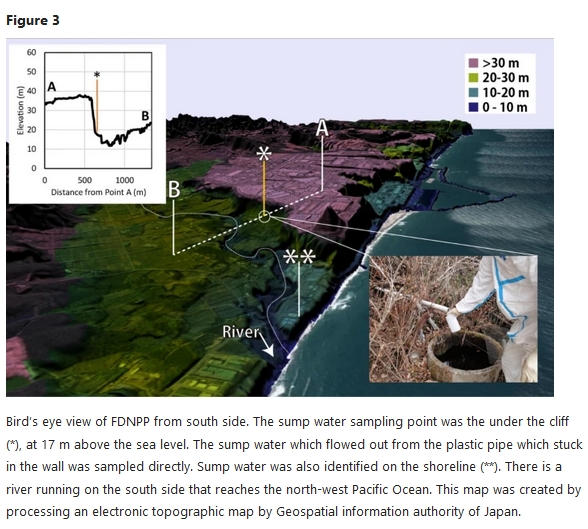
In addition, the sump water also contained radiocesium (134Cs and 137Cs). The concentration of 137Cs ranged from 3 to 4 Bq/kg, and the ratio of 134Cs/137Cs radioactivity at the time of the accident was almost 1. This also suggests that the water originated from FDNPP site24.
Tritium deposited via the air in surface water is not expected to mix with ground water. No tritium exceeding natural levels was detected in the air and precipitation around the FDNPP during the study period (2013–2019). At the FDNPP, four measures have been taken to prevent surface water from infiltrating into groundwater25..
- 1. Grouting of surfaces (to prevent from soaking rainwater into the ground) (from Oct. 2014),
- 2. Pumping of water from the sub-drain (from Sep. 2015),
- 3. Frozen soil wall around the 4 nuclear plants (from Mar. 2016),
- 4. Sea-side impermeable wall (from Oct. 2015).
It was clear that there was no direct correlation with the radioactivity of tritium contained in the leachate compared with the respective construction periods.
No tritium above the natural level was detected in the flowing-wells about 500 m away from the nuclear power plant. (see supplementary data).
The flowing-well water tritium concentration ranged from 0.003 to 0.01 Bq/L and was measured using the ingrowth method. Natural level of 3H in Japan was ranged from 0.13–0.92 Bq/L. Meanwhile the radioactivity of tritium in flowing water was below 0.01 Bq/L. The radioactivity of the water was at least one eighth. It was considered to be at least three half-lives above conservative estimates. Therefore, it was estimated that the tritium in the groundwater from the flowing-well had an age of nearly 40 years.
To read more:
Japan’s nuclear regulator maintains view on Fukushima Daiichi’s No.3 reactor blasts
November 13, 2020
Japan’s nuclear regulator has maintained its view that multiple blasts occurred at the Fukushima Daiichi nuclear power plant’s No.3 reactor following the earthquake and tsunami in 2011.
The plant suffered meltdowns from the accident. Three reactor buildings were severely damaged by hydrogen explosions.
On Thursday, the Nuclear Regulation Authority along with experts analyzed images taken at the No.3 reactor.
Officials say the state of buckled beams on the third floor indicates an instantaneous wind pressure of up to 5 atmospheres. The officials say such force can damage concrete structures and collapse wooden buildings.
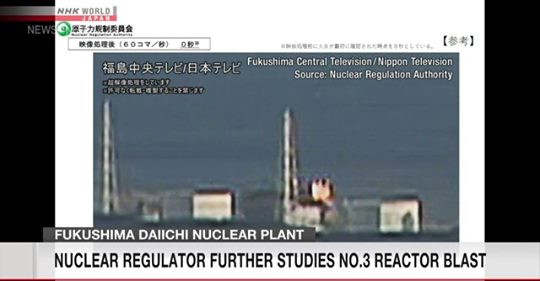
They also studied the only footage of the No.3 reactor in the explosion, which was captured by a TV station in Fukushima Prefecture.
The officials say an analysis of image processing shows the first blast damaged the fourth floor. They say an ensuing fire on the uppermost fifth floor caused the remaining hydrogen to explode, which caused black smoke to emerge.
The regulator resumed its probe into the cause of the accident last year. It plans to draw up a report as early as next month.
Fukushima’s Radioactive Legacy with Shaun Burnie of Greenpeace
Shaun Burnie, of Greenpeace, discusses the Fukushima radioactive water problem and the impacts of the nuclear power industry on the environment and people. This video was organized in partnership with groups making up the Coalition for Nuclear Safety. Recorded on October 30, 2020
Disposal plan all at sea?
In late October pressure appeared to be mounting on the Japanese government to decide on a method of disposal for 1.2 million tonnes of radioactive wastewater from the former nuclear plant at Fukushima Daiichi
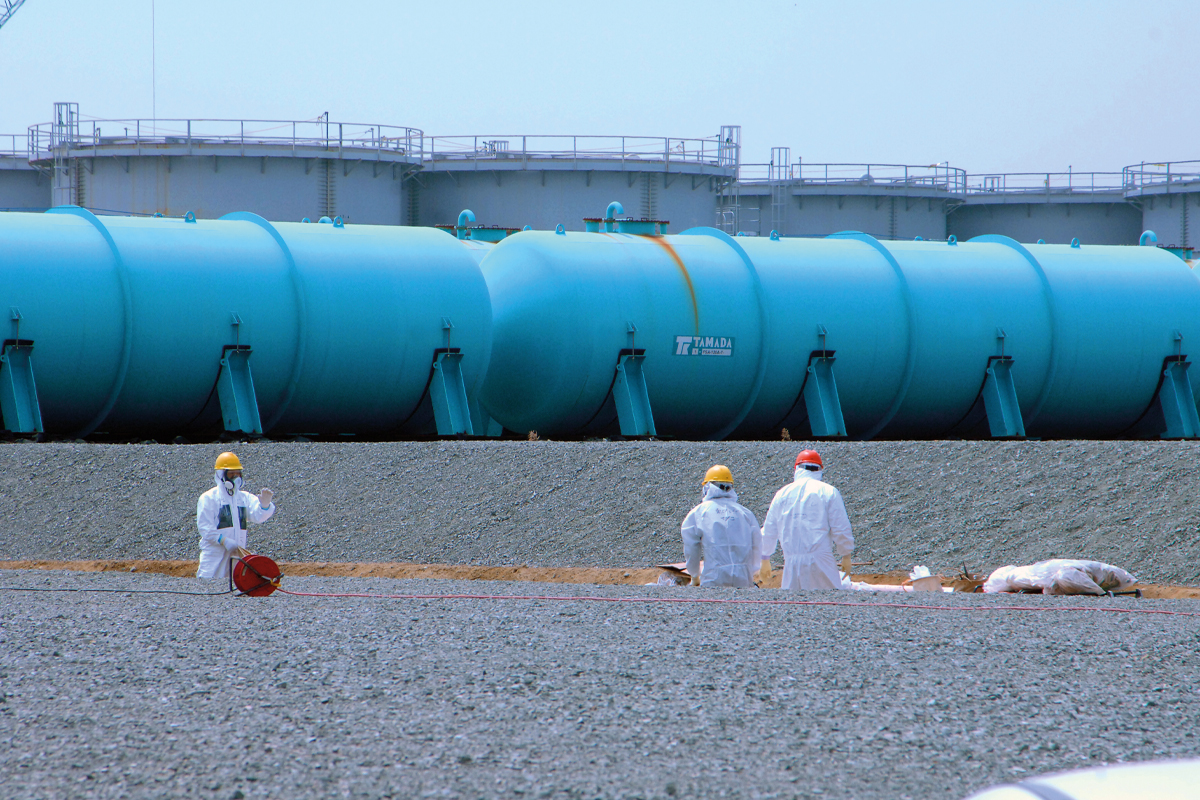
Workers at TEPCO’s Fukushima Daiichi Nuclear Power Station work near above-ground storage tanks in 2013
11 November, 2020
As rain and groundwater continue to pour into the site – at a rate of 180m3 per day in 2019 – the volume of contaminated water is expected to reach 1.37 million tonnes by the end of 2020. The water is being stored in around 1000 tanks on the site, with existing capacity likely to be surpassed by mid-2022, according to the International Atomic Energy Agency (IAEA).
In late October, the Japanese government were preparing to approve a plan to begin discharging the contaminated water into the sea, starting in 2022 and continuing for decades. Opposition has come from fishing and farming groups in the area, neighbouring countries, and environmental groups.
A purification system is treating the water, known as the Advanced Liquid Processing System (ALPS), and the filtering process therein is said to remove around 62 radioactive contaminants, according to an October report in NewScientist.
A report released by Greenpeace in October – Stemming the Tide 2020: The reality of the Fukushima radioactive water crisis – argues that the ALPS is flawed, and many of the dangers presented by this wastewater are being ignored. The firms operating the ALPS, Toshiba and Hitachi General Nuclear Electric (HGNE) came to the project with “practically no experience in water processing” said the report, and the ALPS’ poor performance is also likely related to a decision to exclude an alternative technology, an ion exchange system proposed by US firm Purolite, which in 2011 was seemingly shown capable of reducing concentrations of radionuclides to “non-detectable levels.”
As it stands, says the report, it looks like 72% of the water currently in storage tanks will have to be processed again – and questions remain as to how effective this will be.
The Japanese Government and Tokyo Electric Power Company (TEPCO), which runs the site, have said the main radionuclide remaining in the wastewater is tritium, an isotope of hydrogen. Filtering will remove some but not all of this, although scientists appeared to consider its risk to marine life and the environment as relatively minor, in comments made to NewScientist. However, Greenpeace said TEPCO “continues to misrepresent and selectively ignore basic science facts on radioactive tritium.”
Key among the objections made by Greenpeace to the Government’s plan is that the ALPS was not designed to remove carbon-14, a hazardous radionuclide whose presence in the wastewater was only acknowledged by TEPCO in late August. With its long half life of 5,730 years, its presence is a far greater concern. As the report says, “once introduced into the environment carbon-14 will be delivered to local, regional and global populations for many generations.” Ongoing storage carries the risk of tank leakage, especially in an area where earthquake risk is high.
Discharge to the sea is a routine method of disposal used by nuclear facilities worldwide, according to the IAEA. But if this approach is rejected, alternative disposal plans comprise evaporating the wastewater into the air, or expanding the existing storage capacity and continuing to store the water either on land or underground.
The latter option carries the risk of tank leakage, especially in an area where earthquake risk is high. But Greenpeace said “storage is a viable option”, citing a report from a government sub-committee that appeared to understand that additional storage beyond 2022 was feasible, but had seemingly decided against it as it would take “a substantial amount of coordination and time”. In any case, delaying the beginning of any program to discharge the water into the sea until around 2035 would only delay completion of the project by around three years, until 2055, while allowing much of the tritium’s radioactivity to diminish naturally.
Greepeace’s report said the subcommittee’s preference for discharge to sea “was clearly not based on science and engineering, but on the political interest of the Japanese government and the future viability of TEPCO.”
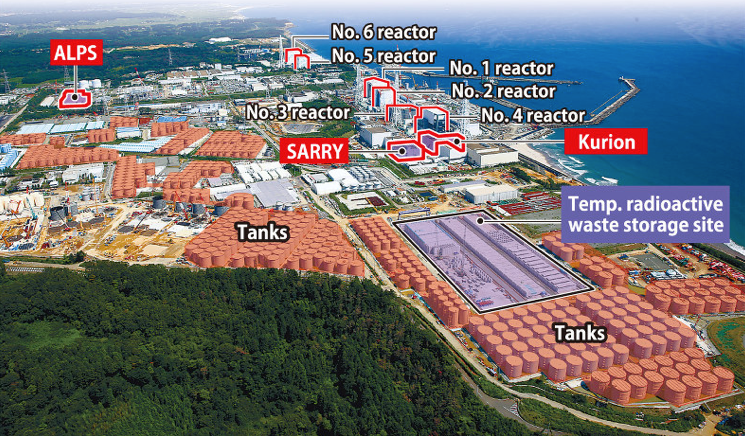
TEPCO claims it is running out of space to store radioactive water and simply must discharge it into the Pacific
November 10, 2020
Dilution is not the solution to pollution! Last month, thanks to local fishermen, citizen concern, and international outrage, Japan delayed plan to dump radioactively contaminated water from Fukushima Daiichi.
TEPCO claims it is running out of space to store radioactive water and simply must discharge it into the Pacific. But land [see picture] immediately adjacent to their property is EMPTY and too radioactive to be sold. Why not build more tanks there?
Source: Fairewinds Energy Education
Brutal Truth’: Fukushima’s Radioactive Water Threatens Life Worldwide, Warns Environmental Journo
by Mohamed Elmaazi November 10, 2020
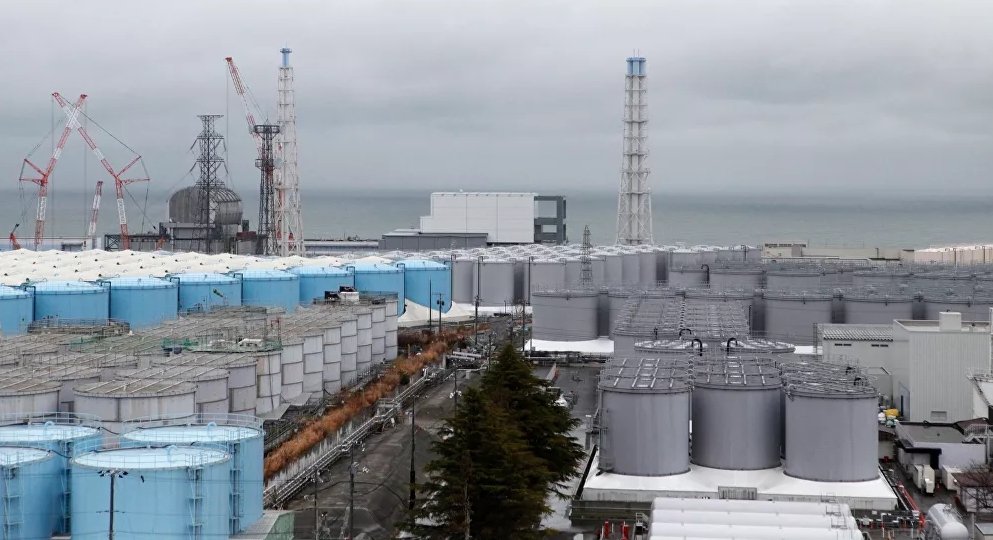
The after effects of the disaster at the Fukushima nuclear power plant continues to be felt as Japanese authorities struggle to appropriately deal with contaminated radioactive water which, some of which is already being released into the Pacific Ocean, an environmental journalist explains.
Robert Hunziker is a widely published writer and environmental journalist whose work has been translated into multiple languages and has appeared in over 50 journals, magazines and sites worldwide.
Mr Hunziker explains to Sputnik that the Japanese power company responsible for managing the Fukushima Daiichi nuclear power plant has been “overwhelmed by the crippled nuclear reactors” and face a very difficult choice in terms of how to deal with an ever growing amount of radioactive water. He also warns that mass dumping of the contaminated water into the Pacific Ocean may well endanger human beings across the world for generations to come.
Sputnik: The Japanese government appears to have decided that they are going to dump radioactive waste from the Fukushima Daiichi nuclear power plant into the Pacific Ocean. Haven’t they already been doing this since the 2011 nuclear accident?
Robert Hunziker: Since 2011, TEPCO (Tokyo Electric Power Company) has managed to control most of the flow of radioactive contaminated water, but an indeterminate amount spews into the ocean on a daily basis. In point of fact, controlling the radioactive water has been, and remains, a logistical nightmare.
For example, seawater is constantly circulated to cool the crippled reactors and turbines, where radioactivity is so high that on occasion it has disabled robotic underwater drones used to view the damage to the reactors.
Contaminated water leaks out of the reactor coolant systems and into buildings that house the reactors and turbines on a daily basis. TEPCO pumps 800 tons/day out of the reactor building basements. The 800 tons is thereafter desalinated and filtered, as much as possible, to remove radioactive caesium. Of the 800 tons, 400 tons/day is pumped back to cool the reactors and is contaminated once again. The balance of 400 tons, containing high concentrations of Stronium-90 (a deadly isotope) and tritium is pumped to a massive storage tank farm.
Additionally, groundwater flows into and out of the basements of the reactor buildings from which some contaminated water leaks out into the soil and surrounding groundwater beyond the facilities. This is contaminated water, including radioactive caesium, strontium, and tritium.
Furthermore, there have been instances of storage tanks leaking highly contaminated water.
Thus, the most direct straightforward answer to the question is: Yes, TEPCO has been dumping radioactive water into the Pacific Ocean but not as an organised plan of action, not intentionally. It happens simply because TEPCO is overwhelmed by the crippled nuclear reactors and the necessity of keeping radioactivity from literally spewing throughout the surrounding countryside.
As such, Fukushima Daiichi is a prime example of humanity’s worst nightmare come true, like the fabled China Syndrome, as one of the worst industrial accidents in history.
It remains a serious threat to this day, which is explained in more detail in my most recent article: “Dumping Fukushima’s Water into the Ocean… What Could Possibly go Wrong?”.
Sputnik: How are they justifying this policy of dumping even greater amounts of radioactive water into the Pacific?
Robert Hunziker: According to numerous sources, dumping Fukushima Daiichi’s radioactive water into the Pacific Ocean will start in 2022 and continue for decades. This approach was recommended by scientific advisers and approved by the International Atomic Energy Agency (IAEA). The Japanese government justifies dumping the radioactive water into the ocean on the following grounds:
- Nuclear power plants around the world routinely dilute and dump radioactive tritium-water into the ocean. (There is nothing positive about that rationale.)
- A panel of experts advised TEPCO that dumping it into the ocean is the most “realistic option.” (Experts are readily available for anything and everything. First, pick a side to an argument, then plug-in the expert.)
- TEPCO’s experts claim tritium, the most prominent isotope amongst the 62 isotopes found in Fukushima Daiichi’s radioactive water, is only harmful to humans in extremely large doses, and they believe it will become relatively harmless due to massive dilution in the ocean. (That is speculation and most likely not entirely true.)
- The IAEA (International Atomic Energy Agency) approves it. (Hmm)
However, many scientists claim tritium, as well as other radionuclides, will never be completely removed from the water in storage tanks, certainly not enough to satisfy the scrutiny of critics. The brutal truth is that dangerous radionuclides, like strontium-90 and iodine-129, will most likely not be completely removed, contrary to claims by TEPCO.
Furthermore, and of major concern, proper monitoring by independent third parties will likely be a virtual nightmare. To date, the Japanese government has not indicated it will allow independent testing of treated water. Alas, this attitude creates suspicion within the ranks of critics throughout the world.
Meanwhile, according to a recent article by the International Atomic Energy Agency – “IAEA Reviews Management of Water Stored at Fukushima Daiichi Nuclear Power Station”:
“Once the Government of Japan has decided on its preferred disposition option, the IAEA is ready to work with Japan to provide radiation safety assistance before, during and after the disposition.”
However, isn’t that like letting the fox into the hen house to check security and safety?
Sputnik: Would they be dumping radioactive waste into the ocean anyway, even without the accident, or is this a direct consequence of the disaster following the 2011 earthquake and tsunami?
Robert Hunziker: It is a direct consequence of the 2011 meltdown. Along those lines, it is important to note that ocean disposal of nuclear/radioactive waste has been banned via international treaties, e.g., The London Convention bans dumping radioactive waste in the seas.
However, there are loopholes, which clever lawyers use to abuse the true spirit behind treaties. In the case of the London Convention (Japan is a signatory) it does include a special provision banning radioactive waste, but the stated “ban at dumping at sea” covers dumping from “vessels, aircraft, and other manmade structures at sea”. However, Fukushima is a land-based discharge. This inconspicuous loophole in language provides weird (questionable) comfort to Fukushima Daiichi to violate the ban on dumping radioactive waste at sea.
Nevertheless, on a strict morality basis, and as importantly, for worldwide opinion purposes, banning should be honoured whether from sea or land so as not to compromise the spirit of the treaty, meaning, no radioactive waste should ever be dumped into the ocean. Why else draft the treaty in the first instance?
Sputnik: According to a report given to the IAEA by Japan, analysis by the power company of sea and groundwater shows “confirm that the radiation level of sampled water is substantially below the operational targets set by TEPCO”. How do you respond to this? Isn’t it possible that the level of radioactive discharge being released will simply be diluted by the ocean and won’t dangerously contaminate sea life and the food chain?
Robert Hunziker: That is questionable. It is very probable that the discharge will not be effectively diluted in ocean water. Rather, the ocean will simply carry radioactive ingredients to the shorelines of other countries.
According to knowledgeable sources with boots on the ground in Japan, leaked internal TEPCO documents have shown that efforts to reduce radionuclides to non-detect levels have not entirely eliminated numerous radioactive elements, including iodine, ruthenium, rhodium, antimony, tellurium, cobalt and strontium. These are deadly isotopes. (Source: Shaun Burnie, senior nuclear specialist for Greenpeace).
Regardless, at the end of the day, TEPCO has publicly stated it will dump “radioactive wastewater in the ocean”. It is their stated intention. They claim that tritium, the main remaining radionuclide after processing, will dilute, emphasising the fact that it is relatively harmless to humans.
This posturing by TEPCO is where the “rubber meets the road”, splitting world opinion into two opposing or warring camps.
On the one hand, advocates of dumping can be found throughout the internet, for example in articles in Forbes magazine, claiming that dumping the contaminated water in the ocean is the only reasonable answer, assuming that it will be diluted enough, especially with the majority of the remaining isotopes, tritium, relatively weak and deemed to be relatively harmless.
The opposing camp, e.g., fishing interests, neighbouring countries like South Korea and China, and environmentalists, do not agree that the ocean is a universal dumping ground, especially for radioactive water.
After all, even assuming that TEPCO is able to remove the most dangerous isotopes, like Stronium-90, leaving only tritium, similar to all radioactive substances, tritium is:
(1) a carcinogen (causes cancer),
(2) a mutagen (causes genetic mutation) and
(3) a teratogen (causes malformation of an embryo).
This is indisputable medical fact.
Moreover, it takes years and years for the damage of radioactivity to show up in human bodies. That is how nuclear power advocates get a “free ride”. It takes years and decades before the true impact of radioactive isotopes are fully recognised in humanoids.
Chernobyl is a prime example of this latent impact of radioactive exposure, to wit:
A BBC special report, “The True Toll of the Chernobyl Disaster,” dated July 26 2019 explains: “The official, internationally recognised death toll, just 31 people died as an immediate result of Chernobyl while the UN estimates that only 50 deaths can be directly attributed to the disaster.” Keep those two numbers of deaths, 31 and 50, in mind while reading ahead.
According to that same BBC article, the Russian Academy of Sciences said as many as 112,000-125,000 Chernobyl victims died by 2005, not 50 or 31 deaths. Therefore, the real death count is 2,500 times more than the official report by the UN. As it happens, radiation takes its merry ole time blasting, destroying, and/or altering human cell structure before it shows up as chronic illness or death.
Moreover, in the BBC article, Ukrainian authorities claimed death rates of Chernobyl cleanup workers rose from 3.5 to 17.5 deaths per 1,000 over 24 years from 1988 to 2012 on a database of 651,453 cleanup workers. That equates to another 11,392 deaths, not 31 or 50 deaths.
Moreover, Belarus had 99,693 cleanup workers, which equals another 1,732 deaths, once again, not 31 or 50 deaths.
Furthermore, disability amongst workers on Chernobyl showed 5 per cent of workers were still healthy in 2012, meaning 95 per cent unhealthy, with commonality of cardiovascular and circulatory diseases and nervous system issues.
By 2008, in Belarus alone, 40,049 “liquidators” Chernobyl cleanup workers registered cancer illnesses.
Viktor Sushko, deputy director general of the National Research Centre for Radiation Medicine based in Kiev, Ukraine, described the Chernobyl disaster as: “The largest anthropogenic disaster in the history of humankind”. That is not an overstatement. It is true.
“As of January 2018, 1.8 million people in Ukraine, including 377,589 children, were considered victims of the Chernobyl nuclear meltdown, according to Dr. Sushko. Not only that, there was a rapid increase in the number of people with disabilities, rising from 40,106 in 1995 to 107,115 in 2018.”
For further evidence of the latent impact of exposure to radioactive isotopes, and a good reason not to dump radioactive substances into the ocean, according to a USA Today article in 2016: “Chernobyl’s Legacy: Kids With Bodies Ravaged by Disaster”:
“There are 2,397,863 people registered with Ukraine’s health ministry to receive ongoing Chernobyl-related health care. Of these, 453,391 are children — none born at the time of the accident. Their parents were children in 1986. These children have a range of illnesses: respiratory, digestive, musculoskeletal, eye diseases, blood diseases, cancer, congenital malformations, genetic abnormalities, trauma.”
Many of the children are hidden away deep in the forested countryside in orphanages in Belarus.
All of which supports the viewpoint that radioactive contaminated water should never be dumped into the ocean.
TEPCO and their experts say tritium is not necessarily dangerous, assuming enough dilution of the isotope; however, there is evidence to suggest beta particles emitted by tritium are more effective at causing cancer than high-energy radiation such as gamma rays. Low-energy electrons (tritium) produce a greater impact because they don’t have the energy to spread impact. At the end of its atomic-scale trip it delivers most of its ionising energy in one relatively confined track rather than shedding energy along its path like higher-energy particles. This is known as “density of ionisation.” As such, scientists say any amount of radiation poses a health risk.
In the final analysis, radioactive isotopes accumulate in living tissue, whether fish or human, and over time disrupt DNA and alter genes to the extent that chronic illnesses overwhelm functionality, as such, given enough time, malformation and/or death ensues. As discussed previously, examples of that happening in the aftermath of Chernobyl are far-reaching. One can only conclude that any amount of tritium dumped into the ocean will become part of the “accumulation process” within living creatures.
Further to the point, dumping Fukushima Daiichi’s contaminated water into the ocean will likely result in the worst PR stunt ever committed by a major nation/state, the worst since human writing started 5,000 years ago.
Sputnik: What realistic alternatives are there to releasing this waste into the Pacific?
Robert Hunziker: At the end of the day, there are no good alternatives. Radioactive isotopes simply do not go away until decay sets in for years and sometimes decades and sometimes centuries.
Some suggested alternatives include evaporating the water into the atmosphere or mixing it into concrete and storing it underground. Neither alternative has been pursued for various unstated reasons.
Environmentalists, and scientists, suggest building as many storage tanks as required and suffer the consequences within Japan, not the world.
After all, the world community did not choose to build one of the world’s largest nuclear facilities on the shoreline of the Pacific Ocean in a country sitting on top of the infamous volcanic zone known as the Pacific Ring of Fire, the most active earthquake belt in the world. It’s why Japan experiences 1,500 earthquakes per year, proving the validity of the saying, “think before you design/build”.
Sputnik: Does Japan have a plausible alternative to continuing to make use of nuclear power?
Robert Hunziker: Of course they have alternatives to nuclear power, as do most countries of the world. More to the point, they’ve gotten along just fine since 2011, almost a full decade, without nuclear power, other than a recent startup of a plant or two. Japan should send a delegation to Norway, which produces 98 per cent of its energy from renewables or to Iceland, which is a world leader in renewable energy. It’s an island, same as Japan.
Seven countries are at, or very nearly, 100 per cent renewable power, to wit: Iceland, Paraguay, Costa Rica, Norway, Austria, Brazil, and Denmark. Japan needs to explore the world. Solutions are already at work and fully operational for all to see in the field.
Taiwan to talk to Japan on radioactive wastewater discharge
November 9, 2020
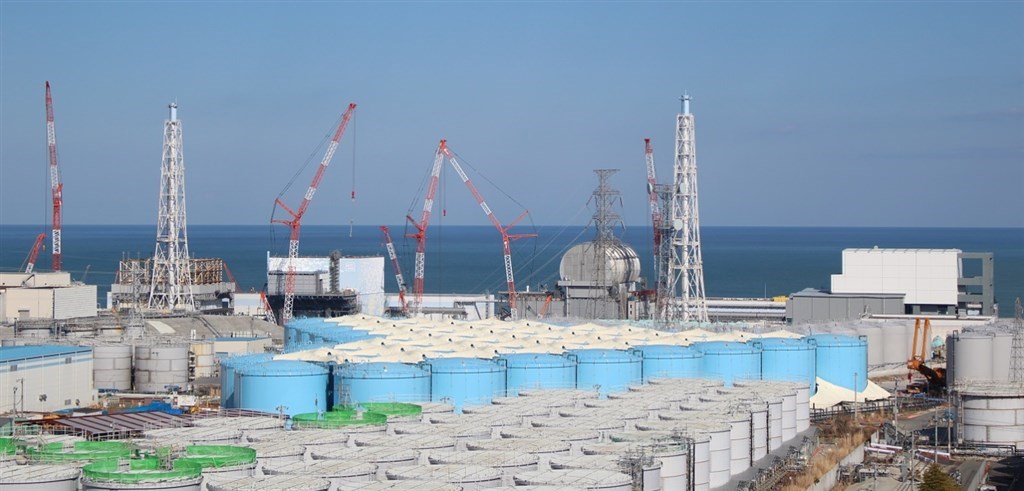
Taipei, Nov. 9 (CNA) Taiwan’s Atomic Energy Council said Monday it will continue to contact Japan on how the country plans to deal with contaminated water from the Fukushima Daiichi nuclear power plant, which is expected to run out of storage space in 2022.
The power plant has been shut down since it experienced a nuclear meltdown in 2011 after Japan was hit by a massive tsunami and earthquake, and it currently stores more than 1 million cubic meters of water containing tritium, a radioactive variant of hydrogen.
Tritium cannot be removed from water with existing technology, but because it poses a relatively low risk to human health, it is common for nuclear plants to dump water with tritium into the ocean after diluting it.
The Fukushima plant’s plan to dump its stored water that way has received pushback from people who live in the region, especially fishermen, who fear that it will damage the region’s reputation, according to local media reports.
Another option is to evaporate the wastewater into the air, according to the International Atomic Energy Agency.
In August 2019, the company that runs the power plant, Tokyo Electric Power Company Holdings Inc., announced that storage space for the contaminated water would run out in 2022.
This issue was brought up in Taiwan on Monday by Legislator Wu Szu-yao (吳思瑤) from the ruling Democratic Progressive Party, who asked the Atomic Energy Council to come up with contingency plans.
In response, the council said that the Japanese government has not yet decided when and how it will deal with the wastewater.
The council reached out to the Japanese government in September 2019 and March 2020 to ask about the situation and remind Japan to share timely information about the situation in accordance with a memorandum signed between the two countries in 2014.
It said it will keep in contact with Japan to obtain necessary information.
The council has also conducted tests to monitor the level of tritium in Taiwan’s surrounding waters and found that current levels are normal, it said.
(By Fan Cheng-hsiang and Chiang Yi-ching)
Korean Ministry calls for IAEA efforts to ensure Japan’s transparent handling of Fukushima treated water
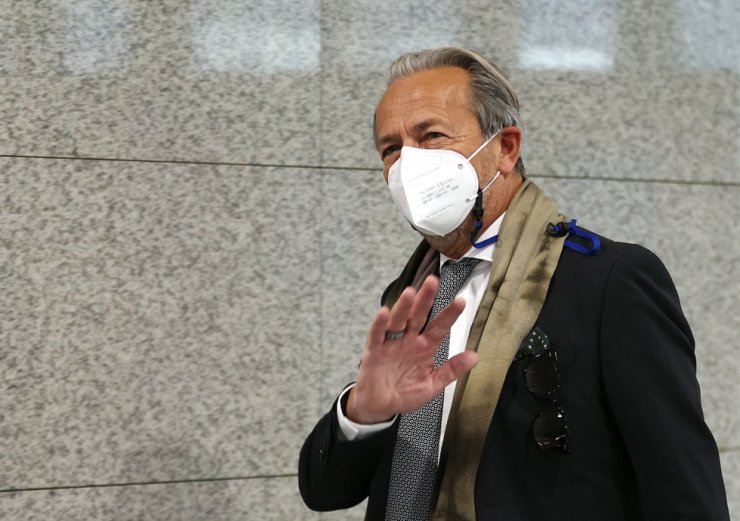
Head of the International Atomic Energy Agency’s department of safeguard Massimo Aparo waves his hand as he walks into the conference hall in the Ministry of Foreign Affairs’s building in Seoul, Tuesday.
November 5, 2020
Korea called Tuesday for the U.N. nuclear watchdog to play an “active” role in ensuring Japan’s transparent and safe handling of contaminated water from its crippled Fukushima nuclear power plant, the foreign ministry said.
Ham Sang-wook, deputy foreign minister for multilateral and global affairs, made the call during an annual policy consultation with Massimo Aparo, the head of the International Atomic Energy Agency (IAEA)’s department of safeguards.
“On the occasion of this consultation, our side stressed the contaminated water issue is a crucial matter that can affect the safety and environment of Japan’s neighboring countries and of the entire international community,” the ministry said in a press release.
“It asked the IAEA to play an active role in terms of securing transparency and verifying the safety in all processes of the Japanese government crafting measures to dispose of the water and disposing of it,” it added.
Amid public concerns over Japan’s possible discharge of the radioactive water into the sea, Seoul has repeatedly called for Tokyo to transparently share related information and stressed its “foremost priority” on the safety of citizens.
Last month, Tokyo was expected to finalize its plan to dispose of the tritium-laced water. But it apparently postponed an announcement on its decision amid strong protests.
At Tuesday’s talks, the ministry and the U.N. agency also discussed cooperation in strengthening readiness to monitor and verify North Korea’s nuclear activity. (Yonhap)
https://www.koreatimes.co.kr/www/nation/2020/11/356_298715.html
‘South Korea Considers Joining IAEA Monitoring of Fukushima Discharge Plan’
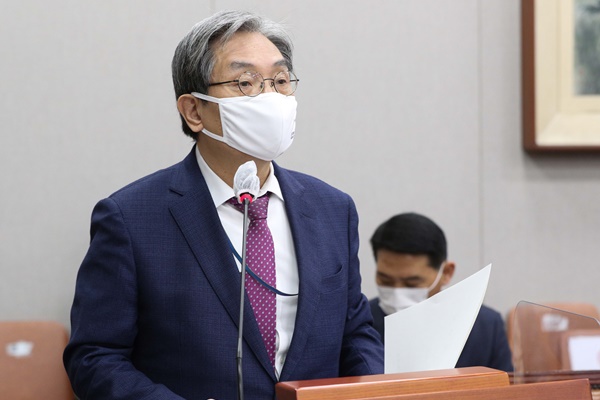
November 4, 2020
Presidential chief of staff Noh Young-min said South Korea is considering joining the International Atomic Energy Agency (IAEA)’s monitoring of Japan’s reported plan to release radioactive water from the Fukushima nuclear power plant into the sea.
In a parliamentary audit Wednesday, Noh said Japan is expected to request reliable international agencies such as the IAEA to play a role in securing global trust in the process.
He said the Seoul government has consistently asked Japan to transparently disclose information and maintain sufficient communication and consultations with the international community.
He said a task force set up within the presidential office continues to monitor the issue and discuss countermeasures.
Meanwhile the chief of staff said the top office was cooperating with calls to submit records related to the prosecution’s investigation into hedge fund fraud scandals involving Lime and Optimus asset management, adding that some records have already been submitted.
Japan faces another Fukushima disaster crisis
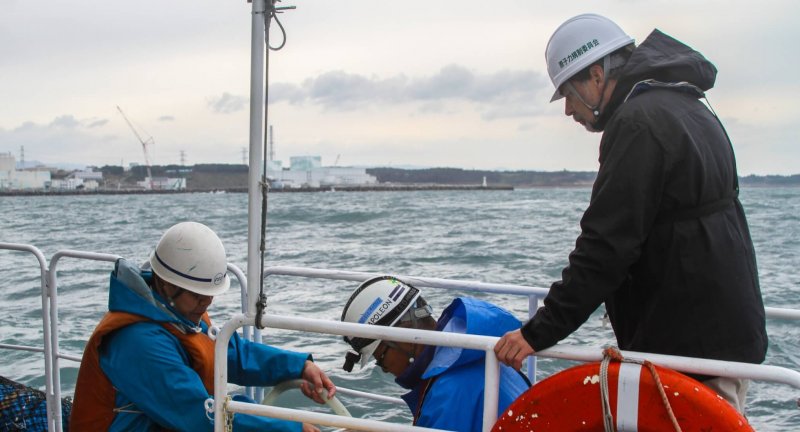
Collecting sea water samples near the damaged Fukushima nuclear power station.
November 3rd, 2020, by Paul Brown
A plan to dump a million tonnes of radioactive water from the Fukushima disaster off Japan is alarming local people.
LONDON, 3 November, 2020 − The Japanese government has an unsolvable problem: what to do with more than a million tonnes of water contaminated with radioactive tritium, in store since the Fukushima disaster and growing at more than 150 tonnes a day.
The water, contained in a thousand giant tanks, has been steadily accumulating since the nuclear accident in 2011. It has been used to cool the three reactors that suffered a meltdown as a result of the tsunami that hit the coast.
Tritium is a radioactive element produced as a by-product by nuclear reactors under normal operation, and is present everywhere in the fabric of the reactor buildings, so water used for cooling them is bound to be contaminated by it.
To avoid another potentially catastrophic meltdown in the remaining fuel the cooling has to continue indefinitely, so the problem continues to worsen. The government has been told that Japan will run out of storage tanks by 2022.
Announcement delayed
As often happens when governments are faced with difficult problems, the unpalatable decision to release the contaminated water into the sea has not been formally announced, but the intention of the government to take this course has been leaked and so widely reported.
Immediately both local and worldwide adverse reaction has resulted. There are the direct effects on the local fishermen who fear that no one will want to buy their catch, but over a wider area the health effects are the main concern.
As ever with the nuclear industry, there are two widely different views on tritium. The Health Physics Society says it is a mildly radioactive element that is present everywhere, and doubts that people will be affected by it. But the Nuclear Information and Resource Service believes tritium is far more dangerous and increases the likelihood of cancers, birth defects and genetic disorders.
The issue is further complicated because the Fukushima wastewater contains a number of other radionuclides, not in such high quantities, but sufficient to cause damage. Ian Fairlie, an independent consultant on radioactivity in the environment, is extremely concerned about Japan’s plans and the health of the local people.
“Ten half-lives for tritium is 123 years: that’s how long these tanks will have to last – at least. This will allow time also for politicians to reflect on the wisdom of their support for nuclear power”
In a detailed assessment of the situation he says other highly dangerous radioactive substances, including caesium-137 and strontium-90, are also in the water stored at Fukushima.
They are in lower quantities than the tritium, he says, but still unacceptably high – up to 100 times above the legally permitted limit. All these radionuclides decay over time − some take thousands of years − but tritium decays faster, the danger from it halving every 12.3 years.
In a briefing for the Nuclear Free Local Authorities (NFLA), a UK based organisation, another independent analyst, Tim Deere-Jones, discusses research that shows that tritium binds with organic material in plants and animals.
This is potentially highly damaging to human health because it travels up the food chain in the marine environment, specifically accumulating in fish. This means fish-eating communities on the Japanese coast could ingest much larger quantities of tritium than some physicists think likely.
Relying on dilution
Tim Deere-Jones is also concerned that the tritium will be blown inshore on the prevailing wind in sea spray and will bio-accumulate in food plants, making it risky to eat crops as far as ten miles inland. Because of the potential dangers of releasing the water the NFLA has asked the Japanese government to reconsider its decision.
The government has not yet responded though, because officially it is still considering what to do. However, it is likely to argue that pumping the contaminated water into the sea is acceptable because it will be diluted millions of times, and anyway seawater does already contain minute quantities of tritium.
Dr Fairlie is among many who think this is too dangerous, but he admits there are no easy solutions.
He says: “Barring a miraculous technical discovery which is unlikely, I think TEPCO/Japanese Gov’t [TEPCO is the Tokyo Electric Power Company, owner of the Fukushima Daiichi plant] will have to buy more land and keep on building more holding tanks to allow for tritium decay to take place. Ten half-lives for tritium is 123 years: that’s how long these tanks will have to last – at least.
“This will allow time not only for tritium to decay, but also for politicians to reflect on the wisdom of their support for nuclear power.” − Climate News Network
Wood incinerator completed at Fukushima Daiichi
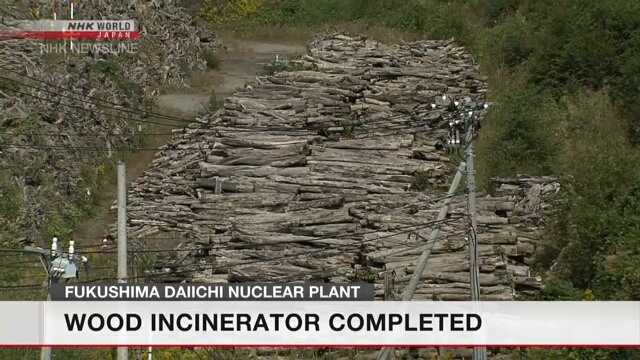
November 1, 2020
An incineration facility to dispose of wood contaminated with radioactive substances has been completed at the Fukushima Daiichi nuclear power plant.
The 2011 nuclear accident at the plant led to the dispersal of radioactive substances, contaminating the reactor buildings as well as other buildings and roads at the facility.
Trees were also contaminated with low levels of radiation. The plant’s operator, Tokyo Electric Power Company, has been building a facility to burn the wood from the trees cut down to make space for tanks to store wastewater.
The incineration facility is expected to undergo a final inspection by the government this month.
The five-story facility is fitted with filters to remove radioactive substances. It is scheduled to start operating in March.
Officials say more than 100,000 cubic meters of wood will be incinerated.
Tokyo Electric Power expects the amount of contaminated waste, such as metal and concrete, to increase as the decommissioning work progresses. It plans to cut the volume of such waste to about one-third through reuse and other procedures.
An official of a TEPCO subsidiary in charge of decommissioning, Saito Noriyuki, said the waste must ultimately be disposed of, but there are many challenges. He said the company will manage the waste in a responsible way.
Fishers and farmers fear impact of Fukushima water release
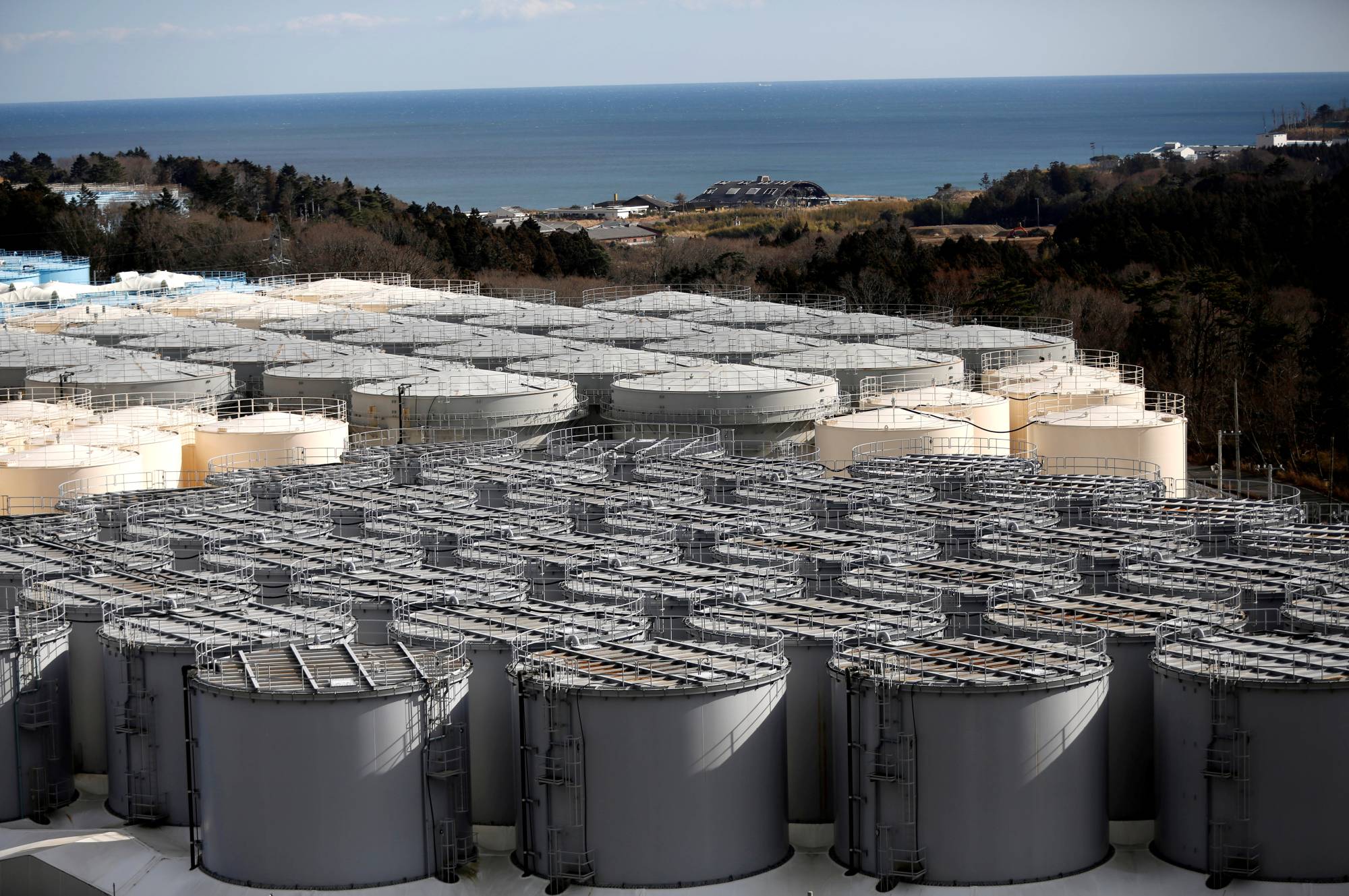
Storage tanks holding water contaminated with radioactive tritium at the Fukushima No. 1 nuclear power plant in 2019
October 30, 2020
Fishermen and farmers in Fukushima Prefecture have voiced concern about the risk of further harmful rumors about produce from the area if the government allows Tokyo Electric Power Company Holdings Inc. (Tepco), the operator of the Fukushima No. 1 nuclear power plant, to release water contaminated with radioactive tritium into the Pacific Ocean.
The government is in the final stages of giving the green light to release the radioactive water accumulating at the plant into the sea.
Nearly 10 years after the triple meltdowns at the nuclear power plant in March 2011, prices for agricultural and fisheries products from the prefecture haven’t fully recovered.
Some producers are still struggling to get retailers to buy their produce. They are concerned that if the government cannot set out detailed measures to tackle the reputational damage, they will need to start all over again from scratch.
“It’s unprecedented, and it’s hard to predict how much and how long it will last,” said deputy trade minister Kiyoshi Ejima, who heads a government task force on nuclear disasters, in an interview, regarding the harmful rumors. “We can’t offer a comprehensive (aid) package at this point of time.”
The government is expected to offer measures of support for the farm and fisheries industries, conduct public information campaigns based on science and compensate for damages as a result of releasing the water into the sea.
But it appears the government has not set out a detailed approach for how it plans to tackle any reputational damage caused by the release.
Since the 2011 disaster, the prefecture’s fisheries cooperative has only been able to conduct experimental fishing on limited days, with restrictions on the areas fished.
It is planning to move to full-scale fishing in April, with all 43 types of fish approved to be shipped.
“What we have been working on will be all for nothing,” said Toshimi Suzuki, 67, who belongs to a cooperative for sea urchin and abalone fishing in the city of Iwaki that is urging the government to decide against releasing the tritium-laced water into the sea. “I want them to listen to the voices of fishermen who are still struggling due to harmful rumors before deciding what measures to take.”
Farmers are also worried.
“If the waters are released when people at home and abroad aren’t adequately informed that it’s safe, based on science, harmful rumors will spread again,” said Yasuaki Kato, 44, a farmer who produces rice and apples.
When Kato worked to promote the safety of Fukushima-made produce in Tokyo, he felt it was extremely difficult to gain the understanding of people from outside Fukushima Prefecture.
“If people don’t understand the safety of the produce and how it has been made, it won’t have a price tag equivalent to what it’s worth,” Kato said.
In northern Fukushima Prefecture, fruit farmers were hit by heavy rain last year, after Typhoon Hagibis swept through the region, and were significantly affected by plant disease this year. Koji Suzuki, 69, who harvests peaches and persimmons in the town of Kunimi, says he was only able to harvest about 40% of his fruit compared to normal years.
He is afraid prices that plummeted after the meltdowns will once again drop.
“I want (the government) to propose measures on what it will do when consumers avoid produce from Fukushima,” Suzuki said.
This section features topics and issues covered by the Fukushima Minpo, the prefecture’s largest newspaper. The original article was published Oct. 21.
https://www.japantimes.co.jp/news/2020/10/30/national/fishers-farmers-fukushima-radioactive-water/
Dumping Fukushima’s Water into the Ocean… Seriously?
By Robert Hunziker
October 30, 2020
For nearly a decade the crippled Fukushima Daiichi Nuclear Power Plant has been streaming radioactive water into the Pacific Ocean. As it happens, TEPCO (Tokyo Electric Power Co.) struggles to control it. Yet, the bulk of the radioactive water is stored in more than 1,000 water tanks.
Assuredly, Japan’s government has made an informal decision to dump Fukushima Daiichi’s radioactive water into the Pacific Ocean. A formal announcement could come as early as this year. Currently, 1.2 million tonnes of radioactive water is stored.
The problem: TEPCO is running out of storage space.
Government of Japan’s solution: Dump it into the Pacific Ocean.
Third-party expert solutions: Build more storage tanks.
Environmental groups insist there is no reason why additional storage tanks cannot be constructed outside the perimeter of the plant. They accuse the government of seeking the cheapest and quickest solution to the problem. All along, authorities have promised the site will be safe in 40 years. Really, only 40 years!
According to IAEA’s Director General Grossi, who visited Fukushima in February 2020, dumping radioactive water that is mainly contaminated with tritium meets global standards of practice. (Source: Michael Jacob in Tokyo, What! Is Japan Really Planning to Dump Radioactive Water From Fukushima Into the Ocean? Sweden-Science-Innovation, June 10, 2020)
In that regard, advocates of nuclear power utilize a subtle storyline that convinces, and deceives, the public into accepting nuclear power, however reluctantly. It goes something like this: “There’s nothing to worry about. Nuclear power plants routinely release tritium into the air and water. There is no economically feasible way to remove it. It’s normal, a standard operating procedure.” Nevertheless, as shall be explained in more detail forthwith, there is nothing positive about that posture, absolutely nothing!
According to TEPCO, all radioactive isotopes will be removed, except tritium, which is hard to separate. Still, similar to all radioactive substances, tritium is a carcinogen (causes cancer), a mutagen (causes genetic mutation), and a teratogen (causes malformation of an embryo).
The good news: Tritium is relatively weak beta radiation and does not have enough energy to penetrate human skin. The principal health risks are ingesting or breathing the tritium.
TEPCO has deployed an Advanced Liquid Processing System that purportedly removes 62 isotopes from the water, all except tritium, which is radioactive hydrogen and cannot easily be filtered out of water.
However, the filtration system has been plagued by malfunctions. According to Greenpeace International, within the past two years TEPCO admitted to failures to reduce radioactivity to levels below regulatory limits in more than 80% of the storage tanks. Reported levels of Strontium-90 (a deadly isotope) were more than 100 times regulatory standards with some tanks at 20,000 times.
“They have deliberately held back for years detailed information on the radioactive material in the contaminated water. They have failed to explain to the citizens of Fukushima, wider Japan and to neighboring countries such as S. Korea and China that the contaminated water to be dumped into the Pacific Ocean contains dangerous levels of carbon-14. These, together with other radionuclides in the water will remain hazardous for thousands of years with the potential to cause genetic damage. It’s one more reason why these plans have to be abandoned.” (Source: Fukushima Reactor Water Could Damage Human DNA if Released, Says Greenpeace, The Guardian, October 23, 2020)
Cancer is the main risk to humans ingesting tritium. When tritium decays it emits a low-energy electron (roughly 18,000 electron volts) that escapes and slams into DNA, a ribosome or some other biologically important molecule. And, unlike other radionuclides, tritium is usually part of water, so it ends up in all parts of the body and therefore, in theory, can promote any kind of cancer. But that also helps reduce the risk because tritiated water is typically excreted in less than a month. (Source: Is Radioactive Hydrogen in Drinking Water a Cancer Threat, Scientific American, Feb. 7, 2014)
Some evidence suggests beta particles emitted by tritium are more effective at causing cancer than the high-energy radiation such as gamma rays. Low-energy electrons produce a greater impact because it doesn’t have the energy to spread its impact. At the end of its atomic-scale trip it delivers most of its ionizing energy in one relatively confined track rather than shedding energy all along its path like a higher-energy particle. This is known as “density of ionization.” As such, scientists say any amount of radiation poses a health risk.
According to Ian Fairlie, Ph.D. (Imperial College/London and Princeton University), a radiation biologist and former member of the 3-person secretariat to Britain’s Committee Examining the Radiation Risks of Internal Emitters: “At the present time, over a million tonnes of tritium-contaminated water are being held in about a thousand tanks at the site of the Fukushima Daiichi nuclear power station in Japan. This is being added to at the rate of ~300 tonnes a day from the water being pumped to keep cool the melted nuclear fuels from the three destroyed reactors at Fukushima. Therefore new tanks are having to be built each week to cope with the influx.” (Source: Ian Fairlie, The Hazards of Tritium, March 13, 2020)
Furthermore, radioactive contaminants in the tanks, such as nuclides like caesium-137 (an extremely deadly isotope) and strontium-90 (which is equally deadly) in reduced concentrations still exist in unacceptable high levels. According to Fairlie: “These problems constitute a sharp reminder to the world’s media that the nuclear disaster at Fukushima did not end in 2011 and is continuing with no end in sight.”
“There are no easy answers here. Barring a miraculous technical discovery which is unlikely, I think TEPCO/Japanese Gov’t will have to buy more land and keep on building more holding tanks to allow for tritium decay to take place. Ten half-lives for tritium is 123 years: that’s how long these tanks will have to last – at least. This will allow time not only for tritium to decay, but also for politicians to reflect on the wisdom of their support for nuclear power.” (Fairlie)
Meanwhile, over the course of seemingly endless years, Fukushima Daiichi remains “the world’s most dangerous active time bomb” for several reasons, and spent fuel rods are at the top of the list.
In addition to the 800 tons of lava-like molten fuel, aka: corium, (the big meltdown) in the three reactor containment vessels, the crippled reactor buildings contain more than 1,500 units of used nuclear fuel rods in open pools of water and must be kept cool at all times or all hell breaks loose. Loss of water from structural damage or another major earthquake (the structures are already seriously compromised) could expose the fuel rods, resulting in uncontrolled massive release of sizzling radiation that could be worse than the original meltdown, possibly exposing Tokyo to an emergency mass evacuation event with people running and screaming.
Tokyo Electric Power has plans for complete removal of the dangerous fuel rods by 2031. That work is being carried out remotely from a control room about 500 metres distance due to extraordinarily high radiation levels inside the reactor buildings.
Dismally, a perverse endlessness overhangs Chernobyl (1986) and Fukushima Daiichi (2011), earmarking these nuclear power meltdowns as the worst industrial accidents in human history.
Yet, with 440 operating nuclear plants worldwide, and 50 new plants under construction, there are plans to build a few hundred more.
Good luck
South Korea’s ‘serious concern’ about Japan’s dumping of Fukushima radioactive water
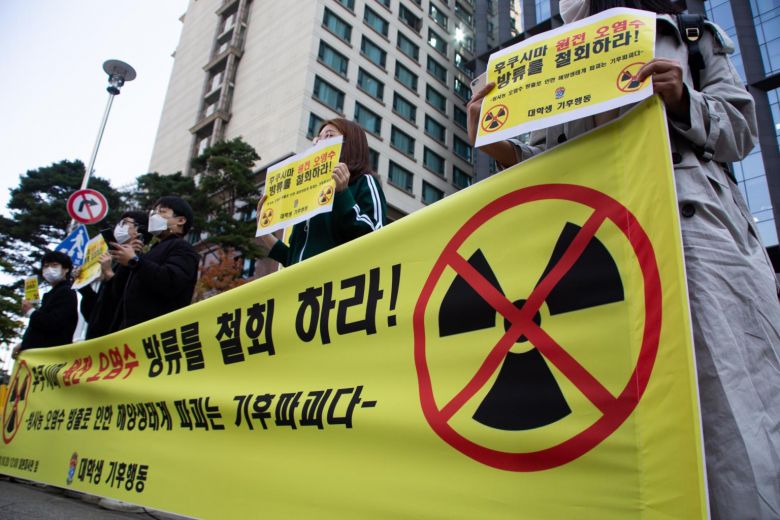
Students protest against Japan’s disposal of radioactive water, outside the Japanese Embassy in Seoul on Oct 20, 2020
South Korea expresses ‘serious concern’ over Japan plan to dump radioactive water from Fukushima
October 29, 2020
SEOUL (REUTERS) – South Korea expressed alarm on Thursday (Oct 29) about the possibility that Japan will dump more than one million tonnes of contaminated water from the tsunami-damaged Fukushima nuclear power plant into the sea.
South Korea’s “serious concern” about the contaminated water was conveyed when senior officials from the uneasy neighbours met for talks in Seoul for the first time since Japan’s new prime minister, Mr Yoshihide Suga, took office last month.
“Director-general Kim highlighted our grave awareness and serious concern about the issue of the Fukushima reactor contaminated water,” the South Korean foreign ministry said in a statement, referring to Mr Kim Jung-han, director-general for Asia and Pacific affairs, who led the South Korean team.
Media has reported that Japanese authorities have decided to discharge some one million tonnes of radioactive water into the sea nearly a decade after an earthquake triggered a tsunami that slammed into the Fukushima nuclear plant north of Tokyo, causing extensive damage.
The Japanese government has said no decision has been made on the disposal of the water from the damaged plant.
Among other issues the two sides discussed were an annual trilateral summit with China and a diplomatic and trade dispute over the issue of South Koreans forced to work at Japanese companies during 1910-45 colonial rule, which has seriously strained ties between the two US allies over the past year.
Mr Kim said Japan needed to show a “more sincere attitude” to resolve the row, urging it to lift trade restrictions imposed on South Korea, the South Korean ministry said.
S Korea expresses concern over any Japanese radioactive water dump
October 30, 2020
SEOUL – South Korea expressed alarm on Thursday about the possibility that Japan will dump more than one million tons of contaminated water from the tsunami-damaged Fukushima Daiichi nuclear power plant into the sea.
South Korea’s “serious concern” about the contaminated water was conveyed when senior officials from the uneasy neighbors met for talks in Seoul for their first time since Japan’s new prime minister, Yoshihide Suga, took office last month.
“Director-general Kim highlighted our grave awareness and serious concern about the issue of the Fukushima reactor contaminated water,” the South Korean foreign ministry said in a statement, referring to Kim Jung-han, director-general for Asia and Pacific affairs, who led the South Korean team.
Media has reported that Japanese authorities have decided to discharge some one million tons of radioactive water into the sea nearly a decade after an earthquake triggered a tsunami that slammed into the Fukushima nuclear plant north of Tokyo, causing extensive damage.
The Japanese government has said no decision has been made on the disposal of the water from the damaged plant.
Among other issues the two sides discussed were an annual trilateral summit with China and a diplomatic and trade dispute over the issue of South Koreans forced to work at Japanese companies during 1910-45 colonial rule, which has seriously strained ties between the two U.S. allies over the past year.
Kim said Japan needed to show a “more sincere attitude” to resolve the row, urging it to lift trade restrictions imposed on South Korea, the South Korean ministry said.
269 compensation claims linked to Fukushima plant work
269 compensation claims linked to Fukushima plant work deemed in Japan
October 29, 2020
TOKYO, Oct. 29 (Xinhua) — A total of 269 cases related to the crippled Fukushima nuclear plant work in Japan have been deemed as job-related accidents and covered by compensation since the nuclear disaster in 2011, labor ministry officials said Thursday.
The compensation claims that have been passed refer to the period since the nuclear accident in March 2011 through Oct. 1 this year.
Among them, six cases of workers developed cancer or leukemia because of radiation exposure, and four suffered from overwork-related illnesses, according to the Ministry of Health, Labor and Welfare officials.
Currently, about 4,000 people still work on site of the Fukushima plant decommissioning every day, with many at risk of radiation exposure, according to local media reports.
The decommissioning work has been under way since nearly 10 years ago when the massive earthquake and tsunami devastated northeastern Japan and triggered meltdowns at the Fukushima Daiichi nuclear plant.
Tokyo Electric Power Company Holdings Inc. (TEPCO), the plant operator, said three people died between fiscal 2011 and 2019.
The company said a total of 98 people suffered from heat-related illnesses between fiscal 2011 and 2019, as they had to wear less permeable masks and protective gear in the scorching summer heat.
Moreover, a total of 313 accidents have occurred in the same period of time at the site of the Fukushima Daiichi plant, including several fatal cases in which workers fell into a tank, TEPCO said. Enditem
http://www.xinhuanet.com/english/2020-10/29/c_139476903.htm
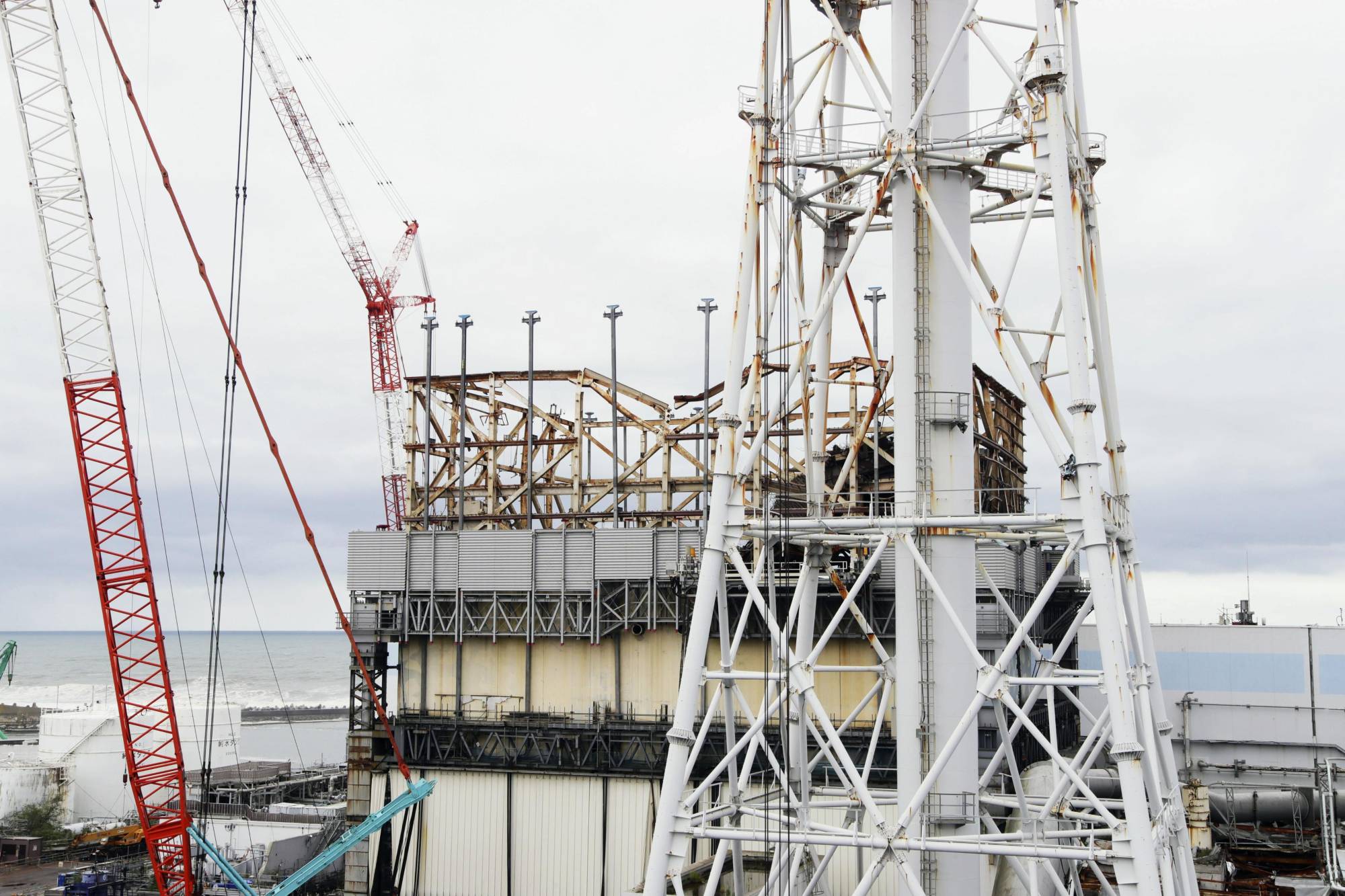
This photo taken on Sept. 26, 2020, in Okuma, northeastern Japan, shows the disaster-stricken Fukushima Daiichi nuclear power plant where decommissioning work is taking place.
Compensation claims related to Fukushima plant work total 269
October 30, 2020
TOKYO (Kyodo) – A total of 269 cases linked to the crippled Fukushima nuclear plant work have been deemed as job-related accidents and covered by compensation since the 2011 nuclear disaster, labor ministry officials said Thursday, underscoring the harsh conditions onsite workers still face.
The workers’ compensation claims that have been recognized by labor authorities include six cases of workers who developed cancer or leukemia due to radiation exposure, and four others who suffered from overwork-related illnesses, according to the Ministry of Health, Labor and Welfare officials.
Decommissioning of the Fukushima plant is still under way nearly 10 years after the massive earthquake and tsunami that devastated northeastern Japan triggered meltdowns at the Fukushima Daiichi nuclear plant. To this day, about 4,000 people still work on site every day, with many at risk of radiation exposure.
The compensation claims that have been approved refer to the period since the March 2011 nuclear accident through Oct. 1 this year.
According to the plant operator, Tokyo Electric Power Company Holdings Inc., three people died between fiscal 2011 and 2019.
One worker, who wished to remain anonymous, told Kyodo News the pressure of working at a nuclear power plant as opposed to a normal working site is “incomparable.”
“I have to deal with so much anxiety and stress as I could never know what may happen inside a nuclear power plant,” said the man from Iwaki, Fukushima Prefecture.
According to the worker, he wears two protective layers of clothing and tapes them together so there is no space between them, and also puts on a raincoat.
“I sweat a lot even in winter and I drink a lot of water,” he said, adding that several of his colleagues suffered from heat stroke or heat exhaustion while working at the plant.
TEPCO said a total of 98 people suffered from heat-related illnesses between fiscal 2011 and 2019, having had to wear masks and protective gear made of less permeable materials under the sweltering summer heat.
At the site of the Fukushima Daiichi plant, 313 accidents have occurred in the same period of time, including several fatal cases between 2014 and 2015 in which workers fell into a tank, TEPCO said.
Acknowledging that many accidents had occurred, a TEPCO official said, “We will continue to work with our contractors to prevent such incidents from happening.”
https://mainichi.jp/english/articles/20201030/p2g/00m/0na/014000c
1 This Month


18 March Webinar @ 1 PM EST: An Assessment of SMR Projects: The Case of Canada
register for the zoom:
https://us02web.zoom.us/webinar/register/WN_o8BIIOUvQ2ONJR1nta65DQ#/registration


of the week – STOP SMALL MODULAR REACTORS IN CANADA
To see nuclear-related stories in greater depth and intensity – go to https://nuclearinformation.wordpress.com
-
Archives
- March 2026 (138)
- February 2026 (268)
- January 2026 (308)
- December 2025 (358)
- November 2025 (359)
- October 2025 (376)
- September 2025 (258)
- August 2025 (319)
- July 2025 (230)
- June 2025 (348)
- May 2025 (261)
- April 2025 (305)
-
Categories
- 1
- 1 NUCLEAR ISSUES
- business and costs
- climate change
- culture and arts
- ENERGY
- environment
- health
- history
- indigenous issues
- Legal
- marketing of nuclear
- media
- opposition to nuclear
- PERSONAL STORIES
- politics
- politics international
- Religion and ethics
- safety
- secrets,lies and civil liberties
- spinbuster
- technology
- Uranium
- wastes
- weapons and war
- Women
- 2 WORLD
- ACTION
- AFRICA
- Atrocities
- AUSTRALIA
- Christina's notes
- Christina's themes
- culture and arts
- Events
- Fuk 2022
- Fuk 2023
- Fukushima 2017
- Fukushima 2018
- fukushima 2019
- Fukushima 2020
- Fukushima 2021
- general
- global warming
- Humour (God we need it)
- Nuclear
- RARE EARTHS
- Reference
- resources – print
- Resources -audiovicual
- Weekly Newsletter
- World
- World Nuclear
- YouTube
-
RSS
Entries RSS
Comments RSS
 nuclear-news