Fukushima residents feel left out in TEPCO’s water plan
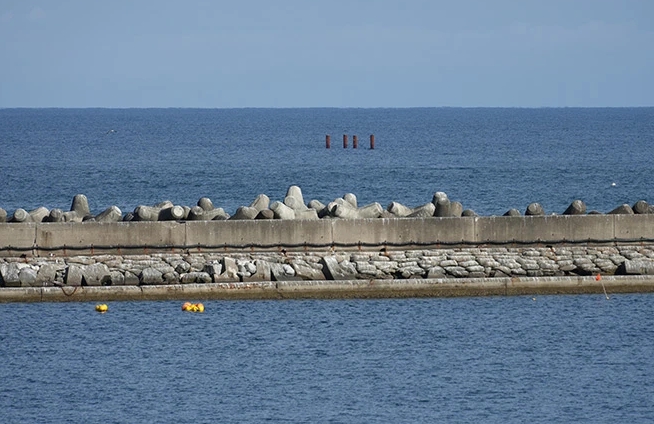
Four pillars stick out of the sea 1 kilometer offshore from Tokyo Electric Power Co.’s Fukushima No. 1 nuclear power plant on Jan. 24. Treated radioactive water will be released from outlets at the bottom of these pillars through an undersea tunnel.
February 26, 2023
As Tokyo Electric Power Co. moves closer to discharging tons of stored water from its stricken Fukushima No. 1 nuclear plant, local opposition has intensified and cries of betrayal are being heard.
The Nuclear Regulation Authority in July 2022 concluded that “there are no safety issues” with the water being released into the sea. The water will be treated to eliminate most of the radioactive substances and diluted to government safety standards.
TEPCO has been steadily moving ahead with the water-discharge plans since the NRA’s assessment.
Locals now feel that their opinions do not matter anymore, even though the water-discharge plan could negatively affect their livelihoods for decades to come.
SPRING OR SUMMER RELEASE
A TEPCO employee on the shore pointed out toward the water and said: “Can you see them?”
Four pillars were sticking out from the sea surface about 1 kilometer offshore of the Fukushima plant.
The employee explained that water discharge outlets are located at the bottoms of these pillars.
Workers in January were digging the final 200 meters of an undersea tunnel that will be connected to the outlets. The drilling work is scheduled to finish this spring.
The water stored at the plant can then be discharged from the tunnel in spring or summer.
TEPCO says it has no other choice to deal with the water-storage problem at the plant.
The tsunami generated by the March 2011 Great East Japan Earthquake knocked out the cooling system for the plant, leading to a triple meltdown.
Water used to cool down the nuclear fuel in the reactor buildings become contaminated with radioactive materials. Compounding the problem was the continuous flow of groundwater and rain into the damaged reactor buildings. This contaminated water also had to be stored for treatment.
After most of the radioactive materials were removed, the water has been stored in tanks on the compound.
Around 1.32 million tons of water is now stored at the plant, more than enough to fill the Tokyo Dome, according to TEPCO.
About 1,000 storage tanks line the compound. The utility said 96 percent of their capacity is already filled, and they will all be full by autumn.
‘TAKING OPPOSITE STANCE’
In April 2021, the administration of then-Prime Minister Yoshihide Suga decided to discharge the treated water into the sea.
The government and TEPCO reached an agreement with the Fukushima Prefectural Federation of Fisheries Co-operative Associations in 2015 that “the treated water will not be released without the understanding of people involved.”
The fishermen see TEPCO’s unceasing progress on the plan as backing out of that promise.
Tetsu Nozaki, head of the associations, and local fishermen had a meeting with economy minister Yasutoshi Nishimura in Iwaki, Fukushima Prefecture, on Feb. 25.
“(The government) made the promise (in 2015). Now you are taking an opposite stance,” Nozaki said to Nishimura.
“We have no choice but to repeatedly and thoroughly explain the plan,” Nishimura said.
Toshimitsu Konno, 64, head of the Soma Futaba fishery cooperative association in the prefecture, said, “What makes the government and TEPCO think that we have agreed?”
The group is the largest in Fukushima Prefecture, with 846 members.
They oppose the water release, saying it may spark harmful rumors about local marine products.
However, Konno has mixed feelings, especially when he thinks about the next generation of fishermen.
About 100 people joined the local fisheries industry after the 2011 nuclear accident.
Konno believes that only the complete decommissioning of the plant will end the reputation damage once and for all.
The government and TEPCO have said the water release is crucial for the decommissioning process.
“That’s why we cannot simply oppose the plan,” Konno said.
TEPCO expects to discharge up to 500 tons of treated water per day. At that rate, it will take at least 30 years to empty all of the tanks.
“We must live with the situation for 30 or 40 years until the plant is decommissioned. No matter what we do, there will always be problems,” Konno said.
He is struggling over what needs to be done now to proceed with the decommissioning and create a future for the fishing industry.
“We have our own distress as residents,” Konno said.
CAN’T STOP WATER FLOW
TEPCO has been unable prevent groundwater and rainwater from becoming contaminated by the damaged reactors.
The utility tried to block the flow of groundwater by creating a 1.5-km-long frozen soil wall around the No. 1 to No. 4 reactor buildings at the plant.
Workers set up cooling pipes underground carrying a refrigerant of minus 30 degrees. The idea was that the frozen soil would create a barrier to divert the water away from the reactor buildings.
The barrier system cost around 34.5 billion yen ($253 million) to build. It began operation in March 2016.
However, the ice wall has had a series of problems, including underground temperatures exceeding zero degrees in some areas and the refrigerant leaking from the pipes.
TEPCO initially planned to complete its countermeasures against water leaks at reactor buildings and finish operations of the ice wall around March 2021.
The ice wall is still in use, but the water flow to the reactor buildings has continued.
According to TEPCO, the amount of treated water generated per day decreased from 540 tons in 2014 to 130 tons in 2021.
The utility expects the amount to drop to 100 tons by fiscal 2025 and between 50 and 70 tons by fiscal 2028.
“It is difficult to reduce the amount of contaminated water to zero at this point,” a TEPCO official said.
(This article was compiled from reports by Shoko Rikimaru, Hideki Motoyama, Takuro Yamano and Ryo Sasaki.)
World Insights: Science should guide Fukushima wastewater release plan, Pacific leaders say
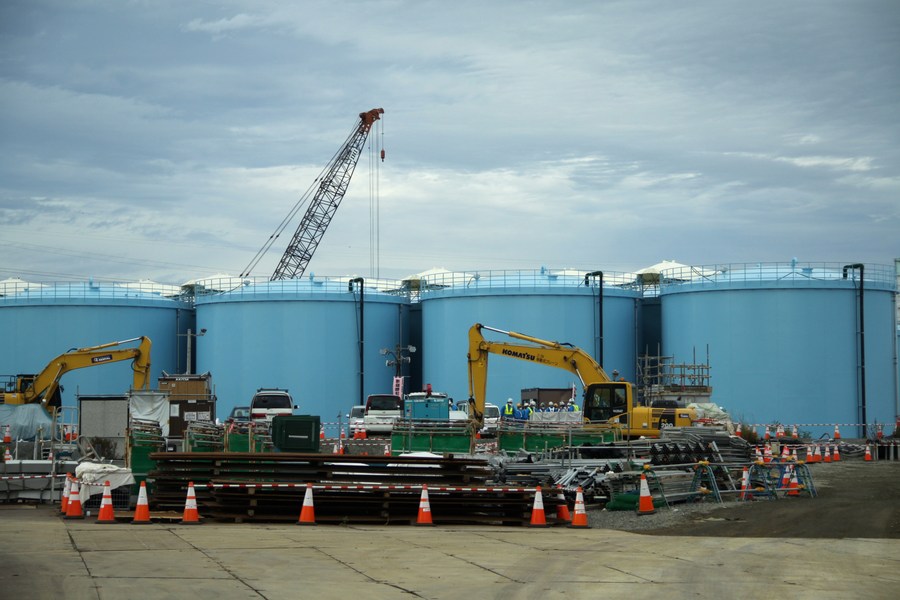
File photo taken on Oct. 12, 2017 shows huge tanks that store contaminated radioactive wastewater in Fukushima Daiichi nuclear plant, in Fukushima Prefecture, Japan
– Civil society groups in Japan and many international organizations have voiced objections to the Fukushima wastewater release plan, citing a lack of a practical demonstration and its potential threat to society and marine ecology.
– Analysts believe that Japan should not ignore the concerns and livelihoods of Pacific islanders.
SUVA, Feb. 26 (Xinhua) — Pacific leaders on Friday wrapped up the two-day Pacific Islands Forum (PIF) Special Leaders’ Retreat in Fiji, where Japan’s Fukushima wastewater release plan was in the limelight.
The PIF rotating chair underlined in a statement that science and data should guide political decisions on Japan’s proposed discharge of treated radioactive wastewater from the wrecked Fukushima nuclear plant into the sea.
The outgoing chair and Fiji’s Prime Minister Sitiveni Rabuka, together with other PIF leaders, believes the decision is not as simple as a domestic issue of Japan, but concerns the South Pacific island countries and beyond.
Given that related data and evidence provided by Japan are far from independent or verifiable, the PIF has called on the country repeatedly to delay the discharge plan.

People rally to protest against the Japanese government’s decision to discharge contaminated radioactive wastewater in Fukushima Prefecture into the sea, in Tokyo, capital of Japan, April 13, 2021.
CRITICISM FROM INT’L COMMUNITY
Civil society groups in Japan and many international organizations have also voiced objections to the plan, citing a lack of a practical demonstration and its potential threat to society and marine ecology.
Over the past years, fishermen in neighboring countries have staged several rallies, calling for immediate stop to the “grave criminal act” of releasing radioactive water into the sea. Within Japan, local civic groups have organized protests outside the government house of Fukushima Prefecture.
Japan’s unilateral push to discharge radioactive wastewater from its crippled Fukushima Daiichi nuclear power plant into the Pacific Ocean is irresponsible and harmful, South Korean green activists have said.
“The Pacific Ocean is not the sea of Japan, but the sea of everybody … Pollutants will flow to neighboring countries in a situation that a lot of radioactive materials have already been released and contaminated (the marine ecosystem),” Ahn Jae-hun, energy and climate change director at the Korea Federation for Environment Movement, told Xinhua.
The Japanese government’s decision to discharge the contaminated water into the sea when there are alternatives such as long-term storage violates the precautionary principle recognized by the international community, Greenpeace Seoul Office has said. Greenpeace is an independent global campaigning network for environment protection.
“We must prevent action that will lead or mislead us toward another major nuclear contamination disaster at the hands of others,” said PIF Secretary General Henry Puna.
Take a look at how Japan proceeded with that.
The Japanese government decided in April 2021 to release more than one million tons of treated wastewater into the Pacific Ocean this spring.
Three months later, Japan greenlit the discharge plan while the International Atomic Energy Agency (IAEA)’s task force was still conducting the review mission.
Earlier this year, Japan unilaterally announced that it would start discharging the radioactive water in spring or summer, just before the agency’s task force arrives in Japan for review.

A poster to boycott Japanese products is seen in a supermarket to protest against Japan’s decision to dump radioactive wastewater from the crippled Fukushima Daiichi nuclear power plant into the Pacific Ocean, in Seoul, South Korea, April 14, 2021.
PACIFIC OPPOSITION
Pacific island countries unanimously oppose Japan’s release plan for multiple reasons, citing ecological fragility, economic dependence on the fisheries industry, and the devastating effects of radioactive pollution caused by Western nuclear testing.
First, Pacific island countries are concerned that the released radioactive substances will spread with ocean currents and tides, risking contaminating fish. As more than half of the world’s tuna comes from the Pacific Ocean, a potentially contaminated environment could hurt the fisheries that those countries rely on.
Second, the Pacific Ocean’s delicate ecology may come under threat. If the wastewater release leads to an ecological disaster, the vulnerable island residents will leave their homes, causing an ecological and survival crisis that will deal a heavy blow to the entire Pacific region.
Last, Western countries have conducted a dazzling array of nuclear tests in the Pacific since the mid-20th century, resulting in shocking radioactive pollution and ecological disasters. These have left painful memories for islanders, who have been sensitive to the wastewater issue.
Analysts believe that Japan should not ignore the concerns and livelihoods of Pacific islanders. Neither should it dump the wastewater into the sea until disputes are settled over the legitimacy of the discharge plan, the reliability of radioactivity data, the effectiveness of purification equipment and the uncertainty of environmental impact, they added.
https://english.news.cn/20230225/1aa34ef7e18444c99e8a1e84a8b691b7/c.html
Academic speaks out against Japan’s wastewater plan for Pacific

At the heart of this special leaders’ retreat is the unity and strength of our one BluePacific, says outgoing forum chair and Fijian Prime Minister Sitiveni Rabuka.
Feb 24 2023
A leading Pacific voice in academia is speaking out against Japan’s plan to dump contaminated water into the Pacific Ocean.
University of Auckland associate dean Pacific Sir Collin Tukuitonga is vehemently opposed to the decision to release 1.25 million litres of treated wastewater from the damaged Fukushima Daiichi Nuclear Power Plant.
“While the science of this issue could perhaps be argued either way, it is completely unacceptable to be dumping contaminated wastewater into our Pacific Ocean,” Tukuitonga said.
“Pacific peoples rely on the ocean for our livelihoods and to feed our families. We are the guardians of the largest and most precious ocean in the world. There is absolutely no way that the Pacific should be the dumping ground for this waste.”
An earthquake in March 2011 followed by a tsunami caused major damage to the plant and knocked out its cooling system.
The nuclear power plant is now defunct but to keep the reactors from overheating hundreds of tonnes of water are pumped through the reactors every day.

University of Auckland academic Sir Collin Tukuitonga has joined the chorus of Pacific voices opposed to a plan to dump treated wastewater from the Fukushima Daiichi Nuclear Power Plant into the Pacific Ocean.
As Japan is running out of space to store this contaminated water, it plans to dump the treated wastewater directly into the Pacific.
Despite protests the dumping is expected to start some time this year and continue for 30 to 40 years.
Many Pacific nations have voiced opposition to the plan including Cook Islands Prime Minister Mark Brown, who is leading a delegation to Japan to present the case against the proposal.
Tukuitonga said it was important that larger Pacific nations such as Aotearoa New Zealand use their voices to oppose the dumping.
“New Zealand has a responsibility to its partners in the region to stand up to Japan for its lack of consideration for Pacific peoples living in the region who heavily rely on the ocean for their livelihoods,” he said.
The matter was high on the agenda at the Special Pacific Leaders Retreat in Fiji on Friday.
World dreads Japan’s date with disaster

2023-02-24
Photographs and videos from the site of the Fukushima Daiichi nuclear plant in northeastern Japan, showing workers preparing to release nuclear wastewater into the ocean, are flooding social networking sites.
Japan plans to start dumping nuclear waste water into the ocean this spring. Twelve years after the meltdown at the plant, caused by a deadly tsunami triggered by an earthquake, Japan is all set to inconvenience the world for its own convenience.
It is clear from developments how Japan prepared for this move. Although Tokyo Electric Power Company Holdings, which owns the now defunct nuclear plant, promised in 2015 that it would not dump nuclear waste water into the ocean, it “found” evidence of new radioactive contamination amid the ruins in March 2021. A month later, TEPCO claimed the tanks in which it was collecting nuclear contaminated water would get filled up by the autumn of 2022, necessitating its dumping into the ocean.
The Japanese Nuclear Regulation Authority, a highly “independent “agency, approved TEPCO’s plan in July 2022. On Feb 22, it approved the reviewing documents for the plan, which will officially pass after soliciting public opinion.
But the seemingly legal procedures do not make Japan’s move legitimate. On the contrary, if the nuclear waste water is “safe” after processing, as it claims, why can’t Japan find a use for it? Its leaders make apologetic gestures, but don’t want to prevent more damage from being done.
Maybe the countries and regions that are going to be affected should sue Japan in international courts, sanction the companies responsible, and even boycott products from Japan for safety’s sake. And do it while being polite all the time.
https://global.chinadaily.com.cn/a/202302/24/WS63f7f644a31057c47ebb08c4.html
Japan not only dumps wastewater but also morality
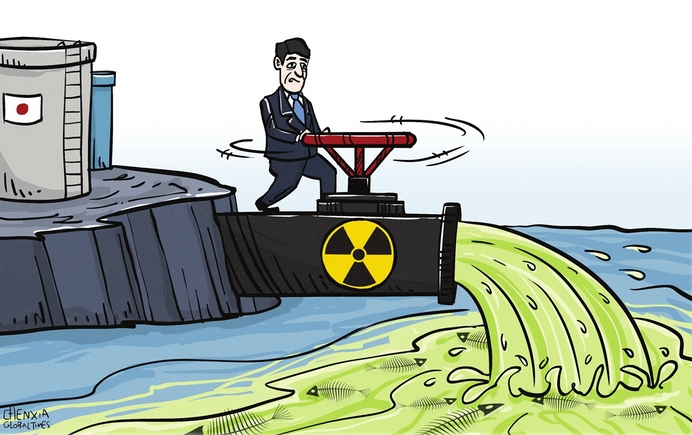
Illustration: Chen Xia/Global Times
Feb 23, 2023
Although Japan’s plan to dump nuclear-contaminated water into the sea has been strongly opposed by the international community, Tokyo is still going its own way and speeding up the plan to make the rest of the world pay for it.
According to the Japan Times, government sources said on Wednesday that Japan will seek the endorsement of the G7 nations for its plan to discharge nuclear-contaminated water from its crippled nuclear power plant in Fukushima Prefecture into the Pacific Ocean when it hosts a meeting of the group’s energy ministers in April.
On March 11, 2011, a 9.0-magnitude earthquake occurred off the coast of northeastern Japan and triggered a tsunami, resulting in a nuclear leak at the Fukushima Daiichi Nuclear Power Plant. Faced with many options for dealing with nuclear-contaminated water, the Japanese government chose to dump it in the ocean because it takes the shortest time and costs the least.
Japan’s attempt to draw other G7 members over to its side is through hosting a G7 meeting, a platform where it is easiest to reach consensus. Tokyo’s aim is very obvious. This is also a kind of public opinion manipulation to cover up its own wrongdoing.
Dumping nuclear-contaminated water into the sea has not only sparked controversy within the country, but also met with strong opposition from neighboring countries such as China, South Korea, and Russia. Therefore, Tokyo wants the Western camp to endorse it in order to find legitimacy for its actions.
If the “treated water” claimed by the Japanese government is really safe, why is it being dumped into the Pacific Ocean? Today, when water resources are so tight, the Japanese government can use “treated water” for irrigation, breeding, or other purposes. Similarly, the Japanese government insists that the dump of nuclear-contaminated water is under the supervision of the international community, but why did it arbitrarily decide before the International Atomic Energy Agency completed its supervision? Tokyo’s guilt is self-evident.
After the Fukushima nuclear disaster, China, Russia, South Korea, and other countries were the first to give Japan a helping hand. However, Japan returned their kindness by ignoring the lives, health, and safety of people in neighboring countries.
The US, which claims human rights come first, is turning a blind eye to Japan’s move. The US is also a victim of the accident. A large amount of pollutants have drifted from west to east to the US coast due to ocean circulation along the North Pacific Current. Nevertheless, in order to maintain the alliance between the US and Japan and achieve the goal of dominating East Asia, Washington continues to tolerate Tokyo.
Indeed, it is not just the US that turns a blind eye to Japan on certain issues; Japan does the same with the US on many things. For instance, the whole world is paying close attention to whether Washington planned the Nord Stream explosion, but the Japanese government, which has always been actively involved in international affairs, has kept a low profile this time. In a sense, Japan and the US are covering up each other’s scandals. In order to maintain the bond of the so-called alliance between them, they do not hesitate to ignore facts and violate science.
After the nuclear-contaminated water is dumped into the sea, it will quickly spread to most parts of the Pacific Ocean, thereby affecting the global oceans. According to marine biologists, radiation will be absorbed by marine organisms and enter the human body along the food chain, which is a major threat to the Pacific Rim countries and the ecosystem on which all human beings depend.
It is not a matter that relates to a single country. Rather, it is a matter of the security of neighboring countries and sustainable security of the international sea food chain, and the health of future generations. Therefore, it deserves high attention from the international community. Some said Japan’s dumping of nuclear-contaminated water has got the approval from its big brother, the US. However, this is both a scientific and humanitarian issue. Japan should explain it to the world, not Washington, in an open and transparent manner. It should also work with relevant international organizations and scientists from neighboring countries.
G7 are not in a position to give scientific evaluation of Japan’s discharge of Fukushima contaminated water. If they do agree on a statement that endorses Japan’s plan, they have to bear the responsibilities for what Japan should bear.
Japan’s attempt to mislead international public opinion and woo the Western bloc is irresponsible and will not work. Japan is not only dumping nuclear-contaminated water, but also its morality too. A Japan that tampers with its history of aggression, a Japan that disrupts the international order, and a Japan that harms the homeland of mankind, will never be able to stand up with dignity.
The article was compiled by Global Times reporter Liu Zixuan based on an interview with Liu Jiangyong, vice dean of the Institute of Modern International Relations at Tsinghua University. opinion@globaltimes.com.cn
Japan beefs up moves in seeking G7 support for wastewater dump
Action to cause irreversible damage to environment, human health: experts

Feb 23, 2023
Amid backlash from domestic and the international community, the Japanese government reportedly is to seek the endorsement of the Group of Seven (G7) nations for its controversial plan to discharge radioactive contaminated wastewater from the crippled nuclear power plant in Fukushima Prefecture into the Pacific Ocean. Analysts criticized countries that are giving a go-ahead signal to Japan’s irresponsible dumping plan, noting they will share the shame of making irreversible damage to maritime environment and human health.
As this year’s chair, Japan is seeking to include a phrase that says the G7 members “welcome” its “transparent” approach toward the disposal of the treated water in a document to be released after the April 15 to 16 gathering in Sapporo, Japanese media Kyodo News reported citing government sources.
In January, the Japanese government and the plant operator, Tokyo Electric Power Company Holdings, announced the plan to begin discharging the treated water around this spring or summer, with construction work underway to install an undersea tunnel and other necessary facilities.
Analysts said that Japan has beefed up efforts in soliciting support from the US and Western countries for its disposal of the Fukushima radioactive contaminated wastewater and in promoting its narrative of the “safety” of the wastewater amid growing oppositions from domestic public, neighboring countries and other stakeholders.
Against the backdrop of the Ukraine crisis and current tense Korean Peninsula situation, Japan is working to create the momentum for its dumping plan especially among Western countries as other G7 nations are also members of NATO and the military pact is seeking closer cooperation with Japan, Da Zhigang, director of the Institute of Northeast Asian Studies at the Heilongjiang Provincial Academy of Social Sciences, told the Global Times.
This is not the first time for Japan to try to include the Fukushima nuclear wastewater issue into the G7 declaration. In May 2016, after the Ise-Shima Summit in Japan, the G7 Leaders’ Declaration wrote about “steady progress on decommissioning and treatment of contaminated water” as well as “Japan’s efforts to proceed in an open and transparent manner in close communication with the international community.”
The US also expressed support for its close ally in Asia. In April 2021, after the Japanese government mentioned the plan to release more than 1 million metric tons of treated radioactive water, the US Department of State said in a statement that Japan “appears to have adopted an approach in accordance with globally accepted nuclear safety standards.”
However, fancy words from the US and the G7 cannot gloss over the increasing questions over the safety of the “treated” wastewater, the transparency of Japan’s processing of the contaminated water and its consultations on the disposal with related neighboring countries, analysts said.
Pacific island nations also urged Japan to delay the release of the contaminated water over fears fisheries will be contaminated and that the health of people will be affected. For example, during a livestreamed public meeting in Suva, Fiji on January 18, the Pacific Island Forum Secretary General Henry Puna said, “Our region is steadfast that there be no discharge until all parties verify it is safe.”
At the Security Council session on February 14 over Japan’s discharge of nuclear-contaminated water, both representatives from China and Russia expressed concerns over the issue. Ambassador Zhang Jun, Permanent Representative of China to the UN, made China’s position clear, stressing that “Japan’s discharge of nuclear contaminated water into the sea will severely endanger the global marine environment, ecosystems, and the lives and health of people of all countries.”
“Japan has been bent on forcibly approving the discharge program of the nuclear contaminated water and has been accelerating the preparations for the discharge. Such behavior is extremely irresponsible,” said Zhang.
Lingering threats
The Japanese government sees the plan of dumping the contaminated water into the ocean as the most “economic” way to get rid of the burden from the destroyed Fukushima nuclear power plant. But people in Japan, neighboring countries and the world will pay the price given the irreversible damage to environment and human health, Zhou Yongsheng, deputy director of the Japanese Studies Center at China Foreign Affairs University, told the Global Times.
The Japanese government will be condemned and held accountable if it irresponsibly discharges contaminated nuclear wastewater into the ocean and countries that give green light to Tokyo’s moves will also share the shame, said Zhou.
Concerns expressed by UN human rights experts, global nongovernmental organizations and activists from all over the world and their own countries may make G7 countries to consider more than only political leverage, analysts said.
As far back as 2021, independent experts appointed by the United Nations Human Rights Council have expressed deep regret on Japan’s decision to release contaminated water into the ocean.
They noted that the water processing technology known as ALPS had failed to completely remove radioactive concentrations in most of the contaminated water stored in tanks at the Fukushima Daiichi plant. The radioactive hazards of tritium in the water, which cannot be removed, have been underestimated and can be detrimental to humans and pose threat to the environment for over 100 years.
Japanese fisheries and Japanese people will be the first to be affected and the whole world will also suffer as oceans are linked. If the US and other G7 nations are the real protectors of the environment and human rights as they like to trumpet, they should have opposed Japanese government’s transboundary environmental harms, said Zhou.
As Japanese activists have staged protests against the government’s discharge plan for years, analysts called on more countries to join them and the neighboring countries in urging the Japanese government to stop making irreparable damage to the world.
Science should guide Fukushima wastewater release plan, Pacific leaders say

2023-02-26
SUVA – Pacific leaders on Friday wrapped up the two-day Pacific Islands Forum (PIF) Special Leaders’ Retreat in Fiji, where Japan’s Fukushima wastewater release plan was in the limelight.
The PIF rotating chair underlined in a statement that science and data should guide political decisions on Japan’s proposed discharge of treated radioactive wastewater from the wrecked Fukushima nuclear plant into the sea.
The outgoing chair and Fiji’s Prime Minister Sitiveni Rabuka, together with other PIF leaders, believes the decision is not as simple as a domestic issue of Japan, but concerns the South Pacific island countries and beyond.
Given that related data and evidence provided by Japan are far from independent or verifiable, the PIF has called on the country repeatedly to delay the discharge plan.
CRITICISM FROM INTL COMMUNITY
Civil society groups in Japan and many international organizations have also voiced objections to the plan, citing a lack of a practical demonstration and its potential threat to society and marine ecology.
Over the past years, fishermen in neighboring countries have staged several rallies, calling for immediate stop to the “grave criminal act” of releasing radioactive water into the sea. Within Japan, local civic groups have organized protests outside the government house of Fukushima Prefecture.
Japan’s unilateral push to discharge radioactive wastewater from its crippled Fukushima Daiichi nuclear power plant into the Pacific Ocean is irresponsible and harmful, South Korean green activists have said.
“The Pacific Ocean is not the sea of Japan, but the sea of everybody … Pollutants will flow to neighboring countries in a situation that a lot of radioactive materials have already been released and contaminated (the marine ecosystem),” Ahn Jae-hun, energy and climate change director at the Korea Federation for Environment Movement, told Xinhua.
The Japanese government’s decision to discharge the contaminated water into the sea when there are alternatives such as long-term storage violates the precautionary principle recognized by the international community, Greenpeace Seoul Office has said. Greenpeace is an independent global campaigning network for environment protection.
“We must prevent action that will lead or mislead us toward another major nuclear contamination disaster at the hands of others,” said PIF Secretary General Henry Puna.
Take a look at how Japan proceeded with that.
The Japanese government decided in April 2021 to release more than one million tons of treated wastewater into the Pacific Ocean this spring.
Three months later, Japan greenlit the discharge plan while the International Atomic Energy Agency (IAEA)’s task force was still conducting the review mission.
Earlier this year, Japan unilaterally announced that it would start discharging the radioactive water in spring or summer, just before the agency’s task force arrives in Japan for review.
PACIFIC OPPOSITION
Pacific island countries unanimously oppose Japan’s release plan for multiple reasons, citing ecological fragility, economic dependence on the fisheries industry, and the devastating effects of radioactive pollution caused by Western nuclear testing.
First, Pacific island countries are concerned that the released radioactive substances will spread with ocean currents and tides, risking contaminating fish. As more than half of the world’s tuna comes from the Pacific Ocean, a potentially contaminated environment could hurt the fisheries that those countries rely on.
Second, the Pacific Ocean’s delicate ecology may come under threat. If the wastewater release leads to an ecological disaster, the vulnerable island residents will leave their homes, causing an ecological and survival crisis that will deal a heavy blow to the entire Pacific region.
Last, Western countries have conducted a dazzling array of nuclear tests in the Pacific since the mid-20th century, resulting in shocking radioactive pollution and ecological disasters. These have left painful memories for islanders, who have been sensitive to the wastewater issue.
Analysts believe that Japan should not ignore the concerns and livelihoods of Pacific islanders. Neither should it dump the wastewater into the sea until disputes are settled over the legitimacy of the discharge plan, the reliability of radioactivity data, the effectiveness of purification equipment and the uncertainty of environmental impact, they added.
https://www.chinadaily.com.cn/a/202302/26/WS63faa2fca31057c47ebb0e4b.html
Fukushima nuclear disaster: Japan set to dump contaminated water in Pacific – a million tonnes
Beside the dangerosity of various radionuclides on our environment, our food chain and our health, we must also consider the fact that TEPCO is not trustworthy for its “transparency”, it has lied repeatedly numerous times during the past 12 years, and that the IAEA itself being for the nuclear industry it has shown well its tendency if not its policy to minimize the radiation risks if not to cover things up.
22 Feb, 2023
Outrage is growing over an “unjust” plan to dump more than a million tonnes of contaminated wastewater on Australia’s doorstep – within months.
In 2011, Japan was rocked by the Fukushima nuclear disaster – the worst of its kind since Chernobyl in 1986.
Responders scrambled to stop damaged reactors at Fukushima’s Daiichi nuclear plant from overheating by pumping massive amounts of water through them, with the contaminated water then being stored in massive tanks at the site.
But now, Japan has run out of space, and in 2021, announced plans to dump 1.3 million tonnes of the contaminated wastewater into the Pacific Ocean.
The water would be treated before being released over a period of several decades, with Prime Minister Yoshihide Suga saying at the time it was “a realistic solution”.
“We will do our utmost to keep the water far above safety standards,” he vowed.
In the almost two years since, Japan has been working out the finer details of the release, which is now due to begin as soon as the northern hemisphere’s spring or summer – Australia’s autumn or winter.
Countries across the Pacific are furious.
‘Catastrophic harm’
Writing for The Guardian soon after the plan was first announced, youth advocates from the region Joey Tau and Talei Luscia Mangioni described it as an “unjust act”.
“To Pacific peoples, who have carried the disproportionate human cost of nuclearism in our region, this is yet another act of catastrophic and irreversible trans-boundary harm that our region has not consented to,” they wrote.
They were referring to the long history of the Pacific being used as the world’s nuclear waste dumping ground, with hundreds of nuclear tests being carried out across the region in the decades since World War II.
High-profile individuals and groups from across the Pacific – including from Vanuatu, Fiji, the Marshall Islands and French Polynesia – have also spoken out against Japan’s plan for months on end.
“If it is safe, dump it in Tokyo, test it in Paris, and store it in Washington, but keep our Pacific nuclear-free,” Vanuatu stateswoman and veteran activist of the Nuclear Free and Independent Pacific (NFIP) movement Motarilavoa Hilda Lini said soon after Japan’s plan was unveiled.
“We are people of the ocean, we must stand up and protect it.”
In another moving statement released last year, environmental advocacy group Youngsolwara Pacific likened the release to “nuclear war”.
“How can the Japanese government, who has experienced the same brutal experiences of nuclear weapons in both Hiroshima and Nagasaki, wish to further pollute our Pacific with nuclear waste? To us, this irresponsible act of trans-boundary harm is just the same as waging nuclear war on us as Pacific peoples and our islands.”
But their pleas have fallen on deaf ears – and a string of experts have even voiced support for Japan’s controversial move.
‘Best option’
Writing for The Conversation recently, Jim Smith, professor of environmental science at the University of Portsmouth, said releasing the wastewater was the “best option”.
Prof Smith – who has worked on the impacts of radioactive pollutants in the environment for more than three decades – explained that before the water is stored in the first place, “the wastewater produced at Fukushima is treated to remove almost all of the radioactive elements”.

“These include cobalt 60, strontium 90 and caesium 137. But tritium – a radioactive form of hydrogen – is left behind,” he explained.
“When one of the hydrogen atoms in water is replaced by tritium, it forms radioactive tritiated water. Tritiated water is chemically identical to normal water, which makes separating it from wastewater expensive, energy intensive and time consuming. A review of tritium separation technologies in 2020 found that they are unable to process the huge volumes of water required.
“But as radioactive elements go, tritium is relatively benign and its existence as tritiated water reduces its environmental impact. Chemically identical to normal water, tritiated water passes through organisms like water does and so does not strongly accumulate in the bodies of living things.”
Meanwhile, a South Korean government study released this month also found the release of the wastewater would have little impact on South Korean waters.
“That change would be too small to detect,” an official at the Korea Institute of Ocean Science and Technology said, according to Reuters.
And the nation of Micronesia has also recently dropped its opposition to the release of the water, with president David Panuelo telling reporters he was no longer worried.
But for many critics of the plan, plenty of concerns remain.
“We must prevent actions that will lead or mislead us towards another major nuclear contamination disaster at the hands of others,” the former prime minister of the Cook Islands Henry Puna said just last month, as the deadline for the release looms. –
Seoul wary of reduced disclosure of radioactive elements in Fukushima wastewater

Prime Minister Han Duck-soo
Feb 22, 2023
Japan’s nuclear regulation authority tentatively confirmed plans Wednesday to narrow the scope of radioactive elements to be monitored in the radiation-contaminated water from quake-stricken Japan’s Fukushima Daiichi nuclear power plant, the South Korean Prime Minister’s Office said in a statement Wednesday.
The types of nuclides under the monitoring has been reduced from 64 to 30, according to Prime Minister Han Duck-soo’s office.
The Seoul government pledged to place the Korean people’s safety as the priority and ensure that the wastewater is treated according to international standards. Moreover, the government will continue to be engaged in the scientific and technological review of Tokyo Electric Power Co.’s plan, as well as the International Atomic Energy Agency’s wastewater analysis.
This came after the Ministry of Foreign Affairs raised the possibility of the narrowing down of the scope of radioactive elements earlier this month. A spokesperson at the Foreign Ministry said on Feb. 10 that such a decision came upon the request of the IAEA.
Tokyo unveiled plans to release the wastewater by as early as this spring.
Japan has claimed that the contaminated water was treated by its own nuclide removal system called Advanced Liquid Processing System. The IAEA has endorsed Japan’s claims that the release meets international standards.
Some 1.3 million tons of wastewater — enough to fill about 500 Olympic-size swimming pools — was used to cool down the quake-hit nuclear reactors, and is being stored at the site. Tokyo announced plans to release the water in 2021.
Recent research jointly conducted by the Korea Institute of Ocean Science and Technology and the Korea Atomic Energy Research Institute indicated some of the nuclides, in particular tritium, could potentially reach South Korean waters within the next four or five years. The impact of it, however, could be “hard to detect,” with about 0.001 becquerel per cubic meter 10 years after the release, research results indicated. A becquerel is a unit of measurement for radioactivity, with even one full becquerel being a tiny amount as relates to human health.
The deadly tsunami in 2011 broke down the nuclear reactor cooling system and melted down three reactors in the Fukushima nuclear power plant in eastern Japan.
Japan slammed for loosening test standards on Fukushima radioactive water

Tokyo Electric Power Company shows a bottle of radioactive water from Fukushima Daiichi Nuclear Power Plant in Japan which has been filtered by ALPS, Feb. 18. The filtering measure is, however, drawing criticism from experts in different countries as its radioactivity-cleansing feature has not been fully verified.
2023-02-23
Seoul urged to respond firmly to Tokyo’s move
By Ko Dong-hwan
Korean environmental activists condemned Thursday, the Japanese government’s latest move to discard radioactive water from their own soil which is now stored at the tsunami-hit nuclear power plant in Fukushima.
Filtered and planned for discharge into the Pacific Ocean this year, the water, according to the Japanese government, has been tested for concentration levels of radioactive nuclides that would pollute the maritime environment.
What concerns the activists is that the Japanese government recently reduced the list of radioactive nuclides to measure and verify their safety levels from 64 to 30.
The list has been shortened to more than half because the Japanese government believes some radioactive nuclides have half-lives that are so short that their radioactivity would thin out to a concentration level minuscule enough to be almost unmeasurable and non-influential to the environment.
But the activists said the move is only an additional problem to the Japanese government’s “doubtful” actions in dealing with the water, largely due to the questionable veracity of the data shared by the government with the world.
“Some radioactive nuclides have very short half-lives, like iodine-131 which has only eight days. Cesium-134, which has a half-life of two years, will also be watered down almost flat in a couple of years,” Choi Kyoung-sook, the coordinator from Korea Radiation Watch, a Seoul-based civic environmental activist group, told The Korea Times.
“But the biggest problem with Japan’s discharge plan is that the water’s potential biological effect on maritime species in the ocean hasn’t been fully tested yet. The Japanese government just got started with that experiment earlier this year, putting halibuts and other fish in an aquarium containing 1 becquerel of cesium to see what happens to the creatures.”
Choi said the Japanese government’s explanation advocating the safety of the discharge is only based on its own belief that the water “appears clean enough” after being filtered by the advanced liquid processing system (ALPS) that the Japanese government claims it has used to treat the water before its discharge planned this spring.

Kim Kyoung-ok from the Korea Institute of Ocean Science and Technology explains the result of a simulation carried out by his institute which demonstrates how discharged radioactive water from the Fukushima nuclear power plant in Japan could affect Korean waters, at Ramada Plaza Jeju Hotel, Feb. 16.
“It’s like they pour one liter of milk into 1,000 tons of water and say, ‘Hey, the water doesn’t look opaque at all,'” Choi said. “ALPS cannot filter out tritium. Carbon-14 has a half-life of 5,000 years. Who can possibly be so sure that radioactive water containing those radioactive particles is safe enough to discharge into the ocean?”
The Korean government has not been as critical of Japan as it should be, Choi said. She said the authority appears to be neglecting to demand sufficient scientific proof from its neighboring country that ensures the safety of the discharge.
“There isn’t any reliable scientific proof whatsoever to what the Japanese government has released to argue the discharge is safe,” Choi said. “Our government should make sure with Japan that there is no harmful biological effect from the discharge and the environmental assessment claimed done by Japan was based on reliable data.”
Choi, alongside other experts concerned with the discharge, proposed the radioactive water be stored for a longer period of time in Japan until it is diluted enough to be safely discharged.
It was found that Japan’s Nuclear Regulation Agency, earlier this year, approved the latest shortlist of radioactive nuclides to be tested, which was proposed by Tokyo Electric Power Company. The list removed 39 types from the original list and added five new ones.
The agency claimed the removed nuclides have half-lives short enough to be dissolved clean into sea waters to the level of not causing any harmful effect on humans and thus do not need to be tested further.
The Japanese authorities have been arguing that their decision-making adhered to the guidelines of the International Atomic Energy Agency, which has been supporting the country’s discharge of the water.
The Korea Institute of Ocean Science and Technology and the Korea Atomic Energy Research Institute last week released the results of a simulation of the discharge they had been studying.
The simulation, designed specifically to track tritium after the water is discharged, showed the water, after circling the Pacific for two years and reaching Korean waters, is expected to have only a negligible amount of the nuclide left. The Ministry of Oceans and Fishery, however, said the simulation was only carried out during a preliminary stage of the study and further simulations are required.
https://www.koreatimes.co.kr/www/nation/2023/02/371_345995.html
800,000 cubic meters of new radioactive waste to be generated as a result of decommissioning of the Fukushima Daiichi Nuclear Power Plant

February 20, 2023
At the Fukushima Daiichi Nuclear Power Plant, buildings around the reactor buildings will be dismantled in preparation for the removal of fuel debris.
TEPCO has released an estimate of 450,000 cubic meters of radioactive waste to be generated as a result of this work.
In addition to this, 805,000 cubic meters of radioactive waste is expected to be generated during the decommissioning work over the next 10 years.
The waste will be stored at the Fukushima Daiichi Nuclear Power Plant, but the amount is expected to increase further in the future.
https://www.fukushima-tv.co.jp/localnews/2023/02/2023022000000013.html?fbclid=IwAR3uLGcmRWtk6l-2k2GSGfXnxjmdsYaaC3EcjiIr93m4l7 HHPFMFDCvp4PM
Fukushima nuclear plant prepared to release treated waste water amid local opposition
February 21, 2023
Twelve years after the nuclear disaster caused by a massive earthquake and tsunami, workers at the Fukushima Daiichi nuclear power plant in Japan are preparing to release treated waste water into the sea despite opposition from locals. The plant’s operator, Tokyo Electric Power Company, said the water had been filtered to remove most of the radioactive elements, adding that the release was “safe and necessary”.
Japan wants G-7 backing for plans on Fukushima water, soil

February 22, 2023
The Japanese government is seeking Group of Seven support for its contentious plans on dealing with water and soil contaminated from the triple meltdown at the Fukushima No. 1 nuclear power plant.
Japan will host the G-7 summit in Hiroshima in May, as well as a series of G-7 meetings of ministers overseeing different policy areas.
One meeting planned for April in Sapporo will bring together G-7 ministers overseeing climate, energy and the environment.
At a working-level meeting in Tokyo on Feb. 1-3, Japanese officials explained their draft of a joint statement called “Building Blocks” that could be issued after the Sapporo meeting.
It said the ministers welcomed “the transparent process toward discharge” of “treated water without any harm to humans and environment” from the grounds of the Fukushima No. 1 plant, as well as the progress made to “recycling of removed soil.”
Both measures have faced stiff opposition in Japan from those directly affected by the plans, such as fishermen who operate off the coast of Fukushima Prefecture.
A government source said, “We could play up the safety of those measures if the G-7 members come together.”
However, some nations may feel uncomfortable about including issues unique to Japan in a joint statement.
Another government source said a consensus had not been reached among the seven nations to include such wording in the statement.
No past G-7 joint statement has ever mentioned the two measures in a positive light.
Water contaminated by the crippled Fukushima reactors has been treated and stored in tanks on the nuclear plant grounds. But groundwater continues to be polluted in the heavily damaged buildings.
Plant operator Tokyo Electric Power Co. said all available tanks would be filled with water between summer and autumn this year.
The utility is using the Advanced Liquid Processing System (ALPS) to lower the levels of 62 radioactive substances to government safety standards. But ALPS cannot remove tritium, a radioactive isotope of hydrogen, so the plan is to dilute it to under one-40th of the statutory standards before the water is discharged.
The plan to release the water about 1 kilometer off the coast of the Fukushima plant is scheduled to begin as early as spring.
In addition to Fukushima fishermen, China, South Korea, Russia and the Pacific Islands Forum, made up of 15 nations and two regions, have raised concerns about the plan.
The International Atomic Energy Agency is scheduled to release its report about the measure between April and June before the start of the water-discharge plan.
The government plans to reuse decontaminated soil to reduce the volume to be placed in final storage. The soil will be treated to a level below 8,000 becquerels per kilogram, the threshold set by the government.
Plans to reuse the soil in two municipalities in Fukushima Prefecture have stalled because of opposition from local residents.
And people in Tokorozawa, Saitama Prefecture, have also raised objections to the plan to reuse the Fukushima soil in their community.
Process of releasing treated water “welcome” Japanese government coordination in G7 ministerial statement.

February 22, 2023
The Japanese government has released a draft of the joint statement that will be compiled by Japan, the chairing country of the G7 climate, energy, and environment ministers, at their meeting in Sapporo in April. Japan is coordinating with other countries to include a statement that “welcomes the transparent process for the release” of treated water from the TEPCO’s Fukushima Daiichi Nuclear Power Plant and “welcomes the progress” of a plan to reuse decontaminated soil. Both of these statements are considered to be aimed at gaining the support of major countries, despite the fact that there is a strong sense of caution in Japan regarding these issues.
The contents of these plans were explained to representatives of each country at working-level meetings held in Tokyo from January 1 to 3. A government official said, “If we can unite in the G7, we can appeal the safety of the G7. However, there are doubts about including issues specific to Japan in the joint statement, and some countries, such as Germany, are cautious about nuclear power, so another official said, “It remains to be seen if we can go so far as to include a ‘welcome’ message. So far, the G7 joint statement has never included language encouraging the release of treated water or the reuse of decontaminated soil.
Contaminated water at the Fukushima Daiichi Nuclear Power Plant is generated in the process of cooling melted-down nuclear fuel. The water is being purified and stored in tanks on the plant grounds, but according to TEPCO, the tanks are expected to be full by this summer or fall. TEPCO is using a multinuclide removal system (ALPS) to reduce the concentration of 62 types of radioactive materials to below the national standard, and tritium, which cannot be removed by ALPS, will be diluted to less than 1/40th of the legal standard. The company plans to discharge the treated water one kilometer offshore from the plant, and plans to begin the discharge around spring or summer of this year.
https://www.asahi.com/articles/ASR2P6222R28ULBH005.html?iref=pc_photo_gallery_bottom
Toxic US-Japan collusion on nuke wastewater taints global environment

2023-02-20
Washington and Tokyo are in the midst of a transition from “alliance protection” of their partnership to “alliance projection” into the Indo-Pacific, US Ambassador to Japan Rahm Emanuel said at a recent press conference in Tokyo.
Now many believe such an alliance takes on a much clearer form of “alliance pollution,” as the two are ganging up to endanger the Pacific and the wider global ecosystem.
At an open debate on the impact of sea-level rise on international peace and security held Tuesday by the United Nations Security Council, representatives of multiple countries criticized Tokyo over its accelerated push to discharge contaminated water from Fukushima Daiichi Nuclear Power Plant.
They argued that Japan’s discharge plan, defying concerns of neighboring countries, will seriously endanger the global marine environment, ecosystems, and the health and safety of people along the Pacific coast.
Presumably, the United States, with a Pacific coastline, would also fall victim to the health hazards posed by the contaminated water once it reaches the west coast along with the ocean currents.
Washington, however, again glossed over the risks. US State Department spokesperson Ned Price has recently claimed that the United States “welcomes Japan’s continued openness,” saying the plan is “in line with the internationally accepted nuclear safety standards.”
Such a response makes sense, considering the government’s handling of a recent hazmat train derailment in Ohio, the environmental fallout of which could be massive. Both the US government and media were indifferent to it at first.
Quite tacitly, across the Pacific, Tokyo and Japanese media have also been reticent on this incident, in stark contrast with their fault-finding on some developing countries regarding environment protection.
Behind their collective, selective silence is a toxic US-Japan collusion on nuke wastewater, which is now tainting the Japanese soil.
In 2022, high levels of cancer-causing perfluoro organic compounds were detected in areas around US military bases in Okinawa prefecture, with the bases’ firefighting foam being the suspected source, local media reported.
Of the 46 sites sampled surrounding the US military installations as part of a biannual groundwater survey, 32 exceeded Japan’s provisional safe drinking water standard.
Outside Okinawa, concentration levels of perfluoro organic compounds sampled at 81 sites in 13 Japanese prefectures exceeded standards, including groundwater and tap water in many parts of Tokyo’s Tama area near the US air base in Yokota.
As the Japanese government denied access to investigation inside the US bases, some local residents chose to swallow anger while some investigated the source of contamination on their own.
“I dare not drink tap water here, so I usually consume bottled water,” a resident from the Tama area told Xinhua, offering a glimpse into the misery and humiliation experienced by locals at the “US occupied land.”
While Emanuel is sparing no effort to urge the US-Japan alliance to draw the sword, the US and Japanese people are suffering from profound pollution problems, with the Pacific Ocean environment and the health of coastal residents under potential threat.
However Washington and Tokyo try to justify each other’s environmental wrongdoings, they can never be exempted in the face of overwhelming facts.
The foul of the US-Japan alliance lies not only in its disregard for the global environment and double standards, but also in its absurd values of prioritizing hegemony over public health.
https://global.chinadaily.com.cn/a/202302/20/WS63f2c05da31057c47ebafa60.html
1 This Month

of the week – Shut Down Drone Warfare!


Tell the Ukrainian Government to Drop Prosecution of Peace Activist Yurii Sheliazhenko

Petition to revoke the licensing of the Near Surface Nuclear Disposal Facility (NSDF) at Chalk River. https://www.ourcommons.ca/petitions/en/Petition/Details?Petition=e-7247
To see nuclear-related stories in greater depth and intensity – go to https://nuclearinformation.wordpress.com
-
Archives
- April 2026 (14)
- March 2026 (251)
- February 2026 (268)
- January 2026 (308)
- December 2025 (358)
- November 2025 (359)
- October 2025 (376)
- September 2025 (257)
- August 2025 (319)
- July 2025 (230)
- June 2025 (348)
- May 2025 (261)
-
Categories
- 1
- 1 NUCLEAR ISSUES
- business and costs
- climate change
- culture and arts
- ENERGY
- environment
- health
- history
- indigenous issues
- Legal
- marketing of nuclear
- media
- opposition to nuclear
- PERSONAL STORIES
- politics
- politics international
- Religion and ethics
- safety
- secrets,lies and civil liberties
- spinbuster
- technology
- Uranium
- wastes
- weapons and war
- Women
- 2 WORLD
- ACTION
- AFRICA
- Atrocities
- AUSTRALIA
- Christina's notes
- Christina's themes
- culture and arts
- Events
- Fuk 2022
- Fuk 2023
- Fukushima 2017
- Fukushima 2018
- fukushima 2019
- Fukushima 2020
- Fukushima 2021
- general
- global warming
- Humour (God we need it)
- Nuclear
- RARE EARTHS
- Reference
- resources – print
- Resources -audiovicual
- Weekly Newsletter
- World
- World Nuclear
- YouTube
-
RSS
Entries RSS
Comments RSS
 nuclear-news