The operator of the Fukushima Daiichi nuclear power plant says a plan to fill in underground tunnels at the defunct facility will be delayed by 2 weeks.
TEPCO officials announced the new schedule at a meeting with the Nuclear Regulation Authority, or NRA, on Monday. The new timetable will start late this month.
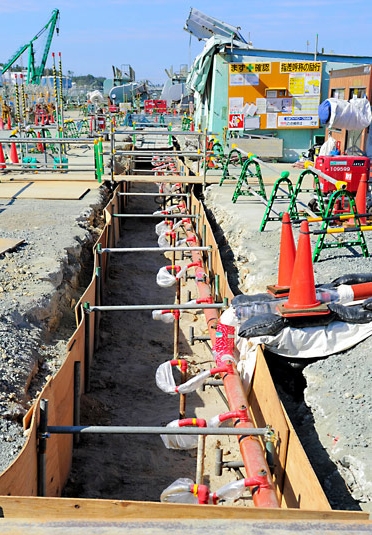
TEPCO had initially planned to remove highly-radioactive water from the tunnels after building an ice wall to stop the water from leaking out of reactor buildings.
The workers poured cement into the tunnels while draining contaminated water. But blocking the water was not successful as it continued to flow through the buildings.
The officials said in the new plan, they will fill in areas where unblocked tunnels and reactor buildings join to stop the tainted water from seeping out.
NRA regulators mostly approved the plan. They will continue to probe what else is necessary to do.
The setback for water blocking effort is likely to affect the plan to build the ice wall.
TEPCO officials say the plan is already 2 weeks to a month behind schedule due to a fatal accident at the plant.
They say they do not yet know how the latest delay will affect the whole decommissioning project. They are still studying the next steps they need to take.
HITACHI, IBARAKI PREF. – A snakelike robot designed to examine the interior of one of the three meltdown-hit reactors at the Fukushima No. 1 nuclear power plant is ready to begin its expedition.
Assessing the damage in the reactors is a crucial step in decommissioning the poorly protected plant, which was crippled by core meltdowns triggered by the Great East Japan Earthquake and tsunami in March 2011.
Remote-controlled robots are essential for the job because the radiation in the reactors chambers is so high it would kill any person who got close.
Using information gathered by the robot, Tokyo Electric Power Co., the plant operator, plans to repair the damaged chambers enough so they can be filled with water in preparation to remove the melted radioactive debris, an operation planned to begin in about a decade.
The 60-cm-long robot, developed by electronics giant Hitachi and its nuclear affiliate Hitachi-GE Nuclear Energy, was demonstrated this week at a Hitachi-GE facility northeast of Tokyo. It is expected to enter the No. 1 reactor as early as April, officials said.
It has a lamp at the front and is designed to crawl like a snake through a 10-cm-wide pipe into the containment vessel. From there it must dangle and descend onto a platform just below the reactor core’s bottom, an area known as the pedestal.
There, the robot is to transform into a U-shaped crawler and capture live images and temperature and radiation levels and transmit them to a control station outside the building.
Expectations for the robot probe are high after earlier efforts at assessment met with limited success.
“Depending on how much data we can collect from this area, I believe (the probe) will give us a clearer vision for future decommissioning,” Hitachi-GE engineer Yoshitomo Takahashi said.
After its exploratory trip, which will make the robot extremely radioactive, technicians plan to store it in a shielded box. They have no plans to reuse it.
Different robots must be designed for each reactor, since each is slightly different.
According to computer simulations, all of the fuel rods in unit 1 probably melted and pooled at the bottom of the containment chamber, but there had been no way of confirming that until now.
A brief fiberscope observation conducted in 2012 produced images that were scratchy and of limited use.
To assess the debris at the bottom of the damaged reactor chambers, which are usually filled with water, an amphibious robot is being developed for deployment next year.
The damage from the melted fuel burned holes in the reactors, thwarting efforts to fill them with cooling water. As a result, water must be pumped into them continuously, producing an endless stream of radiation-contaminated water that is hampering the plant’s cleanup process.
This effort to concrete in the unit 3 trench had not been previously announced and the area had not had any unusually high levels of contamination compared to other areas.
TEPCO concreted the unit 3 trench in some unannounced work at Fukushima Daiichi.
Today’s chedule from 10:00 AM to 13:42PM they unloaded 100m3 of concrete into the Unit 3 trench.
Tokyo Electric Power Co, operator of the wrecked Fukushima Daiichi nuclear power plant, on Tuesday recommenced clean-up work after a two-week break due to two fatal accidents at the Daiichi and Daini plants.
All work was halted following the accidents, in order for safety regulation checks to be conducted.
However, TEPCO said it expects delays to continue for up to a month on a project to build an ice wall intended to contain the leaking of contaminated water from reactors at the Daiichi plant, TV Asahi reported.
TEPCO has been fighting a daily battle against contaminated water since Fukushima was wrecked by an earthquake and tsunami in March 2011 and three reactors underwent meltdowns.
Water flushed over the wrecked reactors to keep them cool enough to prevent further radioactive releases is leaking into basements after contact with the melted uranium fuel.
The water mixes with groundwater that seeps into the basements, requiring more pumping, treatment and storage.
Missteps and leaks have dogged the efforts to contain the water, slowing down the overall decommissioning process, which is expected to take decades.
Tokyo Electric Power Co. will probably not meet its target of completing by the end of March the first section of frozen soil shields to curb the buildup of radioactive water at the Fukushima No. 1 nuclear plant.
Construction is being delayed by two weeks to one month after two deadly accidents at Fukushima No. 1 and No. 2 nuclear plants last month forced the company to suspend work for safety checks, Tepco officials said Monday.
The shields are intended to block groundwater from the nearby mountains from flowing into the reactor building basements and mixing with water that has become highly radioactive after being used to cool the overheating reactors.
Tepco began the construction work last June.
The volume of contaminated water has been increasing by several hundred tons a day due partly to the inflow of groundwater.
Even after the construction is completed, Tepco will need approval from the Nuclear Regulation Authority to start circulating refrigerant to freeze the surrounding soil. The NRA is concerned that the shields may change the flow of groundwater and cause the ground to sink, which could allow contaminated water to flow out of the reactor buildings.
Study: Global consequences from Fukushima-like nuclear disaster; Many nations at risk of ‘great exposure’ — Transport of hot particles to US was especially effective during worst releases after reactor explosions — Radioactivity confined ‘close to surface’ due to seasonal factors
We estimate the contamination risks from the atmospheric dispersion of radionuclides released by severe nuclear power plant accidents… We present an overview of global risks… [These] risks exhibit seasonal variability, with the highest surface level concentrations of gaseous radionuclides in the Northern Hemisphere during winter [Fukushima crisis began with 10 days left in winter].
The model setup was evaluated… using emission estimates from… Fukushima
The risk posed from nuclear power plant accidents is not limited to the national or even regional level, but can assume global dimensions. Many nations may be subjected to great exposure after severe accidents.
Our model shows increased surface-level concentrations throughout the Northern Hemisphere during the boreal winter months compared to the summer… Not only the expected risk magnitude is higher, but the geographical extent of the high concentrations of transported radionuclides is more pronounced towards the north… Horizontal advection [i.e. transfer] is more efficient in winter due to relatively stronger winds, and the concentrations are highest near the surface [and] surface level concentrations in the summer tend to be more localized in the emission region.
Our results illustrate that accidents… could have significant trans-boundary consequences. The risk estimate [shows] increased surface level concentrations of gaseous radionuclides in the Northern Hemisphere during winter and a larger geographical extent towards the north and the east… This is related to the relatively shallow boundary layer in winter that confines the emitted radioactivity to the lowest part of the atmosphere close to the surface…It is the view of the authors that it is imperative to assess the risks from the atmospheric dispersion of radioactivity from potential NPP accidents [for] emergency response planning on national and international levels.
JAMSTEC, Univ. of Tokyo, etc.: We show a numerical simulation for the long-range transport from the [Fukushima] plant to the US… Large-scale updraft [over] Japan from March 14 to 15 was found effective in lifting the particles[to the]jet stream that could carry the particles across the Pacific within 3 to 4 days [See study: On Mar. 15, Fukushima reactors emitted 100 quadrillion Bq of cesium into air — This one day was equal to total lifetime release from Chernobyl]… Some of the particles [had a] long-range atmospheric transport over — 10,000 km within 3 to 4 days… [R]adioactive materials were detected in that period over the east and west coasts of the U.S… In order for the particles to be transported with the jet stream, they must be lifted up from the surface boundary layer to the mid- or upper troposphere. Large-scale updraft was indeed observed… on March 14 through 15… [T]he westerlies in mid-March were thus particularly effective in the trans-Pacific transport of the radioactive materials…
Japan’s nuclear watchdog gave the green light to the operator of the wrecked Fukushima nuclear power plant to discharge pumped up groundwater into the sea if radioactive substances in the water are within safety standards.
The Jan. 21 decision by the Nuclear Regulation Authority concerns groundwater from 41 wells, called subdrains, close to the No. 1 to No. 4 reactor buildings at the Fukushima No. 1 plant.
Operator Tokyo Electric Power Co. will be obliged to remove radioactive substances in the groundwater at its decontamination facilities.
The water must meet certain criteria before it is released into the sea.
The conditions per liter of water are: that radioactive cesium is less than 1 becquerel; radioactive substances that emit beta rays are less than 3 becquerels; and the level of tritium is less than 1,500 becquerels.
Although TEPCO does not have the means to remove tritium at its decontamination facilities, the levels of contamination must be within safety limits.
The NRA said the volume of groundwater that flows into the reactor buildings will be reduced by one-half.
However, it remains unclear if the plan will be implemented as TEPCO is keen to get the approval of local residents, many of whom depend on fishing for their livelihoods.
The utility has been holding meetings with local fishery cooperatives since the summer to explain what it involved. Some members of the cooperatives seemed receptive to the plan, but others were not.
Tokyo Electric Power Co. on Thursday said it will suspend the decommissioning of the Fukushima No. 1 power plant until it completes safety checks related to two fatal accidents at its facilities in the prefecture earlier this week.
“The most important thing is to thoroughly conduct safety checks,” Tepco spokesman Shinichi Kawamura told a news conference in Fukushima.
Decommissioning the wrecked plant involves many processes, but “we can’t tell when we will finish the checks for all work at this point,” Kawamura said, adding that it won’t take weeks.
On Monday, a 55-year-old subcontractor hired to work at the Fukushima No. 1 plant fell into a 10-meter-deep water tank during an inspection Monday. He was taken to a hospital but died the following day. Although the man was wearing a safety belt, he did not appear to be using it at the time.
On Tuesday, a subcontractor in his 40s died at the nearby Fukushima No. 2 plant after his head got crushed by an object during a concentrator inspection. The object was supposed to be held in place by a crane.
Kawamura said Tepco wants to pinpoint potentially unsafe places at the site, improve employee safety habits and ensure the procedures they are performing are safe.
For instance, Tepco will check whether adequate safety steps are being taken when handling heavy objects.
Since decommissioning work often requires the use of special industrial tools, workers must follow the required procedures to ensure their safety, Kawamura added.
The suspension will not affect the fuel-cooling and water-filtering operations, the utility said.
TV: Gov’t approves plan to ‘drain’ Fukushima nuclear waste into ocean — Professor: Monitoring necessary to detect ‘worrisome signals’ —
NHK, Jan 21, 2015 (emphasis added): Regulators approve Fukushima wastewater drainage — Japan’s nuclear regulator has approved a plan by [TEPCO] to drain filtered wastewater from the firm’s crippled Fukushima Daiichi plant into the sea… The firm also plans to reduce the level of radioactive material in the water before releasing it into the nearby Pacific. On Wednesday, the Nuclear Regulation Authority approved TEPCO’s plan to install drainpipes and a pumping system and to reduce the level of radioactive cesium-137 to less than one becquerel per liter.
NHK Transcript, Jan 21, 2015: Japanese regulators have approved a controversial plan by [TEPCO]. They say TEPCO officials can flush filtered waste water into the ocean… Fisherman: “We can’t trust Tepco… If they proceed with their plan the situation will surely go back to how it was before. I’m worried the government and Tepco will act to suit themselves.”
Wall St Journal, Jan 21, 2015: Japan’s nuclear regulator has officially called on [Tepco] to work toward discharging low-level contaminated water… just two days after a worker fell into [a tank] used to store contaminated water… Tepco is using a processing system [that] is unable to take out the tritium [and] is reluctant to release it into the ocean to avoid… criticism from neighboring countries and some nations with a Pacific Ocean coastline… there is no detailed study about tritium’s long-time effect on animal genes. Mamoru Takata, a Kyoto University professor and expert on radiation’s long-term effects, said monitoring would be necessary to detect any worrisome signals.
TEPCO: [ALPS] is designed to remove most remaining radioactive contaminants
TEPCO (pdf): (ALPS) — Removal capacity: Reduce 62 nuclides below the density limit
Asahi Shimbun in Jan. 2012: “To prevent a further contamination of the sea [Tepco] plans to remove about 1,000 kinds of radioactive materials from water”
Japan Atomic Energy Agency (pdf), Feb 2014: TOPICS Fukushima — [W]e carried out detailed calculations… for 1,200 radionuclides, and the results were incorporated into a database.
Dr. Gordon Edwards, court-certified nuclear expert, Aug 8, 2014 (50:00 in): It can’t be dumped into the ocean, because it’s completely unsafe because of these fission products. They have built over 1,000 large tanks, huge tanks… that contain this very, very radioactively contaminated water. At the moment they’re trying to filter out these fission products… It’s impossible for them to remove all those hundreds of radioactive materials. They know how to remove about 62 of them, but there’s other ones that they cannot.
Recall children’s books with dots and numbers? Children connect the dots to reveal pictures of clowns and puppies and spaceships and such.
TEPCO is essentially painting pictures using very few dots with no numbers. They keep running computer studies that put numbers almost randomly on the few dots they have to see what picture emerges. “Lo and behold” to quote a professor I had in college, different pictures emerge.
TEPCO doesn’t know when the Unit 3 core damage began
Or how much of the reactor core was damaged.
Or how and when the damaged core relocated after melting.
Or how, when, and where the molten burned through the reactor pressure vessel.
Or how it moved after it fell onto the containment’s concrete floor.
And they don’t know how much water, if any, was on the containment floor when the molten core joined it.
TEPCO fills in these information gaps with guesses. And they keep revising their results because they keep revising their guesses.
Our Takeaway
I choose not to play rate-a-guess. It would take me away from helping my nephew finish his connect-the-dots drawing. Only seven numbers remain to be connected. While it resembles a race car now, it might yet turn out to be a giraffe. Or maybe even a kitten.
Before I decide which TEPCO picture I most prefer, they are going to have to fetch more dots and put real numbers on as many of them as possible.
At some point in the next few years, TEPCO will maneuver a robot into the reactor area. That will reveal what the former reactor core looks like now. This information won’t answer all the questions, but it’ll number several more dots to support a meaningful analysis of what happened when.
Until then, TEPCO is just keeping their computer jockeys busy. They could get results of similar value using Ouija boards—and it would reduce their carbon footprint.
The Fukushima Dai-ichi nuclear power plant accident is an example of a contemporary nuclear plant accident with serious implications.
The Fukushima NPP accident has had health implications due to the high levels of radiation released and vast area over which the radiation has disperse.
The significant radiation release, as likened to Chernobyl, reflects the context and severity of the Fukushima accident.
The level of 137Cs that was released is likened to Chernobyl levels, with 100,000 TBq released.
Radioactive plume dispersion occurs worldwide, far exceeding 300 miles previously mentioned. This should implicate radiological hazard at distances otherwise overlooked.
Potassium Iodide Distribution
Radioactive plumes from the Chernobyl accident containing 131I caused benign and malignant thyroid nodules to develop, especially in children within a 310 miles radius of the incident.
The current recommendation is for KI [potassium iodide] availability to people 200 miles from a NPP. Plume radii for nuclear events have been shown to exceed 300 [miles]. Extension of KI availability to 300 miles only further underscores the inadequacy of current preparedness plans.
In regard to KI prophylaxis, TEPCO utilized 17,500 KI tablets for 2,000 onsite workers… with one individual receiving and taking 85 tablets.
Radiological plumes containing 131I cause benign and malignant thyroid nodules to develop within a 300 mile radius… This necessitates KI pre-distribution to all schools, hospitals and other of-interest sites extending 300 miles from any nuclear reactor. Evacuation or sequestering is impossible in congested urban areas… There is currently virtually no compliance with [the] 20 miles radius KI pre-distribution law, section 127 of the Bioterrorism Act of 2002. In fact, there is little compliance with the 10 miles Ki pre-distribution radius law in the United States.
Japan did not utilize KI for prophylaxis of the general public, acknowledging it was not prepared to act accordingly.
Japan’s nuclear regulator has approved a plan by Tokyo Electric Power Company, or TEPCO, to drain filtered wastewater from the firm’s crippled Fukushima Daiichi plant into the sea.
TEPCO officials plan to pump up contaminated groundwater through wells built around structures housing the plant’s damaged reactors. The firm also plans to reduce the level of radioactive material in the water before releasing it into the nearby Pacific.
On Wednesday, the Nuclear Regulation Authority approved TEPCO’s plan to install drainpipes and a pumping system and to reduce the level of radioactive cesium-137 to less than one becquerel per liter. It also agreed with the firm’s policy of starting the drainage system gradually.
The regulator asked the utility to ensure that no wastewater leaks and to fully disclose measurements for radioactive material.
Tokyo Electric said it will not drain filtered wastewater until local residents agree to the plan.
The timing of such agreement is unclear, as local fishermen are worried that rumors of tainted seawater would affect their business.
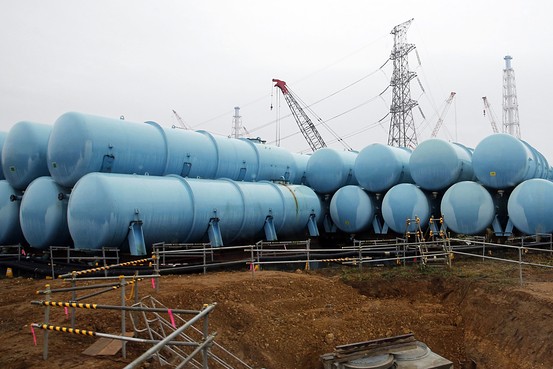
Water tanks storing contaminated water at Fukushima Daiichi nuclear plant are seen in this photo from November
Jan 21, 2015
By Mari Iwata
Japan’s nuclear regulator has officially called on Tokyo Electric Power Co.9501.TO+0.63% to work toward discharging low-level contaminated water into the ocean from the Fukushima Daiichi nuclear plant.
The call on Wednesday comes just two days after a worker fell into one of the hundreds of tanks used to store contaminated water at the plant during an inspection, a fatal accident that has refocused attention on the need for improved safety measures and a longer term solution for the huge amounts of water in storage.
“Tokyo Electric Power must consider whether it (storing the water) is really necessary,” said Shunichi Tanaka, chairman of the Nuclear Regulation Authority, at a regular board meeting Wednesday. “It is surely harmful if it leads to the death of workers.”
The regulator discussed Wednesday a draft timetable for action by Tepco to address risks at the plant that sets out a 2017 start for discharging the water. The draft is likely to be approved next week.
A Tepco spokesman, speaking after Mr. Tanaka’s remarks, said the company wasn’t currently considering releasing the water into the ocean.
Contaminated water has been a constant headache for the operator of the plant since the triple meltdowns in March 2011. A large amount of groundwater is flowing into the site, adding 300 to 400 tons to the amount of highly contaminated water at the plant on a daily basis.
Tepco is using a processing system to remove radioactive material from the highly contaminated water, but the system is unable to take out the tritium. Tepco has been storing the tritium-contaminated water in about 1,000 tanks, but is reluctant to release it into the ocean to avoid adding to tension with local communities and criticism from neighboring countries and some nations with a Pacific Ocean coastline.
But the power company is close to running out of space to build new tanks at the plant and workers are increasingly under pressure to juggle their other duties with the ever-increasing workload of tank management, prompting the IAEA call in late 2013.
Tritium is considered one of the least harmful radioactive materials at nuclear plants. Water contaminated with tritium is discharged from plants elsewhere in the world after dilution.
However, there is no detailed study about tritium’s long-time effect on animal genes. Mamoru Takata, a Kyoto University professor and expert on radiation’s long-term effects, said monitoring would be necessary to detect any worrisome signals.
Plan OK’d for dumping Fukushima’s water into ocean after treatment
TOKYO (Kyodo) — The Nuclear Regulation Authority on Wednesday gave the green light to Tokyo Electric Power Co.’s plan to dump toxic groundwater pumped up at the stricken Fukushima Daiichi nuclear complex into the Pacific Ocean after removing almost all radioactive materials from it.
The plan is one of the measures aimed at curbing the amount of contaminated water building up at the seaside complex. But it remains uncertain when the operator may actually release the water.
Local fishermen have registered strong concerns that dumping the water will heighten consumer apprehension about marine pollution, and TEPCO has said it will not release the water unless it obtains consent from the locals.
The company plans to treat water pumped up through 42 of its wells at a water treatment facility at the plant. After treatment, the water will be temporarily stored in tanks to check whether the amount of radioactive materials left in it is within levels deemed safe for release into the sea.
According to TEPCO, the amount of radioactive water at the complex is believed to be increasing by some 350 tons every day as fresh, untainted groundwater is seeping into reactor buildings and mixing with toxic water generated in the process of cooling the reactors that suffered meltdowns in the 2011 nuclear disaster.
Separately, TEPCO is running a groundwater bypass that is aimed at pumping up untainted groundwater before it mixes with radioactive water. Since the earthquake- and tsunami-triggered disaster, the operator has dumped such water into the Pacific numerous times after confirming its safety.
Source: Mainichi http://mainichi.jp/english/english/newsselect/news/20150121p2g00m0dm071000c.html
Two workers died Tuesday in separate incidents at the Fukushima No. 1 power plant and the nearby No. 2 complex.
The fatality at No. 1 was first there since March, although there has been a rise in the number of industrial accidents at the site as Tokyo Electric Power Co. stepped up cleanup efforts and brought in more workers.
Tepco has said at least 40 workers were involved in accidents at No. 1 from last April to November, prompting labor inspectors last week to call for thorough preventive measures.
The utility has routinely pledged to improve work conditions at the site.
A 55-year-old worker at No. 1 fell into a 10-meter-high water tank during inspections Monday. He was taken to a hospital but was confirmed dead in the early hours of Tuesday.
Later, a worker in his 40s at the No. 2 plant, which escaped severe damage in the 2011 earthquake and tsunami, died after equipment fell on him.
In a statement, Akira Ono, manager of the No. 1 plant, expressed sorrow for the death of the first worker, who was not named but was identified as an employee of construction company Hazama Ando Corp.
“We are deeply sorry for the death of the worker and express our deepest condolences to the family,” Ono said. “We promise to implement measures to ensure that such tragedy does not occur again.”
Hazama Ando had no immediate comment.
The number of accidents at Fukushima No. 1 has almost doubled this fiscal year to 55. The increase came as Tepco ramped up cleanup efforts and doubled the number of workers at the site to nearly 7,000.
In March, a worker died after being buried in gravel while digging a ditch.
Tepco has been widely criticized for its handling of the cleanup. Until last year it struggled to contain leaks of radioactive water from hastily built tanks at the site, and it has repeatedly promised to improve working conditions.
Most workers inside the plant are contract laborers hired by multiple layers of construction companies. Reporters in 2013 revealed widespread labor abuses, including workers who said their pay was skimmed and that there was little scrutiny of working conditions.
“It’s not just the number of accidents that has been on the rise. It’s the serious cases, including deaths and serious injuries that have risen,” said Katsuyoshi Ito, a local labor inspector overseeing Fukushima No. 1. “We have asked Tepco to improve the situation.”






 nuclear-news